Decoherence to quantum theory from a causally-indefinite post-quantum theory
Pith reviewed 2026-05-18 01:06 UTC · model grok-4.3
The pith
A hyper-decoherence process turns the theory of quantum boxes into standard quantum theory.
A machine-rendered reading of the paper's core claim, the machinery that carries it, and where it could break.
Core claim
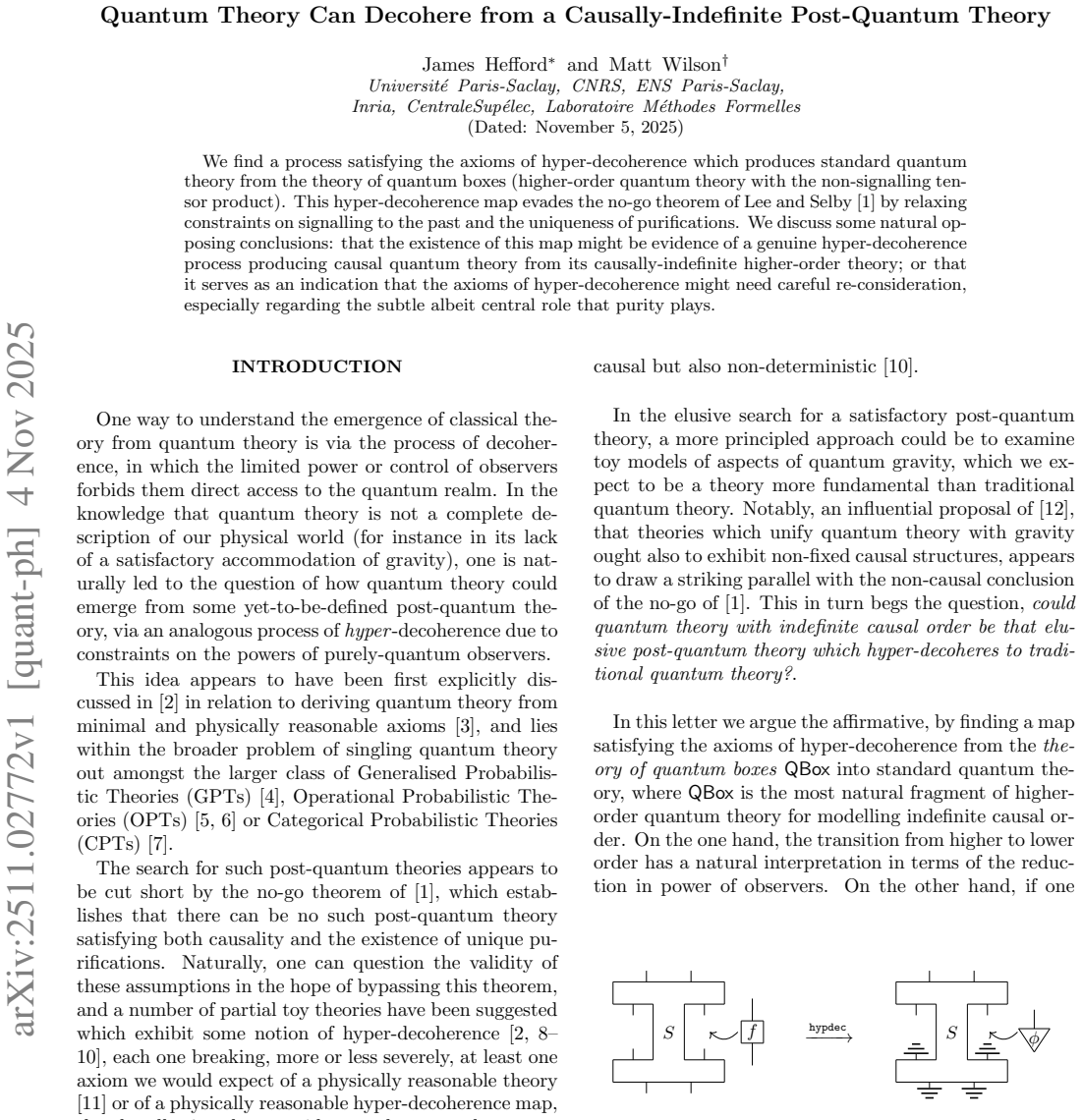
We find a process satisfying the axioms of hyper-decoherence which produces standard quantum theory from the theory of quantum boxes. This hyper-decoherence map evades the no-go theorem of Lee and Selby by relaxing constraints on signalling to the past and the uniqueness of purifications. We discuss some natural opposing conclusions: that the existence of this map might be evidence of a genuine hyper-decoherence process producing causal quantum theory from its causally-indefinite higher-order theory; or that it serves as an indication that the axioms of hyper-decoherence might need careful re-consideration, especially regarding the subtle albeit central role that purity plays.
What carries the argument
The hyper-decoherence map from quantum boxes to quantum theory, constructed by relaxing past signalling and purification uniqueness.
If this is right
- Standard quantum theory can be recovered from a higher-order causally indefinite theory by a single hyper-decoherence process.
- Previous no-go theorems blocking such emergence can be bypassed once limited past signalling and non-unique purifications are allowed.
- Two interpretations remain open: the map may describe a physical selection mechanism or may indicate that current hyper-decoherence axioms need adjustment around purity.
- The construction supplies a concrete example linking post-quantum frameworks to ordinary quantum mechanics.
Where Pith is reading between the lines
- If the map is physical, experiments that probe higher-order operations or causal indefiniteness might reveal signatures of an underlying decoherence step.
- The result suggests that causal structure itself could emerge from a more symmetric post-quantum theory rather than being fundamental.
- Similar maps might be sought in other post-quantum models to test whether hyper-decoherence is a general mechanism for recovering quantum theory.
Load-bearing premise
The standard axioms of hyper-decoherence continue to hold after the relaxations on signalling to the past and uniqueness of purifications that evade the Lee-Selby no-go theorem.
What would settle it
An explicit calculation or simulation demonstrating that the proposed map either violates a hyper-decoherence axiom or fails to recover the exact state space and operations of quantum theory.
Figures
read the original abstract
We find a process satisfying the axioms of hyper-decoherence which produces standard quantum theory from the theory of quantum boxes (higher-order quantum theory with the non-signalling tensor product). This hyper-decoherence map evades the no-go theorem of Lee and Selby by relaxing constraints on signalling to the past and the uniqueness of purifications. We discuss some natural opposing conclusions: that the existence of this map might be evidence of a genuine hyper-decoherence process producing causal quantum theory from its causally-indefinite higher-order theory; or that it serves as an indication that the axioms of hyper-decoherence might need careful re-consideration, especially regarding the subtle albeit central role that purity plays.
Editorial analysis
A structured set of objections, weighed in public.
Referee Report
Summary. The paper claims to construct a hyper-decoherence map from the theory of quantum boxes (higher-order quantum theory using the non-signalling tensor product) to standard quantum theory. The construction evades the Lee-Selby no-go theorem by relaxing constraints on signalling to the past and uniqueness of purifications. The authors discuss two opposing interpretations: that the map evidences a genuine hyper-decoherence process, or that the axioms of hyper-decoherence require re-examination, especially regarding the role of purity.
Significance. If rigorously verified, the result would be significant for quantum foundations: it supplies a concrete example of how causal quantum theory might emerge from a causally-indefinite post-quantum theory via hyper-decoherence, while highlighting subtleties in the axioms. The manuscript's balanced discussion of opposing conclusions is a strength, as is its focus on an explicit construction rather than a fitted or derived quantity.
major comments (2)
- [§3] §3 (construction of the map): no explicit derivation steps, axiom-by-axiom verification, or internal-consistency checks are supplied showing that the proposed process satisfies the hyper-decoherence axioms once the relaxations on past signalling and purification uniqueness are imposed. This verification is load-bearing for the central existence claim.
- [§3] §3 and §4: the manuscript does not demonstrate that the stated relaxations preserve the purity and causal-structure properties required by hyper-decoherence; without this, it remains unclear whether the output is forced to be standard quantum theory or could admit other theories.
minor comments (2)
- The abstract and introduction would benefit from a concise table or bullet list contrasting the original hyper-decoherence axioms with the relaxed versions used here.
- [§2] Notation for quantum boxes and the non-signalling tensor product is introduced but would be clearer with one or two worked examples of the relaxed signalling condition.
Simulated Author's Rebuttal
We thank the referee for their thoughtful and constructive report. The comments correctly identify areas where the presentation of the central construction can be strengthened with additional explicit verification. We address each major comment below and will revise the manuscript to incorporate the requested details.
read point-by-point responses
-
Referee: [§3] §3 (construction of the map): no explicit derivation steps, axiom-by-axiom verification, or internal-consistency checks are supplied showing that the proposed process satisfies the hyper-decoherence axioms once the relaxations on past signalling and purification uniqueness are imposed. This verification is load-bearing for the central existence claim.
Authors: We agree that a more granular, axiom-by-axiom verification would make the central claim easier to assess. Section 3 of the manuscript defines the hyper-decoherence map on quantum boxes and states that it satisfies the axioms under the two relaxations. To address the referee’s concern, we will add a dedicated subsection (or appendix) that walks through each hyper-decoherence axiom, shows the explicit action of the map on the relevant objects, and verifies internal consistency once past signalling and non-unique purification are permitted. This will include the concrete calculations that were omitted for brevity in the original draft. revision: yes
-
Referee: [§3] §3 and §4: the manuscript does not demonstrate that the stated relaxations preserve the purity and causal-structure properties required by hyper-decoherence; without this, it remains unclear whether the output is forced to be standard quantum theory or could admit other theories.
Authors: The manuscript argues in §§3–4 that the chosen relaxations are minimal and sufficient to evade the Lee–Selby obstruction while still forcing the image of the map to be ordinary quantum theory. However, we acknowledge that an explicit demonstration that no other post-quantum theory survives the map under these relaxations is not fully spelled out. In the revision we will insert a short argument (supported by a small number of lemmas) showing that (i) the purity condition is preserved for the output states once the relaxed purification axiom is used, and (ii) the causal structure of the output is necessarily that of standard quantum theory. If the referee finds the added material insufficient, we are prepared to include a brief counter-example construction showing that further relaxation would allow non-quantum outputs. revision: yes
Circularity Check
Explicit construction of hyper-decoherence map with no reduction to self-inputs or fitted quantities
full rationale
The paper presents an explicit construction of a process satisfying the hyper-decoherence axioms that produces standard quantum theory from quantum boxes, achieved by relaxing signalling-to-the-past and purification-uniqueness constraints to evade the Lee-Selby no-go theorem. This is a direct existence result via construction rather than any derivation that reduces by the paper's own equations to previously defined quantities, fitted parameters renamed as predictions, or load-bearing self-citations. No self-definitional steps, ansatz smuggling, or renaming of known results are present; the central claim stands as an independent construction outside the input axioms.
Axiom & Free-Parameter Ledger
axioms (2)
- domain assumption Axioms of hyper-decoherence
- domain assumption Theory of quantum boxes with non-signalling tensor product
Lean theorems connected to this paper
-
IndisputableMonolith/Foundation/AlexanderDuality.leanalexander_duality_circle_linking unclear?
unclearRelation between the paper passage and the cited Recognition theorem.
We find a process satisfying the axioms of hyper-decoherence which produces standard quantum theory from the theory of quantum boxes... by relaxing constraints on signalling to the past and the uniqueness of purifications.
-
IndisputableMonolith/Cost/FunctionalEquation.leanwashburn_uniqueness_aczel unclear?
unclearRelation between the paper passage and the cited Recognition theorem.
Lemma 3. The pre-image of any pure state under hyper-decoherence is pure.
What do these tags mean?
- matches
- The paper's claim is directly supported by a theorem in the formal canon.
- supports
- The theorem supports part of the paper's argument, but the paper may add assumptions or extra steps.
- extends
- The paper goes beyond the formal theorem; the theorem is a base layer rather than the whole result.
- uses
- The paper appears to rely on the theorem as machinery.
- contradicts
- The paper's claim conflicts with a theorem or certificate in the canon.
- unclear
- Pith found a possible connection, but the passage is too broad, indirect, or ambiguous to say the theorem truly supports the claim.
Reference graph
Works this paper leans on
-
[1]
These toy theories however, do not just break causality or uniqueness of purifications
or of a physically reasonable hyper-decoherence map, thereby allowing them to side-step the no-go theorem. These toy theories however, do not just break causality or uniqueness of purifications. Quartic Quantum Theory
-
[2]
and density cubes [8] suffer from substantial founda- tional issues including ill-defined processes and joint sys- tems [11]. Density hypercubes [9, 10] on the other hand can be considered a legitimate theory in the sense that it is a CPT [7] with tomography, however, its hyper- decoherence process suffers from being not only non- causal but also non-dete...
work page internal anchor Pith review Pith/arXiv arXiv 2025
-
[3]
1 :n− →1 for eachn. The causal sub-process theoryMat R+ isStoch. Causality of a process theory imposes a more tradi- tional notion of no-signalling in terms of the outcomes of Bell scenarios. Given any bipartite state, with each half located in spacelike separated regions, one can ask whether deterministic events occurring in one region can influence the ...
work page 2030
-
[4]
C. M. Lee and J. H. Selby, A no-go theorem for theories that decohere to quantum mechanics, Proc. R. Soc. A 474, 10.1098/rspa.2017.0732 (2018)
-
[5]
K. ˙Zyczkowski, Quartic quantum theory: an extension of the standard quantum mechanics, Journal of Physics A: Mathematical and Theoretical41, 355302 (2008)
work page 2008
-
[6]
Quantum Theory From Five Reasonable Axioms
L. Hardy, Quantum Theory From Five Reasonable Ax- ioms (2001), arXiv:quant-ph/0101012 [quant-ph]
work page internal anchor Pith review Pith/arXiv arXiv 2001
-
[7]
Barrett, Information processing in generalized proba- bilistic theories, Phys
J. Barrett, Information processing in generalized proba- bilistic theories, Phys. Rev. A75, 032304 (2007)
work page 2007
-
[8]
G. Chiribella, G. M. D’Ariano, and P. Perinotti, Prob- abilistic theories with purification, Phys. Rev. A81, 062348 (2010)
work page 2010
-
[9]
G. Chiribella, G. M. D’Ariano, and P. Perinotti, Infor- mational derivation of quantum theory, Phys. Rev. A84, 012311 (2011)
work page 2011
-
[10]
S. Gogioso and C. M. Scandolo, Categorical Probabilistic Theories, inProceedings QPL 2017, Vol. 266 (EPTCS,
work page 2017
-
[11]
B. Daki´ c, T. Paterek, and ˇC. Brukner, Density cubes and higher-order interference theories, New Journal of Physics16, 023028 (2014)
work page 2014
-
[12]
S. Gogioso and C. M. Scandolo, Density Hypercubes, Higher Order Interference and Hyper-decoherence: A Categorical Approach, inQuantum Interaction(Springer International Publishing, 2019) pp. 141–160
work page 2019
-
[13]
J. Hefford and S. Gogioso, Hyper-decoherence in Density Hypercubes, inProceedings QPL 2020, Vol. 340 (EPTCS,
work page 2020
-
[14]
C. M. Lee and J. H. Selby, Higher-Order Interference in Extensions of Quantum Theory, Found Phys47, 89 (2017)
work page 2017
-
[15]
L. Hardy, Towards quantum gravity: a framework for 8 probabilistic theories with non-fixed causal structure, Journal of Physics A: Mathematical and Theoretical40, 3081 (2007)
work page 2007
-
[16]
B. Coecke and A. Kissinger,Picturing Quantum Pro- cesses: A First Course in Quantum Theory and Di- agrammatic Reasoning(Cambridge University Press, 2017)
work page 2017
- [17]
-
[18]
Coecke, Terminality Implies No-signalling
B. Coecke, Terminality Implies No-signalling... and Much More Than That, New Generation Computing34, 69 (2016)
work page 2016
-
[19]
M. Wilson and G. Chiribella, Causality in Higher Or- der Process Theories, inProceedings QPL 2021, Vol. 343 (EPTCS, 2021) pp. 265–300
work page 2021
-
[20]
Gogioso, Higher-order CPM Constructions, inProceed- ings QPL 2018, Vol
S. Gogioso, Higher-order CPM Constructions, inProceed- ings QPL 2018, Vol. 287 (EPTCS, 2019) pp. 145–162
work page 2018
-
[21]
O. Oreshkov, F. Costa, and ˇC. Brukner, Quantum corre- lations with no causal order, Nature Communications3, 10.1038/ncomms2076 (2012)
-
[22]
G. Chiribella, G. M. D’Ariano, and P. Perinotti, Theo- retical framework for quantum networks, Phys. Rev. A 80, 022339 (2009)
work page 2009
-
[23]
A. Kissinger and S. Uijlen, A categorical semantics for causal structure, Logical Methods in Computer Science 15, 10.23638/LMCS-15(3:15)2019 (2019)
-
[24]
J. Hefford and C. Comfort, Coend Optics for Quantum Combs, inProceedings ACT 2022, Vol. 380 (EPTCS,
work page 2022
-
[25]
J. Hefford and M. Wilson, A Profunctorial Semantics for Quantum Supermaps, inProceedings of the 39th Annual ACM/IEEE Symposium on Logic in Computer Science, LICS ’24 (Association for Computing Machinery, New York, NY, USA, 2024)
work page 2024
-
[26]
G. Chiribella, G. M. D’Ariano, and P. Perinotti, Trans- forming quantum operations: Quantum supermaps, EPL (Europhysics Letters)83, 30004 (2008)
work page 2008
-
[27]
P. Selinger, Idempotents in Dagger Categories: (Ex- tended Abstract), Electronic Notes in Theoretical Com- puter Science210, 107 (2008)
work page 2008
- [28]
-
[29]
Gogioso,Categorical quantum dynamics, DPhil thesis, University of Oxford (2016)
S. Gogioso,Categorical quantum dynamics, DPhil thesis, University of Oxford (2016)
work page 2016
-
[30]
J. H. Selby,A process theoretic triptych, PhD thesis, Im- perial College London (2017)
work page 2017
-
[31]
Hefford,Categorical post-quantum theories, DPhil the- sis, University of Oxford (2023)
J. Hefford,Categorical post-quantum theories, DPhil the- sis, University of Oxford (2023)
work page 2023
-
[32]
J. Hefford and S. Gogioso, CPM Categories for Galois Extensions, inProceedings QPL 2021, Vol. 343 (EPTCS,
work page 2021
-
[33]
M.-D. Choi, Completely positive linear maps on complex matrices, Linear Algebra and its Applications10, 285 (1975)
work page 1975
-
[34]
Although, it should be noted that we took care to inter- pret purity co-preservation with regards to extremality in the deterministic state space (so extremality in the space of quantum channels). Purity co-preservation within the non-deterministic state space does not hold for our ex- ample for the same reasons outlined by Lee and Selby in
-
[35]
regarding the discarding of spatial dimensions
-
[36]
R. D. Sorkin, Quantum mechanics as quantum measure theory, Mod. Phys. Lett. A9, 3119 (1994)
work page 1994
-
[37]
R. D. Sorkin, Quantum classical correspondence: Pro- ceedings of the 4th drexel symposium on quantum nonin- tegrability (International Press, Cambridge Mass., 1997) Chap. Quantum Measure Theory and its Interpretation, pp. 229–251
work page 1997
-
[38]
P. J. Cavalcanti, J. H. Selby, J. Sikora, and A. B. Sainz, Decomposing all multipartite non-signalling channels via quasiprobabilistic mixtures of local channels in gener- alised probabilistic theories, Journal of Physics A: Math- ematical and Theoretical55, 404001 (2022). No Superluminal Signalling inQBox In this section we show that the theoryQBoxis no-...
work page 2022
discussion (0)
Sign in with ORCID, Apple, or X to comment. Anyone can read and Pith papers without signing in.