REVIEW 4 major objections 4 minor 74 references
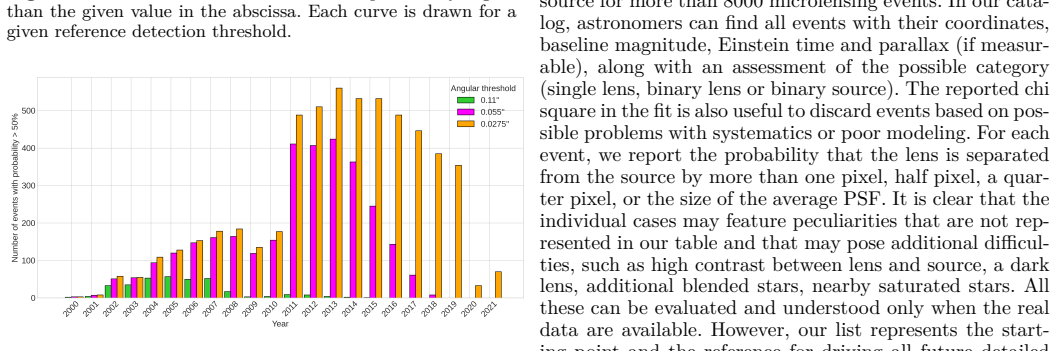
By re-analyzing 8,081 historic microlensing events and crossing them with Galactic models, this paper computes for each the probability that its lens is already resolvable from its source in Euclid images, and ranks them for follow-up.
Reviewed by Pith at T0; open to challenge. T0 means a machine referee read the full paper against a public rubric. the ladder, T0–T4 →
A ranked catalog of ~8000 historic microlensing events with predicted lens-source separation probabilities identifies the best targets for resolving lenses in Euclid images.
T0 review reviewed 2026-08-03 challenge →
load-bearing objection A genuinely useful ranked catalog for Euclid microlensing follow-up, but the headline probabilities are prior-dominated for many top targets and need sensitivity analysis and error bars before being used quantitatively. the 4 major comments →
Historic microlensing events in the euclid Galactic Bulge Survey
The pith
A machine-rendered reading of the paper's core claim, the machinery that carries it, and where it could break.
The reading
Core claim
The central claim is that the single observable t_E is too degenerate to predict whether a lens will be resolved from its source, but once a Galactic-model prior is applied, the resulting posterior distribution of relative proper motion—multiplied by the 6–20 year baseline between event peak and the Euclid observations—yields a defensible per-event probability of lens-source separation. The paper states this as: taking into account all uncertainties, for each microlensing event we are able to estimate the probability that the lens is separated from the source by more than a given angular distance threshold. Applied to 8,081 events, the method produces a ranked catalog, and a sub-table for 51
What carries the argument
The central object is the per-event posterior probability distribution of lens-source relative proper motion, built by combining the measured Einstein time, I-band baseline magnitude (an upper bound on lens/source brightness), and microlensing parallax where measurable, with a Galactic model that predicts the stellar density and kinematics along the sight-line. The posterior is converted into a separation probability by multiplying proper motion by the time elapsed since the event's peak; four thresholds are offered, from one full pixel (0.11") down to a quarter pixel (0.0275"). This is the engine that turns a degenerate set of light-curve parameters into a ranked, decision-ready list.
Load-bearing premise
The ranking is trustworthy only if the Galactic stellar population model used as a prior is a fair description of the real bulge and disk along each line of sight; for most events the data themselves (mainly t_E) are too weak to override that prior.
What would settle it
Look at the top-ranked events in the catalog and measure the actual lens-source separation in the Euclid images (or with adaptive optics on large telescopes). If the fraction of events resolved at a given threshold falls well below the predicted probability for that threshold, the prior-based proper-motion estimates are wrong.
If this is right
- Astronomers can immediately prioritize which of the 8,081 events to search first in the Euclid images, starting at the top of the ranked list.
- For the 51 known planetary microlensing events, the paper gives a dedicated table of predicted lens-source separations, with two events expected to exceed one pixel and about thirty exceeding a quarter pixel.
- The four thresholds (one pixel, half pixel, quarter pixel, and average PSF size) let different observing strategies choose their own criterion for 'resolved'.
- For short, fast events where the lens is expected to be well separated, a non-detection would support free-floating-planet or dark-lens explanations rather than a slow stellar lens.
- Joint analysis with future high-resolution surveys can convert these probabilities into actual lens detections, sharpening mass and distance estimates for hundreds of events.
Where Pith is reading between the lines
- If the Galactic-model prior is systematically wrong, the ranking inherits that error; checking the actual resolution rate in the top-ranked events is a direct test of the prior's validity.
- The same prior-driven method could be re-run with future space surveys, where longer baselines shift the whole distribution toward higher separations.
- The catalog's 'misclassified binary' events—nearly half of the sample—are an artifact of online photometry rather than real binaries, so users should treat model categories with caution, as the paper itself warns.
Editorial analysis
A structured set of objections, weighed in public.
Referee Report
Summary. The paper compiles a catalog of historic microlensing events in the Euclid Galactic Bulge Survey (EGBS) footprint from OGLE, MOA, and KMTNet, re-models all events homogeneously with RTModel, and then uses the genulens Galactic model as a prior to derive posterior distributions of the lens-source relative proper motion. From these posteriors, the authors compute, for each event, the probability that the lens is separated from the source by more than four angular thresholds (0.18", 0.11", 0.055", 0.0275"), and rank the events by these probabilities (Sec. 4.3). The catalog is public, and special attention is paid to 51 known planetary events, whose independently published proper-motion constraints are compared with the new predictions (Sec. 5, Table 3). The central claim is that this ranking provides a useful prioritization tool for future high-resolution follow-up observations with Euclid, HST, and Roman.
Significance. If the ranking is robust, this is a valuable community resource: it is the first homogeneous, footprint-complete prioritization of historic microlensing targets for lens-source resolution, and the public catalog and scripts are a concrete deliverable. The authors correctly emphasize that the approach is Bayesian and prior-dependent, but the paper does not quantify how sensitive the ranking is to the adopted Galactic prior. The consistency check against 51 planetary events using independent finite-source/parallax/high-resolution-imaging constraints is a genuinely useful validation for that subset. However, because ~99% of events have no parallax measurement and t_E alone is degenerate in mass, distance, and velocity, the ranking for most events is a projection of the Galactic prior rather than a data-driven measurement. The absence of a prior-sensitivity analysis and of uncertainties on the reported probabilities leaves the headline ranking vulnerable, even though the methodology is sound in principle.
major comments (4)
- [Sec. 4.2, Fig. 7, Table 2] The posterior driving the ranking is prior-dominated for most events. Sec. 4.2 states that for most events the only constraints are t_E and I_base, and Fig. 7 shows that parallax is measured in only ~1% of events. Under Eqs. (1)-(3), t_E alone is degenerate among mass, distance, and proper motion. Table 2 includes top-ranked events with sigma_tE > t_E (OB020139: t_E=4.115±10.949 d; OB030120: 8.578±28.214 d; OB020372: 13.956±15.628 d). For these, the reported P(>55 mas)>96% is essentially drawn from the genulens prior, not from the data. No alternative-prior test is provided. I request a sensitivity analysis (e.g., varying the mass function, bulge kinematics, or extinction map) and a statement of how much the top-ranked list changes. Without this, the central deliverable — the ranked list — is not robust.
- [Sec. 4.3, Table 2] The probabilities are quoted to three decimal places with no uncertainties or credible intervals. Even assuming the Galactic model is correct, the probability is a point estimate from a posterior sample; events in Table 2 differ by fractions of a percent (e.g., P(>55 mas)=98.798 vs 98.502). The paper should provide error bars on P(>threshold) or otherwise demonstrate that the ranking is stable under resampling of the posterior draws. Without this, follow-up programs cannot judge whether the top-ranked events are significantly better targets than slightly lower-ranked ones.
- [Sec. 4.1, Fig. 6] The decision to preserve all outliers in the online photometry is load-bearing. Nearly half of the events are classified as binary-lens or binary-source (Fig. 6), and the text acknowledges that this is partly an artifact of outliers. The paper argues that such 'false anomalies do not spoil the measurement of the Einstein time,' but no test supports this. If the misclassification biases t_E for a significant fraction of events, the entire ranking inherits the bias. A recovery test on simulated light curves with outliers would quantify the bias in t_E and validate the modeling choice.
- [Abstract / Sec. 4.2 / Fig. 11] The abstract says the catalog contains 7801 entries, while the main text and Fig. 11 state 8081 events. This is a factual inconsistency that must be reconciled. Since the full catalog is the primary product, the event count needs to be exact and consistent across abstract, body, and figures.
minor comments (4)
- [Sec. 4.3] The epoch of the EGBS is given as 'HJD≃2460758±1'; please define this epoch explicitly (or cite the survey description) so the separation baseline is reproducible.
- [Table 3] The table lists 51 planetary events, but the excerpt shows only a subset; consider indicating clearly which events have multiple models and how the model probabilities are weighted.
- [Sec. 2] The text says the EGBS fields 'were rotated by 17° from the north'; it would be clearer to state the position angle, since rotation direction matters for the field footprint.
- [Fig. 6] The figure caption labels the y-axis as 'Incidence' but the units (counts or percentages) should be stated explicitly.
Circularity Check
No significant circularity: the separation probabilities are a Bayesian posterior from an external Galactic model conditioned on measured light-curve parameters, with independent validation against published planetary separations.
full rationale
The paper's central deliverable is a ranked list of P(separation > threshold) values obtained by conditioning an external Galactic-model prior (genulens; Koshimoto & Ranc 2022, based on Koshimoto et al. 2021) on per-event constraints t_E, I_base, and, when available, pi_E. The method is stated explicitly rather than hidden: 'we must rely on prior expectations from our knowledge of the Galactic stellar populations... Crossing this prior expectation with the constraints coming from our measured parameters, we can derive posterior probability distributions.' No parameter is fitted to reproduce a target separation; the reported probabilities are tail probabilities of the posterior separation distribution after multiplying the posterior proper motion by the time baseline. The consistency check in Sec. 5 compares the general re-modeling against independently published separations obtained via finite-source effects, parallax, or high-resolution imaging; this is validation, not circularity. Self-citations to RTModel, VBMicrolensing, and genulens refer to public modeling codes whose assumptions (stellar density and kinematics from Gaia, OGLE, and radial-velocity surveys) are external and are not fitted to the EGBS sample. The main weakness is prior dominance for events with poorly constrained t_E (e.g., Table 2 events with sigma_tE > tE), but that is a robustness/calibration concern rather than a circular derivation; the paper openly acknowledges reliance on prior expectations. The abstract/full-text count mismatch (7801 vs 8081) is an internal quality-control issue, not evidence of circularity.
Axiom & Free-Parameter Ledger
free parameters (2)
- Einstein time t_E per event =
Catalog values (e.g., Table 2)
- Reference separation thresholds =
0.0275, 0.055, 0.11, 0.18 arcsec
axioms (4)
- domain assumption genulens/Koshimoto et al. (2021) Galactic model correctly describes lens and source populations (mass function, density, kinematics) in the EGBS fields.
- domain assumption Online photometry from OGLE/MOA/KMTNet yields unbiased Einstein times for 8081 events.
- ad hoc to paper Preserving all data, including outliers that create binary-lens/source artifacts, preserves correct t_E more often than it corrupts it.
- domain assumption Large-scale extinction maps (Schlegel et al. 1998; Schlafly & Finkbeiner 2011) are accurate enough for baseline-magnitude constraints.
Cite this review
Pith. "Pith review of Historic microlensing events in the euclid Galactic Bulge Survey." pith.science (2026). https://pith.science/paper/YL2GJTNR
@misc{pith2026251103307,
  author       = {Pith},
  title        = {Pith review of: Historic microlensing events in the euclid Galactic Bulge Survey},
  year         = {2026},
  howpublished = {\url{https://pith.science/paper/YL2GJTNR}},
  note         = {Machine review of arXiv:2511.03307}
}
read the original abstract
Microlensing campaigns have a long history of observations covering the Galactic bulge, where thousands of detections have been obtained, including many exoplanetary systems. The Euclid Galactic Bulge Survey represents a unique opportunity to revisit a large number of past events and attempt the lens-source resolution of known events falling in the covered area. As the analysis of individual events requires non-negligible efforts, it is important to establish priorities among all possible targets, identifying those candidates with the higher chance for a successful resolution of the lens from the source and with the highest scientific interest. Drawing from the databases of the three main microlensing surveys (OGLE, MOA and KMTNet), we compile the complete catalog of past microlensing events in the Euclid survey footprint up to year 2023, containing 7801 entries. By re-modeling all events and cross-checking with Galactic models, we estimate the relative lens-source proper motions for all events. Taking into account all uncertainties, for each microlensing event we are able to estimate the probability that the lens is separated from the source by more than a given angular distance threshold. Hence, we rank all events by their resolution probability, providing additional useful information that will guide future analyses on the most promising candidates. A particular attention is dedicated to the 51 known planetary microlensing events.
Figures


Reference graph
Works this paper leans on
-
[1]
N., Alard, C., et al
Afonso, C., Albert, J. N., Alard, C., et al. 2003, A&A, 404, 145
2003
-
[2]
W., Allsman, R
Alcock, C., Akerlof, C. W., Allsman, R. A., et al. 1993, Nature, 365, 621
1993
-
[3]
& Penny, M
Bachelet, E. & Penny, M. 2019, ApJ, 880, L32
2019
-
[4]
2022, A&A, 664, A136
Bachelet, E., Specht, D., Penny, M., et al. 2022, A&A, 664, A136
2022
-
[5]
P., Gould, A., et al
Batista, V., Beaulieu, J. P., Gould, A., et al. 2014, ApJ, 780, 54
2014
-
[6]
2018, Universe, 4, 61
Beaulieu, J.-P. 2018, Universe, 4, 61
2018
-
[7]
P., Bennett, D
Beaulieu, J. P., Bennett, D. P., Fouqué, P., et al. 2006, Nature, 439, 437
2006
-
[8]
P., Anderson, J., Bond, I
Bennett, D. P., Anderson, J., Bond, I. A., Udalski, A., & Gould, A. 2006, ApJ, 647, L171
2006
-
[9]
P., Bhattacharya, A., Anderson, J., et al
Bennett, D. P., Bhattacharya, A., Anderson, J., et al. 2015, ApJ, 808, 169
2015
-
[10]
P., Bhattacharya, A., Beaulieu, J.-P., et al
Bennett, D. P., Bhattacharya, A., Beaulieu, J.-P., et al. 2020, AJ, 159, 68
2020
-
[11]
P., Bhattacharya, A., Beaulieu, J.-P., et al
Bennett, D. P., Bhattacharya, A., Beaulieu, J.-P., et al. 2024, AJ, 168, 15
2024
-
[12]
P., Rhie, S
Bennett, D. P., Rhie, S. H., Nikolaev, S., et al. 2010, ApJ, 713, 837
2010
-
[13]
P., Rhie, S
Bennett, D. P., Rhie, S. H., Udalski, A., et al. 2016, AJ, 152, 125
2016
-
[14]
2019, BAAS, 51, 520
Bhattacharya, A., Akeson, R., Anderson, J., et al. 2019, BAAS, 51, 520
2019
-
[15]
P., Bennett, D
Bhattacharya, A., Beaulieu, J. P., Bennett, D. P., et al. 2018, AJ, 156, 289
2018
-
[16]
P., Beaulieu, J
Bhattacharya, A., Bennett, D. P., Beaulieu, J. P., et al. 2023, AJ, 165, 206
2023
-
[17]
P., Bond, I
Bhattacharya, A., Bennett, D. P., Bond, I. A., et al. 2016, AJ, 152, 140
2016
-
[18]
W., Beaulieu, J
Blackman, J. W., Beaulieu, J. P., Cole, A. A., et al. 2021, AJ, 161, 279
2021
-
[19]
A., Abe, F., Dodd, R
Bond, I. A., Abe, F., Dodd, R. J., et al. 2001, MNRAS, 327, 868
2001
-
[20]
A., Bennett, D
Bond, I. A., Bennett, D. P., Sumi, T., et al. 2017, MNRAS, 469, 2434
2017
-
[21]
A., Udalski, A., Jaroszyński, M., et al
Bond, I. A., Udalski, A., Jaroszyński, M., et al. 2004, ApJ, 606, L155
2004
-
[22]
2025, A&A, 694, A219
Bozza, V., Saggese, V., Covone, G., Rota, P., & Zhang, J. 2025, A&A, 694, A219
2025
-
[23]
P., Wegg, C., Gerhard, O., et al
Clarke, J. P., Wegg, C., Gerhard, O., et al. 2019, MNRAS, 489, 3519
2019
-
[24]
2016, in Society of Photo- Optical Instrumentation Engineers (SPIE) Conference Series, Vol
Cropper, M., Pottinger, S., Niemi, S., et al. 2016, in Society of Photo- Optical Instrumentation Engineers (SPIE) Conference Series, Vol. 9904, Space Telescopes and Instrumentation 2016: Optical, In- frared, and Millimeter Wave, ed. H. A. MacEwen, G. G. Fazio, M. Lystrup, N. Batalha, N. Siegler, & E. C. Tong, 99040Q
2016
-
[25]
2006, MNRAS, 367, 669 Gaia Collaboration, Katz, D., Antoja, T., et al
Dominik, M. 2006, MNRAS, 367, 669 Gaia Collaboration, Katz, D., Antoja, T., et al. 2018, A&A, 616, A11
2006
-
[26]
Gaudi, B. S. 2012, ARA&A, 50, 411
2012
-
[27]
S., Bennett, D
Gaudi, B. S., Bennett, D. P., Udalski, A., et al. 2008, Science, 319, 927
2008
-
[28]
G., et al
Gould, A., Udalski, A., Shin, I. G., et al. 2014, Science, 345, 46
2014
-
[29]
P., Udalski, A., et al
Han, C., Bennett, D. P., Udalski, A., et al. 2019, AJ, 158, 114
2019
-
[30]
& Gould, A
Han, C. & Gould, A. 2003, ApJ, 592, 172
2003
-
[31]
P., Ryu, Y.-H., et al
Hirao, Y., Bennett, D. P., Ryu, Y.-H., et al. 2020, AJ, 160, 74
2020
-
[32]
2016, ApJ, 824, 139
Hirao, Y., Udalski, A., Sumi, T., et al. 2016, ApJ, 824, 139
2016
-
[33]
K., Gould, A., Udalski, A., et al
Jung, Y. K., Gould, A., Udalski, A., et al. 2019, AJ, 158, 28
2019
-
[34]
K., Hwang, K.-H., Ryu, Y.-H., et al
Jung, Y. K., Hwang, K.-H., Ryu, Y.-H., et al. 2018, AJ, 156, 208
2018
-
[35]
2021, AJ, 162, 15
Kim, H.-W., Hwang, K.-H., Gould, A., et al. 2021, AJ, 162, 15
2021
-
[36]
2016, Journal of Korean Astronomical Society, 49, 37
Kim, S.-L., Lee, C.-U., Park, B.-G., et al. 2016, Journal of Korean Astronomical Society, 49, 37
2016
-
[37]
Koshimoto, N., Baba, J., & Bennett, D. P. 2021, ApJ, 917, 78
2021
-
[38]
& Ranc, C
Koshimoto, N. & Ranc, C. 2022, nkoshimoto/genulens: Release ver- sion 1.2
2022
-
[39]
M., et al
Kunder, A., Koch, A., Rich, R. M., et al. 2012, AJ, 143, 57
2012
-
[40]
Y., Lu, J
Lam, C. Y., Lu, J. R., Udalski, A., et al. 2022, ApJ, 933, L23
2022
-
[41]
& Paczynski, B
Mao, S. & Paczynski, B. 1991, ApJ, 374, L37
1991
-
[42]
A., et al
Mellier, Y., Abdurro’uf, Acevedo Barroso, J. A., et al. 2025, A&A, 697, A1 Mróz, P., Udalski, A., Bond, I. A., et al. 2017a, AJ, 154, 205 Mróz, P., Udalski, A., Skowron, J., et al. 2017b, Nature, 548, 183 Mróz, P., Udalski, A., Skowron, J., et al. 2019, ApJS, 244, 29 Mróz, P., Udalski, A., Szymański, M. K., et al. 2024a, ApJ, 976, L19 Mróz, P., Udalski, A...
2025
-
[43]
M., Gould, A., Fouqué, P., et al
Nataf, D. M., Gould, A., Fouqué, P., et al. 2013, ApJ, 769, 88
2013
-
[44]
2019, Nature Astronomy, 3, 524
Niikura, H., Takada, M., Yasuda, N., et al. 2019, Nature Astronomy, 3, 524
2019
-
[45]
2025, ApJ, 979, 123
Nunota, K., Sumi, T., Koshimoto, N., et al. 2025, ApJ, 979, 123
2025
-
[46]
1986, ApJ, 304, 1
Paczynski, B. 1986, ApJ, 304, 1
1986
-
[47]
T., Kerins, E., Rattenbury, N., et al
Penny, M. T., Kerins, E., Rattenbury, N., et al. 2013, MNRAS, 434, 2
2013
-
[48]
D., Laureijs, R., Stagnaro, L., et al
Racca, G. D., Laureijs, R., Stagnaro, L., et al. 2016, in Society of Photo-Optical Instrumentation Engineers (SPIE) Conference Se- ries, Vol. 9904, Space Telescopes and Instrumentation 2016: Op- tical, Infrared, and Millimeter Wave, ed. H. A. MacEwen, G. G
2016
-
[49]
P., Hirao, Y., et al
Ranc, C., Bennett, D. P., Hirao, Y., et al. 2019, AJ, 157, 232
2019
-
[50]
J., Bennett, D
Rattenbury, N. J., Bennett, D. P., Sumi, T., et al. 2017, MNRAS, 466, 2710
2017
-
[51]
1966, MNRAS, 134, 315
Refsdal, S. 1966, MNRAS, 134, 315
1966
-
[52]
C., Reylé, C., Derrière, S., & Picaud, S
Robin, A. C., Reylé, C., Derrière, S., & Picaud, S. 2003, A&A, 409, 523 ROTAC. 2025, arXiv e-prints, arXiv:2505.10574
arXiv 2003
-
[53]
C., Anderson, J., Casertano, S., et al
Sahu, K. C., Anderson, J., Casertano, S., et al. 2022, ApJ, 933, 83
2022
-
[54]
Schlafly, E. F. & Finkbeiner, D. P. 2011, ApJ, 737, 103
2011
-
[55]
J., Finkbeiner, D
Schlegel, D. J., Finkbeiner, D. P., & Davis, M. 1998, ApJ, 500, 525
1998
-
[56]
C., Calchi Novati, S., et al
Shvartzvald, Y., Yee, J. C., Calchi Novati, S., et al. 2017, ApJ, 840, L3
2017
-
[57]
A., Udalski, A., Calchi Novati, S., et al
Street, R. A., Udalski, A., Calchi Novati, S., et al. 2016, ApJ, 819, 93
2016
-
[58]
A., et al
Sumi, T., Abe, F., Bond, I. A., et al. 2003, ApJ, 591, 204
2003
-
[59]
P., Bond, I
Sumi, T., Bennett, D. P., Bond, I. A., et al. 2013, ApJ, 778, 150
2013
-
[60]
P., et al
Sumi, T., Koshimoto, N., Bennett, D. P., et al. 2023, AJ, 166, 108
2023
-
[61]
K., Bachelet, E., Zohrabi, F., et al
Terry, S. K., Bachelet, E., Zohrabi, F., et al. 2025, arXiv e-prints, arXiv:2510.13974
arXiv 2025
-
[62]
2007, A&A, 469, 387
Tisserand, P., Le Guillou, L., Afonso, C., et al. 2007, A&A, 469, 387
2007
-
[63]
2018, Geosciences, 8, 365
Tsapras, Y. 2018, Geosciences, 8, 365
2018
-
[64]
H., Sajadian, S., et al
Udalski, A., Ryu, Y. H., Sajadian, S., et al. 2018, Acta Astron., 68, 1
2018
-
[65]
1993, Acta Astron., 43, 289
Udalski, A., Szymanski, M., Kaluzny, J., et al. 1993, Acta Astron., 43, 289
1993
-
[66]
1992, Acta Astron., 42, 253
Udalski, A., Szymanski, M., Kaluzny, J., Kubiak, M., & Mateo, M. 1992, Acta Astron., 42, 253
1992
-
[67]
K., & Szymański, G
Udalski, A., Szymański, M. K., & Szymański, G. 2015, Acta Astron., 65, 1
2015
-
[68]
P., Beaulieu, J.-P., et al
Vandorou, A., Bennett, D. P., Beaulieu, J.-P., et al. 2020, AJ, 160, 121
2020
-
[69]
Vandorou, A., Bennett, D. P., Beaulieu, J.-P., et al. 2025a, arXiv e- prints, arXiv:2504.06347
-
[70]
Witt, H. J. & Mao, S. 1994, ApJ, 430, 505
1994
-
[71]
2011, MNRAS, 416, 2949
Wyrzykowski, L., Skowron, J., Kozłowski, S., et al. 2011, MNRAS, 416, 2949
2011
-
[72]
2021, MNRAS, 502, 5631
Yang, H., Mao, S., Zang, W., & Zhang, X. 2021, MNRAS, 502, 5631
2021
-
[73]
C., Shvartzvald, Y., Gal-Yam, A., et al
Yee, J. C., Shvartzvald, Y., Gal-Yam, A., et al. 2012, ApJ, 755, 102
2012
-
[74]
E.R. Caianiello
Zhang, X., Zang, W., Udalski, A., et al. 2020, AJ, 159, 116 1 Dipartimento di Fisica "E.R. Caianiello", Università di
2020
This paper was first reviewed by deepseek-v4-flash on August 3, 2026.
discussion (0)
Sign in with ORCID, Apple, or X to comment. Anyone can read and Pith papers without signing in.