REVIEW 3 major objections 7 minor 64 references
The paper claims that contrastive self-supervised pretraining on unlabeled forest lidar, combined with task-specific transfer or domain adaptation, lets deep models segment and classify individual trees from laser scanning point clouds usin
Reviewed by Pith at T0; open to challenge. T0 means a machine referee read the full paper against a public rubric. the ladder, T0–T4 →
T0 review · deepseek-v4-flash
2026-08-03 23:17 UTC pith:ZG3O64IK
load-bearing objection Useful integrated framework, but the headline instance-segmentation gain is confounded by an added supervised source pass—needs ablations before the SSL claim holds. the 3 major comments →
Label-Efficient 3D Forest Mapping: Self-Supervised and Transfer Learning for Instance Segmentation, Semantic Segmentation, and Species Classification
The pith
A machine-rendered reading of the paper's core claim, the machinery that carries it, and where it could break.
Core claim
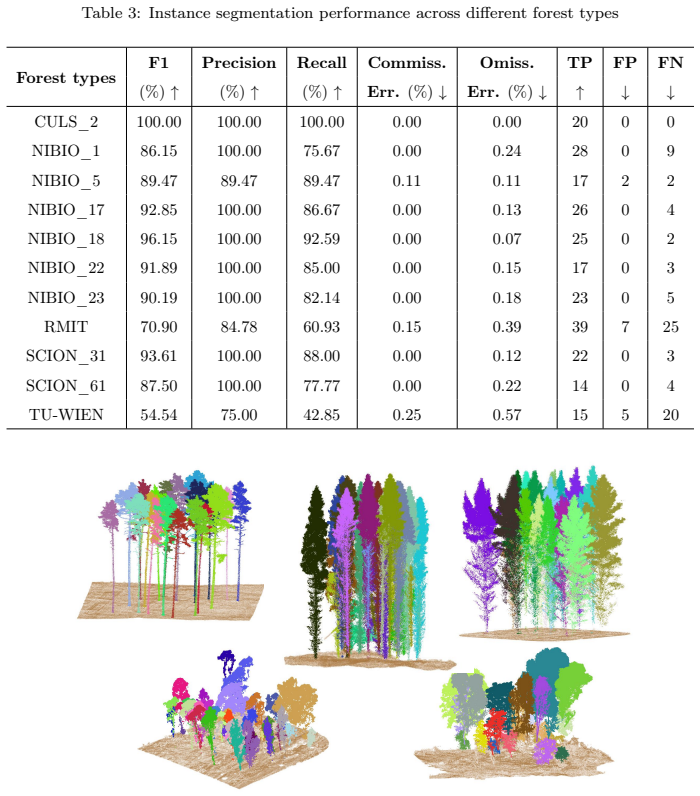
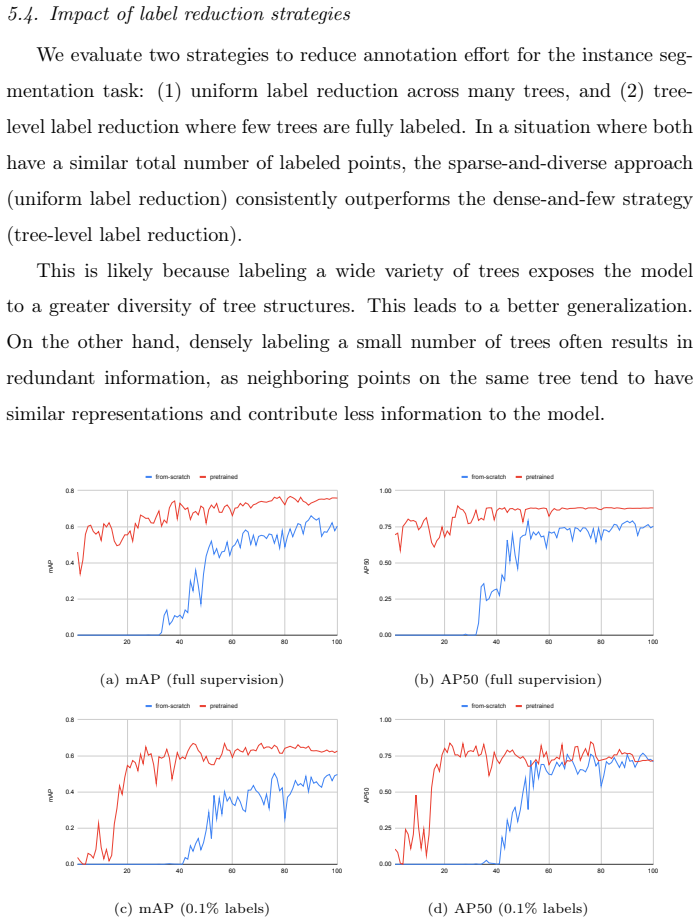
The central claim is that a single self-supervised contrastive pretraining stage (Masked Scene Contrast on a Sparse UNet encoder) provides transferable point-level features for forest scenes, so that downstream segmentation and classification models can be fine-tuned with very few labels. For instance segmentation the authors find that pretraining alone is not enough; they add a supervised domain-adaptation pass on a labeled source region (NIBIO) before fine-tuning on the target (SCION), and report AP50 of 89.36% with full labels versus 72.38% from scratch. For semantic segmentation, self-supervised pretraining without domain adaptation improves mean IoU by 1.79 points under full supervision
What carries the argument
The load-bearing mechanism is contrastive self-supervised pretraining: Masked Scene Contrast (MSC) trains a Sparse UNet encoder by masking parts of raw scene-level point clouds and enforcing contrastive consistency across masked views, so that positive point pairs (nearby in space across views) pull together and negatives push apart. This yields domain- and task-agnostic geometric features. On top of that encoder the paper attaches task-specific heads (PointGroup-style offset prediction for instance segmentation, a per-point MLP for semantic labeling, a global pooling classifier for species) and shows two further mechanisms: a supervised source-domain adaptation pass for instance segmentatio
Load-bearing premise
The paper's central instance-segmentation result assumes the benefit of its pipeline comes from self-supervised pretraining, but the pipeline also adds a fully supervised training pass on a labeled source region (NIBIO) that the from-scratch baseline never receives, so the reported gain could be carried by those extra source labels rather than by self-supervision.
What would settle it
Train the same instance-segmentation model on the SCION target under identical label reductions using (a) SSL pretraining only, (b) supervised training on NIBIO only (no SSL), and (c) the paper's SSL + NIBIO pipeline. If (b) matches or exceeds (c) at 0.1% or 1% labels, the self-supervised pretraining is not the driver of the reported AP50 gains.
If this is right
- Instance segmentation can be performed from only about 4-5 labeled points per tree if the encoder was pretrained with contrastive SSL and adapted on a related labeled region; from-scratch training produces no instances at that level.
- When annotation effort is fixed, sparsely labeling many trees is more effective than fully labeling a few trees, so practical labeling campaigns should maximize tree diversity over per-tree label density.
- Semantic segmentation with 0.1% of labels plus pretraining matches a from-scratch model trained on 100% labels, suggesting per-point tasks need much less annotation when the backbone is pretrained.
- Species classification for species never seen during coarse pretraining improves (up to about 18 points in intra-group Jaccard) when the model first learns broadleaf vs. conifer distinctions.
- Fine-tuning a pretrained model reaches comparable accuracy in roughly 80% of the training time, reducing energy use and CO2 emissions by about 21%.
Where Pith is reading between the lines
- Editorial inference: The headline instance-segmentation gain is confounded because the compared pipeline includes a fully supervised pass on the NIBIO source domain that the from-scratch baseline never receives; without an SSL-only or source-supervised-only ablation, the +16.98 AP50 cannot be attributed to self-supervision alone.
- Editorial inference: The uniform-versus-tree-level reduction results (diverse sparse beats dense-few) imply an annotation tool could rank trees by structural diversity and present a small sparse set to annotators, potentially improving performance per labeling hour.
- Editorial inference: The success of head-only fine-tuning at 0.01% labels suggests a practical rule: freeze the backbone under extreme label scarcity, then unfreeze once more labels arrive; the paper reports this pattern but does not claim it as a general recipe.
- Editorial inference: The energy measurement is for reaching similar accuracy rather than a fixed epoch budget, so the 21% figure bundles both fewer epochs and lower average GPU power; a fair replication should compare at equal final accuracy on the same task.
Editorial analysis
A structured set of objections, weighed in public.
Referee Report
Summary. The paper proposes a unified deep-learning framework that combines self-supervised contrastive pretraining, supervised domain adaptation, and hierarchical transfer learning for three forest point-cloud tasks: instance segmentation, semantic segmentation, and tree species classification. Using FOR-instance and FOR-species20K benchmarks, it reports that self-supervised pretraining combined with domain adaptation improves instance-segmentation AP50 by 16.98% over training from scratch, that self-supervised pretraining alone improves semantic-segmentation mIoU by 1.79%, and that hierarchical broadleaf/conifer pretraining improves few-shot species-classification Jaccard by 6.07%. The paper also reports a ~21% reduction in energy consumption and carbon emissions when fine-tuning from pretrained weights, and it makes code and pretrained models openly available.
Significance. If the results hold, the framework offers a practical route to reducing annotation effort for individual-tree mapping from lidar, which is a clear need in the field. The semantic segmentation comparison (Table 6) is a clean initialization-only difference, and the tree classification comparison (Table 8) excludes target species from pretraining; these two experiments are well controlled. The energy measurement (Table 10) is a useful, concrete contribution. However, the headline instance-segmentation result is confounded: the 'fine-tune' conditions differ from the from-scratch baseline by both initialization and exposure to a fully supervised source-domain pass, so the causal role of self-supervised learning in the +16.98 AP50 gain is not established. The paper also does not document that its unlabeled pretraining corpus is disjoint from the benchmark evaluation sites.
major comments (3)
- [§4.2, Table 4] The headline +16.98 AP50 (89.36 vs. 72.38 at 100% labels) is measured between 'Fine-tune All' and 'From Scratch'. Per §3.4, the fine-tune conditions are produced by a three-stage pipeline: MSC pretraining, then fully supervised training on the NIBIO source, then fine-tuning on SCION. The from-scratch baseline receives only SCION labels. These conditions differ by two manipulations, so the gain cannot be attributed to self-supervised pretraining. The same confound applies to the 0.01% result (71.09 vs. 0.00). Please add an SSL-only ablation (MSC pretraining + direct SCION fine-tuning, no NIBIO pass) and a source-supervised-only ablation (random init + NIBIO + SCION fine-tuning). Without these, the paper's central causal claim for instance segmentation is not identified; the statement in §5.7 that SSL is 'not yet sufficient to capture instance-level representations independently' does not
- [§3.1, Table 1] The unlabeled pretraining data are described only by region and modality ('Germany' for droneborne; 'multi-country (Europe, North America, South America)' for airborne). The paper never states that these data are disjoint from the FOR-instance test sites (NIBIO, CULS, TU-WIEN, SCION, RMIT) or from the FOR-species20K trees. Given the geographic breadth of the pretraining set, overlap with benchmark regions is plausible. If pretraining included test-area point clouds, the reported gains could reflect data leakage rather than transferable representation learning. Please provide an explicit exclusion statement and, ideally, a dataset-level overlap check (e.g., coordinates or file-level verification) between the pretraining corpus and all benchmark evaluation data.
- [§4.4, Table 8] The few-shot classification comparison rests on a single random selection of 40 training samples per species, with no standard deviation or repeated-seed evaluation. Since few-shot results are highly sensitive to the particular training subset, the reported 6.07-point mJaccard improvement (and the per-species numbers) may not be stable. Please report results over multiple seeds (e.g., 3–5) as mean ± std, or otherwise justify why a single split is sufficient. This is needed to support the third headline claim.
minor comments (7)
- [Abstract / §4.2] The abstract states the instance-segmentation improvement as '+16.98%' without noting that this is at 100% labels (Table 4); the few-shot setting is the paper's stated focus. Please specify the label fraction to avoid overstating the label-efficiency claim.
- [§4.2, Table 4 caption] The caption does not state that the 'Fine-tune Head' and 'Fine-tune All' columns include the prior NIBIO domain-adaptation pass described in §3.4. Clarify in the text or caption that these are SSL+DA conditions, not SSL-only conditions.
- [§4.1, Figures 6–7] The caption for Figure 6 says it 'will be replaced by a better figure' and Figure 7 is similarly preliminary. These should be finalized before publication.
- [§4.5, Table 9] The state-of-the-art comparison does not state the training protocol: are the baselines their published checkpoints, retrained under the same supervision level, or evaluated at full supervision? This is needed for a fair comparison.
- [§5.6, Table 10] The text says the models achieve 'similar instance segmentation accuracy' but does not report the matched accuracy values. Add the AP50/mAP used for the comparison.
- [§3.1] For reproducibility, list the actual pretraining datasets (public sources and collaborating institutions) rather than only aggregate counts and regions. The open-source claim would be strengthened by a data manifest.
- [§5.3, Figure 14] There is a typo in §5.2: 'struggle to optimize in the nearly stages' should be 'the early stages'. Also, the training curves in Figures 13–15 should specify the evaluation intervals and whether the reported tables use the final epoch or the best epoch.
Circularity Check
No circularity: results are empirical comparisons; the instance-segmentation attribution is confounded by an extra supervised source pass, but no prediction reduces to its inputs by construction.
full rationale
The paper's claimed improvements are obtained by training and evaluating networks on benchmark splits, not by deriving a result from its own definition. The instance-segmentation comparison (Section 3.4, Table 4) compares a three-stage pipeline (SSL pretraining, supervised training on NIBIO source, fine-tuning on SCION) against a from-scratch baseline trained only on SCION labels. That comparison is not an ablation of SSL: +16.98 AP50 at 100% labels and the 0.01% result (71.09 vs 0.00 AP50) could be driven by the added source-supervised pass. This is a real attribution/confound weakness and the paper itself concedes (Section 5.7) that 'instance segmentation in our study still relies on domain adaptation' and SSL is 'not yet sufficient to capture instance-level representations independently.' However, this is missing experimental control, not circularity: no quantity is fitted from the target and then called a prediction, and no equation reduces to its input. The semantic segmentation gain (+1.79 mIoU) and classification gain (+6.07 Jaccard) compare pretrained vs scratch under the same fine-tuning labels, and the classification pretraining explicitly excludes the fine-tuned species ('These classes are excluded during pretraining'), so there is no definitional overlap. The only self-citation (SpectralGPT, Hong et al. 2024, cited in Section 3.2 as 'Following the idea of foundation models in earth observation') is used as a motivating analogy, not as load-bearing evidence or a uniqueness theorem. A secondary data-provenance concern (the unlabeled pretraining set in Table 1 is not stated to exclude FOR-instance test regions) is a possible leakage risk, not circularity. Overall, the derivation chain is self-contained empirical evaluation; score 0.
Axiom & Free-Parameter Ledger
free parameters (3)
- InfoNCE temperature τ =
not reported (Eq. 1)
- BFS clustering radius =
not reported
- Few-shot training sample count per species =
40
axioms (4)
- domain assumption FOR-instance and FOR-species20K annotations and predefined splits are correct.
- domain assumption Pretraining corpus is disjoint from benchmark test scenes.
- domain assumption Broadleaf/conifer coarse classes transfer to species-level discrimination.
- ad hoc to paper Two-stage fine-tuning (freeze encoder, then unfreeze) preserves pretrained features.
Cite this review
Pith. "Pith review of Label-Efficient 3D Forest Mapping: Self-Supervised and Transfer Learning for Instance Segmentation, Semantic Segmentation, and Species Classification." pith.science (2026). https://pith.science/paper/ZG3O64IK
@misc{pith2026251106331,
  author       = {Pith},
  title        = {Pith review of: Label-Efficient 3D Forest Mapping: Self-Supervised and Transfer Learning for Instance Segmentation, Semantic Segmentation, and Species Classification},
  year         = {2026},
  howpublished = {\url{https://pith.science/paper/ZG3O64IK}},
  note         = {Machine review of arXiv:2511.06331}
}
read the original abstract
Detailed structural and species information on individual tree level is increasingly important to support precision forestry, biodiversity conservation, and provide reference data for biomass and carbon mapping. Point clouds from airborne and ground-based laser scanning are currently the most suitable data source to rapidly derive such information at scale. Recent advancements in deep learning improved segmenting and classifying individual trees and identifying semantic tree components. However, deep learning models typically require large amounts of annotated training data which limits further improvement. Producing dense, high-quality annotations for 3D point clouds, especially in complex forests, is labor-intensive and challenging to scale. We explore strategies to reduce dependence on large annotated datasets using self-supervised and transfer learning. Our objective is to improve performance across three tasks: instance segmentation, semantic segmentation, and tree classification using realistic and operational training sets. We observe improvements across all tasks, compared to training from scratch, evaluated with their respective metrics. For instance segmentation, self-supervised learning combined with domain adaptation improves AP50 by 16.98%. For semantic segmentation, self-supervised learning alone improves mIoU by 1.79%. For tree classification, hierarchical transfer learning improves mean Jaccard by 6.07%. To simplify use and encourage uptake, we integrated the tasks into a unified framework, streamlining the process from raw point clouds to tree delineation, structural analysis, and species classification. Pretrained models reduce energy consumption and carbon emissions by ~21%. This open-source contribution aims to accelerate operational extraction of individual tree information from laser scanning point clouds to support forestry, biodiversity, and carbon mapping.
Figures






Reference graph
Works this paper leans on
-
[1]
, author Hickman, S.H
author Ball, J.G. , author Hickman, S.H. , author Jackson, T.D. , author Koay, X.J. , author Hirst, J. , author Jay, W. , author Archer, M. , author Aubry-Kientz, M. , author Vincent, G. , author Coomes, D.A. , year 2023 . title Accurate delineation of individual tree crowns in tropical forests from aerial rgb imagery using mask r-cnn . journal Remote Sen...
2023
-
[2]
, author Hay, G.J
author Blaschke, T. , author Hay, G.J. , author Kelly, M. , author Lang, S. , author Hofmann, P. , author Addink, E. , author Feitosa, R.Q. , author Van der Meer, F. , author Van der Werff, H. , author Van Coillie, F. , et al., year 2014 . title Geographic object-based image analysis--towards a new paradigm . journal ISPRS journal of photogrammetry and re...
2014
-
[3]
, author Lejeune, P
author Bolyn, C. , author Lejeune, P. , author Michez, A. , author Latte, N. , year 2022 . title Mapping tree species proportions from satellite imagery using spectral--spatial deep learning . journal Remote sensing of environment volume 280 , pages 113205
2022
-
[4]
, author Calders, K
author Brede, B. , author Calders, K. , author Lau, A. , author Raumonen, P. , author Bartholomeus, H.M. , author Herold, M. , author Kooistra, L. , year 2019 . title Non-destructive tree volume estimation through quantitative structure modelling: Comparing uav laser scanning with terrestrial lidar . journal Remote Sensing of Environment volume 233 , pages 111355
2019
-
[5]
, author Gao, S
author Cao, L. , author Gao, S. , author Li, P. , author Yun, T. , author Shen, X. , author Ruan, H. , year 2016 . title Aboveground biomass estimation of individual trees in a coastal planted forest using full-waveform airborne laser scanning data . journal Remote Sensing volume 8 , pages 729
2016
-
[6]
, author R \'e jou-M \'e chain, M
author Chave, J. , author R \'e jou-M \'e chain, M. , author B \'u rquez, A. , author Chidumayo, E. , author Colgan, M.S. , author Delitti, W.B. , author Duque, A. , author Eid, T. , author Fearnside, P.M. , author Goodman, R.C. , et al., year 2014 . title Improved allometric models to estimate the aboveground biomass of tropical trees . journal Global ch...
2014
-
[7]
, author Russell, D
author Chen, M. , author Russell, D. , author Pallavoor, A. , author Young, D. , author Wu, J. , year 2025 . title Zero-shot tree detection and segmentation from aerial forest imagery
2025
-
[8]
, author Baldocchi, D
author Chen, Q. , author Baldocchi, D. , author Gong, P. , author Kelly, M. , year 2006 . title Isolating individual trees in a savanna woodland using small footprint lidar data . journal Photogrammetric Engineering & Remote Sensing volume 72 , pages 923--932
2006
-
[9]
, author Kornblith, S
author Chen, T. , author Kornblith, S. , author Norouzi, M. , author Hinton, G. , year 2020 . title A simple framework for contrastive learning of visual representations , in: booktitle International conference on machine learning , organization PmLR . pp. pages 1597--1607
2020
-
[10]
, author Gwak, J
author Choy, C. , author Gwak, J. , author Savarese, S. , year 2019 . title 4d spatio-temporal convnets: Minkowski convolutional neural networks , in: booktitle Proceedings of the IEEE/CVF conference on computer vision and pattern recognition , pp. pages 3075--3084
2019
-
[11]
, author Abdulkadir, A
author C i c ek, \"O . , author Abdulkadir, A. , author Lienkamp, S.S. , author Brox, T. , author Ronneberger, O. , year 2016 . title 3d u-net: learning dense volumetric segmentation from sparse annotation , in: booktitle International conference on medical image computing and computer-assisted intervention , organization Springer . pp. pages 424--432
2016
-
[12]
, author Schmidt, V
author Courty, B. , author Schmidt, V. , author Goyal-Kamal , author MarionCoutarel , author Feld, B. , author Lecourt, J. , author LiamConnell , author SabAmine , author inimaz , author supatomic , author Léval, M. , author Blanche, L. , author Cruveiller, A. , author ouminasara , author Zhao, F. , author Joshi, A. , author Bogroff, A. , author Saboni, A...
2024
-
[13]
, author Coomes, D.A
author Dalponte, M. , author Coomes, D.A. , year 2016 . title Tree-centric mapping of forest carbon density from airborne laser scanning and hyperspectral data . journal Methods in ecology and evolution volume 7 , pages 1236--1245
2016
-
[14]
, author Jia, Y
author Donahue, J. , author Jia, Y. , author Vinyals, O. , author Hoffman, J. , author Zhang, N. , author Tzeng, E. , author Darrell, T. , year 2014 . title Decaf: A deep convolutional activation feature for generic visual recognition , in: booktitle International conference on machine learning , organization PMLR . pp. pages 647--655
2014
-
[15]
, author Huang, W
author Duncanson, L. , author Huang, W. , author Johnson, K. , author Swatantran, A. , author McRoberts, R.E. , author Dubayah, R. , year 2017 . title Implications of allometric model selection for county-level biomass mapping . journal Carbon Balance and Management volume 12 , pages 18
2017
-
[16]
, author Wei, J
author Fan, Z. , author Wei, J. , author Zhang, R. , author Zhang, W. , year 2023 . title Tree species classification based on pointnet++ and airborne laser survey point cloud data enhancement . journal Forests volume 14 , pages 1246
2023
-
[17]
, author White, J.C
author Fassnacht, F.E. , author White, J.C. , author Wulder, M.A. , author N sset, E. , year 2024 . title Remote sensing in forestry: current challenges, considerations and directions . journal Forestry: An International Journal of Forest Research volume 97 , pages 11--37
2024
-
[18]
, author Ferreira, R.L.C
author Finger, A.P. , author Ferreira, R.L.C. , author Lana, M.D. , author Silva, J.A.A.d. , author Silva, E.A. , author Breunig, F.M. , author Bispo, P.d.C. , author Liesenberg, V. , author Nogueira, S.S. , year 2025 . title Comparison between traditional forest inventory and remote sensing with random forest for estimating the periodic annual increment ...
2025
-
[19]
, author Ustinova, E
author Ganin, Y. , author Ustinova, E. , author Ajakan, H. , author Germain, P. , author Larochelle, H. , author Laviolette, F. , author March, M. , author Lempitsky, V. , year 2016 . title Domain-adversarial training of neural networks , pp. pages 1--35
2016
-
[20]
, author Engelcke, M
author Graham, B. , author Engelcke, M. , author Van Der Maaten, L. , year 2018 . title 3d semantic segmentation with submanifold sparse convolutional networks , in: booktitle Proceedings of the IEEE conference on computer vision and pattern recognition , pp. pages 9224--9232
2018
-
[21]
, author Jacobs, N.B
author Hamraz, H. , author Jacobs, N.B. , author Contreras, M.A. , author Clark, C.H. , year 2019 . title Deep learning for conifer/deciduous classification of airborne lidar 3d point clouds representing individual trees . journal ISPRS Journal of Photogrammetry and Remote Sensing volume 158 , pages 219--230
2019
-
[22]
, author Chen, X
author He, K. , author Chen, X. , author Xie, S. , author Li, Y. , author Doll \'a r, P. , author Girshick, R. , year 2022 . title Masked autoencoders are scalable vision learners , in: booktitle Proceedings of the IEEE/CVF conference on computer vision and pattern recognition , pp. pages 16000--16009
2022
-
[23]
, author Fan, H
author He, K. , author Fan, H. , author Wu, Y. , author Xie, S. , author Girshick, R. , year 2020 . title Momentum contrast for unsupervised visual representation learning , in: booktitle Proceedings of the IEEE/CVF conference on computer vision and pattern recognition , pp. pages 9729--9738
2020
-
[24]
, author van Delden, J
author Henrich, J. , author van Delden, J. , author Seidel, D. , author Kneib, T. , author Ecker, A.S. , year 2024 . title Treelearn: A deep learning method for segmenting individual trees from ground-based lidar forest point clouds . journal Ecological Informatics volume 84 , pages 102888
2024
-
[25]
, author Zhang, B
author Hong, D. , author Zhang, B. , author Li, X. , author Li, Y. , author Li, C. , author Yao, J. , author Yokoya, N. , author Li, H. , author Ghamisi, P. , author Jia, X. , et al., year 2024 . title Spectralgpt: Spectral remote sensing foundation model . journal IEEE Transactions on Pattern Analysis and Machine Intelligence volume 46 , pages 5227--5244
2024
-
[26]
, author Graham, B
author Hou, J. , author Graham, B. , author Nie ner, M. , author Xie, S. , year 2021 . title Exploring data-efficient 3d scene understanding with contrastive scene contexts , in: booktitle Proceedings of the IEEE/CVF conference on computer vision and pattern recognition , pp. pages 15587--15597
2021
-
[27]
a , J. , author Yu, X. , author Hyypp \
author Hyypp \"a , J. , author Yu, X. , author Hyypp \"a , H. , author Vastaranta, M. , author Holopainen, M. , author Kukko, A. , author Kaartinen, H. , author Jaakkola, A. , author Vaaja, M. , author Koskinen, J. , et al., year 2012 . title Advances in forest inventory using airborne laser scanning . journal Remote sensing volume 4 , pages 1190--1207
2012
-
[28]
, author Zhao, H
author Jiang, L. , author Zhao, H. , author Shi, S. , author Liu, S. , author Fu, C.W. , author Jia, J. , year 2020 . title Pointgroup: Dual-set point grouping for 3d instance segmentation , in: booktitle Proceedings of the IEEE/CVF conference on computer vision and Pattern recognition , pp. pages 4867--4876
2020
-
[29]
, author Sutskever, I
author Krizhevsky, A. , author Sutskever, I. , author Hinton, G.E. , year 2012 . title Imagenet classification with deep convolutional neural networks
2012
-
[30]
, author Fassnacht, F.E
author Latifi, H. , author Fassnacht, F.E. , author M \"u ller, J. , author Tharani, A. , author Dech, S. , author Heurich, M. , year 2015 . title Forest inventories by lidar data: A comparison of single tree segmentation and metric-based methods for inventories of a heterogeneous temperate forest . journal International Journal of Applied Earth Observati...
2015
-
[31]
, author Guo, Q
author Li, W. , author Guo, Q. , author Jakubowski, M.K. , author Kelly, M. , year 2012 . title A new method for segmenting individual trees from the lidar point cloud . journal Photogrammetric Engineering & Remote Sensing volume 78 , pages 75--84
2012
-
[32]
, author Huang, H
author Liu, B. , author Huang, H. , author Su, Y. , author Chen, S. , author Li, Z. , author Chen, E. , author Tian, X. , year 2022 . title Tree species classification using ground-based lidar data by various point cloud deep learning methods . journal Remote Sensing volume 14 , pages 5733
2022
-
[33]
, author Dong, Y
author Ma, Z. , author Dong, Y. , author Zi, J. , author Xu, F. , author Chen, F. , year 2023 . title Forest-pointnet: A deep learning model for vertical structure segmentation in complex forest scenes . journal Remote Sensing volume 15 , pages 4793
2023
-
[34]
, author Sp \' nola, M
author Marcello, J. , author Sp \' nola, M. , author Albors, L. , author Marqu \'e s, F. , author Rodr \' guez-Esparrag \'o n, D. , author Eugenio, F. , year 2024 . title Performance of individual tree segmentation algorithms in forest ecosystems using uav lidar data . journal Drones volume 8 , pages 772
2024
-
[35]
, author Tomppo, E.O
author McRoberts, R.E. , author Tomppo, E.O. , year 2007 . title Remote sensing support for national forest inventories . journal Remote sensing of environment volume 110 , pages 412--419
2007
-
[36]
, author Sarawadekar, K
author Mishra, P. , author Sarawadekar, K. , year 2019 . title Polynomial learning rate policy with warm restart for deep neural network , in: booktitle TENCON 2019-2019 IEEE Region 10 Conference (TENCON) , organization IEEE . pp. pages 2087--2092
2019
-
[37]
, author Schindler, Z
author Morhart, C. , author Schindler, Z. , author Frey, J. , author Sheppard, J.P. , author Calders, K. , author Disney, M. , author Morsdorf, F. , author Raumonen, P. , author Seifert, T. , year 2024 . title Limitations of estimating branch volume from terrestrial laser scanning . journal European Journal of Forest Research volume 143 , pages 687--702
2024
-
[38]
, author Morin, D
author Mouret, F. , author Morin, D. , author Planells, M. , author Vincent-Barbaroux, C. , year 2025 . title Tree species classification at the pixel level using deep learning and multispectral time series in an imbalanced context . journal Remote Sensing volume 17 , pages 1190
2025
-
[39]
, year 2002
author N sset, E. , year 2002 . title Predicting forest stand characteristics with airborne scanning laser using a practical two-stage procedure and field data . journal Remote sensing of environment volume 80 , pages 88--99
2002
-
[40]
, author Lines, E.R
author Puliti, S. , author Lines, E.R. , author M \"u llerov \'a , J. , author Frey, J. , author Schindler, Z. , author Straker, A. , author Allen, M.J. , author Winiwarter, L. , author Rehush, N. , author Hristova, H. , et al., year 2025 . title Benchmarking tree species classification from proximally sensed laser scanning data: Introducing the for-speci...
2025
-
[41]
author Puliti, S. , author Pearse, G. , author Surov \'y , P. , author Wallace, L. , author Hollaus, M. , author Wielgosz, M. , author Astrup, R. , year 2023 . title For‑instance: a uav laser scanning benchmark dataset for semantic and instance segmentation of individual trees . journal arXiv preprint :10.48550/arXiv.2309.01279, http://arxiv.org/abs/2309....
-
[42]
, author Zhou, W
author Qin, H. , author Zhou, W. , author Yao, Y. , author Wang, W. , year 2022 . title Individual tree segmentation and tree species classification in subtropical broadleaf forests using uav-based lidar, hyperspectral, and ultrahigh-resolution rgb data . journal Remote Sensing of Environment volume 280 , pages 113143
2022
-
[43]
, author Auty, D
author Roussel, J.R. , author Auty, D. , author Coops, N.C. , author Tompalski, P. , author Goodbody, T.R. , author Meador, A.S. , author Bourdon, J.F. , author De Boissieu, F. , author Achim, A. , year 2020 . title lidr: An r package for analysis of airborne laser scanning (als) data . journal Remote Sensing of Environment volume 251 , pages 112061
2020
-
[44]
, author Kim, D
author Saito, K. , author Kim, D. , author Sclaroff, S. , author Saenko, K. , year 2020 . title Universal domain adaptation through self supervision . journal Advances in neural information processing systems volume 33 , pages 16282--16292
2020
-
[45]
, author Ene, L
author Salas, C. , author Ene, L. , author Gregoire, T.G. , author N sset, E. , author Gobakken, T. , year 2010 . title Modelling tree diameter from airborne laser scanning derived variables: A comparison of spatial statistical models . journal Remote Sensing of Environment volume 114 , pages 1277--1285
2010
-
[46]
, author Seidl, R
author Senf, C. , author Seidl, R. , author Hostert, P. , year 2017 . title Remote sensing of forest insect disturbances: Current state and future directions . journal International journal of applied earth observation and geoinformation volume 60 , pages 49--60
2017
-
[47]
, author Hudak, A.T
author Silva, C.A. , author Hudak, A.T. , author Vierling, L.A. , author Loudermilk, E.L. , author O’Brien, J.J. , author Hiers, J.K. , author Jack, S.B. , author Gonzalez-Benecke, C. , author Lee, H. , author Falkowski, M.J. , et al., year 2016 . title Imputation of individual longleaf pine (pinus palustris mill.) tree attributes from field and lidar dat...
2016
-
[48]
, author Topin, N
author Smith, L.N. , author Topin, N. , year 2019 . title Super-convergence: Very fast training of neural networks using large learning rates , in: booktitle Artificial intelligence and machine learning for multi-domain operations applications , organization SPIE . pp. pages 369--386
2019
-
[49]
, author Rakofsky, J
author Tompalski, P. , author Rakofsky, J. , author Coops, N.C. , author White, J.C. , author Graham, A.N. , author Rosychuk, K. , year 2019 . title Challenges of multi-temporal and multi-sensor forest growth analyses in a highly disturbed boreal mixedwood forests . journal Remote Sensing volume 11 , pages 2102
2019
-
[50]
, author Hoffman, J
author Tzeng, E. , author Hoffman, J. , author Saenko, K. , author Darrell, T. , year 2017 . title Adversarial discriminative domain adaptation , in: booktitle Proceedings of the IEEE conference on computer vision and pattern recognition , pp. pages 7167--7176
2017
-
[51]
, author Brandmeier, M
author Vahrenhold, J.R. , author Brandmeier, M. , author M \"u ller, M.S. , year 2025 . title Mmtscnet: Multimodal tree species classification network for classification of multi-source, single-tree lidar point clouds . journal Remote Sensing volume 17 , pages 1304
2025
-
[52]
, author Evangelista, P.H
author Vorster, A.G. , author Evangelista, P.H. , author Stovall, A.E. , author Ex, S. , year 2020 . title Variability and uncertainty in forest biomass estimates from the tree to landscape scale: the role of allometric equations . journal Carbon Balance and Management volume 15 , pages 8
2020
-
[53]
, author Marconi, S
author Weinstein, B.G. , author Marconi, S. , author Aubry-Kientz, M. , author Vincent, G. , author Senyondo, H. , author White, E.P. , year 2020 . title Deepforest: A python package for rgb deep learning tree crown delineation . journal Methods in Ecology and Evolution volume 11 , pages 1743--1751
2020
-
[54]
, author Puliti, S
author Wielgosz, M. , author Puliti, S. , author Xiang, B. , author Schindler, K. , author Astrup, R. , year 2024 . title Segmentanytree: A sensor and platform agnostic deep learning model for tree segmentation using laser scanning data . journal Remote Sensing of Environment volume 313 , pages 114367
2024
-
[55]
, author Wen, X
author Wu, X. , author Wen, X. , author Liu, X. , author Zhao, H. , year 2023 . title Masked scene contrast: A scalable framework for unsupervised 3d representation learning , in: booktitle Proceedings of the IEEE/CVF Conference on computer vision and pattern recognition , pp. pages 9415--9424
2023
-
[56]
, author Hopkinson, C
author Xi, Z. , author Hopkinson, C. , year 2022 . title 3d graph-based individual-tree isolation (treeiso) from terrestrial laser scanning point clouds . journal Remote Sensing volume 14 , pages 6116
2022
-
[57]
, author Wielgosz, M
author Xiang, B. , author Wielgosz, M. , author Kontogianni, T. , author Peters, T. , author Puliti, S. , author Astrup, R. , author Schindler, K. , year 2024 . title Automated forest inventory: Analysis of high-density airborne lidar point clouds with 3d deep learning . journal Remote Sensing of Environment volume 305 , pages 114078
2024
-
[58]
, author Gu, J
author Xie, S. , author Gu, J. , author Guo, D. , author Qi, C.R. , author Guibas, L. , author Litany, O. , year 2020 a. title Pointcontrast: Unsupervised pre-training for 3d point cloud understanding , in: booktitle European conference on computer vision , organization Springer . pp. pages 574--591
2020
-
[59]
, author Gu, J
author Xie, S. , author Gu, J. , author Guo, D. , author Qi, C.R. , author Guibas, L. , author Litany, O. , year 2020 b. title Pointcontrast: Unsupervised pre-training for 3d point cloud understanding , in: booktitle European conference on computer vision , organization Springer . pp. pages 574--591
2020
-
[60]
, author Kang, Z
author Yang, J. , author Kang, Z. , author Cheng, S. , author Yang, Z. , author Akwensi, P.H. , year 2020 . title An individual tree segmentation method based on watershed algorithm and three-dimensional spatial distribution analysis from airborne lidar point clouds . journal IEEE Journal of Selected Topics in Applied Earth Observations and Remote Sensing...
2020
-
[61]
, author Clune, J
author Yosinski, J. , author Clune, J. , author Bengio, Y. , author Lipson, H. , year 2014 . title How transferable are features in deep neural networks?
2014
-
[62]
, author Tang, L
author Yu, X. , author Tang, L. , author Rao, Y. , author Huang, T. , author Zhou, J. , author Lu, J. , year 2022 . title Point-bert: Pre-training 3d point cloud transformers with masked point modeling , in: booktitle Proceedings of the IEEE/CVF conference on computer vision and pattern recognition , pp. pages 19313--19322
2022
-
[63]
write newline
" write newline "" before.all 'output.state := FUNCTION n.dashify 't := "" t empty not t #1 #1 substring "-" = t #1 #2 substring "--" = not "--" * t #2 global.max substring 't := t #1 #1 substring "-" = "-" * t #2 global.max substring 't := while if t #1 #1 substring * t #2 global.max substring 't := if while FUNCTION word.in bbl.in ":" * " " * FUNCTION f...
-
[64]
write newline
" write newline "" before.all 'output.state := FUNCTION n.dashify 't := "" t empty not t #1 #1 substring "-" = t #1 #2 substring "--" = not "--" * t #2 global.max substring 't := t #1 #1 substring "-" = "-" * t #2 global.max substring 't := while if t #1 #1 substring * t #2 global.max substring 't := if while FUNCTION word.in bbl.in ":" * " " * FUNCTION f...
discussion (0)
Sign in with ORCID, Apple, or X to comment. Anyone can read and Pith papers without signing in.