UltraGS: Real-Time Physically-Decoupled Gaussian Splatting for Ultrasound Novel View Synthesis
Pith reviewed 2026-05-18 00:19 UTC · model grok-4.3
The pith
Depth-aware Gaussian primitives and a physics-decoupled renderer let ultrasound systems synthesize new views in real time from freehand scans.
A machine-rendered reading of the paper's core claim, the machinery that carries it, and where it could break.
Core claim
UltraGS establishes that depth-aware Gaussian primitives equipped with learnable fields of view, when rendered through the PD operator that merges low-order spherical harmonics with first-order wave effects, produce geometrically consistent novel ultrasound views at real-time rates under unconstrained probe motion.
What carries the argument
The PD Rendering operator, a differentiable acoustic operator that combines low-order spherical harmonics with first-order wave effects, working together with depth-aware Gaussian primitives that carry learnable fields of view.
If this is right
- Novel views can be synthesized at 64.69 frames per second on a single GPU.
- Image quality reaches state-of-the-art PSNR values up to 29.55 and SSIM values up to 0.89 across three evaluated datasets.
- The framework supports freehand probe motion without requiring additional sensors or post-processing steps.
- A new clinical ultrasound dataset acquired under real-world scanning protocols is released for community use.
Where Pith is reading between the lines
- The same primitives and operator could be tested on other freehand imaging modalities that face similar field-of-view limits.
- Real-time rates open the possibility of live view synthesis during interventional procedures.
- The explicit separation of radiance fields from acoustic effects may reduce the cost of adapting the method to new probe hardware.
Load-bearing premise
Depth-aware Gaussian primitives with learnable fields of view plus the PD Rendering operator produce geometrically consistent novel views under unconstrained probe motion without additional constraints or post-processing.
What would settle it
Acquire ground-truth ultrasound images from probe positions never seen during training and measure whether the synthesized views match the actual scans in both intensity and apparent geometry.
Figures




read the original abstract
Ultrasound imaging is a cornerstone of non-invasive clinical diagnostics, yet its limited field of view poses challenges for novel view synthesis. We present UltraGS, a real-time framework that adapts Gaussian Splatting to sensorless ultrasound imaging by integrating explicit radiance fields with lightweight, physics-inspired acoustic modeling. UltraGS employs depth-aware Gaussian primitives with learnable fields of view to improve geometric consistency under unconstrained probe motion, and introduces PD Rendering, a differentiable acoustic operator that combines low-order spherical harmonics with first-order wave effects for efficient intensity synthesis. We further present a clinical ultrasound dataset acquired under real-world scanning protocols. Extensive evaluations across three datasets demonstrate that UltraGS establishes a new performance-efficiency frontier, achieving state-of-the-art results in PSNR (up to 29.55) and SSIM (up to 0.89) while achieving real-time synthesis at 64.69 fps on a single GPU. The code and dataset are open-sourced at: https://github.com/Bean-Young/UltraGS.
Editorial analysis
A structured set of objections, weighed in public.
Referee Report
Summary. The paper introduces UltraGS, a real-time framework adapting 3D Gaussian Splatting to sensorless ultrasound novel view synthesis. It uses depth-aware Gaussian primitives with learnable fields of view for geometric consistency under free probe motion and proposes a PD Rendering operator that combines low-order spherical harmonics with first-order wave effects for differentiable acoustic intensity synthesis. A new clinical ultrasound dataset is presented, and evaluations on three datasets report SOTA quantitative results (PSNR up to 29.55, SSIM up to 0.89) at 64.69 fps on a single GPU, with code and data released.
Significance. If the performance and consistency claims hold under rigorous controls, the work would advance real-time 3D ultrasound visualization by bridging explicit radiance fields with lightweight physics-inspired acoustics, potentially enabling sensorless freehand scanning applications. The open-sourced code, dataset, and real-time efficiency on commodity hardware are notable strengths that support reproducibility and practical adoption.
major comments (2)
- [§3.2] §3.2 (PD Rendering operator): the claim that low-order spherical harmonics plus first-order wave effects suffice for geometrically consistent novel views under unconstrained probe motion lacks a direct test against higher-order scattering or multiple reflections; if the first-order term is the primary acoustic model, consistency may reduce to trajectory overfitting rather than physical generalization, which is load-bearing for the central consistency claim.
- [§4] §4 (Experiments): the reported SOTA PSNR/SSIM values (up to 29.55/0.89) and real-time fps are presented without visible error bars, cross-validation details on data splits, or full ablation tables isolating the contribution of learnable FoV versus the PD operator; this weakens verification of the performance-efficiency frontier.
minor comments (2)
- [§3.1] Notation for the learnable field-of-view parameters could be clarified with an explicit equation linking them to the Gaussian covariance or projection model.
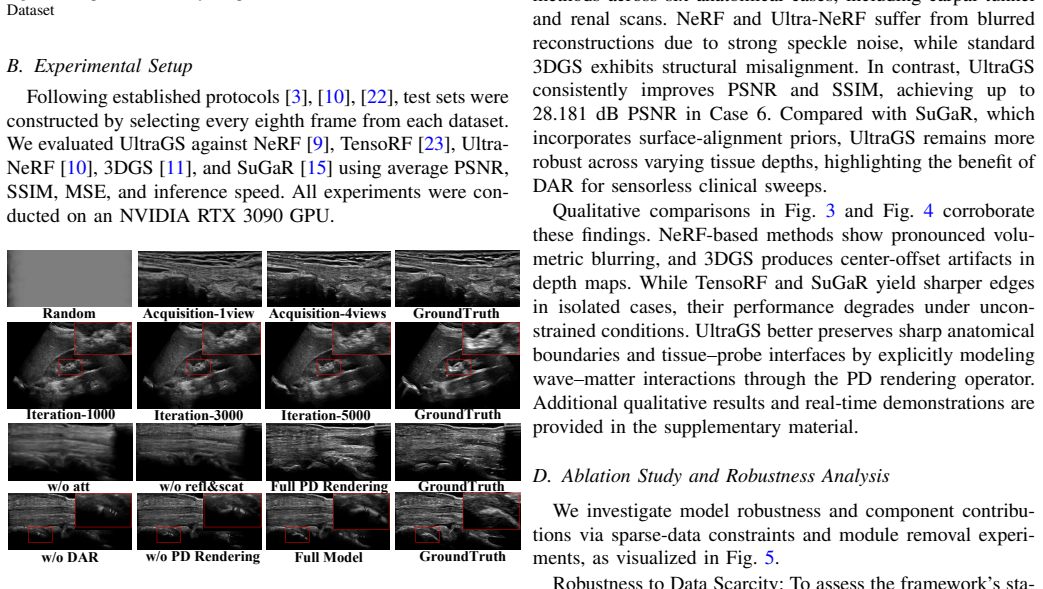
- [Figure 4] Figure captions for qualitative results should explicitly state the probe motion range or trajectory type to allow readers to assess the unconstrained-motion claim.
Simulated Author's Rebuttal
We thank the referee for their constructive comments, which have helped us identify areas to strengthen the manuscript. We address each major comment below and describe the revisions we intend to make.
read point-by-point responses
-
Referee: [§3.2] §3.2 (PD Rendering operator): the claim that low-order spherical harmonics plus first-order wave effects suffice for geometrically consistent novel views under unconstrained probe motion lacks a direct test against higher-order scattering or multiple reflections; if the first-order term is the primary acoustic model, consistency may reduce to trajectory overfitting rather than physical generalization, which is load-bearing for the central consistency claim.
Authors: We appreciate this observation. Our PD Rendering is intentionally designed as an efficient approximation to enable real-time performance, focusing on the dominant low-order effects in ultrasound propagation. While a direct comparison to higher-order models would be valuable, it falls outside the current scope as it would compromise the real-time capability. To address the concern, we will expand §3.2 to include a more detailed justification of the first-order approximation based on acoustic literature and add an experiment demonstrating that removing the first-order term degrades performance on held-out trajectories, supporting that it contributes to generalization rather than pure overfitting. We will also note the limitation regarding multiple reflections as a direction for future work. revision: partial
-
Referee: [§4] §4 (Experiments): the reported SOTA PSNR/SSIM values (up to 29.55/0.89) and real-time fps are presented without visible error bars, cross-validation details on data splits, or full ablation tables isolating the contribution of learnable FoV versus the PD operator; this weakens verification of the performance-efficiency frontier.
Authors: We agree that these details would enhance the transparency and verifiability of our results. In the revised version, we will include error bars (standard deviation over multiple runs or cross-validation folds) for the quantitative metrics, provide explicit information on the train/test splits and any cross-validation procedure used, and present a more comprehensive ablation table that separately evaluates the impact of the learnable field of view and the PD Rendering operator on both accuracy and speed. revision: yes
Circularity Check
No significant circularity detected in derivation chain
full rationale
The paper presents UltraGS as a new framework that adapts Gaussian Splatting to ultrasound via explicitly introduced components: depth-aware Gaussian primitives with learnable fields of view for geometric consistency and the PD Rendering operator that combines low-order spherical harmonics with first-order wave effects for intensity synthesis. These elements are described as novel integrations rather than reductions to prior self-citations or parameters fitted and then relabeled as predictions. Reported results (PSNR up to 29.55, SSIM up to 0.89, 64.69 fps) are tied to evaluations on a new clinical dataset and two others, without equations or claims showing that outputs equal inputs by construction. The derivation chain remains self-contained against external benchmarks and does not rely on load-bearing self-citations or ansatzes smuggled from prior author work.
Axiom & Free-Parameter Ledger
free parameters (1)
- learnable fields of view
axioms (1)
- domain assumption Low-order spherical harmonics combined with first-order wave effects are sufficient to model acoustic intensity for differentiable rendering in ultrasound.
invented entities (1)
-
PD Rendering operator
no independent evidence
Lean theorems connected to this paper
-
IndisputableMonolith/Foundation/AlexanderDuality.leanalexander_duality_circle_linking unclear?
unclearRelation between the paper passage and the cited Recognition theorem.
PD Rendering, a differentiable neural acoustic operator that couples low-order spherical harmonics with first-order wave physics including attenuation, reflection, and scattering
-
IndisputableMonolith/Cost/FunctionalEquation.leanwashburn_uniqueness_aczel unclear?
unclearRelation between the paper passage and the cited Recognition theorem.
depth-aware Gaussian primitives with learnable fields of view
What do these tags mean?
- matches
- The paper's claim is directly supported by a theorem in the formal canon.
- supports
- The theorem supports part of the paper's argument, but the paper may add assumptions or extra steps.
- extends
- The paper goes beyond the formal theorem; the theorem is a base layer rather than the whole result.
- uses
- The paper appears to rely on the theorem as machinery.
- contradicts
- The paper's claim conflicts with a theorem or certificate in the canon.
- unclear
- Pith found a possible connection, but the passage is too broad, indirect, or ambiguous to say the theorem truly supports the claim.
Reference graph
Works this paper leans on
-
[1]
An annotated heterogeneous ultrasound database,
Yuezhe Yang, Yonglin Chen, Xingbo Dong, Junning Zhang, Chihui Long, Zhe Jin, and Yong Dai, “An annotated heterogeneous ultrasound database,”Scientific Data, vol. 12, no. 1, pp. 148, 2025
work page 2025
-
[2]
Trackerless 3d freehand ultrasound reconstruction: A review,
Chrissy A Adriaans, Mark Wijkhuizen, Lennard M van Karnenbeek, Freija Geldof, and Behdad Dashtbozorg, “Trackerless 3d freehand ultrasound reconstruction: A review,”Applied Sciences, vol. 14, no. 17, pp. 7991, 2024
work page 2024
-
[3]
Nerf-us: Removing ultrasound imaging artifacts from neural radiance fields in the wild,
Rishit Dagli, Atsuhiro Hibi, Rahul G Krishnan, and Pascal N Tyrrell, “Nerf-us: Removing ultrasound imaging artifacts from neural radiance fields in the wild,”arXiv preprint arXiv:2408.10258, 2024
-
[4]
Freehand 3-d ultrasound imaging: a systematic review,
Mohammad Hamed Mozaffari and Won-Sook Lee, “Freehand 3-d ultrasound imaging: a systematic review,”Ultrasound in medicine & biology, vol. 43, no. 10, pp. 2099–2124, 2017
work page 2099
-
[5]
Sensorless reconstruction of unconstrained freehand 3d ultra- sound data,
R James Housden, Andrew H Gee, Graham M Treece, and Richard W Prager, “Sensorless reconstruction of unconstrained freehand 3d ultra- sound data,”Ultrasound in medicine & biology, vol. 33, no. 3, pp. 408–419, 2007
work page 2007
-
[6]
Deep motion network for freehand 3d ultrasound reconstruction,
Mingyuan Luo, Xin Yang, Hongzhang Wang, Liwei Du, and Dong Ni, “Deep motion network for freehand 3d ultrasound reconstruction,” in International Conference on Medical Image Computing and Computer- Assisted Intervention. Springer, 2022, pp. 290–299
work page 2022
-
[7]
A freehand 3d ultrasound reconstruction method based on deep learning,
Xin Chen, Houjin Chen, Yahui Peng, Liu Liu, and Chang Huang, “A freehand 3d ultrasound reconstruction method based on deep learning,” Electronics, vol. 12, no. 7, pp. 1527, 2023
work page 2023
-
[8]
Domain adaptation for medical image analysis: a survey,
Hao Guan and Mingxia Liu, “Domain adaptation for medical image analysis: a survey,”IEEE Transactions on Biomedical Engineering, vol. 69, no. 3, pp. 1173–1185, 2021
work page 2021
-
[9]
Nerf: Representing scenes as neural radiance fields for view synthesis,
Ben Mildenhall, Pratul P Srinivasan, Matthew Tancik, Jonathan T Barron, Ravi Ramamoorthi, and Ren Ng, “Nerf: Representing scenes as neural radiance fields for view synthesis,”Communications of the ACM, vol. 65, no. 1, pp. 99–106, 2021
work page 2021
-
[10]
Ultra-nerf: Neural radiance fields for ultrasound imaging,
Magdalena Wysocki, Mohammad Farid Azampour, Christine Eilers, Benjamin Busam, Mehrdad Salehi, and Nassir Navab, “Ultra-nerf: Neural radiance fields for ultrasound imaging,” inMedical Imaging with Deep Learning. PMLR, 2024, pp. 382–401
work page 2024
-
[11]
3d gaussian splatting for real-time radiance field rendering.,
Bernhard Kerbl, Georgios Kopanas, Thomas Leimk ¨uhler, and George Drettakis, “3d gaussian splatting for real-time radiance field rendering.,” ACM Trans. Graph., vol. 42, no. 4, pp. 139–1, 2023
work page 2023
-
[12]
Radiative gaussian splatting for efficient x-ray novel view synthesis,
Yuanhao Cai, Yixun Liang, Jiahao Wang, Angtian Wang, Yulun Zhang, Xiaokang Yang, Zongwei Zhou, and Alan Yuille, “Radiative gaussian splatting for efficient x-ray novel view synthesis,” inEuropean Confer- ence on Computer Vision. Springer, 2024, pp. 283–299
work page 2024
-
[13]
Mip-nerf: A multiscale representation for anti-aliasing neural radiance fields,
Jonathan T Barron, Ben Mildenhall, Matthew Tancik, Peter Hedman, Ri- cardo Martin-Brualla, and Pratul P Srinivasan, “Mip-nerf: A multiscale representation for anti-aliasing neural radiance fields,” inProceedings of the IEEE/CVF international conference on computer vision, 2021, pp. 5855–5864
work page 2021
-
[14]
Zhiqin Chen, Thomas Funkhouser, Peter Hedman, and Andrea Tagliasac- chi, “Mobilenerf: Exploiting the polygon rasterization pipeline for effi- cient neural field rendering on mobile architectures,” inProceedings of the IEEE/CVF Conference on Computer Vision and Pattern Recognition, 2023, pp. 16569–16578
work page 2023
-
[15]
Antoine Gu ´edon and Vincent Lepetit, “Sugar: Surface-aligned gaussian splatting for efficient 3d mesh reconstruction and high-quality mesh rendering,” inProceedings of the IEEE/CVF Conference on Computer Vision and Pattern Recognition, 2024, pp. 5354–5363
work page 2024
-
[16]
Mip-splatting: Alias-free 3d gaussian splatting,
Zehao Yu, Anpei Chen, Binbin Huang, Torsten Sattler, and Andreas Geiger, “Mip-splatting: Alias-free 3d gaussian splatting,” inProceedings of the IEEE/CVF conference on computer vision and pattern recognition, 2024, pp. 19447–19456
work page 2024
-
[17]
Few-shot novel view synthesis using depth aware 3d gaussian splatting,
Raja Kumar and Vanshika Vats, “Few-shot novel view synthesis using depth aware 3d gaussian splatting,” inEuropean Conference on Computer Vision. Springer, 2024, pp. 1–13
work page 2024
-
[18]
Representation Paradigms in AI-based 3D Radiological Image Reconstruction: A Systematic Review
Yuezhe Yang, Boyu Yang, Yaqian Wang, Yang He, Xingbo Dong, and Zhe Jin, “Explicit and implicit representations in ai-based 3d reconstruction for radiology: A systematic literature review,”arXiv preprint arXiv:2504.11349, 2025
work page internal anchor Pith review Pith/arXiv arXiv 2025
-
[19]
Ddgs-ct: Direction-disentangled gaussian splat- ting for realistic volume rendering,
Zhongpai Gao, Benjamin Planche, Meng Zheng, Xiao Chen, Terrence Chen, and Ziyan Wu, “Ddgs-ct: Direction-disentangled gaussian splat- ting for realistic volume rendering,” inThe Thirty-eighth Annual Conference on Neural Information Processing Systems, 2024
work page 2024
-
[20]
Tus-rec2024: A challenge to reconstruct 3d freehand ultrasound without external tracker,
Qi Li, Shaheer U Saeed, Yuliang Huang, Mingyuan Luo, Zhongnuo Yan, Jiongquan Chen, Xin Yang, Dong Ni, Nektarios Winter, Phuc Nguyen, et al., “Tus-rec2024: A challenge to reconstruct 3d freehand ultrasound without external tracker,”arXiv preprint arXiv:2506.21765, 2025
-
[21]
Structure-from- motion revisited,
Johannes Lutz Sch ¨onberger and Jan-Michael Frahm, “Structure-from- motion revisited,” inConference on Computer Vision and Pattern Recognition (CVPR), 2016
work page 2016
-
[22]
Ziwen Guo, Zi Fang, and Zhuang Fu, “Ulre-nerf: 3d ultrasound imaging through neural rendering with ultrasound reflection direction parameterization,”arXiv preprint arXiv:2408.00860, 2024
-
[23]
Ten- sorf: Tensorial radiance fields,
Anpei Chen, Zexiang Xu, Andreas Geiger, Jingyi Yu, and Hao Su, “Ten- sorf: Tensorial radiance fields,” inEuropean conference on computer vision. Springer, 2022, pp. 333–350. APPENDIX A. Justification of the Virtual Pinhole Proxy As discussed in the main paper, ultrasound imaging fun- damentally differs from optical imaging in that it relies on three-dimen...
work page 2022
discussion (0)
Sign in with ORCID, Apple, or X to comment. Anyone can read and Pith papers without signing in.