Exact Floquet dynamics of strongly damped driven quantum systems
Pith reviewed 2026-05-17 23:08 UTC · model grok-4.3
The pith
A periodic matrix product operator representation of the influence functional yields a numerically exact Floquet propagator for non-Markovian dynamics in strongly damped driven quantum systems.
A machine-rendered reading of the paper's core claim, the machinery that carries it, and where it could break.
Core claim
The central claim is that representing the influence functional as a periodic matrix product operator enables construction of a numerically exact Floquet propagator that captures the non-Markovian open-system dynamics, thereby supplying a dissipative counterpart to the Floquet Hamiltonian used for isolated driven systems.
What carries the argument
The periodic matrix product operator representation of the influence functional, which encodes bath memory in a compact, periodically repeating structure that supports exact propagation over many drive cycles.
If this is right
- The method characterizes the asymptotic heating of a reservoir in spin-boson models and quantifies its deviation from equilibrium.
- Local driving applied to two qubits can stabilize a transient entanglement that originates from their shared environment.
- Stationary and transient regimes of strongly damped driven systems become directly accessible inside a single transparent numerical framework.
Where Pith is reading between the lines
- The same periodic representation may extend to other bath spectral densities or non-periodic but slowly varying drives without loss of the exact-propagator property.
- Exact long-time trajectories generated this way could serve as benchmarks for approximate master-equation or perturbative treatments in the strong-damping regime.
- The construction supplies a concrete route to Floquet engineering of steady-state properties in open quantum systems.
Load-bearing premise
The influence functional for strongly damped driven systems admits an efficient and accurate periodic matrix product operator representation that preserves numerical exactness without uncontrolled truncation errors over many periods.
What would settle it
A direct numerical comparison in a solvable spin-boson model that shows accumulating deviation from the known exact dynamics after propagation through many driving periods would falsify the claim of sustained numerical exactness.
Figures


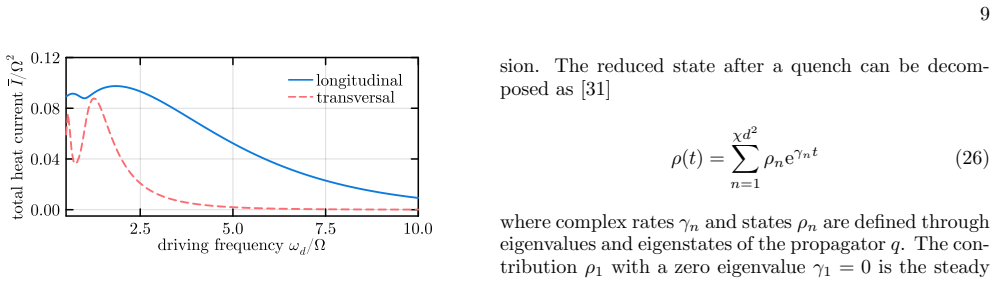

read the original abstract
We present an approach for efficiently simulating strongly damped quantum systems subjected to periodic driving, employing a periodic matrix product operator representation of the influence functional. This representation enables the construction of a numerically exact Floquet propagator that captures the non-Markovian open system dynamics, thus providing a dissipative analogue to the Floquet Hamiltonian of driven isolated quantum systems. We apply this method to study the asymptotic heating of a reservoir in spin-boson models, characterizing the deviation from equilibrium conditions. Moreover, we show how a local driving of two qubits can be utilized to stabilize a transient entanglement buildup of the qubits originating from the interaction with a common environment. Our results make it possible to directly study both stationary and transient dynamics of strongly damped and driven quantum systems within a transparent theoretical and numerical framework.
Editorial analysis
A structured set of objections, weighed in public.
Referee Report
Summary. The manuscript introduces a periodic matrix product operator (MPO) representation of the influence functional for strongly damped, periodically driven quantum systems. This construction is used to build a numerically exact Floquet propagator that captures non-Markovian open-system dynamics, positioned as a dissipative analogue to the Floquet Hamiltonian for closed systems. Applications include analysis of asymptotic reservoir heating in spin-boson models and stabilization of transient entanglement in locally driven two-qubit systems coupled to a common bath.
Significance. If the numerical exactness and error control are established, the approach would offer a transparent and efficient framework for long-time dynamics in driven dissipative systems, enabling direct access to stationary states and transient entanglement without Markovian approximations. It extends influence-functional methods to periodic driving and could support studies in quantum thermodynamics and control.
major comments (2)
- [§3] §3 (Floquet propagator construction): The claim that the periodic MPO yields a numerically exact propagator rests on the assumption that the representation of the influence functional requires no uncontrolled truncation. The manuscript must supply explicit error bounds or a proof that finite-bond-dimension truncation errors remain bounded independently of the number of Floquet periods; without this, iteration of the propagator can accumulate approximation errors, undermining the central 'exact' claim.
- [§4.1] §4.1 (spin-boson heating results): The reported deviation from equilibrium heating is presented as a direct consequence of the exact propagator, yet no convergence tests versus MPO bond dimension or versus exact benchmarks for small bath discretizations are shown. This is load-bearing because any hidden truncation error would directly affect the claimed non-equilibrium characterization.
minor comments (2)
- [§2] Notation for the periodic MPO bond dimension and the discretization of the bath correlation function should be introduced once in §2 and used consistently; current usage mixes symbols across equations.
- [Figures] Figure 2 and Figure 4 captions should explicitly state the bond dimension, time-step discretization, and number of periods used, to allow readers to assess the numerical exactness.
Simulated Author's Rebuttal
We thank the referee for the careful reading of our manuscript and the constructive comments. We are pleased that the referee recognizes the potential of our periodic MPO approach for studying driven dissipative quantum systems. We address each major comment below and describe the revisions we will make to the manuscript.
read point-by-point responses
-
Referee: [§3] §3 (Floquet propagator construction): The claim that the periodic MPO yields a numerically exact propagator rests on the assumption that the representation of the influence functional requires no uncontrolled truncation. The manuscript must supply explicit error bounds or a proof that finite-bond-dimension truncation errors remain bounded independently of the number of Floquet periods; without this, iteration of the propagator can accumulate approximation errors, undermining the central 'exact' claim.
Authors: We agree that clarifying the error control is important for substantiating the 'numerically exact' claim. The construction in the manuscript relies on the fact that for strongly damped systems, the influence functional can be accurately represented by an MPO with modest bond dimension due to the short correlation time of the bath. While we do not provide a rigorous mathematical proof that errors are bounded for all possible parameters independently of the number of periods, our numerical experiments indicate that the results stabilize with increasing bond dimension and do not show accumulation of errors over multiple Floquet periods. In the revised version, we will expand §3 to include a discussion of the truncation error, supported by additional convergence plots demonstrating stability over long times. revision: partial
-
Referee: [§4.1] §4.1 (spin-boson heating results): The reported deviation from equilibrium heating is presented as a direct consequence of the exact propagator, yet no convergence tests versus MPO bond dimension or versus exact benchmarks for small bath discretizations are shown. This is load-bearing because any hidden truncation error would directly affect the claimed non-equilibrium characterization.
Authors: The referee correctly points out the need for explicit convergence tests to support the results in §4.1. Although the original manuscript selects parameters where the MPO representation is expected to be accurate based on prior literature on influence functional methods, we acknowledge that direct evidence was not provided. We will revise this section to include convergence tests with respect to the MPO bond dimension for the asymptotic heating rates. Additionally, for small bath discretizations, we will add comparisons to exact diagonalization or other benchmarks to validate the deviation from equilibrium heating. revision: yes
- A general analytical proof that truncation errors remain bounded independently of the number of Floquet periods for arbitrary finite bond dimensions.
Circularity Check
No circularity: method extends influence-functional formalism with periodic MPO representation
full rationale
The paper introduces a periodic matrix product operator representation of the influence functional to build a Floquet propagator for strongly damped driven systems. This construction is presented as a direct extension of the standard influence-functional approach rather than a self-referential definition or a fitted parameter renamed as a prediction. No quoted equations or steps in the abstract reduce the claimed numerically exact propagator to its own inputs by construction, nor do they rely on load-bearing self-citations or imported uniqueness theorems. The central claim rests on the independent assumption that the influence functional admits an efficient periodic MPO representation that preserves exactness, which is an external methodological choice verifiable against tensor-network benchmarks and not equivalent to the result by definition.
Axiom & Free-Parameter Ledger
axioms (1)
- domain assumption The system-bath interaction is captured by a standard influence functional that can be represented as a matrix product operator.
Lean theorems connected to this paper
-
IndisputableMonolith/Foundation/Breath1024.leanperiod8, flipAt512 echoes?
echoesECHOES: this paper passage has the same mathematical shape or conceptual pattern as the Recognition theorem, but is not a direct formal dependency.
periodic matrix product operator representation of the influence functional... stroboscopic Floquet propagator Q_F = Q_M · · · Q_1
-
IndisputableMonolith/Cost/FunctionalEquation.leanwashburn_uniqueness_aczel unclear?
unclearRelation between the paper passage and the cited Recognition theorem.
uniTEMPO algorithm that we will utilize here can generate a uniform MPO representation
What do these tags mean?
- matches
- The paper's claim is directly supported by a theorem in the formal canon.
- supports
- The theorem supports part of the paper's argument, but the paper may add assumptions or extra steps.
- extends
- The paper goes beyond the formal theorem; the theorem is a base layer rather than the whole result.
- uses
- The paper appears to rely on the theorem as machinery.
- contradicts
- The paper's claim conflicts with a theorem or certificate in the canon.
- unclear
- Pith found a possible connection, but the passage is too broad, indirect, or ambiguous to say the theorem truly supports the claim.
Reference graph
Works this paper leans on
-
[1]
or process tensor [35, 36], in terms of a large tensor [34, 37, 38] I (µN µ′ N )...(µ1µ′
-
[2]
Exact Floquet dynamics of strongly damped driven quantum systems
= trU µN µ′ N N · · · Uµ2µ′ 2 2 U µ1µ′ 1 1 ρenv.(2) The Greek indicesµ= 1. . .dim(H sys)2 label the Liouville-space (density matrix space) of the system, and can be contracted with the operatorsO n to recover the corresponding local observable. Note that, in the influ- ence functional, the environment degrees of freedom are completely traced out and are n...
work page internal anchor Pith review Pith/arXiv arXiv 2025
-
[3]
are square matrices that are independent ofNand act on a auxiliary (bond) space, replacing the original full environment state space. The boundary vectors⃗ vl/r also live in the auxiliary space and resem- ble the initial state and trace of the environment. For Gaussian bosonic baths, this form can be obtained us- ing either tailored Markovian embedding me...
-
[4]
where the RC modea 0 is coupled linearly to a modified residual environment. This allows us to include reaction coordi- nate into the system, while treating the residual bath as a new stationary environment for which a semi-group IF can be constructed. The reaction coordinate can then be included back into the bath IF [38], recovering a pe- riodic Floquet...
-
[5]
T. N. Ikeda and A. Polkovnikov, Fermi’s golden rule for heating in strongly driven Floquet systems, Phys. Rev. B104, 134308 (2021)
work page 2021
-
[6]
Eckardt, Colloquium: Atomic quantum gases in pe- riodically driven optical lattices, Rev
A. Eckardt, Colloquium: Atomic quantum gases in pe- riodically driven optical lattices, Rev. Mod. Phys.89, 011004 (2017)
work page 2017
-
[7]
M. Reitter, J. N¨ ager, K. Wintersperger, C. Str¨ ater, I. Bloch, A. Eckardt, and U. Schneider, Interaction De- pendent Heating and Atom Loss in a Periodically Driven Optical Lattice, Phys. Rev. Lett.119, 200402 (2017)
work page 2017
-
[8]
Y. Chen, Z. Zhu, and K. Viebahn, Mitigating higher- band heating in Floquet-Hubbard lattices via two-tone driving, Phys. Rev. A112, L021301 (2025)
work page 2025
- [9]
-
[10]
S. A. Sato, U. De Giovannini, S. Aeschlimann, I. Gierz, H. H¨ ubener, and A. Rubio, Floquet states in dissipative open quantum systems, J. Phys. B: At. Mol. Opt. Phys. 53, 225601 (2020)
work page 2020
-
[11]
F. Petiziol and A. Eckardt, Cavity-Based Reservoir En- gineering for Floquet-Engineered Superconducting Cir- cuits, Physical Review Letters129, 233601 (2022)
work page 2022
-
[12]
Mori, Floquet States in Open Quantum Systems, Annu
T. Mori, Floquet States in Open Quantum Systems, Annu. Rev. Condens. Matter Phys. , 35 (2023)
work page 2023
- [13]
- [14]
-
[15]
I. de Vega and D. Alonso, Dynamics of non-Markovian open quantum systems, Rev. Mod. Phys.89, 015001 (2017)
work page 2017
-
[16]
R. Hartmann and W. T. Strunz, Accuracy assessment of perturbative master equations: Embracing nonpositivity, Phys. Rev. A101, 012103 (2020)
work page 2020
-
[17]
C. S. Tello Breuer, T. Becker, and A. Eckardt, Bench- marking quantum master equations beyond ultraweak coupling, Phys. Rev. B110, 064319 (2024)
work page 2024
-
[18]
B. Gul´ acsi and G. Burkard, Temporally correlated quan- tum noise in driven quantum systems with applications to quantum gate operations, Phys. Rev. Res.7, 023073 (2025)
work page 2025
- [19]
-
[20]
M. Marthaler and M. I. Dykman, Switching via quantum activation: A parametrically modulated oscillator, Phys. Rev. A73, 042108 (2006)
work page 2006
-
[21]
R. Ketzmerick and W. Wustmann, Statistical mechanics of Floquet systems with regular and chaotic states, Phys. Rev. E82, 021114 (2010)
work page 2010
-
[22]
A. Lazarides, S. Roy, F. Piazza, and R. Moessner, Time crystallinity in dissipative Floquet systems, Phys. Rev. 6 Res.2, 022002 (2020)
work page 2020
-
[23]
J. Gunderson, J. Muldoon, K. W. Murch, and Y. N. Joglekar, Floquet exceptional contours in Lindblad dy- namics with time-periodic drive and dissipation, Phys. Rev. A103, 023718 (2021)
work page 2021
-
[24]
H. Z. Shen, Q. Wang, and X. X. Yi, Dispersive readout with non-Markovian environments, Phys. Rev. A105, 023707 (2022)
work page 2022
-
[25]
D. K. J. Boneß, W. Belzig, and M. I. Dykman, Resonant- force-induced symmetry breaking in a quantum paramet- ric oscillator, Phys. Rev. Res.6, 033240 (2024)
work page 2024
-
[26]
S. Direkci, K. Winkler, C. Gut, M. Aspelmeyer, and Y. Chen, Universality of stationary entanglement in an optomechanical system driven by non-Markovian noise and squeezed light, arXiv 10.48550/arXiv.2502.02979 (2025), 2502.02979
-
[27]
S. Koyanagi and Y. Tanimura, Numerically “exact” sim- ulations of a quantum Carnot cycle: Analysis using ther- modynamic work diagrams, J. Chem. Phys.157, 084110 (2022)
work page 2022
-
[28]
V. Boettcher, R. Hartmann, K. Beyer, and W. T. Strunz, Dynamics of a strongly coupled quantum heat engine—Computing bath observables from the hierarchy of pure states, J. Chem. Phys.160, 10.1063/5.0192075 (2024)
-
[29]
D. Kolisnyk, F. Queißer, G. Schaller, and R. Sch¨ utzhold, Floquet analysis of a superradiant many-qutrit refriger- ator, Phys. Rev. Appl.21, 044050 (2024)
work page 2024
- [30]
-
[31]
J. V. Koski, A. J. Landig, A. P´ alyi, P. Scarlino, C. Re- ichl, W. Wegscheider, G. Burkard, A. Wallraff, K. En- sslin, and T. Ihn, Floquet Spectroscopy of a Strongly Driven Quantum Dot Charge Qubit with a Microwave Resonator, Phys. Rev. Lett.121, 043603 (2018)
work page 2018
-
[32]
F.-E. von Horstig, L. Peri, S. Barraud, S. N. Shevchenko, C. J. B. Ford, and M. F. Gonzalez-Zalba, Floquet in- terferometry of a dressed semiconductor quantum dot, arXiv 10.48550/arXiv.2407.14241 (2024), 2407.14241
-
[33]
N. E. Frattini, R. G. Corti˜ nas, J. Venkatraman, X. Xiao, Q. Su, C. U. Lei, B. J. Chapman, V. R. Joshi, S. M. Girvin, R. J. Schoelkopf, S. Puri, and M. H. Devoret, Ob- servation of pairwise level degeneracies and the quantum regime of the arrhenius law in a double-well parametric oscillator, Phys. Rev. X14, 031040 (2024)
work page 2024
-
[34]
O. V. Ivakhnenko, C. D. Satrya, Y.-C. Chang, R. Upad- hyay, J. T. Peltonen, S. N. Shevchenko, F. Nori, and J. P. Pekola, Probing strongly driven and strongly coupled superconducting qubit-resonator system, arXiv 10.48550/arXiv.2508.03188 (2025), 2508.03188
-
[35]
V. Link, H.-H. Tu, and W. T. Strunz, Open Quan- tum System Dynamics from Infinite Tensor Network Contraction, arXiv 10.48550/arXiv.2307.01802 (2023), 2307.01802
-
[36]
M. Sonner, V. Link, and D. A. Abanin, Semi-group influence matrices for non-equilibrium quantum impu- rity models, arXiv 10.48550/arXiv.2502.00109 (2025), 2502.00109
-
[37]
R. P. Feynman and F. L. Vernon, The theory of a gen- eral quantum system interacting with a linear dissipative system, Ann. Phys.24, 118 (1963)
work page 1963
- [38]
-
[39]
M. R. Jørgensen and F. A. Pollock, Exploiting the Causal Tensor Network Structure of Quantum Processes to Ef- ficiently Simulate Non-Markovian Path Integrals, Phys. Rev. Lett.123, 240602 (2019)
work page 2019
-
[40]
Verifying Quantum Memory in the Dynamics of Spin Boson Models
C. B¨ acker, V. Link, and W. T. Strunz, Verifying Quan- tum Memory in the Dynamics of Spin Boson Models (2025), arXiv:2505.13067 [quant-ph]
work page internal anchor Pith review Pith/arXiv arXiv 2025
-
[41]
F. A. Pollock, C. Rodr´ ıguez-Rosario, T. Frauenheim, M. Paternostro, and K. Modi, Non-Markovian quantum processes: Complete framework and efficient characteri- zation, Phys. Rev. A97, 012127 (2018)
work page 2018
-
[42]
M. Cygorek, M. Cosacchi, A. Vagov, V. M. Axt, B. W. Lovett, J. Keeling, and E. M. Gauger, Simulation of open quantum systems by automated compression of arbitrary environments, Nat. Phys.18, 662 (2022)
work page 2022
- [43]
- [44]
-
[45]
I. Vilkoviskiy, M. Sonner, Q. C. Huang, W. W. Ho, A. Lerose, and D. A. Abanin, Temporal entanglement transition in chaotic quantum many-body dynamics (2025), arXiv:2511.03846 [quant-ph]
-
[46]
Y. Tanimura, Numerically “exact” approach to open quantum dynamics: The hierarchical equations of mo- tion (HEOM), J. Chem. Phys.153, 020901 (2020)
work page 2020
-
[47]
F. Mascherpa, A. Smirne, A. D. Somoza, P. Fern´ andez- Acebal, S. Donadi, D. Tamascelli, S. F. Huelga, and M. B. Plenio, Optimized auxiliary oscillators for the simulation of general open quantum systems, Phys. Rev. A101, 052108 (2020)
work page 2020
-
[48]
Z. Huang, G. Park, G. K.-L. Chan, and L. Lin, Coupled Lindblad pseudomode theory for simulating open quan- tum systems, arXiv 10.48550/arXiv.2506.10308 (2025), 2506.10308
-
[49]
I. Vilkoviskiy and D. A. Abanin, Bound on approximat- ing non-Markovian dynamics by tensor networks in the time domain, Phys. Rev. B109, 205126 (2024)
work page 2024
-
[50]
J. Thoenniss, I. Vilkoviskiy, and D. A. Abanin, Efficient Pseudomode Representation and Complexity of Quan- tum Impurity Models, arXiv 10.48550/arXiv.2409.08816 (2024), 2409.08816
-
[51]
M. C. Ba˜ nuls, M. B. Hastings, F. Verstraete, and J. I. Cirac, Matrix Product States for Dynamical Simulation of Infinite Chains, Phys. Rev. Lett.102, 240603 (2009)
work page 2009
-
[52]
A. Strathearn, P. Kirton, D. Kilda, J. Keeling, and B. W. Lovett, Efficient non-Markovian quantum dynamics us- ing time-evolving matrix product operators, Nat. Com- mun.9, 3322 (2018)
work page 2018
- [53]
-
[54]
D. Gribben, D. M. Rouse, J. Iles-Smith, A. Strathearn, H. Maguire, P. Kirton, A. Nazir, E. M. Gauger, and B. W. Lovett, Exact dynamics of nonadditive environ- ments in non-markovian open quantum systems, PRX Quantum3, 010321 (2022)
work page 2022
-
[55]
J. Thoenniss, A. Lerose, and D. A. Abanin, Nonequi- librium quantum impurity problems via matrix-product 7 states in the temporal domain, Phys. Rev. B107, 195101 (2023)
work page 2023
-
[56]
R. Chen, X. Xu, and C. Guo, Grassmann time-evolving matrix product operators for quantum impurity models, Phys. Rev. B109, 045140 (2024)
work page 2024
-
[57]
M. Fr´ ıas-P´ erez, L. Tagliacozzo, and M. C. Ba˜ nuls, Con- verting Long-Range Entanglement into Mixture: Tensor- Network Approach to Local Equilibration, Phys. Rev. Lett.132, 100402 (2024)
work page 2024
-
[58]
M. Cygorek and E. M. Gauger, Understanding and utilizing the inner bonds of process tensors, arXiv 10.48550/arXiv.2404.01287 (2024), 2404.01287
-
[59]
M. Cygorek and E. M. Gauger, ACE: A general- purpose non-Markovian open quantum systems sim- ulation toolkit based on process tensors, arXiv 10.48550/arXiv.2405.19319 (2024), 2405.19319
-
[60]
A. Schnell, A. Eckardt, and S. Denisov, Is there a floquet lindbladian?, Phys. Rev. B101, 100301 (2020)
work page 2020
-
[61]
H. Chen, Y.-M. Hu, W. Zhang, M. A. Kurniawan, Y. Shao, X. Chen, A. Prem, and X. Dai, Periodically driven open quantum systems: Spectral properties and nonequilibrium steady states, Phys. Rev. B109, 184309 (2024)
work page 2024
- [62]
- [63]
-
[64]
A. Dey, D. Lonigro, K. Yuasa, and D. Burgarth, Error bounds for the Floquet-Magnus expansion and their ap- plication to the semiclassical quantum Rabi model, arXiv 10.48550/arXiv.2504.20533 (2025), 2504.20533
-
[65]
K. Lendi, Extension of quantum dynamical semigroup generators for open systems to time-dependent hamilto- nians, Phys. Rev. A33, 3358 (1986)
work page 1986
-
[66]
H.-P. Breuer, E.-M. Laine, and J. Piilo, Measure for the degree of non-markovian behavior of quantum processes in open systems, Phys. Rev. Lett.103, 210401 (2009)
work page 2009
-
[67]
A. Kato and Y. Tanimura, Quantum heat current under non-perturbative and non-Markovian conditions: Appli- cations to heat machines, J. Chem. Phys.145, 224105 (2016)
work page 2016
-
[68]
D. Gribben, A. Strathearn, G. E. Fux, P. Kirton, and B. W. Lovett, Using the Environment to Understand non-Markovian Open Quantum Systems, Quantum6, 847 (2022), 2106.04212v2
-
[69]
F. Albarelli, B. Vacchini, and A. Smirne, Pseudomode treatment of strong-coupling quantum thermodynamics, Quantum Sci. Technol.10, 015041 (2024)
work page 2024
-
[70]
S. Koyanagi and Y. Tanimura, Classical and quantum thermodynamics described as a system–bath model: The dimensionless minimum work principle, J. Chem. Phys. 160, 234112 (2024)
work page 2024
-
[71]
J. Keeling, E. M. Stoudenmire, M.-C. Ba˜ nuls, and D. R. Reichman, Process Tensor Approaches to Non-Markovian Quantum Dynamics, arXiv 10.48550/arXiv.2509.07661 (2025), 2509.07661
-
[72]
D. F. Walls and G. J. Milburn,Quantum Optics (Springer Berlin Heidelberg, 2008)
work page 2008
-
[73]
R. Hartmann and W. T. Strunz, Environmentally In- duced Entanglement – Anomalous Behavior in the Adi- abatic Regime, Quantum4, 347 (2020), 2006.04412v2
-
[74]
M. W. S.R.J. Patrick, Fu-li Li and Y. Yang, Controlling entanglement dynamics of two qubits coupled to a common reservoir via a coherent field, Journal of Modern Optics57, 295 (2010), https://doi.org/10.1080/09500340903548887
-
[75]
M. E. Kimchi-Schwartz, L. Martin, E. Flurin, C. Aron, M. Kulkarni, H. E. Tureci, and I. Siddiqi, Stabilizing en- tanglement via symmetry-selective bath engineering in superconducting qubits, Phys. Rev. Lett.116, 240503 (2016)
work page 2016
-
[76]
H. T. Quan, Y.-x. Liu, C. P. Sun, and F. Nori, Quantum thermodynamic cycles and quantum heat engines, Phys. Rev. E76, 031105 (2007)
work page 2007
-
[77]
R. Kosloff and Y. Rezek, The quantum harmonic otto cycle, Entropy19, 10.3390/e19040136 (2017)
- [78]
-
[79]
K. H. Hughes, C. D. Christ, and I. Burghardt, Effective- mode representation of non-Markovian dynamics: A hi- erarchical approximation of the spectral density. I. Ap- plication to single surface dynamics, J. Chem. Phys.131, 024109 (2009)
work page 2009
-
[80]
A. W. Chin, ´A. Rivas, S. F. Huelga, and M. B. Plenio, Ex- act mapping between system-reservoir quantum models and semi-infinite discrete chains using orthogonal poly- nomials, J. Math. Phys.51, 092109 (2010)
work page 2010
discussion (0)
Sign in with ORCID, Apple, or X to comment. Anyone can read and Pith papers without signing in.