REVIEW 5 major objections 6 minor 8 references
Vision-language models can describe crochet products but almost never generate a pattern that compiles and matches the photo; neither scale nor finetuning fixes the gap.
Reviewed by Pith at T0; open to challenge. T0 means a machine referee read the full paper against a public rubric. the ladder, T0–T4 →
T0 review · deepseek-v4-flash
2026-08-03 22:36 UTC pith:S4WMJOGK
load-bearing objection A genuinely new executable benchmark for VLM procedural competence in a craft domain, with a credible negative result that is partly confounded by one-shot DSL unfamiliarity. the 5 major comments →
CrochetBench: Can Vision-Language Models Move from Describing to Doing in Crochet Domain?
The pith
A machine-rendered reading of the paper's core claim, the machinery that carries it, and where it could break.
Core claim
The central claim is that current vision-language models cannot yet synthesize executable procedures in a structured craft domain, even when they can describe what they see. Concretely, CrochetBench shows a monotone decline across its four tasks: stitch recognition reaches about 60% F1, instruction selection about 55-68% accuracy, instruction generation BLEU under 5%, and project-level DSL translation yields valid, compilable programs in only 5-8% of cases for the strongest models. The paper interprets this as a failure of long-range symbolic reasoning—tracking stitch counts, repeats, and state across dozens of steps—and of 3D-aware procedural synthesis, because the global geometry of a 3D o
What carries the argument
The load-bearing machinery is CrochetPARADE, a domain-specific language that turns crochet instructions into a compilable stitch graph with explicit loops, labels, and state. By requiring models to emit programs in this grammar, CrochetBench makes procedural correctness an automatic, binary property (Valid Pattern Rate) rather than a matter of text overlap; the renderer then visualizes the program and a DINO encoder compares the rendered image to the target photograph. This execution-based evaluation is the mechanism that separates 'describing' from 'doing': fluent text cannot pass it. The four-task ladder (recognize, select, generate, formalize) is designed to localize exactly where procedu
Load-bearing premise
The paper's central conclusion—that VLMs lack long-range symbolic reasoning—rests on the assumption that low CrochetPARADE compile rates measure reasoning ability rather than the models' unfamiliarity with a niche DSL presented only through one-shot examples; with more DSL exposure, the project-level 5-8% validity could change substantially while reasoning ability stays fixed.
What would settle it
Run any of the nine models on the same 100 project-level task items with a prompt that includes a short CrochetPARADE grammar reference plus 10-20 worked NL-to-DSL translation examples. If Valid Pattern Rate rises to roughly 25% or higher on the original items, the paper's attribution of the collapse to long-range symbolic reasoning is falsified, because the reasoning task is unchanged and only DSL familiarity has been increased.
If this is right
- If the finding holds, current VLMs cannot be trusted to generate executable instructions from images in any stateful craft or assembly domain, which has direct consequences for robotics and CAD-style generation.
- Scaling model size alone will not produce procedural reasoning; the paper shows larger models often achieve lower valid pattern rates and invent more undefined stitch types.
- Text-overlap metrics (BLEU, ROUGE, ChrF) are inadequate for procedural generation; executable validation is necessary to detect structural failure.
- Finetuning on human instructions improves surface fluency (format, vocabulary, conventions) but not the underlying stitch-count, repeat, and geometry reasoning.
- CrochetBench provides a reusable, automated testbed: any future VLM can be scored on the same four tasks, and a model that attains high valid pattern rate and high DINO similarity would be evidence of genuine procedural competence.
Where Pith is reading between the lines
- The collapse may not be specific to crochet: any domain with a formal, stateful grammar and a visual target—knitting, weaving, assembly, CAD—could exhibit the same description-to-execution gap, making CrochetBench a useful early-warning testbed for those domains.
- A plausible confounder is the DSL's novelty: CrochetPARADE is introduced to models only through one-shot prompts, so the low compile rates may partly reflect grammar unfamiliarity rather than pure reasoning limits; providing a grammar reference or additional in-context examples could raise valid pattern rates even without new reasoning ability.
- The DINO similarity comparison mixes rendered meshes with photographs, leaving an uncalibrated domain gap; an alternative evaluation would render both the DSL output and a DSL-transcribed version of the ground-truth pattern, or use human raters, to separate rendering artifacts from procedural error.
- The paper's observation that larger models invent more undefined stitches points toward constrained decoding or grammar-constrained sampling as a cheap intervention that could improve compile rates independently of the models' underlying reasoning.
Editorial analysis
A structured set of objections, weighed in public.
Referee Report
Summary. The paper presents CrochetBench, a benchmark of 6,085 crochet patterns from Yarnspirations, converted to structured JSON via GPT-4o-mini. It proposes four tasks—stitch recognition, instruction selection, instruction generation, and NL-to-DSL translation—and evaluates nine vision-language models plus a finetuned Qwen2-VL. Using the CrochetPARADE DSL and its validator, it reports a sharp drop from moderate recognition/selection scores to very low text-generation and executable-program metrics, and concludes that current models fail at long-range symbolic reasoning and 3D-aware procedural synthesis.
Significance. CrochetBench is a well-motivated and potentially useful resource: executable validation for procedural text is rare, and the paper publicly releases data/code and uses an external executor rather than text similarity alone. The diagnostic error taxonomy and the qualitative case study are valuable. However, the headline negative result is currently over-interpreted because the Task D protocol cannot separate procedural-reasoning failure from one-shot DSL induction, and several auxiliary metrics (DINO threshold, Task C references, finetuning claims) are not calibrated for the claims they support.
major comments (5)
- [§3.4, Figs. 3–5; Appendix C.4–C.5] The central claim that low Task D compile rates 'reveal limitations in long-range symbolic reasoning and 3D-aware procedural synthesis' is confounded by DSL exposure. CrochetPARADE is a recent DSL almost certainly absent from model training; the project-level prompt contains only one in-context example and the step-level prompt provides a few prefix examples. The step-level pattern in Fig. 3—valid rate rising from <15% at prefix 1–2 to 55–65% at prefix 1–6—is exactly what would be expected from grammar induction from the provided examples. Without a human baseline or an ablation varying the number of DSL demonstrations, the 5–8% project-level validity cannot be uniquely attributed to procedural reasoning. This is fixable by adding a DSL-exposure control or by reframing the conclusion as 'models cannot induce CrochetPARADE from one example.'
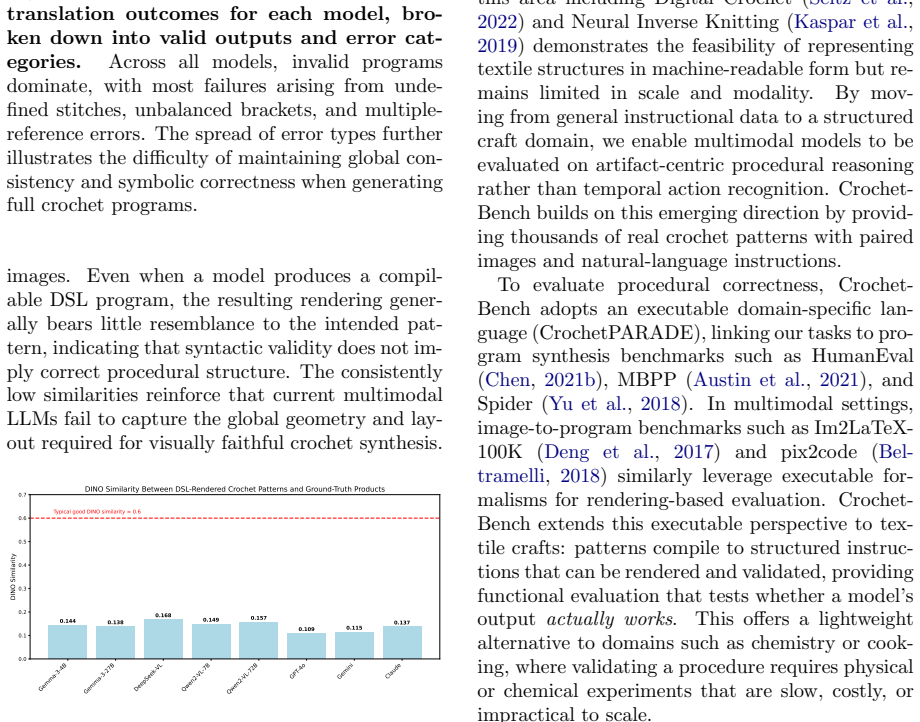
- [§3.4, Fig. 5] DINO similarity between rendered DSL output and the ground-truth photograph is used to conclude that even compilable programs lack global structural fidelity. No calibration is reported for the render-to-photo domain gap, and the 'typical good DINO similarity ≥0.6' threshold is asserted without evidence. DINO embeddings are sensitive to texture/material/lighting, so low scores could reflect domain shift rather than geometric mismatch. The authors should report DINO similarity between the ground-truth DSL rendered through the same pipeline and the ground-truth photograph, or otherwise calibrate the threshold.
- [§3.3, Table 2] Task C evaluates free-form instruction generation with BLEU, ROUGE-L, and ChrF against a single fixed reference. Crochet instructions admit many lexically distinct but procedurally equivalent phrasings, so low text-overlap scores are not direct evidence of procedural failure. This weakens the paper's cross-task 'sharp decrease' narrative between Tasks A/B and C. I recommend adding multiple references, human structural evaluation, or at least an n-gram-free semantic/executable metric before drawing conclusions from the Task C numbers.
- [§4, Table 2 (finetuned row)] The text claims that supervised finetuning 'improves fluency but not procedural correctness,' but the finetuned model is evaluated only on Task C metrics. No Task D compile/execution results are reported for the finetuned model, so the claim about executable correctness is unsupported. Please either evaluate the finetuned model on Task D or explicitly state that executable correctness was not tested.
- [Figure 2 and Appendix F] The case study shows DSL renderings derived from models' natural-language instructions, but the protocol for converting NL instructions into CrochetPARADE is not described. If an automatic NL-to-DSL converter was used, rendering failures could be artifacts of that converter rather than of the models' instructions. The authors should specify the conversion method, and ideally release the converter, so the qualitative evidence is auditable.
minor comments (6)
- [Abstract and GitHub link] The abstract contains the URL 'https://anonymous.4open.science/r/crochet-82E6/README.md' while the final section gives 'https://github.com/Peiyu-Georgia-Li/crochetBench'. Please unify.
- [References] References [Chen 2021a] and [Chen 2021b] are identical; merge into one entry.
- [§B.3.1] The text says three additional rare skill labels were observed, but Table 5 lists only four main categories. Clarify whether these rare labels are included in the counts or excluded.
- [Appendix C.5] The example DSL contains '¶' separators and the user instruction includes '6 sc in ring' after 'Ch 2'. Verify that this is a valid CrochetPARADE example and that the '¶' formatting is intentional rather than a rendering artifact.
- [§3.1] Task A labels are derived from instruction text rather than independent visual annotation. A sentence acknowledging this as a possible label-noise source would help readers interpret the recognition results.
- [Table 2] The finetuned Qwen2-VL row is hard to read because it reports only deltas. Present the baseline and finetuned values side by side.
Circularity Check
No significant circularity: the central negative result is a contingent measurement against an external validator and human-authored gold, not a fit or self-citation chain.
full rationale
CrochetBench's central claim is an empirical negative result about nine VLMs. The load-bearing evidence is Task D, where validity is determined by the external CrochetPARADE validator (cited to Tassev 2025, not an author of this paper), and project-level fidelity is measured by DINO similarity between rendered output and ground-truth images. The gold instructions are human-authored pattern PDFs, and the Task D prefixes are expert-annotated DSL programs (Figure 1). No parameter is fitted to test outputs, no metric is defined in terms of a model's own predictions in a way that forces the reported 5-8% project-level validity, and no load-bearing argument rests on a self-citation. The dataset was parsed into JSON by GPT-4o-mini, but that is a data-construction choice, not a circular reduction: Task A labels are derived from instruction text, Tasks C/D gold is human text, and parser noise would affect all models rather than force the conclusion. The skeptic's concern that low Task D rates may reflect one-shot DSL unfamiliarity is a validity and interpretation threat, not circularity, because the result is contingent on the external executor and could change with more demonstrations; the paper's own Limitations section acknowledges DSL-specific penalties and imperfect proxies. No quoted equation or fitted parameter reduces to its own input by construction, so under the strict criteria of this pass there is no circular step.
Axiom & Free-Parameter Ledger
free parameters (4)
- DINO 'good similarity' threshold =
~0.6 (red line, Figure 5)
- GPT-4o-mini parsing configuration =
not reported
- Task B distractor sampling rule =
3 distractors per item, same project category
- Task D-step prefix bins =
steps 1-2 / 1-4 / 1-6 (52/34/33 items)
axioms (6)
- domain assumption CrochetPARADE grammar and validator faithfully and sufficiently capture structural correctness of real crochet practice
- domain assumption Source patterns and paired images are mutually consistent and correct
- domain assumption GPT-4o-mini parsing preserves the original instructions without systematic error
- domain assumption Stitches named in the instruction text are visually present and detectable in the product photo for Task A
- domain assumption DINO similarity is a monotone proxy for procedural fidelity across the render/photo domain shift
- standard math Standard definitions of BLEU, ROUGE-L, ChrF, and F1
read the original abstract
While multimodal large language models can describe visual content, their ability to generate executable procedures remains underexplored. CrochetBench presented in this paper evaluates this shift from describing to doing through fine-grained procedural reasoning in crochet: models must recognize stitches, select structurally appropriate instructions, and generate compilable procedures. We adopt the CrochetPARADE DSL as our intermediate representation, enabling structural validation and functional evaluation via execution. The benchmark covers tasks including stitch classification, instruction grounding, and both natural language and image-to-DSL translation. Across all tasks, performance sharply decreases as the evaluation shifts from surface-level similarity to executable correctness, revealing limitations in long-range symbolic reasoning and 3D-aware procedural synthesis. Our proposed CrochetBench offers a new lens for assessing procedural competence in multimodal models and highlights the gap between surface-level understanding and executable precision in real-world creative domains. Code is available at https://github.com/Peiyu-Georgia-Li/crochetBench.
Figures




Reference graph
Works this paper leans on
-
[1]
Make sure your output ONLY contains the DSL code, nothing else
-
[2]
Use the previous examples to understand the pattern of translation
-
[3]
Be consistent in naming conventions with the examples
-
[4]
calculate
Your output should be exactly one line of DSL code. USER PROMPT Now translate the NL into DSL: NL: DSL: C.5 T ask D (Project-Level): NL→DSL T ranslation Prompt This task evaluates whether a model can convert natural language crochet instructions (with op- tional images) into compilable CrochetPARADE DSL code. NL→DSL Translation Prompt (Rendered Example) S...
2025
-
[7]
Stripe Pat: With A, work 4 rnds
Ch 2 at beg of rnd does not count as hdc. Stripe Pat: With A, work 4 rnds. With B, work 4 rnds. These 8 rnds form Stripe Pat. Ch 4. Join with sl st to first ch to form ring. See diagram on page 3. 1st rnd:Ch 3. 13 dc in ring. Join with sl st to top of ch 3. 14 dc. 2nd rnd:Ch 3. 1 dc in same sp as last sl st. 2 dc in each dc around. Join with sl st to top of ch
-
[8]
3rd rnd:Ch 3
28 dc. 3rd rnd:Ch 3. 4 dc in same sp as last sl st. *Dc3tog. 5 dc in next dc.* Rep from * to last 3 sts. Dc3tog. Join with sl st to top of ch 3. 4th rnd:Sl st in next dc. Ch 2. 3 hdc in same dc as sl st. *Bobble in next st. 3 hdc in next dc. Hdc3tog.* 3 hdc in next dc. Rep from * around, ending last rep at **. Join with sl st to first hdc. 5th rnd:Sl st i...
1967
-
[2018]
InProceedings of the AAAI conference on artificial intelligence, volume 32
Towards automatic learning of procedures from web instructional videos. InProceedings of the AAAI conference on artificial intelligence, volume 32. 10 A Crochet Primer Crochet patterns describe how to construct a tex- tile artifact through a sequence of symbolic stitch instructions. Each instruction specifies an opera- tion performed with a hook and yarn,...
1967
-
[2024]
Gemma: Open models based on gem- ini research and technology.arXiv preprint arXiv:2403.08295. Peng Wang, Shuai Bai, Sinan Tan, Shijie Wang, Zhihao Fan, Jinze Bai, Keqin Chen, Xuejing Liu, Jialin Wang, Wenbin Ge, and 1 others. 2024. Qwen2-vl: Enhancing vision-language model’s perception of the world at any resolution.arXiv preprint arXiv:2409.12191. Tao Yu...
Pith/arXiv arXiv 2024
discussion (0)
Sign in with ORCID, Apple, or X to comment. Anyone can read and Pith papers without signing in.