The Role of Deep Mesoscale Eddies in Ensemble Forecast Performance
Pith reviewed 2026-05-17 21:52 UTC · model grok-4.3
The pith
Deep ocean eddies in the initial conditions shape the accuracy of surface forecasts for the Loop Current.
A machine-rendered reading of the paper's core claim, the machinery that carries it, and where it could break.
Core claim
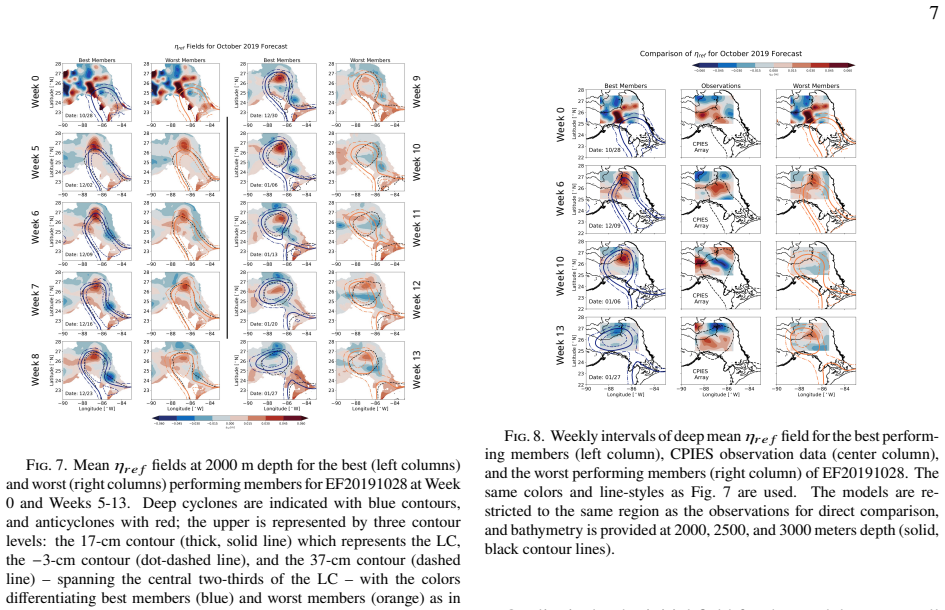
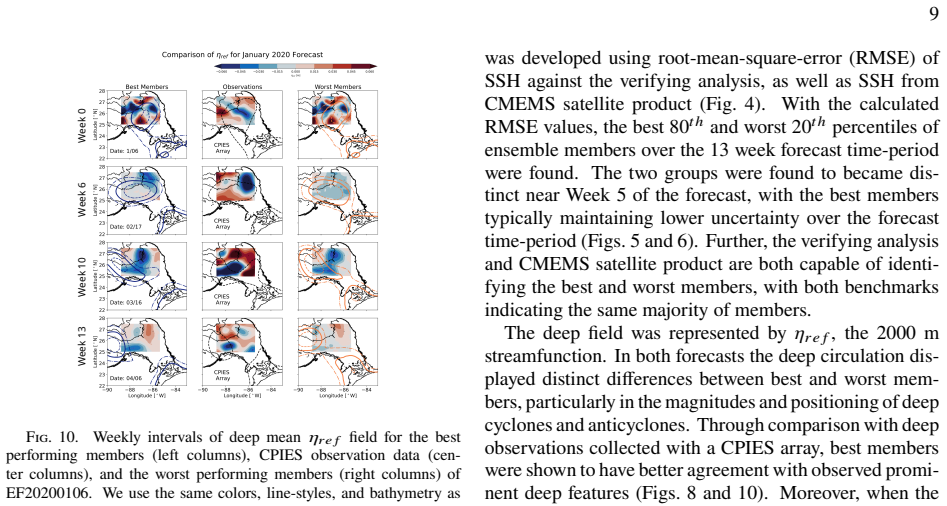
A review of ensemble forecasts in the Gulf of Mexico shows that the initial deep ocean features determine the evolution of the surface field. Best and worst members differ in the positions of deep cyclonic and anticyclonic eddies at relevant times, even when surface performance is assessed against verifying data. The paper concludes that initial conditions throughout the full water column that agree with observations are required to improve forecast predictions.
What carries the argument
The ranking of ensemble members by surface performance against observations, followed by comparison of deep eddy locations between the best and worst groups.
If this is right
- Initial conditions must include accurate deep ocean features to capture surface evolution correctly.
- Assimilation of deep observations is needed to constrain the deep initial fields and improve both surface and subsurface predictions.
- The full water column circulation in the Loop Current system depends on upper-deep dynamical interactions.
- Forecast skill for surface variables during eddy separation events is limited by how well the deep field is initialized.
Where Pith is reading between the lines
- Similar deep-initialization requirements may apply to ensemble forecasts in other basins with strong mesoscale activity.
- Model spread in deep circulation could be an under-appreciated source of surface forecast uncertainty.
- Targeted deep observing campaigns during eddy events could directly test whether matching observed deep positions improves member ranking.
Load-bearing premise
The subtle differences in deep eddy locations between best and worst members are causally responsible for the surface performance gap rather than being correlated with other unexamined model differences.
What would settle it
An independent set of deep observations at the times when the best and worst members diverge that shows the best members match the observed deep eddy positions while the worst members do not.
Figures
read the original abstract
Present forecasting efforts rely on assimilation techniques that adjust the model basic state, meaning that profiles of temperature and salinity are used as measured or converted to temperature and salinity through statistical relationships. This information influences the upper ocean ( $< 1000$ m depth), while minimally influencing the deep ocean. Nevertheless, development of the full water column circulation critically depends upon the dynamical interactions between upper and deep fields. A review of ensemble forecasts in the Gulf of Mexico demonstrates the importance of the initial deep ocean features in the evolution of the surface field. Initial conditions throughout the full water column that agree with observations are needed to improve the forecast predictions. Here, best and worst ensemble members in two 92-day forecasts are identified and contrasted in order to determine how the deep ocean features differ between these groups. The forecasts cover the duration of the Loop Current Eddy Thor separation event, which coincides with available deep observations. Model member performance is assessed with a newly developed ranking method, demonstrated with surface variables against verifying analysis and satellite altimeter data during the forecast time-period. Deep cyclonic and anticyclonic features are reviewed, and compared against deep observations, indicating subtle differences in locations of deep eddies at relevant times. These results highlight both the importance of deep circulation dynamics of the Loop Current system and more broadly motivate efforts to assimilate deep observations to better constrain the deep initial fields and improve surface and sub-surface predictions.
Editorial analysis
A structured set of objections, weighed in public.
Referee Report
Summary. The paper analyzes two 92-day ensemble forecasts of the Loop Current Eddy Thor separation event in the Gulf of Mexico. It introduces a surface-based ranking method to identify best and worst ensemble members against verifying analysis and altimetry data, then contrasts the deep cyclonic and anticyclonic eddy features between these groups. The central claim is that subtle differences in initial deep-ocean eddy locations are associated with surface forecast performance gaps, demonstrating the dynamical importance of deep mesoscale features and motivating assimilation of deep observations to constrain full-column initial conditions.
Significance. If the association can be shown to be causal rather than correlative, the result would strengthen the case for including deep observations in operational assimilation systems for the Gulf of Mexico and similar regions. The manuscript's use of independent deep observations coincident with the forecast period and its focus on a well-observed separation event are positive features that could support falsifiable follow-up tests.
major comments (3)
- [Results on deep eddy comparisons] The manuscript contrasts best and worst members but provides no quantitative metrics (e.g., eddy-center displacement distances, overlap integrals, or kinetic-energy differences) for the reported subtle differences in deep eddy locations, nor any statistical tests or error bars on the surface skill gap. This leaves the load-bearing claim that deep initial features drive surface performance without a verifiable measure of effect size.
- [Methods and experimental design] No controlled experiment (e.g., deep-field swaps between members while holding upper-ocean initial state, boundary conditions, and physics fixed, or adjoint sensitivity analysis) is described to isolate the contribution of deep mesoscale eddies from other sources of ensemble spread. Because perturbations occur throughout the water column and assimilation is limited to the upper 1000 m, the observed association remains confounded.
- [Ranking method description] The new surface-based ranking method is central to member selection, yet the text does not report its validation against established skill scores, sensitivity to the choice of verifying fields, or robustness across different forecast lead times within the 92-day period.
minor comments (2)
- [Figures] Figure captions and axis labels should explicitly state the depth ranges used for the deep eddy diagnostics and the exact verifying datasets (analysis vs. altimetry) for each panel.
- [Introduction] The abstract and introduction use the phrase 'minimally influencing the deep ocean' without citing the specific assimilation scheme or vertical localization length scales employed in the model.
Simulated Author's Rebuttal
We thank the referee for the constructive and detailed comments. We have revised the manuscript to add quantitative metrics for deep eddy differences and validation for the ranking method. We also clarify the correlative nature of our findings and the limitations of the experimental design in a new discussion paragraph.
read point-by-point responses
-
Referee: The manuscript contrasts best and worst members but provides no quantitative metrics (e.g., eddy-center displacement distances, overlap integrals, or kinetic-energy differences) for the reported subtle differences in deep eddy locations, nor any statistical tests or error bars on the surface skill gap. This leaves the load-bearing claim that deep initial features drive surface performance without a verifiable measure of effect size.
Authors: We agree that quantitative support strengthens the presentation. In the revised manuscript we now report eddy-center displacement distances derived from deep velocity fields for both cyclonic and anticyclonic features at days 30, 60 and 90, together with deep kinetic-energy differences between the best and worst groups. We also add bootstrap-derived error bars and a two-sample t-test on the surface skill scores to quantify the performance gap. These metrics appear in the updated Results section and Figure 4. revision: yes
-
Referee: No controlled experiment (e.g., deep-field swaps between members while holding upper-ocean initial state, boundary conditions, and physics fixed, or adjoint sensitivity analysis) is described to isolate the contribution of deep mesoscale eddies from other sources of ensemble spread. Because perturbations occur throughout the water column and assimilation is limited to the upper 1000 m, the observed association remains confounded.
Authors: We acknowledge that the ensemble perturbations affect the full column and that assimilation is restricted to the upper 1000 m, so the association we report is correlative rather than strictly causal. Because the study analyzes existing operational ensemble forecasts, performing deep-field swaps or adjoint sensitivity experiments would require new model integrations that are outside the present scope. We have added an explicit limitations paragraph in the Discussion stating these constraints and noting that the observed link still provides motivation for future controlled tests and deep-data assimilation efforts. revision: partial
-
Referee: The new surface-based ranking method is central to member selection, yet the text does not report its validation against established skill scores, sensitivity to the choice of verifying fields, or robustness across different forecast lead times within the 92-day period.
Authors: We have expanded the Methods section with a validation subsection. The ranking is now compared directly to RMSE and anomaly-correlation skill scores for sea-surface height against both the verifying analysis and independent altimetry. We also test sensitivity to the choice of verifying field and demonstrate that best/worst member identification remains consistent when rankings are recomputed at lead times of 30, 60 and 90 days. These results are presented in a new Table 1 and Supplementary Figure S1. revision: yes
- A controlled experiment isolating the causal contribution of deep mesoscale eddies (via field swaps or adjoint sensitivity analysis) cannot be performed with the existing ensemble dataset.
Circularity Check
No significant circularity; empirical comparison to independent observations
full rationale
The paper identifies best and worst ensemble members using a newly developed surface ranking method evaluated directly against independent verifying analysis and satellite altimetry data over the 92-day period. Deep cyclonic and anticyclonic features are then contrasted and checked against separate deep observations. No equations, fitted parameters, or derivations are shown that reduce the claimed importance of initial deep features to a self-defined quantity or self-citation chain. The central result is an observational association supported by external benchmarks, rendering the analysis self-contained.
Axiom & Free-Parameter Ledger
Lean theorems connected to this paper
-
IndisputableMonolith/Foundation/RealityFromDistinction.leanreality_from_one_distinction unclear?
unclearRelation between the paper passage and the cited Recognition theorem.
best and worst ensemble members... contrasted... subtle differences in locations of deep eddies... RMSE of SSH... η_ref at 2000 m
What do these tags mean?
- matches
- The paper's claim is directly supported by a theorem in the formal canon.
- supports
- The theorem supports part of the paper's argument, but the paper may add assumptions or extra steps.
- extends
- The paper goes beyond the formal theorem; the theorem is a base layer rather than the whole result.
- uses
- The paper appears to rely on the theorem as machinery.
- contradicts
- The paper's claim conflicts with a theorem or certificate in the canon.
- unclear
- Pith found a possible connection, but the passage is too broad, indirect, or ambiguous to say the theorem truly supports the claim.
Reference graph
Works this paper leans on
-
[1]
Androulidakis, Y., V. Kourafalou, M. J. Olascoaga, F. J. Beron-Vera, M. Le H´enaff, H. Kang, and N. Ntaganou, 2021: Impact of caribbean anticyclones on Loop Current variability.Ocean dynamics,71 (9), 935–956. Bishop, C. H., and Z. Toth, 1999: Ensemble transformation and adaptive observations.Journal of the atmospheric sciences,56 (11), 1748–
work page 2021
-
[2]
Candela, J., J. Sheinbaum, J. Ochoa, A. Badan, and R. Leben, 2002: The potential vorticity flux through the yucatan channel and the Loop Current in the Gulf of Mexico.Geophysical Research Letters,29 (22), 16–1. Chang, Y.-L., and L.-Y. Oey, 2011: Loop Current cycle: Coupled re- sponse of the Loop Current with deep flows.Journal of Physical Oceanography,41 ...
work page 2002
-
[3]
Dukhovskoy, D. S., R. R. Leben, E. P. Chassignet, C. A. Hall, S. L. Morey, and R. Nedbor-Gross, 2015: Characterization of the un- certainty of Loop Current metrics using a multidecadal numerical simulation and altimeter observations.Deep Sea Research Part I: Oceanographic Research Papers,100, 140–158. E.U. Copernicus Marine Service Information (CMEMS), 19...
-
[4]
Progress in Oceanography,82 (1), 1–31
Hamilton, P., 2009: Topographic Rossby waves in the Gulf of Mexico. Progress in Oceanography,82 (1), 1–31. Hamilton, P., A. Bower, H. Furey, R. Leben, and P. P´erez-Brunius, 2019: The Loop Current: Observations of deep eddies and topographic waves.Journal of Physical Oceanography,49 (6), 1463–1483. Hamilton, P., A. Lugo-Fern ´andez, and J. Sheinbaum, 2016...
work page 2009
-
[5]
Hodur, R. M., 1997: The naval research laboratory’s coupled ocean/atmosphere mesoscale prediction system (coamps).Monthly weather review,125 (7), 1414–1430. Hurlburt, H. E., and J. D. Thompson, 1982: The dynamics of the Loop Current and shed eddies in a numerical model of the Gulf of Mexico. Elsevier Oceanography Series, Vol. 34, Elsevier, 243–297. Ivanov...
work page 1997
-
[6]
Krishnamurti, T., C. M. Kishtawal, T. E. LaRow, D. R. Bachiochi, Z. Zhang, C. E. Williford, S. Gadgil, and S. Surendran, 1999: Im- proved weather and seasonal climate forecasts from multimodel su- perensemble.Science,285 (5433), 1548–1550. Laxenaire, R., E. P. Chassignet, D. S. Dukhovskoy, and S. L. Morey, 2023: Impact of upstream variability on the Loop ...
work page 1999
-
[7]
Le H ´enaff, M., V. H. Kourafalou, Y. Morel, and A. Srinivasan, 2012: Simulating the dynamics and intensification of cyclonic Loop Cur- rent frontal eddies in the Gulf of Mexico.Journal of Geophysical Research: Oceans,117 (C2). Le H ´enaff, M., and Coauthors, 2021: The role of the Gulf of Mexico ocean conditions in the intensification of hurricane michael...
work page 2012
-
[8]
Leben, R. R., 2005: Altimeter-derived Loop Current metrics.Geophys- ical Monograph-American Geophysical Union,161,
work page 2005
-
[9]
Martin, M. J., and Coauthors, 2015: Status and future of data assimila- tion in operational oceanography.Journal of Operational Oceanog- raphy,8 (sup1), s28–s48. Martin, P. J., and Coauthors, 2009: User’s manual for the navy coastal ocean model (ncom) version 4.0. Tech. rep., Naval Research Labora- tory. Mellor, G. L., and T. Yamada, 1982: Development of ...
work page 2015
-
[10]
Schmitz Jr, W. J., 2005: Cyclones and westward propagation in the shedding of anticyclonic rings from the Loop Current.Geophysical Monograph Series,161, 241–261. Sheinbaum, J., G. Athi´e, J. Candela, J. Ochoa, and A. Romero-Arteaga, 2016: Structure and variability of the yucatan and Loop Currents along the slope and shelf break of the yucatan channel and ...
work page 2005
-
[11]
12 Sturges, W., and R. Leben, 2000: Frequency of ring separations from the Loop Current in the Gulf of Mexico: A revised estimate.Journal of Physical Oceanography,30 (7), 1814–1819. Thoppil, P. G., C. D. Rowley, P. J. Hogan, and J. Stear, 2025: Evalu- ating the performance of an ensemble forecast system in predicting Loop Current Eddy separation in the Gu...
work page 2000
-
[12]
Tsei, S., S. Howden, A.-R. Diercks, J. A. Zhang, T. N. Miles, E. Nyadjro, and K. M. Martin, 2025: Low salinity, high ocean heat content, and warm core eddy effects on the upper ocean response during hurricane sally (2020): An analysis of a hurricane glider observations and coupled atmosphere-ocean model.Journal of Geophysical Research: Oceans,130 (10), e2024JC021
work page 2025
-
[13]
Watts, D. R., X. Qian, and K. L. Tracey, 2001: Mapping abyssal current and pressure fields under the meandering gulf stream.Journal of Atmospheric and Oceanic Technology,18 (6), 1052–1067. Wei, M., Z. Toth, R. Wobus, and Y. Zhu, 2008: Initial perturbations based on the ensemble transform (et) technique in the ncep global operational forecast system.Tellus...
work page 2001
discussion (0)
Sign in with ORCID, Apple, or X to comment. Anyone can read and Pith papers without signing in.