Electron Heat Flux and Whistler Instability in the Earth's Magnetosheath
Pith reviewed 2026-05-17 22:48 UTC · model grok-4.3
The pith
The electron heat flux in the magnetosheath is shaped by the draped magnetic field and limited by whistler instability thresholds.
A machine-rendered reading of the paper's core claim, the machinery that carries it, and where it could break.
Core claim
Using MMS in situ measurements to quantify and characterize the electron heat flux in the magnetosheath, the heat flux is shaped by the magnetosheath magnetic field as it drapes around the magnetosphere. While it is affected by solar wind upstream conditions and increases with magnetic field strength, it is not substantially changed by local magnetosheath processes. Also, the heat flux is limited by whistler instability thresholds.
What carries the argument
The draping of the magnetosheath magnetic field around the magnetosphere that shapes the heat flux, together with the whistler instability thresholds that limit it.
If this is right
- The heat flux depends primarily on upstream solar wind conditions transmitted through the magnetic field.
- Local processes in the magnetosheath have little effect on the overall heat flux.
- Whistler instabilities provide a natural limit to prevent the heat flux from becoming too large.
- Energy regulation in this collisionless region is tied to magnetic field geometry rather than local turbulence.
Where Pith is reading between the lines
- This finding suggests that heat flux in similar regions around other planets could be modeled using magnetic field draping.
- Future observations could test if the same limits apply under different solar wind conditions.
- Plasma simulations incorporating whistler thresholds might better match observed heat flux values.
Load-bearing premise
Local magnetosheath processes do not substantially modify the heat flux, which requires the data to allow clean separation of upstream solar wind effects from local ones.
What would settle it
Finding a case where heat flux varies strongly with local magnetosheath conditions independently of the magnetic field draping, or where measured heat flux exceeds the whistler instability thresholds without triggering the instability.
Figures
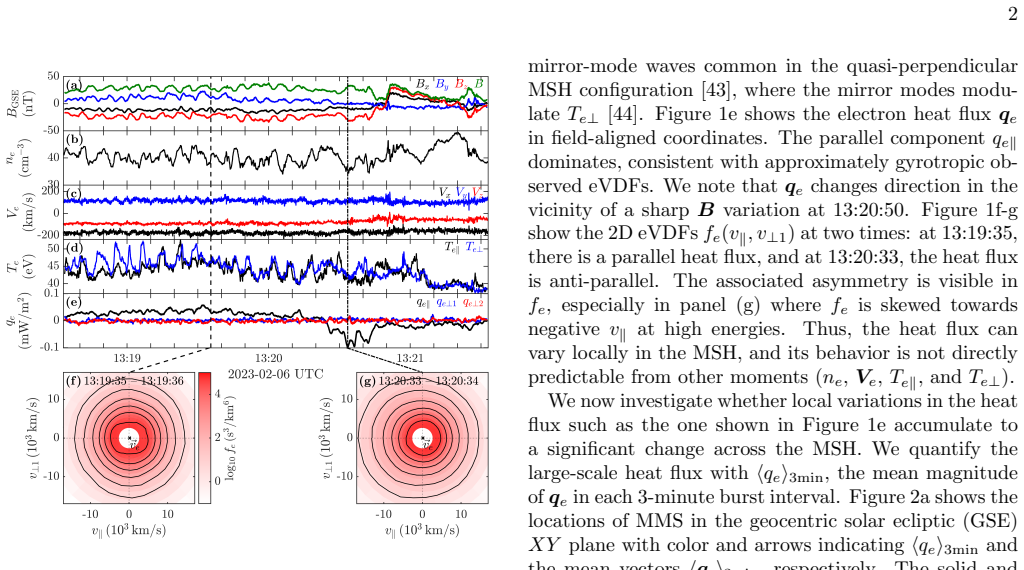

read the original abstract
Despite heat flux's role in regulating energy conversion in collisionless plasmas, its properties and evolution in the magnetosheath downstream of the Earth's bow shock are scarcely explored. We use MMS in situ measurements to quantify and characterize the electron heat flux in the magnetosheath. We find that the heat flux is shaped by the magnetosheath magnetic field as it drapes around the magnetosphere. While it is affected by solar wind upstream conditions and increases with magnetic field strength, it is not substantially changed by local magnetosheath processes. Also, the heat flux is limited by whistler instability thresholds.
Editorial analysis
A structured set of objections, weighed in public.
Referee Report
Summary. The manuscript uses MMS in-situ measurements to quantify electron heat flux in the Earth's magnetosheath. It claims the heat flux is shaped by draping of the magnetosheath magnetic field, is affected by upstream solar wind conditions and increases with magnetic field strength, is not substantially changed by local magnetosheath processes, and is limited by whistler instability thresholds.
Significance. If the central observational claims hold, the work provides direct constraints on electron heat transport and energy regulation in collisionless plasmas downstream of the bow shock, with implications for magnetosheath dynamics and solar wind-magnetosphere coupling. The reliance on in-situ data and comparison to known instability thresholds is a strength.
major comments (1)
- [§3–4] §3–4 (analysis of upstream vs. local dependence): The claim that heat flux 'is not substantially changed by local magnetosheath processes' is load-bearing for attributing the dominant shaping to magnetic-field draping and upstream conditions. The manuscript correlates heat flux with upstream parameters but does not report partial-correlation analysis, matched-interval controls, or conditioning that demonstrates vanishing residual correlation with local quantities (beta, temperature anisotropy, wave power). Because upstream variations set the post-shock state, this separation step requires explicit validation to support the interpretation.
minor comments (2)
- [Abstract and Methods] Abstract and Methods: Provide explicit details on data selection criteria, error analysis for heat-flux moments, and quantitative thresholds used to identify whistler instability limits.
- [Figures] Figures: Add labels distinguishing upstream-conditioned bins from local-parameter bins and include statistical significance markers.
Simulated Author's Rebuttal
We thank the referee for the constructive feedback on our manuscript. The major comment raises an important point about rigorously separating upstream and local influences on electron heat flux. We address it directly below and will revise the manuscript to strengthen the supporting analysis.
read point-by-point responses
-
Referee: [§3–4] §3–4 (analysis of upstream vs. local dependence): The claim that heat flux 'is not substantially changed by local magnetosheath processes' is load-bearing for attributing the dominant shaping to magnetic-field draping and upstream conditions. The manuscript correlates heat flux with upstream parameters but does not report partial-correlation analysis, matched-interval controls, or conditioning that demonstrates vanishing residual correlation with local quantities (beta, temperature anisotropy, wave power). Because upstream variations set the post-shock state, this separation step requires explicit validation to support the interpretation.
Authors: We agree that explicit statistical controls would strengthen the interpretation that local magnetosheath processes do not substantially modify the heat flux. Our existing analysis demonstrates that heat flux tracks the draped magnetic field strength and upstream solar wind parameters across multiple intervals, with the flux remaining consistent even as local plasma beta and temperature anisotropy vary. However, we did not include partial-correlation coefficients or matched-interval conditioning in the original submission. In the revision we will add a dedicated subsection to §4 that reports partial correlations of heat flux with local quantities (beta, anisotropy, and wave power) after controlling for upstream conditions and |B|. We will also include scatter plots and correlation matrices for intervals selected to have similar upstream parameters but differing local properties. These additions will quantify any residual dependence and directly test the claim. revision: yes
Circularity Check
No circularity: purely observational characterization from in-situ data
full rationale
The paper reports direct MMS measurements of electron heat flux in the magnetosheath, its correlation with draped magnetic field strength, and its comparison against known whistler instability thresholds. No theoretical derivation, fitted parameter renamed as prediction, or self-referential equation chain is present. All central claims are empirical patterns extracted from observations rather than quantities forced by construction from the paper's own inputs or prior self-citations. The separation of upstream versus local effects is an interpretive assumption about data conditioning, not a circular reduction in any equation or model.
Axiom & Free-Parameter Ledger
axioms (1)
- domain assumption Whistler instability thresholds limit electron heat flux in collisionless plasmas
Reference graph
Works this paper leans on
- [1]
-
[2]
provides the magnetic field vector B and the Fast Plasma Investigation (FPI) [41] instruments give the full 3D eVDF every 30 ms. We use the highest-resolution burst-mode data to avoid effects of lossy compression of fast-mode data [42]. We pre-process the electron heat flux to remove non-physical noise originating from low- counting statistics. The noise rem...
work page 1994
-
[3]
whistler instability thresholds. However, we find that there is no increase in whistler wave activity when the heat flux is close to the instability thresholds. As the same instabilities bound the heat flux in the SW [6, 9, 51], the fact that the heat flux is constrained by these insta- bility thresholds can be a remainder of SW dynamics, where the heat flux h...
-
[4]
D. Verscharen, R. T. Wicks, O. Alexandrova, R. Bruno, D. Burgess, C. H. K. Chen, R. DAmicis, J. De Keyser, T. D. De Wit, L. Franci, J. He, P. Henri, S. Kasahara, Y. Khotyaintsev, K. G. Klein, B. Lavraud, B. A. Maruca, M. Maksimovic, F. Plaschke, S. Poedts, C. S. Reynolds, O. Roberts, F. Sahraoui, S. Saito, C. S. Salem, J. Saur, S. Servidio, J. E. Stawarz,...
work page 2022
- [5]
-
[6]
S. D. Bale, M. Pulupa, C. Salem, C. H. K. Chen, and E. Quataert, The Astrophysical Journal 769, L22 (2013)
work page 2013
-
[7]
E. E. Scime, S. J. Bame, W. C. Feldman, S. P. Gary, J. L. Phillips, and A. Balogh, Journal of Geophysical Research: Space Physics 99, 23401 (1994)
work page 1994
-
[8]
G. T. Roberg-Clark, J. F. Drake, M. Swisdak, and C. S. Reynolds, The Astrophysical Journal 867, 154 (2018)
work page 2018
-
[9]
J. S. Halekas, P. L. Whittlesey, D. E. Larson, D. McGin- nis, S. D. Bale, M. Berthomier, A. W. Case, B. D. G. Chandran, J. C. Kasper, K. G. Klein, K. E. Kor- reck, R. Livi, R. J. MacDowall, M. Maksimovic, D. M. Malaspina, L. Matteini, M. P. Pulupa, and M. L. Stevens, Astronomy & Astrophysics 650, A15 (2021)
work page 2021
-
[10]
J. T. Coburn, D. Verscharen, C. J. Owen, M. Maksi- movic, T. S. Horbury, C. H. K. Chen, F. Guo, X. Fu, J. Liu, J. B. Abraham, G. Nicolaou, M. E. Innocenti, A. Micera, and V. K. Jagarlamudi, The Astrophysical Journal 964, 100 (2024)
work page 2024
-
[11]
D. J. Gershman, L. Chen, A. Le, J. Shuster, J. C. Dorelli, J. Ng, B. Giles, A. F. Vias, R. Torbert, and J. L. Burch, Geophysical Research Letters 51, e2024GL109783 (2024)
work page 2024
-
[12]
S. P. Gary, E. E. Scime, J. L. Phillips, and W. C. Feld- man, Journal of Geophysical Research 99, 23391 (1994)
work page 1994
-
[13]
S. P. Gary, R. M. Skoug, and W. Daughton, Physics of Plasmas 6, 2607 (1999)
work page 1999
-
[14]
F. Finelli, S. S. Cerri, F. Califano, F. Pucci, D. Laveder, G. Lapenta, and T. Passot, Astronomy & Astrophysics 653, A156 (2021)
work page 2021
-
[15]
P. L. Sulem and T. Passot, Journal of Plasma Physics 81, 325810103 (2015)
work page 2015
- [16]
-
[17]
E. R. Ingelsten, M. C. McGrae-Menge, E. P. Alves, and I. Pusztai, Journal of Plasma Physics 91, E64 (2025)
work page 2025
-
[18]
D. B. Graham, Y. V. Khotyaintsev, M. Andr, A. Vaivads, A. Chasapis, W. H. Matthaeus, A. Retin, F. Valentini, and D. J. Gershman, Journal of Geophysical Research: Space Physics 126, 10.1029/2021JA029260 (2021)
- [19]
-
[20]
S. W. Kahler, Space Science Reviews 129, 359 (2007)
work page 2007
-
[21]
L. Yang, L. Wang, G. Li, R. F. Wimmer-Schweingruber, J. He, C. Tu, H. Tian, and S. D. Bale, The Astrophysical Journal 853, 89 (2018)
work page 2018
-
[22]
J. L. Phillips, S. J. Bame, M. F. Thomsen, B. E. Gold- stein, and E. J. Smith, Journal of Geophysical Research: Space Physics 98, 21189 (1993)
work page 1993
-
[23]
G. Andreone, J. S. Halekas, D. L. Mitchell, C. Mazelle, and J. Gruesbeck, Journal of Geophysical Research: Space Physics 127, e2021JA029404 (2022)
work page 2022
- [24]
- [25]
- [26]
-
[27]
E. Yordanova, Z. Vrs, A. Varsani, D. B. Graham, C. Norgren, Y. V. Khotyaintsev, A. Vaivads, E. Eriks- son, R. Nakamura, P.-A. Lindqvist, G. Marklund, R. E. Ergun, W. Magnes, W. Baumjohann, D. Fischer, F. Plaschke, Y. Narita, C. T. Russell, R. J. Strangeway, O. Le Contel, C. Pollock, R. B. Torbert, B. J. Giles, J. L. Burch, L. A. Avanov, J. C. Dorelli, D. ...
work page 2016
-
[28]
Z. Vrs, E. Yordanova, A. Varsani, K. J. Genestreti, Y. V. Khotyaintsev, W. Li, D. B. Graham, C. Nor- gren, R. Nakamura, Y. Narita, F. Plaschke, W. Magnes, W. Baumjohann, D. Fischer, A. Vaivads, E. Eriksson, P. Lindqvist, G. Marklund, R. E. Ergun, M. Leitner, M. P. Leubner, R. J. Strangeway, O. LeContel, C. Pol- lock, B. J. Giles, R. B. Torbert, J. L. Burc...
-
[29]
T. D. Phan, J. P. Eastwood, M. A. Shay, J. F. Drake, B. U. . Sonnerup, M. Fujimoto, P. A. Cassak, M. ieroset, J. L. Burch, R. B. Torbert, A. C. Rager, J. C. Dorelli, D. J. Gershman, C. Pollock, P. S. Pyakurel, C. C. Hag- gerty, Y. Khotyaintsev, B. Lavraud, Y. Saito, M. Oka, R. E. Ergun, A. Retino, O. Le Contel, M. R. Argall, B. L. Giles, T. E. Moore, F. D...
work page 2018
-
[30]
J. E. Stawarz, J. P. Eastwood, T. D. Phan, I. L. Gingell, M. A. Shay, J. L. Burch, R. E. Ergun, B. L. Giles, D. J. Gershman, O. L. Contel, P.-A. Lindqvist, C. T. Russell, R. J. Strangeway, R. B. Torbert, M. R. Argall, D. Fischer, W. Magnes, and L. Franci, The Astrophysical Journal Letters 877, L37 (2019)
work page 2019
-
[31]
J. E. Stawarz, J. P. Eastwood, T. D. Phan, I. L. Gingell, P. S. Pyakurel, M. A. Shay, S. L. Robertson, C. T. Rus- sell, and O. Le Contel, Physics of Plasmas 29, 012302 (2022)
work page 2022
-
[32]
I. Svenningsson, E. Yordanova, G. Cozzani, Y. V. Khotyaintsev, and M. Andr, Geophysical Research Let- ters 49, 10.1029/2022GL099065 (2022)
-
[33]
I. Svenningsson, E. Yordanova, Y. V. Khotyaintsev, M. Andr, G. Cozzani, and K. Steinvall, Journal of Geo- physical Research: Space Physics 129, e2024JA032661 (2024)
work page 2024
-
[34]
C. H. K. Chen, K. G. Klein, and G. G. Howes, Nature Communications 10, 740 (2019)
work page 2019
-
[35]
A. S. Afshari, G. G. Howes, J. R. Shuster, K. G. Klein, D. McGinnis, M. M. Martinovi, S. A. Boardsen, C. R. Brown, R. Huang, D. P. Hartley, and C. A. Kletzing, Nature Communications 15, 7870 (2024)
work page 2024
-
[36]
H. Breuillard, O. LeContel, T. Chust, M. Berthomier, A. Retino, D. L. Turner, R. Nakamura, W. Baumjo- hann, G. Cozzani, F. Catapano, A. Alexandrova, L. Miri- oni, D. B. Graham, M. R. Argall, D. Fischer, F. D. Wilder, D. J. Gershman, A. Varsani, P. Lindqvist, Y. V. Khotyaintsev, G. Marklund, R. E. Ergun, K. A. Goodrich, N. Ahmadi, J. L. Burch, R. B. Torber...
work page 2018
-
[37]
W. Gonzalez and E. Parker, eds., Magnetic Reconnection: Concepts and Applications , Astrophysics and Space Sci- ence Library, Vol. 427 (Springer International Publishing, Cham, 2016)
work page 2016
-
[38]
J. L. Burch, T. E. Moore, R. B. Torbert, and B. L. Giles, Space Science Reviews 199, 5 (2016)
work page 2016
-
[39]
I. Y. Vasko, V. Krasnoselskikh, Y. Tong, S. D. Bale, J. W. Bonnell, and F. S. Mozer, The Astrophysical Journal Let- ters 871, L29 (2019)
work page 2019
- [40]
-
[41]
S. P. Gary and J. Wang, Journal of Geophysical Research: Space Physics 101, 10749 (1996)
work page 1996
-
[42]
N. Kitamura, Y. Omura, S. Nakamura, T. Amano, S. A. Boardsen, N. Ahmadi, O. Le Contel, P. Lindqvist, R. E. Ergun, Y. Saito, S. Yokota, D. J. Gershman, W. R. Pa- terson, C. J. Pollock, B. L. Giles, C. T. Russell, R. J. Strangeway, and J. L. Burch, Journal of Geophysical Research: Space Physics 125, 10.1029/2019JA027488 (2020)
-
[43]
C. T. Russell, B. J. Anderson, W. Baumjohann, K. R. Bromund, D. Dearborn, D. Fischer, G. Le, H. K. Lein- weber, D. Leneman, W. Magnes, J. D. Means, M. B. Moldwin, R. Nakamura, D. Pierce, F. Plaschke, K. M. Rowe, J. A. Slavin, R. J. Strangeway, R. Torbert, C. Ha- gen, I. Jernej, A. Valavanoglou, and I. Richter, Space Science Reviews 199, 189 (2016)
work page 2016
-
[44]
C. Pollock, T. Moore, A. Jacques, J. Burch, U. Gliese, Y. Saito, T. Omoto, L. Avanov, A. Barrie, V. Cof- fey, J. Dorelli, D. Gershman, B. Giles, T. Rosnack, C. Salo, S. Yokota, M. Adrian, C. Aoustin, C. Auletti, S. Aung, V. Bigio, N. Cao, M. Chandler, D. Chor- nay, K. Christian, G. Clark, G. Collinson, T. Cor- ris, A. DeLosSantos, R. Devlin, T. Diaz, T. D...
work page 2016
-
[45]
A. C. Barrie, D. L. Smith, S. R. Elkington, Z. Sternovsky, D. Silva, B. L. Giles, and C. Schiff, Earth and Space Science 6, 116 (2019)
work page 2019
-
[46]
A. P. Dimmock, A. Osmane, T. I. Pulkkinen, and K. Nykyri, Journal of Geophysical Research: Space Physics 120, 5489 (2015)
work page 2015
-
[47]
S. T. Yao, Q. Q. Shi, J. Liu, Z. H. Yao, R. L. Guo, N. Ahmadi, A. W. Degeling, Q. G. Zong, X. G. Wang, A. M. Tian, C. T. Russell, H. S. Fu, Z. Y. Pu, S. Y. Fu, H. Zhang, W. J. Sun, L. Li, C. J. Xiao, Y. Y. Feng, and B. L. Giles, Journal of Geophysical Research: Space Physics 123, 5561 (2018)
work page 2018
-
[48]
N. E. Papitashvili and J. H. King, NASA Space Physics Data Facility https://doi.org/10.48322/1shr-ht18 (2020)
-
[49]
I. Svenningsson, E. Yordanova, Y. V. Khotyaintsev, M. Andr, and G. Cozzani, Journal of Geophysical Re- search: Space Physics 130, e2024JA033272 (2025)
work page 2025
-
[50]
A. P. Dimmock and K. Nykyri, Journal of Geophysical Research: Space Physics 118, 4963 (2013)
work page 2013
-
[51]
C. A. Cattell, B. Short, A. W. Breneman, and P. Grul, The Astrophysical Journal 897, 126 (2020)
work page 2020
-
[52]
C. S. Salem, M. Pulupa, S. D. Bale, and D. Verscharen, Astronomy & Astrophysics 675, A162 (2023)
work page 2023
-
[53]
D. Verscharen, B. D. G. Chandran, E. Boella, J. Halekas, M. E. Innocenti, V. K. Jagarlamudi, A. Micera, V. Pier- rard, . tverk, I. Y. Vasko, M. Velli, and P. L. Whittle- sey, Frontiers in Astronomy and Space Sciences 9, 951628 7 (2022)
work page 2022
-
[54]
C. Cattell, A. Breneman, J. Dombeck, E. Hanson, M. Johnson, J. Halekas, S. D. Bale, T. Dudok De Wit, K. Goetz, K. Goodrich, D. Malaspina, M. Pulupa, T. Case, J. C. Kasper, D. Larson, M. Stevens, and P. Whittlesey, The Astrophysical Journal Letters 924, L33 (2022)
work page 2022
-
[55]
A. Vaivads, A. Retin, and M. Andr, Plasma Physics and Controlled Fusion 51, 124016 (2009)
work page 2009
-
[56]
See https://lasp.colorado.edu/mms/sdc/public
-
[57]
See https://github.com/irfu/irfu-matlab. Supplemental materials to the manuscript Electron Heat Flux and Whistler Instability in the Earth’s Magnetosheat h by I. Svenningsson et al. HEA T FLUX NOISE REMOV AL METHOD The heat flux is a 3 rd order moment of the electron veloc- ity distribution function, and therefore more sensitive to counting statistics than...
-
[58]
N. E. Papitashvili and J. H. King, NASA Space Physics Data Facility (2020)
work page 2020
-
[59]
I. Svenningsson, E. Yordanova, Y. V. Khotyaintsev, M. Andr´ e, and G. Cozzani, Journal of Geophysical Research: Space Physics 130, e2024JA033272 (2025), ISSN 2169-9380, 2169-9402, URL https://agupubs. onlinelibrary.wiley.com/doi/10.1029/2024JA033272
discussion (0)
Sign in with ORCID, Apple, or X to comment. Anyone can read and Pith papers without signing in.