REVIEW 4 major objections 5 minor 45 references
Generalized descent converges linearly exactly when the descent order θ equals the reciprocal of the Kurdyka–Łojasiewicz exponent ϑ, and a boosted high-order proximal-point method achieves this for every ϑ.
Reviewed by Pith at T0; open to challenge. T0 means a machine referee read the full paper against a public rubric. the ladder, T0–T4 →
T0 review · deepseek-v4-flash
2026-08-03 22:26 UTC pith:YFKR6OE7
load-bearing objection The DEAL framework is a clean, correct unification with rates that check out; the 'linear for any KL exponent' headline is a one-line citation to an unpublished companion preprint. the 4 major comments →
Minimizing Smooth Kurdyka-{L}ojasiewicz Functions via Generalized Descent Methods: Convergence Rate and Complexity
The pith
A machine-rendered reading of the paper's core claim, the machinery that carries it, and where it could break.
Core claim
The central claim is Theorem 3.3: for a sequence satisfying the generalized descent inequality f(x_{k+1}) ≤ f(x_k) − ρ‖∇f(x_k)‖^θ together with the relative-error bound ‖x_{k+1}−x_k‖ ≤ c‖∇f(x_k)‖^{θ−1}, if the objective satisfies the KL inequality at a cluster point with exponent ϑ, then θ = 1/ϑ gives linear convergence of the function gap, the gradient norm, and the iterate distance to 0, with rate q = 1 − ρ/τ^θ; while θ > 1/ϑ gives sublinear rates with explicit polynomial exponents. The paper further claims that the boosted high-order proximal-point method, by setting p = 1/(1−ϑ), achieves linear convergence for arbitrary KL exponent ϑ ∈ (0,1) — a result the authors state is new even in th
What carries the argument
The DEAL framework is built on a single sufficient-decrease inequality, f(x_{k+1}) ≤ f(x_k) − ρ‖∇f(x_k)‖^θ, together with the step-size control ‖x_{k+1}−x_k‖ ≤ c‖∇f(x_k)‖^{θ−1}. The KL inequality (f(x)−f(x̄))^ϑ ≤ τ‖∇f(x)‖ converts these into the scalar recurrence (s_k)^{ϑθ} ≤ (τ^θ/ρ)(s_k − s_{k+1}) for the function gap s_k; a known lemma (Fact 2.2) then turns this recurrence into linear or sublinear estimates depending on whether ϑθ equals or exceeds 1. The high-order Moreau envelope and its gradient formula (33) are the bridge that lets nonsmooth objectives and high-order proximal-point methods enter the same framework.
Load-bearing premise
The headline result that boosted high-order proximal-point converges linearly for any KL exponent rests on the paper's assumption — deferred to a companion preprint — that the high-order Moreau envelope is C^1 and inherits exactly the same KL exponent ϑ as the original function.
What would settle it
Find a concrete semialgebraic KL function with known exponent ϑ whose high-order Moreau envelope φ_γ^p (with p = 1/(1−ϑ)) has a strictly smaller KL exponent, or where C^1 differentiability forces γ so small that the global descent inequality (11) fails; either observation would disprove the claim that boosted HiPPA converges linearly for all ϑ.
If this is right
- For any DEAL instance — constant step-size, Armijo line search, proximal gradient, or high-order proximal-point — global convergence, convergence rates, and complexity are all governed by the same θ–ϑ relation, so no per-algorithm rate analysis is needed.
- Linear convergence is achievable for KL exponents beyond the classical ϑ = 1/2 case; the identity θ = 1/ϑ extends linear rates to all ϑ ∈ (0,1).
- Boosted HiPPA with p = 1/(1−ϑ) is claimed to be the first high-order proximal-point scheme with linear convergence for arbitrary KL exponent, a result the paper says holds even for smooth objectives.
- Under a global KL inequality, DEAL converges to a global minimizer and reaches ε-accuracy in function value, gradient norm, or iterate distance within O(log(1/ε)) iterations; without the KL property, the gradient-norm complexity is only O(ε^{−θ}).
- The framework applies to nonsmooth objectives through smoothing (forward-backward and Moreau envelopes), with the smooth surrogate inheriting the KL exponent in the analyzed cases.
Where Pith is reading between the lines
- A testable extension: for any problem where the KL exponent and Hölder smoothness satisfy ϑ = ν/(1+ν) — as the paper proves for least-p inverse problems — both DEAL-C and DEAL-A automatically sit at the linear-convergence threshold θ = 1/ϑ; checking this identity on other Hölder-smooth KL functions would show whether it is a general design principle.
- If the envelope-inheritance result is confirmed, the same θ–ϑ matching could guide the design of inexact or stochastic variants of DEAL: keeping the effective descent order matched to the smoothed surrogate's exponent should preserve linear convergence.
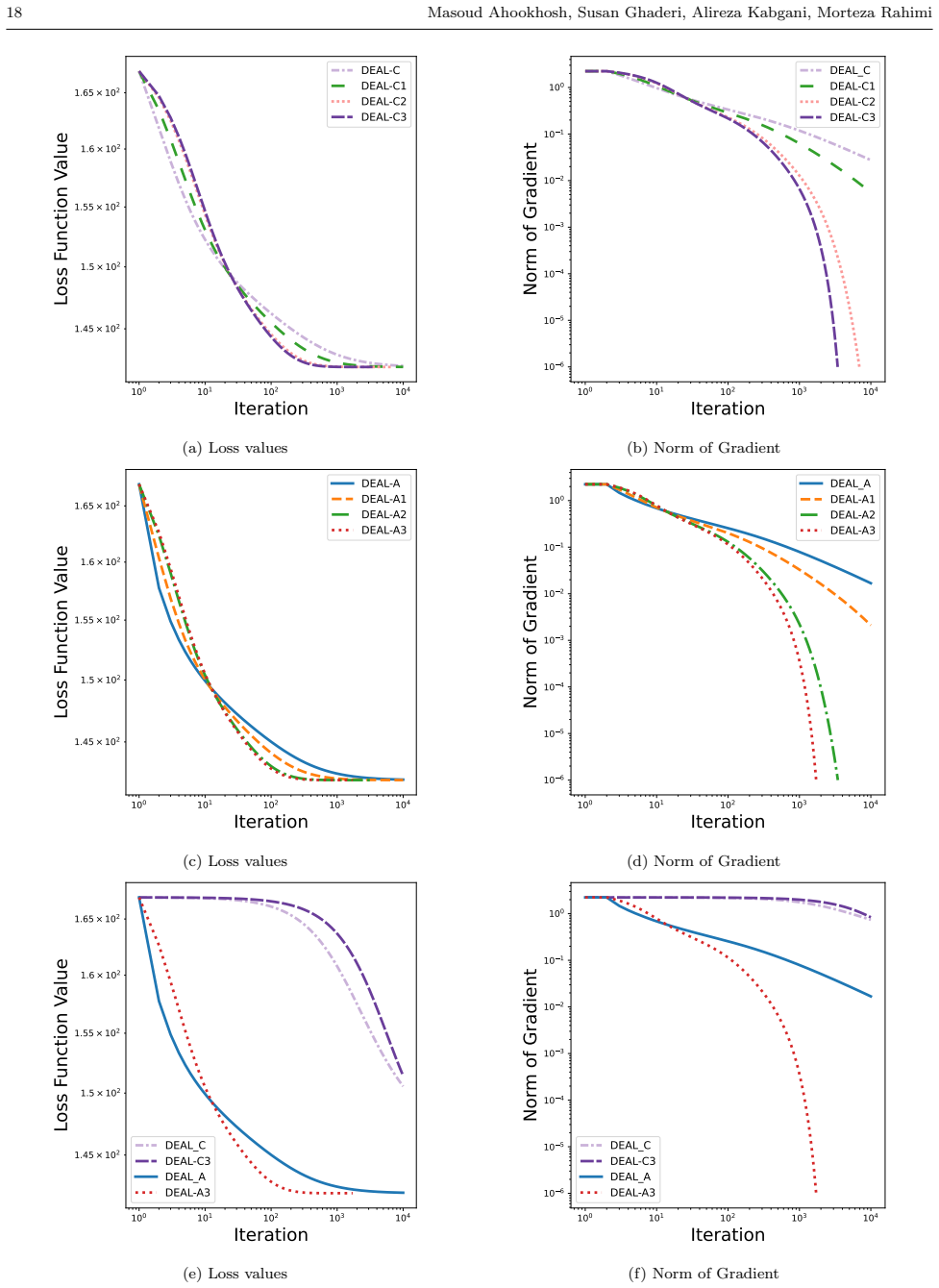
- The numerical experiments show heuristic choices of the generalized-descent parameter β (e.g., −0.2) outperforming the theoretically motivated value; a systematic study of the rate behavior away from the exact threshold θ = 1/ϑ could explain this gap and yield better practical parameter rules.
Editorial analysis
A structured set of objections, weighed in public.
Referee Report
Summary. The paper introduces a generalized descent framework (DEAL), defined by the sufficient-decrease inequality f(x_{k+1}) ≤ f(x_k) − ρ‖∇f(x_k)‖^θ with θ > 1, and analyzes convergence, rates, and complexity under the Kurdyka–Łojasiewicz (KL) property. Section 3 proves, under explicit structural assumptions, that the sequence of gradients is summable, cluster points are critical, and—when the KL exponent ϑ and descent order θ are related—function values, gradient norms, and iterates converge linearly (θ = 1/ϑ) or sublinearly (θ > 1/ϑ); global KL is used to obtain global convergence to minimizers and iteration-complexity bounds. Section 4 instantiates DEAL with constant-step and Armijo line-search versions, and with boosted proximal-gradient and boosted high-order proximal-point methods. The headline claim is that Boosted HiPPA, with regularization order p = 1/(1−ϑ), achieves linear convergence for arbitrary KL exponent ϑ∈(0,1). Numerical experiments on inverse problems and LASSO illustrate the methods.
Significance. If fully established, the paper would provide a clean and reasonably general unification of several descent methods under a single KL-based rate theorem. The core Section 3 arguments are simple, mostly correct, and genuinely useful: the summability of gradient powers, the KL recurrence, and the explicit complexity bounds under global KL are valuable. The paper also gives explicit constants for many of the rates, which is helpful for reproducibility. However, the paper's distinguishing new result—linear convergence of Boosted HiPPA for arbitrary KL exponents—is not proved in this manuscript. It rests on unpublished companion-preprint results about high-order Moreau envelopes that are cited without hypotheses or proof, and the structural hypotheses needed to apply the main theorem to Boosted HiPPA are not verified. The general framework is a solid contribution, but the headline application needs substantial additional justification.
major comments (4)
- [§4.3, Corollary 4.11] The headline claim—Boosted HiPPA converges linearly for arbitrary KL exponent ϑ—is not proved in this manuscript. The proof of Corollary 4.11 is a single citation to [21, Theorem 3.9], an unpublished same-author preprint. To apply Theorem 3.3 to f = φ_γ^p, one needs (i) φ_γ^p ∈ C^1 and (ii) φ_γ^p satisfies the KL inequality at the relevant cluster point with the same exponent ϑ and a usable constant τ_γ. Neither is established here; the paper explicitly says in Section 4.3 'To avoid technicalities, we assume φ_γ^p ∈ C1 whenever differentiability is needed', and Fact 4.8 also cites [21, 23]. No hypotheses on prox-regularity, weak convexity, admissible range of γ, or bounded level sets are stated, and the dependence of τ_γ on γ and p is not given. This is load-bearing because p = 1/(1−ϑ) is chosen exactly so that θ = p/(p−1) = 1/ϑ; if the envelope's KL exponent is not ϑ, or if C^1 regulari
- [§4.3, Algorithm 4 / Corollary 4.11] Even granting the envelope calculus, Corollary 4.11 does not verify the structural hypotheses needed to invoke Theorems 3.2(d) and 3.3. First, Assumption II (existence of a convergent subsequence) is not implied by the DEAL descent inequality or by the KL property; without coercivity or bounded level sets, an unbounded sequence can have decreasing function values and vanishing gradients. Second, the displacement condition ‖x_{k+1}−x_k‖ ≤ c‖∇φ_γ^p(x_k)‖^{θ−1} is never checked for the Boosted HiPPA line search. With x_{k+1} = (1−κ_k)prox^p_{γφ}(x_k) + κ_k(x_k + d_k), we get ‖x_{k+1}−x_k‖ ≤ γ^{1/(p−1)}‖∇φ_γ^p(x_k)‖^{θ−1} + κ_k‖d_k‖; for arbitrary d_k and the 'largest κ' acceptance rule, the extra term κ_k‖d_k‖ need not be dominated by a multiple of ‖∇φ_γ^p(x_k)‖^{θ−1}. Corollary 4.11 therefore overclaims that all DEAL theorems hold for Boosted HiPPA without additional assumptions on d_k or
- [§3, Assumption II and Theorem 3.2] Assumption II is nontrivial and should be highlighted as a limitation. Algorithm 1, as stated, can generate divergent sequences: inequality (11) only controls the decrease of f and the sum of ‖∇f(x_k)‖^θ; it does not imply boundedness of the iterates unless f has bounded sublevel sets or some coercivity is assumed. Thus Theorems 3.2(c)–(d), 3.3, 3.4(c), 3.6, and the corollaries inherit an unverified boundedness/continuity condition. For DEAL-C and DEAL-A the bounded-step structure makes this condition plausible under mild assumptions, but for Boosted HiPPA and Boosted PGA no argument is supplied. The phrase 'global convergence' should be qualified accordingly, or an explicit coercivity/level-set condition should be added to the instances where it is needed.
- [§4.3, Algorithm 4 initialization] The acceptance inequality preceding Algorithm 4 requires σ < 1. Indeed, the exact decrease at the prox point is φ_γ^p(prox) = φ_γ^p(x_k) − (1/(pγ))‖x_k−prox‖^p = φ_γ^p(x_k) − (1/p)γ^{1/(p−1)}‖∇φ_γ^p(x_k)‖^{p/(p−1)}, so the claimed inequality with coefficient σγ^{1/(p−1)}/p is valid only if σ < 1. Algorithm 4 states σ ∈ (0, 1/(pγ)); if pγ < 1, this interval includes values of σ ≥ 1, for which the displayed descent inequality cannot hold and the backtracking loop may never terminate. The parameter range should be σ ∈ (0,1), or an equivalent condition ensuring σ < 1, and the statement of Lemma 4.10 should be updated accordingly.
minor comments (5)
- [§4.3, Lemma 4.10 proof] The proof refers to 'from (40)', but at that point (40) is not yet defined; (40) is later used for BPGA. The reference should be to the line-search inequality introduced just above Algorithm 4, or a new equation number should be assigned.
- [§3, Theorem 3.3 proof] The bounds in (15) and (16) use f(x_0)−f(x̄) even though the linear-rate inequality is proved only for k ≥ k_0. This is harmless if one replaces x_0 by x_{k_0} or absorbs the finite initial segment into the constant, but the text should say so.
- [§5.3, Remark 5.2] The KL property for the Moreau envelope is asserted on {x : φ(x) ≤ φ(x_0)}, but the natural level set for the envelope is {x : φ_γ(x) ≤ φ_γ(x_0)}. The cited result [43, Remark 5.1] should be stated with its actual hypotheses, since the inclusion of level sets may require justification.
- [§4.3, general] The blanket statement 'To avoid technicalities, we assume φ_γ^p ∈ C1 whenever differentiability is needed' is too vague. The paper should specify whether C^1 regularity is global or on a neighborhood of the level set, and how γ is chosen relative to the problem data (e.g., weak-convexity constant).
- [References] Reference [45] appears to contain a typo in the arXiv identifier ('1803.002259'); please verify. Some other references to unpublished arXiv preprints by the same authors ([21], [22], [23]) are used for crucial facts; if these remain unpublished, the main text should include the precise statements used.
Circularity Check
Headline arbitrary-KL linear convergence for Boosted HiPPA is delegated to the authors' own unpublished [21]; the DEAL rate derivation itself is self-contained.
specific steps
-
self citation load bearing
[Corollary 4.11 proof; Section 4.3 after Fact 4.8; paragraph after Corollary 4.14]
"Proof The claim follows from Lemma 4.10 and [21, Theorem 3.9]. ... To avoid technicalities, we assume φ p γ ∈ C1 whenever differentiability is needed. ... A key advantage of Boosted HiPPA lies in its flexibility: by tuning p, it achieves linear convergence for any KL exponent ϑ∈(0,1). Indeed, if φ p γ satisfies the KL inequality with exponent ϑ, choosing θ= 1/ϑ = p/p−1, i.e., p= 1/1−ϑ, guarantees global and linear convergence."
To apply Theorem 3.3 to f=φ_p^γ, the function must be C^1 and must satisfy KL at the cluster point with exponent ϑ. The C^1 property is merely assumed ('to avoid technicalities'), and the KL-exponent preservation is not proved in this manuscript; the proof of Corollary 4.11 is a one-line citation to [21, Theorem 3.9], a same-author arXiv preprint. Thus the paper's strongest advertised result — linear convergence for arbitrary ϑ — is not derived from assumptions stated in this paper but imported from the authors' own companion work, with no statement of the extra conditions (e.g., prox-regularity, weak convexity, small γ) or of how the KL constant depends on γ. If [21, Thm 3.9] requires conditions not met here, the arbitrary-ϑ conclusion reduces to a conditional statement.
full rationale
The core DEAL analysis in Theorems 3.2-3.6 is not circular: Theorem 3.3 derives the recurrence s_k^{ϑθ} ≤ (τ^θ/ρ)(s_k-s_{k+1}) from the assumed descent inequality (11), the KL inequality, and the displacement condition, then applies the external Fact 2.2. The convergence rate q=1−ρ/τ^θ and the polynomial rates follow algebraically; no target rate is inserted into the constants. DEAL-C and DEAL-A are also reduced to (11) from Hölderian descent and the Armijo step-size lower bound, without assuming the conclusions. The circularity concern is localized to the smoothed high-order instance: the differentiability and KL-preservation of φ_p^γ are taken from the same authors' preprints [21,22,23], and Corollary 4.11's proof is a one-line citation. This is a self-citation/verification burden rather than a by-construction equivalence: if [21, Thm 3.9] is independently valid, the application of DEAL to Boosted HiPPA goes through. Separately (a gap, not circularity), the displacement condition ∥x_{k+1}-x_k∥≤c∥∇φ_p^γ∥^{θ−1} required by Theorem 3.3 is not verified for Algorithm 4's update. Numerical experiments do not repair this theoretical import.
Axiom & Free-Parameter Ledger
free parameters (4)
- descent order θ =
user-chosen; for DEAL-C/A θ=1+1/ν; for HiPPA θ=p/(p−1); for PGA θ=2
- generalized descent scaling β =
β=(1−ν)/ν in theory; heuristics β=0.5, β=0, β=−0.2 in Section 5
- proximal order p =
p=1/(1−ϑ)
- decrease constant ρ =
e.g., ρ=c1α^ν/(1+ν), ρ=σᾱc1, ρ=γ^{1/(p−1)}/p, etc.
axioms (7)
- domain assumption Assumption I: f∈C^1 and the minimizer set X* is nonempty.
- domain assumption Assumption II: the generated sequence has a convergent subsequence.
- domain assumption KL inequality holds at a cluster point with exponent ϑ and constant τ.
- domain assumption Global KL inequality holds with constants ϑ, τ.
- ad hoc to paper Iterate proximity condition ‖x_{k+1}−x_k‖ ≤ c‖∇f(x_k)‖^{θ−1}.
- ad hoc to paper For Boosted HiPPA, φ_γ^p∈C^1 and the envelope inherits the KL exponent ϑ from φ.
- domain assumption Assumption III: f has a ν-Hölder continuous gradient.
Cite this review
Pith. "Pith review of Minimizing Smooth Kurdyka-{\L}ojasiewicz Functions via Generalized Descent Methods: Convergence Rate and Complexity." pith.science (2026). https://pith.science/paper/YFKR6OE7
@misc{pith2026251110414,
  author       = {Pith},
  title        = {Pith review of: Minimizing Smooth Kurdyka-\Lojasiewicz Functions via Generalized Descent Methods: Convergence Rate and Complexity},
  year         = {2026},
  howpublished = {\url{https://pith.science/paper/YFKR6OE7}},
  note         = {Machine review of arXiv:2511.10414}
}
read the original abstract
This paper introduces a generalized descent algorithm (DEAL) for minimizing smooth nonconvex functions. If the objective function is nonsmooth, a smoothing technique (e.g., forward-backward and high-order Moreau envelopes) is applied to generate a smooth counterpart. The proposed framework unifies several methods, such as gradient-based methods with constant step-sizes and Armijo line search, and several proximal splitting methods. The method is built around a generalized descent inequality that adapts the amount of decrease to the geometry of the objective function. Under the Kurdyka-{\L}ojasiewicz (KL) property, we establish global convergence of the generated sequence to critical points and provide a unified convergence rate analysis. In particular, we show that the convergence behavior depends jointly on the KL exponent and the descent order, and we identify a precise condition under which generalized descent methods achieve linear convergence. By choosing the order of high-order proximal regularization according to the KL exponent, our boosted high-order proximal-point method achieves linear convergence for arbitrary KL exponents. If the objective function satisfies a global KL inequality, we further strengthen the results by proving convergence to global minimizers and deriving explicit iteration-complexity bounds. Numerical experiments validate our theoretical foundation.
Figures

Reference graph
Works this paper leans on
-
[1]
SIAM Journal on Optimization16(2), 531–547 (2005)
Absil, P.A., Mahony, R., Andrews, B.: Convergence of the iterates of descent methods for analytic cost functions. SIAM Journal on Optimization16(2), 531–547 (2005). DOI 10.1137/040605266
-
[2]
Journal of Machine Learning Research22(98), 1–76 (2021)
Agarwal, A., Kakade, S.M., Lee, J.D., Mahajan, G.: On the theory of policy gradient methods: Optimality, approximation, and distribution shift. Journal of Machine Learning Research22(98), 1–76 (2021)
2021
-
[3]
Mathematical Methods of Operations Research89(3), 319–353 (2019)
Ahookhosh, M.: Accelerated first-order methods for large-scale convex optimization: nearly optimal complexity under strong convexity. Mathematical Methods of Operations Research89(3), 319–353 (2019)
2019
-
[4]
SIAM Journal on Optimization31(1), 653–685 (2021)
Ahookhosh, M., Themelis, A., Patrinos, P.: A Bregman forward-backward linesearch algorithm for nonconvex composite opti- mization: superlinear convergence to nonisolated local minima. SIAM Journal on Optimization31(1), 653–685 (2021)
2021
-
[5]
In: International conference on machine learning, pp
Allen-Zhu, Z., Li, Y., Song, Z.: A convergence theory for deep learning via over-parameterization. In: International conference on machine learning, pp. 242–252. PMLR (2019)
2019
-
[6]
Journal of Global Optimization84(3), 563–589 (2022)
Apidopoulos, V., Ginatta, N., Villa, S.: Convergence rates for the heavy-ball continuous dynamics for non-convex optimization, under polyak– lojasiewicz condition. Journal of Global Optimization84(3), 563–589 (2022)
2022
-
[7]
Mathematical programming169, 95–118 (2018)
Arag´ on Artacho, F.J., Fleming, R.M., Vuong, P.T.: Accelerating the DC algorithm for smooth functions. Mathematical programming169, 95–118 (2018)
2018
-
[8]
Mathematics of Operations Research35(2), 438–457 (2010)
Attouch, H., Bolte, J., Redont, P., Soubeyran, A.: Proximal alternating minimization and projection methods for nonconvex problems: An approach based on the Kurdyka- Lojasiewicz inequality. Mathematics of Operations Research35(2), 438–457 (2010)
2010
-
[9]
Mathematical Programming137(1), 91–129 (2013)
Attouch, H., Bolte, J., Svaiter, B.F.: Convergence of descent methods for semi-algebraic and tame problems: proximal algo- rithms, forward-backward splitting, and regularized Gauss-Seidel methods. Mathematical Programming137(1), 91–129 (2013)
2013
-
[10]
CMS Books in Mathematics
Bauschke, H.H., Combettes, P.L.: Convex analysis and monotone operator theory in Hilbert spaces. CMS Books in Mathematics. Springer (2017)
2017
-
[11]
Journal of Optimization Theory and Applications207(3), 41 (2025)
Bento, G., Mordukhovich, B., Mota, T., Nesterov, Y.: Convergence of descent optimization algorithms under Polyak- Lojasiewicz-kurdyka conditions. Journal of Optimization Theory and Applications207(3), 41 (2025)
2025
-
[12]
Journal of mathematical analysis and applications321(2), 729–740 (2006)
Bolte, J., Daniilidis, A., Lewis, A.: A nonsmooth morse–sard theorem for subanalytic functions. Journal of mathematical analysis and applications321(2), 729–740 (2006)
2006
-
[13]
SIAM Journal on Optimization17(4), 1205–1223 (2007)
Bolte, J., Daniilidis, A., Lewis, A.: The Lojasiewicz inequality for nonsmooth subanalytic functions with applications to sub- gradient dynamical systems. SIAM Journal on Optimization17(4), 1205–1223 (2007)
2007
-
[14]
SIAM Journal on Optimization 18(2), 556–572 (2007)
Bolte, J., Daniilidis, A., Lewis, A., Shiota, M.: Clarke subgradients of stratifiable functions. SIAM Journal on Optimization 18(2), 556–572 (2007)
2007
-
[15]
Mathematical Programming165(2), 471–507 (2017)
Bolte, J., Nguyen, T.P., Peypouquet, J., Suter, B.W.: From error bounds to the complexity of first-order descent methods for convex functions. Mathematical Programming165(2), 471–507 (2017)
2017
-
[16]
arXiv preprint arXiv:1907.08921 (2019)
Bu, J., Mesbahi, A., Fazel, M., Mesbahi, M.: Lqr through the lens of first order methods: Discrete-time case. arXiv preprint arXiv:1907.08921 (2019)
Pith/arXiv arXiv 1907
-
[17]
Advances in Neural Information Processing Systems35, 15836–15848 (2022)
Fatkhullin, I., Etesami, J., He, N., Kiyavash, N.: Sharp analysis of stochastic optimization under global Kurdyka- Lojasiewicz inequality. Advances in Neural Information Processing Systems35, 15836–15848 (2022)
2022
-
[18]
SIAM Journal on Control and Optimization 59(5), 3887–3911 (2021)
Fatkhullin, I., Polyak, B.: Optimizing static linear feedback: Gradient method. SIAM Journal on Control and Optimization 59(5), 3887–3911 (2021)
2021
-
[19]
Journal of Optimization Theory and Applications165, 874–900 (2015)
Frankel, P., Garrigos, G., Peypouquet, J.: Splitting methods with variable metric for kurdyka– lojasiewicz functions and general convergence rates. Journal of Optimization Theory and Applications165, 874–900 (2015)
2015
-
[20]
Mathematical Programming198(1), 937–996 (2023)
Garrigos, G., Rosasco, L., Villa, S.: Convergence of the forward-backward algorithm: beyond the worst-case with the help of geometry. Mathematical Programming198(1), 937–996 (2023)
2023
-
[21]
Kabgani, A., Ahookhosh, M.: ItsOPT: An inexact two-level smoothing framework for nonconvex optimization via high-order moreau envelope. arXiv (2024). URLhttps://doi.org/10.48550/arXiv.2410.19928
-
[22]
Kabgani, A., Ahookhosh, M.: ItsDEAL: Inexact two-level smoothing descent algorithms for weakly convex optimization. arXiv (2025). URLhttps://doi.org/10.48550/arXiv.2501.02155
-
[23]
Kabgani, A., Ahookhosh, M.: Moreau envelope and proximal-point methods under the lens of high-order regularization. arXiv (2025). URLhttps://doi.org/10.48550/arXiv.2503.04577
-
[24]
In: Joint European conference on machine learning and knowledge discovery in databases, pp
Karimi, H., Nutini, J., Schmidt, M.: Linear convergence of gradient and proximal-gradient methods under the Polyak- Lojasiewicz condition. In: Joint European conference on machine learning and knowledge discovery in databases, pp. 795–811. Springer (2016)
2016
-
[25]
Annales de l’institut Fourier48(3), 769–783 (1998) Minimizing smooth Kurdyka- Lojasiewicz functions via generalized descent methods: Convergence rate and complexity 21
Kurdyka, K.: On gradients of functions definable in o-minimal structures. Annales de l’institut Fourier48(3), 769–783 (1998) Minimizing smooth Kurdyka- Lojasiewicz functions via generalized descent methods: Convergence rate and complexity 21
1998
-
[26]
Foundations of computational mathematics18(5), 1199–1232 (2018)
Li, G., Pong, T.K.: Calculus of the exponent of Kurdyka– Lojasiewicz inequality and its applications to linear convergence of first-order methods. Foundations of computational mathematics18(5), 1199–1232 (2018)
2018
-
[27]
Les ´ equations aux d´ eriv´ ees partielles pp
Lojasiewicz, S.: Une propri´ et´ e topologique des sous-ensembles analytiques r´ eels. Les ´ equations aux d´ eriv´ ees partielles pp. 87–89 (1963)
1963
-
[28]
Annales de l’institut Fourier43(5), 1575–1595 (1993)
Lojasiewicz, S.: Sur la g´ eom´ etrie semi- et sous- analytique. Annales de l’institut Fourier43(5), 1575–1595 (1993)
1993
-
[29]
In: International conference on machine learning, pp
Mei, J., Xiao, C., Szepesvari, C., Schuurmans, D.: On the global convergence rates of softmax policy gradient methods. In: International conference on machine learning, pp. 6820–6829. PMLR (2020)
2020
-
[30]
Springer Cham (2018)
Mordukhovich, B.S.: Variational Analysis and Applications. Springer Cham (2018)
2018
-
[31]
Bulletin de la Soci´ et´ e Math´ ematique de France93, 273–299 (1965)
Moreau, J.J.: Proximit´ e et dualit´ e dans un espace hilbertien. Bulletin de la Soci´ et´ e Math´ ematique de France93, 273–299 (1965)
1965
-
[32]
Mathematical Programming152(1-2), 381–404 (2015)
Nesterov, Y.: Universal gradient methods for convex optimization problems. Mathematical Programming152(1-2), 381–404 (2015)
2015
-
[33]
Nesterov, Y.: Lectures on Convex Optimization, vol. 137. Springer (2018)
2018
-
[34]
Springer Science & Business Media (2006)
Nocedal, J., Wright, S.: Numerical Optimization. Springer Science & Business Media (2006)
2006
-
[35]
Cybernetics9, 145–150 (1973)
Nurminskii, E.A.: The quasigradient method for the solving of the nonlinear programming problems. Cybernetics9, 145–150 (1973)
1973
-
[36]
Transactions of the American Mathematical Society348(5), 1805–1838 (1996)
Poliquin, R.A., Rockafellar, R.T.: Prox-regular functions in variational analysis. Transactions of the American Mathematical Society348(5), 1805–1838 (1996)
1996
-
[37]
Rockafellar, R.T., Wets, R.J.B.: Variational Analysis, vol. 317. Springer Science & Business Media (2011)
2011
-
[38]
Journal of Optimization Theory and Applications185, 303–326 (2020)
Rodomanov, A., Nesterov, Y.: Smoothness parameter of power of euclidean norm. Journal of Optimization Theory and Applications185, 303–326 (2020)
2020
-
[39]
Com- putational Optimization and Applications67(3), 443–487 (2017)
Stella, L., Themelis, A., Patrinos, P.: Forward-backward quasi-Newton methods for nonsmooth optimization problems. Com- putational Optimization and Applications67(3), 443–487 (2017)
2017
-
[40]
Themelis, A., Ahookhosh, M., Patrinos, P.: On the acceleration of forward-backward splitting via an inexact Newton method. In: R. Luke, H. Bauschke, R. Burachik (eds.) Splitting Algorithms, Modern Operator Theory, and Applications, pp. 363–412. Springer (2019)
2019
-
[41]
SIAM Journal on Optimization28(3), 2274–2303 (2018)
Themelis, A., Stella, L., Patrinos, P.: Forward-backward envelope for the sum of two nonconvex functions: Further properties and nonmonotone linesearch algorithms. SIAM Journal on Optimization28(3), 2274–2303 (2018)
2018
-
[42]
Optimization letters10, 1361–1370 (2016)
Yashtini, M.: On the global convergence rate of the gradient descent method for functions with H¨ o continuous gradients. Optimization letters10, 1361–1370 (2016)
2016
-
[43]
Foundations of Computational Mathematics 22(4), 1171–1217 (2022)
Yu, P., Li, G., Pong, T.K.: Kurdyka– Lojasiewicz exponent via inf-projection. Foundations of Computational Mathematics 22(4), 1171–1217 (2022)
2022
-
[44]
In: International Conference on Artificial Intelligence and Statistics, pp
Yuan, R., Gower, R.M., Lazaric, A.: A general sample complexity analysis of vanilla policy gradient. In: International Conference on Artificial Intelligence and Statistics, pp. 3332–3380. PMLR (2022)
2022
-
[45]
arXiv preprint arXiv:1803.002259(2018)
Zeng, J., Ouyang, S., Lau, T.T.K., Lin, S., Yao, Y.: Global convergence in deep learning with variable splitting via the Kurdyka- Lojasiewicz property. arXiv preprint arXiv:1803.002259(2018)
Pith/arXiv arXiv 2018
discussion (0)
Sign in with ORCID, Apple, or X to comment. Anyone can read and Pith papers without signing in.