REVIEW 4 major objections 6 minor 34 references
Accuracy and Applicability of the Hartle-Thorne and Komatsu-Eriguchi-Hachisu Methods for Modeling Rotating Neutron Stars
T0 review · 4 major / 6 minor · reviewed 2026-08-03 · deepseek-v4-flash
Pith's one-line read The Hartle-Thorne perturbative method is inaccurate for rotating neutron stars above 200 Hz, so fully general relativistic KEH modeling is indispensable; at 800 Hz radius errors reach 8% and deformation-ratio errors 27%.
desk verdict Useful HT-vs-KEH calibration for OMEG EoSs, but the claim that the OMEG family isolates L is overstated and should be fixed before publication. read the letter →
The pith
A machine-rendered reading of the paper's core claim, the machinery that carries it, and where it could break.
The reading
What carries the argument
The machinery is a head-to-head comparison between two schemes. The Hartle-Thorne (HT) method expands the metric and fluid equations to second order in the spin frequency around a spherical TOV solution, producing radial corrections xi0 and xi2 that give the rotationally inflated radius and the polar-to-equatorial deformation ratio. The Komatsu-Eriguchi-Hachisu (KEH) method solves the full nonlinear Einstein equations as Poisson-like integral equations for an axisymmetric star, iterated to self-consistency on a compactified radial grid. The two are compared through the mass-radius curve and the deformation ratio R_polar/R_equatorial at fixed spin frequencies, with the OMEG equations of state
What would settle it
Build a set of equations of state with S0, K0, and effective mass strictly fixed while L varies from about 20 to 70 MeV, and rerun the HT-versus-KEH comparison at 200, 400, 600, and 800 Hz. If the ordering and size of the HT-KEH radius or deformation-ratio gaps do not follow L in that clean set, the paper's central L attribution fails.
Extended reading notes
Core claim
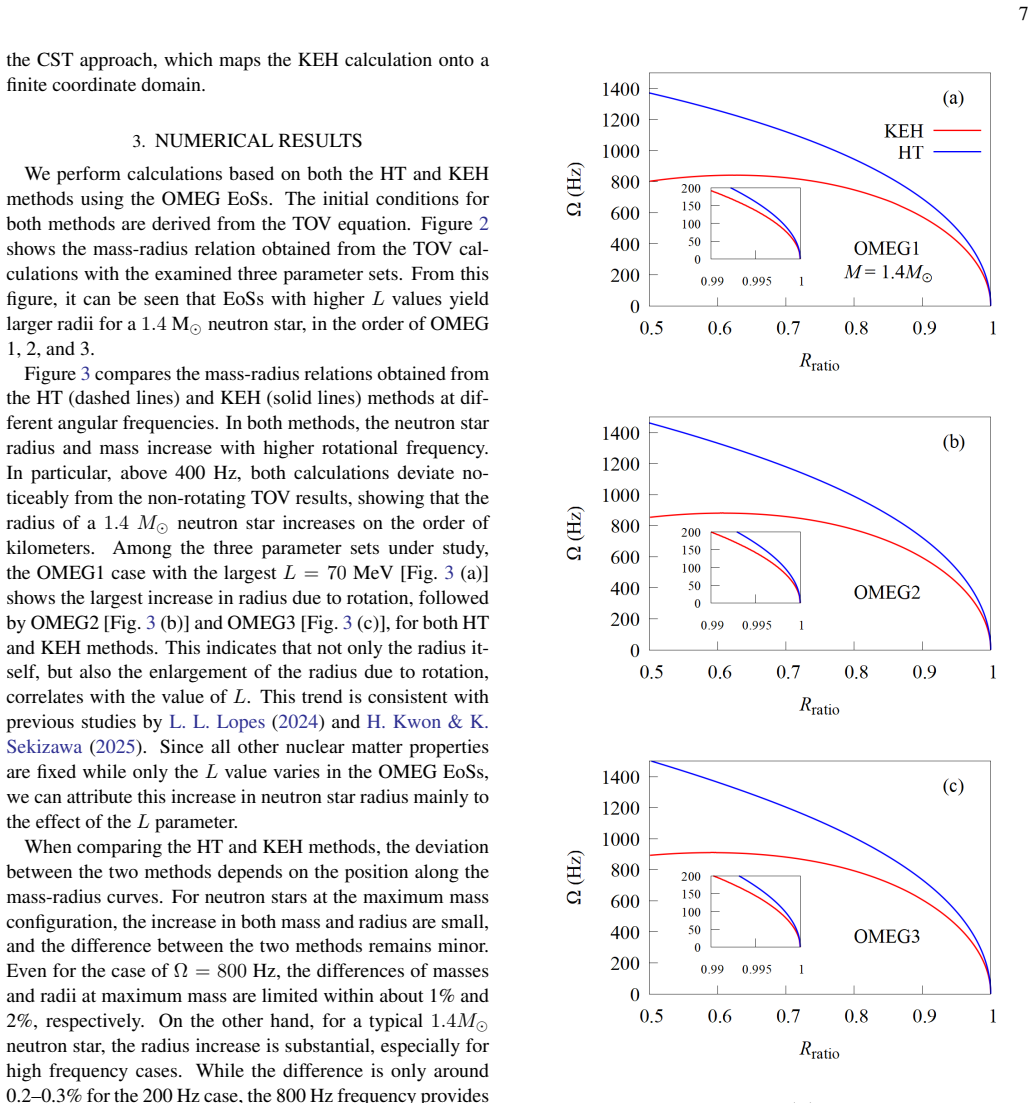
The paper's central claim is that the second-order Hartle-Thorne approximation is not accurate enough for rotating neutron stars above roughly 200 Hz. Using the OMEG series of nuclear equations of state — three relativistic mean-field parameter sets designed to differ only in the symmetry-energy slope L, with L = 70, 45, and 20 MeV — the authors show that rotation inflates the radius of a 1.4-solar-mass star by an L-dependent amount, and that HT misses much of this inflation. At 200 Hz the HT and KEH radii agree to about 0.2-0.3%, but at 800 Hz the HT radius is 6.9-8.4% smaller than the KEH value, and the deformation ratio R_polar/R_equatorial is wrong by 15-27%, with the largest error for t
Load-bearing premise
The conclusion that larger L drives the larger rotation-induced radius increase depends on the OMEG1/2/3 family truly isolating L, yet Table 1 shows the symmetry energy S0 drifts from 35.06 to 30.00 MeV and OMEG3 required an artificial crust-core connection, so if the family is not a clean L-isolation set the attribution is weakened.
Editorial extensions
If this is right
- At spin frequencies relevant to known millisecond pulsars (200-700 Hz), radius and ellipticity estimates obtained from Hartle-Thorne should be treated as unreliable; HT underestimates the radius by several percent at the high end.
- Because rotational stability and mass-shedding limits are controlled by deformation, the 15-27% deformation-ratio error means HT-based stability criteria are not dependable above a few hundred hertz.
- Because the discrepancy grows with L, attempts to constrain the symmetry-energy slope from measured pulsar radii must use fully relativistic models to avoid a stiffness-dependent bias.
- For maximum-mass configurations the two methods nearly agree, so TOV and HT remain adequate for questions about the maximum mass and its radius even at 800 Hz.
Reading between the lines
- This goes beyond the paper: because the HT-KEH gap grows with L, existing constraints on L derived from HT-based radius or ellipticity fits to millisecond pulsars may carry a stiffness-dependent bias; refitting those data with KEH could shift the inferred L.
- This goes beyond the paper: the two schemes should also be compared on moment of inertia and quadrupole moment, since those enter pulsar timing and gravitational-wave signals and would likely inherit the same discrepancy, making the effect observable beyond radii.
- This goes beyond the paper: if the equation-of-state dependence of the gap is real, the spin frequency at which HT becomes unreliable is not universal but scales with stellar compactness; testing that scaling across many EoS families would turn the paper's qualitative conclusion into a quantitative rule.
Editorial analysis
A structured set of objections, weighed in public.
Referee Report
Summary. The manuscript presents a comparative study of the Hartle–Thorne (HT) perturbative method and the fully general-relativistic Komatsu–Eriguchi–Hachisu (KEH) method for rotating neutron stars, using three OMEG equations of state designed to have different symmetry-energy slopes L. The authors compute mass–radius relations and deformation ratios R_ratio at rotation frequencies up to 800 Hz and find that (i) HT and KEH results diverge appreciably at high frequencies, with radius discrepancies of 7–8% at 800 Hz and deformation-ratio errors of 15–27%, and (ii) the rotation-induced radius increase is larger for EoSs with larger L. The paper concludes that the HT method is inadequate for detailed studies of rapidly rotating stars and that the fully relativistic KEH method is indispensable.
Significance. If the conclusions hold, the paper would provide a useful quantitative benchmark for the accuracy of the HT approximation across a range of nuclear equations of state, and would strengthen the case that the slope of the symmetry energy L correlates with rotational deformation and the rotational enhancement of stellar radius. The central qualitative trend—that HT and KEH diverge at high rotation—is consistent with previous work (e.g., Kacskovics et al. 2023; Kwon & Sekizawa 2025) and appears robust to the specific EoS parametrization. The study uses standard, independently implemented methods (TOV, HT, and KEH), and the numerical results are presented in sufficient detail for Tables 2 and 3 to be checked. However, the paper's second objective—isolating the effect of L—is undermined by the fact that the OMEG family does not keep the symmetry energy at saturation S0 fixed, and by an artificial pressure patching for OMEG3. These confounds weaken the attribution of the observed trend to L specifically. The paper also uses a potentially misleading error metric for the deformation ratio, which overstates the agreement between HT and KEH at low frequencies.
major comments (4)
- [Table 1 and §2.1; §3] The claim that the OMEG series isolates L is not supported by the data. Table 1 shows S0 varying from 35.06 to 30.00 MeV across OMEG1–OMEG3, a 14% change. The text of §2.1 dismisses this as a 'minor difference in S0', but §3 and the Conclusion state that 'all other nuclear matter properties are fixed' and that the results reveal the 'pure effect of L'. Since S0 itself is a known determinant of neutron-star radii, the observed monotonic increase in rotation-induced radius growth with L cannot be unambiguously attributed to L. Please either (a) construct an EoS family in which S0 is strictly fixed, (b) quantify the sensitivity of the computed radii and deformation to the S0 variation (e.g., by a covariance analysis or by re-fitting the isovector parameters to hold S0 constant), or (c) substantially soften the language attributing the trend to L alone. As written, the second objective is no
- [§2.1 (OMEG3 pressure patch)] The artificial connection of the OMEG3 core EoS to the MYN13 crust is a potential source of systematic error. The paper states that the original OMEG3 pressure temporarily falls below the crust pressure, so the two segments were 'artificially connected to ensure continuity'. Such a patch can introduce a kink or a non-physical derivative in P(ε), directly affecting the computed stellar radius and its response to rotation. No demonstration is provided that the patched EoS is thermodynamically consistent (e.g., monotonic P(ε), continuous speed of sound) or that the main conclusions are insensitive to the patching procedure. This is especially problematic for OMEG3, which is the key low-L point in the trend. Please show that the patched EoS does not introduce spurious effects, or exclude OMEG3 from the L-trend analysis and replace it with an unproblematic low-L EoS.
- [§3, Fig. 4 and Table 3] There is an internal inconsistency in the reported R_ratio–Ω relation for the KEH method. The text states that at R_ratio = 0.5, the KEH frequency is about 800 Hz for OMEG1 and about 900 Hz for OMEG3. However, Table 3 reports R_ratio^KEH = 0.6787 (OMEG1) and 0.7635 (OMEG3) at Ω = 800 Hz. If the curves in Fig. 4 are monotonic, these two sets of numbers cannot both be correct. The discrepancy affects the quantitative claim about the L-dependence of the deformation and must be resolved. Please correct either the text or the table/figure, and re-evaluate any conclusions that rely on those numbers.
- [Table 3 (error metric)] The 'Error' column in Table 3 computes (R_ratio^HT − R_ratio^KEH)/R_ratio^KEH, which is a relative error in the radius ratio itself. This metric is misleading for the paper's stated goal of assessing rotational deformation. For example, for OMEG1 at 200 Hz, R_ratio^HT = 0.99218 and R_ratio^KEH = 0.98922, so the relative difference in R_ratio is only 0.30%, but the relative difference in the deformation parameter ε = 1 − R_ratio is (0.01078 − 0.00782)/0.01078 ≈ 27.5%. Thus the HT method underestimates the oblateness by about 27% even at 200 Hz, which is not 'agree within a few percent' as the table caption states. The paper should report errors in ε (or in the quadrupole moment) and discuss their implications for the claimed applicability of HT at low frequencies. This directly affects the interpretation of the abstract's statement that the two methods 'deviate from each other even for th
minor comments (6)
- [Abstract] Typo: 'emamine' should be 'examine'.
- [§2.2.2, Eq. (20)] The term 'd¯ω dr 2' is garbled; it should be (d\barω/dr)^2. Please correct the LaTeX/rendering.
- [§2.2.2, Eq. (17)] In Eq. (17), the scaling of \barω is described, but it is not stated that the scaled \barω must be re-integrated into the second-order equations. While this is standard, a brief comment would help readers unfamiliar with the HT method.
- [§3 and Fig. 4] The caption of Fig. 4 says the inset shows 'nearly identical results below 200 Hz', but Table 3 shows errors in R_ratio of 0.30–0.53% at 200 Hz. This is arguably 'nearly identical' for R_ratio itself, but in light of the deformation-error issue (major comment 4), this wording is misleading. Please clarify in terms of the deformation parameter.
- [§2.1] The phrase 'minor difference in the S0 value' is inconsistent with the later claims of 'pure effect of L'. Even if the authors intend to treat S0 as secondary, the manuscript should explicitly acknowledge the 5 MeV variation and discuss its potential impact.
- [References] The DOI for Conde-Ocazionez et al. (2025) appears malformed: '10.1103/c3jx-5487'. Please verify the correct DOI.
Circularity Check
No circular reduction: HT and KEH are independent algorithms; self-citations and the OMEG EoS are not load-bearing, though the L-isolation premise is confounded by S0 variation.
full rationale
The paper's central claims are (1) a direct numerical comparison of two independently formulated stellar-structure algorithms — the HT perturbative ODEs (Eqs. 13–21) and the KEH self-consistent field scheme (Eqs. 28–32) — and (2) a trend in rotational radius increase across the OMEG EoS family. Neither method is fitted to the other: HT is solved at fixed Ω and KEH is iterated at fixed axis ratio, with output Ω compared afterward; no parameter of one method is calibrated to reproduce the other. The EoS tables are taken from the published OMEG construction (Miyatsu et al. 2023) with tabulated nuclear properties in Table 1, and the KEH implementation follows Komatsu et al. 1989 and Cook et al. 1992/1994. Citations to the authors' prior work (Kwon & Sekizawa 2025; Miyatsu et al. 2023, 2025) are descriptive or corroborative, not invoked as a uniqueness theorem or as an ansatz that forbids alternatives. No equation reduces to another by construction. The manuscript's own caveats do flag an imperfect control: Table 1 shows S0 varying from 35.06 to 30.00 MeV while §2.1 states the properties are 'almost the same with minor difference in the S0 value', and §2.1 admits the OMEG3 core/crust match had to be 'artificially connected to ensure continuity.' These are validity/confounding concerns for attributing the trend specifically to L, not circularity: the HT-vs-KEH discrepancy is computed from the actual tabulated EoSs and would stand even if the L-isolation premise fails. Therefore the derivation is not circular; the L-attribution is a scientific-risk flag rather than a circular step.
Assumptions & free parameters
free parameters (3)
- OMEG meson-coupling parameters (g_σ, g_ω, g_ρ, g_δ, g2, g3, c3, Λ_σδ, Λ_ωρ) =
Not listed in this paper; resulting saturation L = 70, 45, 20 MeV
- Artificial OMEG3 crust-core pressure patch =
Unknown; one patching point in density-pressure plane
- S0 variation across OMEG sets =
35.06, 33.00, 30.00 MeV
assumptions (6)
- standard math Einstein field equations with perfect-fluid stress-energy describe neutron-star spacetimes.
- domain assumption Relativistic mean-field approximation and non-linear meson couplings (σ, ω, δ, ρ) give a valid nuclear EoS.
- ad hoc to paper OMEG1-3 isolate L while other saturation properties are fixed.
- domain assumption β-equilibrium, charge neutrality, and matching to the MYN13 crust EoS are valid.
- domain assumption Rigid rotation (j(Ω) = A²(Ω-Ω_c) with A→∞) is a sufficient rotation law for the comparison.
- domain assumption KEH self-consistent-field iterations converge to the exact stationary axisymmetric solution.
Cite this review
Pith. "Pith review of Accuracy and Applicability of the Hartle-Thorne and Komatsu-Eriguchi-Hachisu Methods for Modeling Rotating Neutron Stars." pith.science (2026). https://pith.science/paper/4PX6G6RX
@misc{pith2026251110996,
  author       = {Pith},
  title        = {Pith review of: Accuracy and Applicability of the Hartle-Thorne and Komatsu-Eriguchi-Hachisu Methods for Modeling Rotating Neutron Stars},
  year         = {2026},
  howpublished = {\url{https://pith.science/paper/4PX6G6RX}},
  note         = {Machine review of arXiv:2511.10996}
}
abstract
Neutron stars, which are composed of extremely dense nuclear matter, serve as natural laboratories to study nuclear interactions beyond the terrestrial experiments. Recent researches have actively explored how the equation of state (EoS) can be constrained by observed neutron star masses and radii, and how nuclear interactions affect their macroscopic properties. Most of these studies, however, rely on the Tolman-Oppenheimer-Volkoff (TOV) equations, which assumed static, spherically symmetric neutron stars. Since neutron stars are rotating objects and thus axisymmetrically deformed, the TOV calculation may be insufficient to capture their realistic structure. In this work, we investigate the influence of nuclear matter properties on the physical quantities of rotating neutron stars using two approaches: the perturbative Hartle-Thorne (HT) method and fully general relativistic Komatsu-Eriguchi-Hachisu (KEH) method. For nuclear EoS parameter sets, we emamine the OMEG series, in which the slope of the symmetry energy $L$ is systematically varied. We find that rotational effects lead to a noticeable increase in the stellar radius, which depends sensitively on values of $L$. Additionally, focusing on the rotational deformation, we show that the results obtained by these two methods deviate each other even for the slowly rotating case such as $\Omega=200$ Hz. These results reveal that, for detailed discussions on the internal structure and stability of rotating neutron stars, the fully general relativistic method such as KEH is indispensable.
Figures


Figures from the paper (1 more)
Reference graph
Works this paper leans on
-
[1]
Abbott, B. P., Abbott, R., Abbott, T. D., et al. 2018, Phys. Rev. Lett., 121, 161101, doi: 10.1103/PhysRevLett.121.161101
-
[2]
Adhikari, D., Albataineh, H., Androic, D., et al. 2021, Phys. Rev. Lett., 126, 172502, doi: 10.1103/PhysRevLett.126.172502
-
[3]
Adhikari, D., Albataineh, H., Androic, D., et al. 2022, Phys. Rev. Lett., 129, 042501, doi: 10.1103/PhysRevLett.129.042501
-
[4]
Benhar, O., Ferrari, V ., Gualtieri, L., & Marassi, S. 2005, Phys. Rev. D, 72, 044028, doi: 10.1103/PhysRevD.72.044028
-
[5]
Conde-Ocazionez, C., Yin, T., Noronha-Hostler, J., & Yunes, N. 2025, Phys. Rev. D, 112, 044063, doi: 10.1103/c3jx-5487
-
[6]
Cook, G. B., Shapiro, S. L., & Teukolsky, S. A. 1992, ApJ, 398, 203, doi: 10.1086/171849
-
[7]
Cook, G. B., Shapiro, S. L., & Teukolsky, S. A. 1994, ApJ, 422, 227, doi: 10.1086/173721 Dechargé, J., & Gogny, D. 1980, Phys. Rev. C, 21, 1568, doi: 10.1103/PhysRevC.21.1568
doi:10.1086/173721 1994
-
[8]
1916, Annalen Phys., 49, 769, doi: 10.1002/andp.19163540702
Einstein, A. 1916, Annalen Phys., 49, 769, doi: 10.1002/andp.19163540702
Show all 34 references
-
[9]
2013, The Astrophysical Journal, 773, doi: 10.1088/0004-637X/773/2/141
Gotthelf, E., Halpern, J., Allen, B., & Knispel, B. 2013, The Astrophysical Journal, 773, doi: 10.1088/0004-637X/773/2/141
2013 doi
-
[10]
1986, ApJS, 61, 479, doi: 10.1086/191121
Hachisu, I. 1986, ApJS, 61, 479, doi: 10.1086/191121
1986 doi
-
[11]
K., Thorne, K
Harrison, B. K., Thorne, K. S., Wakano, M., & Wheeler, J. A. 1965, Gravitation Theory and Gravitational Collapse
1965
-
[12]
Hartle, J. B. 1967, ApJ, 150, 1005, doi: 10.1086/149400
1967 doi
- [13]
-
[14]
Hessels, J. W. T., Ransom, S. M., Stairs, I. H., et al. 2006, Science, 311, 1901, doi: 10.1126/science.1123430
2006 doi
-
[15]
2023, Astronomische Nachrichten, 344, e220109, doi: https://doi.org/10.1002/asna.20220109
Kacskovics, B., Barta, D., & Vasúth, M. 2023, Astronomische Nachrichten, 344, e220109, doi: https://doi.org/10.1002/asna.20220109
2023 doi
-
[16]
1989, MNRAS, 237, 355, doi: 10.1093/mnras/237.2.355
Komatsu, H., Eriguchi, Y ., & Hachisu, I. 1989, MNRAS, 237, 355, doi: 10.1093/mnras/237.2.355
1989 doi
-
[17]
1989, Monthly Notices of the Royal Astronomical Society, 239, 153, doi: 10.1093/mnras/239.1.153
Komatsu, H., Eriguchi, Y ., & Hachisu, I. 1989, Monthly Notices of the Royal Astronomical Society, 239, 153, doi: 10.1093/mnras/239.1.153
1989 doi
- [18]
-
[19]
G., & Poisson, E
Laarakkers, W. G., & Poisson, E. 1999, The Astrophysical Journal, 512, 282, doi: 10.1086/306732
1999 doi
-
[20]
Lopes, L. L. 2024, The Astrophysical Journal, 966, 184, doi: 10.3847/1538-4357/ad391e 10
2024 doi
-
[21]
C., Lamb, F
Miller, M. C., Lamb, F. K., Dittmann, A. J., et al. 2019, The Astrophysical Journal Letters, 887, L24, doi: 10.3847/2041-8213/ab50c5
2019 doi
-
[22]
2023, Phys
Miyatsu, T., Cheoun, M.-K., Kim, K., & Saito, K. 2023, Phys. Lett. B, 843, 138013, doi: 10.1016/j.physletb.2023.138013
2023
-
[23]
2025, Frontiers in Physics, V olume 12 - 2024, doi: 10.3389/fphy.2024.1531475
Miyatsu, T., Cheoun, M.-K., Kim, K., & Saito, K. 2025, Frontiers in Physics, V olume 12 - 2024, doi: 10.3389/fphy.2024.1531475
2025
-
[24]
2013, The Astrophysical Journal, 777, 4, doi: 10.1088/0004-637X/777/1/4
Miyatsu, T., Yamamuro, S., & Nakazato, K. 2013, The Astrophysical Journal, 777, 4, doi: 10.1088/0004-637X/777/1/4
2013 doi
- [25]
-
[26]
R., & V olkoff, G
Oppenheimer, J. R., & V olkoff, G. M. 1939, Phys. Rev., 55, 374, doi: 10.1103/PhysRev.55.374
1939 doi
-
[27]
D., & Walecka, J
Serot, B. D., & Walecka, J. D. 1986, Adv. Nucl. Phys., 16, 1
1986
-
[28]
1958, Nuclear Physics, 9, 615, doi: https://doi.org/10.1016/0029-5582(58)90345-6
Skyrme, T. 1958, Nuclear Physics, 9, 615, doi: https://doi.org/10.1016/0029-5582(58)90345-6
1958 doi
-
[29]
Stergioulas, N., & Friedman, J. L. 1995, ApJ, 444, 306, doi: 10.1086/175605
1995 doi
-
[30]
Sun, B., Bhattiprolu, S., & Lattimer, J. M. 2024, Phys. Rev. C, 109, 055801, doi: 10.1103/PhysRevC.109.055801
2024 doi
-
[31]
Tolman, R. C. 1934, Proc. Nat. Acad. Sci., 20, 169, doi: 10.1073/pnas.20.3.169
1934 doi
-
[32]
Tsuruta, S., & Cameron, A. G. W. 1966, Canadian Journal of Physics, 44, 1895, doi: 10.1139/p66-157
1966 doi
-
[33]
Walecka, J. D. 1974, Annals of Physics, 83, 491, doi: 10.1016/0003-4916(74)90208-5
1974 doi
-
[34]
T., Guillot, S., Bogdanov, S., et al
Wolff, M. T., Guillot, S., Bogdanov, S., et al. 2021, The Astrophysical Journal Letters, 918, L26, doi: 10.3847/2041-8213/ac158e
2021 doi
Reviewed August 3, 2026 · model on record in the stance chip above.
Discussion (0). Sign in to comment.