The Persistence of Cultural Memory: Investigating Multimodal Iconicity in Diffusion Models
Pith reviewed 2026-05-17 21:49 UTC · model grok-4.3
The pith
Diffusion models respond to culturally iconic prompts through separate processes of recognizing a reference and then realizing it via replication or reinterpretation.
A machine-rendered reading of the paper's core claim, the machinery that carries it, and where it could break.
Core claim
The behavior of diffusion models in culturally iconic settings cannot be reduced to simple reproduction but depends on how references are recognized and realized. The Cultural Reference Transformation metric isolates these two dimensions and reveals model-specific patterns when applied to 767 Wikidata-derived references spanning still and moving imagery. Recognition further correlates with training data frequency, textual uniqueness, reference popularity, and creation date, while prompt perturbations demonstrate persistent reproduction of iconic visual structures.
What carries the argument
The Cultural Reference Transformation (CRT) metric, which separates recognition of a cultural reference from its realization through replication or reinterpretation.
If this is right
- Some diffusion models exhibit weaker recognition of cultural references while others rely more on visual replication when handling iconic prompts.
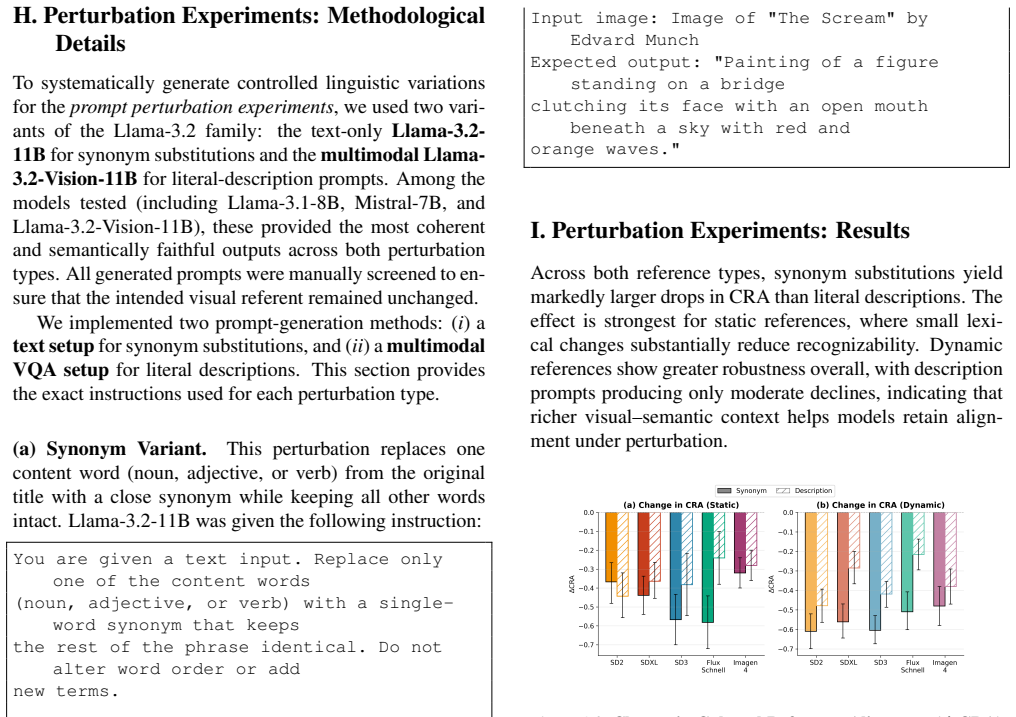
- Models continue to reproduce iconic visual structures even after textual cues are altered through synonym substitutions or literal image descriptions.
- Recognition strength correlates with training data frequency, textual uniqueness, reference popularity, and creation date.
- Evaluation of text-to-image models must account for both recognition and realization rather than relying on basic matching metrics alone.
Where Pith is reading between the lines
- The framework could be applied to other generative systems to detect similar cultural grounding patterns in outputs.
- Training procedures might explicitly reward reinterpretation over replication to reduce unwanted visual copying of popular references.
- Future benchmarks could include controlled variations in reference popularity to isolate its effect on model behavior.
Load-bearing premise
The 767 Wikidata-derived cultural references form a representative sample of multimodal iconicity and the CRT metric isolates recognition from realization without model-specific or reference-specific confounds.
What would settle it
Running the same evaluation on a fresh set of cultural references matched for frequency but drawn from non-iconic sources and finding identical recognition rates across models would indicate the patterns are not driven by cultural specificity.
Figures



read the original abstract
The ambiguity between generalization and memorization in TTI diffusion models becomes pronounced when prompts invoke culturally shared visual references, a phenomenon we term multimodal iconicity. These are instances in which images and texts reflect established cultural associations, such as when a title recalls a familiar artwork or film scene. Such cases challenge existing approaches to evaluating memorization, as they define a setting in which instance-level memorization and culturally grounded generalization are structurally intertwined. To address this challenge, we propose an evaluation framework to assess a model's ability to remain culturally grounded without relying on visual replication. Specifically, we introduce the Cultural Reference Transformation (CRT) metric, which separates two dimensions of model behavior: Recognition, whether a model evokes a reference, from Realization, how it depicts it through replication or reinterpretation. We evaluate five diffusion models on 767 Wikidata-derived cultural references, covering both still and moving imagery, and find differences in how they respond to multimodal iconicity: some show weaker recognition, while others rely more heavily on replication. To assess linguistic sensitivity, we conduct prompt perturbation experiments using synonym substitutions and literal image descriptions, finding that models often reproduce iconic visual structures even when textual cues are altered. Finally, we find that cultural reference recognition correlates not only with training data frequency, but also textual uniqueness, reference popularity, and creation date. Our findings show that the behavior of diffusion models in culturally iconic settings cannot be reduced to simple reproduction, but depends on how references are recognized and realized, advancing evaluation beyond simple text-image matching toward richer contextual understanding.
Editorial analysis
A structured set of objections, weighed in public.
Referee Report
Summary. The paper examines multimodal iconicity in text-to-image diffusion models, where prompts invoke culturally shared visual references (e.g., artworks or film scenes). It introduces the Cultural Reference Transformation (CRT) metric to separate Recognition (whether the model evokes the reference) from Realization (replication versus reinterpretation), evaluates five models on 767 Wikidata-derived references, conducts synonym-substitution and literal-description prompt perturbations, and reports correlations between recognition and factors including training-data frequency, textual uniqueness, reference popularity, and creation date. The central claim is that model behavior under cultural iconicity cannot be reduced to simple reproduction but depends on these separable dimensions.
Significance. If the CRT metric validly isolates the two dimensions without model- or reference-specific confounds, the work strengthens evaluation of generative models by incorporating cultural grounding and contextual understanding beyond standard text-image similarity. The scale of the reference set, use of external Wikidata grounding, and perturbation experiments supply a reproducible empirical basis for comparing models on memorization-versus-generalization trade-offs.
major comments (2)
- [§3 (CRT Metric)] §3 (CRT Metric): Recognition and Realization are both scored from visual features of the identical generated images. This risks circularity because any model-specific generation bias or prompt sensitivity directly couples the two scores, undermining the claim that models differ independently on these dimensions and that prompt-perturbation results cleanly isolate linguistic sensitivity.
- [§4 (Evaluation and Results)] §4 (Evaluation and Results): The manuscript reports model differences, perturbation outcomes, and correlations with popularity/date but supplies no quantitative tables, error analysis, baseline comparisons, or statistical tests for the CRT scores. Without these, the magnitude and reliability of the reported differences cannot be assessed.
minor comments (2)
- [§3.1] Clarify the exact similarity thresholds, feature extractors, or decision rules used to operationalize Recognition versus Realization in the CRT definition.
- [Discussion] Add a limitations paragraph addressing potential selection bias in the 767 Wikidata references and any reference-specific confounds in the metric.
Simulated Author's Rebuttal
We thank the referee for their careful reading and constructive comments, which help strengthen the presentation of our evaluation framework. We address each major comment below, indicating planned revisions where appropriate.
read point-by-point responses
-
Referee: [§3 (CRT Metric)] §3 (CRT Metric): Recognition and Realization are both scored from visual features of the identical generated images. This risks circularity because any model-specific generation bias or prompt sensitivity directly couples the two scores, undermining the claim that models differ independently on these dimensions and that prompt-perturbation results cleanly isolate linguistic sensitivity.
Authors: We appreciate the concern regarding potential coupling. Recognition is operationalized via binary detection of presence/absence of a small set of reference-specific visual attributes drawn from Wikidata (e.g., distinctive objects, composition, or color palette), while Realization is scored separately as a continuous deviation measure using a perceptual hash distance focused on overall visual fidelity to the source image. These use distinct feature sets and decision thresholds, allowing the two dimensions to vary independently across models and prompts. The perturbation experiments further support separability by showing that synonym changes often reduce Recognition scores while leaving Realization largely unchanged. We will expand §3 with explicit scoring formulas, attribute lists, and an ablation demonstrating that the two scores are not deterministically linked. revision: yes
-
Referee: [§4 (Evaluation and Results)] §4 (Evaluation and Results): The manuscript reports model differences, perturbation outcomes, and correlations with popularity/date but supplies no quantitative tables, error analysis, baseline comparisons, or statistical tests for the CRT scores. Without these, the magnitude and reliability of the reported differences cannot be assessed.
Authors: We agree that the current version lacks sufficient quantitative detail for readers to evaluate effect sizes and statistical reliability. The revised manuscript will include: (1) a table of mean CRT Recognition and Realization scores per model with standard deviations and 95% confidence intervals; (2) an error analysis breaking down false-positive and false-negative cases by reference type (artwork vs. film scene); (3) baseline comparisons against CLIP cosine similarity and LPIPS; and (4) Pearson correlations with p-values for the reported factors (training-data frequency, textual uniqueness, popularity, creation date). These additions will be placed in §4 and the appendix. revision: yes
Circularity Check
No significant circularity; empirical metric on external references
full rationale
The paper is an empirical evaluation study that introduces the CRT metric to separate recognition and realization on 767 Wikidata-derived cultural references. It relies on external data sources, prompt perturbation experiments, and generated image assessments rather than any derivation chain, fitted parameters, or self-referential equations that reduce reported outcomes to quantities defined within the paper itself. No load-bearing steps match the enumerated circularity patterns, and the central claims remain independent of internal self-definition or self-citation chains.
Axiom & Free-Parameter Ledger
axioms (1)
- domain assumption Wikidata entries provide an unbiased and representative sample of culturally shared visual references
invented entities (2)
-
multimodal iconicity
no independent evidence
-
Cultural Reference Transformation (CRT) metric
no independent evidence
Lean theorems connected to this paper
-
IndisputableMonolith/Foundation/AbsoluteFloorClosure.leanreality_from_one_distinction unclear?
unclearRelation between the paper passage and the cited Recognition theorem.
We introduce the Cultural Reference Transformation (CRT) metric, which separates two dimensions of model behavior: Recognition, whether a model evokes a reference, from Realization, how it depicts it through replication or reinterpretation.
What do these tags mean?
- matches
- The paper's claim is directly supported by a theorem in the formal canon.
- supports
- The theorem supports part of the paper's argument, but the paper may add assumptions or extra steps.
- extends
- The paper goes beyond the formal theorem; the theorem is a base layer rather than the whole result.
- uses
- The paper appears to rely on the theorem as machinery.
- contradicts
- The paper's claim conflicts with a theorem or certificate in the canon.
- unclear
- Pith found a possible connection, but the passage is too broad, indirect, or ambiguous to say the theorem truly supports the claim.
Reference graph
Works this paper leans on
-
[1]
Stable diffusion v2.1 and dreamstu- dio update.https : / / stability
Stability AI. Stable diffusion v2.1 and dreamstu- dio update.https : / / stability . ai / blog / stablediffusion2 - 1 - release7 - dec - 2022,
work page 2022
-
[2]
Accessed: November 4, 2025. 2, 7
work page 2025
-
[3]
Easily acces- sible text-to-image generation amplifies demographic stereo- types at large scale
Federico Bianchi, Pratyusha Kalluri, Esin Durmus, Faisal Ladhak, Myra Cheng, Debora Nozza, Tatsunori Hashimoto, Dan Jurafsky, James Zou, and Aylin Caliskan. Easily acces- sible text-to-image generation amplifies demographic stereo- types at large scale. InProceedings of the 2023 ACM con- ference on fairness, accountability, and transparency, pages 1493–15...
work page 2023
-
[4]
Flux.1-schnell.https : / / huggingface
Black Forest Labs. Flux.1-schnell.https : / / huggingface . co / black - forest - labs / FLUX . 1-schnell, 2024. Model card. 2
work page 2024
-
[5]
Montrage: Moni- toring training for attribution of generative diffusion models
Jonathan Brokman, Omer Hofman, Roman Vainshtein, Amit Giloni, Toshiya Shimizu, Inderjeet Singh, Oren Rachmil, Alon Zolfi, Asaf Shabtai, Yuki Unno, et al. Montrage: Moni- toring training for attribution of generative diffusion models. InEuropean Conference on Computer Vision, pages 1–17. Springer, 2024. 1, 2
work page 2024
-
[6]
Marc Brysbaert, Amy Beth Warriner, and Victor Kuperman. Concreteness ratings for 40 thousand generally known en- glish word lemmas.Behavior research methods, 46(3):904– 911, 2014. 7
work page 2014
-
[7]
Nicholas Carlini, Matthew Jagielski, Chiyuan Zhang, Nico- las Papernot, Andreas Terzis, and Florian Tramer. The pri- vacy onion effect: Memorization is relative.Advances in Neural Information Processing Systems, 35:13263–13276,
-
[8]
Extracting training data from diffu- sion models
Nicolas Carlini, Jamie Hayes, Milad Nasr, Matthew Jagiel- ski, Vikash Sehwag, Florian Tramer, Borja Balle, Daphne Ip- polito, and Eric Wallace. Extracting training data from diffu- sion models. In32nd USENIX security symposium (USENIX Security 23), pages 5253–5270, 2023. 1, 2
work page 2023
-
[9]
Emerg- ing properties in self-supervised vision transformers
Mathilde Caron, Hugo Touvron, Ishan Misra, Hervé Jégou, Julien Mairal, Piotr Bojanowski, and Armand Joulin. Emerg- ing properties in self-supervised vision transformers. InPro- ceedings of the IEEE/CVF international conference on com- puter vision, pages 9650–9660, 2021. 4
work page 2021
-
[10]
The myth of culturally agnostic ai models
Eva Cetinic. The myth of culturally agnostic ai models. arXiv preprint arXiv:2211.15271, 2022. 2
-
[11]
Giannis Daras, Kulin Shah, Yuval Dagan, Aravind Gol- lakota, Alex Dimakis, and Adam Klivans. Ambient diffu- sion: Learning clean distributions from corrupted data.Ad- vances in Neural Information Processing Systems, 36:288– 313, 2023. 2
work page 2023
-
[12]
Matthijs Douze, Alexandr Guzhva, Chengqi Deng, Jeff Johnson, Gergely Szilvasy, Pierre-Emmanuel Mazaré, Maria Lomeli, Lucas Hosseini, and Hervé Jégou. The faiss library. IEEE Transactions on Big Data, 2025. 7
work page 2025
-
[13]
Scaling recti- fied flow transformers for high-resolution image synthesis
Patrick Esser, Sumith Kulal, Andreas Blattmann, Rahim Entezari, Jonas Müller, Harry Saini, Yam Levi, Dominik Lorenz, Axel Sauer, Frederic Boesel, et al. Scaling recti- fied flow transformers for high-resolution image synthesis. InForty-first international conference on machine learning,
-
[14]
Erasing concepts from diffusion models
Rohit Gandikota, Joanna Materzynska, Jaden Fiotto- Kaufman, and David Bau. Erasing concepts from diffusion models. InProceedings of the IEEE/CVF international con- ference on computer vision, pages 2426–2436, 2023. 1, 2
work page 2023
-
[15]
Google DeepMind. Imagen 4.https://deepmind. google/models/imagen/, 2025. Model overview. 2
work page 2025
-
[16]
University of Chicago Press, 2007
Robert Hariman and John Louis Lucaites.No caption needed: Iconic photographs, public culture, and liberal democracy. University of Chicago Press, 2007. 2
work page 2007
-
[17]
Ai art and its impact on artists
Harry H Jiang, Lauren Brown, Jessica Cheng, Mehtab Khan, Abhishek Gupta, Deja Workman, Alex Hanna, Johnathan Flowers, and Timnit Gebru. Ai art and its impact on artists. InProceedings of the 2023 AAAI/ACM Conference on AI, Ethics, and Society, pages 363–374, 2023. 2
work page 2023
-
[18]
Computational hermeneutics: Evaluating generative ai as a cultural technology
Cody Kommers, Ruth Ahnert, Maria Antoniak, Emmanouil Benetos, Steve Benford, Mercedes Bunz, Baptiste Carami- aux, Shauna Concannon, Martin Disley, James Dobson, et al. Computational hermeneutics: Evaluating generative ai as a cultural technology. 2025. 2
work page 2025
-
[19]
Sasha Luccioni, Christopher Akiki, Margaret Mitchell, and Yacine Jernite. Stable bias: Evaluating societal representa- tions in diffusion models.Advances in Neural Information Processing Systems, 36:56338–56351, 2023. 1
work page 2023
-
[20]
Coen D Needell and Wilma A Bainbridge. Embracing new techniques in deep learning for estimating image memorabil- ity.Computational Brain & Behavior, 5(2):168–184, 2022. 7
work page 2022
-
[21]
Maria-Teresa De Rosa Palmini and Eva Cetinic. Synthetic history: Evaluating visual representations of the past in dif- fusion models.arXiv preprint arXiv:2505.17064, 2025. 1
-
[22]
Photojournalism and foreign policy: Icons of outrage in international crises.(No Title), 1998
David D Perlmutter. Photojournalism and foreign policy: Icons of outrage in international crises.(No Title), 1998. 2
work page 1998
-
[23]
A self-supervised descriptor for image copy detection
Ed Pizzi, Sreya Dutta Roy, Sugosh Nagavara Ravindra, Priya Goyal, and Matthijs Douze. A self-supervised descriptor for image copy detection. InProceedings of the IEEE/CVF Con- ference on Computer Vision and Pattern Recognition, pages 14532–14542, 2022. 1, 3, 4
work page 2022
-
[24]
SDXL: Improving Latent Diffusion Models for High-Resolution Image Synthesis
Dustin Podell, Zion English, Kyle Lacey, Andreas Blattmann, Tim Dockhorn, Jonas Müller, Joe Penna, and Robin Rombach. Sdxl: Improving latent diffusion mod- els for high-resolution image synthesis.arXiv preprint arXiv:2307.01952, 2023. 2
work page internal anchor Pith review Pith/arXiv arXiv 2023
-
[25]
Learning transferable visual models from natural language supervi- sion
Alec Radford, Jong Wook Kim, Chris Hallacy, Aditya Ramesh, Gabriel Goh, Sandhini Agarwal, Girish Sastry, Amanda Askell, Pamela Mishkin, Jack Clark, et al. Learning transferable visual models from natural language supervi- sion. InInternational conference on machine learning, pages 8748–8763. PmLR, 2021. 3
work page 2021
-
[26]
Unveiling and mitigating mem- orization in text-to-image diffusion models through cross at- tention
Jie Ren, Yaxin Li, Shenglai Zeng, Han Xu, Lingjuan Lyu, Yue Xing, and Jiliang Tang. Unveiling and mitigating mem- orization in text-to-image diffusion models through cross at- tention. InEuropean Conference on Computer Vision, pages 340–356. Springer, 2024. 2
work page 2024
-
[27]
The computational mem- orability of iconic images.Proceedings http://ceur-ws
Lisa Saleh and Nanne van Noord. The computational mem- orability of iconic images.Proceedings http://ceur-ws. org ISSN, 1613:0073, 2022. 2
work page 2022
-
[28]
LAION-400M: Open Dataset of CLIP-Filtered 400 Million Image-Text Pairs
Christoph Schuhmann, Richard Vencu, Romain Beaumont, Robert Kaczmarczyk, Clayton Mullis, Aarush Katta, Theo Coombes, Jenia Jitsev, and Aran Komatsuzaki. Laion-400m: Open dataset of clip-filtered 400 million image-text pairs. arXiv preprint arXiv:2111.02114, 2021. 7
work page internal anchor Pith review Pith/arXiv arXiv 2021
-
[29]
Christoph Schuhmann, Romain Beaumont, Richard Vencu, Cade Gordon, Ross Wightman, Mehdi Cherti, Theo Coombes, Aarush Katta, Clayton Mullis, Mitchell Worts- man, et al. Laion-5b: An open large-scale dataset for training next generation image-text models.Advances in neural in- formation processing systems, 35:25278–25294, 2022. 7
work page 2022
-
[30]
Nithish Kannen Senthilkumar, Arif Ahmad, Marco Andreetto, Vinodkumar Prabhakaran, Utsav Prabhu, Adji Bousso Dieng, Pushpak Bhattacharyya, and Shachi Dave. Beyond aesthetics: Cultural competence in text-to- image models.Advances in Neural Information Processing Systems, 37:13716–13747, 2024. 1
work page 2024
-
[31]
Oriane Siméoni, Huy V V o, Maximilian Seitzer, Federico Baldassarre, Maxime Oquab, Cijo Jose, Vasil Khalidov, Marc Szafraniec, Seungeun Yi, Michaël Ramamonjisoa, et al. Dinov3.arXiv preprint arXiv:2508.10104, 2025. 4
work page internal anchor Pith review Pith/arXiv arXiv 2025
-
[32]
Diffusion art or digital forgery? investigating data replication in diffusion models
Gowthami Somepalli, Vasu Singla, Micah Goldblum, Jonas Geiping, and Tom Goldstein. Diffusion art or digital forgery? investigating data replication in diffusion models. InPro- ceedings of the IEEE/CVF conference on computer vision and pattern recognition, pages 6048–6058, 2023. 1, 2, 4, 7
work page 2023
-
[33]
Gowthami Somepalli, Vasu Singla, Micah Goldblum, Jonas Geiping, and Tom Goldstein. Understanding and mitigating copying in diffusion models.Advances in Neural Informa- tion Processing Systems, 36:47783–47803, 2023. 7, 8
work page 2023
-
[34]
Intrinsically mem- orable words have unique associations with their meanings
Greta Tuckute, Kyle Mahowald, Phillip Isola, Aude Oliva, Edward Gibson, and Evelina Fedorenko. Intrinsically mem- orable words have unique associations with their meanings. Journal of Experimental Psychology: General, 2025. 7
work page 2025
-
[35]
Mapping the latent spaces of culture
Ted Underwood. Mapping the latent spaces of culture. 2021. 2
work page 2021
-
[36]
The iconicity of the gen- erated image.arXiv preprint arXiv:2509.16473, 2025
Nanne van Noord and Noa Garcia. The iconicity of the gen- erated image.arXiv preprint arXiv:2509.16473, 2025. 2
-
[37]
Mor Ventura, Eyal Ben-David, Anna Korhonen, and Roi Re- ichart. Navigating cultural chasms: Exploring and unlocking the cultural pov of text-to-image models.Transactions of the Association for Computational Linguistics, 13:142–166,
-
[38]
Wikidata: a free collaborative knowledgebase.Communications of the ACM, 57(10):78–85, 2014
Denny Vrande ˇci´c and Markus Krötzsch. Wikidata: a free collaborative knowledgebase.Communications of the ACM, 57(10):78–85, 2014. 2, 3
work page 2014
-
[39]
Evaluating data attribution for text-to-image models
Sheng-Yu Wang, Alexei A Efros, Jun-Yan Zhu, and Richard Zhang. Evaluating data attribution for text-to-image models. InProceedings of the IEEE/CVF International Conference on Computer Vision, pages 7192–7203, 2023. 1, 2
work page 2023
-
[40]
Wenhao Wang, Yifan Sun, Zhentao Tan, and Yi Yang. Image copy detection for diffusion models.Advances in Neural In- formation Processing Systems, 37:14417–14456, 2024. 1, 2, 4
work page 2024
-
[41]
On the de-duplication of laion-2b.arXiv preprint arXiv:2303.12733, 2023
Ryan Webster, Julien Rabin, Loic Simon, and Frederic Ju- rie. On the de-duplication of laion-2b.arXiv preprint arXiv:2303.12733, 2023. 2
-
[42]
evaluating student performance
Laura Weidinger, Inioluwa Deborah Raji, Hanna Wallach, Margaret Mitchell, Angelina Wang, Olawale Salaudeen, Rishi Bommasani, Deep Ganguli, Sanmi Koyejo, and William Isaac. Toward an evaluation science for generative ai systems.arXiv preprint arXiv:2503.05336, 2025. 2
-
[43]
De- tecting, explaining, and mitigating memorization in diffusion models
Yuxin Wen, Yuchen Liu, Chen Chen, and Lingjuan Lyu. De- tecting, explaining, and mitigating memorization in diffusion models. InThe Twelfth International Conference on Learn- ing Representations, 2024. 2
work page 2024
-
[44]
Chiyuan Zhang, Daphne Ippolito, Katherine Lee, Matthew Jagielski, Florian Tramèr, and Nicholas Carlini. Counter- factual memorization in neural language models.Advances in Neural Information Processing Systems, 36:39321–39362,
-
[45]
Forget-me-not: Learning to for- get in text-to-image diffusion models
Gong Zhang, Kai Wang, Xingqian Xu, Zhangyang Wang, and Humphrey Shi. Forget-me-not: Learning to for- get in text-to-image diffusion models. InProceedings of the IEEE/CVF conference on computer vision and pattern recognition, pages 1755–1764, 2024. 2
work page 2024
-
[46]
Yimeng Zhang, Xin Chen, Jinghan Jia, Yihua Zhang, Chongyu Fan, Jiancheng Liu, Mingyi Hong, Ke Ding, and Sijia Liu. Defensive unlearning with adversarial training for robust concept erasure in diffusion models.Advances in neu- ral information processing systems, 37:36748–36776, 2024. 2 The Persistence of Cultural Memory: Investigating Multimodal Iconicity ...
work page 2024
discussion (0)
Sign in with ORCID, Apple, or X to comment. Anyone can read and Pith papers without signing in.