Relativistic Maxwell-Bloch Equations with Applications to Astrophysics
Pith reviewed 2026-05-17 21:46 UTC · model grok-4.3
The pith
Relativistic Maxwell-Bloch equations show that maser and superradiance responses stay preserved across relative velocities while timescales and intensities transform as expected.
A machine-rendered reading of the paper's core claim, the machinery that carries it, and where it could break.
Core claim
The authors derive relativistic Maxwell-Bloch equations by assuming the non-relativistic form holds in each emitter group's instantaneous rest frame and applying Lorentz transformations to the field and polarization variables. For both maser amplification and superradiance, these equations establish that the system's interaction response is preserved at different relative velocities, while relevant timescales and radiation intensity transform in the expected relativistic manner. The level of coherence between groups of emitters traveling at different speeds remains unchanged across all reference frames, and relativistic steady-state maser equations are obtained for practical application.
What carries the argument
The relativistic Maxwell-Bloch equations, obtained by Lorentz-transforming the electromagnetic field and atomic polarization variables while retaining the non-relativistic interaction form in each instantaneous rest frame.
If this is right
- Astronomical maser models can retain the same coherence parameters after applying relativistic scalings to observed times and intensities.
- Superradiance in high-velocity astrophysical flows can be described without velocity-specific adjustments to the coherence.
- Steady-state maser calculations become usable in relativistic regimes by direct application of the transformed equations.
- Data from different observer frames can be compared directly once intensities and durations are scaled relativistically.
Where Pith is reading between the lines
- The invariance of coherence under boosts may simplify modeling of velocity gradients in extended maser regions such as those in star-forming clouds.
- This approach could be tested against time-resolved observations of intensity variations in known relativistic sources like quasar jets.
- Extensions might address other coherent emission processes in astrophysics where relative motion between emitters and observers is significant.
Load-bearing premise
The non-relativistic Maxwell-Bloch equations remain valid in each emitter group's instantaneous rest frame and Lorentz transformations apply directly to polarization and field variables without extra quantum corrections or frame-dependent decoherence.
What would settle it
An observation of velocity-dependent change in coherence level or deviation from expected intensity scaling in a relativistic astrophysical maser source with known velocity would contradict the preservation result.
Figures


read the original abstract
We derive relativistic Maxwell-Bloch equations for potential applications in astronomical environments, where various radiative processes are known to occur, including the maser action and Dicke's superradiance. We show that for both phenomena a radiating system's response is preserved at different relative velocities between the system's rest frame and the observer, while the relevant timescales and the radiation intensity transform as expected from relativistic considerations. We verify that the level of coherence between groups of emitters travelling at different speeds is unchanged in all reference frames. We also derive relativistic versions of the maser equations applicable in the steady-state regime.
Editorial analysis
A structured set of objections, weighed in public.
Referee Report
Summary. The paper derives relativistic Maxwell-Bloch equations by applying Lorentz transformations to the standard non-relativistic Maxwell-Bloch equations evaluated in the instantaneous rest frame of each emitter group. It claims that for maser action and Dicke superradiance the system's response is preserved across relative velocities while timescales and radiation intensity transform as expected relativistically, and that the coherence level between velocity groups remains frame-invariant. Steady-state relativistic maser equations are also presented.
Significance. If the derivation is free of unaccounted relativistic corrections to the two-level dynamics, the invariance results would offer a practical tool for modeling velocity-broadened radiative processes in astrophysical settings such as relativistic jets or high-velocity maser sources, allowing rest-frame calculations to be transformed rather than re-derived in each frame.
major comments (2)
- [Derivation section (following abstract claims)] The central invariance claims for response and inter-group coherence rest on the assumption that the non-relativistic Maxwell-Bloch equations hold unmodified in each instantaneous rest frame with only subsequent Lorentz boosts applied to P and E; this requires explicit justification or a derivation from the relativistic two-level Hamiltonian, as Doppler-shifted detuning, boosted Rabi frequencies, or proper-time evolution of off-diagonal elements could introduce frame-dependent decoherence that would invalidate the reported preservation of |ρ12|.
- [Verification of coherence (post-derivation)] The verification that coherence between emitter groups at different speeds is unchanged lacks explicit reduction to known limits (e.g., v→0 or single-velocity case) or numerical demonstration that the transformed coherence measure remains invariant under the stated Lorentz rules on polarization and field.
minor comments (2)
- [Equation definitions] Explicit Lorentz transformation rules for the vector components of the electric field and polarization should be written out (including any parallel/perpendicular decomposition) rather than stated in prose only.
- [Applications paragraph] A concrete astrophysical example (e.g., a specific velocity distribution in a maser source) would strengthen the applications section.
Simulated Author's Rebuttal
We thank the referee for their careful reading of the manuscript and for the constructive comments, which have helped us identify areas for improvement. We address each major comment below and indicate the revisions planned for the resubmitted version.
read point-by-point responses
-
Referee: [Derivation section (following abstract claims)] The central invariance claims for response and inter-group coherence rest on the assumption that the non-relativistic Maxwell-Bloch equations hold unmodified in each instantaneous rest frame with only subsequent Lorentz boosts applied to P and E; this requires explicit justification or a derivation from the relativistic two-level Hamiltonian, as Doppler-shifted detuning, boosted Rabi frequencies, or proper-time evolution of off-diagonal elements could introduce frame-dependent decoherence that would invalidate the reported preservation of |ρ12|.
Authors: We agree that additional justification is warranted to support the central assumptions. Our approach follows the standard procedure in relativistic treatments of radiative processes, where the atomic response is evaluated in the instantaneous rest frame and then transformed. To address the referee's concern, we will insert a new paragraph in the derivation section that explicitly discusses the Lorentz transformation of the detuning (via the Doppler shift) and the Rabi frequency (via the boosted electric field), while noting that the density-matrix evolution occurs with respect to proper time in each rest frame. This preserves the form of the off-diagonal elements under the boost. We reference supporting literature on relativistic quantum optics for the two-level system but acknowledge that a complete derivation from the relativistic Hamiltonian lies outside the present scope; the revision will make this limitation and the supporting arguments clearer. revision: partial
-
Referee: [Verification of coherence (post-derivation)] The verification that coherence between emitter groups at different speeds is unchanged lacks explicit reduction to known limits (e.g., v→0 or single-velocity case) or numerical demonstration that the transformed coherence measure remains invariant under the stated Lorentz rules on polarization and field.
Authors: We accept that the current verification can be strengthened. In the revised manuscript we will add an explicit analytic reduction to the v → 0 limit, recovering the standard non-relativistic coherence expression, and we will include a short numerical example for a two-velocity-group system that demonstrates invariance of |ρ12| after applying the Lorentz transformations to the polarization and field. These additions will be placed immediately after the coherence-invariance statement. revision: yes
Circularity Check
No significant circularity: derivation applies standard non-relativistic Maxwell-Bloch in rest frames then Lorentz transforms
full rationale
The paper starts from the established non-relativistic Maxwell-Bloch equations assumed valid in each emitter group's instantaneous rest frame, then applies Lorentz transformations to the polarization and electromagnetic field variables to obtain the relativistic versions. The reported preservation of the system's response, the expected transformation of timescales and intensity, and the frame-invariance of coherence between velocity groups are direct mathematical consequences of those transformations under the stated assumptions. No steps reduce by construction to fitted parameters, self-definitional loops, or load-bearing self-citations; the central claims rest on external Lorentz invariance applied to independently stated equations rather than on any renaming or smuggling of results. The derivation is self-contained against the external benchmark of special relativity.
Axiom & Free-Parameter Ledger
axioms (2)
- domain assumption Standard non-relativistic Maxwell-Bloch equations hold in the instantaneous rest frame of each emitter group.
- domain assumption Lorentz transformations can be directly applied to polarization, field, and timescale variables without additional quantum-field corrections.
Lean theorems connected to this paper
-
IndisputableMonolith/Cost/FunctionalEquation.leanwashburn_uniqueness_aczel unclear?
unclearRelation between the paper passage and the cited Recognition theorem.
We derive relativistic Maxwell-Bloch equations ... based on a fully relativistic Hamiltonian in the observer’s frame ... with Lorentz boost γ ... Doppler relation ω=γ ω′₀(1+β)
What do these tags mean?
- matches
- The paper's claim is directly supported by a theorem in the formal canon.
- supports
- The theorem supports part of the paper's argument, but the paper may add assumptions or extra steps.
- extends
- The paper goes beyond the formal theorem; the theorem is a base layer rather than the whole result.
- uses
- The paper appears to rely on the theorem as machinery.
- contradicts
- The paper's claim conflicts with a theorem or certificate in the canon.
- unclear
- Pith found a possible connection, but the passage is too broad, indirect, or ambiguous to say the theorem truly supports the claim.
Reference graph
Works this paper leans on
-
[1]
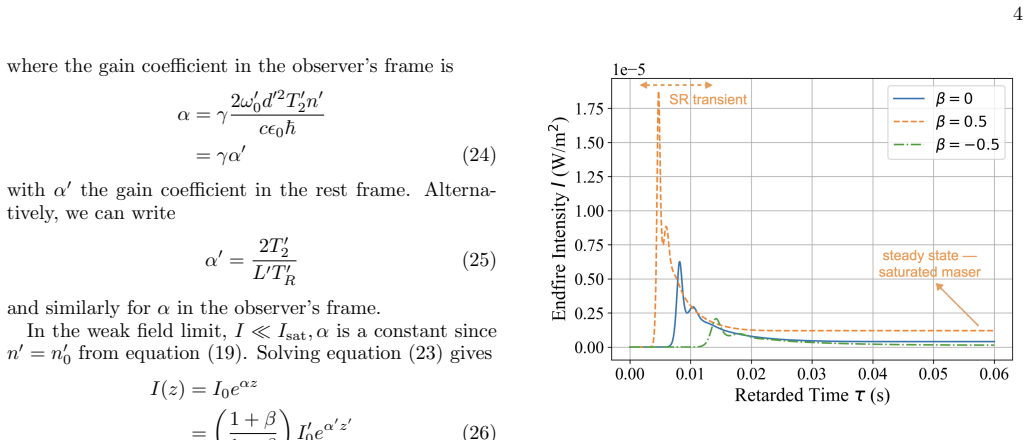
In the fast transient limit,∂P ′+/∂τ≫P ′+/T2, one can write ∂P ′+ ∂τ = 2id′2 ℏ E−n′ 0 (14) ∂E + ∂z =γ iω 2cϵ0 P ′−.(15) These two equations can be combined to yield ∂2P ′+ ∂τ ∂z = 1 L′T ′ R 1 1−β P ′+ = 1 LTR P ′+,(16) where the characteristic superradiance timescale [5, 10] in the rest frame is T ′ R = 8π 3λ′2n′ tL′Γ′ (17) withλ ′ the radiation wavelengt...
work page 2024
-
[2]
R. Bonifacio, Theory of optical maser amplifiers, IEEE Journal of Quantum ElectronicsQE-1, 10.1109/JQE.1965.1072212 (1965)
-
[4]
L. Lugiato, F. Prati, and M. Brambilla,Nonlinear Optical Systems(Cambridge University Press, 2015)
work page 2015
-
[5]
S. L. McCall and E. L. Hahn, Self-induced transparency by pulsed coherent light, Physical Review Letters18, 10.1103/PhysRevLett.18.908 (1967)
-
[6]
M. Gross and S. Haroche, Superradiance: An essay on the theory of collective spontaneous emission (1982)
work page 1982
-
[7]
M. G. Benedict, A. M. Ermolaev, V. A. Malyshev, I. V. Solokov, and E. D. Trifonov,Super-radiance: Mul- tiatomic Coherent Emission, 1st ed. (CRC Press, 1996)
work page 1996
-
[8]
R. H. Dicke, Coherence in spontaneous radiation pro- cesses, Physical Review93, 10.1103/PhysRev.93.99 (1954)
-
[9]
R. H. Dicke, The coherence brightened laser, Quantum Electronics35(1964)
work page 1964
-
[10]
N. Skribanowitz, I. P. Herman, J. C. MacGillivray, and M. S. Feld, Observation of Dicke superradiance in op- tically pumped HF gas, Physical Review Letters30, 10.1103/PhysRevLett.30.309 (1973)
-
[11]
J. C. MacGillivray and M. S. Feld, Theory of superra- diance in an extended, optically thick medium, Physical Review A14, 10.1103/PhysRevA.14.1169 (1976)
-
[12]
J. C. MacGillivray and M. S. Feld, Limits of superradi- ance as a process for achieving short pulses of high en- ergy, Physical Review A23, 10.1103/PhysRevA.23.1334 (1981)
-
[13]
A. V. Andreev, V. I. Emel’yanov, and Y. A. Il’inski˘ ı, Collective spontaneous emission (Dicke superradiance), Soviet Physics - Uspekhi23, 10.1070/PU1980v023n08ABEH005024 (1980)
-
[14]
F. T. Arecchi and E. Courtens, Cooperative phenomena in resonant electromagnetic propagation, Physical Re- view A2, 10.1103/PhysRevA.2.1730 (1970)
-
[15]
F. Rajabi and M. Houde, Dicke’s superradiance in as- trophysics. ii. the OH 1612 MHz line, The Astrophysical Journal828, 10.3847/0004-637x/828/1/57 (2016)
-
[16]
W., et al., 2019, Science, DOI: 10.1126/sci- ence.aaw5903 Barsdell et al., 2010, MNRAS, 408,
F. Rajabi and M. Houde, Explaining recurring maser flares in the ISM through large-scale entangled quan- tum mechanical states, Science Advances3, 10.1126/sci- adv.1601858 (2017)
-
[17]
F. Rajabi, M. Houde, A. Bartkiewicz, M. Olech, M. Szymczak, and P. Wolak, New evidence for Dicke’s superradiance in the 6.7 GHz methanol spectral line in the interstellar medium, Monthly Notices of the Royal Astronomical Society484, 10.1093/mnras/stz074 (2019)
-
[18]
F. Rajabi and M. Houde, Astronomical masers and Dicke’s superradiance, Monthly Notices of the Royal As- tronomical Society494, 10.1093/mnras/staa1067 (2020)
-
[19]
F. Rajabi, M. Houde, G. C. MacLeod, S. Goedhart, Y. Tanabe, S. P. van den Heever, C. M. Wyenberg, and Y. Yonekura, Modelling of the multitransition periodic flaring in G9.62+0.20E, Monthly Notices of the Royal As- tronomical Society526, 10.1093/mnras/stad2671 (2023)
-
[20]
T. Rashidi, V. Anari, A. Bartkiewicz, P. Wolak, M. Szymczak, and F. Rajabi, Modelling the Periodic 6.7 GHz Methanol Flaring in G22.356+0.066, Monthly No- tices of the Royal Astronomical Society542, L12 (2025), arXiv:2409.09209 [astro-ph.HE]
-
[21]
M. S. Feld and J. C. MacGillivray, Superradiance, in Coherent Nonlinear Optics: Recent Advances, edited by 9 M. S. Feld and V. S. Letokhov (Springer Berlin Heidel- berg, Berlin, Heidelberg, 1980) pp. 7–57
work page 1980
-
[22]
M. Houde, A. Mathews, and F. Rajabi, Explain- ing fast radio bursts through Dicke’s superradiance, Monthly Notices of the Royal Astronomical Society475, 10.1093/mnras/stx3205 (2018)
-
[23]
M. Houde, F. Rajabi, B. M. Gaensler, A. Mathews, and V. Tranchant, Triggered superradiance and fast radio bursts, Monthly Notices of the Royal Astronomical Soci- ety482, 10.1093/mnras/sty3046 (2019)
-
[24]
F. Rajabi, M. A. Chamma, C. M. Wyenberg, A. Math- ews, and M. Houde, A simple relationship for the spectro-temporal structure of bursts from FRB 121102, Monthly Notices of the Royal Astronomical Society498, 10.1093/mnras/staa2723 (2020)
-
[25]
M. A. Chamma, F. Rajabi, C. M. Wyenberg, A. Math- ews, and M. Houde, Evidence of a shared spectro- temporal law between sources of repeating fast radio bursts, Monthly Notices of the Royal Astronomical Soci- ety507, 10.1093/mnras/stab2070 (2021)
-
[26]
J. N. Jahns, L. G. Spitler, K. Nimmo, D. M. Hewitt, M. P. Snelders, A. Seymour, J. W. T. Hessels, K. Gourdji, D. Michilli, and G. H. Hilmarsson, The FRB 20121102A November rain in 2018 observed with the Arecibo Tele- scope, Monthly Notices of the Royal Astronomical Soci- ety519, 666 (2023), arXiv:2202.05705 [astro-ph.HE]
-
[27]
M. A. Chamma, F. Rajabi, A. Kumar, and M. Houde, A broad survey of spectro-temporal properties from FRB 20121102A, Monthly Notices of the Royal Astronomical Society522, 10.1093/mnras/stad1108 (2023)
-
[28]
ATOMS: ALMA Three-millimeter Observations of Massive Star-forming Regions - IX
K. Brown, M. A. Chamma, F. Rajabi, A. Kumar, H. Ra- jabi, and M. Houde, Validating the sub-burst slope law: a comprehensive multisource spectro-temporal analysis of repeating fast radio bursts, Monthly Notices of the Royal Astronomical Society: Letters529, 10.1093/mn- rasl/slae012 (2024)
work page doi:10.1093/mn- 2024
-
[29]
M. A. Chamma, V. Pop, and F. Rajabi, High precision spectro-temporal analysis of ultra-fast radio bursts using per-channel arrival times, Monthly Notices of the Royal Astronomical Society , staf1799 (2025), https://academic.oup.com/mnras/advance-article- pdf/doi/10.1093/mnras/staf1799/64819405/staf1799.pdf
work page doi:10.1093/mnras/staf1799/64819405/staf1799.pdf 2025
-
[30]
C. M. Wyenberg, F. Rajabi, and M. Houde, Super- radiance from a relativistic source, New Journal of Physics24, 123046 (2022)
work page 2022
-
[31]
G. Grynberg, A. Aspect, C. Fabre, and C. Cohen- Tannoudji,Introduction to Quantum Optics(Cambridge University Press, 2010)
work page 2010
-
[32]
L. G. Boussiakou, C. R. Bennett, and M. Babiker, Quantum theory of spontaneous emission by real mov- ing atoms, Physical Review Letters89, 10.1103/Phys- RevLett.89.123001 (2002)
-
[33]
C. Cohen-Tannoudji, J. Dupont-Roc, and G. Grynberg, Photons and Atoms: Introduction to Quantum Electro- dynamics(Wiley, New York, 1989)
work page 1989
-
[34]
E. A. Power and S. Zienau, Coulomb gauge in non- relativistic quantum electro-dynamics and the shape of spectral lines, Philosophical Transactions of the Royal Society of London. Series A, Mathematical and Physical Sciences251, 10.1098/rsta.1959.0008 (1959)
-
[35]
R. G. Woolley, Molecular quantum electrodynamics, Pro- ceedings of the Royal Society of London. A. Mathemati- cal and Physical Sciences321, 557 (1971)
work page 1971
discussion (0)
Sign in with ORCID, Apple, or X to comment. Anyone can read and Pith papers without signing in.