Deterministic Switching of Perpendicular Ferromagnets by Higher harmonics of Spin-orbit Torque in Noncentrosymmetric Weyl Semimetals
Pith reviewed 2026-05-17 22:03 UTC · model grok-4.3
The pith
Higher angular harmonics of spin-orbit torques enable deterministic switching of perpendicular ferromagnets even when in-plane mirror symmetries are preserved.
A machine-rendered reading of the paper's core claim, the machinery that carries it, and where it could break.
Core claim
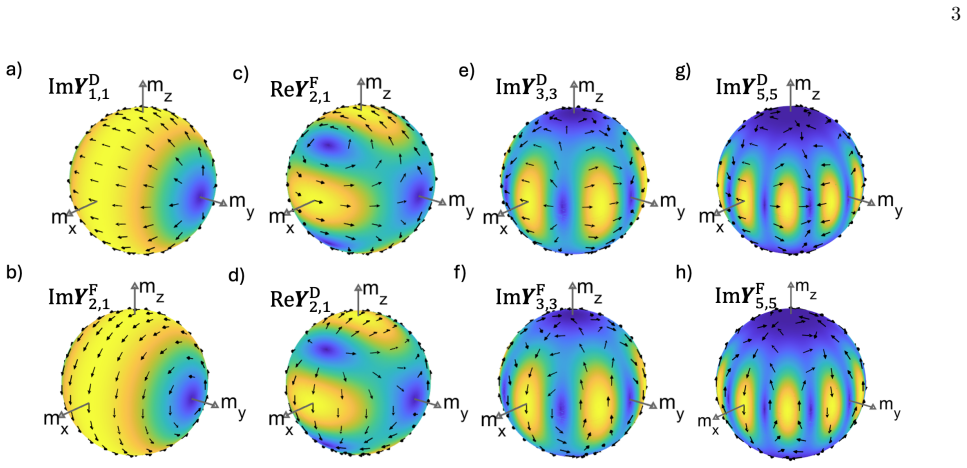
Using a vector spherical harmonics expansion, the higher-harmonic torque components naturally give rise to additional out-of-equator fixed points, enabling reliable magnetization reversal when their magnitude is comparable to conventional lowest-order torques. In PrAlGe, the combination of Weyl-node band topology and strong spin-orbit coupling produces sizable higher-harmonic torque components. The small Fermi surface makes conventional torques relatively weak, allowing higher-order harmonics to compete on equal footing and strongly reshape the magnetization dynamics, confirming deterministic switching without additional symmetry breaking.
What carries the argument
Vector spherical harmonics expansion of spin-orbit torques, which identifies higher angular harmonic components that generate extra out-of-equator fixed points in the magnetization dynamics.
Load-bearing premise
That the higher-harmonic torque components reach magnitudes comparable to the conventional lowest-order torques in the chosen material.
What would settle it
Observation or calculation showing that in PrAlGe or similar materials the higher-harmonic torques are too weak to create the out-of-equator fixed points or fail to produce deterministic switching in spin dynamics simulations.
Figures


read the original abstract
Field-free deterministic switching of perpendicular ferromagnets is a central challenge for spintronics applications, typically requiring explicit symmetry breaking. Here we show that deterministic switching can instead be achieved through higher angular harmonics of spin-orbit torques, even in systems that preserve in-plane mirror symmetries. Using a vector spherical harmonics expansion, we demonstrate that these higher-harmonic torque components naturally give rise to additional out-of-equator fixed points, enabling reliable magnetization reversal when their magnitude is comparable to conventional lowest-order torques. We illustrate this mechanism with first-principles calculations on the noncentrosymmetric Weyl ferromagnet PrAlGe, where the combination of Weyl-node band topology and strong spin-orbit coupling produces sizable higher-harmonic torque components. Because the Fermi surface is small, the conventional lowest-order torques are relatively weak, allowing the higher-order harmonics to compete on equal footing and strongly reshape the magnetization dynamics. The resulting spin dynamics confirm deterministic switching without additional symmetry breaking. Our results establish higher-harmonic spin-orbit torque as a key ingredient for understanding and controlling magnetization dynamics in topological and spintronic materials.
Editorial analysis
A structured set of objections, weighed in public.
Referee Report
Summary. The manuscript proposes that deterministic switching of perpendicular ferromagnets can be realized through higher angular harmonics of spin-orbit torques (SOT) in noncentrosymmetric Weyl semimetals such as PrAlGe, even when in-plane mirror symmetries are preserved. A vector spherical harmonics expansion of the torque is used to identify additional out-of-equator fixed points that enable reliable magnetization reversal provided the higher-harmonic amplitudes are comparable to the conventional lowest-order terms. First-principles calculations on PrAlGe are invoked to argue that Weyl-node topology and strong spin-orbit coupling generate sizable higher-harmonic components, while the small Fermi surface weakens the lowest-order torques, allowing the higher harmonics to reshape the LLG dynamics and produce deterministic switching without external symmetry breaking.
Significance. If the quantitative claim that higher-harmonic torques reach magnitudes sufficient to compete with and reshape the lowest-order torques holds, the work would offer a symmetry-preserving route to field-free switching that exploits the band topology of Weyl ferromagnets, potentially simplifying spintronic device design and broadening the materials palette beyond conventional heavy-metal/ferromagnet bilayers.
major comments (2)
- [First-principles calculations on PrAlGe] The central assertion that higher-harmonic (l ≥ 3) torque components reach magnitudes comparable to the conventional l = 1 terms in PrAlGe is load-bearing for the fixed-point analysis and the deterministic-switching conclusion, yet the first-principles section provides no explicit numerical ratios, angular dependence, or extracted coefficients (e.g., the ratio of the l = 3 to l = 1 torque amplitudes) that would allow the reader to verify the condition under which the effective potential is reshaped.
- [Magnetization dynamics and fixed-point analysis] The LLG dynamics and fixed-point analysis demonstrating reliable reversal are presented as confirmation of the mechanism, but without the quantitative torque coefficients from the first-principles results inserted into the spherical-harmonics expansion, it remains unclear whether the reported trajectories correspond to realistic material parameters or to an illustrative choice of coefficients.
minor comments (2)
- [Abstract and Introduction] The abstract and introduction would benefit from a concise statement of which specific higher orders (l = 3, 5, …) are retained in the vector spherical harmonics expansion.
- [Figures] Figure captions and axis labels should explicitly indicate whether the plotted torque components are normalized or absolute, and whether they are obtained at the Fermi energy or integrated over the Brillouin zone.
Simulated Author's Rebuttal
We thank the referee for their careful reading of our manuscript and for the constructive comments, which help clarify the presentation of our results. We respond to each major comment below and describe the revisions we will implement.
read point-by-point responses
-
Referee: [First-principles calculations on PrAlGe] The central assertion that higher-harmonic (l ≥ 3) torque components reach magnitudes comparable to the conventional l = 1 terms in PrAlGe is load-bearing for the fixed-point analysis and the deterministic-switching conclusion, yet the first-principles section provides no explicit numerical ratios, angular dependence, or extracted coefficients (e.g., the ratio of the l = 3 to l = 1 torque amplitudes) that would allow the reader to verify the condition under which the effective potential is reshaped.
Authors: We agree that explicit numerical values for the torque coefficients are necessary to allow readers to verify the central claim. In the revised manuscript we will report the extracted coefficients from the first-principles calculations on PrAlGe, including the ratios of the l=3 (and higher) torque amplitudes to the conventional l=1 term, together with the corresponding angular dependence. These additions will directly demonstrate that the higher-harmonic components are comparable in magnitude and thereby reshape the effective potential as stated. revision: yes
-
Referee: [Magnetization dynamics and fixed-point analysis] The LLG dynamics and fixed-point analysis demonstrating reliable reversal are presented as confirmation of the mechanism, but without the quantitative torque coefficients from the first-principles results inserted into the spherical-harmonics expansion, it remains unclear whether the reported trajectories correspond to realistic material parameters or to an illustrative choice of coefficients.
Authors: We acknowledge the need to tie the dynamical simulations explicitly to the material-specific coefficients. In the revision we will substitute the quantitative torque coefficients obtained from the PrAlGe first-principles calculations into the spherical-harmonics expansion and the subsequent LLG integrations. The updated trajectories and fixed-point analysis will then be shown to arise from realistic parameters rather than generic illustrative values, and we will add clarifying text that distinguishes the general mechanism from the material-specific demonstration. revision: yes
Circularity Check
No circularity: derivation follows from symmetry expansion and independent first-principles inputs
full rationale
The vector spherical harmonics expansion of the torque is a direct consequence of symmetry considerations and produces additional fixed points mathematically when higher-order coefficients are nonzero. The paper obtains the specific magnitudes of these components via first-principles calculations on PrAlGe rather than fitting them to the switching outcome or to the LLG trajectories themselves. The subsequent dynamics simulations are therefore downstream applications of externally computed inputs. No self-definitional loops, fitted-input predictions, load-bearing self-citations, or ansatz smuggling appear in the chain. The central claim therefore remains independent of its own outputs.
Axiom & Free-Parameter Ledger
axioms (2)
- standard math Vector spherical harmonics provide a complete angular decomposition of the spin-orbit torque vector field.
- domain assumption First-principles electronic structure calculations accurately capture the spin-orbit torque components arising from Weyl-node topology.
Reference graph
Works this paper leans on
-
[1]
A. Manchon, J. ˇZelezn´ y, I. M. Miron, T. Jungwirth, J. Sinova, A. Thiaville, K. Garello, and P. Gambardella, Rev. Mod. Phys.91, 035004 (2019)
work page 2019
-
[2]
J. Grollier, D. Querlioz, K. Y. Camsari, K. Everschor- Sitte, S. Fukami, and M. D. Stiles, Nature Electronics3, 360 (2020)
work page 2020
-
[3]
Q. Shao, P. Li, L. Liu, H. Yang, S. Fukami, A. Razavi, H. Wu, K. Wang, F. Freimuth, Y. Mokrousov, M. D. Stiles, S. Emori, A. Hoffmann, J. Akerman, K. Roy, J.- P. Wang, S.-H. Yang, K. Garello, and W. Zhang, IEEE Transactions on Magnetics57, 1 (2021)
work page 2021
-
[4]
A. Hoffmann, S. Ramanathan, J. Grollier, A. D. Kent, M. J. Rozenberg, I. K. Schuller, O. G. Shpyrko, R. C. Dynes, Y. Fainman, A. Frano, E. E. Fullerton, G. Galli, V. Lomakin, S. P. Ong, A. K. Petford-Long, J. A. Schuller, M. D. Stiles, Y. Takamura, and Y. Zhu, APL Materials10, 070904 (2022)
work page 2022
-
[5]
I. M. Miron, K. Garello, G. Gaudin, P.-J. Zermatten, M. V. Costache, S. Auffret, S. Bandiera, B. Rodmacq, A. Schuhl, and P. Gambardella, Nature476, 189 (2011)
work page 2011
- [6]
-
[7]
D. C. Worledge, G. Hu, D. W. Abraham, J. Z. Sun, P. L. Trouilloud, J. Nowak, S. Brown, M. C. Gaidis, E. J. O’Sullivan, and R. P. Robertazzi, Applied Physics Letters 98, 022501 (2011), https://doi.org/10.1063/1.3536482
- [8]
-
[9]
L. Liu, O. J. Lee, T. J. Gudmundsen, D. C. Ralph, and R. A. Buhrman, Phys. Rev. Lett.109, 096602 (2012)
work page 2012
-
[10]
D. MacNeill, G. M. Stiehl, M. H. D. Guimaraes, R. A. Buhrman, J. Park, and D. C. Ralph, Nature Physics13, 300 (2016)
work page 2016
-
[11]
F. Xue, C. Rohmann, J. Li, V. Amin, and P. Haney, Phys. Rev. B102, 014401 (2020)
work page 2020
-
[12]
I.-H. Kao, R. Muzzio, H. Zhang, M. Zhu, J. Gobbo, S. Yuan, D. Weber, R. Rao, J. Li, J. H. Edgar, J. E. Goldberger, J. Yan, D. G. Mandrus, J. Hwang, R. Cheng, J. Katoch, and S. Singh, Nature Materials21, 1029 (2022)
work page 2022
-
[13]
L. Wang, J. Xiong, B. Cheng, Y. Dai, F. Wang, C. Pan, T. Cao, X. Liu, P. Wang, M. Chen, S. Yan, Z. Liu, J. Xiao, X. Xu, Z. Wang, Y. Shi, S.-W. Cheong, H. Zhang, S.-J. Liang, and F. Miao, Science Advances8, eabq6833 (2022), https://www.science.org/doi/pdf/10.1126/sciadv.abq6833
-
[14]
S. N. Kajale, T. Nguyen, N. T. Hung, M. Li, and D. Sarkar, Science Advances10, eadk8669 (2024), https://www.science.org/doi/pdf/10.1126/sciadv.adk8669
-
[15]
F. Mahfouzi, R. Mishra, P.-H. Chang, H. Yang, and N. Kioussis, Phys. Rev. B101, 060405 (2020)
work page 2020
-
[16]
D. Go, F. Freimuth, J.-P. Hanke, F. Xue, O. Gomonay, K.-J. Lee, S. Bl¨ ugel, P. M. Haney, H.-W. Lee, and Y. Mokrousov, Phys. Rev. Res.2, 033401 (2020)
work page 2020
-
[17]
G. Chang, B. Singh, S.-Y. Xu, G. Bian, S.-M. Huang, C.-H. Hsu, I. Belopolski, N. Alidoust, D. S. Sanchez, H. Zheng, H. Lu, X. Zhang, Y. Bian, T.-R. Chang, H.-T. Jeng, A. Bansil, H. Hsu, S. Jia, T. Neupert, and M. Z. Hasan, Physical Review B97, 10.1103/phys- revb.97.041104 (2018)
-
[18]
B. Meng, H. Wu, Y. Qiu, C. Wang, Y. Liu, Z. Xia, S. Yuan, H. Chang, and Z. Tian, APL Materials7, 051110 (2019)
work page 2019
-
[19]
D. S. Sanchez, G. Chang, I. Belopolski, H. Lu, J.-X. Yin, N. Alidoust, X. Xu, T. A. Cochran, X. Zhang, Y. Bian, S. S. Zhang, Y.-Y. Liu, J. Ma, G. Bian, H. Lin, S.-Y. Xu, S. Jia, and M. Z. Hasan, Nature Communications 11, 10.1038/s41467-020-16879-1 (2020)
-
[20]
D. Destraz, L. Das, S. S. Tsirkin, Y. Xu, T. Neupert, J. Chang, A. Schilling, A. G. Grushin, J. Kohlbrecher, L. Keller, P. Puphal, E. Pomjakushina, and J. S. White, npj Quantum Materials5, 5 (2020)
work page 2020
-
[21]
W. Liu, J. Zhao, F. Meng, A. Rahman, Y. Qin, J. Fan, L. Pi, Z. Tian, H. Du, L. Zhang, and Y. Zhang, Physical Review B103, 214401 (2021)
work page 2021
-
[22]
R. Yang, M. Corasaniti, C. C. Le, C. Yue, Z. Hu, J. P. Hu, C. Petrovic, and L. Degiorgi, npj Quantum Materials 7, 5 (2022)
work page 2022
-
[23]
O. K. Forslund, X. Liu, S. Shin, C. Lin, M. Horio, Q. Wang, K. Kramer, S. Mukherjee, T. Kim, C. Cacho, C. Wang, T. Shang, V. Ukleev, J. S. White, P. Puphal, Y. Sassa, E. Pomjakushina, T. Neupert, and J. Chang, Phys. Rev. Lett.134, 126602 (2025)
work page 2025
-
[24]
K. Garello, I. M. Miron, C. O. Avci, F. Freimuth, Y. Mokrousov, S. Bl¨ ugel, S. Auffret, O. Boulle, G. Gaudin, and P. Gambardella, Nature Nanotechnology 8, 587 (2013)
work page 2013
-
[25]
K. D. Belashchenko, A. A. Kovalev, and M. van Schilf- gaarde, Phys. Rev. B101, 020407 (2020)
work page 2020
-
[26]
F. Xue, M. D. Stiles, and P. M. Haney, Phys. Rev. B 108, 144422 (2023)
work page 2023
-
[27]
O. Johansen, V. Risingg˚ ard, A. Sudbø, J. Linder, and A. Brataas, Phys. Rev. Lett.122, 217203 (2019)
work page 2019
-
[28]
W. Fang, E. Schwartz, A. A. Kovalev, and K. D. Be- lashchenko, Journal of Physics: Condensed Matter37, 155801 (2025)
work page 2025
-
[29]
Slonczewski, Journal of Magnetism and Magnetic Ma- terials159, L1 (1996)
J. Slonczewski, Journal of Magnetism and Magnetic Ma- terials159, L1 (1996)
work page 1996
-
[30]
S. L. Dudarev, G. A. Botton, S. Y. Savrasov, C. J. Humphreys, and A. P. Sutton, Phys. Rev. B57, 1505 (1998)
work page 1998
- [31]
-
[32]
P. E. Bl¨ ochl, Physical Review B50, 17953 (1994)
work page 1994
- [33]
-
[34]
A. A. Mostofi, J. R. Yates, G. Pizzi, Y.-S. Lee, I. Souza, D. Vanderbilt, and N. Marzari, Computer Physics Com- munications185, 2309 (2014)
work page 2014
-
[35]
G.-X. Zhi, C. Xu, S.-Q. Wu, F. Ning, and C. Cao, Com- puter Physics Communications271, 108196 (2022)
work page 2022
- [36]
-
[37]
T. A. Tartaglia, J. N. Tang, J. L. Lado, F. Bahrami, M. Abramchuk, G. T. McCandless, M. C. Doyle, K. S. Burch, Y. Ran, J. Y. Chan, and F. Tafti, Science Advances6, eabb9379 (2020), https://www.science.org/doi/pdf/10.1126/sciadv.abb9379
-
[38]
F. Freimuth, S. Bl¨ ugel, and Y. Mokrousov, Phys. Rev. B 90, 174423 (2014)
work page 2014
- [39]
-
[40]
K. D. Belashchenko, A. A. Kovalev, and M. van Schilf- gaarde, Phys. Rev. Materials3, 011401 (2019)
work page 2019
- [41]
- [42]
-
[43]
W. Liu, J. Zhao, F. Meng, A. Rahman, Y. Qin, J. Fan, L. Pi, Z. Tian, H. Du, L. Zhang, and Y. Zhang, Phys. Rev. B103, 214401 (2021)
work page 2021
- [44]
- [45]
-
[46]
Q. Wu, S. Zhang, H.-F. Song, M. Troyer, and A. A. Soluyanov, Computer Physics Communications224, 405 (2018)
work page 2018
- [47]
-
[48]
N. P. Armitage, E. J. Mele, and A. Vishwanath, Rev. Mod. Phys.90, 015001 (2018)
work page 2018
discussion (0)
Sign in with ORCID, Apple, or X to comment. Anyone can read and Pith papers without signing in.