REVIEW 3 major objections 4 minor 71 references
Accounting for the orbital kinetic energy and radial pressure of a dark-matter spike makes the black-hole spacetime deviate from Schwarzschild about 2.5 times more than rest-mass-only treatments find.
Reviewed by Pith at T0; open to challenge. T0 means a machine referee read the full paper against a public rubric. the ladder, T0–T4 →
T0 review · deepseek-v4-flash
2026-08-03 21:59 UTC pith:YF7OLZLT
load-bearing objection Solid EMT derivation; the factor-2.5 backreaction comparison is not apples-to-apples and should be treated as provisional. the 3 major comments →
Black hole spacetimes with dark matter spikes: Energy-momentum tensor and backreaction effects
The pith
A machine-rendered reading of the paper's core claim, the machinery that carries it, and where it could break.
Core claim
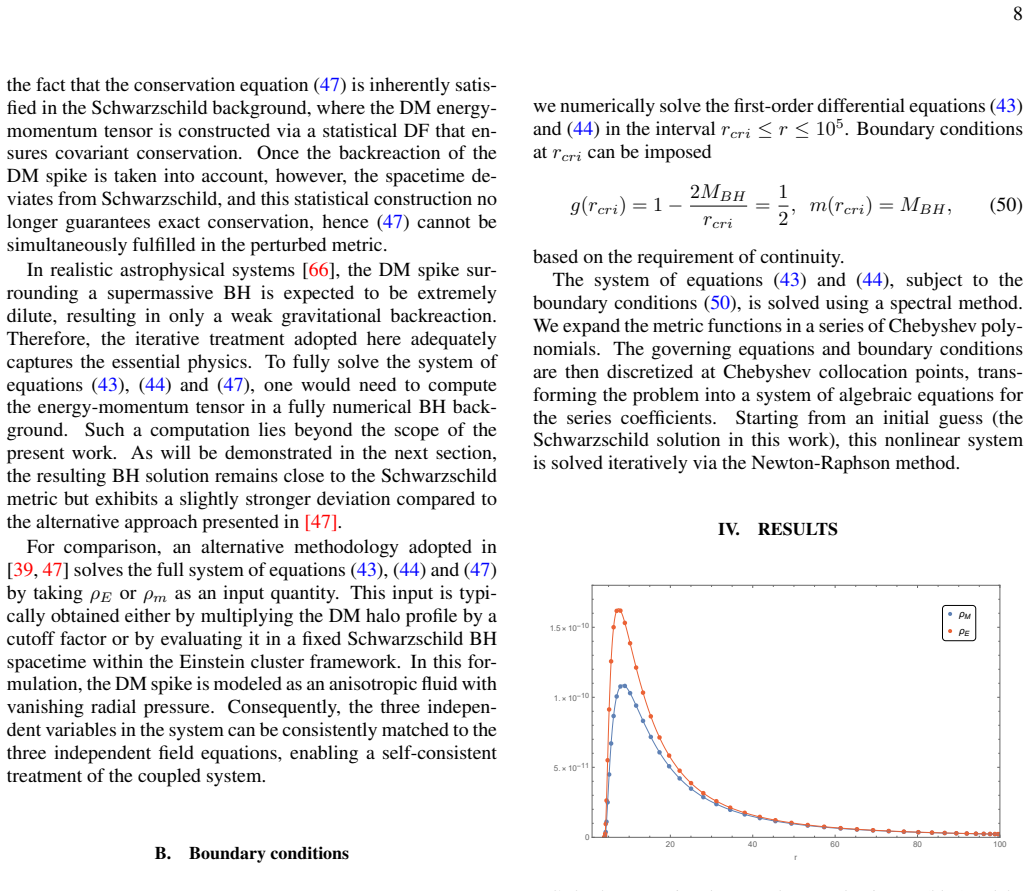
Within the Einstein-cluster framework, the paper derives the complete diagonal energy-momentum tensor of the spike—energy density, radial pressure, tangential pressure—from a distribution function conserved through adiabatic black-hole growth, evaluated in a fixed Schwarzschild background. Near the spike, the full energy density is about 1.5 times the rest-mass density; the radial pressure is two orders of magnitude smaller but nonzero, becoming comparable to the tangential pressure at large radius; all standard energy conditions hold. Solving the tt and rr Einstein equations with this tensor as a fixed source yields metric functions whose deviations from Schwarzschild exceed those of a mass
What carries the argument
The central object is the Einstein-cluster energy-momentum tensor of the spike, T^μ_ν = ∫ u^μ u_ν [M f^(4)(x,p)] √(-g) d^4p, built from the phase-space distribution f(E,L²)=f^(halo)(ε(E,L²)), with the orbital energy mapped through the adiabatic-invariant relation between the halo orbit and a Schwarzschild geodesic. It yields explicit integrals for the energy density, radial pressure, and tangential pressure. The backreaction metric is obtained by solving the tt and rr Einstein equations for g(r) and m(r), with this tensor as a fixed source and Schwarzschild boundary conditions at the spike's inner edge.
Load-bearing premise
The computation solves only the tt and rr Einstein equations, using a source evaluated in the fixed Schwarzschild background, and the paper acknowledges that the conservation equation is not satisfied in the perturbed metric; if the conservation residual is not negligible, the reported metric deviations are not the metric sourced by the claimed tensor.
What would settle it
Evaluate the conservation residual C^r and the tangential Einstein equation using the paper's numerical g(r), m(r), and T^μ_ν; a residual comparable to the claimed deviations would show the metric is an artifact of the truncated system. An iterative re-computation of the distribution function and T in the backreacted metric, repeated to convergence, would also test whether the factor-2.5 enhancement persists.
If this is right
- Near the peak of the energy density, the backreacted metric functions deviate from Schwarzschild by about 2.5 times more than a mass-density-only treatment, so earlier estimates understate the spike's spacetime effect.
- The kinetic contribution makes up about half the peak energy density, so the spike's total gravitational source is not well approximated by its rest-mass density alone.
- The radial pressure is nonzero in the spike and becomes comparable to the tangential pressure at large radius; setting it to zero is not a globally valid simplification.
- The derived energy-momentum tensor satisfies the null, weak, strong, and dominant energy conditions, so it is physically admissible as a source.
- The mass-function deviation m(r)-m_Schwarzschild is larger than the g(r) deviation, indicating the main backreaction is a redistribution of the effective mass profile seen by orbiting particles.
Where Pith is reading between the lines
- The paper attributes the enhancement mainly to kinetic energy but does not separately quantify how much comes from the kinetic term versus the non-zero radial pressure; a run that switches on each term independently would isolate the two effects.
- Because the conservation equation is knowingly not satisfied in the perturbed metric and no residual is reported, the solved (g,m) may not be the exact metric sourced by the claimed tensor; computing the residual of the unenforced equations is a direct check the paper leaves open.
- Applying the same construction to other halo profiles (a different cuspy model or a cored profile) would test whether the ~50% kinetic share and the ~2.5 factor are robust or specific to the chosen cuspy profile.
- If a fully self-consistent calculation confirms the stronger deviation, dark-matter spikes would imprint larger-than-expected signatures in gravitational-wave phase evolution and in photon orbits around the Galactic center black hole.
Editorial analysis
A structured set of objections, weighed in public.
Referee Report
Summary. The paper constructs the energy-momentum tensor of a dark-matter spike formed by adiabatic growth of a Schwarzschild black hole inside a Hernquist halo, using the Einstein-cluster distribution-function formalism. From the Hernquist DF and conserved actions in the Schwarzschild background, the authors derive integral expressions for the mass current and the diagonal EMT components (Eqs. (35)-(38)), including a kinetic contribution to the energy density and non-vanishing radial pressure. They report that near the spike the kinetic energy enhances the energy density by roughly 50% relative to the rest-mass density, that the EMT satisfies the standard energy conditions, and that the backreacted static spherically symmetric metric, obtained by solving only the tt and rr Einstein equations (43)-(44) with this EMT as a fixed source, deviates from Schwarzschild by up to about 2.5 times more than the mass-density-only treatment of Ref. [47]. The paper explicitly acknowledges that the conservation equation (47) is not satisfied in the perturbed metric and calls the construction semi-consistent.
Significance. If established, the result would be a useful quantitative step beyond mass-density-only treatments of DM-spike backreaction, showing that orbital kinetic energy and pressure can matter for the metric. The main strength is the explicit phase-space construction: the integrals (35)-(38) are concrete, depend only on macroscopic Hernquist parameters, and the paper checks the energy conditions numerically. There is no obvious circularity: the kinetic enhancement and the metric deviation are outputs of the orbital-invariant calculation, not fitted targets. However, the central comparison is currently not a controlled one, and the unquantified violation of the conservation equation leaves the reported metric-source correspondence vulnerable.
major comments (3)
- [Sec. IV, Fig. 5; Sec. III.A, Eqs. (43)-(44) and (47)] The paper's central claim that the full dynamical EMT produces metric deviations roughly 2.5 times larger than mass-density-only treatments is not established by the comparison shown. The curves labelled EC from Ref. [47] are obtained by solving the full system (43),(44),(47) with zero radial pressure, whereas the present solution uses the full EMT but solves only (43) and (44), explicitly dropping (47). The factor 2.5 therefore conflates two independent changes: the content of the source and the subset of Einstein equations enforced. A same-method control, e.g., solving exactly (43)-(44) with the mass-density-only source built from Eq. (35), is not presented. Without that control, the attribution of the enhancement to kinetic energy is underdetermined.
- [Sec. III.A, Eq. (47)] The paper states that after backreaction is included, 'this statistical construction no longer guarantees exact conservation, hence (47) cannot be simultaneously fulfilled in the perturbed metric.' The size of the conservation residual is never estimated. Since the reported deviations are small (g deviations of order 10^-7-10^-6 and m deviations of order 10^-5 near the spike), the residual in ∇_μ T^{μν} could be comparable to or larger than the claimed effect. The authors should quantify the residual in the solved metric, or otherwise show that it is negligible. As it stands, the metric obtained from the truncated system cannot be unambiguously identified as the metric sourced by the claimed T^{μν}.
- [Sec. III.A] The choice to solve only (43) and (44) is motivated by the fact that (46)/(47) is automatically satisfied in the fixed Schwarzschild background. That motivation is insufficient: consistency in the background does not imply that the residual remains small once g and m are changed by O(10^-6)-O(10^-5). A linearized estimate of the conservation residual in the perturbed metric, or an iterative scheme that recomputes the EMT in the updated metric, is needed to support the statement that this truncation 'captures the dominant physical effects'.
minor comments (4)
- [Eq. (40) and surrounding text] Typo 'symmertry' should be 'symmetry'.
- [Fig. 5] The right panels plot ratios of deviations against the alternative method. The caption and axis labels should clarify that the comparison is between two different solution schemes, not two sources in the same scheme; otherwise the reader may misread the factor 2.5 as a pure EMT effect.
- [References] Reference [35] has a formatting error: 'arXiv:2508.20238 [gr-qc]]' has a misplaced bracket. Several other references would benefit from journal/volume updates where available.
- [Sec. II.B, Eq. (22)] The adiabatic-invariant relation is central but the numerical evaluation of ϵ(E,L^2) is not described. A brief statement of the root-finding procedure and accuracy would improve reproducibility.
Circularity Check
No significant circularity: central claims are outputs of orbital integrals and Einstein equations, not imposed inputs.
full rationale
The derivation chain is: Hernquist DF -> adiabatic invariant mapping to a Schwarzschild spike -> Einstein-cluster EMT integrals (Eqs. 35-38) -> solving the tt/rr Einstein equations (43)-(44) with boundary conditions (50). The ~50% kinetic enhancement and the factor-2.5 metric-deviation ratio are computed outputs, not parameters fitted to those targets. The comparison with Ref. [47] is between two different calculational schemes; the fact that the present work enforces only (43)-(44) while the alternative solves (43),(44),(47) is a truncation/validity concern, not a circular one. The paper explicitly acknowledges this limitation: 'this statistical construction no longer guarantees exact conservation, hence (47) cannot be simultaneously fulfilled in the perturbed metric' (Sec. III.A). No load-bearing self-citation appears: the cited prior spike results, the Einstein-cluster framework, and the Milky Way parameters are external inputs, and no uniqueness theorem or ansatz is imported from the present authors' own work to force the conclusion. No fitted input is renamed as a prediction, and no known result is merely relabeled. The central quantitative claims therefore do not reduce by construction to their inputs.
Axiom & Free-Parameter Ledger
free parameters (4)
- Hernquist halo total mass M =
1.55×10^12 M_sun (fitted to Milky Way in [66])
- Hernquist scale radius a =
16.9 kpc (fitted to Milky Way in [66])
- SMBH mass M_BH =
4×10^6 M_sun
- Numerical outer radius r_max =
10^5 M_BH
axioms (6)
- domain assumption Adiabatic invariants (radial action) are conserved during BH growth, Eq. (21)-(22).
- domain assumption DM particle orbits are geodesics of the Schwarzschild metric of the central BH; the halo's own gravity is neglected for r<=10^5 M_BH.
- domain assumption The post-growth DF satisfies f(E,L^2)=f^(H)(epsilon(E,L^2)) (Eq. 27), using the Hernquist DF (12).
- domain assumption The Einstein cluster formula (25) gives the EMT as an integral over bound geodesics in the Schwarzschild background.
- ad hoc to paper The EMT computed in Schwarzschild is a valid fixed source for solving Eqs. (43)-(44), and Eq. (47) need not be enforced.
- domain assumption The Hernquist profile is a suitable Milky Way DM halo model with parameters from [66] and Eddington inversion applies.
read the original abstract
We study the energy-momentum tensor of a dark matter (DM) spike formed during the adiabatic growth of a black hole embedded in a DM halo, and investigate its backreaction on the spacetime geometry. Within the Einstein cluster framework, we derive the complete tensor, explicitly incorporating the kinetic contribution to the energy density and the anisotropic pressure arising from noncircular particle orbits. Adopting the Hernquist profile as an illustrative model of DM halo and employing parameters appropriate to the Milky Way, we find that near the spike, the kinetic term enhances the total energy density by approximately 50% relative to the rest-mass component, while the nonzero radial pressure induces a mild anisotropy in the stress tensor. The derived tensor satisfies all standard energy conditions. By treating it as a fixed source in Einstein's equations, we numerically obtain a static, spherically symmetric metric that deviates from the Schwarzschild solution by an amount more than twice that found when only the mass density is considered. These results demonstrate that including the full dynamical structure of the DM spike is essential for accurately modeling the backreaction of DM on black hole spacetimes.
Figures



Reference graph
Works this paper leans on
-
[1]
G. Bertone and D. Hooper, Rev. Mod. Phys.90, no.4, 045002 (2018) [arXiv:1605.04909 [astro-ph.CO]]
Pith/arXiv arXiv 2018
- [2]
-
[3]
J. L. Feng, Ann. Rev. Astron. Astrophys.48, 495-545 (2010) [arXiv:1003.0904 [astro-ph.CO]]
Pith/arXiv arXiv 2010
-
[4]
M. Misiaszek and N. Rossi, Symmetry16, no.2, 201 (2024) [arXiv:2310.20472 [hep-ph]]
Pith/arXiv arXiv 2024
-
[5]
P. Gondolo and J. Silk, Phys. Rev. Lett.83, 1719-1722 (1999) [arXiv:astro-ph/9906391 [astro-ph]]. 1 The latter, however, should be regarded as effective parametrizations rather than equilibrium solutions of collisionless systems, since core-like struc- tures generally require additional physics such as self-interactions or bary- onic feedback
Pith/arXiv arXiv 1999
-
[6]
P. Gondolo and J. Silk, Nucl. Phys. B Proc. Suppl.87, 87-89 (2000) [arXiv:hep-ph/0001070 [hep-ph]]
Pith/arXiv arXiv 2000
-
[7]
E. Barausse, V . Cardoso and P. Pani, Phys. Rev. D89, no.10, 104059 (2014) [arXiv:1404.7149 [gr-qc]]
Pith/arXiv arXiv 2014
-
[8]
K. Eda, Y . Itoh, S. Kuroyanagi and J. Silk, Phys. Rev. D91, no.4, 044045 (2015) [arXiv:1408.3534 [gr-qc]]
Pith/arXiv arXiv 2015
-
[9]
T. Lacroix, M. Karami, A. E. Broderick, J. Silk and C. Boehm, Phys. Rev. D96, no.6, 063008 (2017) [arXiv:1611.01961 [astro-ph.GA]]
Pith/arXiv arXiv 2017
-
[10]
J. F. Navarro, C. S. Frenk and S. D. M. White, Astrophys. J. 490, 493-508 (1997) [arXiv:astro-ph/9611107 [astro-ph]]
Pith/arXiv arXiv 1997
-
[11]
L. Sadeghian, F. Ferrer and C. M. Will, Phys. Rev. D88, no.6, 063522 (2013) [arXiv:1305.2619 [astro-ph.GA]]
Pith/arXiv arXiv 2013
- [12]
-
[13]
F. Ferrer, A. M. da Rosa and C. M. Will, Phys. Rev. D96, no.8, 083014 (2017) [arXiv:1707.06302 [astro-ph.CO]]
Pith/arXiv arXiv 2017
-
[14]
A. Coogan, G. Bertone, D. Gaggero, B. J. Kavanagh and 11 D. A. Nichols, Phys. Rev. D105, no.4, 043009 (2022) [arXiv:2108.04154 [gr-qc]]
Pith/arXiv arXiv 2022
-
[15]
N. Becker, L. Sagunski, L. Prinz and S. Rastgoo, Phys. Rev. D 105, no.6, 063029 (2022) [arXiv:2112.09586 [gr-qc]]
Pith/arXiv arXiv 2022
-
[16]
X. J. Yue and W. B. Han, Phys. Rev. D97, no.6, 064003 (2018) [arXiv:1711.09706 [gr-qc]]
Pith/arXiv arXiv 2018
-
[17]
O. A. Hannuksela, K. C. Y . Ng and T. G. F. Li, Phys. Rev. D 102, no.10, 103022 (2020) [arXiv:1906.11845 [astro-ph.CO]]
Pith/arXiv arXiv 2020
-
[18]
X. J. Yue and Z. Cao, Phys. Rev. D100, no.4, 043013 (2019) [arXiv:1908.10241 [astro-ph.HE]]
Pith/arXiv arXiv 2019
-
[19]
N. Speeney, A. Antonelli, V . Baibhav and E. Berti, Phys. Rev. D106, no.4, 044027 (2022) [arXiv:2204.12508 [gr-qc]]
Pith/arXiv arXiv 2022
-
[20]
V . Cardoso, K. Destounis, F. Duque, R. Panosso Macedo and A. Maselli, Phys. Rev. Lett.129, no.24, 241103 (2022) [arXiv:2210.01133 [gr-qc]]
Pith/arXiv arXiv 2022
-
[21]
P. S. Cole, G. Bertone, A. Coogan, D. Gaggero, T. Karydas, B. J. Kavanagh, T. F. M. Spieksma and G. M. Tomaselli, Nature Astron.7, no.8, 943-950 (2023) [arXiv:2211.01362 [gr-qc]]
arXiv 2023
-
[22]
M. H. Chan and C. M. Lee, Astrophys. J. Lett.943, no.2, L11 (2023) [arXiv:2212.05664 [astro-ph.HE]]
Pith/arXiv arXiv 2023
-
[23]
N. Dai, Y . Gong, Y . Zhao and T. Jiang, Phys. Rev. D110, no.8, 084080 (2024) [arXiv:2301.05088 [gr-qc]]
Pith/arXiv arXiv 2024
-
[24]
M. Rahman, S. Kumar and A. Bhattacharyya, JCAP01, 035 (2024) [arXiv:2306.14971 [gr-qc]]
Pith/arXiv arXiv 2024
-
[25]
C. Zhang, G. Fu and N. Dai, JCAP04, 088 (2024) [arXiv:2401.04467 [gr-qc]]
Pith/arXiv arXiv 2024
-
[26]
D. Montalvo, A. Smith-Orlik, S. Rastgoo, L. Sagunski, N. Becker and H. Khan, Universe10, no.11, 427 (2024) [arXiv:2401.06084 [gr-qc]]
Pith/arXiv arXiv 2024
-
[27]
Z. C. Zhang and Y . Tang, Phys. Rev. D110, no.10, 103008 (2024) [arXiv:2403.18529 [astro-ph.GA]]
Pith/arXiv arXiv 2024
-
[28]
Q. Tan, W. Deng, S. Long and J. Jing, JCAP05, 044 (2025) [arXiv:2409.17760 [gr-qc]]
arXiv 2025
-
[29]
Y . Zhao, N. Dai and Y . Gong, Mon. Not. Roy. Astron. Soc. 2326, 2337 (2025) [arXiv:2410.06882 [gr-qc]]
arXiv 2025
-
[30]
D. Shadykul, H. Chakrabarty and D. Malafarina, Phys. Rev. D 111, no.10, 104003 (2025) [arXiv:2410.18657 [gr-qc]]
Pith/arXiv arXiv 2025
-
[31]
Y . Z. Cheng, Y . Cao and Y . Tang, Phys. Rev. D111, no.8, 8 (2025) [arXiv:2411.03095 [gr-qc]]
Pith/arXiv arXiv 2025
-
[32]
F. Dosopoulou and J. Silk, Phys. Rev. Lett.135, no.8, 081401 (2025) [arXiv:2502.15468 [astro-ph.HE]]
Pith/arXiv arXiv 2025
- [33]
-
[34]
M. Alloqulov, T. Xamidov, S. Shaymatov and B. Ahmedov, Eur. Phys. J. C85, no.7, 798 (2025) [arXiv:2504.05236 [gr-qc]]
Pith/arXiv arXiv 2025
-
[35]
Q. Alnasheet, V . Cardoso, F. Duque and R. Panosso Macedo, Phys. Rev. D112, no.4, 044066 (2025) arXiv:2508.20238 [gr- qc]]
Pith/arXiv arXiv 2025
-
[36]
A. Ashoorioon, R. Casadio, K. Jafarzade, M. B. Jahani Poshteh and O. Luongo, [arXiv:2509.08569 [gr-qc]]
- [37]
-
[38]
Z. Xu, X. Hou, X. Gong and J. Wang, JCAP09, 038 (2018) [arXiv:1803.00767 [gr-qc]]
Pith/arXiv arXiv 2018
-
[39]
V . Cardoso, K. Destounis, F. Duque, R. P. Macedo and A. Maselli, Phys. Rev. D105, no.6, L061501 (2022) [arXiv:2109.00005 [gr-qc]]
Pith/arXiv arXiv 2022
-
[40]
R. A. Konoplya and A. Zhidenko, Astrophys. J.933, no.2, 166 (2022) [arXiv:2202.02205 [gr-qc]]
Pith/arXiv arXiv 2022
-
[41]
R. G. Daghigh and G. Kunstatter, Astrophys. J.940, no.1, 33 (2022) [erratum: Astrophys. J.963, no.2, 167 (2024)] [arXiv:2206.04195 [astro-ph.GA]]
Pith/arXiv arXiv 2022
-
[42]
Z. Shen, A. Wang, Y . Gong and S. Yin, Phys. Lett. B855, 138797 (2024) [arXiv:2311.12259 [gr-qc]]
Pith/arXiv arXiv 2024
-
[43]
R. Acharyya, P. Banerjee and S. Kar, JCAP04, 070 (2024) [arXiv:2311.18622 [gr-qc]]
Pith/arXiv arXiv 2024
- [44]
-
[45]
Z. Shen, A. Wang and S. Yin, Phys. Lett. B862, 139300 (2025) [arXiv:2408.05417 [gr-qc]]
Pith/arXiv arXiv 2025
-
[46]
K. i. Maeda, V . Cardoso and A. Wang, Phys. Rev. D111, no.4, 044060 (2025) [arXiv:2410.04175 [gr-qc]]
Pith/arXiv arXiv 2025
-
[47]
S. Chakraborty, G. Compère and L. Machet, Phys. Rev. D112, no.2, 024015 (2025) [arXiv:2412.14831 [gr-qc]]
Pith/arXiv arXiv 2025
-
[48]
P. G. S. Fernandes and V . Cardoso, [arXiv:2507.04389 [gr-qc]]
-
[49]
C. Zhang, T. Zhu and A. Wang, Phys. Rev. D104, no.12, 124082 (2021) [arXiv:2111.04966 [gr-qc]]
Pith/arXiv arXiv 2021
-
[50]
C. Zhang, T. Zhu, X. Fang and A. Wang, Phys. Dark Univ.37, 101078 (2022) [arXiv:2201.11352 [gr-qc]]
Pith/arXiv arXiv 2022
-
[51]
E. Figueiredo, A. Maselli and V . Cardoso, Phys. Rev. D107, no.10, 104033 (2023) [arXiv:2303.08183 [gr-qc]]
Pith/arXiv arXiv 2023
-
[52]
Y . Zhao, B. Sun, K. Lin and Z. Cao, Phys. Rev. D108, no.2, 024070 (2023) [arXiv:2303.09215 [gr-qc]]
Pith/arXiv arXiv 2023
-
[53]
Y . Zhao, B. Sun, Z. Cao, K. Lin and W. L. Qian, Phys. Rev. D 109, no.4, 044031 (2024) [arXiv:2308.15371 [gr-qc]]
Pith/arXiv arXiv 2024
-
[54]
R. G. Daghigh and G. Kunstatter, Phys. Rev. D109, no.8, 083004 (2024) [arXiv:2308.15682 [gr-qc]]
Pith/arXiv arXiv 2024
-
[55]
N. Speeney, E. Berti, V . Cardoso and A. Maselli, Phys. Rev. D 109, no.8, 084068 (2024) [arXiv:2401.00932 [gr-qc]]
Pith/arXiv arXiv 2024
-
[56]
D. Liu, Y . Yang and Z. W. Long, Eur. Phys. J. C84, no.7, 731 (2024) [arXiv:2401.09182 [gr-qc]]
Pith/arXiv arXiv 2024
-
[57]
L. Pezzella, K. Destounis, A. Maselli and V . Cardoso, Phys. Rev. D111, no.6, 064026 (2025) [arXiv:2412.18651 [gr-qc]]
Pith/arXiv arXiv 2025
-
[58]
Toshmatov, B
B. Toshmatov, B. Ahmedov, A. Boydedayev and B. Ahmedov, Phys. Rev. D111, no.12, 124058 (2025)
2025
- [59]
- [60]
-
[61]
G. H. Li, C. K. Qiao and J. Tao, [arXiv:2510.24989 [gr-qc]]
-
[62]
S. Das, S. Dalui, B. H. Lee and Y . F. Cai, [arXiv:2511.03657 [gr-qc]]
-
[63]
Einstein, Annals Math.40, 922-936 (1939)
A. Einstein, Annals Math.40, 922-936 (1939)
1939
-
[64]
G. L. Comer, D. Langlois and P. Peter, Class. Quant. Grav.10.9, L127 (1993)
1993
-
[65]
Hernquist, Astrophys
L. Hernquist, Astrophys. J.356, 359 (1990)
1990
-
[66]
G. M. Eadie, W. E. Harris and L. M. Widrow, Astrophys. J.806, 54 (2015) [arXiv:1504.04376 [astro-ph.GA]]
Pith/arXiv arXiv 2015
-
[67]
Binney and S
J. Binney and S. Tremaine, Princeton Series in Astrophysics (Princeton University Press, 2011), ISBN 9781400828722, URL https://books.google.kz/books?id=6mF4CKxlbLsC
2011
-
[68]
E. D. Fackerell, Astrophysical Journal, vol. 153, p. 643, 1968, 153: 643
1968
-
[69]
G. L. Comer and J. Katz, Class. Quant. Grav.10, 1751-1765 (1993)
1993
-
[70]
E. Retana-Montenegro, E. Van Hese, G. Gentile, M. Baes and F. Frutos-Alfaro, Astron. Astrophys.540, A70 (2012) [arXiv:1202.5242 [astro-ph.CO]]
Pith/arXiv arXiv 2012
-
[71]
M. Weber and W. de Boer, Astron. Astrophys.509, A25 (2010) [arXiv:0910.4272 [astro-ph.CO]]
Pith/arXiv arXiv 2010
discussion (0)
Sign in with ORCID, Apple, or X to comment. Anyone can read and Pith papers without signing in.