REVIEW 4 major objections 5 minor 88 references
HadroTOPS provides exact leading-order QED kinematics plus arbitrary hadronic models for exclusive two-meson two-photon production.
Reviewed by Pith at T0; open to challenge. T0 means a machine referee read the full paper against a public rubric. the ladder, T0–T4 →
T0 review · deepseek-v4-flash
2026-08-03 21:56 UTC pith:ZQ63JGJA
load-bearing objection A useful, honest MC generator paper: the exclusive QED formula and ππ/πη modes look solid, but the K K/ηη finite-Q² modes rest on an admitted model guess. the 4 major comments →
HadroTOPS: A Monte Carlo Event Generator For Hadron Production In Two-Photon Scattering In Electron Positron Collisions
The pith
A machine-rendered reading of the paper's core claim, the machinery that carries it, and where it could break.
Core claim
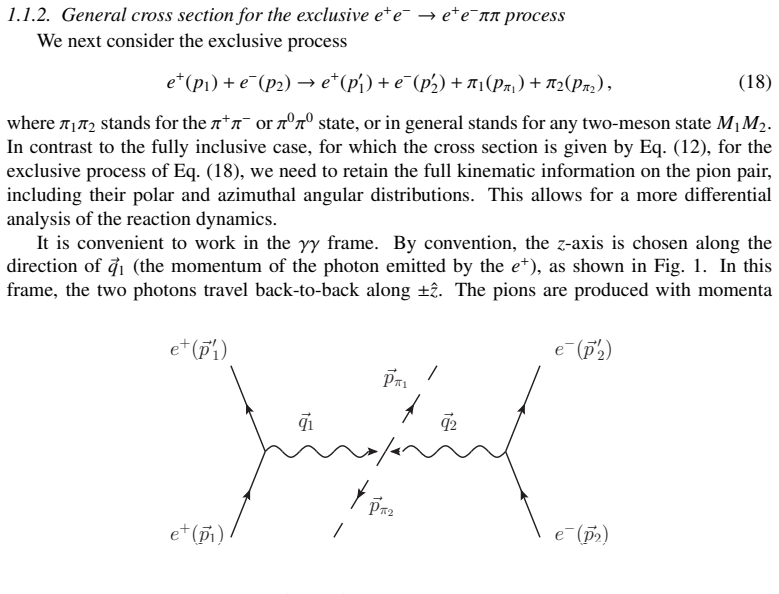
The paper's central discovery is a practical factorization: for e+e- -> e+e- M1M2, the exact leading-order QED part can be separated from hadronic dynamics and written as a sum over 25 helicity-dependent response functions and interference terms (Eq. 31). The lepton side enters through virtual-photon density matrices and polarization parameters; the hadronic side is entirely in the response functions built from gamma*gamma* -> M1M2 helicity amplitudes. Retaining the azimuthal angles between the lepton planes and the hadron plane exposes interference terms that are integrated away in the inclusive formula. The generator pairs this with an efficient phase-space algorithm and flat N-body decay,
What carries the argument
The load-bearing machinery is the set of 25 helicity-dependent response functions — the differential cross sections dsigma_TT, dsigma_TL, ... and interference terms dtau_j — defined from the gamma*gamma* -> M1M2 helicity amplitudes H_{lambda1 lambda2}. They enter the exclusive cross section Eq. (31) through lepton helicity density matrices and virtual-photon polarization parameters epsilon1, epsilon2. The phase-space generator works with five Lorentz invariants (W, t1, t2, s1, s2), using logarithmic mappings that cancel the photon propagator poles, followed by a recursive construction of the N-body hadronic decay. This separation of QED lepton kinematics from hadronic response functions is w
Load-bearing premise
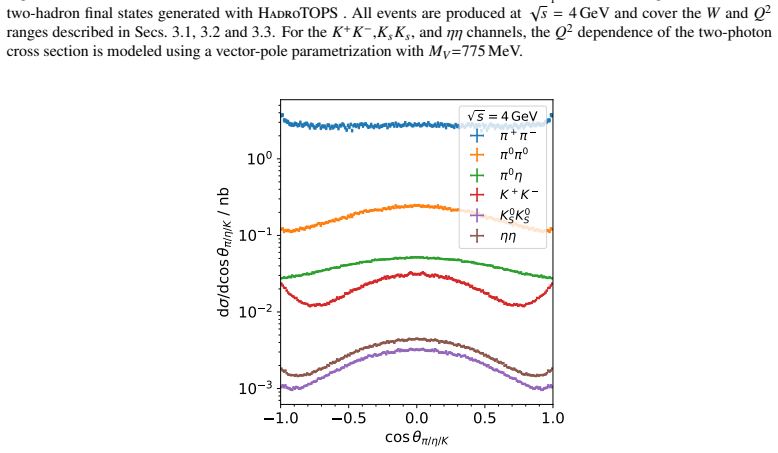
The load-bearing premise is that for the K+K-, K0S K0S, and eta eta channels, the missing momentum-transfer dependence can be represented by a factorized vector-pole form factor (default mass 775 MeV); the paper states that for these channels only the real-photon transverse-transverse cross section is available, so the virtuality dependence is essentially an assumption.
What would settle it
Measure the single-tag cross section d sigma/dQ1^2 for K+K- production at fixed two-photon mass W and compare it with the generator's vector-pole prediction; if the measured fall-off disagrees, the finite-virtuality simulation for that channel is wrong. Alternatively, test the exclusive azimuthal formula directly: the cos(phiTilde1) and cos(2 phiTilde1) modulations predicted for single-tagged pi0pi0 events should appear in data, and their absence would falsify the response-function input.
If this is right
- Single-tag (one outgoing lepton detected) and double-tag events for pi+pi-, pi0pi0, pi0eta, K+K-, K0S K0S, eta eta, and f1(1285) -> eta pi+pi- can be simulated in one framework with the same leading-order QED treatment.
- The azimuthal modulations retained in Eq. (31) let experiments access interference response functions such as tauT2, tau-12, and tau1L by analyzing cos(phiTilde1) and cos(2 phiTilde1) distributions.
- Flat phase-space decay makes the samples suitable for partial-wave analysis tools, which require uniform phase-space coverage to fit resonance parameters.
- The luminosity-function mode reproduces the analytical two-photon luminosity functions for all polarization combinations, so detector acceptance can be checked independently of hadronic modeling.
- Users can add new hadronic final states or replace the included models without touching the QED part of the generator.
Where Pith is reading between the lines
- The same decomposition could be inverted: fitting the azimuthal harmonics of experimental data against the generator would let collaborations extract individual interference response functions as functions of W and Q2, turning the simulator into a measurement tool.
- For channels where only real-photon cross sections exist, single-tag measurements would provide direct input grids that replace the vector-pole extrapolation, a natural upgrade path the paper leaves implicit.
- The exact-QED-plus-flat-decay architecture could be reused beyond meson pairs — for example four-pion or kaon-pion final states — once the corresponding gamma*gamma* -> X response functions are supplied, because the QED and phase-space layers are independent.
- Benchmarking the generated events against hadronic light-by-light dispersive calculations could sharpen estimates of the two-pion and a0(980) contributions to the muon g-2.
Editorial analysis
A structured set of objections, weighed in public.
Referee Report
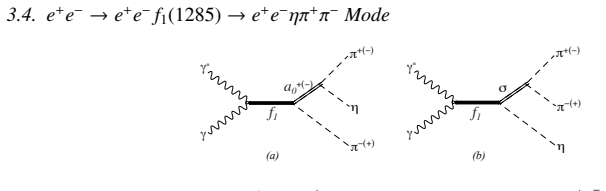
Summary. The paper presents HadroTOPS, a C++ Monte Carlo event generator for the two-photon process e+e− → e+e−X at electron-positron colliders. The central ingredient is a derivation of the fully differential cross section for the exclusive two-meson final state e+e− → e+e−M1M2, Eq. (31), written in terms of 25 helicity-dependent response functions and interference terms that retain azimuthal modulations between the lepton and hadron planes. The generator combines this QED formula with a flat phase-space decay of the hadronic system, making it suitable for partial-wave analyses. The paper implements several channels: π+π−, π0π0, π0η, K+K−, K0S K0S, ηη, and f1(1285)→ηπ+π−. The ππ and πη inputs use dispersive γ∗γ∗→M1M2 amplitudes; the K K and ηη inputs are fits to untagged Belle/BESIII data with a factorized vector-pole model for the Q2 dependence; the f1 channel uses an effective-Lagrangian model. Validation includes comparisons of luminosity functions against analytic results (Sec. 6.1) and an Ekhara3.2 comparison for π0π0 (Fig. 19).
Significance. If the code and inputs are made available and the caveats below are properly addressed, HadroTOPS would fill a genuine gap: existing generators such as Ekhara3.2 are limited to specific final states, while HadroTOPS targets multi-hadron final states and higher multiplicities with exact leading-order QED lepton kinematics. The exclusive cross-section formula Eq. (31) is a useful and nontrivial extension of the inclusive formula Eq. (12), and the azimuthal-angle dependence it retains could enable new experimental access to interference response functions. The validation against analytic luminosity functions at the 0.5% level and the Ekhara3.2 agreement for π0π0 give confidence in the QED framework. However, the advertised coverage of K+K−, K0S K0S, and ηη at finite photon virtuality rests on an unvalidated model, and the manuscript as posted does not include the code or numerical input grids. The central QED part appears sound; the hadronic-model limitations are openly stated but conflict with the abstract's broad claim of applicability across 'a wide range of ... photon virtualities'.
major comments (4)
- [Sec. 3.3, Eq. (60)] The K+K−, K0S K0S, and ηη channels are presented as included final states, and the abstract advertises the generator as suitable 'across a wide range of energies and photon virtualities.' However, the Belle/BESIII inputs for these channels are untagged (Q1^2≈Q2^2≈0), so only σ_TT is measured. The entire finite-Q2 behavior is supplied by the factorized vector-pole model Eq. (68) with a default MV=775 MeV (Fig. 17), and the other response functions are set analogously via Eqs. (65)–(66). The paper itself concedes in the last paragraph of Sec. 3.5 that 'for the K K and eta eta channels, only the sigma_TT cross section is available, meaning that essential components of the required information are missing for simulations at finite virtuality.' Thus any single-tag or double-tag simulation for these channels is dominated by an unvalidated factorization assumption, not by data or a derived ampl
- [Sec. 3.3 and Fig. 13] For the K+K−, K0S K0S, and ηη channels, the angular extrapolation from the measured |cosθ| ranges to full coverage is obtained by fitting the model of Eq. (60) with four W-dependent parameters S, D0, D2, and φ. The text states that 'Equation (60) reproduces the data within the quoted experimental uncertainties,' but no fit uncertainties or goodness-of-fit quantities are reported. Fig. 13 shows substantial scatter in the integrated cross sections when the fits are extended beyond the original angular coverage (e.g., the K+K− intermediate mass region for |cosθ|<1). This extrapolation feeds directly into the normalization of these channels in the generator. The authors should provide fit-quality information, quote uncertainties on the input cross-section tables, and discuss the sensitivity of generated distributions to the angular-extrapolation choice.
- [Program Summary] The main deliverable of this paper is a Monte Carlo generator, but the manuscript as posted contains no code, no numerical input grids, no example jobOptions file, and no documentation of the data format. The Program Summary says the CPC Library link and Code Ocean capsule are 'to be added.' Without the code, the validations in Sec. 6.1 and the Ekhara3.2 comparison in Fig. 19 cannot be reproduced, and the actual implementation of Eq. (31) cannot be checked. This is a load-bearing omission for a code paper. The authors should provide the source code and all numerical input tables, or at least a clearly referenced repository/version, before the paper can be fully assessed. The review process should verify that the code compiles and reproduces the reported distributions.
- [Abstract and Sec. 7] The abstract and summary claim the generator is suitable for 'a wide range of energies and photon virtualities' without qualification. This overstates the current status given the explicit limitation stated in Sec. 3.5 for the K K and ηη channels. The summary should distinguish between channels with theory-grade Q2 dependence (ππ, πη) and channels with model-extrapolated Q2 dependence (K K, ηη, and the f1 mode, which also uses a dipole form factor and a quark-model relation for F_TT). The recommendation should be to recalibrate the claims to match the actual model content.
minor comments (5)
- [Sec. 3.1] The statement in Sec. 3.1 that 'the π+π− channel ... currently includes only the two-photon production of pions ... via e+e−→e+e−π+π−' is an important caveat; it should be mentioned in the abstract or program summary as well, since users may otherwise assume Bhabha-induced pion-pair production is included.
- [Sec. 2.1] The notation dLipseeX and dLips eeX is used inconsistently around Eqs. (37) and (58). Also, the sentence about 'the less efficient option is provided for completeness, but is assumed to be unnecessary' appears garbled; please clarify.
- [Fig. 16] In the top-right panel, the label for (τ0+τ1)/2 appears truncated as '= GeV−2'; the intended numerical value should be shown consistently with the caption.
- [References] Reference [41] has DOI '10.1103/wdrk-7nrt', which looks like a placeholder or erroneous identifier; please verify. Also, Ref. [54] is a private communication and should be replaced by a citable source if available, or clearly marked as such.
- [Sec. 3.5] The sentence 'When both are set to unity, the generated can be directly used in partial-wave analysis frameworks' contains a typo ('generated' should be 'generator').
Circularity Check
No significant circularity: the QED framework is independently validated, and the data-driven K/ηη inputs are presented as inputs with acknowledged finite-Q2 modeling, not as predictions.
full rationale
The central new content is the exclusive formula Eq. (31), built from the standard Budnev/Bonneau decomposition and checked in two ways: luminosity functions are compared with the analytic expressions of Ref. [1] (Sec. 6.1, Fig. 15), and the π0π0 cross section is cross-checked against the independent Ekhara3.2 implementation (Sec. 6.3.1, Fig. 19). The hadronic inputs are external: the ππ and πη channels use published dispersive amplitudes (Refs. [47,49,60,30]) that are compared with Belle/Crystal Ball data (Figs. 4 and 8); the f1 mode uses the published effective-Lagrangian model of Ref. [81], with user-adjustable parameters. For K+K−, K0S K0S, and ηη, the manuscript is explicit that the Belle/BESIII inputs are untagged and only σTT is available (Sec. 3.3), and that the finite-Q2 continuation uses a user-configurable factorized vector-pole model (Eqs. 65–68). Sec. 3.5 even concedes 'for the K K and eta eta channels, only the sigma_TT cross section is available, meaning that essential components of the required information are missing for simulations at finite virtuality.' Because the paper labels these as data-driven inputs and model-dependent extrapolations rather than as first-principles predictions, this is a limitation/correctness risk, not a circular reduction. No fitted parameter is relabeled as a prediction, and no self-citation is used to force the central result.
Axiom & Free-Parameter Ledger
free parameters (4)
- Angular fit coefficients S(W), D0(W), D2(W), phi(W) for K+K-, K0S K0S, eta eta =
fitted per W bin to Belle/BESIII data
- Vector-pole mass M_V for Q2 dependence of K+K-, K0S K0S, eta eta =
775 MeV (chosen in Fig. 17)
- f1(1285) transition form factor scale Lambda_f1 and FLT(0,0) =
as in Ref. [81]
- Relative phase phi between a0(980)pi and f0(500)eta amplitudes in f1(1285) decay =
180 degrees (default)
axioms (6)
- domain assumption Leading-order QED factorization of the e+e- -> e+e-X amplitude into leptonic tensors and a hadronic tensor, Eq. (8), is adequate for the generator's target applications.
- domain assumption The dispersive gamma*gamma* -> pi pi and gamma*gamma* -> pi0 eta amplitudes of Refs. [47,49,60,30] are correct within their stated ranges W < 2 GeV and Q2 < 4 GeV2.
- domain assumption The Belle data and preliminary BESIII partial-wave results used for K+K-, K0S K0S, and eta eta are unbiased and can be extrapolated to full angular coverage by Eq. (60).
- domain assumption The Lorentz structure of the gamma*gamma* -> tensor-meson contribution is described by the quark-model transition form factor of Ref. [79], with only F1^T nonzero.
- domain assumption The effective-Lagrangian model for gamma*gamma* -> f1(1285) -> eta pi+ pi- of Ref. [81], with phi = 180 degrees, provides the correct interference pattern.
- domain assumption For arbitrary hadronic final states in the custom mode, a flat phase-space decay is a sufficient default because partial-wave analyses reweight the sample.
read the original abstract
We present a Monte Carlo event generator specifically developed for the study of hadronic two-photon fusion events in two-photon scattering at electron-positron colliders. The code enables the generation of events with exact leading-order QED coupling and a flat phase space decay of the hadronic state into an arbitrary number of final state particles as selected by the user. Thus, this generator is well-suited for the use of partial wave analyses tools to study the two-photon production of higher-multiplicity final states across a wide range of energies and photon virtualities. Furthermore, the code integrates both experimental and theoretical inputs on the two-photon couplings of hadrons to simulate two-photon production processes. Motivated by the investigations of the BESIII collaboration, the final states $\pi^+\pi^-$, $\pi^0\pi^0$, $\pi^0\eta$, $K^+K^-$, $K^0_SK^0_S$, $\eta\eta$, and $f_1(1285)\to \eta\pi^+\pi^-$ via $a_0^\pm(980)\pi^\mp$ and $f_0(500)\eta$ are currently included. The code is sufficiently flexible to easily add additional final states as well as quickly change the already included channels.
Figures






Reference graph
Works this paper leans on
-
[1]
Bonneau, M
G. Bonneau, M. Gourdin, F. Martin, Inelastic lepton anti-lepton scattering and the two photon exchange approximation, Nucl. Phys. B 54 (1973) 573–597. doi:10.1016/ 0550-3213(73)90440-9
1973
-
[2]
V . M. Budnev, I. F. Ginzburg, G. V . Meledin, V . G. Serbo, The Two photon particle produc- tion mechanism. Physical problems. Applications. Equivalent photon approximation, Phys. Rept. 15 (1975) 181–281. doi:10.1016/0370-1573(75)90009-5
-
[3]
V . Pascalutsa, V . Pauk, M. V anderhaeghen, Light-by-light scattering sum rules constraining meson transition form factors, Phys. Rev. D 85 (2012) 116001. arXiv:1204.0740, doi: 10.1103/PhysRevD.85.116001
Pith/arXiv arXiv 2012
-
[4]
G. A. Schuler, Two photon physics with GALUGA 2.0, Comput. Phys. Commun. 108 (1998) 279–303. arXiv:hep-ph/9710506, doi:10.1016/S0010-4655(97)00127-6
Pith/arXiv arXiv 1998
-
[5]
K. Abe, et al., Measurement of K+K− production in two photon collisions in the resonant mass region, Eur. Phys. J. C 32 (2003) 323–336. arXiv:hep-ex/0309077, doi:10. 1140/epjc/s2003-01468-9
Pith/arXiv arXiv 2003
-
[6]
H. Nakazawa, et al., Measurement of the gamma gamma — > pi+ pi- and gamma gamma —> K+ K- processes at energies of 2.4-Gev to 4.1-GeV, Phys. Lett. B 615 (2005) 39–49. arXiv:hep-ex/0412058, doi:10.1016/j.physletb.2005.03.067
Pith/arXiv arXiv 2005
-
[7]
S. Uehara, et al., High-statistics measurement of neutral pion-pair production in two- photon collisions, Phys. Rev. D 78 (2008) 052004. arXiv:0805.3387, doi:10.1103/ PhysRevD.78.052004
Pith/arXiv arXiv 2008
-
[8]
Aubert, et al., Measurement of the γγ∗ → π0 transition form factor, Phys
B. Aubert, et al., Measurement of the γγ∗ → π0 transition form factor, Phys. Rev. D 80 (2009) 052002. arXiv:0905.4778, doi:10.1103/PhysRevD.80.052002
Pith/arXiv arXiv 2009
-
[9]
Uehara, et al., Measurement of ηη production in two-photon collisions, Phys
S. Uehara, et al., Measurement of ηη production in two-photon collisions, Phys. Rev. D 82 (2010) 114031. arXiv:1007.3779, doi:10.1103/PhysRevD.82.114031. 45
Pith/arXiv arXiv 2010
-
[10]
KüSSner, Coupled channel partial wave analysis of two-photon reactions at besiii, doctoralthesis, Ruhr-Universität Bochum, Universitätsbibliothek (2022)
M. KüSSner, Coupled channel partial wave analysis of two-photon reactions at besiii, doctoralthesis, Ruhr-Universität Bochum, Universitätsbibliothek (2022). doi:10.13154/ 294-8590
2022
-
[11]
Küßner, Recent Highlights on Meson Spectroscopy at BESIII, EPJ Web Conf
M. Küßner, Recent Highlights on Meson Spectroscopy at BESIII, EPJ Web Conf. 291 (2024) 01002. doi:10.1051/epjconf/202429101002
arXiv 2024
-
[12]
G. Colangelo, M. Hoferichter, M. Procura, P . Stoffer, Dispersion relation for hadronic light- by-light scattering: theoretical foundations, JHEP 09 (2015) 074. arXiv:1506.01386, doi:10.1007/JHEP09(2015)074
Pith/arXiv arXiv 2015
-
[13]
P . Masjuan, P . Sánchez-Puertas, Pseudoscalar-pole contribution to the ( gµ − 2): a ratio- nal approach, Phys. Rev. D 95 (5) (2017) 054026. arXiv:1701.05829, doi:10.1103/ PhysRevD.95.054026
Pith/arXiv arXiv 2017
-
[14]
G. Colangelo, M. Hoferichter, M. Procura, P . Stoffer, Dispersion relation for hadronic light- by-light scattering: two-pion contributions, JHEP 04 (2017) 161. arXiv:1702.07347, doi:10.1007/JHEP04(2017)161
Pith/arXiv arXiv 2017
-
[15]
M. Hoferichter, B.-L. Hoid, B. Kubis, S. Leupold, S. P . Schneider, Dispersion relation for hadronic light-by-light scattering: pion pole, JHEP 10 (2018) 141. arXiv:1808.04823, doi:10.1007/JHEP10(2018)141
Pith/arXiv arXiv 2018
-
[16]
G. Eichmann, C. S. Fischer, E. Weil, R. Williams, Single pseudoscalar meson pole and pion box contributions to the anomalous magnetic moment of the muon, Phys. Lett. B 797 (2019) 134855, [Erratum: Phys. Lett. B 799, 135029 (2019)]. arXiv:1903.10844, doi:10.1016/j.physletb.2019.134855
Pith/arXiv arXiv 2019
-
[17]
J. Bijnens, N. Hermansson-Truedsson, A. Rodríguez-Sánchez, Short-distance constraints for the HLbL contribution to the muon anomalous magnetic moment, Phys. Lett. B 798 (2019) 134994. arXiv:1908.03331, doi:10.1016/j.physletb.2019.134994
Pith/arXiv arXiv 2019
-
[18]
J. Leutgeb, A. Rebhan, Axial vector transition form factors in holographic QCD and their contribution to the anomalous magnetic moment of the muon, Phys. Rev. D 101 (11) (2020) 114015. arXiv:1912.01596, doi:10.1103/PhysRevD.101.114015
Pith/arXiv arXiv 2020
-
[19]
L. Cappiello, O. Catà, G. D’Ambrosio, D. Greynat, A. Iyer, Axial-vector and pseudoscalar mesons in the hadronic light-by-light contribution to the muon ( g − 2), Phys. Rev. D 102 (1) (2020) 016009. arXiv:1912.02779, doi:10.1103/PhysRevD.102.016009
Pith/arXiv arXiv 2020
-
[20]
P . Masjuan, P . Roig, P . Sánchez-Puertas, The interplay of transverse degrees of freedom and axial-vector mesons with short-distance constraints in g − 2, J. Phys. G 49 (1) (2022) 015002. arXiv:2005.11761, doi:10.1088/1361-6471/ac3892
Pith/arXiv arXiv 2022
-
[21]
J. Bijnens, N. Hermansson-Truedsson, L. Laub, A. Rodríguez-Sánchez, Short-distance HLbL contributions to the muon anomalous magnetic moment beyond perturbation the- ory, JHEP 10 (2020) 203. arXiv:2008.13487, doi:10.1007/JHEP10(2020)203
Pith/arXiv arXiv 2020
-
[22]
J. Bijnens, N. Hermansson-Truedsson, L. Laub, A. Rodríguez-Sánchez, The two-loop perturbative correction to the ( g − 2)µ HLbL at short distances, JHEP 04 (2021) 240. arXiv:2101.09169, doi:10.1007/JHEP04(2021)240. 46
Pith/arXiv arXiv 2021
-
[23]
I. Danilkin, M. Hoferichter, P . Sto ffer, A dispersive estimate of scalar contributions to hadronic light-by-light scattering, Phys. Lett. B 820 (2021) 136502. arXiv:2105.01666, doi:10.1016/j.physletb.2021.136502
Pith/arXiv arXiv 2021
-
[24]
D. Stamen, D. Hariharan, M. Hoferichter, B. Kubis, P . Sto ffer, Kaon electromagnetic form factors in dispersion theory, Eur. Phys. J. C 82 (5) (2022) 432. arXiv:2202.11106, doi: 10.1140/epjc/s10052-022-10348-3
Pith/arXiv arXiv 2022
-
[25]
J. Leutgeb, J. Mager, A. Rebhan, Hadronic light-by-light contribution to the muon g − 2 from holographic QCD with solved U(1)A problem, Phys. Rev. D 107 (5) (2023) 054021. arXiv:2211.16562, doi:10.1103/PhysRevD.107.054021
Pith/arXiv arXiv 2023
-
[26]
M. Hoferichter, B. Kubis, M. Zanke, Axial-vector transition form factors and e+e− → f1π+π−, JHEP 08 (2023) 209. arXiv:2307.14413, doi:10.1007/JHEP08(2023)209
Pith/arXiv arXiv 2023
-
[27]
M. Hoferichter, P . Stoffer, M. Zillinger, An optimized basis for hadronic light-by-light scat- tering, JHEP 04 (2024) 092. arXiv:2402.14060, doi:10.1007/JHEP04(2024)092
Pith/arXiv arXiv 2024
-
[28]
E. J. Estrada, S. Gonzàlez-Solís, A. Guevara, P . Roig, Improved π0, η, η’ transition form factors in resonance chiral theory and their aHLbL µ contribution, JHEP 12 (2024) 203. arXiv:2409.10503, doi:10.1007/JHEP12(2024)203
Pith/arXiv arXiv 2024
-
[29]
J. Lüdtke, M. Procura, P . Sto ffer, Dispersion relations for the hadronic VV A correlator, JHEP 04 (2025) 130. arXiv:2410.11946, doi:10.1007/JHEP04(2025)130
Pith/arXiv arXiv 2025
-
[30]
O. Deineka, I. Danilkin, M. V anderhaeghen, Dispersive estimate of the a0(980) contribution to (g-2) µ, Phys. Rev. D 111 (3) (2025) 034009. arXiv:2410.12894, doi:10.1103/ PhysRevD.111.034009
Pith/arXiv arXiv 2025
-
[31]
G. Eichmann, C. S. Fischer, T. Haeuser, O. Regenfelder, Axial-vector and scalar contri- butions to hadronic light-by-light scattering, Eur. Phys. J. C 85 (4) (2025) 445. arXiv: 2411.05652, doi:10.1140/epjc/s10052-025-14055-7
Pith/arXiv arXiv 2025
-
[32]
J. Bijnens, N. Hermansson-Truedsson, A. Rodríguez-Sánchez, Constraints on the hadronic light-by-light tensor in corner kinematics for the muon g − 2, JHEP 03 (2025) 094. arXiv: 2411.09578, doi:10.1007/JHEP03(2025)094
Pith/arXiv arXiv 2025
-
[33]
M. Hoferichter, P . Sto ffer, M. Zillinger, Dispersion relation for hadronic light-by-light scattering: subleading contributions, JHEP 02 (2025) 121. arXiv:2412.00178, doi: 10.1007/JHEP02(2025)121
Pith/arXiv arXiv 2025
-
[34]
S. Holz, M. Hoferichter, B.-L. Hoid, B. Kubis, Dispersion relation for hadronic light-by- light scattering: η and η′ poles, JHEP 04 (2025) 147. arXiv:2412.16281, doi:10.1007/ JHEP04(2025)147
Pith/arXiv arXiv 2025
-
[35]
L. Cappiello, J. Leutgeb, J. Mager, A. Rebhan, Tensor meson transition form factors in holographic QCD and the muon g − 2Accepted for publication in JHEP (1 2025). arXiv: 2501.09699
Pith/arXiv arXiv 2025
-
[36]
G. Colangelo, M. Hoferichter, A. Ny ffeler, M. Passera, P . Stoffer, Remarks on higher-order hadronic corrections to the muon g−2, Phys. Lett. B 735 (2014) 90–91. arXiv:1403.7512, doi:10.1016/j.physletb.2014.06.012. 47
Pith/arXiv arXiv 2014
-
[37]
T. Blum, N. Christ, M. Hayakawa, T. Izubuchi, L. Jin, C. Jung, C. Lehner, The hadronic light-by-light scattering contribution to the muon anomalous magnetic moment from lattice QCD, Phys. Rev. Lett. 124 (13) (2020) 132002. arXiv:1911.08123, doi:10.1103/ PhysRevLett.124.132002
Pith/arXiv arXiv 2020
-
[38]
E.-H. Chao, R. J. Hudspith, A. Gérardin, J. R. Green, H. B. Meyer, K. Ottnad, Hadronic light-by-light contribution to (g−2)µ from lattice QCD: a complete calculation, Eur. Phys. J. C 81 (7) (2021) 651. arXiv:2104.02632, doi:10.1140/epjc/s10052-021-09455-4
Pith/arXiv arXiv 2021
-
[39]
E.-H. Chao, R. J. Hudspith, A. Gérardin, J. R. Green, H. B. Meyer, The charm-quark con- tribution to light-by-light scattering in the muon ( g − 2) from lattice QCD, Eur. Phys. J. C 82 (8) (2022) 664. arXiv:2204.08844, doi:10.1140/epjc/s10052-022-10589-2
Pith/arXiv arXiv 2022
-
[40]
T. Blum, N. Christ, M. Hayakawa, T. Izubuchi, L. Jin, C. Jung, C. Lehner, C. Tu, Hadronic light-by-light contribution to the muon anomaly from lattice QCD with infinite volume QED at physical pion mass, Phys. Rev. D 111 (1) (2025) 014501. arXiv:2304.04423, doi:10.1103/PhysRevD.111.014501
Pith/arXiv arXiv 2025
-
[41]
Z. Fodor, A. Gérardin, L. Lellouch, K. K. Szabó, B. C. Toth, C. Zimmermann, Hadronic light-by-light scattering contribution to the anomalous magnetic moment of the muon at the physical pion mass, Phys. Rev. D 111 (11) (2025) 114509. arXiv:2411.11719, doi: 10.1103/wdrk-7nrt
Pith/arXiv arXiv 2025
-
[42]
R. Aliberti, et al., The anomalous magnetic moment of the muon in the Standard Model: an update (5 2025). arXiv:2505.21476
Pith/arXiv arXiv 2025
-
[43]
G. Colangelo, M. Hoferichter, M. Procura, P . Sto ffer, Rescattering e ffects in the hadronic- light-by-light contribution to the anomalous magnetic moment of the muon, Phys. Rev. Lett. 118 (23) (2017) 232001. arXiv:1701.06554, doi:10.1103/PhysRevLett.118. 232001
Pith/arXiv arXiv 2017
-
[44]
R. Garcia-Martin, B. Moussallam, MO analysis of the high statistics Belle results on γγ → π+π−, π0π0 with chiral constraints, Eur. Phys. J. C 70 (2010) 155–175. arXiv:1006.5373, doi:10.1140/epjc/s10052-010-1471-7
Pith/arXiv arXiv 2010
-
[45]
M. Hoferichter, D. R. Phillips, C. Schat, Roy-Steiner equations for gamma gamma - > pi pi, Eur. Phys. J. C 71 (2011) 1743. arXiv:1106.4147, doi:10.1140/epjc/ s10052-011-1743-x
Pith/arXiv arXiv 2011
-
[46]
B. Moussallam, Unified dispersive approach to real and virtual photon-photon scattering at low energy, Eur. Phys. J. C 73 (2013) 2539. arXiv:1305.3143, doi:10.1140/epjc/ s10052-013-2539-y
Pith/arXiv arXiv 2013
-
[47]
I. Danilkin, M. V anderhaeghen, Dispersive analysis of the γγ∗ → ππ process, Phys. Lett. B 789 (2019) 366–372. arXiv:1810.03669, doi:10.1016/j.physletb.2018.12.047
Pith/arXiv arXiv 2019
-
[48]
M. Hoferichter, P . Stoffer, Dispersion relations for γ∗γ∗ → ππ: helicity amplitudes, sub- tractions, and anomalous thresholds, JHEP 07 (2019) 073. arXiv:1905.13198, doi: 10.1007/JHEP07(2019)073. 48
Pith/arXiv arXiv 2019
-
[49]
I. Danilkin, O. Deineka, M. V anderhaeghen, Dispersive analysis of the γ∗γ∗ → ππ process, Phys. Rev. D 101 (5) (2020) 054008. arXiv:1909.04158, doi:10.1103/PhysRevD. 101.054008
Pith/arXiv arXiv 2020
-
[50]
H. Czyz, S. Ivashyn, EKHARA: A Monte Carlo generator for e+e− → e+e−π0 and e+e− → e+e−π+π− processes, Comput. Phys. Commun. 182 (2011) 1338–1349. arXiv: 1009.1881, doi:10.1016/j.cpc.2011.01.029
Pith/arXiv arXiv 2011
-
[51]
H. Czyz, S. Ivashyn, A. Korchin, O. Shekhovtsova, Two-photon form factors of the π0, η and η′ mesons in the chiral theory with resonances, Phys. Rev. D 85 (2012) 094010. arXiv:1202.1171, doi:10.1103/PhysRevD.85.094010
Pith/arXiv arXiv 2012
-
[52]
H. Czy˙ z, P . Kisza, S. Tracz, Modeling interactions of photons with pseudoscalar and vec- tor mesons, Phys. Rev. D 97 (1) (2018) 016006. arXiv:1711.00820, doi:10.1103/ PhysRevD.97.016006
Pith/arXiv arXiv 2018
-
[53]
H. Czyz, P . Kisza, EKHARA 3.0: an update of the EKHARA Monte Carlo event generator, Comput. Phys. Commun. 234 (2019) 245–255. arXiv:1805.07756, doi:10.1016/j. cpc.2018.07.021
Pith/arXiv arXiv 2019
-
[54]
Czy˙ z, private communication (2024)
H. Czy˙ z, private communication (2024)
2024
-
[55]
M. Shepherd, J. Stevens, R. Mitchell, M. Albrecht, B. Grube, A. Austregesilo, N. D. Ho ff- man, N. Hüsken, AmpTools: V ersion 0.15.2 (2023). doi:10.5281/zenodo.10223330
-
[56]
M. Fritsch, M. Michel, S. Pflüger, R. de Boer, L. Wollenberg, W. Gradl, P . Weidenka ff, K. Peters, K. Götzen, Common partial wave analysis: A collaboration-independent organi- sation for amplitude analysis software (2022). doi:10.5281/zenodo.6908150
-
[57]
G. A. Schuler, Two-photon physics with GALUGA 2.0, Computer Physics Communi- cations 108 (2) (1998) 279–303. doi:https://doi.org/10.1016/S0010-4655(97) 00127-6
-
[58]
Aubert, et al., Observation of the χc2(2p) Meson in the Reaction γγ → D ¯D at BaBar, Phys
B. Aubert, et al., Observation of the χc2(2p) Meson in the Reaction γγ → D ¯D at BaBar, Phys. Rev. D 81 (2010) 092003. arXiv:1002.0281, doi:10.1103/PhysRevD.81. 092003
Pith/arXiv arXiv 2010
-
[59]
A. Mustafa, Analyse der systeme π+π−η, η’ π0 sowie π+π− π0 in zwei-photon-reaktionen bei besiii, doctoralthesis, Ruhr-Universität Bochum, Universitätsbibliothek (2019). doi: 10.13154/294-6287
-
[60]
I. Danilkin, C. F. Redmer, M. V anderhaeghen, The hadronic light-by-light contribution to the muon’s anomalous magnetic moment, Prog. Part. Nucl. Phys. 107 (2019) 20–68. arXiv:1901.10346, doi:10.1016/j.ppnp.2019.05.002
Pith/arXiv arXiv 2019
-
[61]
D. Drechsel, L. Tiator, Threshold pion photoproduction on nucleons, J. Phys. G 18 (1992) 449–497. doi:10.1088/0954-3899/18/3/004
-
[62]
Courau, A FAST MONTE CARLO GENERA TOR FOR ee → eeX UNTAGGED EX- PERIMENTS, in: 6th International Conference on Photon-Photon Collisions, 1984
A. Courau, A FAST MONTE CARLO GENERA TOR FOR ee → eeX UNTAGGED EX- PERIMENTS, in: 6th International Conference on Photon-Photon Collisions, 1984. 49
1984
-
[63]
Bellucci, A
S. Bellucci, A. Courau, S. Ong, Azimuthal correlations in γγ → π0π0 at DAPHNE, in: SIS-Pubblicazioni, INFN Laboratori Nazionali di Frascati, 1994
1994
-
[64]
F. Nguyen, F. Piccinini, A. D. Polosa, e+e− → e+e−π0π0 at DAPHNE, Eur. Phys. J. C 47 (2006) 65–70. arXiv:hep-ph/0602205, doi:10.1140/epjc/s2006-02567-9
Pith/arXiv arXiv 2006
-
[65]
D. Babusci, et al., Measurement of η meson production in γγ interactions and Γ(η → γγ) with the KLOE detector, JHEP 01 (2013) 119. arXiv:1211.1845, doi:10.1007/ JHEP01(2013)119
Pith/arXiv arXiv 2013
-
[66]
S. Uehara, TREPS: A Monte-Carlo Event Generator for Two-photon Processes at e+e− Colliders using an Equivalent Photon Approximation (7 1996). arXiv:1310.0157
Pith/arXiv arXiv 1996
-
[67]
S. Uehara, et al., High-statistics study of K0 S pair production in two-photon collisions, PTEP 2013 (12) (2013) 123C01. arXiv:1307.7457, doi:10.1093/ptep/ptt097
Pith/arXiv arXiv 2013
-
[68]
V . Druzhinin, L. Kardapoltsev, V . Tayursky, GGRESRC: A Monte Carlo gener- ator for the two-photon process e+e− → e+e−R(JPC = 0−+) in the single-tag mode, Computer Physics Communications 185 (1) (2014) 236–243. doi:https: //doi.org/10.1016/j.cpc.2013.07.017. URL https://www.sciencedirect.com/science/article/pii/ S0010465513002452
-
[69]
J. P . Lees, et al., Measurement of theγ⋆γ⋆ → η′ transition form factor, Phys. Rev. D 98 (11) (2018) 112002. arXiv:1808.08038, doi:10.1103/PhysRevD.98.112002
Pith/arXiv arXiv 2018
-
[70]
S. Ong, P . Kessler, A Process Independent Radiative Correction Formula for Single Tag and Double Tag Measurements of γγ Reactions, Phys. Rev. D 38 (1988) 2280. doi:10.1103/ PhysRevD.38.2280
1988
-
[71]
James, Monte-Carlo phase space (5 1968)
F. James, Monte-Carlo phase space (5 1968)
1968
-
[72]
I. Danilkin, O. Deineka, M. V anderhaeghen, Data-driven dispersive analysis of the ππ and πK scattering, Phys. Rev. D 103 (11) (2021) 114023. arXiv:2012.11636, doi:10.1103/ PhysRevD.103.114023
Pith/arXiv arXiv 2021
-
[73]
F. Niecknig, B. Kubis, S. P . Schneider, Dispersive analysis of ω− > 3π and ϕ− > 3π decays, Eur. Phys. J. C 72 (2012) 2014. arXiv:1203.2501, doi:10.1140/epjc/ s10052-012-2014-1
Pith/arXiv arXiv 2012
-
[74]
S. P . Schneider, B. Kubis, F. Niecknig, The ω− > π 0γ∗ and ϕ− > π 0γ∗ transition form factors in dispersion theory, Phys. Rev. D 86 (2012) 054013. arXiv:1206.3098, doi: 10.1103/PhysRevD.86.054013
Pith/arXiv arXiv 2012
-
[75]
I. V . Danilkin, C. Fernández-Ramírez, P . Guo, V . Mathieu, D. Schott, M. Shi, A. P . Szczepaniak, Dispersive analysis of ω/ϕ→3π,πγ*, Phys. Rev. D 91 (9) (2015) 094029. arXiv:1409.7708, doi:10.1103/PhysRevD.91.094029
Pith/arXiv arXiv 2015
-
[76]
Masuda, et al., Study of π0 pair production in single-tag two-photon collisions, Phys
M. Masuda, et al., Study of π0 pair production in single-tag two-photon collisions, Phys. Rev. D 93 (3) (2016) 032003. arXiv:1508.06757, doi:10.1103/PhysRevD.93. 032003. 50
Pith/arXiv arXiv 2016
-
[77]
Guo, Two photon physics at BESIII, J
Y . Guo, Two photon physics at BESIII, J. Phys. Conf. Ser. 1137 (1) (2019) 012008. doi: 10.1088/1742-6596/1137/1/012008
-
[78]
M. Hoferichter, P . Stoffer, Asymptotic behavior of meson transition form factors, JHEP 05 (2020) 159. arXiv:2004.06127, doi:10.1007/JHEP05(2020)159
Pith/arXiv arXiv 2020
-
[79]
G. A. Schuler, F. A. Berends, R. van Gulik, Meson photon transition form-factors and resonance cross-sections in e + e- collisions, Nucl. Phys. B 523 (1998) 423–438. arXiv: hep-ph/9710462, doi:10.1016/S0550-3213(98)00128-X
Pith/arXiv arXiv 1998
-
[80]
Wang, private communication (2025)
W. Wang, private communication (2025)
2025
discussion (0)
Sign in with ORCID, Apple, or X to comment. Anyone can read and Pith papers without signing in.