REVIEW 5 major objections 5 minor 3 references
DeepDefense: Robust Learning via Layer-Wise Gradient-Feature Alignment
T0 review · 5 major / 5 minor · reviewed 2026-08-04 · deepseek-v4-flash
Pith's one-line read DeepDefense claims that aligning each layer's input gradient with its feature representation flattens the loss in tangential directions, forcing adversarial attacks to become large and visible.
desk verdict New layer-wise gradient-feature alignment regularizer, but the theory linking it to robustness is unproven and the evaluation lacks adaptive attacks. read the letter →
The pith
A machine-rendered reading of the paper's core claim, the machinery that carries it, and where it could break.
The reading
What carries the argument
The central object is the Gradient-Feature Alignment (GFA) regularizer, defined as the negative cosine similarity between a layer's input vector and the gradient of the loss with respect to that input, L_total = L_task + β Σ (1 − GFA^(l)). Its role is to enforce the proportionality ∇_h L = λ h at selected layers. The argument then leans on a radial/tangential decomposition of the input space: if ∇_x L = λx, any perturbation orthogonal to x leaves the loss unchanged to first order, so attackers are pushed toward radial perturbations, which the paper argues are naturally attenuated by activation functions and normalization. Layer-wise application (the 'DeepDefense' extension) aims to stop pert
What would settle it
Compute ∇_x L for a DEEP-trained model on held-out test inputs and measure its cosine similarity with x. If the mean absolute cosine is far below 1 (the paper's own Table 1 implies ~0.5 on test data), then the asserted input-space tangential flatness is not present, and the robustness gains must be attributed to some other mechanism. A sharper test: train a purely linear network, where ∇_x L = W^T (Wx − y), and check whether layer-wise GFA can make loss flat in tangential input directions when W^T W is not proportional to identity.
Extended reading notes
Core claim
The paper's central claim is that adversarial vulnerability is a geometric phenomenon: the loss surface of a standard network is curved in directions orthogonal to the input, and that is exactly where adversarial perturbations live. DeepDefense adds a penalty, at one or multiple layers, that aligns the gradient of the loss with the layer's input (GFA). The paper argues this drives the input gradient toward the form ∇_x L = λx, making the first-order loss change vanish for every perturbation δ orthogonal to x, and thereby flattening the loss in tangential directions. Attacks such as DeepFool, C&W, EADEN, and JSMA are then forced to search in the radial direction, where the network's own nonli
Load-bearing premise
The load-bearing premise is that aligning gradients with features at selected internal layers makes the loss flat specifically in input-space tangential directions — the paper states this without proving that the chain rule preserves alignment from deep layers back to the raw input.
Editorial extensions
If this is right
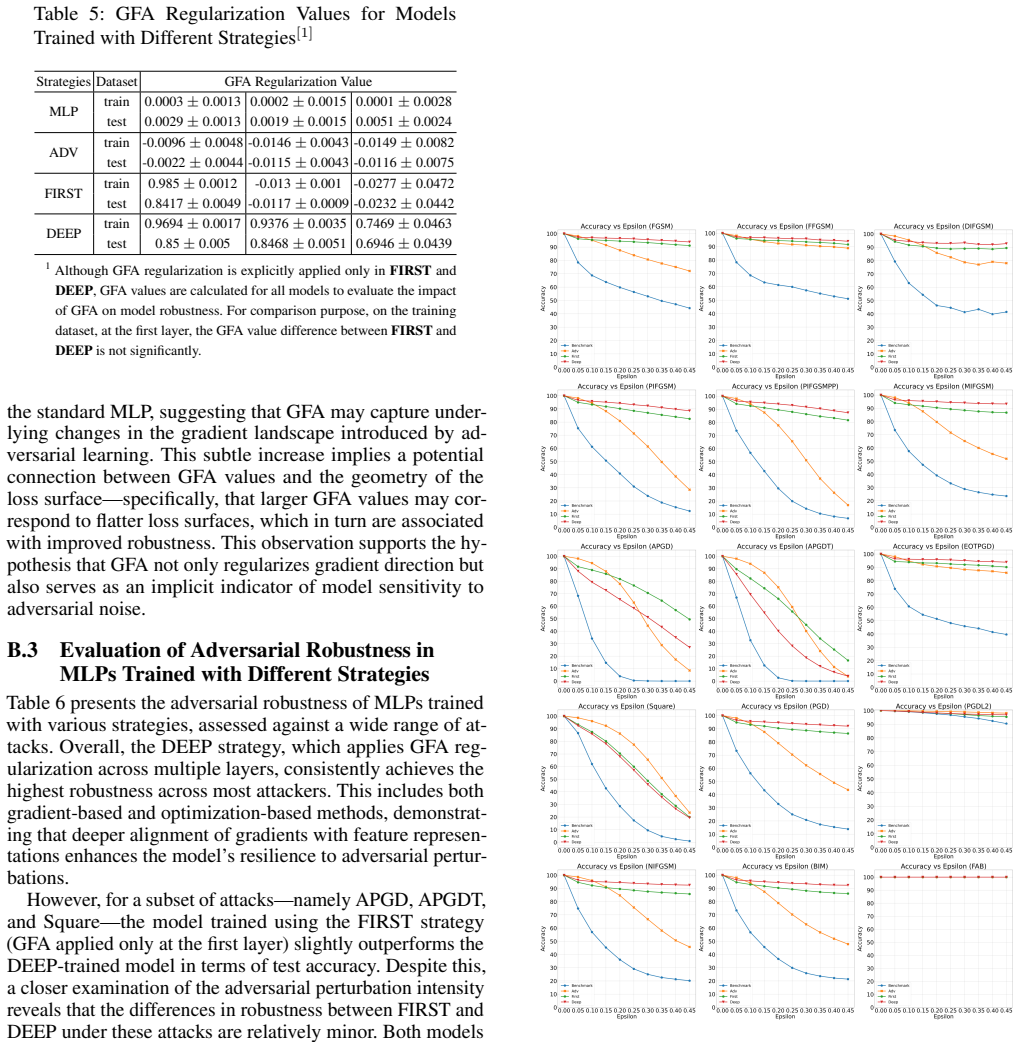
- On CIFAR-10, CNN models trained with GFA at the first three layers (DEEP) exceed PGD adversarial training by up to 15.2% under APGD and 24.7% under FGSM, with similar gains across many gradient-based attacks.
- Optimization-based attackers (DeepFool, EADEN, JSMA, C&W) require 20–30 times larger perturbations to fool GFA-trained models, making adversarial examples perceptible.
- Applying GFA at multiple layers suppresses perturbation propagation, giving greater robustness than first-layer-only alignment in most configurations.
- The defense is self-contained and architecture-agnostic: it needs no teacher model, perceptual prior, or adversarial example generation, and it works on both CNNs and MLPs.
- The loss-landscape flattening is targeted: tangential directions become flat, while radial perturbations are handled by the network's own structure, so robustness comes without explicit adversarial training.
Reading between the lines
- A direct extension suggested by the claimed geometry is to apply GFA at the input layer as well as hidden layers, which would make the input-space flatness argument direct rather than inferred through the chain rule.
- If the tangential-flatness claim is correct, GFA should combine naturally with certified defenses: a flat loss landscape should reduce the margin needed for Lipschitz-based certificates, a direction the paper lists as future work.
- The paper reports that GFA values drop sharply from train to test on CIFAR-10 (about 0.93 to 0.54 for DEEP); a practical lever is data augmentation that preserves gradient-feature alignment, which could close that generalization gap and make the robustness gains more consistent.
- The OnePixel results indicate that unstructured black-box perturbations sidestep the defense; a follow-up could test whether applying GFA to the last layer or to a detection head restores robustness in that regime.
Editorial analysis
A structured set of objections, weighed in public.
Referee Report
Summary. The paper proposes DeepDefense, a layer-wise Gradient-Feature Alignment (GFA) regularizer that penalizes the negative cosine similarity between each selected layer's input and the loss gradient with respect to that input. The authors claim that this enforces an approximately radial input gradient, flattening the loss in tangential directions at the input and forcing adversarial perturbations into radial directions that are supposedly suppressed by activation functions or normalization layers. Empirically, they report that CNNs on CIFAR-10 and MLPs on Fashion-MNIST trained with GFA at the first three layers outperform standard training, adversarial training, and several other defenses across many gradient-based and optimization-based attacks.
Significance. If the proposed mechanism were valid, DeepDefense would be a noteworthy contribution: it is simple, architecture-agnostic, needs no teacher or perceptual prior, and the reported robustness gains are large. The empirical study is genuinely based on holdout test data with repeated runs, and it is a strength that no parameters are fitted to the test set. However, the central theoretical derivation is not mathematically established, and the paper's own test-time GFA measurements contradict the proposed mechanism. As a result, the paper currently reads as an unexplained empirical regularization study rather than a supported defense mechanism.
major comments (5)
- [§3.1, Eq. (1)–(2)] The derivation asserts that under standard training ∇xL(x)ᵀx ≈ 0 and then concludes that for any δ⊥x, DδL(x) ≈ ‖∇xL(x)‖·‖δ‖. This does not follow: orthogonality to x only places ∇xL in the tangent subspace; the directional derivative can be zero for most tangential δ and is maximized only when δ is parallel to ∇xL. More importantly, GFA is a cosine-similarity penalty on selected layer inputs with finite coefficient β; it cannot enforce the exact equality ∇xL(x)=λx used to conclude DδL=0 for all δ⊥x. The additional claim that radial perturbations are suppressed by activation functions or normalization layers is asserted without proof.
- [§3.2, Eqs. (4)–(6)] The backpropagation equations are dimensionally inconsistent. For a linear layer h=Wx, ∂L/∂x = Wᵀ ∂L/∂h, not a product of terms (σ′(z_i)W_i) as in Eq. (6). Even if ∂L/∂h is parallel to h, ∂L/∂x is parallel to WᵀWx, which is parallel to x only if x is an eigenvector of WᵀW. No such spectral condition is established for the CNN/MLP architectures used. Thus the load-bearing claim that layer-wise GFA flattens the loss in input-space tangential directions is unsupported.
- [Table 1 and footnote] For the DEEP model, the first-layer GFA value drops from 0.9262 ± 0.0039 on the training set to 0.5409 ± 0.0396 on the test set; FIRST drops from 0.9449 to 0.4734. The footnote explicitly admits that GFA does not fully generalize to the test set. Since robustness is measured on the test set, the proposed mechanism is not operative at evaluation time, so the observed robustness cannot be explained by the claimed alignment. The paper needs either a quantitative argument that partial alignment suffices or an alternative explanation for the empirical gains.
- [Appendix A.3, Eq. (17)] The claim ∇xZ(x)=γx is asserted with no derivation. This assertion is then used to argue that C&W, EADEN, and JSMA perturbations are essentially radial and therefore ineffective against GFA-trained models. For a general deep network the claim is false, and even an approximate version would require a nontrivial argument about the Jacobian. This unsupported assertion is load-bearing for the interpretation of the optimization-based attack results.
- [§4.2 vs. Table 2] The text states that 'GFA applied to the first layer is most effective in mitigating adversarial perturbations, whereas its application in deeper layers offers diminished robustness benefits,' yet Table 2 shows DEEP outperforming FIRST on nearly every gradient-based attack, and other parts of the text state the opposite. This internal contradiction undermines the empirical narrative. In addition, no adaptive attacks are considered; for a defense that explicitly modifies gradient properties, the reported gains could be an artifact of gradient masking.
minor comments (5)
- [Algorithm 1] Typo: 'pseudoscope' should be 'pseudocode'.
- [Table 1 footnote] The footnote says the GAIE regularization value is 'approximately 9.3'; the intended value is 0.93. Also, the GAIE row reports GFA values, not GAIE loss values, which makes the comparison with GFA-trained models confusing.
- [§3.1] 'Robustest' should be 'most robust'. The phrase 'tangential space, also known as feature space' is imprecise and should be defined formally.
- [§4.1] The hyperparameters α, β in Algorithm 1 are not specified in the experimental section, and no sensitivity analysis is provided. This makes it difficult to assess the practical robustness of the method to hyperparameter choices.
- [Appendix A.3] The text refers to 'first, consistency and alternation' strategies that are not defined in the paper; this appears to be a leftover from an earlier draft.
Circularity Check
Central mechanism is definitional for input-space GFA and unproven for the layer-wise regularizer; empirical robustness numbers are not circular, but the explanatory chain partially reduces to its own definition.
-
self definitional
[Section 3.1 (Eq. 1 and following paragraph); Section 3.2 (Eq. 2)]
"However, GFA regularization enforces that ∇xL(x)=λx. This implies that the loss varies only along the radial direction of x and remains invariant in all tangential directions. ... DeepDefense enforces robustness by applying GFA regularization at a variety of layers."
∇xL=λx is just the definitional content of input-space GFA (cos θ=1 in Eq. 1). The actual objective (Eq. 2) penalizes 1−GFA^(l) at selected layers h^(l), not at the input. No chain-rule argument is given showing that layer-wise alignment implies input alignment; for a linear layer h=Wx this would require W^T W proportional to the identity, which is never established. Thus the claimed input-tangential flatness is not derived from the method; it is restated from the idealized definition and then silently transferred to the layer-wise regularizer.
-
self definitional
[Appendix A.3, Eq. (16)-(17), 'Detailed Analysis of DeepDefense Against EADENL1 Attack']
"Now, assuming that the MSE is used as the loss function, then the input gradient against the loss function ∇xJ(x) and the ∇xZ(x) is differ in one terms, as shown in Equation 16. ∇xJ(x)=∇xZ(x)·(Z(x)−y) (16) It is straightforward to note that for the rate of change of the i-th logit with respect to the j-th input feature is shown in Equation 17. ∇xZ(x)=γx (17)"
Eq. 17 asserts that the logit Jacobian is everywhere parallel to the input. This is exactly the input-space radial-gradient property whose enforcement by the layer-wise GFA penalty was never proved. The subsequent explanation that DeepFool/EADEN/JSMA perturbations are 'aligned with the original samples' therefore assumes the very mechanism under test. The attack accuracies themselves are genuine holdout measurements, but the proposed explanation of why they improve is circular: it takes the desired input-alignment conclusion as an unstated premise.
full rationale
Most of the empirical machinery is not circular: models are evaluated under identical attack configurations on test data, no test-set parameters are fitted, and the self-citations (Lin, Yeap, and Kiringa 2024, 2023; Lin et al. 2024) are only application context, not load-bearing. The circularity is confined to the theoretical explanation. The paper's formal story reduces the robustness mechanism to the definition of input-space GFA (Eq. 1) and then silently applies it to the layer-wise objective (Eq. 2). Appendix Eq. 17 repeats the same assumption in explaining optimization-based attack results. Table 1's test-time GFA values (DEEP ≈0.54) and the footnote's admission that GFA 'may not fully generalize to unseen data' are internal tensions that reinforce the gap, but they are not themselves a circular fit. Score 4 reflects a partial circularity in the load-bearing mechanistic claim while the empirical robustness evaluations retain independent content.
Assumptions & free parameters
free parameters (2)
- β (per-layer GFA regularization strength)
- α (task-loss coefficient in Algorithm 1)
assumptions (4)
- domain assumption Standard-trained networks have input gradients approximately orthogonal to the input (∇_x L^T x ≈ 0).
- ad hoc to paper GFA regularization enforces the equality ∇_x L = λ x.
- ad hoc to paper Radial perturbations are suppressed by activation functions or normalization layers.
- ad hoc to paper Layer-wise alignment at selected layers implies flatness in input-space tangential directions.
Cite this review
Pith. "Pith review of DeepDefense: Robust Learning via Layer-Wise Gradient-Feature Alignment." pith.science (2026). https://pith.science/paper/MB2HEE77
@misc{pith2026251113749,
  author       = {Pith},
  title        = {Pith review of: DeepDefense: Robust Learning via Layer-Wise Gradient-Feature Alignment},
  year         = {2026},
  howpublished = {\url{https://pith.science/paper/MB2HEE77}},
  note         = {Machine review of arXiv:2511.13749}
}
read the original abstract
Deep neural networks are known to be vulnerable to adversarial perturbations, which are small, carefully crafted inputs that lead to incorrect predictions. In this paper, we propose DeepDefense, a novel defense framework that applies Gradient-Feature Alignment (GFA) regularization across multiple layers to suppress adversarial vulnerability. By aligning input gradients with internal feature representations, DeepDefense promotes a smoother loss landscape in tangential space, also known as feature space, thereby reducing the model's sensitivity to adversarial noise. We provide insights into how adversarial perturbations can be decomposed into radial and tangential components and demonstrate that alignment suppresses loss variation in tangential space, where most attacks are effective. Empirically, our method achieves significant improvements in robustness against both gradient-based and optimization-based attacks. For example, on CIFAR-10, CNN models trained with DeepDefense outperform standard adversarial training by up to 15.2 percent under APGD attacks and 24.7 percent under FGSM attacks. Against optimization-based attacks such as DeepFool and EADEN, DeepDefense requires perturbation magnitudes that are 20 to 30 times larger to cause misclassification, indicating stronger decision boundaries and a flatter loss landscape. Our approach is architecture-agnostic, simple to implement, and highly effective, offering a promising direction for improving the adversarial robustness of deep learning models.
Figures


Figures from the paper (9 more)



Reference graph
Works this paper leans on
-
[2]
InInternational Conference on Learning Represen- tations
Stochastic Activation Pruning for Robust Adversarial Defense. InInternational Conference on Learning Represen- tations. Dong, Y .; Liao, F.; Pang, T.; Su, H.; Zhu, J.; Hu, X.; and Li, J. 2018. Boosting adversarial attacks with momentum. In Proceedings of the IEEE conference on computer vision and pattern recognition, 9185–9193. Ganz, R.; Kawar, B.; and El...
arXiv 2018
-
[2018]
Detecting adversarial examples via neural fingerprint- ing.arXiv preprint arXiv:1803.03870. Dhillon, G. S.; Azizzadenesheli, K.; Lipton, Z. C.; Bern- stein, J. D.; Kossaifi, J.; Khanna, A.; and Anandkumar, A
-
[4979]
Rodríguez-Muñoz, A.; Wang, T.; and Torralba, A
PMLR. Rodríguez-Muñoz, A.; Wang, T.; and Torralba, A. 2024. Characterizing Model Robustness via Natural Input Gradi- ents. InEuropean Conference on Computer Vision, 161–178. Springer. Ross, A.; and Doshi-Velez, F. 2018. Improving the adversar- ial robustness and interpretability of deep neural networks by regularizing their input gradients. InProceedings ...
arXiv 2024
Reviewed August 4, 2026 · model on record in the stance chip above.
Discussion (0). Sign in to comment.