5d-mediated indirect exchange and effective spin Hamiltonians in Ce triangular-lattice delafossites
Pith reviewed 2026-05-17 20:13 UTC · model grok-4.3
The pith
A new ab initio framework shows 5d-mediated indirect exchange dominates in CsCeSe2 while superexchange dominates in RbCeO2.
A machine-rendered reading of the paper's core claim, the machinery that carries it, and where it could break.
Core claim
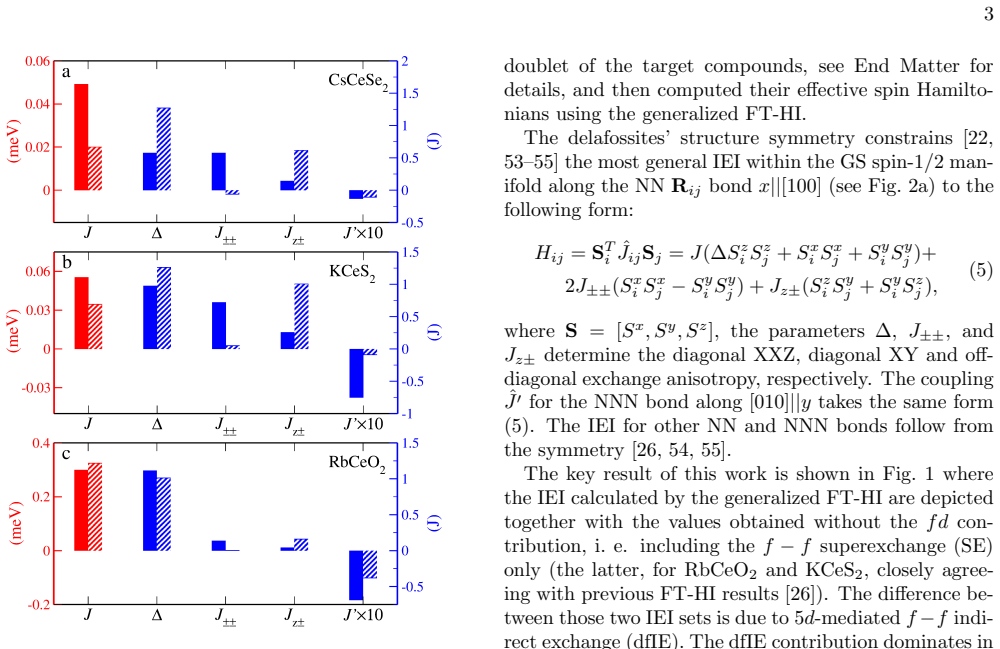
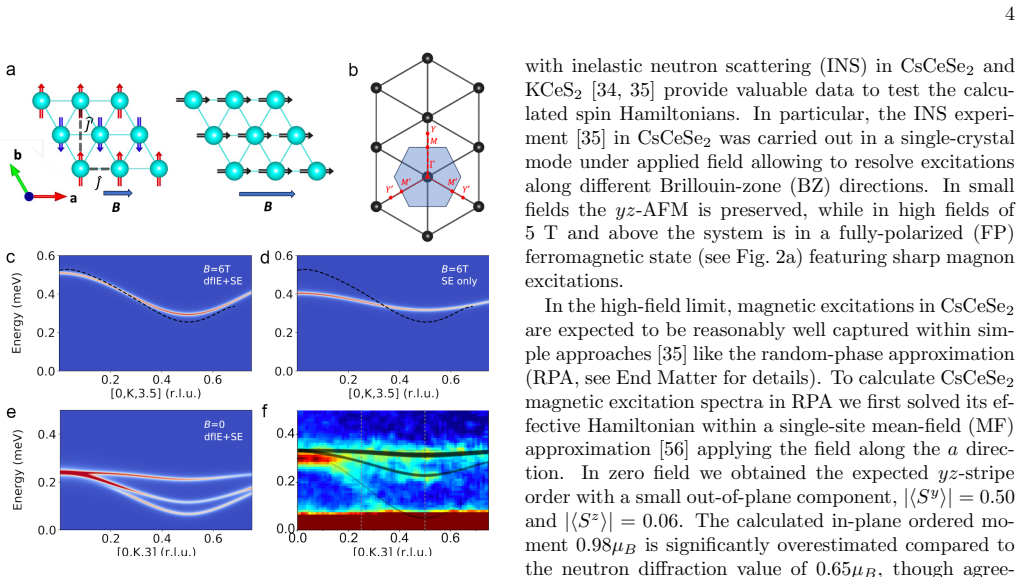
The force-theorem framework that combines the quasi-atomic Hubbard-I treatment of 4f correlations with a static mean-field description of the on-site 4f-5d intershell Coulomb interaction allows simultaneous ab initio evaluation of 4f superexchange and 5d-mediated indirect exchange. Applied to CsCeSe2, KCeS2, and RbCeO2, it establishes that indirect exchange dominates in the selenide, superexchange dominates in the oxide, and the two contributions are nearly equal in the sulfide, with the resulting spin Hamiltonians yielding magnetic excitation spectra in good qualitative and quantitative agreement with experiment for CsCeSe2 and KCeS2.
What carries the argument
Ab initio force-theorem framework combining quasi-atomic Hubbard-I approach to 4f correlations with static mean-field treatment of on-site 4f-5d Coulomb interaction.
If this is right
- Indirect exchange dominates the magnetism in CsCeSe2.
- Superexchange is the leading mechanism in RbCeO2.
- Both indirect exchange and superexchange contribute almost equally in KCeS2.
- Magnetic excitation spectra evaluated from the calculated spin Hamiltonians agree with experimental data for CsCeSe2 and KCeS2.
Where Pith is reading between the lines
- The same framework could be used to predict the dominant exchange path and resulting ground state in other rare-earth delafossites or triangular-lattice compounds where only one mechanism has been assumed so far.
- If the mean-field approximation for 4f-5d coupling proves robust, it offers a computationally lighter route than full dynamical treatments for mapping exchange mechanisms across the rare-earth series.
- The anion dependence (Se, S, O) identified here suggests a chemical tuning knob for shifting the balance between the two exchange channels in related materials.
Load-bearing premise
The static mean-field treatment of the on-site intershell Coulomb interaction between rare-earth 4f and 5d states is sufficient to capture the 5d-mediated indirect exchange without needing dynamical or higher-order corrections.
What would settle it
Inelastic neutron scattering measurements of the magnetic excitation spectra in CsCeSe2 or KCeS2 that cannot be reproduced by the spin Hamiltonians derived from the framework would indicate that the calculated exchange contributions or their relative weights are incorrect.
Figures

read the original abstract
Anisotropic intersite exchange interactions in frustrated rare-earth magnets are difficult to assess both theoretically and experimentally. Here, we propose an ab initio force-theorem framework combining the quasi-atomic Hubbard-I approach to 4f correlations with a static mean-field treatment of the on-site intershell Coulomb interaction between rare-earth 4f and 5d states to simultaneously capture both 4f superexchange and 5d-mediated indirect exchange. Applying it to the triangular lattice Ce delafossites CsCeSe$_2$, KCeS$_2$, and RbCeO$_2$, we find that the indirect exchange dominates in the selenide, the superexchange in the oxide, while both mechanisms contribute almost equally in the sulfide. The magnetic exciation spectra of CsCeSe$_2$ and KCeS$_2$ evaluated from the calculated spin Hamiltonains are in good qualitative and quantitative agreement with experimental data.
Editorial analysis
A structured set of objections, weighed in public.
Referee Report
Summary. The manuscript proposes an ab initio force-theorem framework that combines the quasi-atomic Hubbard-I approach for 4f correlations with a static mean-field treatment of the on-site 4f-5d intershell Coulomb interaction. This is used to simultaneously compute 4f superexchange and 5d-mediated indirect exchange in triangular-lattice Ce delafossites. Application to CsCeSe₂, KCeS₂, and RbCeO₂ shows that indirect exchange dominates in the selenide, superexchange dominates in the oxide, and the two mechanisms contribute nearly equally in the sulfide. Magnetic excitation spectra derived from the resulting spin Hamiltonians for CsCeSe₂ and KCeS₂ are reported to agree qualitatively and quantitatively with experimental data.
Significance. If the central claims hold, the work provides a practical route to disentangle competing exchange mechanisms in frustrated rare-earth magnets, where such separation has been difficult. The reported mechanism dominance across chemically related compounds and the quantitative spectral agreement for two materials constitute a concrete advance. The force-theorem implementation and the explicit decomposition into superexchange versus indirect exchange are strengths that could be extended to other 4f systems.
major comments (2)
- [Methods / framework description] The static mean-field decoupling of the on-site 4f-5d Coulomb interaction is load-bearing for the reported mechanism dominance (indirect exchange dominating in CsCeSe₂, superexchange in RbCeO₂). Because 5d states hybridize with ligand p states near the Fermi level, frequency-dependent self-energy or vertex corrections could renormalize the effective 5d-mediated paths and shift the relative weights; the manuscript should either justify why dynamical corrections are negligible or provide a cross-check (e.g., against a frequency-dependent treatment or a different decoupling scheme) to confirm that the dominance conclusions survive.
- [Results / mechanism analysis] The quantitative agreement of the calculated spectra with experiment for CsCeSe₂ and KCeS₂ is cited as validation, yet the decomposition into indirect versus superexchange contributions is not independently falsifiable from the spectra alone. An explicit sensitivity analysis showing how the extracted J values change when the mean-field 4f-5d term is varied (or turned off) would strengthen the claim that the reported dominance is robust rather than an artifact of the chosen decoupling.
minor comments (2)
- [Abstract] Abstract contains two typographical errors: 'exciation' should be 'excitation' and 'Hamiltonains' should be 'Hamiltonians'.
- [Throughout] Notation for the effective spin Hamiltonian parameters (e.g., J, D, etc.) should be defined once in a dedicated table or equation block and used consistently thereafter to avoid ambiguity when comparing the three compounds.
Simulated Author's Rebuttal
We thank the referee for the positive overall assessment and the detailed, constructive comments. We address each major point below and have revised the manuscript accordingly to strengthen the justification and robustness of our results.
read point-by-point responses
-
Referee: [Methods / framework description] The static mean-field decoupling of the on-site 4f-5d Coulomb interaction is load-bearing for the reported mechanism dominance (indirect exchange dominating in CsCeSe₂, superexchange in RbCeO₂). Because 5d states hybridize with ligand p states near the Fermi level, frequency-dependent self-energy or vertex corrections could renormalize the effective 5d-mediated paths and shift the relative weights; the manuscript should either justify why dynamical corrections are negligible or provide a cross-check (e.g., against a frequency-dependent treatment or a different decoupling scheme) to confirm that the dominance conclusions survive.
Authors: We thank the referee for this important observation. Within the quasi-atomic Hubbard-I plus force-theorem framework, the static mean-field treatment of the on-site 4f-5d Coulomb interaction is adopted because it provides a computationally tractable way to incorporate the intershell repulsion while allowing direct decomposition of the resulting exchange paths. The 5d-ligand hybridization is already included at the level of the underlying DFT calculation. We have added a dedicated paragraph in the Methods section justifying the static approximation on the basis of energy-scale separation: U_fd greatly exceeds both the 5d bandwidth and the exchange energies of interest, rendering dynamical renormalizations perturbative for the quantities we compute. A full frequency-dependent treatment lies beyond the present scope but is noted as a worthwhile direction for future work. The consistency of the mechanism dominance across the three compounds with different ligand electronegativities provides additional support for the robustness of the conclusions. revision: yes
-
Referee: [Results / mechanism analysis] The quantitative agreement of the calculated spectra with experiment for CsCeSe₂ and KCeS₂ is cited as validation, yet the decomposition into indirect versus superexchange contributions is not independently falsifiable from the spectra alone. An explicit sensitivity analysis showing how the extracted J values change when the mean-field 4f-5d term is varied (or turned off) would strengthen the claim that the reported dominance is robust rather than an artifact of the chosen decoupling.
Authors: We agree that an explicit sensitivity analysis improves the clarity of the mechanism decomposition. In the revised manuscript we have added new calculations in which the strength of the mean-field 4f-5d term is systematically scaled (including the limit in which it is switched off) and the resulting exchange parameters are recomputed. These results are presented in a new supplementary figure together with a short discussion in the main text. The analysis shows that the qualitative dominance (indirect exchange in CsCeSe₂, superexchange in RbCeO₂, comparable contributions in KCeS₂) remains unchanged, with only modest quantitative shifts in the individual J values. This confirms that the reported mechanism assignment is not an artifact of the particular decoupling choice. revision: yes
Circularity Check
No significant circularity; derivation is self-contained ab initio calculation validated externally
full rationale
The paper introduces a force-theorem framework that combines the quasi-atomic Hubbard-I method for 4f correlations with a static mean-field treatment of 4f-5d intershell Coulomb interactions to compute both superexchange and 5d-mediated indirect exchange. These computed interactions are then used to construct effective spin Hamiltonians whose magnetic excitation spectra are compared to experimental data for CsCeSe₂ and KCeS₂. The reported dominance of indirect exchange in the selenide versus superexchange in the oxide is an output of this calculation applied to the three specific compounds, not a redefinition or refit of input parameters. No equations or steps are shown to reduce by construction to fitted values, self-citations, or ansatzes imported from prior work by the same authors. The external experimental agreement serves as independent validation, keeping the derivation non-circular.
Axiom & Free-Parameter Ledger
axioms (2)
- domain assumption Quasi-atomic Hubbard-I approach accurately captures 4f correlations in Ce compounds
- domain assumption Static mean-field treatment suffices for on-site 4f-5d Coulomb interaction
Lean theorems connected to this paper
-
IndisputableMonolith/Cost/FunctionalEquation.leanwashburn_uniqueness_aczel unclear?
unclearRelation between the paper passage and the cited Recognition theorem.
propose an ab initio force-theorem framework combining the quasi-atomic Hubbard-I approach to 4f correlations with a static mean-field treatment of the on-site intershell Coulomb interaction between rare-earth 4f and 5d states
What do these tags mean?
- matches
- The paper's claim is directly supported by a theorem in the formal canon.
- supports
- The theorem supports part of the paper's argument, but the paper may add assumptions or extra steps.
- extends
- The paper goes beyond the formal theorem; the theorem is a base layer rather than the whole result.
- uses
- The paper appears to rely on the theorem as machinery.
- contradicts
- The paper's claim conflicts with a theorem or certificate in the canon.
- unclear
- Pith found a possible connection, but the passage is too broad, indirect, or ambiguous to say the theorem truly supports the claim.
Reference graph
Works this paper leans on
-
[1]
J. Jensen and A. R. Mackintosh,Rare Earth Magnetism: Structures and Excitations(Clarendon Press, Oxford, 1991)
work page 1991
- [2]
-
[3]
R. Shiina, H. Shiba, and P. Thalmeier, Journal of the Physical Society of Japan66, 1741 (1997), https://doi.org/10.1143/JPSJ.66.1741
-
[4]
A. S. Cameron, G. Friemel, and D. S. Inosov, Reports on Progress in Physics79, 066502 (2016)
work page 2016
-
[5]
P. Santini, S. Carretta, G. Amoretti, R. Caciuffo, N. Magnani, and G. H. Lander, Rev. Mod. Phys.81, 807 (2009)
work page 2009
-
[6]
S. Khmelevskyi and L. V. Pourovskii, Communications Physics7, 12 (2024)
work page 2024
-
[7]
T. Onimaru and H. Kusunose, Journal of the Physical Society of Japan85, 082002 (2016)
work page 2016
-
[8]
M. J. P. Gingras and P. A. McClarty, Reports on Progress in Physics77, 056501 (2014)
work page 2014
-
[9]
R. Sibille, N. Gauthier, E. Lhotel, V. Por´ ee, V. Pom- jakushin, R. A. Ewings, T. G. Perring, J. Ollivier, A. Wildes, C. Ritter, T. C. Hansen, D. A. Keen, G. J. Nilsen, L. Keller, S. Petit, and T. Fennell, Nature Physics 16, 546 (2020)
work page 2020
-
[10]
E. M. Smith, E. Lhotel, S. Petit, and B. D. Gaulin, An- nual Review of Condensed Matter Physics16, 387 (2025)
work page 2025
-
[11]
M. Xie, W. Zhuo, Y. Cai, Z. Zhang, and Q. Zhang, Chi- nese Physics Letters41, 117505 (2024)
work page 2024
-
[12]
T. Arh, B. Sana, M. Pregelj, P. Khuntia, Z. Jagliˇ ci´ c, M. D. Le, P. K. Biswas, P. Manuel, L. Mangin-Thro, A. Ozarowski, and A. Zorko, Nature Materials21, 416 (2022)
work page 2022
-
[13]
B. Johansson, The Philosophical Magazine: A Journal of Theoretical Experimental and Applied Physics30, 469 (1974)
work page 1974
-
[14]
Kasuya, IBM Journal of Research and Development 14, 214 (1970)
T. Kasuya, IBM Journal of Research and Development 14, 214 (1970)
work page 1970
-
[15]
L. V. Pourovskii, Phys. Rev. B94, 115117 (2016)
work page 2016
-
[16]
N. Iwahara, Z. Huang, I. Neefjes, and L. F. Chibotaru, Phys. Rev. B105, 144401 (2022)
work page 2022
- [17]
-
[18]
L. V. Pourovskii, D. Fiore Mosca, L. Celiberti, S. Khmelevskyi, A. Paramekanti, and C. Franchini, Na- ture Reviews Materials10, 674 (2025)
work page 2025
- [19]
-
[20]
Y. Iqbal, W.-J. Hu, R. Thomale, D. Poilblanc, and F. Becca, Phys. Rev. B93, 144411 (2016)
work page 2016
- [21]
-
[22]
Z. Zhu, P. A. Maksimov, S. R. White, and A. L. Cherny- shev, Phys. Rev. Lett.120, 207203 (2018)
work page 2018
- [23]
-
[24]
N. E. Sherman, M. Dupont, and J. E. Moore, Phys. Rev. B107, 165146 (2023)
work page 2023
- [25]
- [26]
-
[27]
M. M. Bordelon, E. Kenney, C. Liu, T. Hogan, L. Posthuma, M. Kavand, Y. Lyu, M. Sherwin, N. P. Butch, C. Brown, M. J. Graf, L. Balents, and S. D. Wil- son, Nature Physics15, 1058 (2019)
work page 2019
- [28]
-
[29]
P.-L. Dai, G. Zhang, Y. Xie, C. Duan, Y. Gao, Z. Zhu, E. Feng, Z. Tao, C.-L. Huang, H. Cao, A. Podlesnyak, G. E. Granroth, M. S. Everett, J. C. Neuefeind, D. Voneshen, S. Wang, G. Tan, E. Morosan, X. Wang, H.-Q. Lin, L. Shu, G. Chen, Y. Guo, X. Lu, and P. Dai, Phys. Rev. X11, 021044 (2021)
work page 2021
-
[30]
A. O. Scheie, Y. Kamiya, H. Zhang, S. Lee, A. J. Woods, M. O. Ajeesh, M. G. Gonzalez, B. Bernu, J. W. Villanova, J. Xing, Q. Huang, Q. Zhang, J. Ma, E. S. Choi, D. M. Pajerowski, H. Zhou, A. S. Sefat, S. Okamoto, T. Berlijn, L. Messio, R. Movshovich, C. D. Batista, and D. A. Ten- nant, Phys. Rev. B109, 014425 (2024)
work page 2024
-
[31]
M. M. Bordelon, X. Wang, D. M. Pajerowski, A. Baner- jee, M. Sherwin, C. M. Brown, M. S. Eldeeb, T. Petersen, L. Hozoi, U. K. R¨ oßler, M. Mourigal, and S. D. Wilson, Phys. Rev. B104, 094421 (2021)
work page 2021
-
[32]
G. Bastien, B. Rubrecht, E. Haeussler, P. Schlender, Z. Zangeneh, S. Avdoshenko, R. Sarkar, A. Alfonsov, S. Luther, Y. A. Onykiienko, H. C. Walker, H. K¨ uhne, V. Grinenko, Z. Guguchia, V. Kataev, H. H. Klauss, L. Hozoi, J. van den Brink, D. S. Inosov, B. B¨ uchner, A. U. B. Wolter, and T. Doert, SciPost Phys.9, 041 (2020)
work page 2020
-
[33]
A. A. Kulbakov, S. M. Avdoshenko, I. Puente-Orench, M. Deeb, M. Doerr, P. Schlender, T. Doert, and D. S. In- osov, Journal of Physics: Condensed Matter33, 425802 (2021)
work page 2021
-
[34]
S. M. Avdoshenko, A. A. Kulbakov, E. H¨ außler, P. Schlender, T. Doert, J. Ollivier, and D. S. Inosov, Phys. Rev. B106, 214431 (2022)
work page 2022
-
[35]
T. Xie, S. Gozel, J. Xing, N. Zhao, S. M. Avdoshenko, L. Wu, A. S. Sefat, A. L. Chernyshev, A. M. L¨ auchli, A. Podlesnyak, and S. E. Nikitin, Phys. Rev. Lett.133, 096703 (2024)
work page 2024
-
[36]
T. Xie, N. Zhao, S. Gozel, J. Xing, S. M. Avdoshenko, K. M. Taddei, A. I. Kolesnikov, L. D. Sanjeewa, P. Ma, N. Harrison, C. dela Cruz, L. Wu, A. S. Sefat, A. L. Chernyshev, A. M. L¨ auchli, A. Podlesnyak, and S. E. Nikitin, Phys. Rev. B110, 054445 (2024)
work page 2024
-
[37]
B. R. Ortiz, M. M. Bordelon, P. Bhattacharyya, G. Pokharel, P. M. Sarte, L. Posthuma, T. Petersen, M. S. Eldeeb, G. E. Granroth, C. R. Dela Cruz, S. Calder, D. L. Abernathy, L. Hozoi, and S. D. Wilson, Phys. Rev. Mater.6, 084402 (2022)
work page 2022
-
[38]
J. W. Villanova, A. O. Scheie, D. A. Tennant, S. Okamoto, and T. Berlijn, Phys. Rev. Res.5, 033050 (2023)
work page 2023
-
[39]
A. Georges, G. Kotliar, W. Krauth, and M. J. Rozenberg, Rev. Mod. Phys.68, 13 (1996)
work page 1996
-
[40]
V. I. Anisimov, A. I. Poteryaev, M. A. Korotin, A. O. Anokhin, and G. Kotliar, Journal of Physics: Condensed Matter9, 7359 (1997)
work page 1997
-
[41]
A. I. Lichtenstein and M. I. Katsnelson, Phys. Rev. B57, 6884 (1998)
work page 1998
- [42]
-
[43]
G. Kotliar, S. Y. Savrasov, K. Haule, V. S. Oudovenko, O. Parcollet, and C. A. Marianetti, Rev. Mod. Phys.78, 865 (2006)
work page 2006
-
[44]
Georges, AIP Conference Proceedings715, 3 (2004)
A. Georges, AIP Conference Proceedings715, 3 (2004)
work page 2004
-
[45]
A. R. Mackintosh and O. Andersen (Cambridge Univer- sity Press, 1980) Chap. The electronic structure of tran- sition metals
work page 1980
-
[46]
A. Liechtenstein, M. Katsnelson, V. Antropov, and V. Gubanov, Journal of Magnetism and Magnetic Ma- terials67, 65 (1987)
work page 1987
- [47]
-
[48]
D. Fiore Mosca, L. V. Pourovskii, and C. Franchini, Phys. Rev. B106, 035127 (2022)
work page 2022
-
[49]
L. V. Pourovskii and D. Fiore Mosca, MagInt,https: //github.com/MagInteract/MagInt
-
[50]
O. Parcollet, M. Ferrero, T. Ayral, H. Hafermann, I. Krivenko, L. Messio, and P. Seth, Computer Physics Communications196, 398 (2015)
work page 2015
-
[51]
M. Aichhorn, L. V. Pourovskii, P. Seth, V. Vildosola, M. Zingl, O. E. Peil, X. Deng, J. Mravlje, G. J. Kraberger, C. Martins,et al., Computer Physics Com- munications204, 200 (2016)
work page 2016
- [52]
-
[53]
Y. Li, G. Chen, W. Tong, L. Pi, J. Liu, Z. Yang, X. Wang, and Q. Zhang, Phys. Rev. Lett.115, 167203 (2015)
work page 2015
-
[54]
J. Iaconis, C. Liu, G. B. Hal´ asz, and L. Balents, SciPost Phys.4, 003 (2018)
work page 2018
-
[55]
P. A. Maksimov, Z. Zhu, S. R. White, and A. L. Cherny- shev, Phys. Rev. X9, 021017 (2019)
work page 2019
-
[56]
M. Rotter, Journal of Magnetism and Magnetic Materials 272-276, E481 (2004), proceedings of the International Conference on Magnetism (ICM 2003)
work page 2004
-
[57]
Y.-D. Li, Y. Shen, Y. Li, J. Zhao, and G. Chen, Phys. Rev. B97, 125105 (2018)
work page 2018
-
[58]
M. Pivetta, F. m. c. Patthey, I. Di Marco, A. Subramo- nian, O. Eriksson, S. Rusponi, and H. Brune, Phys. Rev. X10, 031054 (2020)
work page 2020
-
[59]
F. Aryasetiawan, M. Imada, A. Georges, G. Kotliar, S. Biermann, and A. I. Lichtenstein, Phys. Rev. B70, 195104 (2004)
work page 2004
-
[60]
Plefka, Journal of Physics A: Mathematical and Gen- eral15, 1971 (1982)
T. Plefka, Journal of Physics A: Mathematical and Gen- eral15, 1971 (1982)
work page 1971
-
[61]
A. Georges and J. S. Yedidia, Journal of Physics A: Math- ematical and General24, 2173 (1991)
work page 1991
-
[62]
M. Aichhorn, L. V. Pourovskii, V. Vildosola, M. Ferrero, O. Parcollet, T. Miyake, A. Georges, and S. Biermann, Phys. Rev. B80, 085101 (2009). 7
work page 2009
-
[63]
L. V. Pourovskii, J. Boust, R. Ballou, G. G. Eslava, and D. Givord, Phys. Rev. B101, 214433 (2020)
work page 2020
-
[64]
R. Cowan,The Theory of Atomic Structure and Spectra, Los Alamos Series in Basic and Applied Sciences (Uni- versity of California Press, 1981)
work page 1981
-
[65]
G. W. Burdick and M. F. Reid, inHandbook on the Physics and Chemistry of Rare Earths, Vol. 37, edited by K. A. Gschneidner, J.-C. B¨ unzli, and V. K. Pecharsky (Elsevier, 2007) pp. 61–98
work page 2007
-
[66]
P. Delange, S. Biermann, T. Miyake, and L. Pourovskii, Phys. Rev. B96, 155132 (2017)
work page 2017
-
[67]
S. W. Lovesey and G. van der Laan, Phys. Rev. B101, 144419 (2020). 8 END MA TTER Outline of FT-HI approach In order to render this paper self-contained, we briefly outline the FT-HI approach [15] here. We start by as- suming the following form for the low-energy effective quantum Hamiltonian of the system: Heff =H 1s +H IEI =H 1s + X ⟨ij⟩ X αβ V αβ ij Oα(...
work page 2020
discussion (0)
Sign in with ORCID, Apple, or X to comment. Anyone can read and Pith papers without signing in.