Evaluating Low-Light Image Enhancement Across Multiple Intensity Levels
Pith reviewed 2026-05-17 20:28 UTC · model grok-4.3
The pith
A new multi-illumination dataset reveals performance gaps in low-light enhancement and guides fixes that raise PSNR by up to 10 dB on DSLR images.
A machine-rendered reading of the paper's core claim, the machinery that carries it, and where it could break.
Core claim
The central claim is that the unique multi-illumination structure of the MILL dataset can be leveraged to propose improvements to low-light enhancement algorithms that enhance their robustness across diverse illumination scenarios. These modifications achieve up to 10 dB PSNR improvement for DSLR and 2 dB for the smartphone on Full HD images.
What carries the argument
The Multi-Illumination Low-Light (MILL) dataset of controlled captures at multiple intensities with precise illuminance values. It supplies the missing radiance diversity that lets both evaluation and targeted robustness fixes be performed in one framework.
If this is right
- Enhancement methods show large accuracy changes when tested at different illumination intensities rather than a single level.
- Modifications derived from multi-level data increase consistency of results across lighting conditions.
- The measured gains appear on full-resolution images from both DSLR and smartphone sensors.
- Controlled fixed-setting captures isolate illumination effects from camera parameter changes.
- A single dataset now supports both systematic benchmarking and method improvement.
Where Pith is reading between the lines
- The same multi-intensity structure could be used to train enhancement networks directly instead of applying post-hoc fixes.
- Comparable multi-condition datasets might improve related low-light tasks such as denoising or color constancy.
- If the gains hold in the wild, consumer devices could deliver higher-quality night images without extra hardware.
Load-bearing premise
That the robustness gains obtained from the controlled multi-illumination structure will continue to appear when the same modifications are applied outside the MILL capture conditions.
What would settle it
Running the modified enhancement algorithms on an independent set of low-light images captured at varying intensities in uncontrolled natural scenes and measuring whether the reported PSNR improvements are reproduced.
Figures


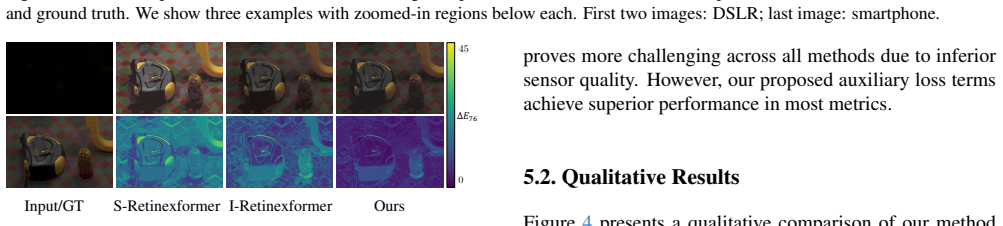

read the original abstract
Imaging in low-light environments is challenging due to reduced scene radiance, which leads to elevated sensor noise and reduced color saturation. Most learning-based low-light enhancement methods rely on paired training data captured under a single low-light condition and a well-lit reference. The lack of radiance diversity limits our understanding of how enhancement techniques perform across varying illumination intensities. We introduce the Multi-Illumination Low-Light (MILL) dataset, containing images captured at diverse light intensities under controlled conditions with fixed camera settings and precise illuminance measurements. MILL enables comprehensive evaluation of enhancement algorithms across variable lighting conditions. We benchmark several state-of-the-art methods and reveal significant performance variations across intensity levels. Leveraging the unique multi-illumination structure of our dataset, we propose improvements that enhance robustness across diverse illumination scenarios. Our modifications achieve up to 10 dB PSNR improvement for DSLR and 2 dB for the smartphone on Full HD images.
Editorial analysis
A structured set of objections, weighed in public.
Referee Report
Summary. The manuscript introduces the Multi-Illumination Low-Light (MILL) dataset containing images captured at multiple controlled illumination intensities with fixed camera settings and precise illuminance measurements. It benchmarks several state-of-the-art low-light enhancement methods, revealing performance variations across intensity levels, and proposes modifications that leverage the dataset's multi-illumination structure to improve robustness, claiming PSNR gains of up to 10 dB for DSLR and 2 dB for smartphone on Full HD images.
Significance. The MILL dataset is a clear strength, enabling controlled, multi-intensity evaluation that addresses limitations of prior single-condition low-light datasets. The benchmarking results usefully document intensity-dependent performance differences across methods and devices. If the modifications can be shown to exploit cross-intensity information, the work could support more robust enhancement techniques; the controlled capture protocol with exact measurements is a positive contribution to reproducibility in the area.
major comments (1)
- [§5] §5 (Proposed Improvements): The specific modifications to the baseline enhancement methods are not described. It remains unclear whether they incorporate multi-level loss terms, joint training across intensity pairs, intensity-aware normalization, or other mechanisms that use the multi-illumination structure. Without this detail the central claim of up to 10 dB PSNR gains cannot be evaluated for genuine robustness versus dataset-specific tuning on MILL's controlled conditions.
minor comments (3)
- [Abstract] Abstract: The claim of 'up to 10 dB PSNR improvement' does not identify the exact baseline methods or the intensity levels at which the gains occur; adding this context would improve clarity without altering the result.
- [Dataset section] Dataset description: While the controlled capture and illuminance measurements are well-motivated, the exact number of scenes, the discrete intensity levels used, and the precise camera models should be stated explicitly in a table or list for full reproducibility.
- [Benchmarking section] Benchmarking results: The manuscript should report which specific SOTA methods were evaluated and include error bars or statistical significance tests for the observed performance variations across intensities.
Simulated Author's Rebuttal
We thank the referee for the constructive feedback and for highlighting the strengths of the MILL dataset and its benchmarking contributions. We address the major comment on the description of the proposed improvements below.
read point-by-point responses
-
Referee: [§5] §5 (Proposed Improvements): The specific modifications to the baseline enhancement methods are not described. It remains unclear whether they incorporate multi-level loss terms, joint training across intensity pairs, intensity-aware normalization, or other mechanisms that use the multi-illumination structure. Without this detail the central claim of up to 10 dB PSNR gains cannot be evaluated for genuine robustness versus dataset-specific tuning on MILL's controlled conditions.
Authors: We agree that Section 5 lacked sufficient detail on the modifications. In the revised manuscript we will expand this section with a precise description of the approach. The modifications consist of joint training across intensity pairs from the same scene, a multi-level loss combining per-intensity reconstruction with cross-intensity consistency terms, and intensity-aware normalization layers conditioned on the measured illuminance values. We will include pseudocode, architectural diagrams, and ablation studies to demonstrate that the reported PSNR gains (up to 10 dB on DSLR and 2 dB on smartphone Full HD images) derive from exploiting the multi-illumination structure for robustness rather than overfitting to MILL's controlled capture protocol. revision: yes
Circularity Check
No circularity: empirical dataset creation and benchmarking with independent results
full rationale
The paper introduces the MILL dataset with multi-intensity captures under controlled conditions and benchmarks existing methods, then reports empirical PSNR gains from proposed modifications. No mathematical derivation chain, equations, or predictions are present that reduce by construction to fitted parameters, self-definitions, or prior self-citations. The claimed improvements and gains are presented as outcomes of new data evaluation rather than forced by input structure or ansatz smuggling. This is a standard empirical contribution self-contained against external benchmarks.
Axiom & Free-Parameter Ledger
Lean theorems connected to this paper
-
IndisputableMonolith/Cost/FunctionalEquation.leanwashburn_uniqueness_aczel unclear?
unclearRelation between the paper passage and the cited Recognition theorem.
We propose two loss terms that exploit the auxiliary illumination information (i.e., intensity level) provided by our dataset. ... an intensity prediction loss that uses the first latent channel to predict the input illumination level, and (2) a scene consistency loss that encourages the remaining channels to encode illumination-invariant scene content
-
IndisputableMonolith/Foundation/DimensionForcing.leanalexander_duality_circle_linking unclear?
unclearRelation between the paper passage and the cited Recognition theorem.
Leveraging the unique multi-illumination structure of our dataset, we propose improvements that enhance robustness across diverse illumination scenarios.
What do these tags mean?
- matches
- The paper's claim is directly supported by a theorem in the formal canon.
- supports
- The theorem supports part of the paper's argument, but the paper may add assumptions or extra steps.
- extends
- The paper goes beyond the formal theorem; the theorem is a base layer rather than the whole result.
- uses
- The paper appears to rely on the theorem as machinery.
- contradicts
- The paper's claim conflicts with a theorem or certificate in the canon.
- unclear
- Pith found a possible connection, but the passage is too broad, indirect, or ambiguous to say the theorem truly supports the claim.
Reference graph
Works this paper leans on
-
[1]
Learning a deep single image contrast enhancer from multi-exposure images
Jianrui Cai, Shuhang Gu, and Lei Zhang. Learning a deep single image contrast enhancer from multi-exposure images. IEEE TIP, 27(4):2049–2062, 2018. 2, 3, 8
work page 2049
-
[2]
Retinexformer: One-stage retinex- based transformer for low-light image enhancement
Yuanhao Cai, Hao Bian, Jing Lin, Haoqian Wang, Radu Tim- ofte, and Yulun Zhang. Retinexformer: One-stage retinex- based transformer for low-light image enhancement. In ICCV, 2023. 2, 3, 5, 6, 7
work page 2023
-
[3]
Chen Chen, Qifeng Chen, Jia Xu, and Vladlen Koltun. Learning to see in the dark. InCVPR, 2018. 2, 3
work page 2018
-
[4]
Darkir: Robust low-light image restoration
Daniel Feijoo, Juan C Benito, Alvaro Garcia, and Marcos V Conde. Darkir: Robust low-light image restoration. In CVPR, 2025. 3, 5, 6
work page 2025
-
[5]
Dancing in the dark: A benchmark towards general low-light video enhancement
Huiyuan Fu, Wenkai Zheng, Xicong Wang, Jiaxuan Wang, Heng Zhang, and Huadong Ma. Dancing in the dark: A benchmark towards general low-light video enhancement. In ICCV, 2023. 2
work page 2023
-
[6]
A weighted variational model for simultane- ous reflectance and illumination estimation
Xueyang Fu, Delu Zeng, Yue Huang, Xiao-Ping Zhang, and Xinghao Ding. A weighted variational model for simultane- ous reflectance and illumination estimation. InCVPR, 2016. 3
work page 2016
-
[7]
Zero-reference deep curve estimation for low-light image enhancement
Chunle Guo, Chongyi Li, Jichang Guo, Chen Change Loy, Junhui Hou, Sam Kwong, and Runmin Cong. Zero-reference deep curve estimation for low-light image enhancement. In CVPR, 2020. 3
work page 2020
-
[8]
Lime: Low-light im- age enhancement via illumination map estimation.IEEE TIP, 26(2):982–993, 2016
Xiaojie Guo, Yu Li, and Haibin Ling. Lime: Low-light im- age enhancement via illumination map estimation.IEEE TIP, 26(2):982–993, 2016. 2, 3
work page 2016
-
[9]
Jiang Hai, Zhu Xuan, Ren Yang, Yutong Hao, Fengzhu Zou, Fang Lin, and Songchen Han. R2rnet: Low-light image enhancement via real-low to real-normal network.Jour- nal of Visual Communication and Image Representation, 90: 103712, 2023. 2
work page 2023
-
[10]
Multiscale sliced wasserstein distances as perceptual color difference measures
Jiaqi He, Zhihua Wang, Leon Wang, Tsein-I Liu, Yuming Fang, Qilin Sun, and Kede Ma. Multiscale sliced wasserstein distances as perceptual color difference measures. InECCV,
-
[11]
Dslr-quality photos on mobile devices with deep convolutional networks
Andrey Ignatov, Nikolay Kobyshev, Radu Timofte, Kenneth Vanhoey, and Luc Van Gool. Dslr-quality photos on mobile devices with deep convolutional networks. InICCV, 2017. 2
work page 2017
-
[12]
Enlightengan: Deep light enhancement without paired supervision.IEEE TIP, 30:2340–2349, 2021
Yifan Jiang, Xinyu Gong, Ding Liu, Yu Cheng, Chen Fang, Xiaohui Shen, Jianchao Yang, Pan Zhou, and Zhangyang Wang. Enlightengan: Deep light enhancement without paired supervision.IEEE TIP, 30:2340–2349, 2021. 3
work page 2021
-
[13]
The retinex.American Scientist, 52(2):247– 264, 1964
Edwin H Land. The retinex.American Scientist, 52(2):247– 264, 1964. 3
work page 1964
-
[14]
Contrast en- hancement based on layered difference representation
Chulwoo Lee, Chul Lee, and Chang-Su Kim. Contrast en- hancement based on layered difference representation. In ICIP, 2012. 8
work page 2012
-
[15]
Chongyi Li, Chunle Guo, Linghao Han, Jun Jiang, Ming- Ming Cheng, Jinwei Gu, and Chen Change Loy. Low-light image and video enhancement using deep learning: A sur- vey.IEEE TPAMI, 44(12):9396–9416, 2021. 2
work page 2021
-
[16]
Gt-mean loss: A simple yet effective solution for brightness mismatch in low-light image enhancement
Jingxi Liao, Shijie Hao, Richang Hong, and Meng Wang. Gt-mean loss: A simple yet effective solution for brightness mismatch in low-light image enhancement. InICCV, 2025. 3, 5, 6, 7
work page 2025
-
[17]
Benchmarking low-light image enhance- ment and beyond.IJCV, 129:1153–1184, 2021
Jiaying Liu, Xu Dejia, Wenhan Yang, Minhao Fan, and Haofeng Huang. Benchmarking low-light image enhance- ment and beyond.IJCV, 129:1153–1184, 2021. 2
work page 2021
-
[18]
Toward fast, flexible, and robust low-light image enhancement
Long Ma, Tengyu Ma, Risheng Liu, Xin Fan, and Zhongx- uan Luo. Toward fast, flexible, and robust low-light image enhancement. InCVPR, 2022. 3, 5, 6, 7
work page 2022
-
[19]
Alexandra Malyugina, Nantheera Anantrasirichai, and David Bull. A topological loss function for image denoising on a new bvi-lowlight dataset.Signal Processing, 211:109081,
-
[20]
No-reference image quality assessment in the spa- tial domain.IEEE TIP, 21(12):4695–4708, 2012
Anish Mittal, Anush Krishna Moorthy, and Alan Conrad Bovik. No-reference image quality assessment in the spa- tial domain.IEEE TIP, 21(12):4695–4708, 2012. 7
work page 2012
-
[21]
Anish Mittal, Rajiv Soundararajan, and Alan C Bovik. Mak- ing a “completely blind” image quality analyzer.IEEE Sig- nal processing letters, 20(3):209–212, 2012. 7
work page 2012
-
[22]
Multi-scale retinex for color image enhancement
Zia-ur Rahman, Daniel J Jobson, and Glenn A Woodell. Multi-scale retinex for color image enhancement. InICIP,
-
[23]
Liu Risheng, Ma Long, Zhang Jiaao, Fan Xin, and Luo Zhongxuan. Retinex-inspired unrolling with cooperative prior architecture search for low-light image enhancement. InCVPR, 2021. 2, 3, 5, 6
work page 2021
-
[24]
Promptnorm: Image ge- ometry guides ambient light normalization
David Serrano-Lozano, Francisco A Molina-Bakhos, Danna Xue, Yixiong Yang, Maria Pilligua, Ramon Baldrich, Maria Vanrell, and Javier Vazquez-Corral. Promptnorm: Image ge- ometry guides ambient light normalization. InCVPR Work- shops, 2025. 5, 6, 7
work page 2025
-
[25]
Survey of methods and evaluation of retinex-inspired image enhancers.J
Gabriele Simone, Michela Lecca, Gabriele Gianini, and Alessandro Rizzi. Survey of methods and evaluation of retinex-inspired image enhancers.J. Electron. Imaging, 31 (6):063055–063055, 2022. 3
work page 2022
-
[26]
Tm-died: The most difficult image en- hancement dataset, Accessed 10/2025
Vassilios V onikakis. Tm-died: The most difficult image en- hancement dataset, Accessed 10/2025. 2
work page 2025
-
[27]
A biologically in- spired scale-space for illumination invariant feature detec- tion.Meas
Vasillios V onikakis, Dimitrios Chrysostomou, Rigas Kousk- ouridas, and Antonios Gasteratos. A biologically in- spired scale-space for illumination invariant feature detec- tion.Meas. Sci. Technol., 24(7):074024, 2013. 2, 3 9
work page 2013
-
[28]
Fourllie: Boosting low-light image enhancement by fourier frequency informa- tion
Chenxi Wang, Hongjun Wu, and Zhi Jin. Fourllie: Boosting low-light image enhancement by fourier frequency informa- tion. InACM MM, 2023. 5, 6
work page 2023
-
[29]
Underexposed photo enhance- ment using deep illumination estimation
Ruixing Wang, Qing Zhang, Chi-Wing Fu, Xiaoyong Shen, Wei-Shi Zheng, and Jiaya Jia. Underexposed photo enhance- ment using deep illumination estimation. InCVPR, 2019. 2
work page 2019
-
[30]
Seeing dynamic scene in the dark: High- quality video dataset with mechatronic alignment
Ruixing Wang, Xiaogang Xu, Chi-Wing Fu, Jiangbo Lu, Bei Yu, and Jiaya Jia. Seeing dynamic scene in the dark: High- quality video dataset with mechatronic alignment. InICCV,
-
[31]
Shuhang Wang, Jin Zheng, Hai-Miao Hu, and Bo Li. Nat- uralness preserved enhancement algorithm for non-uniform illumination images.IEEE TIP, 22(9):3538–3548, 2013. 3
work page 2013
-
[32]
Ultra-high-definition low-light image enhancement: A benchmark and transformer-based method
Tao Wang, Kaihao Zhang, Tianrun Shen, Wenhan Luo, Bjorn Stenger, and Tong Lu. Ultra-high-definition low-light image enhancement: A benchmark and transformer-based method. InAAAI, 2023. 3, 5
work page 2023
-
[33]
Deep retinex decomposition for low-light enhancement
Wenjing Wang, Chen Wei, Wenhan Yang, and Jiaying Liu. Deep retinex decomposition for low-light enhancement. In BMVC, 2018. 2, 3
work page 2018
-
[34]
Gladnet: Low-light enhancement network with global awareness
Wenjing Wang, Chen Wei, Wenhan Yang, and Jiaying Liu. Gladnet: Low-light enhancement network with global awareness. InFace and Gestures, 2018. 3
work page 2018
-
[35]
Deep retinex decomposition for low-light enhancement
Chen Wei, Wenjing Wang, Wenhan Yang, and Jiaying Liu. Deep retinex decomposition for low-light enhancement. In BMVC, 2018. 2, 3
work page 2018
-
[36]
Hvi: A new color space for low-light image enhancement
Qingsen Yan, Yixu Feng, Cheng Zhang, Guansong Pang, Kangbiao Shi, Peng Wu, Wei Dong, Jinqiu Sun, and Yan- ning Zhang. Hvi: A new color space for low-light image enhancement. InCVPR, 2025. 3, 5, 6
work page 2025
-
[37]
From fidelity to perceptual quality: A semi- supervised approach for low-light image enhancement
Wenhan Yang, Shiqi Wang, Yuming Fang, Yue Wang, and Jiaying Liu. From fidelity to perceptual quality: A semi- supervised approach for low-light image enhancement. In CVPR, 2020. 3
work page 2020
-
[38]
Wenhan Yang, Wenjing Wang, Haofeng Huang, Shiqi Wang, and Jiaying Liu. Sparse gradient regularized deep retinex network for robust low-light image enhancement.IEEE TIP, 30:2072–2086, 2021. 2, 3
work page 2072
-
[39]
Diff-retinex: Rethinking low-light image enhancement with a generative diffusion model
Xunpeng Yi, Han Xu, Hao Zhang, Linfeng Tang, and Jiayi Ma. Diff-retinex: Rethinking low-light image enhancement with a generative diffusion model. InICCV, 2023. 3
work page 2023
-
[40]
Learning enriched features for real image restoration and enhancement
Syed Waqas Zamir, Aditya Arora, Salman Khan, Munawar Hayat, Fahad Shahbaz Khan, Ming-Hsuan Yang, and Ling Shao. Learning enriched features for real image restoration and enhancement. InECCV, 2020. 5, 6
work page 2020
-
[41]
Restormer: Efficient transformer for high-resolution image restoration
Syed Waqas Zamir, Aditya Arora, Salman Khan, Mu- nawar Hayat, Fahad Shahbaz Khan, and Ming-Hsuan Yang. Restormer: Efficient transformer for high-resolution image restoration. InCVPR, 2022. 6
work page 2022
-
[42]
Benchmarking ultra-high-definition image super-resolution
Kaihao Zhang, Dongxu Li, Wenhan Luo, Wenqi Ren, Bjorn Stenger, Wei Liu, Hongdong Li, and Ming-Hsuan Yang. Benchmarking ultra-high-definition image super-resolution. InICCV, 2021. 2, 3, 6
work page 2021
-
[43]
The unreasonable effectiveness of deep features as a perceptual metric
Richard Zhang, Phillip Isola, Alexei A Efros, Eli Shechtman, and Oliver Wang. The unreasonable effectiveness of deep features as a perceptual metric. InCVPR, 2018. 6
work page 2018
-
[44]
Kindling the darkness: A practical low-light image enhancer
Yonghua Zhang, Jiawan Zhang, and Xiaojie Guo. Kindling the darkness: A practical low-light image enhancer. InACM MM, 2019. 2, 3, 5, 6
work page 2019
-
[45]
Beyond brightening low-light images.IJCV, 129(4): 1013–1037, 2021
Yonghua Zhang, Xiaojie Guo, Jiayi Ma, Wei Liu, and Jiawan Zhang. Beyond brightening low-light images.IJCV, 129(4): 1013–1037, 2021. 3
work page 2021
-
[46]
Pyramid diffusion models for low-light image enhancement
Dewei Zhou, Zongxin Yang, and Yi Yang. Pyramid diffusion models for low-light image enhancement. InIJCAI, 2023. 3
work page 2023
-
[47]
Led- net: Joint low-light enhancement and deblurring in the dark
Shangchen Zhou, Chongyi Li, and Chen Change Loy. Led- net: Joint low-light enhancement and deblurring in the dark. InECCV, 2022. 3 10
work page 2022
discussion (0)
Sign in with ORCID, Apple, or X to comment. Anyone can read and Pith papers without signing in.