REVIEW 4 major objections 5 minor 59 references
Splitting QAOA's problem Hamiltonian into two angle sets yields better schedules for time-constrained tasks.
Reviewed by Pith at T0; open to challenge. T0 means a machine referee read the full paper against a public rubric. the ladder, T0–T4 →
T0 review · deepseek-v4-flash
2026-08-03 21:20 UTC pith:UMN65QUC
load-bearing objection Honest engineering paper with a useful in-circuit overlap idea, but the headline performance claim is confounded by parameter count and is not yet supported. the 4 major comments →
QTIS: A QAOA-Based Quantum Time Interval Scheduler
The pith
A machine-rendered reading of the paper's core claim, the machinery that carries it, and where it could break.
Core claim
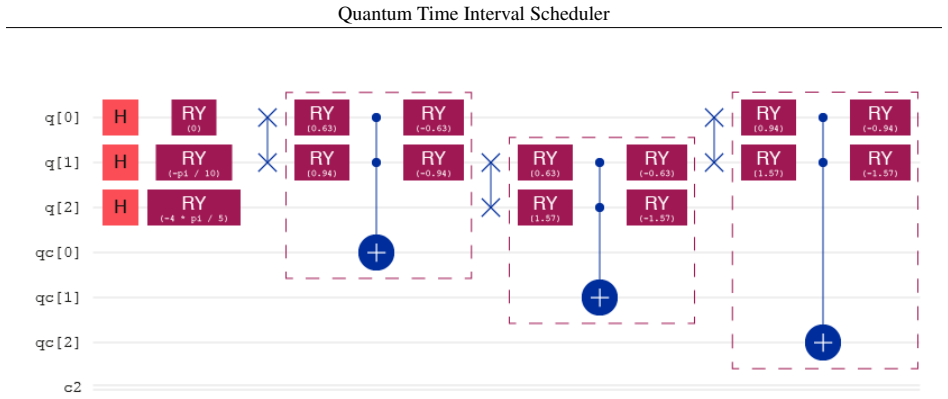
The central claim is the three-operator ansatz U(H_p, gamma_i) U(H_c, zeta_i) U(H_B, beta_i) per layer, where H_c encodes the pairwise overlap penalties. The overlap coefficients c_ik, instead of being hard-coded from the QUBO, are represented as ancilla qubits set either by the 'Damselfly' quantum circuit (RY rotations followed by a CCNOT) or by a classical preprocessor that computes sign(t_k^s - t_i^e). The authors argue that giving H_c independent parameters zeta enables the classical optimizer to tune the constraint-penalty strength separately from the objective, which they show empirically on six test sets: the mean normalized energy with gamma != zeta is lower than with gamma = zeta fo
What carries the argument
The central machinery is the decomposition H_P = H_p + H_c and the consequent split of the QAOA rotation into U(H_p, gamma_i) and U(H_c, zeta_i). H_c is realized through controlled R_z and R_zz gates whose control qubits are ancilla states representing the overlap coefficients c_ik; the paper's 'Damselfly' gate computes these coefficients in-circuit via RY rotations and a CCNOT, while the classical variant precomputes sign(t_k^s - t_i^e). The separate zeta angles are the key parameterization choice that the paper claims drives the lower normalized energies.
Load-bearing premise
The load-bearing premise is that the quantum conflict-detection circuit reliably reflects the boolean overlap condition t_i^e - t_k^s > 0 AND t_k^e - t_i^s > 0 through the probability of an ancilla qubit being |1> after RY rotations and a CCNOT; the paper itself notes this only works when the time differences are large enough after scaling to [0, pi/2], so small differences make the detection approximate rather than exact.
What would settle it
For a fixed circuit depth, compute the normalized energy of QTIS-QAOA with gamma_i = zeta_i for all layers and compare it to the same circuit with gamma_i and zeta_i optimized independently over a large batch of random initial parameters; if the independent-parameter version never achieves lower energy, the central claim collapses.
If this is right
- If separate angles for constraint Hamiltonians generalize, other constrained QUBO problems (e.g., TSP, job-shop scheduling, graph coloring) could adopt the same split, isolating hard constraints into their own variational parameters.
- The in-circuit overlap detection means large scheduling instances need only time-interval normalization as classical preprocessing, not a full QUBO coefficient computation, potentially easing the path to larger circuits.
- HT-QAOA's interpolation-based warm-start gives a cheap way to initialize deep QAOA circuits from a single L=1 run, which could reduce optimization iterations on noisy hardware.
- The classical conflict-detection variant, at the cost of more classical preprocessing, offers an accuracy-preserving fallback when the quantum detector's approximation fails, so the separate-angle benefit is not tied to the approximate quantum detector.
Where Pith is reading between the lines
- We infer a mechanistic interpretation not developed in the paper: giving H_c its own angles per layer effectively allows the optimizer to choose a different effective penalty weight at each layer, so the separate-angle advantage may be equivalent to an annealed schedule on the constraint term; this is testable by fitting a penalty schedule and comparing.
- A concrete extension would be to replace the RY-CCNOT overlap detector with an exact reversible comparator using quantum integer subtraction; if the exact version further lowers energy on tight-overlap instances, it would quantify the cost of the approximation the paper acknowledges.
- The O(N^2) ancilla count for overlap pairs will dominate qubit requirements as N grows; an inference is that the method's near-term utility will hinge on whether a streaming/reuse scheme for ancillas, like the Damselfly gate's reuse, can reduce this to O(N) without losing the conflict information.
Editorial analysis
A structured set of objections, weighed in public.
Referee Report
Summary. QTIS-QAOA splits the standard problem Hamiltonian H_P into H_p (objective plus assignment penalties) and H_c (overlap penalties), and parameterizes the corresponding unitaries with independent angles γ and ζ. Overlap coefficients are either prepared classically or by an ancilla circuit using R_y rotations and a CCNOT gate. The paper compares standard QAOA, T-QAOA, and a proposed HT-QAOA initialization on six 3-task/2-resource sets with L=10, reporting mean normalized energies over ten runs for γ≠ζ and γ=ζ (Table 4). It concludes that separate ζ parameters improve performance and that HT-QAOA offers intermediate performance at lower cost. Appendix A gives the QUBO-to-Ising derivation of H_c.
Significance. The design pattern of decomposing H_P into objective and constraint parts, with constraint rotations controlled by ancilla qubits, is an interesting and potentially reusable idea. The classical conflict-detection variant is clearly specified, and the Ising transformation in Appendix A is correct. However, the current evidence does not establish the paper's headline claims: the γ≠ζ comparison is confounded by parameter count, the quantum conflict detector has a sign ambiguity that is not merely a small-difference issue, and the reported normalized energies do not demonstrate feasibility or solution quality. The contributions are conditional on substantial additional experiments.
major comments (4)
- [§6.3, Table 4; §1 Contributions] The claim that separate ζ parameters improve performance is not supported because the γ≠ζ variational family strictly contains the γ=ζ submanifold (set ζ_l=γ_l for all l). Adding L free parameters can only lower (or leave unchanged) the optimized expectation value in a noiseless simulation, regardless of whether the H_p/H_c decomposition is useful. A matched-parameter control is needed: e.g., split H_P into two arbitrary subsets with independent angles, use a multi-angle QAOA with the same total parameter count, or compare γ=ζ at depth 2L. Without such a control, Table 4 quantifies parameter-count flexibility, not the value of the decomposition.
- [§5.1, Eqs. (31)–(33), Fig. 7; §5.2.1] The full-quantum detector cannot implement Eq. (30) as written. For a qubit in |+⟩, R_Y(θ)|+⟩ has |1⟩ probability sin²(θ/2), so a negative difference t_i^e−t_k^s produces the same measurement statistics as a positive difference of the same magnitude. The CCNOT gate therefore cannot tell whether both differences are positive; it only sees squared amplitudes. Section 5.2.1 attributes the limitation to 'small differences', but the problem is sign ambiguity at all scales. This needs either a corrected encoding with signed information or a clear statement that the quantum variant is a heuristic approximate detector whose false-positive rate must be quantified.
- [§6.3, Eq. (39), Table 3] The normalized energy is computed with E_min=-3 for all six sets. For Set 2 all three tasks overlap pairwise and only two resources are available, so no feasible schedule can schedule all three tasks; E_min=-3 is infeasible. A lower normalized energy in this set can indicate moving toward an infeasible configuration, so it is not a reliable proxy for solution quality. The paper also reports no success probabilities, no counts of feasible sampled bitstrings, and no classical optimum/solver baseline for the six small instances. Please report these quantities, or at least restrict normalized-energy claims to feasible instances.
- [§6.1 vs §6.3] Section 6.1 promises that results for Set 1 using the quantum conflict-detection variant will be compared with the classical variant. Section 6.3 reports only the classical variant; no comparison appears. Since the full-quantum circuit is presented as a main contribution, the missing comparison (or removal of the promise) is a gap.
minor comments (5)
- [Throughout] Notation is inconsistent: H_P, H_p, and Hc are used interchangeably (e.g., §4, Eq. (18)). Define each symbol once and use it consistently.
- [§6.2.1, Eqs. (39)–(41)] Equation (41) optimizes ⟨H_P⟩ while Eq. (39) defines normalized energy via H; clarify whether H=H_P and which operator is used in the classical optimizer.
- [§6.2.3] The HT-QAOA initialization is plausible, but the connection to [48] is motivational; state explicitly what is borrowed from the homotopy method and what is new.
- [§5.1, Fig. 6 caption] The caption should explain the dashed boxes and the role of the 'Damselfly' gate; currently the figure is hard to interpret without referring to the text.
- [Abstract, §7] The abstract and conclusions say 'improved solution quality', but the only reported metric is mean normalized energy. Qualify this language unless feasibility statistics are added.
Circularity Check
No significant circularity: the Hamiltonians are derived algebraically from the QUBO and the performance claims are empirical simulator measurements; the gamma-vs-zeta comparison is a parameter-count confound but not a definitional reduction.
full rationale
The derivation chain is self-contained. H_p and H_c are obtained by splitting the QUBO in Eqs. (19) and (23) and applying the standard QUBO-to-Ising transformation; Appendix A carries out the algebra explicitly, so no fitted constant is relabeled as a prediction. The performance claims in Tables 4 and 5 are measured normalized energies on six fixed instances, not quantities constructed to equal the conclusions. The quantum conflict-detection circuit is approximate, as the paper itself states in Sec. 5.2.1, which is a limitation rather than a circular step. There are no load-bearing self-citations: HT-QAOA is adapted from external reference [48] as a heuristic initialization, and no uniqueness theorem or prior author result is invoked to force the ansatz. The main validity caveat is that the gamma != zeta comparison in Sec. 6.3.2 compares variational families of different sizes; setting zeta_l = gamma_l in Eq. (42) recovers the shared-parameter circuit, so the observed lower minima are partly a parameter-count effect rather than evidence specifically for the H_p/H_c decomposition. That is an experimental-design confound, not a definitional or self-citational circularity, because the reported energies are genuine optimizer outputs that could in principle have been worse in finite samples.
Axiom & Free-Parameter Ledger
free parameters (3)
- HT-QAOA interpolation endpoints =
gamma in [gamma_1, pi], zeta in [zeta_1, pi], beta in [beta_1, 0]
- Time scaling factor for quantum conflict detection =
intervals scaled to [0, pi/2]
- Circuit depth L=10 =
10
axioms (4)
- standard math Ising transformation x_ij = (1 - s_ij)/2 maps QUBO to Hamiltonian
- domain assumption Overlap condition is exactly c_ik = [t_i^e > t_k^s AND t_k^e > t_i^s]
- ad hoc to paper The RY rotation probabilities sin^2(time difference) can be used as a proxy for the boolean overlap condition
- ad hoc to paper Hamiltonian homotopy intuition from [48] justifies initializing gamma near pi and beta near 0 in HT-QAOA
read the original abstract
Task scheduling with constrained time intervals and limited resources remains a fundamental challenge across domains such as manufacturing, logistics, cloud computing, and healthcare. This study presents a novel variant of the Quantum Approximate Optimization Algorithm (QAOA) designed to address the task scheduling problem formulated as a Quadratic Unconstrained Binary Optimization (QUBO) model. The proposed method, referred to as Quantum Time Interval Scheduler (QTIS), integrates an ancilla-assisted quantum circuit to dynamically detect and penalize overlapping tasks, enhancing the enforcement of scheduling constraints. Two complementary implementations are explored for overlap detection: a quantum approach based on RY rotations and CCNOT gates, and a classical alternative relying on preprocessed interval comparisons. QTIS decomposes the problem Hamiltonian, Hp, into two components, each parameterized by a distinct angle. The first component encodes the objective function, while the second captures penalty terms associated with overlapping intervals, which are controlled by the auxiliary circuit. Subsequently, three minimization strategies are evaluated: standard QAOA, T-QAOA, and HT-QAOA, showing that employing separate parameters for the different components of the problem Hamiltonian leads to lower energy values and improved solution quality. Results confirm the efficiency of QTIS in scheduling tasks with fixed temporal windows while minimizing conflicts, demonstrating its potential to advance hybrid quantum-classical optimization in complex scheduling environments.
Figures




Reference graph
Works this paper leans on
-
[1]
Scheduling in manufacturing with transportation: Classification and solution techniques.European journal of operational research, 315(3):821–843,
Amir Hosseini, Alena Otto, and Erwin Pesch. Scheduling in manufacturing with transportation: Classification and solution techniques.European journal of operational research, 315(3):821–843,
-
[2]
Intelligent scheduling methods for optimisation of job shop scheduling problems in the manufacturing sector: A systematic review.Electronics (Basel), 14 (8):1663–, 2025
Atefeh Momenikorbekandi and Tatiana Kalganova. Intelligent scheduling methods for optimisation of job shop scheduling problems in the manufacturing sector: A systematic review.Electronics (Basel), 14 (8):1663–, 2025. ISSN 2079-9292
2025
-
[3]
A systematic literature review of ve- hicle routing problems with time windows.Sustain- ability, 15(15):12004–, 2023
Xiaobo Liu, Yen-Lin Chen, Lip Yee Por, and Chin Soon Ku. A systematic literature review of ve- hicle routing problems with time windows.Sustain- ability, 15(15):12004–, 2023. ISSN 2071-1050
2023
-
[4]
A comprehensive review of task scheduling problem in cloud computing: Recent ad- vances and comparative analysis
Jessica González-San-Martín, Laura Cruz-Reyes, Claudia Gómez-Santillán, Héctor Fraire-Huacuja, Nelson Rangel-Valdez, Bernabé Dorronsoro, Marcela Quiroz-Castellanos, Patricia Melin, and Oscar Castillo. A comprehensive review of task scheduling problem in cloud computing: Recent ad- vances and comparative analysis. InNew Horizons for Fuzzy Logic, Neural Net...
-
[5]
Mah- moud
Amin Avan, Akramul Azim, and Qusay H. Mah- moud. A state-of-the-art review of task schedul- ing for edge computing: A delay-sensitive applica- tion perspective.Electronics (Basel), 12(12):2599–,
-
[6]
Abdalkareem, Amiza Amir, Mo- hammed Azmi Al-Betar, Phaklen Ekhan, and Ab- delaziz I
Zahraa A. Abdalkareem, Amiza Amir, Mo- hammed Azmi Al-Betar, Phaklen Ekhan, and Ab- delaziz I. Hammouri. Healthcare scheduling in opti- mization context: a review.Health and technology, 11(3):445–469, 2021. ISSN 2190-7188
2021
-
[7]
Research on hospital human resource al- location and scheduling based on multi-objective op- timization algorithm.Applied mathematics and non- linear sciences, 10(1), 2025
Zhuo Liu. Research on hospital human resource al- location and scheduling based on multi-objective op- timization algorithm.Applied mathematics and non- linear sciences, 10(1), 2025. ISSN 2444-8656
2025
-
[8]
Dantzig, Delbert R
George B. Dantzig, Delbert R. Fulkerson, and Selmer M. Johnson. Solution of a large-scale traveling-salesman problem.Journal of the Oper- ations Research Society of America, 2(4):393–410,
-
[9]
Lawler, Jan Karel Lenstra, Alexander H
Eugene L. Lawler, Jan Karel Lenstra, Alexander H. G. Rinnooy Kan, and David B. Shmoys.The Trav- eling Salesman Problem: A Guided Tour of Com- binatorial Optimization. Wiley, 1985. ISBN 978- 0471904137
1985
-
[10]
Holt, Franco Modigliani, John F
Charles C. Holt, Franco Modigliani, John F. Muth, and Herbert A. Simon. A linear decision rule for pro- duction and employment scheduling.Management Science, 2(1):1–30, 1955. doi: 10.1287/mnsc.2.1.1
-
[11]
Punnen.The Trav- eling Salesman Problem and Its Variations
Gregory Gutin and Abraham P. Punnen.The Trav- eling Salesman Problem and Its Variations. Combi- natorial Optimization ; 12. Springer US, New York, NY , 1st ed. 2007. edition, 2007. ISBN 0-306-48213- 4
2007
-
[12]
R Garey, D
M. R Garey, D. S Johnson, and Ravi Sethi. The com- plexity of flowshop and jobshop scheduling.Mathe- matics of operations research, 1(2):117–129, 1976. ISSN 0364-765X
1976
-
[13]
Graham, Eugene L
Ronald L. Graham, Eugene L. Lawler, Jan Karel Lenstra, and Alexander H. G. Rinnooy Kan. Op- timization and approximation in deterministic se- quencing and scheduling: a survey.Annals of Dis- crete Mathematics, 5:287–326, 1979. doi: 10.1016/ S0167-5060(08)70356-X
1979
-
[14]
Kernighan
Shen Lin and Brian W. Kernighan. An effective heuristic algorithm for the traveling-salesman prob- 16 Quantum Time Interval Scheduler QAOA ( != ) QAOA ( = ) HTQAOA ( != ) HTQAOA ( = ) TQAOA ( != ) TQAOA ( = ) 0.00 0.02 0.04 0.06 0.08 0.10 0.12 0.14 0.16Normalized Energy Set 1 QAOA ( != ) QAOA ( = ) HTQAOA ( != ) HTQAOA ( = ) TQAOA ( != ) TQAOA ( = ) 0.14 ...
1973
-
[15]
J. Adams, E. Balas, and D. Zawack. The shift- ing bottleneck procedure for job shop scheduling. Management Science, 34(3):391–401, 1988. doi: 10.1287/mnsc.34.3.391
-
[16]
Punnen, editors.The Traveling Salesman Problem and Its Variations, vol- ume 12 ofCombinatorial Optimization
Gregory Gutin and Abraham P. Punnen, editors.The Traveling Salesman Problem and Its Variations, vol- ume 12 ofCombinatorial Optimization. Springer,
-
[17]
E. Nowicki and C. Smutnicki. A fast taboo search algorithm for the job shop problem.Management Science, 42(6):797–813, 1996. doi: 10.1287/mnsc. 42.6.797
doi:10.1287/mnsc 1996
-
[18]
Metaheuristics for multi-objective scheduling problems in industry 4.0 and 5.0: a state- of-the-arts survey.Frontiers in Industrial Engineer- ing, 3:1540022, 2025
Wenqiang Zhang, Xuan Bao, Xinchang Hao, and Mitsuo Gen. Metaheuristics for multi-objective scheduling problems in industry 4.0 and 5.0: a state- of-the-arts survey.Frontiers in Industrial Engineer- ing, 3:1540022, 2025
2025
-
[19]
Discovering heuristics and metaheuristics for job shop scheduling from scratch via deep reinforce- ment learning
Tilo Van Ekeris, Richard Meyes, and Tobias Meisen. Discovering heuristics and metaheuristics for job shop scheduling from scratch via deep reinforce- ment learning. InProceedings of the Conference on Production Systems and Logistics : CPSL 2021, pages 709–718. Hannover: publish-Ing., 2021
2021
-
[20]
Quantum algorithms: an overview.npj quantum information, 2(1):15023– 15023, 2016
Ashley Montanaro. Quantum algorithms: an overview.npj quantum information, 2(1):15023– 15023, 2016. ISSN 2056-6387
2016
-
[21]
A quantum approximate optimization algo- rithm.arXiv.org, 2014
Edward Farhi, Jeffrey Goldstone, and Sam Gut- mann. A quantum approximate optimization algo- rithm.arXiv.org, 2014. ISSN 2331-8422
2014
-
[22]
Tameem Albash and Daniel A. Lidar. Adiabatic quantum computation.Reviews of modern physics, 90(1):015002–, 2018. ISSN 0034-6861
2018
-
[23]
E. J. Crosson and Daniel A. Lidar. Prospects for quantum enhancement with diabatic quantum an- nealing.Nature Reviews Physics, 3:466–489, 2021. doi: 10.1038/s42254-021-00313-6
-
[24]
Evaluating the job shop schedul- ing problem on a d-wave quantum annealer.Scien- tific reports, 12(1):6539–11, 2022
Costantino Carugno, Maurizio Ferrari Dacrema, and Paolo Cremonesi. Evaluating the job shop schedul- ing problem on a d-wave quantum annealer.Scien- tific reports, 12(1):6539–11, 2022. ISSN 2045-2322
2022
-
[25]
Ossorio-Castillo and F
J. Ossorio-Castillo and F. Pena-Brage. Optimization of a refinery scheduling process with column gen- eration and a quantum annealer.Optimization and engineering, 23(3):1471–1488, 2022. ISSN 1389- 4420
2022
-
[26]
Beweis des adi- abatensatzes.Zeitschrift für Physik, 51:165–180,
Max Born and Vladimir Fock. Beweis des adi- abatensatzes.Zeitschrift für Physik, 51:165–180,
-
[27]
Combinato- rial optimization with quantum computers.Engi- neering optimization, 57(1):208–233, 2025
Francisco Chicano, Gabiel Luque, Zakaria Abdel- moiz Dahi, and Rodrigo Gil-Merino. Combinato- rial optimization with quantum computers.Engi- neering optimization, 57(1):208–233, 2025. ISSN 0305-215X
2025
-
[28]
A case study of variational quantum algorithms for a job shop scheduling problem.EPJ quantum technology, 9(1), 2022
David Amaro, Matthias Rosenkranz, Nathan Fitz- patrick, Koji Hirano, and Mattia Fiorentini. A case study of variational quantum algorithms for a job shop scheduling problem.EPJ quantum technology, 9(1), 2022. ISSN 2662-4400
2022
-
[29]
Solving combina- torial optimization and machine learning problems on hybrid near-term quantum photonic computers
Mateusz Slysz, Łukasz Grodzki, Piotr Rydli- chowski, Dawid Siera, Krzysztof Kurowski, Grze- gorz Waligóra, and Jan W˛ eglarz. Solving combina- torial optimization and machine learning problems on hybrid near-term quantum photonic computers. Future Generation Computer Systems, page 107934, 2025
2025
-
[30]
Love, Alán Aspuru-Guzik, and Jeremy L
Alberto Peruzzo, Jarrod McClean, Peter Shadbolt, Man-Hong Yung, Xiao-Qi Zhou, Peter J. Love, Alán Aspuru-Guzik, and Jeremy L. O’Brien. A varia- tional eigenvalue solver on a photonic quantum pro- cessor.Nature communications, 5(1):4213–4213,
-
[31]
Quantum computing in the nisq era and beyond.Quantum (Vienna, Austria), 2:79–,
John Preskill. Quantum computing in the nisq era and beyond.Quantum (Vienna, Austria), 2:79–,
-
[32]
Kottmann, Tim Menke, Wai-Keong Mok, Sukin Sim, Leong-Chuan Kwek, and Alán Aspuru-Guzik
Kishor Bharti, Alba Cervera-Lierta, Thi Ha Kyaw, Tobias Haug, Sumner Alperin-Lea, Abhinav Anand, Matthias Degroote, Hermanni Heimonen, Jakob S. Kottmann, Tim Menke, Wai-Keong Mok, Sukin Sim, Leong-Chuan Kwek, and Alán Aspuru-Guzik. Noisy intermediate-scale quantum algorithms.Re- views of modern physics, 94(1):1–, 2022. ISSN 0034-6861
2022
-
[33]
Xiaozhen Ge, Re-Bing Wu, and Herschel Rab- itz. The optimization landscape of hybrid quan- tum–classical algorithms: From quantum control to nisq applications.Annual Reviews in Control, 54: 314–323, 2022. ISSN 1367-5788. doi: https://doi. org/10.1016/j.arcontrol.2022.06.001
-
[34]
Hy- brid quantum-classical algorithms in the noisy intermediate-scale quantum era and beyond.Physi- cal review
Adam Callison and Nicholas Chancellor. Hy- brid quantum-classical algorithms in the noisy intermediate-scale quantum era and beyond.Physi- cal review. A, 106(1), 2022. ISSN 2469-9926
2022
-
[35]
Coles, Ryan Babbush, Si- mon C
Marco Cerezo, Patrick J. Coles, Ryan Babbush, Si- mon C. Benjamin, and et al. Variational quantum algorithms.Nature Reviews Physics, 3(9):625–644,
-
[36]
A review on quantum ap- proximate optimization algorithm and its variants
Kostas Blekos, Dean Brand, Andrea Ceschini, Chiao-Hui Chou, Rui-Hao Li, Komal Pandya, and Alessandro Summer. A review on quantum ap- proximate optimization algorithm and its variants. Physics reports, 1068:1–66, 2024. ISSN 0370-1573
2024
-
[37]
Benjamin, and Xiao Yuan
Sam McArdle, Suguru Endo, Alán Aspuru-Guzik, Simon C. Benjamin, and Xiao Yuan. Quantum com- putational chemistry.Reviews of modern physics, 92 (1):1–, 2020. ISSN 0034-6861
2020
-
[38]
18 Quantum Time Interval Scheduler Chow, and Jay M
Abhinav Kandala, Antonio Mezzacapo, Kristan Temme, Maika Takita, Markus Brink, Jerry M. 18 Quantum Time Interval Scheduler Chow, and Jay M. Gambetta. Hardware-efficient variational quantum eigensolver for small molecules and quantum magnets.Nature (London), 549(7671): 242–246, 2017. ISSN 0028-0836
2017
-
[39]
Lotshaw, James Os- trowski, Travis S
Rebekah Herrman, Phillip C. Lotshaw, James Os- trowski, Travis S. Humble, and George Siopsis. Multi-angle quantum approximate optimization al- gorithm.Scientific Reports, 2021
2021
-
[40]
Vijendran, Aritra Das, Dax E
V . Vijendran, Aritra Das, Dax E. Koh, Syed M. Assad, and Ping Koy Lam. An expressive ansatz for low-depth quantum approximate optimisation. Quantum Science and Technology, 2023
2023
-
[41]
Quantum alternating operator ansatz for solving the minimum exact cover problem.Physica A: Statistical Mechan- ics and its Applications, 626:129089, 2023
Sha-Sha Wang, Hai-Ling Liu, Yan-Qi Song, Fei Gao, Su-Juan Qin, and Qiao-Yan Wen. Quantum alternating operator ansatz for solving the minimum exact cover problem.Physica A: Statistical Mechan- ics and its Applications, 626:129089, 2023
2023
-
[42]
Yuichiro Minato. Two-step qaoa: Enhancing quantum optimization by decomposing k-hot con- straints in qubo formulations.arXiv preprint arXiv:2408.05383, 2024
Pith/arXiv arXiv 2024
-
[43]
Rieffel, Davide Venturelli, and Rupak Biswas
Stuart Hadfield, Zhihui Wang, Bryan O’Gorman, Eleanor G. Rieffel, Davide Venturelli, and Rupak Biswas. From the quantum approximate optimiza- tion algorithm to a quantum alternating operator ansatz.Algorithms, 12(2):34, 2019
2019
-
[44]
Quantum computation by adiabatic evolution.arXiv preprint quant- ph/0001106, 2000
Edward Farhi, Jeffrey Goldstone, Sam Gutmann, and Michael Sipser. Quantum computation by adiabatic evolution.arXiv preprint quant- ph/0001106, 2000. URLhttps://arxiv.org/ abs/quant-ph/0001106
arXiv 2000
-
[45]
A depth-progressive initialization strategy for quantum approximate op- timization algorithm.Mathematics (Basel), 11(9): 2176–, 2023
Xinwei Lee, Ningyi Xie, Dongsheng Cai, Yoshiyuki Saito, and Nobuyoshi Asai. A depth-progressive initialization strategy for quantum approximate op- timization algorithm.Mathematics (Basel), 11(9): 2176–, 2023. ISSN 2227-7390
2023
-
[46]
Iteration-free quan- tum approximate optimization algorithm using neu- ral networks.Quantum machine intelligence, 6(2),
Ohad Amosy, Tamuz Danzig, Ohad Lev, Ely Porat, Gal Chechik, and Adi Makmal. Iteration-free quan- tum approximate optimization algorithm using neu- ral networks.Quantum machine intelligence, 6(2),
-
[47]
Leo Zhou, Sheng-Tao Wang, Soonwon Choi, Hannes Pichler, and Mikhail D. Lukin. Quantum approximate optimization algorithm: Performance, mechanism, and implementation on near-term de- vices.Physical review. X, 10(2):021067–, 2020. ISSN 2160-3308
2020
-
[48]
Hamiltonian-oriented homotopy quantum approxi- mate optimization algorithm.Physical review
Akash Kundu, Ludmila Botelho, and Adam Glos. Hamiltonian-oriented homotopy quantum approxi- mate optimization algorithm.Physical review. A, 109(2), 2024. ISSN 2469-9926
2024
-
[49]
Wenyang Qian, Robert A. M. Basili, Mary Mehrnoosh Eshaghian-Wilner, Ashfaq Khokhar, Glenn Luecke, and James P. Vary. Comparative study of variations in quantum ap- proximate optimization algorithms for the traveling salesman problem.Entropy, 25(8), 2023. doi: 10.3390/e25081238. Cited by: 13; All Open Access, Gold Open Access, Green Open Access
-
[50]
Reinhardt
Uchenna Chukwu, Raouf Dridi, Jesse Berwald, Michael Booth, John Dawson, DeYung Le, Mark Wainger, and Steven P. Reinhardt. Constrained- optimization approach delivers superior classical performance for graph partitioning via quantum- ready method. In2020 IEEE High Performance Ex- treme Computing Conference (HPEC), pages 1–6,
-
[51]
Hybrid quantum-classical algo- rithms for approximate graph coloring.Quantum, 6, 2022
Sergey Bravyi, Alexander Kliesch, Robert Koenig, and Eugene Tang. Hybrid quantum-classical algo- rithms for approximate graph coloring.Quantum, 6, 2022. doi: 10.22331/Q-2022-03-30-678. Cited by: 52; All Open Access, Gold Open Access, Green Open Access
-
[52]
Hegade, Alejandro Gomez Cadavid, Enrique Solano, Abhishek Awasthi, Davide V odola, Caitlin Jones, Horst Weiss, and Gernot Füchsel
Archismita Dalal, Iraitz Montalban, Narendra N. Hegade, Alejandro Gomez Cadavid, Enrique Solano, Abhishek Awasthi, Davide V odola, Caitlin Jones, Horst Weiss, and Gernot Füchsel. Digi- tized counterdiabatic quantum algorithms for logis- tics scheduling.Physical review applied, 22(6),
-
[53]
Optimal task scheduling in 6g networks: A variational quantum computing approach
Uman Khalid, Junaid ur Rehman, Ahmad Farooq, Fakhar Zaman, and Hyundong Shin. Optimal task scheduling in 6g networks: A variational quantum computing approach. InLecture Notes of the In- stitute for Computer Sciences, Social-Informatics and Telecommunications Engineering, LNICST, vol- ume 595 LNICST, pages 61–72, Cham, Switzer- land, 2024. Springer Scienc...
-
[54]
Adaptive hybrid quantum-classical computing framework for deep space exploration mission applications.Journal of Industrial Information Integration, page 100803, 2025
MW Geda and Yuk Ming Tang. Adaptive hybrid quantum-classical computing framework for deep space exploration mission applications.Journal of Industrial Information Integration, page 100803, 2025. 19
2025
-
[1928]
doi: 10.1007/BF01343193
-
[1954]
doi: 10.1287/opre.2.4.393
-
[2002]
doi: 10.1007/ b101971
ISBN 978-0-306-47462-7. doi: 10.1007/ b101971
-
[2020]
doi: 10.1109/HPEC43674.2020.9286230
arXiv 2020
-
[2021]
doi: 10.1038/s41567-021-00348-9
discussion (0)
Sign in with ORCID, Apple, or X to comment. Anyone can read and Pith papers without signing in.