Demon with dementia - the deterioration of information transcription
Pith reviewed 2026-05-25 07:28 UTC · model grok-4.3
The pith
An autonomous Maxwell's demon models information transcription where fidelity decays under stochastic dynamics.
A machine-rendered reading of the paper's core claim, the machinery that carries it, and where it could break.
Core claim
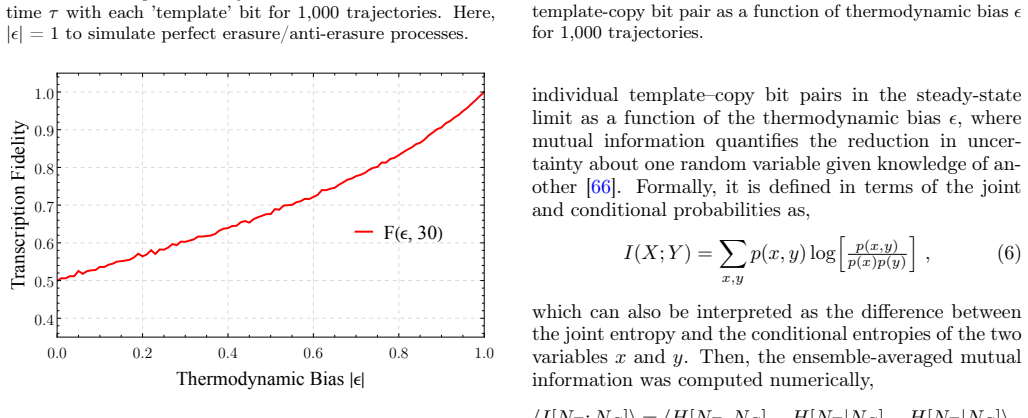
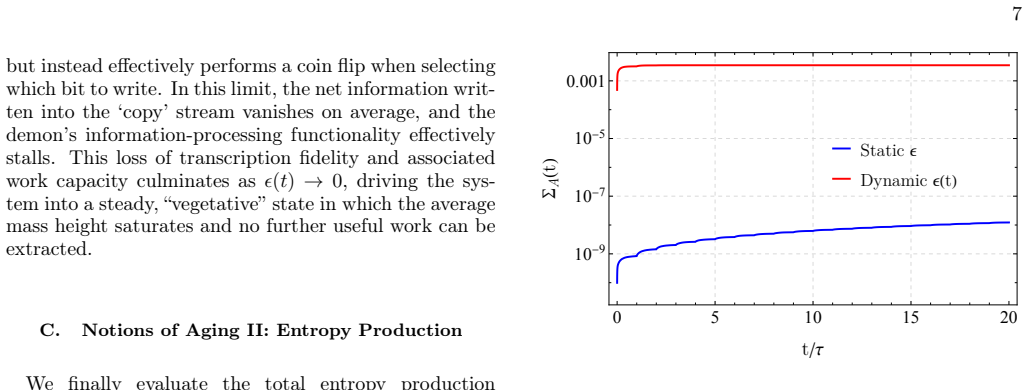
We model the process of information transcription with an autonomous Maxwell's demon which interacts with two bitstreams, a lifted mass, and a heat reservoir. As main results, we analyze the steady-state properties of the system with both time-independent and time-dependent transition rates, focusing on the statistics of extractable work, bit transcription fidelity, and two-bit mutual information. Together, these results provide a holistic view of a simplified model for DNA transcription as an information-theoretic process.
What carries the argument
Autonomous Maxwell's demon coupled to two bitstreams, a lifted mass, and a heat reservoir, which controls transitions to copy bits while extracting work.
If this is right
- The statistics of extractable work are set by the transcription fidelity reached in steady state.
- Bit transcription fidelity is a direct function of the chosen transition rates.
- Two-bit mutual information measures the amount of correlation preserved during copying.
- Time-dependent transition rates produce different steady-state work and fidelity values than constant rates.
Where Pith is reading between the lines
- Stabilizing the transition rates in the model would reduce long-term error accumulation.
- The same demon setup could describe error buildup in other molecular copying tasks such as protein synthesis.
- Simulations of the underlying Markov chain would generate explicit distributions for work and fidelity that could be checked in vitro.
Load-bearing premise
The abstracted process of information transcription can be understood using Markovian dynamics.
What would settle it
Direct measurement of transcription error rates in a system where molecular transition rates are deliberately made time-dependent, compared against the model's predicted steady-state fidelity.
Figures






read the original abstract
In introductory biology, aging is typically explained as a result of mutations during the DNA replication process within cells. Upon abstraction, we recognize that cellular aging can be understood as the gradual decay in fidelity of information transcription. Since cellular processes are microscopic and inherently stochastic, the abstracted process of information transcription can be understood using Markovian dynamics. In our work, we model the process of information transcription with an autonomous Maxwell's demon (AMD) which interacts with two bitstreams, a lifted mass, and a heat reservoir. As main results, we analyze the steady-state properties of the system with both time-independent and time-dependent transition rates, focusing on the statistics of extractable work, bit transcription fidelity, and two-bit mutual information. Together, these results provide a holistic view of a simplified model for DNA transcription as an information-theoretic process.
Editorial analysis
A structured set of objections, weighed in public.
Referee Report
Summary. The manuscript abstracts cellular aging as the gradual decay of information transcription fidelity in DNA replication. It models the process via an autonomous Maxwell's demon (AMD) coupled to two bitstreams, a lifted mass, and a heat reservoir, then analyzes the steady-state statistics of extractable work, bit transcription fidelity, and two-bit mutual information for both time-independent and time-dependent transition rates.
Significance. If the derivations hold, the work supplies a simplified stochastic-thermodynamic and information-theoretic framework linking microscopic Markovian dynamics to biological fidelity decay. The explicit consideration of both constant and time-varying rates together with multiple observables (work, fidelity, mutual information) is a constructive feature. The highly abstracted nature of the model, however, leaves open how directly the results map onto real cellular processes.
major comments (1)
- [Abstract / Model definition] The abstract claims that steady-state properties are analyzed and that the statistics of work, fidelity, and mutual information follow from the AMD dynamics, yet the manuscript provides neither the explicit transition rates (time-independent or time-dependent), the master equations, nor any derivation or numerical verification of the reported steady-state distributions. Without these elements it is impossible to determine whether the claimed statistics are consequences of the stated dynamics or rest on post-hoc parameter choices.
Simulated Author's Rebuttal
We thank the referee for the careful reading of the manuscript and for identifying the need for greater transparency in the dynamical details. We address the single major comment below.
read point-by-point responses
-
Referee: [Abstract / Model definition] The abstract claims that steady-state properties are analyzed and that the statistics of work, fidelity, and mutual information follow from the AMD dynamics, yet the manuscript provides neither the explicit transition rates (time-independent or time-dependent), the master equations, nor any derivation or numerical verification of the reported steady-state distributions. Without these elements it is impossible to determine whether the claimed statistics are consequences of the stated dynamics or rest on post-hoc parameter choices.
Authors: We agree that the explicit transition rates, master equations, and their derivations must be presented clearly so that the steady-state results can be verified. The current manuscript defines the AMD setup and states the observables but does not display the full rate matrices or the master-equation derivations in the main text. In the revised version we will add a dedicated methods subsection that (i) lists the time-independent rates, (ii) gives the explicit functional form of the time-dependent rates, (iii) writes the master equations, and (iv) reports numerical integration confirming that the reported steady-state distributions of work, fidelity, and mutual information are obtained from those dynamics rather than from ad-hoc parameter tuning. revision: yes
Circularity Check
No significant circularity; model construction is independent of outputs
full rationale
The paper presents an AMD model with two bitstreams, lifted mass, and reservoir under Markovian dynamics, then computes steady-state statistics for work, fidelity, and mutual information with given transition rates (time-independent or dependent). No equations or sections are quoted that define fidelity in terms of the rates and then claim the rates predict fidelity, nor any self-citation load-bearing the central result, nor ansatz smuggled via prior work. The derivation chain remains self-contained as a forward simulation from chosen rates to statistics, with no reduction by construction visible from the abstract or described results.
Axiom & Free-Parameter Ledger
free parameters (1)
- transition rates (time-independent and time-dependent)
axioms (1)
- domain assumption cellular processes are microscopic and inherently stochastic so information transcription obeys Markovian dynamics
invented entities (1)
-
autonomous Maxwell's demon (AMD)
no independent evidence
Reference graph
Works this paper leans on
- [1]
-
[2]
T. Quarton, T. Kang, V. Papakis, K. Nguyen, C. Nowak, Y. Li, and L. Bleris, Uncoupling gene expression noise along the central dogma using genome engineered human cell lines, Nucleic Acids Res.48, 9406 (2020)
work page 2020
-
[3]
J. D. Sipe and A. S. Cohen, Review: history of the amy- loid fibril, J. Struct. Biol.130, 88 (2000)
work page 2000
-
[4]
D. Eisenberg and M. Jucker, The amyloid state of pro- teins in human diseases, Cell148, 1188 (2012)
work page 2012
-
[5]
M. A. Gertz, A. Dispenzieri, and T. Sher, Pathophys- iology and treatment of cardiac amyloidosis, Nat. Rev. Cardiol.12, 91 (2015)
work page 2015
-
[6]
K. L. Moreau and J. A. King, Protein misfolding and aggregation in cataract disease and prospects for preven- tion, Trends Mol. Med.18, 273 (2012)
work page 2012
-
[7]
L. M. Dember, Amyloidosis-associated kidney disease, J. Am. Soc. Nephrol.17, 3458 (2006)
work page 2006
-
[8]
R. Schröder, Protein aggregate myopathies: the many faces of an expanding disease group, Acta Neuropathol. 125, 1 (2013)
work page 2013
- [9]
-
[10]
C. S. Chung, Y. Kou, S. J. Shemtov,et al., Transcript errors generate amyloid-like proteins in human cells, Nat. Commun.15, 8676 (2024)
work page 2024
-
[11]
X. Liu, D. A. Bushnell, and R. D. Kornberg, Rna polymerase ii transcription: structure and mechanism, Biochim. Biophys. Acta Gene Regul. Mech.1829, 2 (2013)
work page 2013
-
[12]
Vermulstet al., Transcription errors induce pro- teotoxic stress and shorten cellular lifespan, Nat
M. Vermulstet al., Transcription errors induce pro- teotoxic stress and shorten cellular lifespan, Nat. Com- mun.6, 8065 (2015)
work page 2015
-
[13]
L. Peliti and S. Pigolotti,Stochastic thermodynamics: an introduction(Princeton University Press, 2021)
work page 2021
-
[14]
D. Mandal and C. Jarzynski, Work and information pro- cessing in a solvable model of maxwell’s demon, Proc. Natl. Acad. Sci. U.S.A.109, 11641 (2012)
work page 2012
-
[15]
J. C. Maxwell,Theory of Heat(Longmans, Green, and Co., London, 1871) see Chapter XXII, “Theory of Gases,” for Maxwell’s demon thought experiment
-
[16]
L. Szilard, On the decrease of entropy in a thermody- namic system by the intervention of intelligent beings, Z. Phys.65, 840 (1929)
work page 1929
-
[17]
Landauer, Irreversibility and heat generation in the computing process, IBM J
R. Landauer, Irreversibility and heat generation in the computing process, IBM J. Res. Dev.5, 183 (1961)
work page 1961
-
[18]
C. H. Bennett, Demons, engines and the second law, Sci. Am.257, 108 (1987)
work page 1987
-
[19]
S. Deffner and C. Jarzynski, Information processing and the second law of thermodynamics: An inclusive, hamil- tonian approach, Phys. Rev. X3, 041003 (2013)
work page 2013
-
[20]
A. B. Boyd and J. P. Crutchfield, Identifying func- tional thermodynamics in autonomous maxwellian ratch- ets, New J. Phys.18, 023049 (2016)
work page 2016
-
[21]
A. B. Boyd, D. Mandal, and J. P. Crutchfield, 11 Correlation-powered information engines and the ther- modynamic efficiency of prediction, Phys. Rev. E95, 012152 (2017)
work page 2017
-
[22]
A.B.Boyd, D.Mandal,andJ.P.Crutchfield,Thermody- namics of temporal correlations, Phys. Rev. E97, 032129 (2018)
work page 2018
-
[23]
J. M. Horowitz and M. Esposito, Multipartite informa- tion flow for markov processes, J. Stat. Mech.: Theory Exp.2014(P03006)
work page 2014
-
[24]
D. Šafránek and S. Deffner, Quantum zeno effect in cor- related qubits, Phys. Rev. A98, 032308 (2018)
work page 2018
-
[25]
A. B. Boyd, P. M. Riechers, and J. P. Crutchfield, Func- tional thermodynamics of maxwellian ratchets: Con- structing and deconstructing patterns, randomizing and derandomizing behaviors, Phys. Rev. Res.2, 033334 (2020)
work page 2020
-
[26]
A. B. Boyd and J. P. Crutchfield, Thermodynamics of prediction and adaptation in living systems, Theory Biosci.141, 167 (2022)
work page 2022
-
[27]
J. M. Horowitz and M. Esposito, Thermodynamics with continuous information flow, Phys. Rev. X4, 031015 (2014)
work page 2014
-
[28]
T. Sagawa and M. Ueda, Fluctuation theorem with in- formation exchange: Role of correlations in stochastic thermodynamics, Phys. Rev. Lett.109, 180602 (2012)
work page 2012
-
[29]
M. Prokopenko and I. Einav, Information thermodynam- ics of near-equilibrium computation, Phys. Rev. E91, 062143 (2015)
work page 2015
-
[30]
A. Sone and S. Deffner, Quantum and classical ergotropy from relative entropies, Entropy23, 10.3390/e23091107 (2021)
- [31]
-
[32]
E. Stopnitzky, S.Still, T.E. Ouldridge,andL. Altenberg, Physical limitations of work extraction from temporal correlations, Phys. Rev. E99, 042115 (2019)
work page 2019
-
[33]
L. Cocconi and L. Chen, Efficiency of an autonomous, dynamic information engine operating on a single active particle, Phys. Rev. E110, 014602 (2024)
work page 2024
-
[34]
S.S.ChittariandZ.Lu,Revisitingkineticmontecarloal- gorithms for time-dependent processes: From open-loop control to feedback control, J. Chem. Phys.161, 044104 (2024)
work page 2024
-
[35]
N. M. van Dijk, Uniformization for nonhomogeneous markov chains, Oper. Res. Lett.12, 241 (1992)
work page 1992
-
[36]
M. Arns, P. Buchholz, and A. Panchenko, On the numer- ical analysis of inhomogeneous continuous-time markov chains, INFORMS J. Comput.22, 416 (2010)
work page 2010
-
[37]
Y. Hsu, W. F. Wu, and J.-R. Chiou, Reliability anal- ysis based on nonhomogeneous continuous-time markov modelingwithapplicationtorepairablepumpsofapower plant, Int. J. Reliab. Qual. Saf. Eng.24, 1750004 (2017)
work page 2017
-
[38]
P. Lencastre, N. Macedo, and P. G. Lind, From empiri- cal data to time-inhomogeneous continuous markov pro- cesses, Phys. Rev. E93, 032135 (2016)
work page 2016
-
[39]
Z. Ding, X. Guo, and H. Jiao, Markov chain approxima- tion and measure change for time-inhomogeneous diffu- sion processes, Appl. Math.Comput.387, 125024 (2021)
work page 2021
-
[40]
Truquet,Local Stationarity and Time-Inhomogeneous Markov Chains, Tech
L. Truquet,Local Stationarity and Time-Inhomogeneous Markov Chains, Tech. Rep. (ENSAI, 2019) research re- port
work page 2019
-
[41]
Talkner, Statistics of entrance times, Physica A325, 124 (2003)
P. Talkner, Statistics of entrance times, Physica A325, 124 (2003)
work page 2003
-
[42]
P. Talkner and J. Łuczka, Rate description of markov processes with time dependent parameters, Acta Phys. Pol. B36, 1837 (2005)
work page 2005
-
[43]
Forastiere, Linear stochastic thermodynamics, New J
L. Forastiere, Linear stochastic thermodynamics, New J. Phys.24, 083021 (2022)
work page 2022
- [44]
-
[45]
T. Aslyamov and M. Esposito, Nonequilibrium response for markov jump processes: Exact results and tight bounds, Phys. Rev. Lett.132, 037101 (2024)
work page 2024
-
[46]
Á. M. Ledezma, Time-varying energy landscapes and temperature paths: Dynamic transition rates in lo- cally ultrametric complex systems, SSRN Electron. J. 10.2139/ssrn.5015668 (2024), arXiv:2411.03406 [cond- mat.stat-mech]
work page internal anchor Pith review Pith/arXiv arXiv doi:10.2139/ssrn.5015668 2024
-
[47]
G. C. P. Innocentini, A. Hodgkinson, and O. Radulescu, Time dependent stochastic mrna and protein synthesis in piecewise-deterministic models of gene networks, Front. Phys.6, 46 (2018)
work page 2018
- [48]
-
[49]
B. Wu, J. Holehouse, R. Grima, and C. Jia, Solving the time-dependent protein distributions for autoregulated bursty gene expression using spectral decomposition, J. Chem. Phys.160, 074105 (2024)
work page 2024
- [50]
-
[51]
S. L. Wu, J. B. Bennett, H. M. Sánchez C., A. J. Dolgert, T. M. León, and J. M. Marshall, Mgdrive 2: A simulation framework for gene drive systems incorporating season- ality and epidemiological dynamics, PLoS Comput. Biol. 17, e1009030 (2021)
work page 2021
-
[52]
R. Meng, B. Soper, H. K. Lee, J. F. Nygård, and M. Nygård, Hierarchical continuous-time inhomogeneous hidden markov model for cancer screening with extensive followup data, Stat. Methods Med. Res.31, 2383 (2022)
work page 2022
-
[53]
H. Qian, Open-system nonequilibrium steady state: Sta- tistical thermodynamics, fluctuations, and chemical os- cillations, J. Phys. Chem. B110, 15063 (2006)
work page 2006
-
[54]
M. L. Esquível, Statistics for continuous time markov chains, a short review, Axioms14, 283 (2025)
work page 2025
-
[55]
J. D. Watson and F. H. C. Crick, Molecular structure of nucleic acids: A structure for deoxyribose nucleic acid, Nature171, 737 (1953)
work page 1953
-
[56]
M. Grunberg-Manago and S. Ochoa, Enzymatic synthe- sis of ribonucleic acid, Biochim. Biophys. Acta18, 495 (1955)
work page 1955
-
[57]
A. Kornberg, I. R. Lehman, M. J. Bessman, and E. S. Simms, Enzymatic synthesis of deoxyribonucleic acid, J. Biol. Chem.219, 623 (1956)
work page 1956
- [58]
-
[59]
P. A. Levene and W. A. Jacobs, On the structure of yeast nucleic acid, J. Biol. Chem.7, 163 (1909)
work page 1909
-
[60]
V. Serreli, C. F. Lee, E. R. Kay, and D. A. Leigh, A molecular information ratchet, Nature445, 523 (2007)
work page 2007
-
[61]
R. E. Spinney, M. Prokopenko, and D. Chu, Informa- tion ratchets exploiting spatially structured information reservoirs, Phys. Rev. E98, 022124 (2018)
work page 2018
-
[62]
A. M. Jurgens and J. P. Crutchfield, Functional thermo- 12 dynamics of maxwellian ratchets: Constructing and de- constructing patterns, randomizing and derandomizing behaviors, Phys. Rev. Res.2, 033334 (2020)
work page 2020
-
[63]
P. D. Boyer, The atp synthase — a splendid molecular machine, Annu. Rev. Biochem.66, 717 (1997)
work page 1997
-
[64]
N. G. van Kampen,Stochastic Processes in Physics and Chemistry, 3rd ed. (Elsevier, 2007)
work page 2007
-
[65]
D. T. Gillespie, Exact stochastic simulation of coupled chemical reactions, J. Phys. Chem.81, 2340 (1977)
work page 1977
-
[66]
C. E. Shannon, A mathematical theory of communica- tion, Bell Syst. Tech. J.27, 379 (1948)
work page 1948
- [67]
-
[68]
R. Lipschitz, De explicatione per series trigonometricas instituenda functionum unius variabilis arbitrariarum, et praecipue earum, quae per variabilis spatium finitum val- orum maximourm et minimorum numerum habent infini- tum, disquisitio, J. Reine Angew. Math.63, 296 (1864)
-
[69]
H. Risken,The Fokker–Planck Equation: Methods of So- lution and Applications, 2nd ed., Springer Series in Syn- ergetics (Springer, Berlin, 1996)
work page 1996
-
[70]
R. Chetrite and S. Gupta, Two refreshing views of fluc- tuation theorems through kinematics elements and dy- namical symmetries, J. Stat. Phys.166, 1153 (2018)
work page 2018
-
[71]
M. Esposito and C. Van den Broeck, Three faces of the second law. i. master equation formulation, Phys. Rev. E 82, 011143 (2010)
work page 2010
-
[72]
F. Wang, Q. He, M. O’Donnell, and H. Li, Error- correcting processes maintain transcriptional fidelity in aging cells, bioRxiv , 2025.04.11.648458 (2025), preprint
work page 2025
-
[73]
D. T. Gillespie, Approximate accelerated stochastic sim- ulation of chemically reacting systems, J. Chem. Phys. 115, 1716 (2001)
work page 2001
- [74]
-
[75]
D. F. Anderson, A modified next reaction method for simulating chemical systems with time dependent propensities and delays, J. Chem. Phys.127, 214107 (2007)
work page 2007
- [76]
-
[77]
A. Edelman and B. D. Sutton, From random matrices to stochastic operators, J. Stat. Phys.127, 1121 (2007)
work page 2007
discussion (0)
Sign in with ORCID, Apple, or X to comment. Anyone can read and Pith papers without signing in.