Time-Varying Energy Landscapes and Temperature paths: Dynamic Transition Rates in locally Ultrametric Complex Systems
Pith reviewed 2026-05-23 17:39 UTC · model grok-4.3
The pith
P-adic parametrization turns hierarchical energy landscapes into ultrametric spaces where time-dependent master equations are well-posed.
A machine-rendered reading of the paper's core claim, the machinery that carries it, and where it could break.
Core claim
By p-adically parametrizing the metabasins of a complex system the states acquire an ultrametric structure; the master equation then becomes a well-posed stochastic evolution under a time-dependent transition operator. The same operator governs both glass relaxation, where rapid cooling slows the dynamics with persistent history dependence, and protein folding, where temperature changes induce folding followed by unfolding to a possibly different unfolded configuration. The ultrametric property reduces the effort needed to track intra-metabasin transitions without raising overall computational cost.
What carries the argument
p-adic parametrization of metabasins that equips the state space with an ultrametric metric on which the time-dependent transition operator acts
If this is right
- The initial-value problem for the generalized master equation admits unique solutions.
- The resulting dynamics constitute a stochastic, not necessarily time-homogeneous Markov process.
- Glass relaxation under rapid cooling slows anomalously, with the final state depending on the rate and extent of the temperature drop.
- Protein folding across the melting temperature produces a whiplash sequence in which the chain folds and then returns to an unfolded configuration that may differ from the starting state.
Where Pith is reading between the lines
- The same construction could be used to track relaxation in other materials whose energy landscapes are known to be hierarchically organized.
- Controlled cooling protocols in laboratory glasses could be compared directly with the predicted dependence on cooling rate to test the model.
- Folding trajectories obtained from molecular-dynamics runs under time-varying temperature could be checked for the whiplash signature.
Load-bearing premise
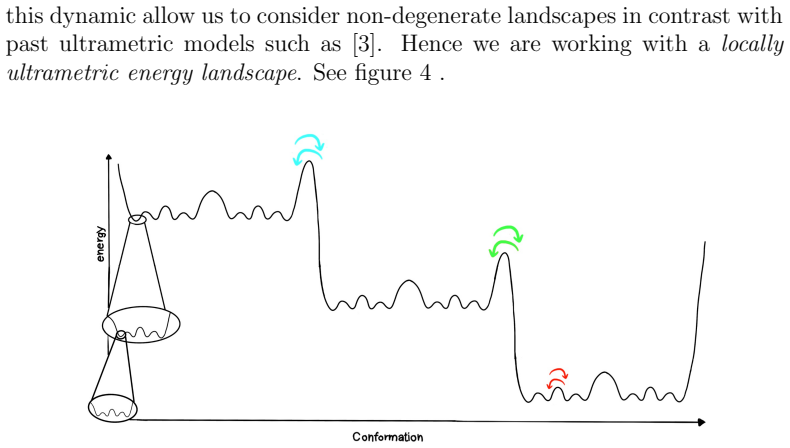
The states of the system can be arranged in a fractal hierarchical pattern that admits a p-adic parametrization yielding an ultrametric space.
What would settle it
An experiment in which a glass cooled at different rates shows identical long-term relaxation behavior independent of cooling history would falsify the predicted lasting effect of the temperature path.
Figures




read the original abstract
In this work, we study the dynamics of complex systems with time-dependent transition rates, focusing on $p$-adic analysis in modeling such systems. Starting from the master equation that governs the stochastic dynamics of a system with a large number of interacting components, we generalize it by $p$-adically parametrizing the metabasins to account for states that are organized in a fractal and hierarchical manner within the energy landscape. This leads to a not necessarily time homogeneous Markov process described by a time-dependent operator acting on an ultrametric space. We prove well-posedness of the initial value problem and analyze the stochastic nature of the master equation with time-dependent transition-operator. We demonstrate how ultrametricity simplifies the description of intra-metabasin dynamics without increasing computational complexity. We apply our theoretical framework to two scenarios: glass relaxation under rapid cooling and protein folding dynamics influenced by temperature variations. In the glass relaxation model, we observe anomalous relaxation behavior where the dynamics slow down during cooling, with lasting effects depending on how drastic the temperature drop is. In the protein folding model, we incorporate temperature-dependent transition rates to simulate folding and unfolding processes across the melting temperature. Our results capture a "whiplash" effect: from an unfolded state, the system folds and then returns to an unfolded state (which may differ from the initial one) in response to temperature changes. This study demonstrates the effectiveness of $p$-adic parametrization and ultrametric analysis in modeling complex systems with dynamic transition rate, providing analytical solutions that improve our understanding of relaxation processes in material and biological systems.
Editorial analysis
A structured set of objections, weighed in public.
Referee Report
Summary. The manuscript generalizes the master equation for stochastic dynamics of complex systems by p-adically parametrizing metabasins to capture fractal hierarchical organization in the energy landscape. This yields a time-inhomogeneous Markov process governed by a time-dependent transition operator on an ultrametric space. The central claims are proofs of well-posedness of the initial-value problem together with stochastic analysis of the equation; ultrametricity is asserted to simplify intra-metabasin dynamics without added computational cost. The framework is applied to two models: glass relaxation under rapid cooling (showing anomalous slowing and history dependence) and protein folding across the melting temperature (showing a temperature-induced 'whiplash' effect between folded and unfolded states).
Significance. If the well-posedness result is established under verifiable conditions, the work supplies an analytic p-adic/ultrametric route to time-dependent relaxation in hierarchically organized systems. This could be useful for materials and biophysical modeling where temperature protocols are prescribed, and the claimed simplification of intra-metabasin dynamics is a potential practical advantage. The applications illustrate concrete dynamical signatures (anomalous cooling response, whiplash) that are falsifiable in principle.
major comments (2)
- [well-posedness proof] Proof of well-posedness (section containing the IVP analysis): the claim that the time-dependent operator generates a well-posed evolution on the ultrametric space is load-bearing for all subsequent results. Standard theorems (Kato-Tanabe or similar) for time-inhomogeneous generators on Banach spaces of measures require explicit stability, measurability, or integrability conditions on the family of operators. No such conditions on the temperature paths or resulting rate functions are stated or verified; arbitrary rapid cooling could violate them, so the generality asserted in the abstract is not yet supported.
- [applications] Application sections (glass relaxation and protein folding models): the numerical or analytic solutions for the time-dependent rates are presented as consequences of the ultrametric simplification, yet the manuscript supplies no error estimates or comparison against the full non-ultrametric master equation to confirm that the claimed reduction in complexity preserves the observed anomalous relaxation and whiplash phenomenology.
minor comments (2)
- [model setup] Notation: the precise definition of the p-adic parametrization of metabasins and the induced ultrametric distance should be stated explicitly before the operator is introduced, to allow readers to verify the claimed simplification.
- [theoretical framework] The abstract states that ultrametricity 'simplifies the description without increasing computational complexity,' but this is not quantified (e.g., scaling of matrix size or number of independent rates) in the main text.
Simulated Author's Rebuttal
We thank the referee for the careful reading and constructive comments, which help clarify the scope and validation of our results. We address the two major comments point by point below.
read point-by-point responses
-
Referee: [well-posedness proof] Proof of well-posedness (section containing the IVP analysis): the claim that the time-dependent operator generates a well-posed evolution on the ultrametric space is load-bearing for all subsequent results. Standard theorems (Kato-Tanabe or similar) for time-inhomogeneous generators on Banach spaces of measures require explicit stability, measurability, or integrability conditions on the family of operators. No such conditions on the temperature paths or resulting rate functions are stated or verified; arbitrary rapid cooling could violate them, so the generality asserted in the abstract is not yet supported.
Authors: We agree that explicit conditions are necessary for the Kato-Tanabe theorem (or equivalent) to apply to the time-dependent family of operators. The manuscript invokes this theorem for the initial-value problem but does not list the required stability and integrability assumptions on the temperature-dependent rates. In the revision we will insert a new subsection that states the precise hypotheses (continuous temperature paths of bounded variation, uniform boundedness of the rate operators, and Bochner integrability of the generator family) under which well-posedness holds, thereby restricting the claimed generality to protocols satisfying these conditions. revision: yes
-
Referee: [applications] Application sections (glass relaxation and protein folding models): the numerical or analytic solutions for the time-dependent rates are presented as consequences of the ultrametric simplification, yet the manuscript supplies no error estimates or comparison against the full non-ultrametric master equation to confirm that the claimed reduction in complexity preserves the observed anomalous relaxation and whiplash phenomenology.
Authors: The ultrametric parametrization is constructed so that intra-metabasin transitions are exactly captured by the p-adic metric; nevertheless, we accept that the absence of quantitative error bounds or side-by-side comparisons with a non-ultrametric master equation leaves the preservation of the reported phenomenology unverified. In the revised manuscript we will add, in each application section, either an analytic error estimate (when the non-ultrametric rates admit a perturbative expansion) or a small-scale numerical benchmark demonstrating that the anomalous slowing and whiplash signatures remain intact under the ultrametric reduction. revision: yes
Circularity Check
No circularity: mathematical generalization and well-posedness proof are self-contained.
full rationale
The paper generalizes the master equation via p-adic parametrization of metabasins on an ultrametric space and claims to prove well-posedness of the time-inhomogeneous IVP. No equations or steps reduce by construction to fitted inputs, self-definitions, or load-bearing self-citations; the ultrametric structure is introduced as an assumption rather than derived from the target dynamics, and applications to glass relaxation and protein folding are presented as illustrative models rather than statistical predictions forced by parameter fits. The derivation chain therefore remains independent of its own outputs.
Axiom & Free-Parameter Ledger
axioms (1)
- domain assumption States of the complex system can be organized into metabasins that admit a p-adic parametrization yielding an ultrametric metric.
Lean theorems connected to this paper
-
IndisputableMonolith/Cost/FunctionalEquation.leanwashburn_uniqueness_aczel unclear?
unclearRelation between the paper passage and the cited Recognition theorem.
We prove well-posedness of the initial value problem ... time-dependent operator acting on an ultrametric space ... p-adically parametrizing the metabasins ... radial function w(|x−y|p,t)
-
IndisputableMonolith/Foundation/AlexanderDuality.leanalexander_duality_circle_linking unclear?
unclearRelation between the paper passage and the cited Recognition theorem.
ultrametricity simplifies the description of intra-metabasin dynamics ... Trotter-Kato Theorem for semigroups
-
IndisputableMonolith/Foundation/ArithmeticFromLogic.leanembed_strictMono_of_one_lt unclear?
unclearRelation between the paper passage and the cited Recognition theorem.
fractal and hierarchical manner within the energy landscape ... p-adic parametrization
What do these tags mean?
- matches
- The paper's claim is directly supported by a theorem in the formal canon.
- supports
- The theorem supports part of the paper's argument, but the paper may add assumptions or extra steps.
- extends
- The paper goes beyond the formal theorem; the theorem is a base layer rather than the whole result.
- uses
- The paper appears to rely on the theorem as machinery.
- contradicts
- The paper's claim conflicts with a theorem or certificate in the canon.
- unclear
- Pith found a possible connection, but the passage is too broad, indirect, or ambiguous to say the theorem truly supports the claim.
Forward citations
Cited by 1 Pith paper
-
Demon with dementia - the deterioration of information transcription
Abstracts DNA transcription as an autonomous Maxwell demon on two bitstreams and analyzes steady-state work extraction, transcription fidelity, and mutual information under constant and time-varying rates.
Reference graph
Works this paper leans on
-
[1]
V. A. Avetisov, A. H. Bikulov, S. V. Kozyrev, and V. A. Osipov. p- adic models of ultrametric diffusion constrained by hierarchical energy landscapes. Journal of Physics A: Mathematical and General, 35(2):177– 189, 2002
work page 2002
-
[2]
V.A. Avetisov, A.H. Bikulov, and S.V. Kozyrev. Application of p-adic analysis to models of spontaneous breaking of replica symmetry.J. Phys. A: Math. Gen. , 32:8785–8791, 1999. 31
work page 1999
-
[3]
V.A. Avetisov, A.H. Bikulov, S.V. Kozyrev, and V.A. Osipov. p-adic models of ultrametric diffusion constrained by hierarchical energy land- scapes. J. Phys. A: Math. Gen. , 35:177–189, 2002
work page 2002
-
[4]
V.A. Avetisov, A.Kh. Bikulov, and A.P. Zubarev. Ultrametric random walk and dynamics of protein molecules. Proc. Steklov Inst. Math. , 285:3–25, 2014
work page 2014
-
[5]
Gregory R. Bowman, Vijay S. Pande, and Frank No´ e, editors. An Introduction to Markov State Models and Their Application to Long Timescale Molecular Simulation, volume 797 of Advances in Experimen- tal Medicine and Biology . Springer New York LLC, 2014
work page 2014
-
[6]
P. Bradley and ´A. Mor´ an Ledezma. A non-autonomousp-adic diffusion equation on time changing graphs. To appear in Reports on Mathemat- ical Physics
-
[7]
Fractal free energy landscapes in struc- tural glasses
Patrick Charbonneau, Jorge Kurchan, Giorgio Parisi, Pierfrancesco Ur- bani, and Francesco Zamponi. Fractal free energy landscapes in struc- tural glasses. Nature Communications, 5:3725, 2014
work page 2014
-
[8]
R. C. Dennis and E. I. Corwin. Jamming energy landscape is hierarchical and ultrametric. Phys. Rev. Lett., 124:078002, Feb 2020
work page 2020
-
[9]
B. Dragovich and A. Dragovich. A p-adic model of dna sequence and genetic code. Comput. J, 53:432–442, 2010
work page 2010
-
[10]
B. Dragovich, A.Yu. Khrennikov, S.V. Kozyrev, and N. ˇZ. Miˇ si´ c.p-adic mathematics and theoretical biology. Biosystems, 199:104288, 2021
work page 2021
-
[11]
K.-J. Engel and R. Nagel. One-Parameter Semigroups for Linear Evo- lution Equations. Graduate Textes in Mathematics 194. Springer, New York, 2000
work page 2000
- [12]
-
[13]
H. Frauenfelder, S. S. Chan, and W. S. Chan, editors. The Physics of Proteins. Springer-Verlag, 2010
work page 2010
-
[14]
H. Frauenfelder, B. H. McMahon, and P. W. Fenimore. Myoglobin: the hydrogen atom of biology and paradigm of complexity. Proceedings of the National Academy of Sciences , 100(15):8615–8617, 2003. 32
work page 2003
-
[15]
H. Frauenfelder, S. G. Sligar, and P. G. Wolynes. The energy landscape and motions of proteins. Science, 254:1598–1603, 1991
work page 1991
- [16]
-
[17]
Temperature de- pendence of protein folding kinetics in living cells
Minghao Guo, Yangfan Xu, and Martin Gruebele. Temperature de- pendence of protein folding kinetics in living cells. Proceedings of the National Academy of Sciences , 109(44):17863–17867, 2012
work page 2012
-
[18]
Brooke E. Husic and Vijay S. Pande. Markov state models: From an art to a science. Journal of the American Chemical Society , 140(7):2386– 2396, 2018
work page 2018
-
[19]
Foundations of Modern Probability
Olav Kallenberg. Foundations of Modern Probability. Probability The- ory and Stochastic Modelling. Springer Cham, 3 edition, 2021
work page 2021
-
[20]
Andrei Khrennikov. Ultrametric diffusion equation on energy landscape to model disease spread in hierarchic socially clustered population.Phys- ica A: Statistical Mechanics and its Applications , 583:126284, 2021
work page 2021
-
[21]
A.Yu. Khrennikov and A.N. Kochubei. p-adic analogue of the porous medium equation. J. Fourier Anal. Appl. , 24:1401–1424, 2018
work page 2018
-
[22]
John C. Mauro. Materials Kinetics. Elsevier, 2021
work page 2021
-
[23]
John C. Mauro, Roger J. Loucks, and Prabhat K. Gupta. Metabasin approach for computing the master equation dynamics of systems with broken ergodicity. The Journal of Physical Chemistry A , 111(32):7957– 7965, 2007
work page 2007
-
[24]
John C. Mauro and Morten M. Smedskjaer. Minimalist landscape model of glass relaxation. Physica A: Statistical Mechanics and its Applica- tions, 391(12):3446–3459, 2012
work page 2012
-
[25]
Protein Folding Kinetics: Biophysical Methods
Bengt Nolting. Protein Folding Kinetics: Biophysical Methods. Springer, 2nd edition, 2005
work page 2005
-
[26]
Stochastic Thermodynamics: An In- troduction
Luca Peliti and Simone Pigolotti. Stochastic Thermodynamics: An In- troduction. Princeton University Press, 2021
work page 2021
-
[27]
R. Schnaubelt. VI.9 Semigroups for nonautonomous Cauchy problems. In One-Parameter Semigroups for Linear Evolution Equations , Gradu- ate Textes in Mathematics 194. Springer, New York, 2000. 33
work page 2000
-
[28]
J.A. van Casteren. Markov Processes, Feller Semigroups and evolution equations. Series on Concrete and Applicable Mathematics – Vol.12. World Scientific, 2011
work page 2011
- [29]
-
[30]
W. Z´ u˜ niga-Galindo. Reaction-diffusion equations on complex networks and Turing patterns, via p-adic analysis. Journal of Mathematical Anal- ysis and Applications , 491(1):124239, 2020
work page 2020
-
[31]
W.A. Z´ u˜ niga-Galindo. Ultrametric diffusion, rugged energy landscapes and transition networks. Physica A, 597:127221, 2022. 34
work page 2022
discussion (0)
Sign in with ORCID, Apple, or X to comment. Anyone can read and Pith papers without signing in.