REVIEW 3 major objections 7 minor 55 references
Frontier AI models achieve only a small fraction of human performance when asked to run a stochastic, long-horizon amusement-park business simulator.
Reviewed by Pith at T0; open to challenge. T0 means a machine referee read the full paper against a public rubric. the ladder, T0–T4 →
2026-08-03 21:16 UTC pith:YXZEMZ6Q
load-bearing objection A genuinely useful new benchmark with a likely-robust headline gap, but the reported human-AI multiples are not internally consistent and the human denominator is essentially unmeasured. the 3 major comments →
Mini Amusement Parks (MAPs): A Testbed for Modelling Business Decisions
The pith
A machine-rendered reading of the paper's core claim, the machinery that carries it, and where it could break.
Core claim
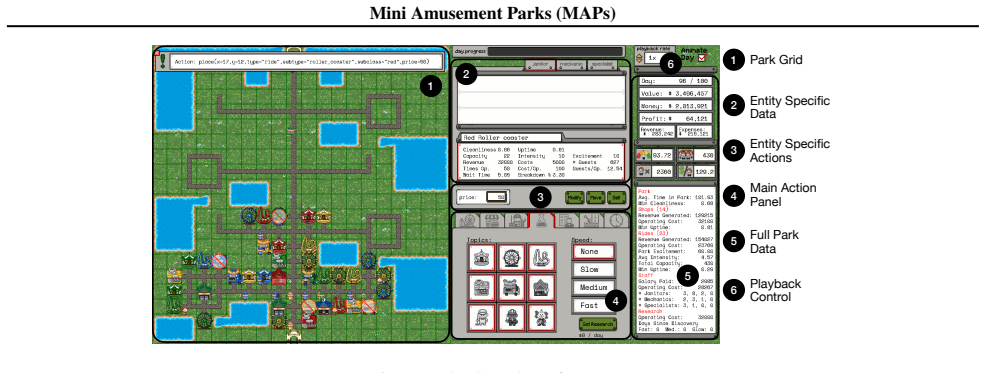
The paper's discovery is a diagnostic benchmark and an empirical result around it. MAPs is a 20x20 amusement-park grid with terrain, rides, shops, staff, research tiers, and guests with hidden needs; the objective is total park value after 50 (easy) or 100 (medium) in-game days. Benchmarking five frontier LLM agents under a ReAct protocol with full game documentation, the strongest model earns 13.89% of the human average on easy and 7.16% on medium. Giving agents 100 in-game days of sandbox exploration with tools such as undo, reset, grants, and layout switching does not consistently help: the strongest model improves somewhat, but most models regress. A simple placement heuristic that favor
What carries the argument
The central object is MAPs itself: a stochastic, 20x20 park simulator with an open-ended objective (maximize park value) and a structured action space. Its load-bearing components are (1) the ReAct agent loop, which receives JSON observations and a 5-state history; (2) a sandbox mode with counterfactual actions (undo, max money, reset, switch layouts) used to test active world-model learning; (3) a spatial-placement heuristic that overrides LLM-chosen coordinates; and (4) random-shooting MPC paired with either an oracle or a learned world model to isolate stochastic planning. Each component isolates one of the five challenges while the environment remains fixed, making the benchmark diagnost
Load-bearing premise
The entire reported gap rests on the online leaderboard human scores being a valid upper bound; if those scores are inflated by retries and shared strategies, or if the AI evaluation protocol (short history, fixed prompt budget) artificially suppresses model scores, the headline gap shrinks.
What would settle it
Run MAPs medium, one fixed layout, with (a) a fresh human cohort playing each layout exactly once with no communication and (b) the same five agents given longer histories and more lookahead rollouts; if the fresh human average falls well below the leaderboard average while agent scores rise, the paper's central claim about the size of the gap would fail.
If this is right
- If the gap is real, MAPs offers a single scoreboard for tracking whether new agent designs actually improve integrated decision-making, avoiding fragmented subskill benchmarks.
- The failure of sandbox learning implies that giving agents exploration tools is not enough; sample-efficient, active world-model learning must become a first-class research target.
- The oracle-versus-learned world model contrast implies that stochastic world models, not search procedures, are the current bottleneck; better learned dynamics could unlock larger gains than better policies.
- The spatial heuristic result implies that hybrid systems that offload low-level spatial placement to rule-based components can outperform end-to-end LLM control today.
- The benchmark provides a stable human upper bound that future agents can be measured against, making progress or stagnation in business-style decision-making visible.
Where Pith is reading between the lines
- Editorial inference: Because the human baseline is an online leaderboard that permits retries and strategy sharing, and the agents run with a short 5-state history, the exact multiples (roughly 7x on easy, 14x on medium) should be read as an upper bound on the human–AI gap rather than a calibrated ratio.
- Editorial inference: The success of an oracle world model with only a 4-step lookahead suggests a concrete next experiment: combine a learned stochastic world model with a more powerful search procedure than random shooting, to test whether the bottleneck shifts from modelling to planning.
- Editorial inference: The paper leaves untested whether models that are fine-tuned rather than prompted on sandbox experience, or that maintain an evolving belief state, could use the 100-day budget more effectively; this is a testable extension within the same MAPs harness.
- Editorial inference: Because MAPs provides counterfactual sandbox actions, it could also serve as an evaluation suite for causal discovery and active learning algorithms, a use the authors only gesture at.
Editorial analysis
A structured set of objections, weighed in public.
Referee Report
Summary. The paper introduces Mini Amusement Parks (MAPs), a simulator-based benchmark for business-style decision making that requires agents to optimize an open-ended objective over long horizons, learn environment dynamics actively, reason spatially, and handle stochasticity. The authors provide human baselines from an online leaderboard and evaluate five state-of-the-art LLM-based agents (GPT-5, GPT-5 Nano, Grok 4, Sonnet 4.5, Gemini 2.5 Pro) under several protocols (ReAct, sandbox learning, spatial heuristic, and MPC with learned/oracle world models). The central claim is that the best model, GPT-5, achieves only 7.16% of human performance on medium difficulty, and that MAPs exposes persistent weaknesses in long-horizon planning, active world-model learning, spatial reasoning, and stochasticity handling (CH1–CH5).
Significance. If the empirical picture holds, MAPs is a valuable addition to the agent-benchmark landscape: it combines an open-ended objective, stochastic transitions, spatial reasoning, and an online human leaderboard in a single grounded simulator, with code released. The qualitative error analyses (Sections F–H) are rich and actionable, and the use of a hand-crafted spatial heuristic and an oracle world model as interpretable reference points, rather than fitted baselines, is a methodological strength. The paper is also commendable for explicitly acknowledging that the human leaderboard is an upper bound. However, the headline quantitative claim currently rests on an insufficiently documented human denominator and is stated with inconsistent numbers in different parts of the manuscript; these issues need to be resolved before the central CH1 claim can be taken as a precise measurement.
major comments (3)
- [Abstract and Section 4.1 / Table 2] The central quantitative claim is internally inconsistent. The full-text abstract reports humans outperform AI by 6.5x on easy and 9.8x on medium, while the arXiv metadata abstract reports 11.4x and 15.3x. Table 2 implies for GPT-5 a gap of 100/13.89 ≈ 7.2x on easy and 100/7.16 ≈ 14.0x on medium. None of the three sets of numbers agree. Since the magnitude of the human–AI gap is the paper's primary contribution, please reconcile these values and specify exactly how the ratios are computed from the per-layout normalization.
- [Section 3.3 and Table 2] The human baseline is taken from an online leaderboard where participants can retry layouts or share strategies, and the paper itself labels it 'an empirical upper bound rather than a direct comparison.' Yet every AI score in Tables 2–6 is normalized by this leaderboard value, and the abstract/CH1 state the resulting 7.16% figure as a direct gap. The paper does not report the number of participants, the aggregation rule (mean vs. best), or any controlled single-attempt human baseline. The 7.16% is therefore a lower bound on the AI/human ratio relative to a typical human, not a controlled measurement. Please either provide a controlled human baseline with participant count and protocol, or consistently present the headline as an upper-bound comparison.
- [Section 4.2 / Table 3] The claim that relative performance deteriorates as long-horizon planning demands increase (CH2) confounds two factors: easy mode has a 50-day horizon with no research, while medium has a 100-day horizon plus the research mechanic. The observed drop in relative scores could be driven by the added research complexity rather than by horizon length itself. To cleanly support the CH2 conclusion, the comparison should include a condition that varies only the horizon (e.g., a 100-day easy-like setting without research), or the authors should explicitly argue that the research mechanic is a minor contributor. As presented, the CH2 result is not uniquely identified.
minor comments (7)
- [Abstract vs. metadata] The discrepancy between the full-text abstract and the arXiv metadata abstract (6.5x/9.8x vs. 11.4x/15.3x) should also be corrected in the arXiv record itself, not only in the PDF.
- [Table 2 caption] The caption states 'Score (%) indicates performance relative to humans per layout.' Please clarify whether the reported percentage is the mean of the per-layout ratios or the ratio of the mean park values, since this affects how the numbers in the abstract are derived.
- [Sections 4.4 and 4.5] The text says 'results, shown in Section 4.4' and 'Section 4.5' when referring to Tables 5 and 6. Please fix the cross-references.
- [Throughout] The benchmark name is inconsistently styled as 'MAPS' and 'MAPs' (e.g., abstract vs. Section 1). Please standardize.
- [Table 2] Several standard deviations are very large (e.g., GPT-5 easy 13.89 ± 11.16; Grok 4 easy 6.62 ± 14.50). When discussing model rankings, please add significance tests or at least note the overlap in confidence intervals.
- [Section 3.1 and Table 4 caption] The sandbox budget is described as '100 in-game days' in Section 3.1 and '100 in-game steps' in the Table 4 caption. Please make the units consistent.
- [Throughout] Spellings of 'W ALL-E' / 'Walle' / 'WALL-E' should be normalized.
Circularity Check
No significant circularity: the benchmark results are direct simulator measurements, not derivations from fitted parameters or self-citing constraints.
full rationale
This is an empirical benchmark paper. The central claims are direct measurements taken from the MAPs simulator: the GPT-5 score of 7.16% of human performance (Table 2) is the observed ratio of final park value to a human leaderboard score, not a quantity derived from a fitted parameter or from an equation that embeds the conclusion. The spatial-placement heuristic in Section 3.1/4.4 is a hand-coded baseline (density, water adjacency, path adjacency) compared against the same LLM agents; it is not fit to the data it is later used to explain. The sandbox 'active world-model learning' experiments use a fixed 100-day protocol with learnings appended to the prompt; the finding that these learnings do not help is again a measured outcome, not an artifact of construction. The oracle world model is the ground-truth simulator used as an upper bound, which is a legitimate comparison target rather than a circularity. The paper explicitly acknowledges that the human leaderboard reflects an unlimited setting and 'serve[s] as an empirical upper bound rather than as a direct comparison' (Section 3.3); this is a caveat about the strength of the human baseline, not a circular step in the derivation. The only self-citation, Aroca-Ouellette et al. (2025), appears in the introduction as background support for the claim that LLMs struggle with long-horizon planning; it is not load-bearing for MAPs' own results, and no uniqueness theorem or ansatz is imported from prior work by the same authors. The inconsistency between the abstract's 6.5x/9.8x and the introduction's 11.4x/15.3x performance ratios is a reporting/consistency issue, not a circular reduction. Overall, the paper's evaluations are self-contained measurements against an external agent and human baseline; no prediction reduces to its input by construction.
Axiom & Free-Parameter Ledger
free parameters (5)
- ReAct history length =
5
- MPC rollout count =
5
- MPC lookahead steps =
4
- Sandbox learning budget =
100 in-game days
- Spatial heuristic weights =
not explicitly quantified
axioms (4)
- domain assumption MAPs simulator captures the interconnected challenges of real-world business decision-making.
- domain assumption Human leaderboard scores represent expert performance.
- domain assumption ReAct with 5-state history is a representative evaluation protocol for SOTA LLM agents.
- domain assumption Park value is a valid measure of business decision quality.
Cite this review
Pith. "Pith review of Mini Amusement Parks (MAPs): A Testbed for Modelling Business Decisions." pith.science (2026). https://pith.science/paper/YXZEMZ6Q
@misc{pith2026251115830,
  author       = {Pith},
  title        = {Pith review of: Mini Amusement Parks (MAPs): A Testbed for Modelling Business Decisions},
  year         = {2026},
  howpublished = {\url{https://pith.science/paper/YXZEMZ6Q}},
  note         = {Machine review of arXiv:2511.15830}
}
read the original abstract
Despite rapid progress in artificial intelligence, current systems struggle with the interconnected challenges that define real-world decision making. Practical domains such as business management require open-ended optimization, actively learning environment dynamics from sparse experience, planning over long horizons in stochastic settings, and reasoning over spatial information. Yet no existing human--AI benchmarks assess how well agents integrate these challenges in a grounded decision-making context. To this end, we introduce Mini Amusement Parks (MAPs), an amusement-park simulator designed to evaluate an agent's ability to model its environment, anticipate long-term consequences under uncertainty, and strategically operate a complex business. We provide expert human performance and a comprehensive evaluation of state-of-the-art agents, finding experts outperform these systems by 11.4x on easy mode and 15.3x on medium mode. Our analysis reveals persistent weaknesses in long-horizon planning, sample-efficient learning, spatial reasoning, and modelling uncertainty. By unifying these challenges within a single environment, MAPs offers a new foundation for benchmarking agents capable of adaptable decision making. Code: https://github.com/Skyfall-Research/MAPs
Figures


Reference graph
Works this paper leans on
-
[1]
write newline
" write newline "" before.all 'output.state := FUNCTION n.dashify 't := "" t empty not t #1 #1 substring "-" = t #1 #2 substring "--" = not "--" * t #2 global.max substring 't := t #1 #1 substring "-" = "-" * t #2 global.max substring 't := while if t #1 #1 substring * t #2 global.max substring 't := if while FUNCTION format.date year duplicate empty "emp...
-
[2]
Allen, K. R., Smith, K. A., and Tenenbaum, J. B. Rapid trial-and-error learning with simulation supports flexible tool use and physical reasoning. Proceedings of the National Academy of Sciences of the United States of America, 117 0 (47): 0 29302—29310, November 2020. ISSN 0027-8424. doi:10.1073/pnas.1912341117. URL https://europepmc.org/articles/PMC7703630
-
[3]
Herobench: A benchmark for long-horizon planning and structured reasoning in virtual worlds, 2025
Anokhin, P., Khalikov, R., Rebrikov, S., Volkov, V., Sorokin, A., and Bissonnette, V. Herobench: A benchmark for long-horizon planning and structured reasoning in virtual worlds, 2025. URL https://arxiv.org/abs/2508.12782
Pith/arXiv arXiv 2025
-
[4]
Introducing claude sonnet 4.5
Anthropic . Introducing claude sonnet 4.5. https://www.anthropic.com/news/claude-sonnet-4-5, September 2025
2025
-
[5]
R e S eeding latent states for sequential language understanding
Aroca-Ouellette, S., von der Wense, K., and Roncone, A. R e S eeding latent states for sequential language understanding. In Christodoulopoulos, C., Chakraborty, T., Rose, C., and Peng, V. (eds.), Proceedings of the 2025 Conference on Empirical Methods in Natural Language Processing, pp.\ 25233--25247, Suzhou, China, November 2025. Association for Computa...
-
[6]
Backlund, A. and Petersson, L. Vending-bench: A benchmark for long-term coherence of autonomous agents, 2025. URL https://arxiv.org/abs/2502.15840
Pith/arXiv arXiv 2025
-
[7]
K., Koss, E., and Lichtenbaum, C
Bai, M., Cohen, A. K., Koss, E., and Lichtenbaum, C. Stuck in the matrix: Probing spatial reasoning in large language models, 2025. URL https://arxiv.org/abs/2510.20198
arXiv 2025
-
[8]
G., Naddaf , Y., Veness , J., and Bowling , M
Bellemare , M. G., Naddaf , Y., Veness , J., and Bowling , M. The arcade learning environment: An evaluation platform for general agents. Journal of Artificial Intelligence Research, 47: 0 253--279, jun 2013
2013
-
[9]
When is tree search useful for LLM planning? it depends on the discriminator
Chen, Z., White, M., Mooney, R., Payani, A., Su, Y., and Sun, H. When is tree search useful for LLM planning? it depends on the discriminator. In Ku, L.-W., Martins, A., and Srikumar, V. (eds.), Proceedings of the 62nd Annual Meeting of the Association for Computational Linguistics (Volume 1: Long Papers), pp.\ 13659--13678, Bangkok, Thailand, August 2024...
-
[10]
H., and Bengio, Y
Chevalier-Boisvert, M., Bahdanau, D., Lahlou, S., Willems, L., Saharia, C., Nguyen, T. H., and Bengio, Y. Baby AI : First steps towards grounded language learning with a human in the loop. In International Conference on Learning Representations, 2019. URL https://openreview.net/forum?id=rJeXCo0cYX
2019
-
[11]
On the measure of intelligence, 2019
Chollet, F. On the measure of intelligence, 2019. URL https://arxiv.org/abs/1911.01547
Pith/arXiv arXiv 2019
-
[12]
Arc-agi-2: A new challenge for frontier ai reasoning systems, 2025
Chollet, F., Knoop, M., Kamradt, G., Landers, B., and Pinkard, H. Arc-agi-2: A new challenge for frontier ai reasoning systems, 2025. URL https://arxiv.org/abs/2505.11831
Pith/arXiv arXiv 2025
-
[13]
Self-directed learning in new and changing environments: understanding human algorithms for exploration
Collignon, N. Self-directed learning in new and changing environments: understanding human algorithms for exploration. PhD thesis, University of Edinburgh, Jul 25 2020. URL https://hdl.handle.net/1842/37293. PhD Thesis, Informatics, School of Informatics
2020
-
[14]
LLM-Guided Probabilistic Program Induction for POMDP Model Estimation
Curtis, A., Tang, H., Veloso, T., Ellis, K., Tenenbaum, J. B., Lozano - P \' e rez, T., and Kaelbling, L. P. Llm-guided probabilistic program induction for POMDP model estimation. CoRR, abs/2505.02216, 2025. doi:10.48550/ARXIV.2505.02216. URL https://doi.org/10.48550/arXiv.2505.02216
work page internal anchor Pith review Pith/arXiv arXiv doi:10.48550/arxiv.2505.02216 2025
-
[15]
Generating code world models with large language models guided by monte carlo tree search
Dainese, N., Merler, M., Alakuijala, M., and Marttinen, P. Generating code world models with large language models guided by monte carlo tree search. In Globersons, A., Mackey, L., Belgrave, D., Fan, A., Paquet, U., Tomczak, J. M., and Zhang, C. (eds.), Advances in Neural Information Processing Systems 38: Annual Conference on Neural Information Processin...
2024
-
[16]
Minedojo: Building open-ended embodied agents with internet-scale knowledge
Fan, L., Wang, G., Jiang, Y., Mandlekar, A., Yang, Y., Zhu, H., Tang, A., Huang, D.-A., Zhu, Y., and Anandkumar, A. Minedojo: Building open-ended embodied agents with internet-scale knowledge. In Thirty-sixth Conference on Neural Information Processing Systems Datasets and Benchmarks Track, 2022. URL https://openreview.net/forum?id=rc8o_j8I8PX
2022
-
[17]
Gemini Team, Google DeepMind . Gemini 2.5: Pushing the frontier with advanced reasoning, multimodality, long context, and next generation agentic capabilities. Technical Report arXiv:2507.06261, Google DeepMind, July 2025
Pith/arXiv arXiv 2025
-
[18]
Gopnik, A. and Sobel, D. M. Detecting blickets: How young children use information about novel causal powers in categorization and induction. Child Development, 71 0 (5): 0 1205--1222, 2000. doi:10.1111/1467-8624.00224
arXiv 2000
-
[19]
The Scientist in the Crib: Minds, Brains, and How Children Learn
Gopnik, A., Meltzoff, A., and Kuhl, P. The Scientist in the Crib: Minds, Brains, and How Children Learn. Harper Collins, 1999
1999
-
[20]
Benchmarking the spectrum of agent capabilities
Hafner, D. Benchmarking the spectrum of agent capabilities. In International Conference on Learning Representations, 2022. URL https://openreview.net/forum?id=1W0z96MFEoH
2022
-
[21]
Reasoning with language model is planning with world model
Hao, S., Gu, Y., Ma, H., Hong, J., Wang, Z., Wang, D., and Hu, Z. Reasoning with language model is planning with world model. In Bouamor, H., Pino, J., and Bali, K. (eds.), Proceedings of the 2023 Conference on Empirical Methods in Natural Language Processing, pp.\ 8154--8173, Singapore, December 2023. Association for Computational Linguistics. doi:10.186...
-
[22]
W., Li, L., Yang, Z., Wang, L., and Cheng, Y
Hao, Y., Gu, J., Wang, H. W., Li, L., Yang, Z., Wang, L., and Cheng, Y. Can MLLM s reason in multimodality? EMMA : An enhanced multimodal reasoning benchmark. In Forty-second International Conference on Machine Learning, 2025. URL https://openreview.net/forum?id=v26vwjxOEz
2025
-
[23]
D., Majumder, B
Jansen, P., C \^o t \'e , M.-A., Khot, T., Bransom, E., Mishra, B. D., Majumder, B. P., Tafjord, O., and Clark, P. Discoveryworld: A virtual environment for developing and evaluating automated scientific discovery agents. In The Thirty-eight Conference on Neural Information Processing Systems Datasets and Benchmarks Track, 2024. URL https://openreview.net...
2024
-
[24]
M., Bommarito, M
Katz, D. M., Bommarito, M. J., Gao, S., and Arredondo, P. D. Gpt-4 passes the bar exam. SSRN, 2023
2023
-
[25]
Khan, Z., Prasad, A., Stengel-Eskin, E., Cho, J., and Bansal, M. One life to learn: Inferring symbolic world models for stochastic environments from unguided exploration, 2025. URL https://arxiv.org/abs/2510.12088
Pith/arXiv arXiv 2025
-
[26]
u ttler, H., Nardelli, N., Miller, A., Raileanu, R., Selvatici, M., Grefenstette, E., and Rockt\
K\" u ttler, H., Nardelli, N., Miller, A., Raileanu, R., Selvatici, M., Grefenstette, E., and Rockt\" a schel, T. The nethack learning environment. In Larochelle, H., Ranzato, M., Hadsell, R., Balcan, M., and Lin, H. (eds.), Advances in Neural Information Processing Systems, volume 33, pp.\ 7671--7684. Curran Associates, Inc., 2020. URL https://proceeding...
2020
-
[27]
Competition-level code generation with alphacode
Li, Y., Choi, D., Chung, J., et al. Competition-level code generation with alphacode. Science, 378 0 (6624): 0 1092--1097, 2022
2022
-
[28]
Performance of chatgpt across different versions in medical licensing examinations worldwide: systematic review and meta-analysis
Liu, M., Okuhara, T., Chang, X., Shirabe, R., Nishiie, Y., Okada, H., and Kiuchi, T. Performance of chatgpt across different versions in medical licensing examinations worldwide: systematic review and meta-analysis. Journal of medical Internet research, 26: 0 e60807, 2024 a
2024
-
[29]
Liu, X., Wu, Z., Wu, X., Lu, P., Chang, K.-W., and Feng, Y. Are LLM s capable of data-based statistical and causal reasoning? benchmarking advanced quantitative reasoning with data. In Ku, L.-W., Martins, A., and Srikumar, V. (eds.), Findings of the Association for Computational Linguistics: ACL 2024, pp.\ 9215--9235, Bangkok, Thailand, August 2024 b . As...
-
[30]
Non-myopic generation of language models for reasoning and planning
Ma, C., Zhao, H., Zhang, J., He, J., and Kong, L. Non-myopic generation of language models for reasoning and planning. In The Thirteenth International Conference on Learning Representations, 2025. URL https://openreview.net/forum?id=OoNazl6T7D
2025
-
[31]
Introducing gpt-5
OpenAI . Introducing gpt-5. https://openai.com/index/introducing-gpt-5/, August 2025
2025
-
[32]
Textquests: How good are llms at text-based video games?, 2025
Phan, L., Mazeika, M., Zou, A., and Hendrycks, D. Textquests: How good are llms at text-based video games?, 2025. URL https://arxiv.org/abs/2507.23701
Pith/arXiv arXiv 2025
-
[33]
T., Liang, Y., Tang, H., Weller, A., Kryven, M., and Ellis, K
Piriyakulkij, W. T., Liang, Y., Tang, H., Weller, A., Kryven, M., and Ellis, K. Poe-world: Compositional world modeling with products of programmatic experts. CoRR, abs/2505.10819, 2025. doi:10.48550/ARXIV.2505.10819. URL https://doi.org/10.48550/arXiv.2505.10819
-
[34]
Reasoning under uncertainty: Exploring probabilistic reasoning capabilities of llms, 2025
Pournemat, M., Rezaei, K., Sriramanan, G., Zarei, A., Fu, J., Wang, Y., Eghbalzadeh, H., and Feizi, S. Reasoning under uncertainty: Exploring probabilistic reasoning capabilities of llms, 2025. URL https://arxiv.org/abs/2509.10739
arXiv 2025
-
[35]
Synthesis of model predictive control and reinforcement learning: Survey and classification
Reiter, R., Hoffmann, J., Reinhardt, D., Messerer, F., Baumg \" a rtner, K., Sawant, S., Boedecker, J., Diehl, M., and Gros, S. Synthesis of model predictive control and reinforcement learning: Survey and classification. CoRR, abs/2502.02133, 2025. doi:10.48550/ARXIV.2502.02133. URL https://doi.org/10.48550/arXiv.2502.02133
-
[36]
\ ALFW \ orld: Aligning text and embodied environments for interactive learning
Shridhar, M., Yuan, X., Cote, M.-A., Bisk, Y., Trischler, A., and Hausknecht, M. \ ALFW \ orld: Aligning text and embodied environments for interactive learning. In International Conference on Learning Representations, 2021. URL https://openreview.net/forum?id=0IOX0YcCdTn
2021
-
[37]
Mastering the game of go without human knowledge
Silver, D., Schrittwieser, J., Simonyan, K., et al. Mastering the game of go without human knowledge. Nature, 550 0 (7676): 0 354--359, 2017
2017
-
[38]
Y., and Ellis, K
Tang, H., Key, D. Y., and Ellis, K. Worldcoder, a model-based LLM agent: Building world models by writing code and interacting with the environment. In The Thirty-eighth Annual Conference on Neural Information Processing Systems, 2024. URL https://openreview.net/forum?id=QGJSXMhVaL
2024
-
[39]
Tenenbaum, J. B., Kemp, C., Griffiths, T. L., and Goodman, N. D. How to grow a mind: Statistics, structure, and abstraction. Science, 331 0 (6022): 0 1279--1285, 2011. doi:10.1126/science.1192788. URL https://www.science.org/doi/abs/10.1126/science.1192788
-
[40]
On the planning abilities of large language models - a critical investigation
Valmeekam, K., Marquez, M., Sreedharan, S., and Kambhampati, S. On the planning abilities of large language models - a critical investigation. In Thirty-seventh Conference on Neural Information Processing Systems, 2023. URL https://openreview.net/forum?id=X6dEqXIsEW
2023
-
[41]
X., King, M., Porcel, N
Wang, J. X., King, M., Porcel, N. P. M., Kurth-Nelson, Z., Zhu, T., Deck, C., Choy, P., Cassin, M., Reynolds, M., Song, H. F., Buttimore, G., Reichert, D. P., Rabinowitz, N. C., Matthey, L., Hassabis, D., Lerchner, A., and Botvinick, M. Alchemy: A benchmark and analysis toolkit for meta-reinforcement learning agents. In Thirty-fifth Conference on Neural I...
2021
-
[42]
Wang, R., Jansen, P., C \^o t \'e , M.-A., and Ammanabrolu, P. S cience W orld: Is your agent smarter than a 5th grader? In Goldberg, Y., Kozareva, Z., and Zhang, Y. (eds.), Proceedings of the 2022 Conference on Empirical Methods in Natural Language Processing, pp.\ 11279--11298, Abu Dhabi, United Arab Emirates, December 2022. Association for Computationa...
-
[43]
B., Vollmer, S., Ellis, K., and Tavares, Z
Warrier, A., Nguyen, D., Naim, M., Jain, M., Liang, Y., Schroeder, K., Yang, C., Tenenbaum, J. B., Vollmer, S., Ellis, K., and Tavares, Z. Benchmarking world-model learning, 2025. URL https://arxiv.org/abs/2510.19788
Pith/arXiv arXiv 2025
-
[44]
Grok 4 model card
xAI . Grok 4 model card. Technical report, xAI, August 2025
2025
-
[45]
Revealing the barriers of language agents in planning
Xie, J., Zhang, K., Chen, J., Yuan, S., Zhang, K., Zhang, Y., Li, L., and Xiao, Y. Revealing the barriers of language agents in planning. In Chiruzzo, L., Ritter, A., and Wang, L. (eds.), Proceedings of the 2025 Conference of the Nations of the Americas Chapter of the Association for Computational Linguistics: Human Language Technologies (Volume 1: Long P...
doi:10.18653/v 2025
-
[46]
J., Cheng, Z., Shin, D., Lei, F., Liu, Y., Xu, Y., Zhou, S., Savarese, S., Xiong, C., Zhong, V., and Yu, T
Xie, T., Zhang, D., Chen, J., Li, X., Zhao, S., Cao, R., Hua, T. J., Cheng, Z., Shin, D., Lei, F., Liu, Y., Xu, Y., Zhou, S., Savarese, S., Xiong, C., Zhong, V., and Yu, T. OSW orld: Benchmarking multimodal agents for open-ended tasks in real computer environments. In The Thirty-eight Conference on Neural Information Processing Systems Datasets and Benchm...
2024
-
[47]
Interactive visual reasoning under uncertainty
Xu, M., Jiang, G., Liang, W., Zhang, C., and Zhu, Y. Interactive visual reasoning under uncertainty. In Oh, A., Naumann, T., Globerson, A., Saenko, K., Hardt, M., and Levine, S. (eds.), Advances in Neural Information Processing Systems, volume 36, pp.\ 42409--42432. Curran Associates, Inc., 2023. URL https://proceedings.neurips.cc/paper_files/paper/2023/f...
2023
-
[48]
Yao, S., Chen, H., Yang, J., and Narasimhan, K. R. Webshop: Towards scalable real-world web interaction with grounded language agents. In Oh, A. H., Agarwal, A., Belgrave, D., and Cho, K. (eds.), Advances in Neural Information Processing Systems, 2022. URL https://openreview.net/forum?id=R9KnuFlvnU
2022
-
[49]
L., Cao, Y., and Narasimhan, K
Yao, S., Yu, D., Zhao, J., Shafran, I., Griffiths, T. L., Cao, Y., and Narasimhan, K. R. Tree of thoughts: Deliberate problem solving with large language models. In Thirty-seventh Conference on Neural Information Processing Systems, 2023 a . URL https://openreview.net/forum?id=5Xc1ecxO1h
2023
-
[50]
R., and Cao, Y
Yao, S., Zhao, J., Yu, D., Du, N., Shafran, I., Narasimhan, K. R., and Cao, Y. React: Synergizing reasoning and acting in language models. In The Eleventh International Conference on Learning Representations, 2023 b . URL https://openreview.net/forum?id=WE_vluYUL-X
2023
-
[51]
M., Sharma, P., Colas, C., Zhao, K
Ying, L., Collins, K. M., Sharma, P., Colas, C., Zhao, K. I., Weller, A., Tavares, Z., Isola, P., Gershman, S. J., Andreas, J. D., Griffiths, T. L., Chollet, F., Allen, K. R., and Tenenbaum, J. B. Assessing adaptive world models in machines with novel games, 2025. URL https://arxiv.org/abs/2507.12821
Pith/arXiv arXiv 2025
-
[52]
S., and Hsu, D
Zhao, Z., Lee, W. S., and Hsu, D. Large language models as commonsense knowledge for large-scale task planning. In Oh, A., Naumann, T., Globerson, A., Saenko, K., Hardt, M., and Levine, S. (eds.), Advances in Neural Information Processing Systems 36: Annual Conference on Neural Information Processing Systems 2023, NeurIPS 2023, New Orleans, LA, USA, Decem...
2023
-
[53]
F., Zhu, H., Zhou, X., Lo, R., Sridhar, A., Cheng, X., Bisk, Y., Fried, D., Alon, U., et al
Zhou, S., Xu, F. F., Zhu, H., Zhou, X., Lo, R., Sridhar, A., Cheng, X., Bisk, Y., Fried, D., Alon, U., et al. Webarena: A realistic web environment for building autonomous agents. arXiv preprint arXiv:2307.13854, 2023
Pith/arXiv arXiv 2023
-
[54]
Wall-e: World alignment by rule learning improves world model-based llm agents
Zhou, S., Zhou, T., Yang, Y., Long, G., Ye, D., Jiang, J., and Zhang, C. Wall-e: World alignment by rule learning improves world model-based llm agents. arXiv preprint arXiv:2410.07484, 2024
Pith/arXiv arXiv 2024
-
[55]
WALL-E 2.0: World alignment by neurosymbolic learning improves world model-based LLM agents
Zhou, S., Zhou, T., Yang, Y., Long, G., Ye, D., Jiang, J., and Zhang, C. WALL-E 2.0: World alignment by neurosymbolic learning improves world model-based LLM agents. CoRR, abs/2504.15785, 2025. doi:10.48550/ARXIV.2504.15785. URL https://doi.org/10.48550/arXiv.2504.15785
This paper was first reviewed by deepseek-v4-flash on August 3, 2026.
discussion (0)
Sign in with ORCID, Apple, or X to comment. Anyone can read and Pith papers without signing in.