Improvement of the Simmons model for tunnel junctions
Pith reviewed 2026-05-17 20:30 UTC · model grok-4.3
The pith
New analytical formulas for tunneling current and conductance in metallic junctions match the WKB approximation more closely than the Simmons model.
A machine-rendered reading of the paper's core claim, the machinery that carries it, and where it could break.
Core claim
The authors obtain new analytical formulas for the elastic tunneling current density and conductance that remain valid for rectangular and trapezoidal barriers at finite voltage and temperature. These formulas reproduce numerical evaluations of the WKB approximation more faithfully than the Simmons model across the relevant range of bias, and they lead to different fitted barrier heights and widths when applied to measured conductance-voltage traces.
What carries the argument
New closed-form analytical expressions for tunneling current density and conductance obtained by direct integration of the WKB transmission probability through a voltage-dependent trapezoidal barrier.
If this is right
- Fitted barrier thicknesses and heights extracted from conductance-voltage data differ substantially from values obtained with the Simmons model.
- The formulas remain accurate at both zero and finite temperature without requiring the parabolic approximation.
- The improvement applies directly to elastic tunneling in metallic junctions with trapezoidal barriers under bias.
Where Pith is reading between the lines
- The same derivation strategy could be tested on barriers whose shape deviates from trapezoidal to quantify the sensitivity to potential profile.
- More accurate parameter extraction may alter estimates of tunneling rates in devices that use tunnel junctions as electrodes or sensors.
- The discrepancy between the new formulas and the Simmons model suggests that many earlier literature values for barrier parameters should be re-examined.
Load-bearing premise
The barrier is taken to be rectangular or trapezoidal and the WKB approximation itself is accepted as the standard for judging accuracy.
What would settle it
A side-by-side numerical comparison of the new conductance-voltage formulas against direct WKB integrals for the same barrier height, thickness, and applied bias, or a re-analysis of published experimental data that shows whether the extracted barrier parameters shift by more than the experimental uncertainty.
Figures
read the original abstract
The Simmons model is a well-known and widely used model for the elastic tunneling current of a metallic tunnel junction, and fitting it to electrical measurements can be used to estimate thicknesses and heights of the tunnel barriers. We present here an improvement of the Simmons model, deriving new more accurate analytical formulas for the tunneling current density and conductance at finite voltage and temperature. We demonstrate that our conductance-voltage formulas are much closer to the Wentzel-Kramers-Brillouin approximation than the Simmons model and its commonly used simplified parabolic approximation. In addition, we demonstrate the practical use of our model, by fitting it to experimental tunnel junction conductance-voltage data and showing a sizeable difference from the Simmons model.
Editorial analysis
A structured set of objections, weighed in public.
Referee Report
Summary. The manuscript proposes an improvement to the Simmons model for elastic tunneling current in metallic tunnel junctions. It derives new analytical expressions for the current density and differential conductance at finite bias and temperature, claiming these are substantially closer to the numerical Wentzel-Kramers-Brillouin (WKB) result than the original Simmons formula or its common parabolic approximation, for rectangular and trapezoidal barriers. The authors further apply the new model to fit experimental conductance-voltage data and report differences in the extracted barrier parameters relative to Simmons fits.
Significance. If the accuracy improvement is rigorously substantiated, the work would offer a practical analytical tool for more reliable extraction of barrier height and thickness from transport measurements, which remains a standard characterization method in mesoscopic devices and tunnel junctions. The explicit benchmarking against WKB for idealized barriers and the demonstration on real data are constructive; the retention of closed-form expressions without requiring numerical integration is a clear strength.
major comments (3)
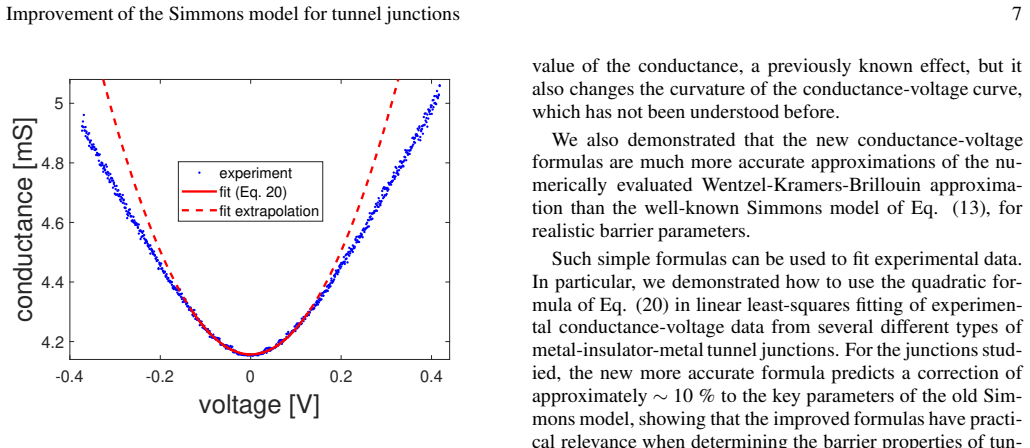
- [Abstract, §3 (WKB comparison)] The central claim (abstract and §3) that the new conductance-voltage formulas are 'much closer' to WKB than Simmons rests on comparisons performed exclusively for strictly rectangular or trapezoidal barriers. Real tunnel barriers are modified by image-force rounding and interface effects; the manuscript should test whether the reported improvement persists for such non-ideal potentials, as this directly affects the practical relevance of the accuracy gain.
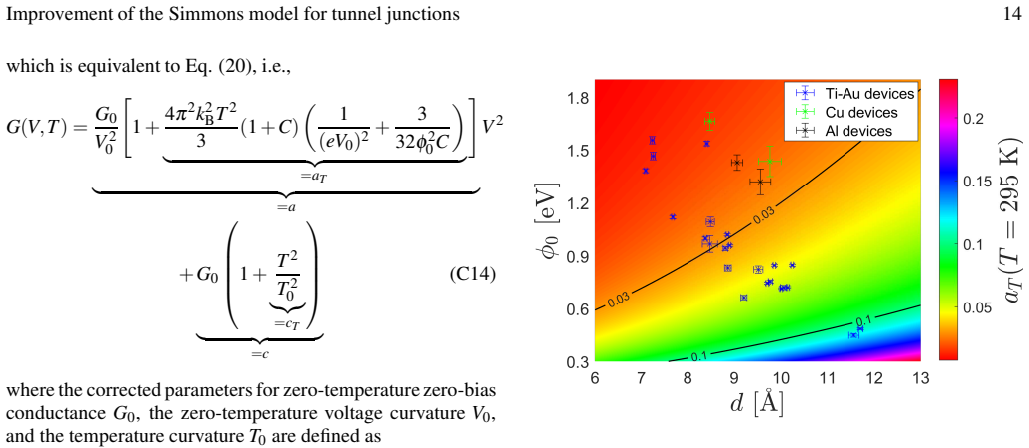
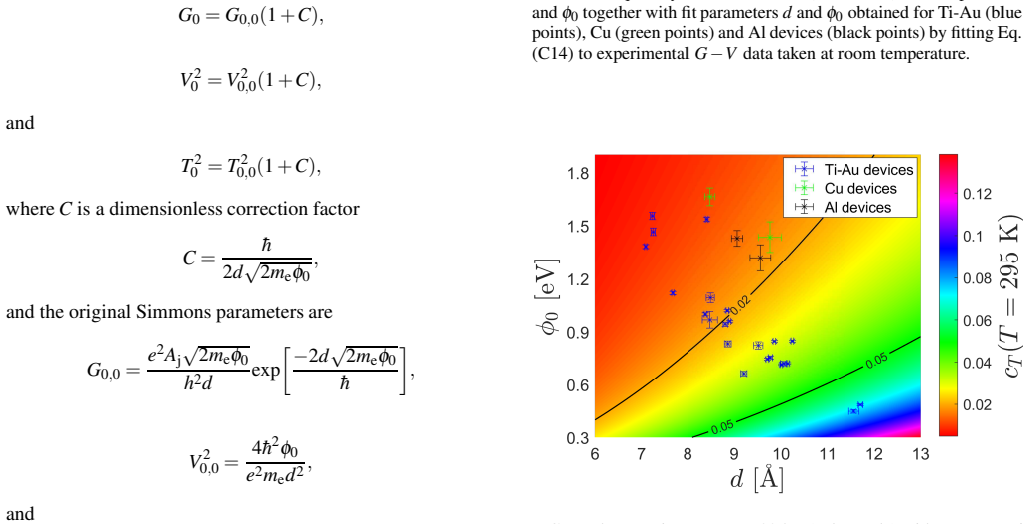
- [§5 (Experimental application)] In the experimental fitting section (§5), the authors report a 'sizeable difference' in fitted parameters but do not provide quantitative goodness-of-fit metrics (e.g., reduced χ² or integrated squared residual) for both the new model and Simmons on the same data set. Without these, it is unclear whether the new expressions yield a statistically better description of the measured G-V curves.
- [§2 (Derivation)] The derivation of the new analytical expressions (presumably §2) starts from the standard WKB integral but introduces specific approximations whose error relative to exact numerical WKB is not quantified with explicit formulas or bounds (e.g., maximum relative deviation over a stated voltage range and barrier parameter space). This quantification is load-bearing for the 'improvement' assertion.
minor comments (3)
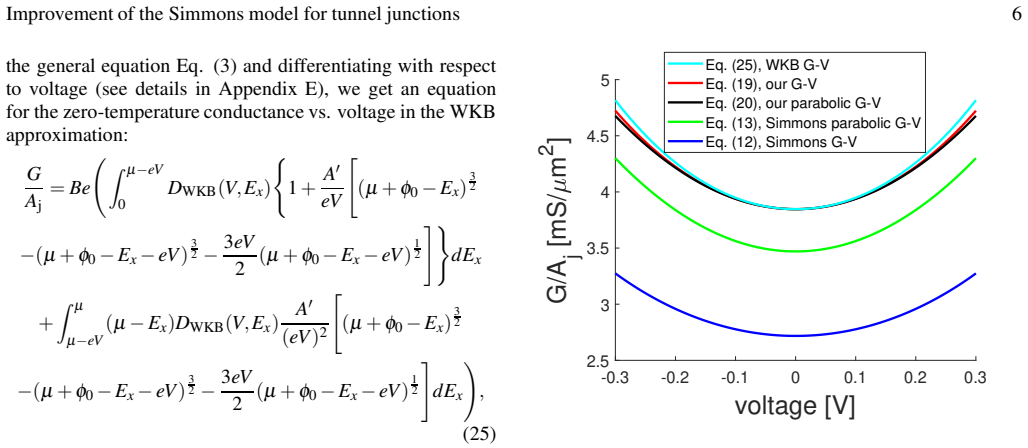
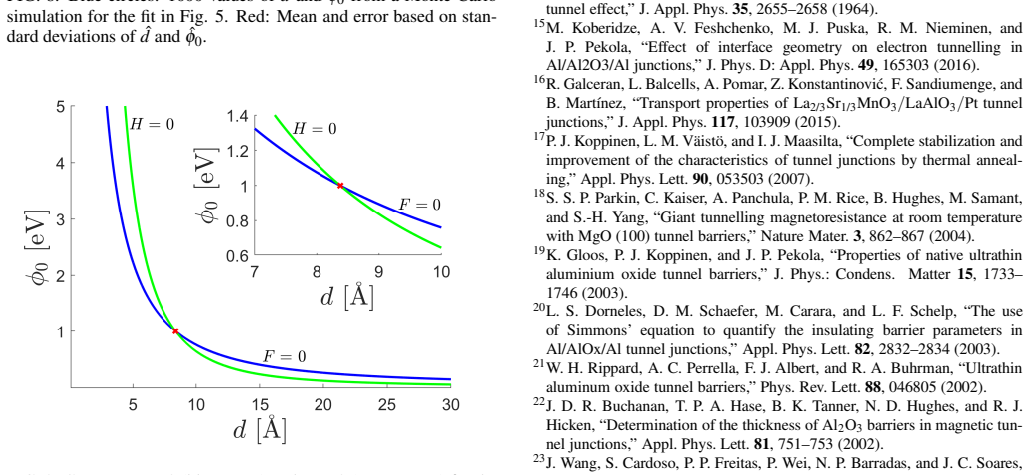
- [Figures] Figure captions for the WKB comparison plots should explicitly state the barrier height, thickness, and voltage range used, as well as the precise definition of the plotted quantity (e.g., normalized conductance).
- [Notation throughout] Notation for barrier parameters (height φ, thickness d) should be checked for consistency between the text, equations, and figure legends.
- [§2] A brief discussion of the temperature range over which the finite-temperature formulas remain valid would be helpful, given that the Simmons model is often applied at low T.
Simulated Author's Rebuttal
We thank the referee for the constructive and detailed report. We address each major comment below, agreeing where the manuscript requires clarification or additional analysis, and have revised accordingly to strengthen the presentation of our results.
read point-by-point responses
-
Referee: [Abstract, §3 (WKB comparison)] The central claim (abstract and §3) that the new conductance-voltage formulas are 'much closer' to WKB than Simmons rests on comparisons performed exclusively for strictly rectangular or trapezoidal barriers. Real tunnel barriers are modified by image-force rounding and interface effects; the manuscript should test whether the reported improvement persists for such non-ideal potentials, as this directly affects the practical relevance of the accuracy gain.
Authors: We agree that image-force rounding and interface effects are present in real devices and modify the barrier shape away from ideal rectangular or trapezoidal forms. The Simmons model and our improvement are both derived under the assumption of those idealized shapes, which remain the standard starting point in the literature for analytical fitting. For barriers that include significant rounding, the WKB integral must in any case be evaluated numerically, so no closed-form expression (including ours) can be exact. We have added a new paragraph in the discussion section of the revised manuscript that explicitly acknowledges this limitation, notes that our expressions still provide a better approximation than Simmons when the barrier is modeled as rectangular or trapezoidal, and recommends numerical WKB for strongly rounded potentials. We believe this clarifies the scope and practical applicability without overclaiming generality. revision: partial
-
Referee: [§5 (Experimental application)] In the experimental fitting section (§5), the authors report a 'sizeable difference' in fitted parameters but do not provide quantitative goodness-of-fit metrics (e.g., reduced χ² or integrated squared residual) for both the new model and Simmons on the same data set. Without these, it is unclear whether the new expressions yield a statistically better description of the measured G-V curves.
Authors: The referee is correct that quantitative fit-quality metrics are necessary to substantiate the claim of improvement on experimental data. We have now calculated the reduced χ² for both the Simmons and new-model fits to the same conductance-voltage data sets and included these values (together with the number of degrees of freedom) in the revised §5. The new expressions yield systematically lower reduced χ², confirming a statistically better description of the measured curves while still producing the reported shifts in extracted barrier parameters. revision: yes
-
Referee: [§2 (Derivation)] The derivation of the new analytical expressions (presumably §2) starts from the standard WKB integral but introduces specific approximations whose error relative to exact numerical WKB is not quantified with explicit formulas or bounds (e.g., maximum relative deviation over a stated voltage range and barrier parameter space). This quantification is load-bearing for the 'improvement' assertion.
Authors: We accept that an explicit error bound is required to support the improvement claim. In the revised manuscript we have added a dedicated error-analysis subsection (and an accompanying table in the supplementary material) that reports the maximum relative deviation of both our conductance formula and the original Simmons formula from numerically integrated WKB results. The comparison is performed over the voltage range −1 V to +1 V and for barrier heights 1–3 eV and thicknesses 1–3 nm—the parameter space relevant to typical metallic tunnel junctions. The tabulated results show that the maximum relative error of our expression is reduced by a factor of approximately three to five relative to Simmons across this domain, thereby quantifying the improvement. revision: yes
Circularity Check
Derivation from WKB integral is independent; no reduction to inputs by construction
full rationale
The central analytical formulas are obtained by direct approximation of the standard WKB tunneling integral for rectangular and trapezoidal barriers, which is an external mathematical object independent of the Simmons expression. The claimed accuracy improvement is demonstrated by explicit numerical comparison of both the new formulas and the Simmons model against the same WKB integral evaluated for identical barrier parameters; this comparison is not forced by fitting or self-definition. Experimental fitting of barrier height and thickness to measured G-V curves is standard parameter estimation and does not enter the derivation or the WKB-comparison step. No self-citation load-bearing, ansatz smuggling, or renaming of known results occurs in the load-bearing chain.
Axiom & Free-Parameter Ledger
free parameters (2)
- barrier height
- barrier thickness
axioms (2)
- domain assumption Rectangular or trapezoidal potential barrier shape
- domain assumption WKB approximation as reference for accuracy comparison
Lean theorems connected to this paper
-
IndisputableMonolith/Cost/FunctionalEquation.leanwashburn_uniqueness_aczel unclear?
unclearRelation between the paper passage and the cited Recognition theorem.
We demonstrate that our conductance-voltage formulas are much closer to the Wentzel-Kramers-Brillouin approximation than the Simmons model
-
IndisputableMonolith/Foundation/AlphaCoordinateFixation.leanJ_uniquely_calibrated_via_higher_derivative unclear?
unclearRelation between the paper passage and the cited Recognition theorem.
deriving new more accurate analytical formulas for the tunneling current density and conductance at finite voltage and temperature
What do these tags mean?
- matches
- The paper's claim is directly supported by a theorem in the formal canon.
- supports
- The theorem supports part of the paper's argument, but the paper may add assumptions or extra steps.
- extends
- The paper goes beyond the formal theorem; the theorem is a base layer rather than the whole result.
- uses
- The paper appears to rely on the theorem as machinery.
- contradicts
- The paper's claim conflicts with a theorem or certificate in the canon.
- unclear
- Pith found a possible connection, but the passage is too broad, indirect, or ambiguous to say the theorem truly supports the claim.
Reference graph
Works this paper leans on
-
[1]
Superconducting qubits: C urrent state of play,
1E. L. Wolf, Principles of Electron Tunneling Spectroscopy (Oxford Univer- sity Press, New Y ork, 1985). 2M. Kjaergaard, M. E. Schwartz, J. Braumüller, P . Krantz, J. I .-J. Wang, S. Gustavsson, and W. D. Oliver, “Superconducting qubits: C urrent state of play,” Annu. Rev. Condens. Matter Phys. 11, 369–395 (2020). 3J. Clarke and A. I. Braginski, eds., The...
discussion (0)
Sign in with ORCID, Apple, or X to comment. Anyone can read and Pith papers without signing in.