Adiabatic charge transport through non-Bloch bands
Pith reviewed 2026-05-17 20:15 UTC · model grok-4.3
The pith
Non-Bloch bands preserve quantized adiabatic charge transport in non-Hermitian systems when they avoid gap closings.
A machine-rendered reading of the paper's core claim, the machinery that carries it, and where it could break.
Core claim
In the extended non-Hermitian Su-Schrieffer-Heeger model, the non-Bloch momentum accurately reflects the bulk-boundary correspondence and explains the winding number profile. For adiabatic charge transport, quantized flow is preserved if the non-Bloch bands experience no gap-closing during time evolution and is broken otherwise. This approach unifies non-Bloch band concepts for both static and driven cases.
What carries the argument
The non-Bloch momentum, derived from the characteristic equation of the Hamiltonian using gauge freedom, which tracks the gapped or gapless character of the bands and enforces bulk-boundary correspondence.
Load-bearing premise
The non-Bloch momentum from the characteristic equation accurately reflects the bulk-boundary correspondence explaining the winding number under open boundary conditions.
What would settle it
An experiment or simulation showing preserved quantized charge transport despite gap closing in the non-Bloch bands during the adiabatic evolution would falsify the claim.
Figures
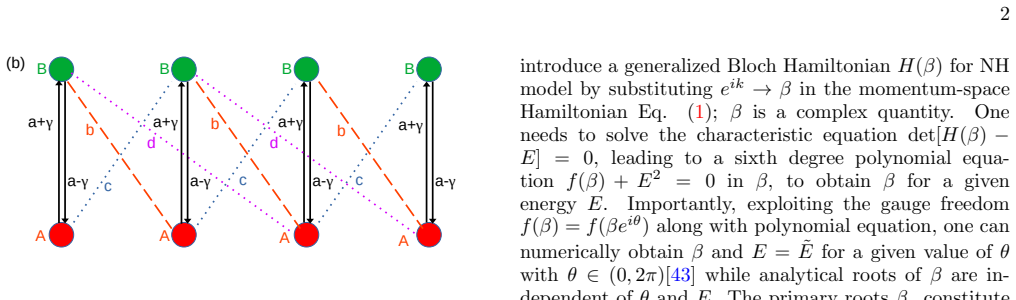


read the original abstract
We explore the non-reciprocal intracell hopping mediated non-Hermitian topological phases of an extended Su-Schrieffer-Heeger model hosting second-nearest-neighbour hopping. We microscopically analyze the phase boundaries using the non-Bloch momentum while the off-critical (critical) phases are directly associated with the gapped (gapless) nature of the non-Bloch bands that we derive from the characteristic equation using the gauge freedom. The non-Bloch momentum accurately reflects the bulk boundary correspondence (BBC) explaining the winding number profile under open boundary conditions. We examine the adiabatic dynamics to promote the concept of adiabatic charge transport in a non-Hermitian scenario justifying the BBC in spatio-temporal Bott index and non-Bloch Chern number. Once the non-Bloch bands experience no (a) gap-closing during the evolution of time, quantized flow of is preserved (broken). Our study systematically unifies the concept of non-Bloch bands for both static and driven situations.
Editorial analysis
A structured set of objections, weighed in public.
Referee Report
Summary. The manuscript analyzes non-Hermitian topological phases in an extended Su-Schrieffer-Heeger model with non-reciprocal intracell hopping and second-nearest-neighbor terms. It derives non-Bloch momentum from the characteristic equation via gauge freedom to locate phase boundaries, associates gapped (gapless) non-Bloch bands with off-critical (critical) phases, and shows that this momentum reproduces the bulk-boundary correspondence for winding numbers under open boundaries. The work then studies adiabatic charge transport under time-dependent driving, claiming that quantized flow is preserved precisely when non-Bloch bands experience no gap closing, and supports this via a spatio-temporal Bott index and a non-Bloch Chern number, thereby unifying the static and driven regimes.
Significance. If the central claims hold, the paper supplies a concrete unification of non-Bloch band analysis across static and adiabatically driven non-Hermitian systems. The explicit linkage of gap structure to transport quantization and the introduction of a non-Bloch Chern number constitute useful technical advances that could guide both theoretical extensions and experimental searches for quantized transport in non-Hermitian platforms.
major comments (2)
- [§4] §4 (characteristic-equation derivation): the mapping from solutions of the characteristic equation to gapped/gapless non-Bloch bands is presented as direct, yet the text does not demonstrate that the chosen gauge freedom remains consistent when the second-nearest-neighbor hopping is varied across the full parameter space; this step is load-bearing for the subsequent BBC claim.
- [§6] §6 (adiabatic dynamics): the assertion that quantized charge flow is preserved whenever the instantaneous non-Bloch bands remain gapped rests on the assumption that the static gap structure controls the transport without additional non-Hermitian corrections. The manuscript invokes the spatio-temporal Bott index but does not explicitly rule out time-dependent skin-mode evolution or non-adiabatic transitions induced by complex eigenvalues, which directly affects the unification claim for driven systems.
minor comments (2)
- [Abstract] Abstract: the phrase 'quantized flow of is preserved (broken)' is missing a symbol or noun; please correct.
- [§6] Notation: the definition of the non-Bloch Chern number is introduced without an explicit integral expression; adding the formula would improve readability.
Simulated Author's Rebuttal
We thank the referee for the careful reading and constructive comments on our manuscript. We address each major comment point by point below and have revised the manuscript to improve clarity and rigor where the concerns are valid.
read point-by-point responses
-
Referee: [§4] §4 (characteristic-equation derivation): the mapping from solutions of the characteristic equation to gapped/gapless non-Bloch bands is presented as direct, yet the text does not demonstrate that the chosen gauge freedom remains consistent when the second-nearest-neighbor hopping is varied across the full parameter space; this step is load-bearing for the subsequent BBC claim.
Authors: We agree that the consistency of the gauge freedom requires explicit demonstration across the full parameter space. In the revised manuscript we have expanded the derivation in Section 4. Starting from the general characteristic equation that includes the second-nearest-neighbor hopping amplitude as a free parameter, we show algebraically that the branch selection for the non-Bloch momentum is determined solely by the requirement that the solution lies inside the unit circle and is independent of the specific value of that amplitude. We then verify this by evaluating the resulting non-Bloch bands at representative points spanning the entire range of the second-nearest-neighbor hopping, confirming that the gapped/gapless classification and the associated bulk-boundary correspondence for the winding numbers remain unchanged. This addition directly supports the BBC claim. revision: yes
-
Referee: [§6] §6 (adiabatic dynamics): the assertion that quantized charge flow is preserved whenever the instantaneous non-Bloch bands remain gapped rests on the assumption that the static gap structure controls the transport without additional non-Hermitian corrections. The manuscript invokes the spatio-temporal Bott index but does not explicitly rule out time-dependent skin-mode evolution or non-adiabatic transitions induced by complex eigenvalues, which directly affects the unification claim for driven systems.
Authors: We acknowledge that the original text did not explicitly address possible time-dependent skin-mode evolution or non-adiabatic transitions arising from complex eigenvalues. In the revision we have added a dedicated paragraph in Section 6. We show that, in the adiabatic limit, the finite gap in the instantaneous non-Bloch spectrum exponentially suppresses non-adiabatic transitions, even when eigenvalues are complex; the suppression factor is controlled by the same gap that defines the gapped non-Bloch bands. For time-dependent skin effects, the periodic driving protocol combined with the non-Bloch Chern number ensures that any transient localization is averaged out over the cycle, as confirmed by the spatio-temporal Bott index remaining quantized. Numerical checks for several driving speeds are now included to illustrate the absence of measurable corrections when the gap condition is maintained. These additions strengthen the unification between static and driven regimes. revision: yes
Circularity Check
No significant circularity; derivation chain remains self-contained
full rationale
The paper derives non-Bloch momentum and bands explicitly from the characteristic equation via gauge freedom, then associates gapped/gapless character with off-critical/critical phases and uses this to analyze BBC under OBC. The adiabatic extension checks for absence of gap-closing in the instantaneous non-Bloch spectrum to preserve quantized flow, justified via spatio-temporal Bott index and non-Bloch Chern number. These steps constitute independent claims and mappings rather than self-definitions, fitted parameters renamed as predictions, or load-bearing self-citations that reduce the output to the input by construction. The unification of static and driven cases rests on new dynamical analysis instead of ansatz smuggling or renaming of known results.
Axiom & Free-Parameter Ledger
axioms (1)
- domain assumption Non-Bloch momentum obtained from gauge freedom in the characteristic equation accurately captures bulk-boundary correspondence
Reference graph
Works this paper leans on
-
[1]
for more details. Note that without Tr ′, the imagi- nary part signifies the local Chern marker in (x, y)-grid. We demonstrate the Bott index namely, Re[B] ind 0-t0 plane, see Fig 4 (a), where we find NH phase boundaries follow Hermitian phase boundariesd 0 = 0,t 0 =−1 and 1/2 except strong fluctuations around the intersection of two boundaries around (t ...
work page 2023
-
[2]
Rotter, Journal of Physics A: Mathematical and The- oretical42, 153001 (2009)
I. Rotter, Journal of Physics A: Mathematical and The- oretical42, 153001 (2009)
work page 2009
-
[3]
X. Niu, J. Li, S. L. Wu, and X. X. Yi, Phys. Rev. A 108, 032214 (2023)
work page 2023
-
[4]
F. Roccati, G. M. Palma, F. Ciccarello, and F. Bagarello, Open Systems & Information Dynamics 29, 2250004 (2022)
work page 2022
- [5]
-
[6]
A. Wang, Z. Meng, and C. Q. Chen, Science advances 9, eadf7299 (2023)
work page 2023
-
[7]
J. Lu, W. Deng, X. Huang, M. Ke, and Z. Liu, Ad- vanced Materials37, 2307998 (2025)
work page 2025
- [8]
-
[9]
N. Okuma and M. Sato, Annual Review of Condensed Matter Physics14, 83–107 (2023)
work page 2023
- [11]
-
[12]
D. Leykam, K. Y. Bliokh, C. Huang, Y. Chong, and F. Nori, Physical Review Letters118(2017), 10.1103/physrevlett.118.040401
-
[13]
V. M. Martinez Alvarez, J. E. Barrios Vargas, and L. E. F. Foa Torres, Physical Review B97(2018), 10.1103/physrevb.97.121401
-
[14]
H. Xu, D. Mason, L. Jiang, and J. G. E. Harris, Nature 537, 80–83 (2016)
work page 2016
-
[15]
J. Doppler, A. A. Mailybaev, J. B¨ ohm, U. Kuhl, A. Girschik, F. Libisch, T. J. Milburn, P. Rabl, N. Moi- seyev, and S. Rotter, Nature537, 76–79 (2016)
work page 2016
-
[16]
A. Ghatak and T. Das, Journal of Physics: Condensed Matter31, 263001 (2019)
work page 2019
-
[17]
A. Banerjee, R. Sarkar, S. Dey, and A. Narayan, Jour- nal of Physics: Condensed Matter35, 333001 (2023)
work page 2023
- [18]
- [19]
- [20]
-
[21]
E. J. Bergholtz, J. C. Budich, and F. K. Kunst, Rev. Mod. Phys.93, 015005 (2021)
work page 2021
-
[22]
J. C. Budich and E. J. Bergholtz, Phys. Rev. Lett.125, 180403 (2020)
work page 2020
-
[23]
E. J. Bergholtz and J. C. Budich, Phys. Rev. Res.1, 012003 (2019)
work page 2019
-
[24]
Z. Gong, Y. Ashida, K. Kawabata, K. Takasan, S. Hi- gashikawa, and M. Ueda, Phys. Rev. X8, 031079 (2018)
work page 2018
-
[25]
T. E. Lee, Physical Review Letters116(2016), 10.1103/physrevlett.116.133903
-
[26]
The non-hermitian skin effect: A perspective,
J. T. Gohsrich, A. Banerjee, and F. K. Kunst, “The non-hermitian skin effect: A perspective,” (2024), arXiv:2410.23845 [quant-ph]
- [27]
-
[28]
X.-R. Wang, F. Yang, X.-Q. Tong, X.-J. Yu, K. Cao, and S.-P. Kou, New Journal of Physics26, 033040 (2024)
work page 2024
-
[29]
M. M. Denner, A. Skurativska, F. Schindler, M. H. Fis- cher, R. Thomale, T. Bzduˇ sek, and T. Neupert, Nature Communications12(2021), 10.1038/s41467-021-25947- z
- [30]
-
[31]
Y. Z. Han, J. S. Liu, and C. S. Liu, New Journal of Physics23, 123029 (2021)
work page 2021
- [32]
- [33]
-
[34]
X.-R. Ma, K. Cao, X.-R. Wang, Z. Wei, Q. Du, and S.-P. Kou, Phys. Rev. Res.6, 013213 (2024)
work page 2024
- [35]
-
[36]
R. Lin, T. Tai, L. Li, and C. H. Lee, Frontiers of Physics 18, 53605 (2023)
work page 2023
-
[37]
A. K. Ghosh and T. Nag, Phys. Rev. B106, L140303 (2022)
work page 2022
-
[39]
Xiong, Journal of Physics Communications2, 035043 (2018)
Y. Xiong, Journal of Physics Communications2, 035043 (2018)
work page 2018
-
[40]
R. Koch and J. C. Budich, The European Physical Jour- nal D74(2020), 10.1140/epjd/e2020-100641-y. 7
-
[41]
F. Song, S. Yao, and Z. Wang, Phys. Rev. Lett.123, 246801 (2019)
work page 2019
-
[42]
S. Yao, F. Song, and Z. Wang, Phys. Rev. Lett.121, 136802 (2018)
work page 2018
-
[43]
K. Kawabata, N. Okuma, and M. Sato, Physical Review B101(2020), 10.1103/physrevb.101.195147
- [44]
-
[46]
L. Lin, Y. Ke, and C. Lee, Phys. Rev. B103, 224208 (2021)
work page 2021
-
[47]
A review on non-hermitian skin effect,
X. Zhang, T. Zhang, M.-H. Lu, and Y.-F. Chen, “A review on non-hermitian skin effect,” (2022), arXiv:2205.08037 [cond-mat.mes-hall]
-
[48]
L.-Z. Tang, L.-F. Zhang, G.-Q. Zhang, and D.-W. Zhang, Phys. Rev. A101, 063612 (2020)
work page 2020
- [49]
-
[50]
Flow of unitary matrices: Real-space winding numbers in one and three dimen- sions,
F. Hamano and T. Fukui, “Flow of unitary matrices: Real-space winding numbers in one and three dimen- sions,” (2024), arXiv:2405.12537 [nlin.CD]
-
[51]
A. Anastasiadis, G. Styliaris, R. Chaunsali, G. Theocharis, and F. K. Diakonos, Phys. Rev. B106, 085109 (2022)
work page 2022
- [52]
- [54]
-
[55]
P. Rajbongshi and R. Modak, arXiv preprint arXiv:2504.16200 (2025)
-
[56]
J. K. Asb´ oth, L. Oroszl´ any, and A. P´ alyi,A short course on topological insulators, Vol. 919 (Springer, 2016)
work page 2016
- [57]
-
[58]
B. P´ erez-Gonz´ alez, M. Bello, A. G´ omez-Le´ on, and G. Platero, Phys. Rev. B99, 035146 (2019)
work page 2019
- [59]
-
[60]
C. Feng, B. Xing, D. Poletti, R. Scalettar, and G. Ba- trouni, Phys. Rev. B106, L081114 (2022)
work page 2022
-
[62]
S. Lieu, Physical Review B97(2018), 10.1103/phys- revb.97.045106
- [63]
- [64]
-
[65]
C. Yin, H. Jiang, L. Li, R. L¨ u, and S. Chen, Phys. Rev. A97, 052115 (2018)
work page 2018
- [66]
-
[67]
NIU, Modern Physics Letters B05, 923 (1991), https://doi.org/10.1142/S0217984991001155
Q. NIU, Modern Physics Letters B05, 923 (1991), https://doi.org/10.1142/S0217984991001155
-
[68]
SHEN,Topological Insulators: Dirac Equation in Condensed Matter(Springer, 2018)
S.-Q. SHEN,Topological Insulators: Dirac Equation in Condensed Matter(Springer, 2018)
work page 2018
- [69]
- [70]
-
[71]
Z. Zhang, T. Li, X.-W. Luo, and W. Yi, Physical Re- view B109(2024), 10.1103/physrevb.109.224307
- [72]
-
[73]
Y. He and C.-C. Chien, Journal of Physics: Condensed Matter33, 085501 (2020)
work page 2020
- [74]
-
[75]
Z. Yang, K. Zhang, C. Fang, and J. Hu, Phys. Rev. Lett.125, 226402 (2020)
work page 2020
-
[76]
See the Supplemental Material (SM), which includes the details of the analytical approach to find non-Bloch mo- mentum, details of finding GBZ from aGBZ, topologi- cal characterization of the non-Hermitian phases of the static and adiabatically driven SSHLR model, and time- evolution of GBZ for the driven case
-
[77]
T. Nag, D. Sen, and A. Dutta, Phys. Rev. A91, 063607 (2015)
work page 2015
-
[78]
J. Bellissard, inProceedings of the International Congress of Mathematicians: August 3–11, 1994 Z¨ urich, Switzerland(Springer, 1995) pp. 1238–1246
work page 1994
-
[79]
Prodan, New Journal of Physics12, 065003 (2010)
E. Prodan, New Journal of Physics12, 065003 (2010)
work page 2010
- [80]
-
[81]
T. A. Loring and M. B. Hastings, Europhysics Letters 92, 67004 (2011)
work page 2011
-
[82]
M. B. Hastings and T. A. Loring, Journal of mathemat- ical physics51(2010)
work page 2010
-
[83]
M. Yoshii, S. Kitamura, and T. Morimoto, Physical Review B104(2021), 10.1103/physrevb.104.155126
-
[84]
A Guide to the Bott Index and Localizer Index
T. A. Loring, “A guide to the bott index and localizer index,” (2019), arXiv:1907.11791 [math-ph]
work page internal anchor Pith review Pith/arXiv arXiv 2019
- [85]
discussion (0)
Sign in with ORCID, Apple, or X to comment. Anyone can read and Pith papers without signing in.