Simulated Annealing for Quadratic and Higher-Order Unconstrained Integer Optimization
Pith reviewed 2026-05-17 20:40 UTC · model grok-4.3
The pith
Direct simulated annealing on integer variables outperforms QUBO conversions for quadratic and higher-order problems.
A machine-rendered reading of the paper's core claim, the machinery that carries it, and where it could break.
Core claim
A direct simulated-annealing framework for quadratic and higher-order unconstrained integer optimization (QUIO and HUIO) problems achieves higher efficiency and better solution quality than the conventional route of converting the same problems into QUBO instances via binary encoding and term reduction.
What carries the argument
Direct SA updates on integer variables combined with the optimal-transition Metropolis method that selects state changes to maintain efficiency across wide variable ranges.
If this is right
- The number of variables and interactions remains unchanged by the problem formulation instead of growing with binary encoding.
- For large-scale instances the conversion step itself ceases to dominate runtime.
- The optimal-transition Metropolis rule provides measurable speed-up precisely when the allowed integer range is wide.
- Solution quality improves on the tested benchmark set relative to the converted formulation.
Where Pith is reading between the lines
- The same direct-update idea could be tested inside other local-search metaheuristics that currently rely on QUBO preprocessing.
- Problems whose natural variables are integers with moderate but not tiny ranges become newly practical targets for annealing hardware that accepts higher-order or integer couplings.
- When integer ranges grow very large, the per-sweep cost of the direct method may still need further engineering to stay competitive.
Load-bearing premise
Implementing the direct updates on integer variables and higher-order terms adds no hidden computational costs that cancel the savings from skipping the QUBO conversion.
What would settle it
A timing comparison on a large-scale instance with wide integer ranges in which the direct method's per-update cost exceeds the overhead of the QUBO conversion and produces longer total run times.
Figures
read the original abstract
Simulated annealing (SA) is a key algorithm for solving combinatorial optimization problems, which model numerous real-world systems. While SA is commonly used to solve quadratic unconstrained binary optimization (QUBO) problems, many practical problems are more naturally formulated using integer variables. We therefore study quadratic and higher-order unconstrained integer optimization (QUIO and HUIO) problems, which generalize QUBO by allowing integer-valued variables and higher-order interactions. Conventional approaches often convert these problems into QUBO formulations through binary encoding and the reduction of higher-order terms. Such conversions, however, greatly increase the number of variables and interactions, resulting in long computation times and, for large-scale problems, even making the conversion itself a dominant computational bottleneck. To overcome this limitation, we propose an efficient framework that directly applies SA to QUIO and HUIO problems without converting them into QUBO. Within this framework, we introduce an optimal-transition Metropolis method, designed to improve efficiency when the variable range is wide, and evaluate its performance alongside the conventional Metropolis and heat bath methods. Numerical experiments demonstrate that the proposed direct approach achieves higher efficiency and better solution quality than the conventional QUBO-based formulation and reveal the practical advantages of the optimal-transition Metropolis method. The algorithm developed in this study is available as part of the open-source library OpenJij, which provides a Python front end with a C++ backend.
Editorial analysis
A structured set of objections, weighed in public.
Referee Report
Summary. The manuscript proposes a direct simulated annealing framework for quadratic and higher-order unconstrained integer optimization (QUIO and HUIO) problems that avoids conversion to QUBO formulations. It introduces an optimal-transition Metropolis method for efficiency with wide variable ranges, compares it to standard Metropolis and heat-bath algorithms, and reports numerical experiments claiming superior efficiency and solution quality over QUBO-based approaches. The implementation is released as part of the OpenJij open-source library.
Significance. If the performance advantages hold, the work addresses a practical bottleneck in combinatorial optimization arising from binary encoding overhead, which is relevant to statistical-mechanics models and integer-variable problems in scheduling or resource allocation. The open-source release and the new Metropolis variant support reproducibility and further development.
major comments (1)
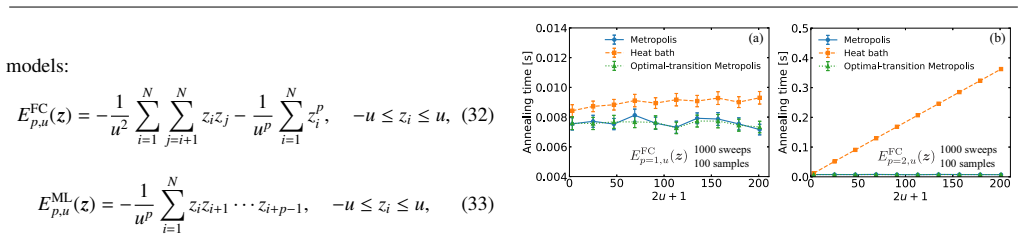
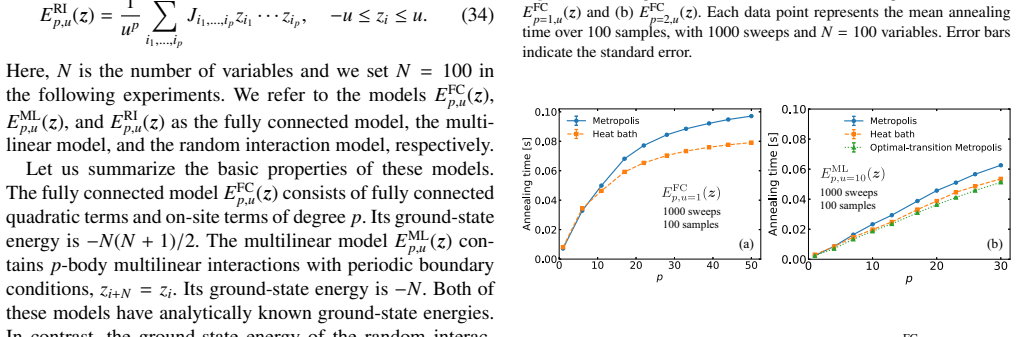
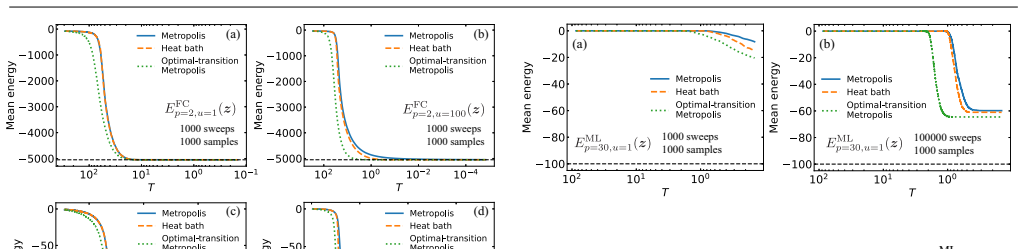
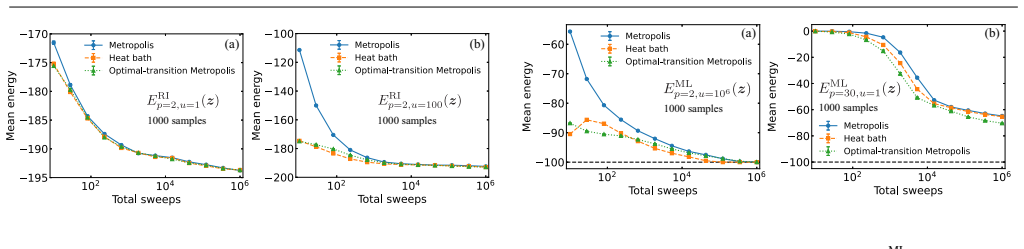
- [Numerical Experiments] Numerical Experiments section: the central claims of higher efficiency and better solution quality rest on numerical experiments, yet the manuscript provides no visible data details, error bars, or complete methodology for the tested instances and variable ranges. This gap prevents verification that direct SA incurs no hidden per-update costs that offset the avoided QUBO overhead, which is load-bearing for the main conclusion.
minor comments (2)
- [Abstract] The abstract introduces the 'optimal-transition Metropolis method' without a one-sentence description of its transition rule; a brief clarification would improve immediate readability.
- [Introduction] Ensure that the distinction between QUIO/HUIO and QUBO is illustrated with at least one concrete example problem (e.g., from statistical mechanics) in the introduction.
Simulated Author's Rebuttal
We thank the referee for the careful reading and constructive feedback. The single major comment identifies a genuine gap in experimental documentation that we will address in revision.
read point-by-point responses
-
Referee: Numerical Experiments section: the central claims of higher efficiency and better solution quality rest on numerical experiments, yet the manuscript provides no visible data details, error bars, or complete methodology for the tested instances and variable ranges. This gap prevents verification that direct SA incurs no hidden per-update costs that offset the avoided QUBO overhead, which is load-bearing for the main conclusion.
Authors: We agree that the current Numerical Experiments section is insufficiently detailed for independent verification. In the revised manuscript we will add: (i) explicit descriptions of all benchmark instances, including exact variable ranges, problem sizes, and interaction orders; (ii) error bars and statistics from at least 20 independent runs per instance; (iii) a complete methodology subsection with pseudocode and parameter settings; and (iv) separate timing breakdowns that isolate per-update computational cost from encoding overhead. These additions will directly demonstrate that the observed speed-ups are not offset by hidden costs in the direct formulation. revision: yes
Circularity Check
No significant circularity; algorithmic proposal with independent experiments
full rationale
The paper proposes a direct SA framework for QUIO/HUIO problems, introduces an optimal-transition Metropolis method, and supports its claims via numerical experiments comparing efficiency and solution quality against QUBO conversion. No derivation chain, predictions, or first-principles results reduce to inputs by construction. No self-definitional steps, fitted inputs renamed as predictions, or load-bearing self-citations are present. The central claims rest on the described algorithms and external benchmarks from experiments, which are independent of the proposal itself. This is a standard self-contained algorithmic paper.
Axiom & Free-Parameter Ledger
axioms (1)
- domain assumption Simulated annealing converges to good solutions under suitable cooling schedules for integer and higher-order problems
invented entities (1)
-
optimal-transition Metropolis method
no independent evidence
Lean theorems connected to this paper
-
IndisputableMonolith/Cost/FunctionalEquationwashburn_uniqueness_aczel unclear?
unclearRelation between the paper passage and the cited Recognition theorem.
We propose an efficient framework that directly applies SA to QUIO and HUIO problems without converting them into QUBO... optimal-transition Metropolis method... P(ΔE(i)_k,T)=1/(u_k−l_k) min[1,exp(−ΔE(i)_k/T)]
-
IndisputableMonolith/Foundation/RealityFromDistinctionreality_from_one_distinction unclear?
unclearRelation between the paper passage and the cited Recognition theorem.
Numerical experiments demonstrate that the proposed direct approach achieves higher efficiency... on E_FC, E_ML, E_RI models with log-encoding QUBO baselines
What do these tags mean?
- matches
- The paper's claim is directly supported by a theorem in the formal canon.
- supports
- The theorem supports part of the paper's argument, but the paper may add assumptions or extra steps.
- extends
- The paper goes beyond the formal theorem; the theorem is a base layer rather than the whole result.
- uses
- The paper appears to rely on the theorem as machinery.
- contradicts
- The paper's claim conflicts with a theorem or certificate in the canon.
- unclear
- Pith found a possible connection, but the passage is too broad, indirect, or ambiguous to say the theorem truly supports the claim.
Reference graph
Works this paper leans on
-
[1]
Simulated Annealing for Quadratic and Higher-Order Unconstrained Integer Optimization
Introduction Combinatorial optimization problems play a central role in a wide range of real-world applications, including finance, lo- gistics, drug discovery, and scheduling. Many of these prob- lems are NP-complete or NP-hard, and obtaining exact so- lutions in polynomial time is generally intractable. 1) There- fore, efficient approximation algorithms...
work page internal anchor Pith review Pith/arXiv arXiv 2025
-
[2]
We begin with the quadratic unconstrained integer optimization
Model In this section, we introduce the polynomial unconstrained integer optimization, namely QUIO and HUIO. We begin with the quadratic unconstrained integer optimization. QUIO is defined as the problem of minimizing a quadratic function composed of integer variables: Ep=2(z)= X i1 Ji1zi1 + X i1,i2 Ji1,i2zi1zi2 .(1) Here,z=(z 1,z 2, . . . ,zN) is the set...
-
[3]
Simulated Annealing In this section, we present the SA framework for general QUIO and HUIO, and describe several techniques to make it efficient. Section 3.1 outlines the SA procedure itself, in- cluding initialization, cooling schedule, and update rules. Sec- tion 3.2 then explains a method for efficiently evaluating the energy difference when a variable...
-
[4]
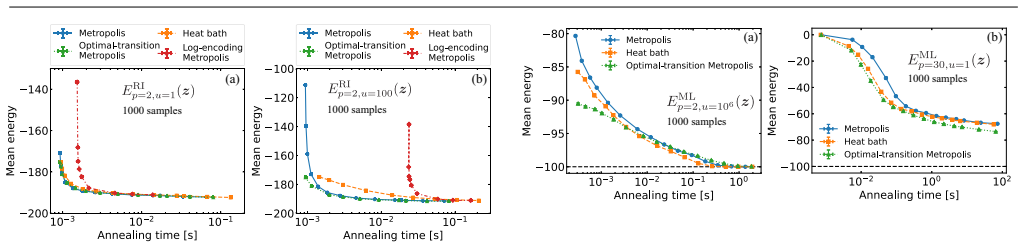
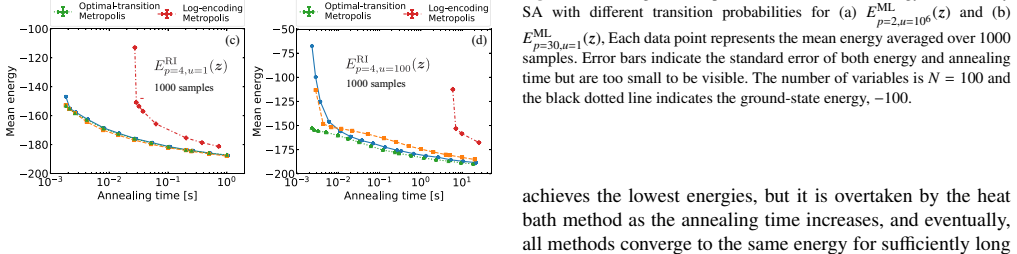
Results In this section, we present numerical results for SA with the transition probabilities described in Sect. 3.3. Our pro- posed algorithms are implemented in the open-source library OpenJij,36) and are freely available for use. All numerical ex- periments presented below were performed using OpenJij on a machine equipped with an Apple M1 Max process...
-
[5]
Promoting the ap- plication of advanced quantum technology platforms to social issues
Summary We proposed an SA method for optimizing polynomial functions composed of integer variables, namely the QUIO and HUIO problems. By storing and updating the coefficients required for energy-difference computations, we can evalu- ate the transition probabilities efficiently. We also proposed a method for estimating the initial and final temperatures ...
- [6]
- [7]
-
[8]
ˇCern´y: Journal of Optimization Theory and Applications45(1985) 41
V . ˇCern´y: Journal of Optimization Theory and Applications45(1985) 41
work page 1985
-
[9]
G. Kochenberger, J.-K. Hao, F. Glover, M. Lewis, Z. L ¨u, H. Wang, and Y . Wang: Journal of Combinatorial Optimization28(2014) 58
work page 2014
- [10]
- [11]
- [12]
- [13]
-
[14]
M. Anthony, E. Boros, Y . Crama, and A. Gruber: Mathematical Pro- gramming162(2017) 115
work page 2017
-
[15]
M. Cardoso, R. Salcedo, S. de Azevedo, and D. Barbosa: Computers & Chemical Engineering21(1997) 1349
work page 1997
- [16]
- [17]
-
[18]
P. Tian, H. Wang, and D. Zhang: IFAC Proceedings V olumes28(1995)
work page 1995
-
[19]
7th IFAC Symposium on Large Scale Systems: Theory and Appli- cations 1995, London, UK, 11-13 July, 1995
work page 1995
-
[20]
N. Metropolis, A. W. Rosenbluth, M. N. Rosenbluth, A. H. Teller, and E. Teller: J. Chem. Phys.21(1953) 1087
work page 1953
-
[21]
W. K. Hastings: Biometrika57(1970) 97
work page 1970
-
[22]
Barker: Australian Journal of Physics18(1965) 119
A. Barker: Australian Journal of Physics18(1965) 119
work page 1965
-
[23]
S. Geman and D. Geman: IEEE Transactions on Pattern Analysis and Machine IntelligencePAMI-6(1984) 721
work page 1984
-
[24]
F. Glover, J.-K. Hao, and G. Kochenberger: International Journal of Metaheuristics1(2011) 232
work page 2011
-
[25]
F. Glover, J.-K. Hao, and G. Kochenberger: International Journal of Metaheuristics1(2011) 317
work page 2011
-
[26]
Y . Couzini ´e, Y . Nishiya, H. Nishi, T. Kosugi, H. Nishimori, and Y .-i. Matsushita: Phys. Rev. A109(2024) 032416
work page 2024
-
[27]
B.-Y . Wang, X. Cui, Q. Zeng, Y . Zhan, M.-H. Yung, and Y . Shi: Com- munications Physics8(2025) 150
work page 2025
- [28]
-
[29]
D. P. Bertsekas:Constrained Optimization and Lagrange Multiplier Methods(Academic Press, New York, 1982)
work page 1982
- [30]
-
[31]
Ingber: Control and Cybernetics25(1996) 33
L. Ingber: Control and Cybernetics25(1996) 33
work page 1996
-
[32]
Y . Nourani and B. Andresen: Journal of Physics A: Mathematical and General31(1998) 8373
work page 1998
- [33]
- [34]
-
[35]
Devroye:Non-Uniform Random Variate Generation(Springer Sci- ence & Business Media, 1986)
L. Devroye:Non-Uniform Random Variate Generation(Springer Sci- ence & Business Media, 1986)
work page 1986
- [36]
-
[37]
M. M. Ali and C. Storey: Journal of Global Optimization11(1997) 181
work page 1997
-
[38]
M. Ali, A. T ¨orn, and S. Viitanen: Computers & Operations Research29 (2002) 87
work page 2002
-
[39]
Locatelli: inSimulated Annealing Algorithms for Continuous Global Optimization, ed
M. Locatelli: inSimulated Annealing Algorithms for Continuous Global Optimization, ed. P. M. Pardalos and H. E. Romeijn (Springer US, Boston, MA, 2002), pp. 179–229
work page 2002
-
[40]
S. R. White: AIP Conference Proceedings122(1984) 261
work page 1984
-
[41]
E. E. Aarts and V . Laarhoven: Philips Journal of Research40(1985) 193
work page 1985
-
[42]
K. Nishimura, Y . Sakamoto, T. Shimizu, K. Suzuki, and Y . Yamashiro. OpenJij. DOI: 10.5281/zenodo.15790495
- [43]
-
[44]
T. Toshiki, S. Taro, and I. Hiromi. presented at The 39th Annual Con- ference of the Japanese Society for Artificial Intelligence, 2025
work page 2025
-
[45]
T. Toshiki, S. Taro, and I. Hiromi. OMMX. DOI: 10.5281/zen- odo.17638431
-
[46]
A. Frigessi, C.-R. Hwang, and L. Younes: The Annals of Applied Prob- ability2(1992) 610
work page 1992
-
[47]
J. S. LIU: Biometrika83(1996) 681
work page 1996
- [48]
- [49]
-
[50]
T.-L. Chen, W.-K. Chen, C.-R. Hwang, and H.-M. Pai: SIAM Journal on Control and Optimization50(2012) 2743
work page 2012
-
[51]
R. H. Swendsen and J.-S. Wang: Phys. Rev. Lett.58(1987) 86
work page 1987
- [52]
discussion (0)
Sign in with ORCID, Apple, or X to comment. Anyone can read and Pith papers without signing in.