REVIEW 4 major objections 6 minor 1 cited by
The paper claims that nine state-of-the-art VLLMs all exhibit notable deficiencies in robust path planning, collision avoidance, and active exploration in dynamic industrial navigation, based on a new Unity-based benchmark with safety-orien
Reviewed by Pith at T0; open to challenge. T0 means a machine referee read the full paper against a public rubric. the ladder, T0–T4 →
T0 review · deepseek-v4-flash
2026-08-03 20:55 UTC pith:ZUVSB27K
load-bearing objection Promising industrial navigation benchmark, but the action-space inconsistency in the prompt makes the headline VLLM deficiency results unreliable until fixed. the 4 major comments →
IndustryNav: Exploring Spatial Reasoning of Embodied Agents in Dynamic Industrial Navigation
The pith
A machine-rendered reading of the paper's core claim, the machinery that carries it, and where it could break.
Core claim
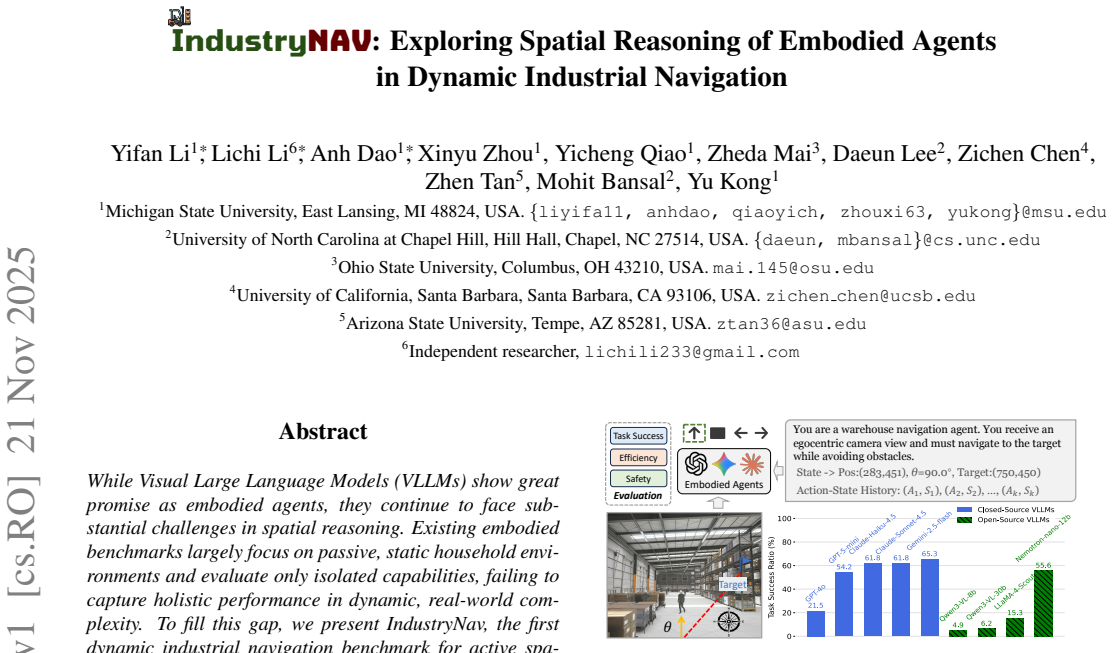
The central claim is a measured capability gap: under a zero-shot PointGoal protocol in dynamic warehouse scenes, none of the nine tested VLLMs reaches the target in more than 65% of runs, closed-source models consistently beat open-source ones, and safety behaviors—collisions and near-miss warnings—are poor across all models. The authors interpret this as evidence that current VLLMs lack robust spatial reasoning for active, dynamic environments, particularly in combining local obstacle avoidance with global path planning.
What carries the argument
The load-bearing mechanism is the IndustryNav evaluation pipeline. At each step the agent receives an egocentric 1024×1024 image, a textual global state (position, heading, target, distance), and the last ten action-state pairs; it must output a JSON action from a discrete set (forward, turn left/right, stop) plus a reasoning trace. The benchmark's distinctive instruments are the two safety metrics: Collision Ratio, computed by checking whether a forward action fails to change position, and Warning Ratio, computed by feeding the egocentric image to a monocular depth estimator and flagging frames where any pixel in a forward region of interest is below a one-meter threshold. A fixed red-cone
Load-bearing premise
The paper's conclusion that VLLMs lack active spatial reasoning rests on the evaluation protocol genuinely measuring that competence: one 70-step run per start–target pair, exact coordinates and distances typed into the prompt, and an action space that differs between the method text and the actual prompt.
What would settle it
Re-run the nine models with a single consistent action space (no back/strafe actions), give each model several independent runs per start–target pair, and add a simple greedy planner as a baseline. If the greedy planner reaches near-perfect success while the VLLMs stay below 70%, or if any VLLM jumps above 90% once the prompt is fixed, the paper's deficiency claim would be strong evidence of prompt-sensitivity rather than a fundamental spatial-reasoning gap.
If this is right
- Embodied AI evaluation should include dynamic, domain-specific scenarios with explicit safety metrics, not only static household question-answering.
- No current VLLM meets the safety bar for real warehouse deployment: collision rates and warning rates remain far too high.
- Closed-source models' consistent edge over open-source models points to a concrete target for open-model development; Nemotron is the closest open baseline.
- Action-state histories materially improve success and safety, while adding a top-down map does not—a practical design hint for future navigation pipelines.
- The benchmark's 12 scenes and five metrics offer a reusable test suite for the next generation of embodied agents.
Where Pith is reading between the lines
- The reported model ranking may be underpowered: with one run per start–target pair (48 episodes per model), differences like 54% vs 55% success are within the noise; a reader should treat exact ordering cautiously.
- The paper's action-space description is internally inconsistent: Section 3.2 lists forward/turn/stop, while the prompt in Figure 11 (and Figure 12) includes back and strafe actions. If any model attempted those actions, the simulator may have mis-handled them, potentially deflating success scores.
- A natural next experiment is to compare against a simple classical planner (e.g., greedy heading toward the target with obstacle avoidance). If such a planner clears the success bar easily, the benchmark is mainly measuring VLLM limitations; if it also struggles, the scenes themselves are unusually hard.
- The Warning Ratio could be sharpened into a time-to-collision or motion-prediction metric, which would reward agents for anticipating moving forklifts rather than merely reacting to instantaneous depth.
Editorial analysis
A structured set of objections, weighed in public.
Referee Report
Summary. IndustryNav introduces a Unity-based benchmark of 12 manually constructed warehouse scenes with dynamic objects and workers, together with a zero-shot PointGoal navigation pipeline that feeds egocentric images, global odometry text, and action-state history to VLLMs. Five metrics are proposed: Success Ratio, Distance Ratio, Average Steps, Collision Ratio, and Warning Ratio. Nine VLLMs are evaluated (five closed-source, four open-source) on four start–target pairs per scene with 70-step episodes. The paper reports that no model reaches high success, closed-source models outperform open-source ones, Nemotron-nano-12B is the best open-source model, and safety remains poor. Ablations show action-state history helps and a top-down minimap does not. The supplementary material includes prompts, additional cases, further ablations, and a candid limitations section.
Significance. If the benchmark and evaluation are sound, IndustryNav would fill a real gap: existing spatial-reasoning benchmarks are mostly passive and household-oriented, while industrial navigation with moving obstacles and safety-oriented metrics is practically important. The proposed Collision Ratio and Warning Ratio are useful additions beyond standard success/efficiency metrics, and the paper contains concrete case analyses and ablations. The strengths are the manually built dynamic warehouse assets, the effort to combine local egocentric perception with global odometry, and the explicit attention to safety. However, the paper's central empirical conclusions are currently under-supported by the evaluation protocol and clouded by an internal action-space inconsistency.
major comments (4)
- [Sec. 3.2 vs. Fig. 11/Fig. 12] The defined action space is internally inconsistent. Sec. 3.2 states that the agent selects from {forward, turn left, turn right, stop} and provides an Action–State Mapping only for those four actions. The actual navigation prompt in Fig. 11 (and the minimap prompt in Fig. 12) instructs the model to output exactly one action from {forward, back, strafe right, strafe left, stop}, with no dynamics or state-transition rules for back or strafe. The paper never reports how these additional actions were parsed, mapped, or penalized. This is not a cosmetic mismatch: a model that follows the literal prompt may emit back or strafe. If those outputs were ignored, the agent freezes, inflating Average Steps and damaging Distance Ratio; if they were mapped to arbitrary motions, collisions and warnings would be artificially generated. Since the load-bearing claims in Sec. 4.1 — universal deficiency an
- [Sec. 4.1, Table 2] The evaluation is statistically underpowered, with no error bars, confidence intervals, or significance tests. Each model is run once on each of 4 start–target pairs per scene, i.e., N=48 episodes per model. For binary success outcomes, the standard error at p≈0.65 and N=48 is about 6.9 percentage points. Differences such as Claude-Haiku-4.5 at 61.81% vs. Gemini-2.5-flash at 65.28% are therefore within one standard error. The conclusion that closed-source models 'consistently outperform' open-source models and the claim that Nemotron 'approaches' closed-source performance are not established without such statistical support. Additionally, no non-VLLM baseline is reported; a simple heading-to-target policy or a random policy is needed to calibrate whether the low success ratios reflect a deficiency of VLLM spatial reasoning or the inherent difficulty of the episodes under the 70-step cap.
- [Sec. 3.1, Sec. 4.1] No code, scene files, prompts, raw logs, or evaluation harness are released. For a benchmark paper whose contribution is the 12 Unity warehouse scenarios and the navigation pipeline, the absence of an artifact link is a major reproducibility gap. The community cannot audit the collision detection, warning ROI, action parsing, or trajectory computation without the simulator and scenes. The manuscript should include a release URL or explain clearly why the benchmark cannot be released; without this, the benchmark is not usable as proposed.
- [Sec. 3.2, Sec. 4.2] The construct validity of 'active spatial reasoning' is weaker than claimed because the pipeline supplies exact coordinates, target coordinates, and distance-to-target as text at every step. Under this protocol, much of the global reasoning can be performed by language-level arithmetic (current heading vs. desired heading and distance minimization) rather than visual-spatial reasoning from the egocentric image. The qualitative 'distance estimation deficiency' discussion in Sec. 4.2 is then hard to reconcile with the fact that distance is explicitly provided numerically. Either the pipeline should ablate the textual odometry/distance information, or the paper should frame the task as testing instruction-following plus local visual obstacle avoidance rather than holistic spatial reasoning.
minor comments (6)
- [Abstract] The abstract says 'fourteen state-of-the-art VLLMs (including models such as GPT-5.2, Claude-4.6, and Gemini-3)', while the main text and Table 2 evaluate nine models, named GPT-5-mini, Claude-4.5, and Gemini-2.5-flash. These numbers and model names must be aligned.
- [Sec. 4.1] The results analysis says 'as shown in Tab. 1', but the performance table is Table 2; Table 1 is the comparison with prior benchmarks. Please fix the cross-reference.
- [Appendix B.1, Fig. 13] The text refers to 'seven evaluated embodied agents' and mentions 'GPT-3.5-mini', while the main evaluation has nine models including GPT-5-mini. Also, some displayed headings are 'θ=360.0°' and 'Heading 360.0°(West)', although the coordinate system in Sec. 3.2 defines West as θ=0°; normalize angles to [0,360).
- [Sec. 3.3, Eq. (4)] Collision Ratio only counts collisions when a forward action is executed and position does not change. Collisions caused by dynamic vehicles or workers moving into the agent while it is stationary or turning are not counted. This should be stated explicitly, and the metric definition should be justified.
- [Sec. 3.3, Eq. (5) and Sec. 4.1] The warning threshold is given as '1 meter', but the depth estimates come from Depth Pro and the ROI geometry is not defined. Please specify how the metric depth is calibrated and the exact ROI used, including its size and placement relative to the agent.
- [Appendix C.3] The limitation that 'the environment remains static between steps' is important and should appear in the main paper. The word 'dynamic' in the title and abstract should be qualified accordingly; the benchmark is step-based with discrete dynamics, not a continuous asynchronous environment.
Circularity Check
No significant circularity: the benchmark's claims are empirical measurements with metric definitions, not derivations that reduce to their own inputs.
full rationale
IndustryNav is a benchmark paper; its load-bearing claims are direct empirical measurements of nine VLLMs. The metrics SR, DR, AS, CR, and WR are defined by explicit equations (Eqs. 1-5) rather than derived from fitted parameters, and the reported performance table is a measurement of model outputs, not a prediction generated from the same data. No parameter is fitted to a subset and then 'predicted' for a closely related quantity, and no uniqueness theorem or prior self-authored result is invoked to force the conclusions. The only self-citation to the same authors' prior work (IndustryEQA, ref. [27]) appears in related work as a description of an existing industrial embodied-QA benchmark and is not load-bearing for the present claims. The internal inconsistency between the Section 3.2 action space (forward/turn left/turn right/stop) and the prompt in Fig. 11 (forward|back|strafe right|strafe left|stop, with no dynamics mapping for back/strafe) is a real protocol-validity concern, but it is not circularity: it does not make any success, efficiency, or safety result true by construction. The ablations are empirical comparisons, and the stated limitations in the appendix concern engineering constraints rather than circular derivation. Overall, the paper's derivations are self-contained and its conclusions are not equivalent to its inputs by definition.
Axiom & Free-Parameter Ledger
free parameters (6)
- success threshold δ =
20 px
- warning distance threshold =
1 m
- action step size Δ =
34 px
- action-state history length =
10 steps
- episode step limit =
70 steps
- start-target pairs per scene =
4
axioms (4)
- domain assumption Unity colliders plus 'position changed after forward' is a valid collision detector
- domain assumption Depth Pro monocular depth is accurate enough to set safety warnings in these scenes
- domain assumption The 12 manually designed scenes and four hand-picked start-target pairs per scene are representative of industrial navigation
- domain assumption OpenRouter API responses at evaluation time represent stable, comparable model capability
read the original abstract
While Visual Large Language Models (VLLMs) show great promise as embodied agents, they continue to face substantial challenges in spatial reasoning. Existing embodied benchmarks largely focus on passive, static household environments and evaluate isolated capabilities, failing to capture holistic performance in interactive and dynamic complexity of specific domains. To fill this gap, we present IndustryNav, the first dynamic industrial navigation benchmark for active spatial reasoning. IndustryNav leverages 12 manually created, high-fidelity Unity warehouse scenarios featuring dynamic objects and human movement. We proposes a zero-shot PointGoal navigation pipeline that effectively combines egocentric vision with global odometry to assess holistic local-global planning. Furthermore, we introduce the "collision rate" and "warning rate" metrics to measure safety-oriented behaviors. A comprehensive study of fourteen state-of-the-art VLLMs (including models such as GPT-5.2, Claude-4.6, and Gemini-3) reveals that closed-source models maintain a consistent advantage; however, all agents exhibit notable deficiencies in robust path planning, collision avoidance and active exploration. This highlights a critical need for embodied research to move beyond passive perception and toward tasks that demand stable planning, active exploration, and safe behavior in vivid, dynamic environments.
Figures


Forward citations
Cited by 1 Pith paper
-
IndustryAssetEQA: A Neurosymbolic Operational Intelligence System for Embodied Question Answering in Industrial Asset Maintenance
IndustryAssetEQA integrates episodic telemetry representations with an FMEA knowledge graph to support embodied question answering over industrial assets, showing large gains in validity and reduced overclaims versus ...
Reference graph
Works this paper leans on
-
[1]
Vision-and-language navigation: Interpreting visually-grounded navigation instructions in real environments
Peter Anderson, Qi Wu, Damien Teney, Jake Bruce, Mark Johnson, Niko S ¨underhauf, Ian Reid, Stephen Gould, and Anton Van Den Hengel. Vision-and-language navigation: Interpreting visually-grounded navigation instructions in real environments. InCVPR, pages 3674–3683, 2018. 3
2018
-
[2]
Claude sonnet 4.5, 2025
Anthropic. Claude sonnet 4.5, 2025. 7
2025
-
[3]
Scanqa: 3d question answering for spatial scene understanding
Daichi Azuma, Taiki Miyanishi, Shuhei Kurita, and Motoaki Kawanabe. Scanqa: 3d question answering for spatial scene understanding. InCVPR, pages 19129–19139, 2022. 2
2022
-
[4]
The r2r framework: Publishing and discovering mappings on the web.COLD, 665:97–108, 2010
Christian Bizer and Andreas Schultz. The r2r framework: Publishing and discovering mappings on the web.COLD, 665:97–108, 2010. 3
2010
-
[5]
Depth pro: Sharp monocular metric depth in less than a second
Alexey Bochkovskiy, Ama ¨el Delaunoy, Hugo Germain, Marcel Santos, Yichao Zhou, Stephan Richter, and Vladlen Koltun. Depth pro: Sharp monocular metric depth in less than a second. InICLR, 2025. 6
2025
-
[6]
Spatialbot: Pre- cise spatial understanding with vision language models
Wenxiao Cai, Iaroslav Ponomarenko, Jianhao Yuan, Xiaoqi Li, Wankou Yang, Hao Dong, and Bo Zhao. Spatialbot: Pre- cise spatial understanding with vision language models. In ICRA, pages 9490–9498. IEEE, 2025. 2
2025
-
[7]
Partnr: A benchmark for planning and rea- soning in embodied multi-agent tasks
Matthew Chang, Gunjan Chhablani, Alexander Clegg, Mikael Dallaire Cote, Ruta Desai, Michal Hlavac, Vladimir Karashchuk, Jacob Krantz, Roozbeh Mottaghi, Priyam Parashar, et al. Partnr: A benchmark for planning and rea- soning in embodied multi-agent tasks. InICLR, 2025. 2, 3
2025
-
[8]
Neural topological slam for vi- sual navigation
Devendra Singh Chaplot, Ruslan Salakhutdinov, Abhinav Gupta, and Saurabh Gupta. Neural topological slam for vi- sual navigation. InCVPR, pages 12875–12884, 2020. 4
2020
-
[9]
Spatialvlm: Endow- ing vision-language models with spatial reasoning capabili- ties
Boyuan Chen, Zhuo Xu, Sean Kirmani, Brain Ichter, Dorsa Sadigh, Leonidas Guibas, and Fei Xia. Spatialvlm: Endow- ing vision-language models with spatial reasoning capabili- ties. InCVPR, pages 14455–14465, 2024. 2
2024
-
[10]
Spatial- rgpt: Grounded spatial reasoning in vision-language models
An-Chieh Cheng, Hongxu Yin, Yang Fu, Qiushan Guo, Rui- han Yang, Jan Kautz, Xiaolong Wang, and Sifei Liu. Spatial- rgpt: Grounded spatial reasoning in vision-language models. InNeurIPS, pages 135062–135093, 2024. 1, 2
2024
-
[11]
Kai Cheng, Zhengyuan Li, Xingpeng Sun, Byung-Cheol Min, Amrit Singh Bedi, and Aniket Bera. Efficienteqa: An efficient approach for open vocabulary embodied question answering.arXiv preprint arXiv:2410.20263, 2024. 3
Pith/arXiv arXiv 2024
-
[12]
Lota-bench: Benchmarking language- oriented task planners for embodied agents
Jaewoo Choi, Youngwoo Yoon, Hyobin Ong, Jaehong Kim, and Minsu Jang. Lota-bench: Benchmarking language- oriented task planners for embodied agents. InICLR, 2024. 2, 3
2024
-
[13]
Embodied question answer- ing
Abhishek Das, Samyak Datta, Georgia Gkioxari, Stefan Lee, Devi Parikh, and Dhruv Batra. Embodied question answer- ing. InCVPR, pages 1–10, 2018. 3
2018
-
[14]
Mm-spatial: Exploring 3d spatial understanding in multimodal llms
Erik Daxberger, Nina Wenzel, David Griffiths, Haiming Gang, Justin Lazarow, Gefen Kohavi, Kai Kang, Marcin Eichner, Yinfei Yang, Afshin Dehghan, et al. Mm-spatial: Exploring 3d spatial understanding in multimodal llms. In ICCV, pages 7395–7408, 2025. 2, 3
2025
-
[15]
EmbSpatial-bench: Benchmarking spatial un- derstanding for embodied tasks with large vision-language models
Mengfei Du, Binhao Wu, Zejun Li, Xuanjing Huang, and Zhongyu Wei. EmbSpatial-bench: Benchmarking spatial un- derstanding for embodied tasks with large vision-language models. InACL, pages 346–355, 2024. 2
2024
-
[16]
Blink: Multimodal large language models can see but not perceive
Xingyu Fu, Yushi Hu, Bangzheng Li, Yu Feng, Haoyu Wang, Xudong Lin, Dan Roth, Noah A Smith, Wei-Chiu Ma, and Ranjay Krishna. Blink: Multimodal large language models can see but not perceive. InECCV, pages 148–166, 2024. 1
2024
-
[17]
Gemini 2.5 Flash Preview Model Card
Google DeepMind. Gemini 2.5 Flash Preview Model Card. Technical report, Google, Mountain View, CA, 2025. 7
2025
-
[18]
Autotag & tagmap: Llm-powered moodle plugins for peda- gogical alignment checks.SN Computer Science, 6(7):1–11,
Christian Gr ´evisse, Claude Braun, and Jos´e Batista da Costa. Autotag & tagmap: Llm-powered moodle plugins for peda- gogical alignment checks.SN Computer Science, 6(7):1–11,
-
[19]
3d-llm: In- jecting the 3d world into large language models.Advances in Neural Information Processing Systems, 36:20482–20494,
Yining Hong, Haoyu Zhen, Peihao Chen, Shuhong Zheng, Yilun Du, Zhenfang Chen, and Chuang Gan. 3d-llm: In- jecting the 3d world into large language models.Advances in Neural Information Processing Systems, 36:20482–20494,
-
[20]
Enhancing visualization and interaction of complex spatial data through augmented reality.The International Journal of Advanced Manufacturing Technology, 134(11):5891–5906, 2024
Zhenghang Hou, Weiping He, and Shuxia Wang. Enhancing visualization and interaction of complex spatial data through augmented reality.The International Journal of Advanced Manufacturing Technology, 134(11):5891–5906, 2024. 3
2024
-
[21]
Visual language maps for robot navigation
Chenguang Huang, Oier Mees, Andy Zeng, and Wolfram Burgard. Visual language maps for robot navigation. In ICRA, pages 10608–10615. IEEE, 2023. 3
2023
-
[22]
Gqa: A new dataset for real-world visual reasoning and compositional question answering
Drew A Hudson and Christopher D Manning. Gqa: A new dataset for real-world visual reasoning and compositional question answering. InCVPR, pages 6700–6709, 2019. 2
2019
-
[23]
Clevr: A diagnostic dataset for compositional language and elementary visual reasoning
Justin Johnson, Bharath Hariharan, Laurens Van Der Maaten, Li Fei-Fei, C Lawrence Zitnick, and Ross Girshick. Clevr: A diagnostic dataset for compositional language and elementary visual reasoning. InCVPR, pages 2901–2910, 2017. 2
2017
-
[24]
Openvla: An open-source vision-language-action model.arXiv preprint arXiv:2406.09246, 2024
Moo Jin Kim, Karl Pertsch, Siddharth Karamcheti, Ted Xiao, Ashwin Balakrishna, Suraj Nair, Rafael Rafailov, Ethan Foster, Grace Lam, Pannag Sanketi, et al. Openvla: An open-source vision-language-action model.arXiv preprint arXiv:2406.09246, 2024. 1
Pith/arXiv arXiv 2024
-
[25]
Llava-next: Stronger llms supercharge multimodal capa- bilities in the wild, 2024
Bo Li, Kaichen Zhang, Hao Zhang, Dong Guo, Renrui Zhang, Feng Li, Yuanhan Zhang, Ziwei Liu, and Chunyuan Li. Llava-next: Stronger llms supercharge multimodal capa- bilities in the wild, 2024. 2
2024
-
[26]
Behavior-1k: A benchmark for embodied ai with 1,000 ev- eryday activities and realistic simulation
Chengshu Li, Ruohan Zhang, Josiah Wong, Cem Gokmen, Sanjana Srivastava, Roberto Mart ´ın-Mart´ın, Chen Wang, Gabrael Levine, Michael Lingelbach, Jiankai Sun, et al. Behavior-1k: A benchmark for embodied ai with 1,000 ev- eryday activities and realistic simulation. InCoRL, pages 80–93. PMLR, 2023. 2, 3
2023
-
[27]
Yifan Li, Yuhang Chen, Anh Dao, Lichi Li, Zhongyi Cai, Zhen Tan, Tianlong Chen, and Yu Kong. Industryeqa: Push- ing the frontiers of embodied question answering in indus- trial scenarios.arXiv preprint arXiv:2505.20640, 2025. 2
Pith/arXiv arXiv 2025
-
[28]
Yifan Li, Zhixin Lai, Wentao Bao, Zhen Tan, Anh Dao, Kewei Sui, Jiayi Shen, Dong Liu, Huan Liu, and Yu Kong. Visual large language models for generalized and specialized applications.arXiv preprint arXiv:2501.02765, 2025. 1
Pith/arXiv arXiv 2025
-
[29]
Toa: Task-oriented active vqa.Advances in Neural Information Processing Systems, 36:54061–54074, 2023
Mingfu Liang, Ying Wu, et al. Toa: Task-oriented active vqa.Advances in Neural Information Processing Systems, 36:54061–54074, 2023. 3
2023
-
[30]
Reasoning paths with reference objects elicit quanti- tative spatial reasoning in large vision-language models
Yuan-Hong Liao, Rafid Mahmood, Sanja Fidler, and David Acuna. Reasoning paths with reference objects elicit quanti- tative spatial reasoning in large vision-language models. In EMNLP, pages 17028–17047, 2024. 2
2024
-
[31]
Navcot: Boosting llm-based vision-and- language navigation via learning disentangled reasoning
Bingqian Lin, Yunshuang Nie, Ziming Wei, Jiaqi Chen, Shikui Ma, Jianhua Han, Hang Xu, Xiaojun Chang, and Xiaodan Liang. Navcot: Boosting llm-based vision-and- language navigation via learning disentangled reasoning. IEEE TPAMI, 2025. 3
2025
-
[32]
3dsrbench: A comprehensive 3d spatial reasoning benchmark
Wufei Ma, Haoyu Chen, Guofeng Zhang, Yu-Cheng Chou, Jieneng Chen, Celso de Melo, and Alan Yuille. 3dsrbench: A comprehensive 3d spatial reasoning benchmark. InICCV, pages 6924–6934, 2025. 2
2025
-
[33]
Openeqa: Embodied question answering in the era of foun- dation models
Arjun Majumdar, Anurag Ajay, Xiaohan Zhang, Pranav Putta, Sriram Yenamandra, Mikael Henaff, Sneha Silwal, Paul Mcvay, Oleksandr Maksymets, Sergio Arnaud, et al. Openeqa: Embodied question answering in the era of foun- dation models. InCVPR, pages 16488–16498, 2024. 1, 2, 3
2024
-
[34]
Llama 4 model card, 2025
Meta AI. Llama 4 model card, 2025. 7
2025
-
[35]
Efficient hybrid mamba- transformer reasoning model.arXiv preprint arXiv:2508.14444, 2025
NVIDIA Nemotron Nano. Efficient hybrid mamba- transformer reasoning model.arXiv preprint arXiv:2508.14444, 2025. 7
Pith/arXiv arXiv 2025
-
[36]
Gpt-4o system card, 2024
OpenAI. Gpt-4o system card, 2024. 7
2024
-
[37]
Is map- ping necessary for realistic pointgoal navigation? InCVPR, pages 17232–17241, 2022
Ruslan Partsey, Erik Wijmans, Naoki Yokoyama, Oles Do- bosevych, Dhruv Batra, and Oleksandr Maksymets. Is map- ping necessary for realistic pointgoal navigation? InCVPR, pages 17232–17241, 2022. 4
2022
-
[38]
Reverie: Remote embodied visual referring expres- sion in real indoor environments
Yuankai Qi, Qi Wu, Peter Anderson, Xin Wang, William Yang Wang, Chunhua Shen, and Anton van den Hengel. Reverie: Remote embodied visual referring expres- sion in real indoor environments. InCVPR, pages 9982– 9991, 2020. 3
2020
-
[39]
Habitat: A plat- form for embodied ai research
Manolis Savva, Abhishek Kadian, Oleksandr Maksymets, Yili Zhao, Erik Wijmans, Bhavana Jain, Julian Straub, Jia Liu, Vladlen Koltun, Jitendra Malik, et al. Habitat: A plat- form for embodied ai research. InCVPR, pages 9339–9347,
-
[40]
Learning to navigate using mid-level visual priors
Alexander Sax, Jeffrey O Zhang, Bradley Emi, Amir Za- mir, Silvio Savarese, Leonidas Guibas, and Jitendra Malik. Learning to navigate using mid-level visual priors. InCoRL, pages 791–812, 2020. 4
2020
-
[41]
Alfred: A benchmark for interpreting grounded instructions for everyday tasks
Mohit Shridhar, Jesse Thomason, Daniel Gordon, Yonatan Bisk, Winson Han, Roozbeh Mottaghi, Luke Zettlemoyer, and Dieter Fox. Alfred: A benchmark for interpreting grounded instructions for everyday tasks. InCVPR, 2020. 3
2020
-
[42]
Robospatial: Teaching spatial understanding to 2d and 3d vision-language models for robotics
Chan Hee Song, Valts Blukis, Jonathan Tremblay, Stephen Tyree, Yu Su, and Stan Birchfield. Robospatial: Teaching spatial understanding to 2d and 3d vision-language models for robotics. InCVPR, pages 15768–15780, 2025. 2
2025
-
[43]
Habitat 2.0: Training home assistants to rearrange their habitat
Andrew Szot, Alexander Clegg, Eric Undersander, Erik Wi- jmans, Yili Zhao, John Turner, Noah Maestre, Mustafa Mukadam, Devendra Singh Chaplot, Oleksandr Maksymets, et al. Habitat 2.0: Training home assistants to rearrange their habitat. InNeurIPS, pages 251–266, 2021. 4
2021
-
[44]
Cambrian-1: A fully open, vision-centric explo- ration of multimodal llms
Peter Tong, Ellis Brown, Penghao Wu, Sanghyun Woo, Adithya Jairam Vedagiri IYER, Sai Charitha Akula, Shusheng Yang, Jihan Yang, Manoj Middepogu, Ziteng Wang, et al. Cambrian-1: A fully open, vision-centric explo- ration of multimodal llms. InNeurIPS, pages 87310–87356,
-
[45]
Hierarchical open- vocabulary 3d scene graphs for language-grounded robot navigation
Abdelrhman Werby, Chenguang Huang, Martin B ¨uchner, Abhinav Valada, and Wolfram Burgard. Hierarchical open- vocabulary 3d scene graphs for language-grounded robot navigation. InICRA, 2024. 2
2024
-
[46]
Vsp: Diagnosing the dual challenges of perception and reasoning in spatial planning tasks for mllms
Qiucheng Wu, Handong Zhao, Michael Saxon, Trung Bui, William Yang Wang, Yang Zhang, and Shiyu Chang. Vsp: Diagnosing the dual challenges of perception and reasoning in spatial planning tasks for mllms. InICCV, pages 2270– 2280, 2025. 2
2025
-
[47]
The rise and potential of large language model based agents: A survey.SCIS, 68(2):121101, 2025
Zhiheng Xi, Wenxiang Chen, Xin Guo, Wei He, Yiwen Ding, Boyang Hong, Ming Zhang, Junzhe Wang, Senjie Jin, Enyu Zhou, et al. The rise and potential of large language model based agents: A survey.SCIS, 68(2):121101, 2025. 1
2025
-
[48]
Gibson env: Real-world percep- tion for embodied agents
Fei Xia, Amir R Zamir, Zhiyang He, Alexander Sax, Jitendra Malik, and Silvio Savarese. Gibson env: Real-world percep- tion for embodied agents. InCVPR, pages 9068–9079, 2018. 4
2018
-
[49]
Expand vsr benchmark for vllm to expertize in spatial rules
Peijin Xie, Lin Sun, Bingquan Liu, Dexin Wang, Xi- angzheng Zhang, Chengjie Sun, and Jiajia Zhang. Expand vsr benchmark for vllm to expertize in spatial rules. InAAAI, pages 8745–8752, 2025. 2
2025
-
[50]
Point2graph: An end-to-end point cloud- based 3d open-vocabulary scene graph for robot navigation
Yifan Xu, Ziming Luo, Qianwei Wang, Vineet Kamat, and Carol Menassa. Point2graph: An end-to-end point cloud- based 3d open-vocabulary scene graph for robot navigation. InICRA, pages 2853–2860. IEEE, 2025. 2
2025
-
[51]
Qwen3 technical report.arXiv preprint arXiv:2505.09388, 2025
An Yang, Anfeng Li, Baosong Yang, Beichen Zhang, Binyuan Hui, Bo Zheng, Bowen Yu, Chang Gao, Chengen Huang, Chenxu Lv, et al. Qwen3 technical report.arXiv preprint arXiv:2505.09388, 2025. 7
Pith/arXiv arXiv 2025
-
[52]
Thinking in space: How mul- timodal large language models see, remember, and recall spaces
Jihan Yang, Shusheng Yang, Anjali W Gupta, Rilyn Han, Li Fei-Fei, and Saining Xie. Thinking in space: How mul- timodal large language models see, remember, and recall spaces. InCVPR, pages 10632–10643, 2025. 1, 2
2025
-
[53]
Rila: Re- flective and imaginative language agent for zero-shot seman- tic audio-visual navigation
Zeyuan Yang, Jiageng Liu, Peihao Chen, Anoop Cherian, Tim K Marks, Jonathan Le Roux, and Chuang Gan. Rila: Re- flective and imaginative language agent for zero-shot seman- tic audio-visual navigation. InCVPR, pages 16251–16261,
-
[54]
Sg-nav: Online 3d scene graph prompting for llm-based zero-shot object navigation
Hang Yin, Xiuwei Xu, Zhenyu Wu, Jie Zhou, and Jiwen Lu. Sg-nav: Online 3d scene graph prompting for llm-based zero-shot object navigation. InNeurIPS, pages 5285–5307,
-
[55]
L3mvn: Leveraging large language models for visual target naviga- tion
Bangguo Yu, Hamidreza Kasaei, and Ming Cao. L3mvn: Leveraging large language models for visual target naviga- tion. InIROS, pages 3554–3560. IEEE, 2023. 3
2023
-
[56]
A continual learning approach for em- bodied question answering with generative adversarial imi- tation learning
Xin Zeng, Haonan Luo, Zihang Wang, Sijia Li, Zhixuan Shen, and Tianrui Li. A continual learning approach for em- bodied question answering with generative adversarial imi- tation learning. InICASSP, pages 1–5. IEEE, 2025. 3
2025
-
[57]
Open3d-vqa: A benchmark for embodied spatial concept reasoning with multimodal large language model in open space
Weichen Zhang, Zile Zhou, Xin Zeng, Liu Xuchen, Jianjie Fang, Chen Gao, Jinqiang Cui, Yong Li, Xinlei Chen, and Xiao-Ping Zhang. Open3d-vqa: A benchmark for embodied spatial concept reasoning with multimodal large language model in open space. InACMMM, pages 12784–12791,
-
[58]
Dsi- bench: A benchmark for dynamic spatial intelligence.arXiv preprint arXiv:2510.18873, 2025
Ziang Zhang, Zehan Wang, Guanghao Zhang, Weilong Dai, Yan Xia, Ziang Yan, Minjie Hong, and Zhou Zhao. Dsi- bench: A benchmark for dynamic spatial intelligence.arXiv preprint arXiv:2510.18873, 2025. 2
arXiv 2025
-
[59]
Yong Zhao, Kai Xu, Zhengqiu Zhu, Yue Hu, Zhiheng Zheng, Yingfeng Chen, Yatai Ji, Chen Gao, Yong Li, and Jincai Huang. Cityeqa: A hierarchical llm agent on embodied question answering benchmark in city space.arXiv preprint arXiv:2502.12532, 2025. 3
Pith/arXiv arXiv 2025
-
[60]
3d- vla: a 3d vision-language-action generative world model
Haoyu Zhen, Xiaowen Qiu, Peihao Chen, Jincheng Yang, Xin Yan, Yilun Du, Yining Hong, and Chuang Gan. 3d- vla: a 3d vision-language-action generative world model. In ICML, pages 61229–61245, 2024. 2
2024
-
[61]
Towards learning a generalist model for embodied navigation
Duo Zheng, Shijia Huang, Lin Zhao, Yiwu Zhong, and Liwei Wang. Towards learning a generalist model for embodied navigation. InCVPR, pages 13624–13634, 2024. 3
2024
-
[62]
reasoning
Filippo Ziliotto, Tommaso Campari, Luciano Serafini, and Lamberto Ballan. Tango: training-free embodied ai agents for open-world tasks. InCVPR, pages 24603–24613, 2025. 1 IndustryNav : Exploring Spatial Reasoning of Embodied Agents in Dynamic Industrial Navigation Supplementary Material A. More Details about IndustryNav A.1. Scene Layouts We provide the t...
2025
discussion (0)
Sign in with ORCID, Apple, or X to comment. Anyone can read and Pith papers without signing in.