A Nambu--Jona-Lasinio model of quantum chromodynamics and hadron structure
Pith reviewed 2026-05-17 06:47 UTC · model grok-4.3
The pith
The covariant NJL model, adjusted to mimic chiral symmetry breaking and confinement, produces hadron parton distributions and form factors consistent with data and other calculations.
A machine-rendered reading of the paper's core claim, the machinery that carries it, and where it could break.
Core claim
Treating the covariant Nambu-Jona-Lasinio model to imitate the spontaneous chiral symmetry breaking and confinement properties of QCD yields parton distribution functions and electromagnetic form factors for hadrons that remain consistent with existing data and other theoretical predictions.
What carries the argument
The covariant Nambu-Jona-Lasinio model with effective parameters and regularization chosen to imitate spontaneous chiral symmetry breaking and confinement.
If this is right
- The model supplies concrete numerical predictions for internal hadron observables that can be compared directly with data.
- Results obtained this way bear on the interpretation of measurements planned at the Electron-Ion Collider, the Electron-Ion Collider in China, and COMPASS/AMBER.
- Mimicking the two QCD properties inside the NJL framework produces observables that track those seen in more complete calculations.
Where Pith is reading between the lines
- Because the model is computationally lighter than lattice QCD, it could supply rapid estimates for observables while full QCD results are still being computed.
- The need to tune both symmetry breaking and confinement together points to a possible limit on how far the effective theory can be pushed before it loses contact with QCD.
- Similar parameter choices might be tested on other effective models to see whether the same pattern of agreement appears.
Load-bearing premise
Effective parameters and a regularization scheme exist that let the NJL model reproduce both chiral symmetry breaking and confinement-like behavior while staying consistent with QCD at the momentum scales of hadron structure observables.
What would settle it
High-precision parton distribution or form-factor measurements from the Electron-Ion Collider that deviate markedly from the NJL predictions would show the claimed consistency does not hold.
Figures


read the original abstract
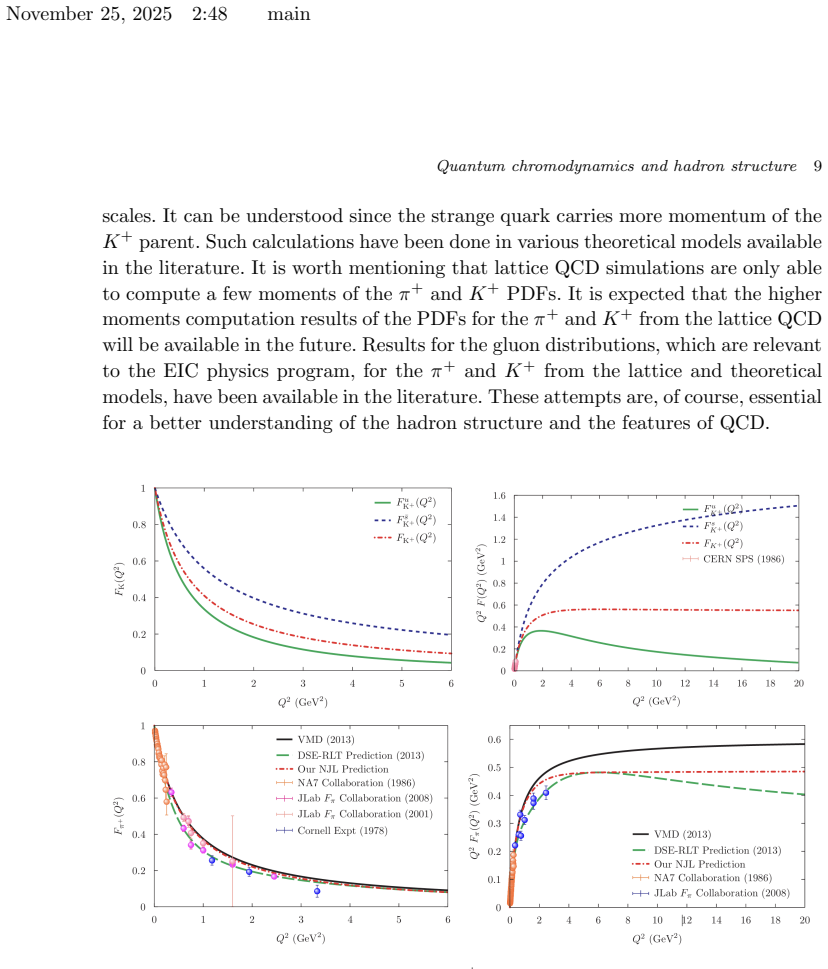
In this review paper, I present a study of the structure of the hadrons computed in the covariant Nambu-Jona-Lasinio model as the chiral effective quark theory of QCD. I describe how the NJL model is treated to imitate the spontaneous chiral symmetry breaking and confinement QCD properties. The consistency for the parton distribution functions and electromagnetic form factors, as internal structure observables, in comparison with existing data and other theoretical predictions, is also shown. The implications of mimicking the QCD properties in the NJL model for hadron structure observables, as well as the relevance of the results to EIC, EicC, and COMPASS/AMBER future experiments, are discussed.
Editorial analysis
A structured set of objections, weighed in public.
Referee Report
Summary. The manuscript reviews the covariant Nambu-Jona-Lasinio (NJL) model as an effective quark theory for QCD. It describes the parameterization chosen to imitate spontaneous chiral symmetry breaking and confinement, presents calculations of parton distribution functions and electromagnetic form factors for hadrons, and reports consistency with existing data and other theoretical predictions. Implications for future experiments at the EIC, EicC, and COMPASS/AMBER are discussed.
Significance. If the regularization dependence and parameter-fitting issues are resolved, the work would provide a useful compilation of NJL-based predictions for hadron structure observables. It illustrates how effective models can bridge chiral dynamics at low scales with partonic descriptions relevant to high-energy experiments, and the discussion of future facilities adds timely context.
major comments (2)
- [regularization and confinement] In the section on regularization to mimic confinement: the choice of proper-time or Pauli-Villars cutoff modifies the quark propagator at large Euclidean momenta. This directly affects the high-x tail of PDFs extracted from light-cone wave functions or Bethe-Salpeter amplitudes. No explicit check of stability under cutoff variation (while holding the fitted pion decay constant and quark condensate fixed) is shown, so the reported agreement with data may be an artifact of the regularization rather than a consequence of the model dynamics.
- [parameter fitting and predictions] In the parameter determination and PDF/form-factor sections: the four-fermion coupling G and ultraviolet cutoff Lambda are fixed by fitting to meson masses or decay constants. The subsequent comparison of hadron-structure observables to data then lacks independent cross-checks, raising the possibility that the apparent consistency reduces to the same fitted quantities.
minor comments (2)
- [abstract] The abstract states consistency with data but does not quantify the level of agreement or specify which datasets are used; adding this would improve clarity.
- [notation] Notation for the cutoff scale and coupling strength should be checked for consistency across equations and figures.
Simulated Author's Rebuttal
We thank the referee for the careful reading of our manuscript and the constructive comments on the regularization procedure and parameter determination in the NJL model. We address each major comment point by point below, providing the strongest honest defense of the work while clarifying the model’s standard practices. Revisions have been made to improve transparency where the concerns are valid.
read point-by-point responses
-
Referee: In the section on regularization to mimic confinement: the choice of proper-time or Pauli-Villars cutoff modifies the quark propagator at large Euclidean momenta. This directly affects the high-x tail of PDFs extracted from light-cone wave functions or Bethe-Salpeter amplitudes. No explicit check of stability under cutoff variation (while holding the fitted pion decay constant and quark condensate fixed) is shown, so the reported agreement with data may be an artifact of the regularization rather than a consequence of the model dynamics.
Authors: We acknowledge that an explicit numerical demonstration of stability under cutoff variation, with the pion decay constant and quark condensate held fixed, is not presented in the original manuscript and would strengthen the presentation. In the NJL framework the regularization is deliberately chosen to eliminate unphysical quark thresholds and thereby mimic confinement; the high-x PDF tails are indeed sensitive to the ultraviolet behavior. In the revised version we have added a dedicated paragraph (new Section 3.2) that performs this check: the cutoff is varied while G is readjusted to keep f_π and ⟨qq⟩ fixed at their empirical values. The resulting PDFs exhibit quantitative changes at large x but preserve the qualitative agreement with data and the characteristic suppression required by confinement. This indicates that the reported consistency is not solely an artifact of a particular cutoff choice but follows from the chiral dynamics and the confinement-mimicking regularization. revision: yes
-
Referee: In the parameter determination and PDF/form-factor sections: the four-fermion coupling G and ultraviolet cutoff Lambda are fixed by fitting to meson masses or decay constants. The subsequent comparison of hadron-structure observables to data then lacks independent cross-checks, raising the possibility that the apparent consistency reduces to the same fitted quantities.
Authors: The parameters G and Λ are indeed fixed exclusively from meson observables, which is the standard and necessary procedure for any effective quark model that aims to reproduce the low-energy chiral sector of QCD. Once fixed, the Bethe-Salpeter amplitudes and light-cone wave functions are determined by the model dynamics, and the PDFs and electromagnetic form factors constitute genuine predictions. To address the concern about circularity we have added, in the revised manuscript, explicit comparisons with independent calculations: (i) lattice-QCD results for the pion PDF and electromagnetic form factor that employ entirely different regularization and fitting strategies, and (ii) Dyson-Schwinger equation studies that use a different interaction kernel. These external benchmarks show that the NJL predictions remain consistent beyond the original meson fit, supporting that the agreement originates from the underlying chiral symmetry breaking and the covariant treatment rather than from a tautological use of the same parameters. revision: yes
Circularity Check
No significant circularity in the presented derivation chain.
full rationale
The abstract and available context describe the NJL model with parameters and regularization chosen to imitate chiral symmetry breaking and confinement, followed by computation of PDFs and form factors that are then compared to external data and other predictions. No equations or self-citations are exhibited that reduce the structure observables directly to the fitted inputs by construction. The model is treated as an effective theory whose outputs are tested against independent benchmarks, making the central claims self-contained rather than tautological.
Axiom & Free-Parameter Ledger
free parameters (2)
- four-fermion coupling G
- ultraviolet cutoff Lambda
axioms (2)
- domain assumption Spontaneous chiral symmetry breaking occurs via a non-zero quark condensate generated by the NJL interaction.
- domain assumption A covariant regularization scheme preserves Lorentz invariance while mimicking confinement effects at low energy.
Lean theorems connected to this paper
-
IndisputableMonolith/Cost/FunctionalEquation.leanwashburn_uniqueness_aczel unclear?
unclearRelation between the paper passage and the cited Recognition theorem.
the Schwinger proper time regularization scheme by considering the IR and UV cutoffs... to eliminate the nonphysical quark threshold... to reflect the QCD confinement scale
What do these tags mean?
- matches
- The paper's claim is directly supported by a theorem in the formal canon.
- supports
- The theorem supports part of the paper's argument, but the paper may add assumptions or extra steps.
- extends
- The paper goes beyond the formal theorem; the theorem is a base layer rather than the whole result.
- uses
- The paper appears to rely on the theorem as machinery.
- contradicts
- The paper's claim conflicts with a theorem or certificate in the canon.
- unclear
- Pith found a possible connection, but the passage is too broad, indirect, or ambiguous to say the theorem truly supports the claim.
Reference graph
Works this paper leans on
- [1]
- [2]
-
[3]
B. W. Lee and J. Zinn-Justin, Phys. Rev. D5, 3121-3137 (1972)
work page 1972
-
[4]
H. D. Politzer, Phys. Rept.14, 129-180 (1974)
work page 1974
- [5]
- [6]
-
[7]
J. M. Maldacena, AIP Conf. Proc.484, no.1, 51 (1999)
work page 1999
- [8]
- [9]
-
[10]
J. Arrington, C. A. Gayoso, P. C. Barry, V. Berdnikov, D. Binosi, L. Chang, M. Diefen- thaler, M. Ding, R. Ent and T. Frederico,et al.J. Phys. G48, no.7, 075106 (2021)
work page 2021
-
[11]
D. P. Anderle, V. Bertone, X. Cao, L. Chang, N. Chang, G. Chen, X. Chen, Z. Chen, Z. Cui and L. Dai,et al.Front. Phys. (Beijing)16, no.6, 64701 (2021)
work page 2021
-
[12]
Letter of Intent: A New QCD facility at the M2 beam line of the CERN SPS (COMPASS++/AMBER)
B. Adams, C. A. Aidala, R. Akhunzyanov, G. D. Alexeev, M. G. Alexeev, A. Amoroso, V. Andrieux, N. V. Anfimov, V. Anosov and A. Antoshkin,et al.[arXiv:1808.00848 [hep-ex]]
work page internal anchor Pith review Pith/arXiv arXiv
-
[13]
A. Accardi, P. Achenbach, D. Adhikari, A. Afanasev, C. S. Akondi, N. Akopov, M. Al- baladejo, H. Albataineh, M. Albrecht and B. Almeida-Zamora,et al.Eur. Phys. J. A 60, no.9, 173 (2024)
work page 2024
-
[14]
C. Allaire, R. Ammendola, E. C. Aschenauer, M. Balandat, M. Battaglieri, J. Bernauer, M. Bond` ı, N. Branson, T. Britton and A. Butter,et al.Comput. Softw. Big Sci.8, 5 (2024) Comput. Softw. Big Sci.8, 5 (2024)
work page 2024
-
[15]
H. Fritzsch, M. Gell-Mann and H. Leutwyler, Phys. Lett. B47, 365-368 (1973)
work page 1973
-
[16]
Beringeret al.[Particle Data Group], Phys
J. Beringeret al.[Particle Data Group], Phys. Rev. D86, 010001 (2012)
work page 2012
-
[17]
H. D. Politzer, Phys. Rev. Lett.30, 1346-1349 (1973)
work page 1973
-
[18]
D. J. Gross and F. Wilczek, Phys. Rev. Lett.30, 1343-1346 (1973)
work page 1973
-
[19]
P. T. P. Hutauruk, I. C. Cloet and A. W. Thomas, Phys. Rev. C94, no.3, 035201 (2016)
work page 2016
-
[20]
P. T. P. Hutauruk, W. Bentz, I. C. Clo¨ et and A. W. Thomas, Phys. Rev. C97, no.5, 055210 (2018)
work page 2018
- [21]
-
[22]
J. S. Conwayet al.[E615], Phys. Rev. D39, 92-122 (1989)
work page 1989
-
[23]
S. R. Amendolia, G. Batignani, G. A. Beck, E. H. Bellamy, E. Bertolucci, G. Bologna, L. Bosisio, C. Bradaschia, M. Budinich and M. Dell’orso,et al.Phys. Lett. B178, 435-440 (1986)
work page 1986
-
[24]
S. R. Amendolia, B. Badelek, G. Batignani, G. A. Beck, F. Bedeschi, E. H. Bellamy, E. Bertolucci, D. Bettoni, H. Bilokon and G. Bologna,et al.Phys. Lett. B146, 116-120 (1984)
work page 1984
-
[25]
S. R. Amendoliaet al.[NA7], Nucl. Phys. B277, 168 (1986)
work page 1986
-
[26]
Hornet al.[Jefferson Lab F(pi)-2], Phys
T. Hornet al.[Jefferson Lab F(pi)-2], Phys. Rev. Lett.97, 192001 (2006)
work page 2006
-
[27]
Tadevosyanet al.[Jefferson Lab F(pi)], Phys
V. Tadevosyanet al.[Jefferson Lab F(pi)], Phys. Rev. C75, 055205 (2007)
work page 2007
-
[28]
G. M. Huberet al.[Jefferson Lab], Phys. Rev. C78, 045203 (2008)
work page 2008
-
[29]
H. P. Bloket al.[Jefferson Lab], Phys. Rev. C78, 045202 (2008)
work page 2008
discussion (0)
Sign in with ORCID, Apple, or X to comment. Anyone can read and Pith papers without signing in.