REVIEW 3 major objections 4 minor 135 references
RoPE phase mismatch, not content, breaks mixed-resolution diffusion; rescaling keys to the query grid restores quality.
Reviewed by Pith at T0; open to challenge. T0 means a machine referee read the full paper against a public rubric. the ladder, T0–T4 →
T0 review · deepseek-v4-flash
2026-08-03 20:26 UTC pith:X45YCDLR
load-bearing objection Useful fix with a causal story that outruns the evidence — referee it, but make them untangle phase alignment from content exchange. the 3 major comments →
Phase-Aligned RoPE for Mixed-Resolution Diffusion Transformer
The pith
A machine-rendered reading of the paper's core claim, the machinery that carries it, and where it could break.
Core claim
Pretrained DiT attention heads act as sharply tuned, multi-frequency phase kernels over the relative RoPE offset Δ. Empirically, the expected attention score κ(Δ) peaks sharply near Δ=0, oscillates periodically with Δ, and is amplified in RoPE-dominant heads, stably across diffusion timesteps. Formally, the score takes the form Σ_i C_i(q,k) cos(ω_i Δ + φ_i), a mixture of sinusoids at the fixed RoPE frequencies. Interpolating LR and HR tokens into one index space makes the same kernel see different Δ values for the same physical displacement, corrupting the score. CRPA re-indexes every key/value position onto the query's native grid — p_k^(q) = α_{k→q} p_k — so the score depends on a single r
What carries the argument
The central mechanism is the RoPE index map rescaling: before each dot product, key/value positions are multiplied by the ratio of query spacing to key spacing, α_{k→q} = S_q/S_k, so the attention score becomes ⟨q, R(α_{k→q} p_k − p_q) k⟩. This makes the phase increment depend only on physical distance measured on the query's grid. The supporting object is the phase kernel, the measured and derived function κ(Δ) = E[⟨q̂, R(Δ) k̂⟩] = Σ_i C_i(q,k) cos(ω_i Δ + φ_i), which quantifies the head's learned sensitivity to relative offset and explains why cross-rate interpolation fails. A second, lighter mechanism is the Boundary Expand-and-Replace module, which dilates the LR/HR masks and bidirection
Load-bearing premise
The load-bearing premise is that the mixed-resolution failure is driven by RoPE phase mismatch rather than by content-fidelity mismatch between LR and HR tokens; the paper's ablations do not isolate the two, and the boundary module (which exchanges content) accounts for the larger share of the gain over the interpolation baseline.
What would settle it
A controlled experiment that turns off phase alignment while keeping the boundary content-exchange module: if the resulting DOVER/FID matches the full method, the phase-mismatch account is falsified. Conversely, running CRPA with content fully preserved (HR keys not subsampled in content for LR queries) would isolate the phase effect.
If this is right
- Mixed-resolution denoising becomes a stable, plug-and-play option for pretrained DiTs: no retraining, no architectural change, only a per-attention index map.
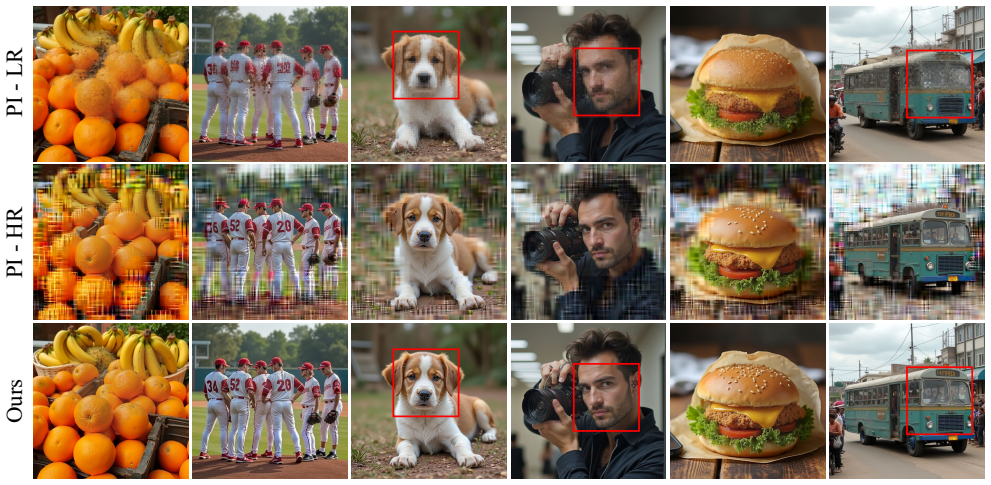
- A coarse→mixed (optionally fine) schedule with high resolution restricted to salient regions yields near-full-resolution quality at about 4x lower latency, with the quality–cost curve saturating quickly at small HR token ratios.
- The phase-alignment rule extends to arbitrary LR/HR layouts, irregular masks, and mixed spatiotemporal grids, supporting the same stable attention across all heads and layers.
- CRPA composes with orthogonal acceleration techniques such as token caching, further cutting latency while keeping quality nearly unchanged (e.g., video DOVER 75.57 at 2.0x, image FID 32.76 at 1.6x).
Where Pith is reading between the lines
- The paper's ablation shows the boundary module adds a larger quality gain (DOVER 68.43 → 75.34) than CRPA alone over the PI-LR baseline (63.39 → 68.43). A direct test that ablates content exchange without phase alignment would determine whether phase mismatch or content-fidelity mismatch is the primary driver of the remaining gap.
- Because the rule is stated per dot-product, it suggests a more general principle: any positional encoding that defines a phase over token offsets will be unstable in mixed-scale attention unless the effective sampling rate is constant within each dot product. This principle could transfer to other sinusoidal or relative encodings, and to any model mixing tokens at different native densities.
- The asymmetry in CRPA — LR queries subsample HR keys both in index and content, while HR queries only lift LR indices — is a design choice that could be tested against a symmetric variant that exchanges content in both directions at every query scale.
- The phase-kernel diagnostic (κ(Δ) vs Δ) could serve as a cheap probe for RoPE sensitivity in other architectures, possibly predicting which models will tolerate mixed-resolution inference before running full generation.
Editorial analysis
A structured set of objections, weighed in public.
Referee Report
Summary. The paper studies why linear interpolation of RoPE positions fails in mixed-resolution diffusion transformers, and proposes Cross-Resolution Phase-Aligned Attention (CRPA). The central principle is that within each attention computation all query/key positions must be expressed on the query's spatial stride, so that equal physical distances produce equal phase increments. A supplementary derivation (Eq. (6)) shows that the RoPE-modulated attention score is a mixture of sinusoids in the relative offset. The paper measures a phase kernel κ(Δ) on pretrained DiTs, observing a sharp peak near Δ=0, periodicity, and amplification in RoPE-dominant heads. CRPA is a training-free index rescaling, augmented by a Boundary Expand-and-Replace module that exchanges content across resolution boundaries. Experiments on Wan2.1-1.3B and FLUX.1-dev report large gains over PI/NTK/YaRN at roughly 4x lower latency than full-resolution inference.
Significance. If the causal attribution is correct, the paper provides a simple, training-free, drop-in fix for a practically important failure mode in mixed-resolution DiT inference. The strengths are real: the derivation in Supplementary A is a correct trigonometric identity; κ(Δ) is a measurement rather than a fitted relation; CRPA has no tunable parameters beyond the schedule choices; and the method is tested on public benchmarks (DOVER, VBench, MSCOCO) against external baselines. The main limitation is that the empirical evidence does not isolate phase misalignment from content-resolution mismatch, and the reported metric deltas are not accompanied by uncertainty estimates. These issues are addressable and do not invalidate the method itself, but they currently leave the central causal claim only partially supported.
major comments (3)
- [Sec. 4.2, Tab. 8] The causal claim that phase mismatch — not content-fidelity mismatch — drives mixed-resolution failure is not isolated by the current ablation. With CRPA alone, DOVER overall is 68.43 over a PI-LR baseline of 63.39; adding Boundary Expand-and-Replace raises it to 75.34. Thus the content-exchange module contributes a larger share of the total gain than phase alignment alone. The paper never runs Boundary Expand-and-Replace on top of PI-LR or YaRN, and never compares a condition in which HR-key content is subsampled/lifted while RoPE positions are left misaligned. As written, the sentence in Sec. 3.3 ('the issue is not the interpolation scheme but the lack of a uniform sampling rate for Δ') is an assertion. Please add the missing controls: content exchange on non-CRPA baselines and a content-matched/phase-mismatched condition.
- [Sec. 3.3, Fig. 3] The κ(Δ) measurement is a single-rate kernel: it samples offsets on one grid, uses Δ=0 pairs with identical content, and averages over content. It is consistent with the phase-aliasing story but cannot predict the mixed-resolution interaction between phase mismatch and content-density mismatch. A direct diagnostic — for example, measuring attention entropy or κ on LR-query/HR-key pairs with matched versus mismatched RoPE reference scales — would substantially strengthen the causal attribution.
- [Tabs. 1–3, 5–7] All quantitative tables report single-run metrics without error bars or significance tests. Several headline differences are small: in Tab. 2 FID is 32.04 (Ours) versus 31.50 (HR) and 33.83 (YaRN); in Tab. 3 FID is 32.45 (Ours-18) versus 32.67 (FLUX-50) and 32.91 (RALU-18). Deltas around 0.2–0.5 are typically within sampling noise for FID on 5K pairs. The claims 'close to HR' and 'surpasses RALU' need at least multiple seeds or a confidence interval, otherwise the comparisons are not reliable.
minor comments (4)
- [Abstract vs. Sec. 4.1] The abstract introduces the method as 'Phase-Aligned Mixed-Resolution Attention (PMA)', but the rest of the paper calls it 'Cross-Resolution Phase-Aligned Attention (CRPA)'. Please unify the acronym.
- [Table 1, Table 2 captions] Typo: 'denosing' should be 'denoising' in both captions.
- [Sec. 5.1, video implementation] The text says 'a coarse stage at 480p followed by a mixed-resolution stage', but Fig. 6 includes a '480p-then-960p' reference (LR+HR). Clarify whether this reference is the same two-stage schedule or a separate full-resolution upper bound; the description is currently ambiguous.
- [Fig. 3 caption] The threshold 'rds > 0.085' appears only in the caption and is not defined in the main text or supplementary; please state how it was chosen.
Circularity Check
No significant circularity: Eq. (6) is an identity from RoPE's definition, CRPA is parameter-free and externally benchmarked, and the causal-attribution confound is a validity concern, not a circular derivation.
full rationale
The paper's central analytical step, Eq. (6), is derived in supplementary Sec. A directly from the RoPE rotation definition: score(q,k,Δ)=Σ_i q_iᵀR(ω_iΔ)k_i = Σ_i C_i(q,k)cos(ω_iΔ+φ_i). This is a mathematical identity, not a fitted relation or a prediction obtained from the data. The κ(Δ) curves in Sec. 3.3 are empirical measurements on pretrained models and are not used to fit any parameter; they are descriptive evidence. CRPA itself has no learned parameters and is evaluated on held-out VBench/MSCOCO against external baselines (PI, NTK, YaRN, RALU), so the empirical gains are not forced by construction. There is no load-bearing self-citation chain or imported uniqueness theorem; the rds definition follows prior external work [15], and the method is not justified by an author-authored theorem. The ablation in Tab. 8 shows that Boundary Expand-and-Replace contributes a large share of the total gain, and the LR-query branch of CRPA does subsample HR keys in content; these facts create a legitimate causal-attribution confound between phase alignment and content-resolution matching. However, that is an experimental identification concern, not a circular step in the derivation: the paper never defines the failure as 'whatever CRPA fixes,' and the standalone CRPA gain over PI-LR (63.39→68.43) is an independent empirical comparison. No quoted equation or parameter is equivalent to its own input by construction. Therefore the paper's derivation is self-contained and the circularity score is 0.
Axiom & Free-Parameter Ledger
free parameters (4)
- High-resolution token ratio =
15% (Wan video), 30% (FLUX two-stage), ~60% (FLUX matched-compute)
- Stage step splits =
Video 15/35; image 7/11; three-stage 4/10/5 or 2/7/3
- Boundary band size n_pad =
2 (LR), 2 (HR)
- Learned latent resizer weights
axioms (5)
- standard math RoPE relative-position property: (R(p_q)q)^T (R(p_k)k) = q^T R(p_k − p_q) k
- domain assumption The measured κ(Δ) sharp peak near Δ≈0 reflects learned phase selectivity, not content autocorrelation
- domain assumption Phase mismatch, not content-fidelity mismatch, is the dominant driver of the failure
- domain assumption Asymmetric per-query content scaling preserves the pretrained head distribution
- domain assumption Phase priors are stable across timesteps and transfer to mixed-resolution inference
read the original abstract
Rotary positional embeddings (RoPE) are widely used in diffusion transformers (DiTs) to encode spatial relationships, yet their behavior with mixed-resolution tokens remains underexplored. A natural approach is to rescale token positions from different resolutions into a unified coordinate system before attention, but we show this fails. Our analysis shows that with RoPE, the attention similarity score is a highly structured and periodic function of token distance, so rescaling distances across resolutions moves token pairs to different regions of this periodic function, leading to incorrect attention scores. Motivated by this, we introduce Phase-Aligned Mixed-Resolution Attention (PMA), a training-free mechanism that stabilizes mixed-resolution attention. PMA modifies the RoPE position mapping to enforce a consistent positional scale for every query-key pair, ensuring that relative distances are evaluated under a single reference scale. To further improve local coherence near resolution transitions, we incorporate a lightweight boundary refinement module that softly exchanges features across adjacent scales. Experiments on image and video diffusion models validate our analysis and demonstrate consistent improvements in visual fidelity and computational efficiency.
Figures






Reference graph
Works this paper leans on
-
[1]
Approximate caching for efficiently serving{Text- to-Image}diffusion models
Shubham Agarwal, Subrata Mitra, Sarthak Chakraborty, Srikrishna Karanam, Koyel Mukherjee, and Shiv Kumar Saini. Approximate caching for efficiently serving{Text- to-Image}diffusion models. In21st USENIX Symposium on Networked Systems Design and Implementation (NSDI 24), pages 1173–1189, 2024. 2
2024
-
[2]
Qwen technical report.arXiv preprint arXiv:2309.16609, 2023
Jinze Bai, Shuai Bai, Yunfei Chu, Zeyu Cui, Kai Dang, Xiaodong Deng, Yang Fan, Wenbin Ge, Yu Han, Fei Huang, et al. Qwen technical report.arXiv preprint arXiv:2309.16609, 2023. 1
Pith/arXiv arXiv 2023
-
[3]
Federico Barbero, Alex Vitvitskyi, Christos Perivolaropou- los, Razvan Pascanu, and Petar Veli ˇckovi´c. Round and round we go! what makes rotary positional encodings use- ful?arXiv preprint arXiv:2410.06205, 2024. 1
Pith/arXiv arXiv 2024
-
[4]
Gpt-neox- 20b: An open-source autoregressive language model
Sidney Black, Stella Biderman, Eric Hallahan, Quentin An- thony, Leo Gao, Laurence Golding, Horace He, Connor Leahy, Kyle McDonell, Jason Phang, et al. Gpt-neox- 20b: An open-source autoregressive language model. In Proceedings of BigScience Episode# 5–Workshop on Chal- lenges & Perspectives in Creating Large Language Models, pages 95–136, 2022. 1
2022
-
[5]
Taehv: Tiny autoencoder for hun- yuan video.https://github.com/madebyollin/ taehv, 2025
Ollin Boer Bohan. Taehv: Tiny autoencoder for hun- yuan video.https://github.com/madebyollin/ taehv, 2025. 8, 17, 18
2025
-
[6]
Token merging for fast stable diffusion
Daniel Bolya and Judy Hoffman. Token merging for fast stable diffusion. InProceedings of the IEEE/CVF con- ference on computer vision and pattern recognition, pages 4599–4603, 2023. 2
2023
-
[7]
Ld-pruner: Efficient pruning of latent diffusion models using task-agnostic insights
Thibault Castells, Hyoung-Kyu Song, Bo-Kyeong Kim, and Shinkook Choi. Ld-pruner: Efficient pruning of latent diffusion models using task-agnostic insights. InProceed- ings of the IEEE/CVF Conference on Computer Vision and Pattern Recognition, pages 821–830, 2024. 2
2024
-
[8]
Sparsedit: Token sparsification for efficient diffusion transformer
Shuning Chang, W ANG Pichao, Jiasheng Tang, Fan Wang, and Yi Yang. Sparsedit: Token sparsification for efficient diffusion transformer. InThe Thirty-ninth Annual Confer- ence on Neural Information Processing Systems, 2025. 2
2025
-
[9]
Pixart-α: Fast train- ing of diffusion transformer for photorealistic text-to-image synthesis, 2023
Junsong Chen, Jincheng Yu, Chongjian Ge, Lewei Yao, Enze Xie, Yue Wu, Zhongdao Wang, James Kwok, Ping Luo, Huchuan Lu, and Zhenguo Li. Pixart-α: Fast train- ing of diffusion transformer for photorealistic text-to-image synthesis, 2023. 2
2023
-
[10]
Q-dit: Ac- curate post-training quantization for diffusion transformers
Lei Chen, Yuan Meng, Chen Tang, Xinzhu Ma, Jingyan Jiang, Xin Wang, Zhi Wang, and Wenwu Zhu. Q-dit: Ac- curate post-training quantization for diffusion transformers. InProceedings of the Computer Vision and Pattern Recog- nition Conference, pages 28306–28315, 2025. 2
2025
-
[11]
Pengtao Chen, Mingzhu Shen, Peng Ye, Jianjian Cao, Chongjun Tu, Christos-Savvas Bouganis, Yiren Zhao, and Tao Chen. A training-free acceleration method tailored for diffusion transformers.arXiv preprint arXiv:2406.01125,
-
[12]
Pengtao Chen, Xianfang Zeng, Maosen Zhao, Peng Ye, Mingzhu Shen, Wei Cheng, Gang Yu, and Tao Chen. Sparse-vdit: Unleashing the power of sparse attention to accelerate video diffusion transformers.arXiv preprint arXiv:2506.03065, 2025. 2
Pith/arXiv arXiv 2025
-
[13]
Shouyuan Chen, Sherman Wong, Liangjian Chen, and Yuandong Tian. Extending context window of large lan- guage models via positional interpolation.arXiv preprint arXiv:2306.15595, 2023. 1, 2, 3, 6, 7, 8, 19
Pith/arXiv arXiv 2023
-
[14]
Edt: An efficient diffusion transformer frame- work inspired by human-like sketching.Advances in Neu- ral Information Processing Systems, 37:134075–134106,
Xinwang Chen, Ning Liu, Yichen Zhu, Feifei Feng, and Jian Tang. Edt: An efficient diffusion transformer frame- work inspired by human-like sketching.Advances in Neu- ral Information Processing Systems, 37:134075–134106,
-
[15]
Yiting Chen and Junchi Yan. What rotary position embed- ding can tell us: Identifying query and key weights corre- sponding to basic syntactic or high-level semantic informa- tion.Advances in Neural Information Processing Systems, 37:54507–54528, 2024. 2, 4, 19
2024
-
[16]
Palm: Scaling language modeling with pathways.Journal of Machine Learning Research, 24(240): 1–113, 2023
Aakanksha Chowdhery, Sharan Narang, Jacob Devlin, Maarten Bosma, Gaurav Mishra, Adam Roberts, Paul Barham, Hyung Won Chung, Charles Sutton, Sebastian Gehrmann, et al. Palm: Scaling language modeling with pathways.Journal of Machine Learning Research, 24(240): 1–113, 2023. 1
2023
-
[17]
A deep multi-level network for saliency prediction
Marcella Cornia, Lorenzo Baraldi, Giuseppe Serra, and Rita Cucchiara. A deep multi-level network for saliency prediction. In2016 23rd International Conference on Pat- tern Recognition (ICPR), pages 3488–3493. IEEE, 2016. 20
2016
-
[18]
Predicting human eye fixations via an lstm- based saliency attentive model.IEEE Transactions on Im- age Processing, 27(10):5142–5154, 2018
Marcella Cornia, Lorenzo Baraldi, Giuseppe Serra, and Rita Cucchiara. Predicting human eye fixations via an lstm- based saliency attentive model.IEEE Transactions on Im- age Processing, 27(10):5142–5154, 2018. 20
2018
-
[19]
Scalable high-resolution pixel-space image syn- thesis with hourglass diffusion transformers
Katherine Crowson, Stefan Andreas Baumann, Alex Birch, Tanishq Mathew Abraham, Daniel Z Kaplan, and Enrico Shippole. Scalable high-resolution pixel-space image syn- thesis with hourglass diffusion transformers. InForty-first International Conference on Machine Learning, 2024. 1
2024
-
[20]
Vq4dit: Efficient post-training vec- tor quantization for diffusion transformers
Juncan Deng, Shuaiting Li, Zeyu Wang, Hong Gu, Kedong Xu, and Kejie Huang. Vq4dit: Efficient post-training vec- tor quantization for diffusion transformers. InProceedings of the AAAI Conference on Artificial Intelligence, pages 16226–16234, 2025. 2
2025
-
[21]
Longrope: Extending llm context window beyond 2 million tokens.arXiv preprint arXiv:2402.13753, 2024
Yiran Ding, Li Lyna Zhang, Chengruidong Zhang, Yuanyuan Xu, Ning Shang, Jiahang Xu, Fan Yang, and Mao Yang. Longrope: Extending llm context window beyond 2 million tokens.arXiv preprint arXiv:2402.13753, 2024. 2
Pith/arXiv arXiv 2024
-
[22]
Patched denoising diffusion models for high-resolution im- age synthesis
Zheng Ding, Mengqi Zhang, Jiajun Wu, and Zhuowen Tu. Patched denoising diffusion models for high-resolution im- age synthesis. InThe Twelfth International Conference on Learning Representations, 2024. 2 9
2024
-
[23]
Alexey Dosovitskiy. An image is worth 16x16 words: Transformers for image recognition at scale.arXiv preprint arXiv:2010.11929, 2020. 20
Pith/arXiv arXiv 2010
-
[24]
Fewer denoising steps or cheaper per-step inference: Towards compute-optimal dif- fusion model deployment
Zhenbang Du, Yonggan Fu, Lifu Wang, Jiayi Qian, Xiao Luo, and Yingyan Celine Lin. Fewer denoising steps or cheaper per-step inference: Towards compute-optimal dif- fusion model deployment. InProceedings of the IEEE/CVF International Conference on Computer Vision, pages 3001– 3010, 2025. 2
2025
-
[25]
The llama 3 herd of models.arXiv e-prints, pages arXiv–2407,
Abhimanyu Dubey, Abhinav Jauhri, Abhinav Pandey, Ab- hishek Kadian, Ahmad Al-Dahle, Aiesha Letman, Akhil Mathur, Alan Schelten, Amy Yang, Angela Fan, et al. The llama 3 herd of models.arXiv e-prints, pages arXiv–2407,
-
[26]
Scaling recti- fied flow transformers for high-resolution image synthesis
Patrick Esser, Sumith Kulal, Andreas Blattmann, Rahim Entezari, Jonas M ¨uller, Harry Saini, Yam Levi, Dominik Lorenz, Axel Sauer, Frederic Boesel, et al. Scaling recti- fied flow transformers for high-resolution image synthesis. InForty-first international conference on machine learning,
-
[27]
Structural pruning for diffusion models
Gongfan Fang, Xinyin Ma, and Xinchao Wang. Structural pruning for diffusion models. InAdvances in Neural Infor- mation Processing Systems, 2023. 2
2023
-
[28]
Tinyfusion: Diffusion transformers learned shallow
Gongfan Fang, Kunjun Li, Xinyin Ma, and Xinchao Wang. Tinyfusion: Diffusion transformers learned shallow. InPro- ceedings of the Computer Vision and Pattern Recognition Conference, pages 18144–18154, 2025. 2
2025
-
[29]
Video diffusion transformers are in-context learners.arXiv preprint arXiv:2412.10783, 2024
Zhengcong Fei, Di Qiu, Debang Li, Changqian Yu, and Mingyuan Fan. Video diffusion transformers are in-context learners.arXiv preprint arXiv:2412.10783, 2024. 2
Pith/arXiv arXiv 2024
-
[30]
Relational diffu- sion distillation for efficient image generation
Weilun Feng, Chuanguang Yang, Zhulin An, Libo Huang, Boyu Diao, Fei Wang, and Yongjun Xu. Relational diffu- sion distillation for efficient image generation. InProceed- ings of the 32nd ACM international conference on multime- dia, pages 205–213, 2024. 2
2024
-
[31]
Romantex: Decoupling 3d-aware rotary positional embedded multi-attention network for texture synthesis
Yifei Feng, Mingxin Yang, Shuhui Yang, Sheng Zhang, Ji- aao Yu, Zibo Zhao, Yuhong Liu, Jie Jiang, and Chunchao Guo. Romantex: Decoupling 3d-aware rotary positional embedded multi-attention network for texture synthesis. In Proceedings of the IEEE/CVF International Conference on Computer Vision, pages 17203–17213, 2025. 1
2025
-
[32]
Alireza Ganjdanesh, Reza Shirkavand, Shangqian Gao, and Heng Huang. Not all prompts are made equal: Prompt- based pruning of text-to-image diffusion models.arXiv preprint arXiv:2406.12042, 2024. 2
Pith/arXiv arXiv 2024
-
[33]
Daya Guo, Dejian Yang, Haowei Zhang, Junxiao Song, Ruoyu Zhang, Runxin Xu, Qihao Zhu, Shirong Ma, Peiyi Wang, Xiao Bi, et al. Deepseek-r1: Incentivizing reason- ing capability in llms via reinforcement learning.arXiv preprint arXiv:2501.12948, 2025. 1
Pith/arXiv arXiv 2025
-
[34]
Ltx-video: Realtime video latent diffusion.arXiv preprint arXiv:2501.00103,
Yoav HaCohen, Nisan Chiprut, Benny Brazowski, Daniel Shalem, Dudu Moshe, Eitan Richardson, Eran Levin, Guy Shiran, Nir Zabari, Ori Gordon, et al. Ltx-video: Realtime video latent diffusion.arXiv preprint arXiv:2501.00103,
-
[35]
Graph- based visual saliency
Jonathan Harel, Christof Koch, and Pietro Perona. Graph- based visual saliency. InAdvances in Neural Information Processing Systems. MIT Press, 2006. 20
2006
-
[36]
Rotary position embedding for vision transformer
Byeongho Heo, Song Park, Dongyoon Han, and Sangdoo Yun. Rotary position embedding for vision transformer. In European Conference on Computer Vision, pages 289–305. Springer, 2024. 1, 2
2024
-
[37]
Gans trained by a two time-scale update rule converge to a local nash equilib- rium.Advances in neural information processing systems, 30, 2017
Martin Heusel, Hubert Ramsauer, Thomas Unterthiner, Bernhard Nessler, and Sepp Hochreiter. Gans trained by a two time-scale update rule converge to a local nash equilib- rium.Advances in neural information processing systems, 30, 2017. 8, 18
2017
-
[38]
Cascaded diffusion models for high fidelity image generation.Jour- nal of Machine Learning Research, 23(47):1–33, 2022
Jonathan Ho, Chitwan Saharia, William Chan, David J Fleet, Mohammad Norouzi, and Tim Salimans. Cascaded diffusion models for high fidelity image generation.Jour- nal of Machine Learning Research, 23(47):1–33, 2022. 2
2022
-
[39]
Vbench: Comprehensive benchmark suite for video generative models
Ziqi Huang, Yinan He, Jiashuo Yu, Fan Zhang, Chenyang Si, Yuming Jiang, Yuanhan Zhang, Tianxing Wu, Qingyang Jin, Nattapol Chanpaisit, et al. Vbench: Comprehensive benchmark suite for video generative models. InProceed- ings of the IEEE/CVF Conference on Computer Vision and Pattern Recognition, pages 21807–21818, 2024. 7, 8, 18, 19
2024
-
[40]
A model of saliency-based visual attention for rapid scene analysis
Laurent Itti, Christof Koch, and Ernst Niebur. A model of saliency-based visual attention for rapid scene analysis. IEEE Transactions on pattern analysis and machine intelli- gence, 20(11):1254–1259, 2002. 20
2002
-
[41]
Latent space super-resolution for higher-resolution image generation with diffusion models
Jinho Jeong, Sangmin Han, Jinwoo Kim, and Seon Joo Kim. Latent space super-resolution for higher-resolution image generation with diffusion models. InProceedings of the Computer Vision and Pattern Recognition Conference, pages 2355–2365, 2025. 2
2025
-
[42]
Wongi Jeong, Kyungryeol Lee, Hoigi Seo, and Se Young Chun. Upsample what matters: Region-adaptive latent sampling for accelerated diffusion transformers.arXiv preprint arXiv:2507.08422, 2025. 1, 2, 7, 8, 17, 18
arXiv 2025
-
[43]
Eml-net: An expandable multi- layer network for saliency prediction.Image and vision computing, 95:103887, 2020
Sen Jia and Neil DB Bruce. Eml-net: An expandable multi- layer network for saliency prediction.Image and vision computing, 95:103887, 2020. 20
2020
-
[44]
Salicon: Saliency in context
Ming Jiang, Shengsheng Huang, Juanyong Duan, and Qi Zhao. Salicon: Saliency in context. InProceedings of the IEEE conference on computer vision and pattern recogni- tion, pages 1072–1080, 2015. 20
2015
-
[45]
Pyramidal flow matching for efficient video generative modeling.arXiv preprint arXiv:2410.05954,
Yang Jin, Zhicheng Sun, Ningyuan Li, Kun Xu, Hao Jiang, Nan Zhuang, Quzhe Huang, Yang Song, Yadong Mu, and Zhouchen Lin. Pyramidal flow matching for efficient video generative modeling.arXiv preprint arXiv:2410.05954,
-
[46]
Adaptive caching for faster video generation with dif- fusion transformers
Kumara Kahatapitiya, Haozhe Liu, Sen He, Ding Liu, Menglin Jia, Chenyang Zhang, Michael S Ryoo, and Tian Xie. Adaptive caching for faster video generation with dif- fusion transformers. InProceedings of the IEEE/CVF In- ternational Conference on Computer Vision, pages 15240– 15252, 2025. 2
2025
-
[47]
Musiq: Multi-scale image quality transformer
Junjie Ke, Qifei Wang, Yilin Wang, Peyman Milanfar, and Feng Yang. Musiq: Multi-scale image quality transformer. InProceedings of the IEEE/CVF international conference on computer vision, pages 5148–5157, 2021. 8, 17, 18
2021
-
[48]
A nonparametric approach to bottom- 10 up visual saliency.Advances in neural information process- ing systems, 19, 2006
Wolf Kienzle, Felix A Wichmann, Matthias Franz, and Bernhard Sch¨olkopf. A nonparametric approach to bottom- 10 up visual saliency.Advances in neural information process- ing systems, 19, 2006. 20
2006
-
[49]
Diffusehigh: Training-free progressive high- resolution image synthesis through structure guidance
Younghyun Kim, Geunmin Hwang, Junyu Zhang, and Eun- byung Park. Diffusehigh: Training-free progressive high- resolution image synthesis through structure guidance. In Proceedings of the AAAI conference on artificial intelli- gence, pages 4338–4346, 2025. 20
2025
-
[50]
Imagenet classification with deep convolutional neural net- works.Advances in neural information processing systems, 25, 2012
Alex Krizhevsky, Ilya Sutskever, and Geoffrey E Hinton. Imagenet classification with deep convolutional neural net- works.Advances in neural information processing systems, 25, 2012. 20
2012
-
[51]
Deepfix: A fully convolutional neural network for predicting human eye fixations.IEEE Transactions on Im- age Processing, 26(9):4446–4456, 2017
Srinivas SS Kruthiventi, Kumar Ayush, and R Venkatesh Babu. Deepfix: A fully convolutional neural network for predicting human eye fixations.IEEE Transactions on Im- age Processing, 26(9):4446–4456, 2017. 20
2017
-
[52]
Matthias K ¨ummerer, Lucas Theis, and Matthias Bethge. Deep gaze i: Boosting saliency prediction with feature maps trained on imagenet.arXiv preprint arXiv:1411.1045,
-
[53]
Flux.1 kontext: Flow matching for in-context image generation and editing in latent space, 2025
Black Forest Labs, Stephen Batifol, Andreas Blattmann, Frederic Boesel, Saksham Consul, Cyril Diagne, Tim Dockhorn, Jack English, Zion English, Patrick Esser, Sum- ith Kulal, Kyle Lacey, Yam Levi, Cheng Li, Dominik Lorenz, Jonas M ¨uller, Dustin Podell, Robin Rombach, Harry Saini, Axel Sauer, and Luke Smith. Flux.1 kontext: Flow matching for in-context im...
2025
-
[54]
Hao Li, Shamit Lal, Zhiheng Li, Yusheng Xie, Ying Wang, Yang Zou, Orchid Majumder, R Manmatha, Zhuowen Tu, Stefano Ermon, et al. Efficient scaling of diffusion transformers for text-to-image generation.arXiv preprint arXiv:2412.12391, 2024. 2
Pith/arXiv arXiv 2024
-
[55]
Muyang Li, Yujun Lin, Zhekai Zhang, Tianle Cai, Xiuyu Li, Junxian Guo, Enze Xie, Chenlin Meng, Jun-Yan Zhu, and Song Han. Svdquant: Absorbing outliers by low- rank components for 4-bit diffusion models.arXiv preprint arXiv:2411.05007, 2024. 2
arXiv 2024
-
[56]
Snapfusion: Text-to-image diffusion model on mobile de- vices within two seconds.Advances in Neural Information Processing Systems, 36:20662–20678, 2023
Yanyu Li, Huan Wang, Qing Jin, Ju Hu, Pavlo Chemerys, Yun Fu, Yanzhi Wang, Sergey Tulyakov, and Jian Ren. Snapfusion: Text-to-image diffusion model on mobile de- vices within two seconds.Advances in Neural Information Processing Systems, 36:20662–20678, 2023. 2
2023
-
[57]
Zhimin Li, Jianwei Zhang, Qin Lin, Jiangfeng Xiong, Yanxin Long, Xinchi Deng, Yingfang Zhang, Xingchao Liu, Minbin Huang, Zedong Xiao, et al. Hunyuan- dit: A powerful multi-resolution diffusion transformer with fine-grained chinese understanding.arXiv preprint arXiv:2405.08748, 2024. 2
Pith/arXiv arXiv 2024
-
[58]
Microsoft coco: Common objects in context
Tsung-Yi Lin, Michael Maire, Serge Belongie, James Hays, Pietro Perona, Deva Ramanan, Piotr Doll ´ar, and C Lawrence Zitnick. Microsoft coco: Common objects in context. InComputer Vision–ECCV 2014: 13th European Conference, Zurich, Switzerland, September 6-12, 2014, Proceedings, Part V 13, pages 740–755. Springer, 2014. 18
2014
-
[59]
Deepgaze iie: Calibrated prediction in and out-of-domain for state-of-the-art saliency modeling
Akis Linardos, Matthias K ¨ummerer, Ori Press, and Matthias Bethge. Deepgaze iie: Calibrated prediction in and out-of-domain for state-of-the-art saliency modeling. InProceedings of the IEEE/CVF International Conference on Computer Vision, pages 12919–12928, 2021. 20
2021
-
[60]
Deepgaze iie: Calibrated prediction in and out-of-domain for state-of-the-art saliency modeling
Akis Linardos, Matthias K ¨ummerer, Ori Press, and Matthias Bethge. Deepgaze iie: Calibrated prediction in and out-of-domain for state-of-the-art saliency modeling. InProceedings of the IEEE/CVF International Conference on Computer Vision, pages 12919–12928, 2021. 8, 17, 18
2021
-
[61]
Timestep embedding tells: It’s time to cache for video diffusion model
Feng Liu, Shiwei Zhang, Xiaofeng Wang, Yujie Wei, Hao- nan Qiu, Yuzhong Zhao, Yingya Zhang, Qixiang Ye, and Fang Wan. Timestep embedding tells: It’s time to cache for video diffusion model. InProceedings of the Computer Vision and Pattern Recognition Conference, pages 7353– 7363, 2025. 2, 17
2025
-
[62]
A deep spatial contextual long- term recurrent convolutional network for saliency detec- tion.IEEE Transactions on Image Processing, 27(7):3264– 3274, 2018
Nian Liu and Junwei Han. A deep spatial contextual long- term recurrent convolutional network for saliency detec- tion.IEEE Transactions on Image Processing, 27(7):3264– 3274, 2018. 20
2018
-
[63]
Region-adaptive sampling for diffusion transformers.arXiv preprint arXiv:2502.10389, 2025
Ziming Liu, Yifan Yang, Chengruidong Zhang, Yiqi Zhang, Lili Qiu, Yang You, and Yuqing Yang. Region-adaptive sampling for diffusion transformers.arXiv preprint arXiv:2502.10389, 2025. 2
arXiv 2025
-
[64]
Transalnet: Towards perceptually relevant visual saliency prediction.Neurocomputing, 494:455–467,
Jianxun Lou, Hanhe Lin, David Marshall, Dietmar Saupe, and Hantao Liu. Transalnet: Towards perceptually relevant visual saliency prediction.Neurocomputing, 494:455–467,
-
[65]
Token caching for diffusion transformer accel- eration.arXiv preprint arXiv:2409.18523, 2024
Jinming Lou, Wenyang Luo, Yufan Liu, Bing Li, Xinmiao Ding, Weiming Hu, Jiajiong Cao, Yuming Li, and Chen- guang Ma. Token caching for diffusion transformer accel- eration.arXiv preprint arXiv:2409.18523, 2024. 2
arXiv 2024
-
[66]
Dpm-solver: A fast ode solver for diffu- sion probabilistic model sampling in around 10 steps.Ad- vances in neural information processing systems, 35:5775– 5787, 2022
Cheng Lu, Yuhao Zhou, Fan Bao, Jianfei Chen, Chongxuan Li, and Jun Zhu. Dpm-solver: A fast ode solver for diffu- sion probabilistic model sampling in around 10 steps.Ad- vances in neural information processing systems, 35:5775– 5787, 2022. 2
2022
-
[67]
Dpm-solver++: Fast solver for guided sampling of diffusion probabilistic models.Machine Intel- ligence Research, pages 1–22, 2025
Cheng Lu, Yuhao Zhou, Fan Bao, Jianfei Chen, Chongx- uan Li, and Jun Zhu. Dpm-solver++: Fast solver for guided sampling of diffusion probabilistic models.Machine Intel- ligence Research, pages 1–22, 2025. 2
2025
-
[68]
Fit: Flexible vision transformer for diffusion model.arXiv preprint arXiv:2402.12376, 2024
Zeyu Lu, Zidong Wang, Di Huang, Chengyue Wu, Xi- hui Liu, Wanli Ouyang, and Lei Bai. Fit: Flexible vision transformer for diffusion model.arXiv preprint arXiv:2402.12376, 2024. 1, 2
Pith/arXiv arXiv 2024
-
[69]
Simian Luo, Yiqin Tan, Longbo Huang, Jian Li, and Hang Zhao. Latent consistency models: Synthesizing high- resolution images with few-step inference.arXiv preprint arXiv:2310.04378, 2023. 2
Pith/arXiv arXiv 2023
-
[70]
Zhengyao Lv, Chenyang Si, Junhao Song, Zhenyu Yang, Yu Qiao, Ziwei Liu, and Kwan-Yee K Wong. Fastercache: Training-free video diffusion model acceleration with high quality.arXiv preprint arXiv:2410.19355, 2024. 2
Pith/arXiv arXiv 2024
-
[71]
Video saliency forecasting transformer.IEEE transactions on circuits and systems for video technology, 32(10):6850–6862, 2022
Cheng Ma, Haowen Sun, Yongming Rao, Jie Zhou, and Jiwen Lu. Video saliency forecasting transformer.IEEE transactions on circuits and systems for video technology, 32(10):6850–6862, 2022. 20
2022
-
[72]
Learning-to-cache: Accelerating diffusion trans- former via layer caching.Advances in Neural Information Processing Systems, 37:133282–133304, 2024
Xinyin Ma, Gongfan Fang, Michael Bi Mi, and Xinchao Wang. Learning-to-cache: Accelerating diffusion trans- former via layer caching.Advances in Neural Information Processing Systems, 37:133282–133304, 2024. 2 11
2024
-
[73]
Deepcache: Accelerating diffusion models for free
Xinyin Ma, Gongfan Fang, and Xinchao Wang. Deepcache: Accelerating diffusion models for free. InProceedings of the IEEE/CVF conference on computer vision and pattern recognition, pages 15762–15772, 2024. 2
2024
-
[74]
Latte: Latent diffusion transformer for video generation.arXiv preprint arXiv:2401.03048, 2024
Xin Ma, Yaohui Wang, Gengyun Jia, Xinyuan Chen, Zi- wei Liu, Yuan-Fang Li, Cunjian Chen, and Yu Qiao. Latte: Latent diffusion transformer for video generation.arXiv preprint arXiv:2401.03048, 2024. 2
Pith/arXiv arXiv 2024
-
[75]
Magcache: Fast video generation with magnitude- aware cache.arXiv preprint arXiv:2506.09045, 2025
Zehong Ma, Longhui Wei, Feng Wang, Shiliang Zhang, and Qi Tian. Magcache: Fast video generation with magnitude- aware cache.arXiv preprint arXiv:2506.09045, 2025. 17
arXiv 2025
-
[76]
Liere: Gen- eralizing rotary position encodings.arXiv preprint arXiv:2406.10322, 2(4), 2024
Sophie Ostmeier, Brian Axelrod, Michael E Moseley, Akshay Chaudhari, and Curtis Langlotz. Liere: Gen- eralizing rotary position encodings.arXiv preprint arXiv:2406.10322, 2(4), 2024. 2
Pith/arXiv arXiv 2024
-
[77]
Scalable diffusion mod- els with transformers
William Peebles and Saining Xie. Scalable diffusion mod- els with transformers. InProceedings of the IEEE/CVF international conference on computer vision, pages 4195– 4205, 2023. 2
2023
-
[78]
Ntk-aware scaled rope allows llama models to have extended (8k+) context size without any fine-tuning and minimal perplexity degrada- tion, 2023
Bowen Peng and Jeffrey Quesnelle. Ntk-aware scaled rope allows llama models to have extended (8k+) context size without any fine-tuning and minimal perplexity degrada- tion, 2023. 2, 6, 7, 8, 19
2023
-
[79]
Bowen Peng, Jeffrey Quesnelle, Honglu Fan, and Enrico Shippole. Yarn: Efficient context window extension of large language models.arXiv preprint arXiv:2309.00071, 2023. 2, 6, 7, 8, 19, 20
Pith/arXiv arXiv 2023
-
[80]
W ¨urstchen: An efficient architecture for large-scale text-to-image diffusion models
Pablo Pernias, Dominic Rampas, Mats L Richter, Christo- pher J Pal, and Marc Aubreville. W ¨urstchen: An efficient architecture for large-scale text-to-image diffusion models. arXiv preprint arXiv:2306.00637, 2023. 2
Pith/arXiv arXiv 2023
discussion (0)
Sign in with ORCID, Apple, or X to comment. Anyone can read and Pith papers without signing in.