REVIEW 1 major objections 5 minor 49 references
The paper establishes an exact dimension-matching identity between irreducible affine sl2 modules at admissible levels and Virasoro minimal-model modules with a tripled index parameter.
Reviewed by Pith at T0; open to challenge. T0 means a machine referee read the full paper against a public rubric. the ladder, T0–T4 →
T0 review · deepseek-v4-flash
2026-08-03 20:21 UTC pith:FKUWNCIM
load-bearing objection Solid q-series identities connecting admissible-level affine sl2 modules to Virasoro minimal models; the abstract oversells the Galois/Hecke conjectures, but the central character computations hold up. the 1 major comments →
Character Identities Between Affine and Virasoro Vertex Operator Algebra Modules
The pith
A machine-rendered reading of the paper's core claim, the machinery that carries it, and where it could break.
Core claim
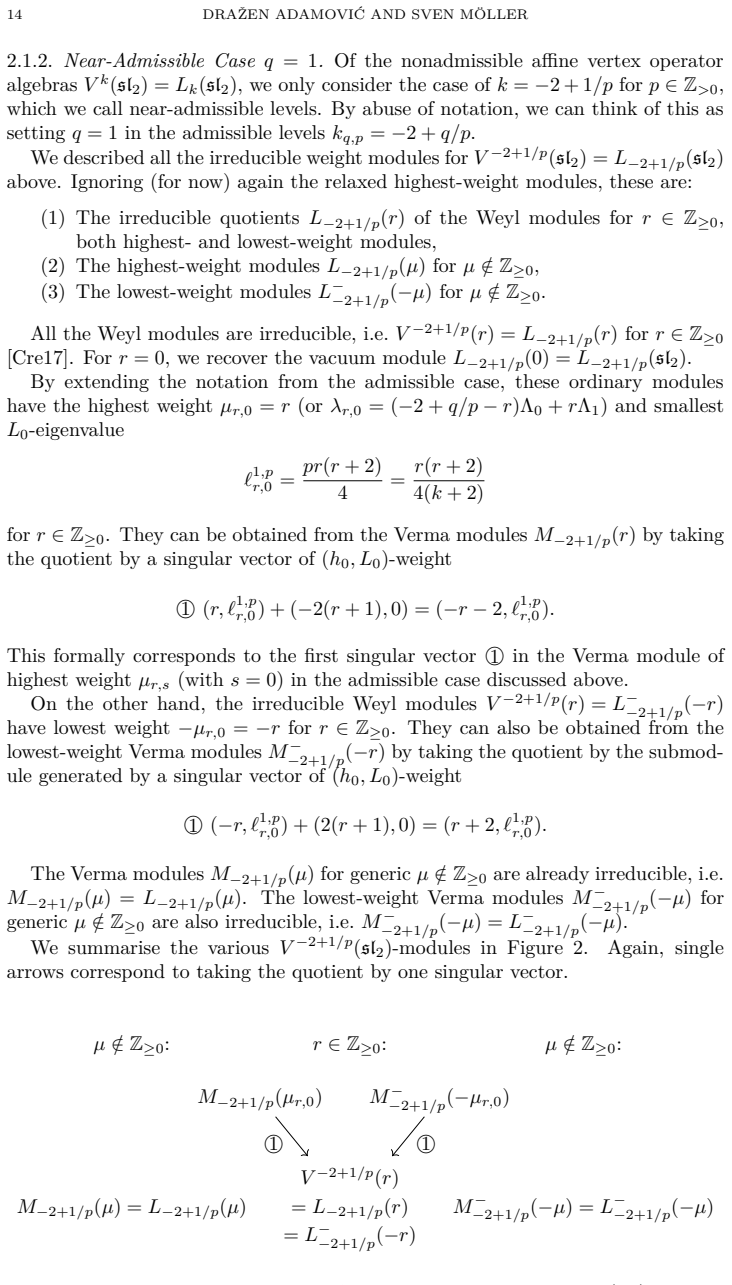
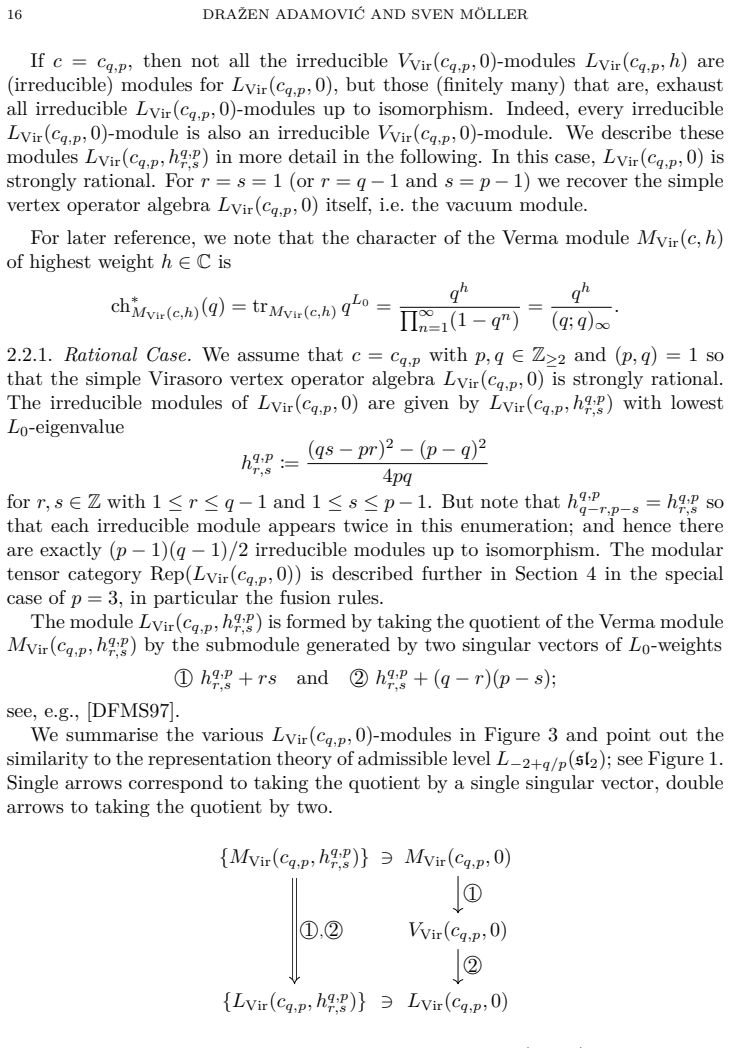
The central discovery is the character identity ch*_{L_{-2+q/p}(mu_{r,s})}(q^{-1/2}, q^3) = ch*_{LVir(c_{q,3p}, h^{q,3p}_{r+1,3s+1})}(q), for coprime q >= 2, p >= 1, 3 not dividing q, with 0 <= r <= q-2 and 0 <= s <= p-1; the lowest-weight analogue uses q^{1/2}. The paper proves this by comparing the standard theta-function character formulas after the substitution, and shows that the underlying Verma-module isomorphism sends the two singular vectors to vectors whose L0-weights exactly match the singular-vector weights of the corresponding Virasoro Verma module, so the equality descends to irreducible quotients. For q=1 it proves the analogous identity between near-admissible irreducible Wey
What carries the argument
The load-bearing mechanism is a Poincaré-Birkhoff-Witt vector-space isomorphism between Verma modules that maps e_{-i} to L_{-3i±1}, h_{-i} to L_{-3i}, f_{-i} to L_{-3i∓1} (and f_0 to L_{-1}), reweighting an affine vector of (h0,L0)-weight (f,n) to Virasoro L0-weight ∓f/2 + 3n after choosing the central charge and conformal weight appropriately. Because this map sends the two singular vectors of admissible affine Verma modules to vectors whose L0-weights exactly match the two singular-vector weights of Virasoro Verma modules at c_{q,3p}, the identity descends from Verma modules to irreducible quotients; the characters then match by direct theta-function computation. The index reparameterizat
Load-bearing premise
The identity holds only to the extent that the imported lists of irreducible modules and their character formulas for admissible affine sl2 and rational Virasoro vertex operator algebras are complete and correct; the paper proves the character match, not those classifications.
What would settle it
Compute the first ten coefficients of ch*_{L_{-2+5/2}(mu_{1,1})}(q^{-1/2}, q^3) and compare with ch*_{LVir(c_{5,6}, h^{5,6}_{2,4})}(q); any coefficient mismatch would falsify Proposition 3.4. Alternatively, for q=7, p=1, check whether the fusion-matrix coefficients of a simple current in Rep(L_{-5}(sl2)) match those of its Virasoro partner under the correspondence; a mismatch would falsify Proposition 4.1.
If this is right
- At every admissible level -2+q/p with 3 not dividing q, each irreducible admissible sl2 module L(mu_{r,s}) is paired with a Virasoro minimal-model module LVir(c_{q,3p}, h^{q,3p}_{r+1,3s+1}) of identical graded dimension; outside p=1 roughly one third of the Virasoro modules have no affine partner.
- For integral levels p=1, the index-shifted bijection is compatible with fusion products, so it is a fusion-ring isomorphism between Rep(L_{-2+q}(sl2)) and Rep(LVir(c_{q,3},0)); the ribbon structures differ, so this is not a modular-category equivalence.
- In the near-admissible q=1 case, the direct sums V(p) = sum (r+1) V_{-2+1/p}(mu_{r,0}) and the doublet A(3p) have identical (super)characters after the substitution, and p=2 recovers a known Schur-index identity relating N=4 SU(2) super-Yang-Mills to a (3,2) type superconformal theory.
- In the boundary admissible case q=2, the vacuum character identity implies Schur-index identities of the form I_{(A1,D_{2n+1})}(q^{∓1/2}, q^3) = I_{(A1,A_{6n})}(q).
- For q=4 the graded isomorphisms can be written explicitly: the three-fermion and one-fermion vertex operator superalgebras become mutual irreducible modules, making L_2(sl2) and LVir(c_{4,3},0) dual in the paper's sense.
Where Pith is reading between the lines
- The index shift (r,s) -> (r+1,3s+1) resembles a 'tripling' of the Virasoro parameter p; a natural extension would be composing the correspondence with itself or with Hamiltonian reduction to generate families of identities indexed by powers of 3, which the paper does not explore.
- Since only graded dimensions and not module structures are shown to match, the identity suggests looking for a tensor-product or homological relation between the two module categories that would explain the dimension coincidences; the paper explicitly leaves such a categorical mechanism open.
- For p=1, the Galois-conjugation conjecture predicts an explicit Galois automorphism carrying the S-matrix of Rep(L_{-2+q}(sl2)) to that of Rep(LVir(c_{q,3},0)); computing S-matrices for q=10 would be a direct test of the conjecture beyond the cases already in the literature.
- The relaxed-module isomorphism, although it has no character on the Virasoro side, suggests regularizing the unbounded L0-grading to obtain 'character-like' statements for relaxed modules; this would extend the numerical content of the correspondence beyond the ordinary highest-weight setting.
Editorial analysis
A structured set of objections, weighed in public.
Referee Report
Summary. The paper establishes a new family of character identities between modules of the simple affine vertex operator algebra L_{-2+q/p}(sl_2) at admissible levels (and certain nonadmissible levels) and modules of Virasoro minimal models L_Vir(c_{q,3p},0). The central result, Proposition 3.4, asserts that for q≥2, p≥1, (p,q)=1, 3∤q, and 0≤r≤q-2, 0≤s≤p-1, the formal Jacobi character of L_{-2+q/p}(μ_{r,s}) evaluated at (q^{-1/2},q^3) equals the ordinary character of L_Vir(c_{q,3p},h^{q,3p}_{r+1,3s+1}). The proof is a direct q-series computation using the Kac--Wakimoto and Rocha--Caridi character formulas. Analogous statements are proved for lowest-weight modules, for the near-admissible case q=1, and for the boundary admissible case q=2. The paper also discusses applications: an isomorphism of fusion rings for integral levels p=1, a conjectural Galois conjugation and Hecke-operator relations, free-fermion dualities for (q,p)=(4,1), Schur-index identities for 4d N=2 theories, and sketches for relaxed and Whittaker modules.
Significance. If the results hold, as the proofs suggest, they give a clean and explicit correspondence between two well-studied families of VOA modules, distinct from the known Drinfeld--Sokolov reduction and coset constructions. The main proofs are direct, transparent q-series computations with no fitted parameters or post-hoc exclusions, and they rely only on standard external character formulas and classifications. The applications to Schur indices and the explicit free-fermion duality at (q,p)=(4,1) are attractive and likely to be of interest to both the VOA and physics communities. The paper is honest about the conjectural nature of the Galois-conjugation and Hecke-operator statements in Section 4.1, but the abstract overstates their status, which should be corrected.
major comments (1)
- [Abstract and Section 4.1 (Conjectures 4.2 and 4.3)] The abstract states that for integral levels p=1, 'our character identity induces a Galois conjugation between the representation categories Rep(L_{-2+q}(sl_2)) and Rep(L_Vir(c_{q,3},0)); and for small values of q, the characters are related by the action of certain Hecke operators.' However, Section 4.1 introduces these statements as Conjecture 4.2 and Conjecture 4.3, with the caveats 'Most likely, the following is true' and 'We have kept the formulation purposely vague.' The text further notes that the Galois assertion is known only for odd q via [Gan03], and the Hecke-operator assertion only for q=2,4,5,7,8. The abstract should be revised to explicitly mark these as conjectures, or as results conditional on known special cases, so that the advertised scope matches the paper's content.
minor comments (5)
- [Section 4.1, after Conjecture 4.2] The sentence 'It should not be difficult to verify the assertion in general' is speculative. Recommend replacing by a more neutral statement, e.g., 'We expect the general case can be proved by similar methods.'
- [Section 3.2, paragraph after Proposition 3.4] The phrase 'misses some (roughly one third) of the L_Vir(c_{q,3p},0)-modules' is informal. Since the count is straightforward, consider giving the exact number: the left-hand side has p(q-1) modules and the right-hand side has (3p-1)(q-1)/2 inequivalent modules, so the fraction missed is (p-1)/(3p-1) (about one third for large p).
- [Section 2.1.1 and Proof of Proposition 3.4] In the displayed character formulas, some lines appear to contain stray 'q' characters (e.g., 'q 1/8−p/4qθb+,2a(...)' and similar in the proof of Proposition 3.4). Please check the typesetting; the computations themselves appear correct.
- [Section 5.2, paragraph on [BN22]] The remark 'It is not completely clear to us that this ψ− would restrict exactly to the ψ− ... that we constructed above' is honest but leaves the reader uncertain about the precise relation to the earlier construction. Consider adding a sentence clarifying whether the two maps agree on each summand or merely induce the same character identity.
- [Section 7.1, definition of E^Vir_{λ,χ}] The definition of the Virasoro relaxed module depends on the choice of the sl_2 subalgebra generated by e=-L_1, h=-2L_0, f=L_{-1}. This is fine, but the central charge c appears only implicitly in the induced module; it may be helpful to indicate explicitly how c enters the L_0 action on the top component so that the graded isomorphism in Proposition 7.1 is unambiguous.
Circularity Check
No significant circularity: the central character identities are proved by direct q-series comparison against independent external character formulas.
full rationale
The paper's main results, Propositions 3.4, 3.6, 3.9, and 3.12, are not circular. The Verma-module correspondence is an explicit PBW vector-space isomorphism, and the irreducible character identities are obtained by substituting (w,q) -> (q^{-1/2}, q^3) into the quoted Kac-Wakimoto characters and comparing the result with the standard Rocha-Caridi Virasoro characters. The choice of central charge c_{q,3p} and highest weight h_{r+1,3s+1} is not a fitted parameter: it is exactly what makes the PBW grading map weight-preserving, and the final irreducible identity is then verified independently from the external character formulas, as explicitly done in the proof of Proposition 3.4. The paper does not derive the classifications of admissible affine modules or Virasoro minimal-model modules; it imports them from the literature, which is legitimate external input rather than circularity. The fusion-ring isomorphism in Proposition 4.1 is checked by comparing independently stated fusion rules. The only notable concern is that the abstract presents the Galois-conjugation and Hecke-operator statements as established, whereas the body labels them Conjecture 4.2 and Conjecture 4.3, states that the Galois assertion is known only for odd q via [Gan03], and calls the Hecke formulation 'purposely vague'. This is an overstatement of scope, not a circular derivation. Self-citations such as [BN22] and [AW23] appear as motivation or applications and are not load-bearing for the central character computations. No fitted input is renamed as a prediction, no definition builds in the target identity, and no load-bearing claim reduces to a self-citation chain. The central identity has independent content and is checked directly against standard external formulas. Score 0.
Axiom & Free-Parameter Ledger
axioms (4)
- standard math Classification and character formula for admissible-level L_{-2+q/p}(sl2) irreducible modules
- standard math Classification and character formula for rational Virasoro minimal-model irreducible modules
- standard math PBW bases for affine sl2 and Virasoro Verma modules
- domain assumption Formal substitution of w = q^{+/-1/2} in theta quotients is well-defined
read the original abstract
The affine vertex operator algebras for $\mathfrak{sl}_2$ and the Virasoro minimal models are related by Drinfeld-Sokolov reduction and by the Goddard-Kent-Olive coset construction. In this work, we propose another connection based on certain character identities between these vertex operator algebras and their modules. This relates the simple affine vertex operator algebras $L_k(\mathfrak{sl}_2)$ at admissible levels $k=-2+q/p$ to the rational $(q,3p)$-minimal models $L_\mathrm{Vir}(c_{q,3p},0)$, and also extends to the nonadmissible levels with $q=1$. Several special cases are particularly interesting. In the nonadmissible case $q=1$, the character identities extend to certain abelian intertwining algebras, specifically $\mathcal{V}^{(p)}$ and the doublet $\mathcal{A}^{(3p)}$. Specialising further to $p=2$, where $\mathcal{V}^{(2)}$ is the simple small $\mathcal{N}=4$ superconformal algebra of central charge $c=-9$, this recovers, via the 4d/2d-correspondence, a known identity between the Schur indices of the 4d $\mathcal{N}=4$ supersymmetric Yang-Mills theory for $\mathrm{SU}(2)$ and the 4d $\mathcal{N}=2$ $(3,2)$ Argyres-Douglas theory. In the boundary admissible case $q=2$, in a similar vein, we obtain an identity between the Schur indices of 4d $\mathcal{N}=2$ Argyres-Douglas theories of types $(A_1,D_{2n+1})$ and $(A_1,A_{6n})$. On the other hand, for integral levels, $p=1$, where both involved vertex operator algebras are strongly rational, our character identity induces a Galois conjugation between the representation categories $\mathrm{Rep}(L_{-2+q}(\mathfrak{sl}_2))$ and $\mathrm{Rep}(L_\mathrm{Vir}(c_{q,3},0))$; and for small values of $q$, the characters are related by the action of certain Hecke operators. Finally, we also sketch how to extend the results of this paper to relaxed highest-weight and Whittaker modules.
Figures



Reference graph
Works this paper leans on
-
[1]
The vertex alge- brasR (p) andV (p).Comm
[ACGY21] Dražen Adamović, Thomas Creutzig, Naoki Genra and Jinwei Yang. The vertex alge- brasR (p) andV (p).Comm. Math. Phys., 383(2):1207–1241, 2021.(arXiv:2001.08048v1 [math.RT]). [Ada16] Dražen Adamović. A realization of certain modules for theN= 4superconformal algebra and the affine Lie algebraA (1) 2 .Transform. Groups, 21(2):299–327,
Pith/arXiv arXiv 2021
-
[5]
[AM95] Dražen Adamović and Antun Milas
(arXiv:1409.5354v2 [math.RT]). [AM95] Dražen Adamović and Antun Milas. Vertex operator algebras associated to modu- lar invariant representations forA(1) 1 .Math. Res. Lett., 2(5):563–575,
-
[7]
[Bán03] PéterBántay.ThekernelofthemodularrepresentationandtheGaloisactioninRCFT
(arXiv:2109.06475v1 [math.QA]). [Bán03] PéterBántay.ThekernelofthemodularrepresentationandtheGaloisactioninRCFT. Comm. Math. Phys., 233(3):423–438,
-
[10]
[BMR19] Federico Bonetti, Carlo Meneghelli and Leonardo Rastelli
(arXiv:1312.5344v3 [hep-th]). [BMR19] Federico Bonetti, Carlo Meneghelli and Leonardo Rastelli. VOAs labelled by complex reflection groups and4dSCFTs.J. High Energy Phys., (5):155,
-
[12]
(arXiv:1603.00887v2 [hep-th]). [BN22] Matthew Buican and Takahiro Nishinaka.N= 4SYM, Argyres-Douglas theories, and an exact graded vector space isomorphism.J. High Energy Phys., (4):28,
-
[14]
[BSR22] Christopher Beem, Palash Singh and Shlomo S
(arXiv:1707.07679v4 [hep-th]). [BSR22] Christopher Beem, Palash Singh and Shlomo S. Razamat. Schur indices of classSand quasimodular forms.Phys. Rev. D, 105(8):085009,
-
[15]
[CDZ13] Sergio Cecotti and Michele Del Zotto
(arXiv:2112.10715v1 [hep- th]). [CDZ13] Sergio Cecotti and Michele Del Zotto. Infinitely manyN= 2SCFT withADEflavor symmetry.J. High Energy Phys., (1):191,
-
[17]
[CG94] Antoine Coste and Terry Gannon
(arXiv:1303.3149v3 [hep-th]). [CG94] Antoine Coste and Terry Gannon. Remarks on Galois symmetry in rational conformal field theories.Phys. Lett. B, 323(3-4):316–321,
-
[21]
[DLN15] Chongying Dong, Xingjun Lin and Siu-Hung Ng
(arXiv:q-alg/9509026v1). [DLN15] Chongying Dong, Xingjun Lin and Siu-Hung Ng. Congruence property in confor- mal field theory.Algebra Number Theory, 9(9):2121–2166,
-
[22]
[DLS22] Zhihao Duan, Kimyeong Lee and Kaiwen Sun
(arXiv:1201.6644v7 [math.QA]). [DLS22] Zhihao Duan, Kimyeong Lee and Kaiwen Sun. Hecke relations, cosets and the clas- sification of 2d RCFTs.J. High Energy Phys., (9):202,
-
[23]
[DZVX15] Michele Del Zotto, Cumrun Vafa and Dan Xie
(arXiv:2206.07478v1 [hep-th]). [DZVX15] Michele Del Zotto, Cumrun Vafa and Dan Xie. Geometric engineering, mirror symme- try and6d(1,0)→4d (N=2).J. High Energy Phys., (11):123,
-
[24]
[EH21] Jethro van Ekeren and Reimundo Heluani
(arXiv:1504.08348v2 [hep-th]). [EH21] Jethro van Ekeren and Reimundo Heluani. Chiral homology of elliptic curves and the Zhu algebra.Comm. Math. Phys., 386(1):495–550,
-
[29]
(arXiv:0805.4096v2 [math.QA]). [Gan03] Terry Gannon. Comments on nonunitary conformal field theories.Nuclear Phys. B, 670(3):335–358,
-
[30]
[GK07] Maria Gorelik and Victor G
(arXiv:hep-th/0305070v1). [GK07] Maria Gorelik and Victor G. Kac. On simplicity of vacuum modules.Adv. Math., 211(2):621–677,
-
[33]
(arXiv:2303.17190v2 [math.QA]),
-
[34]
(arXiv:0706.0236v1 [math.QA]). [Jia24] Hongliang Jiang. Modularity in Argyres-Douglas theories witha=c.J. High Energy Phys., (6):131,
-
[35]
(arXiv:2403.05323v1 [hep-th]). [Kac98] Victor G. Kac.Vertex Algebras for Beginners, volume 10 ofUniv. Lecture Ser.Amer. Math. Soc., 2nd edition,
-
[36]
[KR19] Kazuya Kawasetsu and David Ridout
(arXiv:2106.12579v2 [hep-th]). [KR19] Kazuya Kawasetsu and David Ridout. Relaxed highest-weight modules I: Rank 1 cases. Comm. Math. Phys., 368(2):627–663,
-
[37]
(arXiv:1803.01989v2 [math.RT]). [KW88] Victor G. Kac and Minoru Wakimoto. Modular invariant representations of infinite-dimensional Lie algebras and superalgebras.Proc. Nat. Acad. Sci. U.S.A., 85(14):4956–4960,
-
[40]
[LGZ11] Rencai Lü, Xiangqian Guo and Kaiming Zhao
(arXiv:1612.07423v1 [math.RT]). [LGZ11] Rencai Lü, Xiangqian Guo and Kaiming Zhao. Irreducible modules over the Virasoro algebra.Doc. Math., 16:709–721,
-
[41]
Quasi-lisse vertex (super)algebras
[Li23] Hao Li. Quasi-lisse vertex (super)algebras. (arXiv:2308.04993v1 [math.QA]),
-
[44]
[PWZ22] Yiwen Pan, Yufan Wang and Haocong Zheng
(arXiv:2112.09705v3 [hep-th]). [PWZ22] Yiwen Pan, Yufan Wang and Haocong Zheng. Defects, modular differential equa- tions, and free field realization ofN= 4vertex operator algebras.Phys. Rev. D, 105(8):085005,
-
[45]
[PY25] Yiwen Pan and Peihe Yang
(arXiv:2104.12180v1 [hep-th]). [PY25] Yiwen Pan and Peihe Yang. Modularity, 4d mirror symmetry, and VOA modules of 4dN= 2SCFTs witha=c. (arXiv:2505.04706v1 [hep-th]),
-
[46]
(arXiv:2308.06312v1 [hep-th]). [RSW09] Eric C. Rowell, Richard Stong and Zhenghan Wang. On classification of modular tensor categories.Comm. Math. Phys., 292(2):343–389,
-
[47]
[RW15] David Ridout and Simon J
(arXiv:0712.1377v4 [math.QA]). [RW15] David Ridout and Simon J. Wood. Relaxed singular vectors, Jack symmetric functions and fractional level ˆsl(2)models.Nuclear Phys. B, 894:621–664,
-
[48]
[TY98] Daisuke Tambara and Shigeru Yamagami
(arXiv:1501.07318v2 [hep-th]). [TY98] Daisuke Tambara and Shigeru Yamagami. Tensor categories with fusion rules of self- duality for finite abelian groups.J. Algebra, 209(2):692–707,
-
[1988]
Kac and Minoru Wakimoto
[KW89] Victor G. Kac and Minoru Wakimoto. Classification of modular invariant representa- tions of affine algebras. In Victor G. Kac, editor,Infinite-dimensional Lie algebras and groups (Luminy-Marseille, 1988), volume 7 ofAdv. Ser. Math. Phys., pages 138–177. World Scientific,
1988
-
[1993]
(arXiv:hep-th/9301039v1). [FFT11] BorisL.Feigin, EvgenyFeiginandIlyaY.Tipunin.Fermionicformulasforcharactersof (1, p)logarithmic model inΦ 2,1 quasiparticle realisation. In Koji Hasegawa, Takahiro Hayashi, Shinobu Hosono and Yasuhiko Yamada, editors,Exploring new structures and natural constructions in mathematical physics, volume 61 ofAdv. Stud. Pure Mat...
-
[1995]
[AM13] Dražen Adamović and Antun Milas
(arXiv:q- alg/9509025v1). [AM13] Dražen Adamović and Antun Milas. The doublet vertex operator superalgebrasA(p) andA 2,p. In Vyjayanthi Chari, Jacob Greenstein, Kailash C. Misra, Komaranapu- ram N. Raghavan and Sankaran N. Viswanath, editors,Recent developments in al- gebraic and combinatorial aspects of representation theory, volume 602 ofContemp. Math.,...
-
[1997]
[DLM97b] Chongying Dong, Haisheng Li and Geoffrey Mason
(arXiv:q-alg/9508018v1). [DLM97b] Chongying Dong, Haisheng Li and Geoffrey Mason. Vertex operator algebras asso- ciated to admissible representations ofˆsl2.Comm. Math. Phys., 184(1):65–93,
-
[1998]
[Wu20] Yuxiao Wu.Hecke operators and Galois symmetry in rational conformal field theory. Ph.D. thesis, University of Chicago, 2020
2020
-
[2003]
[BDF15] Jun Bourdier, Nadav Drukker and Jan Felix
(arXiv:math/0102149v2 [math.QA]). [BDF15] Jun Bourdier, Nadav Drukker and Jan Felix. The exact Schur index ofN= 4SYM. J. High Energy Phys., (11):210,
-
[2004]
Chiral algebra, Wilson lines, and mixed Hodge structure of Coulomb branch
[LPY25] Yutong Li, Yiwen Pan and Wenbin Yan. Chiral algebra, Wilson lines, and mixed Hodge structure of Coulomb branch. (arXiv:2510.03888v1 [hep-th]),
-
[2005]
(arXiv:math/0203060v11 [math.QA]). [FBZ04] Edward V. Frenkel and David Ben-Zvi.Vertex Algebras and Algebraic Curves, vol- ume 88 ofMath. Surveys Monogr.Amer. Math. Soc., 2nd edition,
-
[2007]
[GKO86] Peter Goddard, Adrian Kent and David I
(arXiv:math-ph/0606002v2). [GKO86] Peter Goddard, Adrian Kent and David I. Olive. Unitary representations of the Vira- soro and super-Virasoro algebras.Comm. Math. Phys., 103(1):105–119,
-
[2008]
(arXiv:1305.2665v2 [math.QA]). [KW17] Victor G. Kac and Minoru Wakimoto. A remark on boundary level admissible repre- sentations.C. R. Math. Acad. Sci. Paris, 355(2):128–132,
-
[2009]
[PP22] Yiwen Pan and Wolfger Peelaers
(arXiv:0805.2686v2 [math.RT]). [PP22] Yiwen Pan and Wolfger Peelaers. Exact Schur index in closed form.Phys. Rev. D, 106(4):045017,
-
[2011]
(arXiv:0704.2464v4 [hep-th]). [FLM88] Igor B. Frenkel, James I. Lepowsky and Arne Meurman.Vertex operator algebras and the Monster, volume 134 ofPure Appl. Math.Academic Press,
-
[2013]
[CDZG13] Sergio Cecotti, Michele Del Zotto and Simone Giacomelli
(arXiv:1210.2886v1 [hep-th]). [CDZG13] Sergio Cecotti, Michele Del Zotto and Simone Giacomelli. More on theN= 2superconformal systems of typeD p(G).J. High Energy Phys., (4):153,
-
[2015]
[BG91] Jan de Boer and Jacob Goeree
(arXiv:1507.08659v2 [hep-th]). [BG91] Jan de Boer and Jacob Goeree. Markov traces andII1 factors in conformal field theory. Comm. Math. Phys., 139(2):267–304,
-
[2016]
(arXiv:1407.1527v1 [math.QA]). [AEH23] George E. Andrews, Jethro van Ekeren and Reimundo Heluani. The singular support of the Ising model.Int. Math. Res. Not., (10):8800–8831,
-
[2017]
[DFMS97] Philippe Di Francesco, Pierre Mathieu and David Sénéchal.Conformal field theory
(arXiv:1701.05926v1 [hep-th]). [DFMS97] Philippe Di Francesco, Pierre Mathieu and David Sénéchal.Conformal field theory. Grad. Texts Contemp. Phys. Springer,
-
[2018]
[AKM23] Tomoyuki Arakawa, Toshiro Kuwabara and Sven Möller
(arXiv:1610.05865v4 [math.QA]). [AKM23] Tomoyuki Arakawa, Toshiro Kuwabara and Sven Möller. Hilbert schemes of points in the plane and quasi-lisse vertex algebras withN= 4symmetry. (arXiv:2309.17308v1 [math.RT]),
-
[2019]
[BN16] Matthew Buican and Takahiro Nishinaka
(arXiv:1810.03612v2 [hep-th]). [BN16] Matthew Buican and Takahiro Nishinaka. Conformal manifolds in four dimensions and chiral algebras.J. Phys. A, 49(46):465401,
-
[2020]
[HM23] Gerald Höhn and Sven Möller
(arXiv:1912.11955v3 [hep-th]). [HM23] Gerald Höhn and Sven Möller. Classification of self-dual vertex operator superalgebras of central charge at most
Pith/arXiv arXiv 1912
-
[2021]
(arXiv:1804.00017v4 [math.QA]). [ENO05] Pavel I. Etingof, Dmitri A. Nikshych and Victor Ostrik. On fusion categories.Ann. of Math., 162(2):581–642,
-
[2022]
[BR18] Christopher Beem and Leonardo Rastelli
(arXiv:2012.13209v1 [hep-th]). [BR18] Christopher Beem and Leonardo Rastelli. Vertex operator algebras, Higgs branches, and modular differential equations.J. High Energy Phys., (8):114,
Pith/arXiv arXiv 2012
-
[2023]
[AK18] Tomoyuki Arakawa and Kazuya Kawasetsu
(arXiv:2005.10769v2 [math.QA]). [AK18] Tomoyuki Arakawa and Kazuya Kawasetsu. Quasi-lisse vertex algebras and mod- ular linear differential equations. InLie groups, geometry, and representation the- ory, volume 326 ofProgr. Math., pages 41–57. Birkhäuser,
Pith/arXiv arXiv 2005
-
[2024]
(arXiv:2411.11386v1 [math.QA]). [Cre17] Thomas Creutzig. W-algebras for Argyres-Douglas theories.Eur. J. Math., 3(3):659– 690,
discussion (0)
Sign in with ORCID, Apple, or X to comment. Anyone can read and Pith papers without signing in.