REVIEW 4 major objections 5 minor 87 references
CrossEarth-Gate claims that a Fisher-information gate over a toolbox of spatial, semantic, and frequency adapters beats any single-pathway PEFT for cross-domain remote sensing segmentation, reporting state-of-the-art results on 16 of 18 ben
Reviewed by Pith at T0; open to challenge. T0 means a machine referee read the full paper against a public rubric. the ladder, T0–T4 →
T0 review · deepseek-v4-flash
2026-08-03 20:16 UTC pith:IWBFCMW3
load-bearing objection Useful toolbox-plus-pruning paper; the Fisher-selection headline is real but under-tested—worth a referee with additions. the 4 major comments →
CrossEarth-Gate: Fisher-Guided Adaptive Tuning Engine for Efficient Adaptation of Cross-Domain Remote Sensing Semantic Segmentation
The pith
A machine-rendered reading of the paper's core claim, the machinery that carries it, and where it could break.
Core claim
The paper's central claim is that remote-sensing domain gaps are multifaceted—spatial, semantic, and frequency shifts—and that a parameter-efficient fine-tuning method must address all three to generalize. To that end, CrossEarth-Gate installs a toolbox of three adapter types at every transformer block (low-rank matrices on attention for spatial structure, parallel adapters on the MLP for semantic knowledge, and a frequency-decomposed adapter for spectral artifacts), then uses the diagonal empirical Fisher information—the squared gradient of the task loss with respect to each module's parameters—as a flow meter. Periodically, it activates all modules, computes per-layer importance scores nor
What carries the argument
The load-bearing object is the RS module toolbox plus a Fisher-guided gate. The toolbox injects three adapter types into a frozen transformer: low-rank matrices into attention (spatial), parallel adapters on the MLP (semantic), and frequency-decomposed adapters (frequency). The gate periodically activates all modules, computes the diagonal empirical Fisher information of each module's parameters as squared gradients of the task loss, normalizes scores per module type across layers, and activates the top-k modules for the next N iterations. This turns adaptation into a directed gradient flow that the model re-routes as training evolves.
Load-bearing premise
The method assumes that a gradient-based importance score (Fisher information) computed on source or pseudo-labeled target data tells which adapter modules will help on the unseen target domain; the paper never tests this against random module choice, so the score's predictive power is the load-bearing, unverified premise.
What would settle it
Run the same toolbox and training schedule with random module selection at an equal parameter budget: if random selection matches CrossEarth-Gate's mIoU across the 18 benchmarks, the Fisher guide adds no predictive value. A second check: fix the best static module configuration per benchmark using a validation split; if that oracle matches or beats the dynamic gate, periodic re-selection is unnecessary.
If this is right
- A single CrossEarth-Gate configuration, without per-benchmark tuning, can serve as a drop-in replacement for specialized PEFT methods across diverse domain shifts.
- The Fisher gate's layer-wise pattern (semantic early, spatial in middle, frequency deep) implies that domain adaptation benefits from allocating different adapter types to different depths rather than uniformly.
- The 'all modules on' variant performs worse than the gated version, indicating that unguided multi-path adaptation creates conflicting gradients; gating is necessary, not just the toolbox.
- Because the method works across several frozen backbones with minimal parameter counts, it offers a path to adapting large Earth-observation models without catastrophic forgetting.
Where Pith is reading between the lines
- (Editorial inference) The Fisher guide's value is not isolated by the reported experiments; a random-selection or fixed-best-module baseline at matched parameter count would tell whether the guide itself, rather than module pruning, drives the gains.
- (Editorial inference) The spatial/semantic/frequency trichotomy, while motivated by climate, disaster, and urban-rural shifts, may not cover temporal or sensor-specific shifts; extending the toolbox with modules for those gaps could make the method's central claim testable beyond the current benchmark set.
- (Editorial inference) The dynamic selection pattern reported for one benchmark suggests a testable hypothesis—that shallow layers should get semantic adapters, middle layers spatial, deep layers frequency—which could be validated by fixing that pattern and comparing to the Fisher-chosen pattern.
Editorial analysis
A structured set of objections, weighed in public.
Referee Report
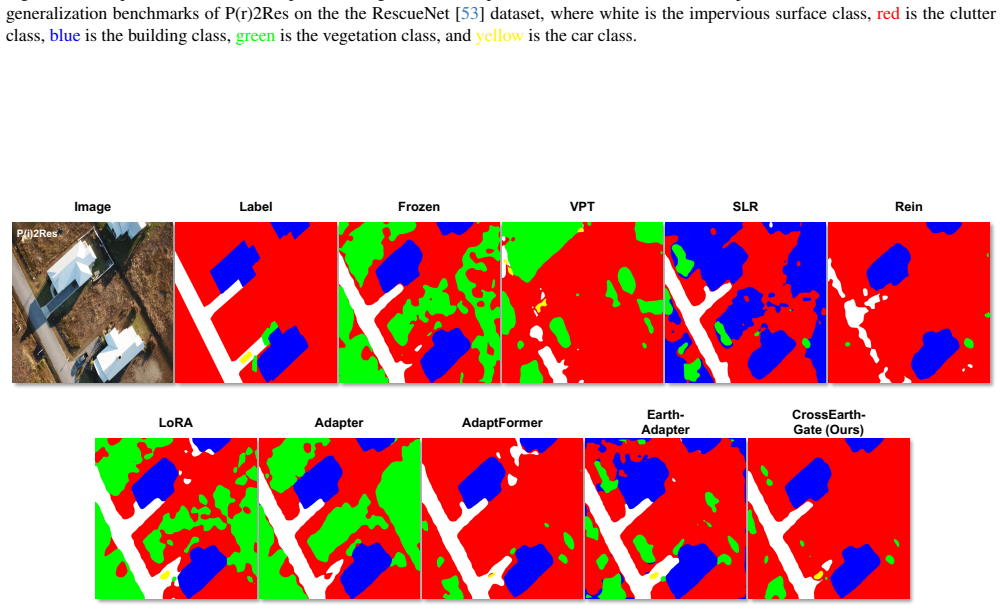
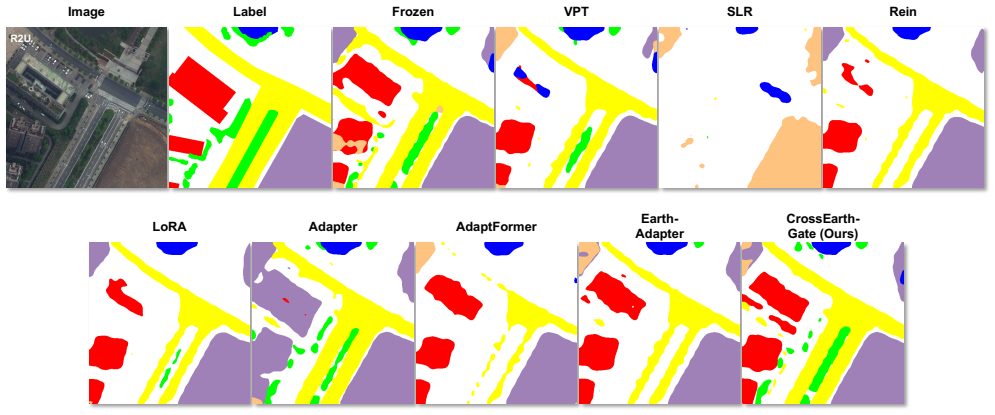
Summary. The paper proposes CrossEarth-Gate, a parameter-efficient fine-tuning (PEFT) method for cross-domain remote sensing semantic segmentation. It introduces a toolbox of three module types inserted at all transformer layers: a spatial LoRA module on attention projections, a semantic Adapter module parallel to MLPs, and a frequency Earth-Adapter module. A Fisher-information-based selection mechanism (Eq. 10) periodically computes squared-gradient importance scores for each module, normalizes by module type, and activates only the Top-k modules for the next training interval. The method is evaluated on 18 domain-generalization and domain-adaptation benchmarks across multiple backbones (DINOv2, SAM, SatMAE, Scale-MAE), reporting state-of-the-art average mIoU on 16 benchmarks with 3.0-4.4M trainable parameters.
Significance. If the Fisher-guided selection mechanism is genuinely responsible for the gains, this is a useful contribution: it provides a dynamic, data-driven way to combine multiple PEFT pathways for heterogeneous domain shifts, and the experimental scope (18 benchmarks, 5 backbones) is unusually broad. The toolbox design and the dynamic analysis in Fig. 4 are also informative. However, the central novelty — the Fisher guide — is not isolated in the experiments. There is no comparison against random module selection under the same parameter budget or against a fixed best-module configuration, and the 'w/o Selection' control uses 14.4M parameters versus 3-4.4M, so its degradation could be due to optimization difficulty with more parameters rather than the absence of gating. Since most gains are 0.3-2.0 mIoU with no error bars, the support for the headline claim is weaker than the abstract suggests. The paper is a solid empirical study of a combined PEFT toolbox, but the specific benefit of Fisher-based selection remains unverified.
major comments (4)
- [§4.2, Fig. 3] The Fisher-guided selection is never compared against a random-selection baseline or a fixed module-subset baseline with the same parameter budget. The 'w/o Selection' control in Fig. 3 trains all modules (14.4M params) versus 3.0-4.4M for CrossEarth-Gate, so it does not control for the number of active modules. This is the central claim of the paper: the novelty is the data-driven mechanism, not merely the toolbox or module pruning. Please add controls such as: (a) random Top-k modules re-sampled with the same schedule and same budget, (b) a fixed per-benchmark best module configuration selected on source validation, and (c) Top-k selected by an alternative importance metric (e.g., gradient-norm) to distinguish Fisher information from simpler proxies.
- [Tables 1-3, Appendix C.2.3] Most reported improvements over the best baseline are small (0.3-2.0 mIoU), and no error bars or statistical significance tests are provided. The claim of '16 out of 18 SOTA' therefore rests on margins that could be within run-to-run variance. Moreover, the appendix discloses individual benchmarks where the full method underperforms an ablated variant (e.g., Appendix C.2.3: Tms2Sub w/o Spatial 70.0 vs 68.3; Trf2Tem w/o Selection 51.0 vs 50.0). These cases are acknowledged but not reconciled with the conclusion that Fisher-guided selection is consistently beneficial. Please report standard deviations across seeds and, where possible, a pairwise significance test for the primary comparisons.
- [Eq. (10), §4.2] The Fisher scores are computed from source-domain gradients in the DG setting, but the objective is target-domain performance. The text asserts that high Fisher score indicates where gradients are 'highly impactful,' but this is a heuristic: a large source gradient does not necessarily identify modules that reduce target-domain loss. The dynamic analysis in Appendix C (Fig. 4) shows only that selections are non-uniform and evolve; it does not show that these selections outperform random selections with the same temporal dynamics. Please provide a direct test, e.g., comparing final target mIoU of random, fixed-best, and Fisher-guided selections across multiple benchmarks.
- [Table 8, §5.1] The method depends on several fixed hyperparameters: Top-k=18, selection number=10, accumulation steps 50/100, and module bottleneck dimensions (64/64/32). No sensitivity analysis is reported for any of these. Since Top-k directly controls the pruning ratio and the selection schedule controls when modules are re-evaluated, the robustness of the central mechanism to these choices should be demonstrated. Without such an analysis, it is unclear whether Fisher-guided selection is the cause of the gains or an incidental component of a tuned training recipe.
minor comments (5)
- [Abstract/Introduction] Typo: 'PEFE approaches' should be 'PEFT approaches.' Also, the abstract says '16 cross-domain benchmarks' while the introduction says '16 out of 18' — please be consistent.
- [Table 2] The CrossEarth-Gate row is formatted inconsistently: some cells show a parenthesized delta and others do not (e.g., P(r)2Res 'Bldg' shows -3.1, 'Tree' +2.0, but 'Surf' has no sign). The text also quotes 60.1/58.6 mIoU, but the table row is hard to read due to merged/duplicated numbers.
- [Table 8] Typo: 'Active nodules' should be 'Active modules.' Also, 'Selection number' and 'Accumulation steps' would benefit from a short explanation in the table caption.
- [References/Baselines] Some references use inconsistent naming (e.g., 'Dinov2' vs 'DINOv2', 'Adaptformer' vs 'AdaptFormer'). Consider standardizing to the official names. Also, Earth-Adapter is cited as [29] in Appendix Table 7 but as [32] elsewhere.
- [Appendix C.1.2] The description of Fig. 4(a) says the vertical axis flows downwards, but the figure axis label says 'Time Step (Training Progress)' — clarify whether later steps are at the bottom or top. The bubble-size legend is also missing.
Circularity Check
No circularity found: the Fisher-guided selection is an empirical heuristic evaluated on held-out domains, and self-citations are used only as components/protocol, not as the derivation.
full rationale
The paper's derivation chain is not circular. The Fisher importance score in Eq. (10) is an empirical diagonal FIM estimate computed from task gradients over the training (source or pseudo-labeled) data; the selection rule then activates Top-k modules for subsequent training. The reported target-domain mIoU values are never used to define the Fisher scores, and no fitted parameter is renamed as a prediction. The toolbox modules (LoRA, Adapter, Earth-Adapter) are pre-existing, independently published methods; even though Earth-Adapter [32] and CrossEarth [18] are prior works by overlapping authors, they serve as a toolbox component and an experimental protocol/baseline, not as the justification that Fisher gating works. The central SOTA claim is tested against multiple external baselines on held-out target domains, and the ablations (w/o Spatial, w/o Semantic, w/o Frequency, w/o Selection) are legitimate, if imperfect, controls. The absence of a random-selection baseline is an experimental-design limitation, not circularity, and the appendix explicitly reports edge cases where an ablation beats the full method (Tms2Sub: 70.0 vs 68.3; Trf2Tem: 51.0 vs 50.0), which is a limitation statement rather than a circularity. The derivation is self-contained: it combines known modules, computes gradients, and measures the result on unseen domains.
Axiom & Free-Parameter Ledger
free parameters (5)
- Active-module count (Top-k) =
18
- Selection number =
10
- Fisher accumulation steps =
50 on DA, 100 on DG
- Module bottleneck dimensions =
semantic=64, spatial=64, frequency=32
- Fisher batch size M =
not specified
axioms (3)
- domain assumption The empirical diagonal Fisher information (squared gradients) is a valid proxy for module importance for out-of-distribution generalization.
- domain assumption The trichotomy of RS domain gaps into spatial, semantic, and frequency shifts is complete enough to capture the relevant adaptation needs.
- domain assumption The mapping between module types and functional pathways (MSA for spatial, MLP for semantic, residual frequency adapter) is correct.
read the original abstract
In Remote Sensing (RS), Parameter-Efficient Fine-Tuning (PEFT) has emerged as a key approach to activate the generalizable representation ability of foundation models for downstream tasks. However, existing specialized PEFT methods often fail when applied to large-scale Earth observation tasks, as they are unable to fully handle the multifaceted and unpredictable domain gaps (e.g., spatial, semantic, and frequency shifts) inherent in RS data. To overcome this, we propose CrossEarth-Gate, which introduces two primary contributions. First, we establish a comprehensive RS module toolbox to address multifaceted domain gaps, comprising spatial, semantic, and frequency modules. Second, we develop a Fisher-guided adaptive selection mechanism that operates on this toolbox. This selection is guided by Fisher Information to quantify each module's importance by measuring its contribution to the task-specific gradient flow. It dynamically activates only the most critical modules at the appropriate layers, guiding the gradient flow to maximize adaptation effectiveness and efficiency. Comprehensive experiments validate the efficacy and generalizability of our method, where CrossEarth-Gate achieves state-of-the-art performance on 16 out of 18 cross-domain benchmarks for RS semantic segmentation.
Figures





Reference graph
Works this paper leans on
-
[1]
A review of the global climate change impacts, adaptation, and sustainable mitigation measures.Environmental science and pollution research, 29(28):42539–42559, 2022
Kashif Abbass, Muhammad Zeeshan Qasim, Huaming Song, Muntasir Murshed, Haider Mahmood, and Ijaz Younis. A review of the global climate change impacts, adaptation, and sustainable mitigation measures.Environmental science and pollution research, 29(28):42539–42559, 2022. 5
2022
-
[2]
Composable sparse fine-tuning for cross-lingual trans- fer.arXiv preprint arXiv:2110.07560, 2021
Alan Ansell, Edoardo Maria Ponti, Anna Korhonen, and Ivan Vuli´c. Composable sparse fine-tuning for cross-lingual trans- fer.arXiv preprint arXiv:2110.07560, 2021. 3
Pith/arXiv arXiv 2021
-
[3]
Lan- guage models are few-shot learners.Advances in neural in- formation processing systems, 33:1877–1901, 2020
Tom Brown, Benjamin Mann, Nick Ryder, Melanie Sub- biah, Jared D Kaplan, Prafulla Dhariwal, Arvind Neelakan- tan, Pranav Shyam, Girish Sastry, Amanda Askell, et al. Lan- guage models are few-shot learners.Advances in neural in- formation processing systems, 33:1877–1901, 2020. 3
1901
-
[4]
Adaptformer: Adapting vision transformers for scalable visual recogni- tion.Advances in Neural Information Processing Systems, 35:16664–16678, 2022
Shoufa Chen, Chongjian Ge, Zhan Tong, Jiangliu Wang, Yibing Song, Jue Wang, and Ping Luo. Adaptformer: Adapting vision transformers for scalable visual recogni- tion.Advances in Neural Information Processing Systems, 35:16664–16678, 2022. 1, 3, 4, 5, 6, 7, 2, 14, 15
2022
-
[5]
A simple framework for contrastive learning of visual representations
Ting Chen, Simon Kornblith, Mohammad Norouzi, and Ge- offrey Hinton. A simple framework for contrastive learning of visual representations. InInternational conference on ma- chine learning, pages 1597–1607. PmLR, 2020. 3
2020
-
[6]
Masked-attention mask transformer for universal image segmentation
Bowen Cheng, Ishan Misra, Alexander G Schwing, Alexan- der Kirillov, and Rohit Girdhar. Masked-attention mask transformer for universal image segmentation. InProceed- ings of the IEEE/CVF conference on computer vision and pattern recognition, pages 1290–1299, 2022. 5
2022
-
[7]
Palm: Scaling language modeling with pathways.Journal of Machine Learning Research, 24(240): 1–113, 2023
Aakanksha Chowdhery, Sharan Narang, Jacob Devlin, Maarten Bosma, Gaurav Mishra, Adam Roberts, Paul Barham, Hyung Won Chung, Charles Sutton, Sebastian Gehrmann, et al. Palm: Scaling language modeling with pathways.Journal of Machine Learning Research, 24(240): 1–113, 2023. 3
2023
-
[8]
Satmae: Pre-training transformers for tem- poral and multi-spectral satellite imagery.Advances in Neu- ral Information Processing Systems, 35:197–211, 2022
Yezhen Cong, Samar Khanna, Chenlin Meng, Patrick Liu, Erik Rozi, Yutong He, Marshall Burke, David Lobell, and Stefano Ermon. Satmae: Pre-training transformers for tem- poral and multi-spectral satellite imagery.Advances in Neu- ral Information Processing Systems, 35:197–211, 2022. 1, 3, 6, 7, 8, 4, 5
2022
-
[9]
MMSegmentation: Openmmlab semantic segmentation toolbox and benchmark.https : / / github
MMSegmentation Contributors. MMSegmentation: Openmmlab semantic segmentation toolbox and benchmark.https : / / github . com / open - mmlab/mmsegmentation, 2020. 5
2020
-
[10]
Qlora: Efficient finetuning of quantized llms
Tim Dettmers, Artidoro Pagnoni, Ari Holtzman, and Luke Zettlemoyer. Qlora: Efficient finetuning of quantized llms. Advances in neural information processing systems, 36: 10088–10115, 2023. 3
2023
-
[11]
Bert: Pre-training of deep bidirectional trans- formers for language understanding
Jacob Devlin, Ming-Wei Chang, Kenton Lee, and Kristina Toutanova. Bert: Pre-training of deep bidirectional trans- formers for language understanding. InProceedings of the 2019 conference of the North American chapter of the asso- ciation for computational linguistics: human language tech- nologies, volume 1 (long and short papers), pages 4171– 4186, 2019. 3
2019
-
[12]
Upetu: A unified parameter-efficient fine-tuning framework for remote sens- ing foundation model.IEEE Transactions on Geoscience and Remote Sensing, 62:1–13, 2024
Zhe Dong, Yanfeng Gu, and Tianzhu Liu. Upetu: A unified parameter-efficient fine-tuning framework for remote sens- ing foundation model.IEEE Transactions on Geoscience and Remote Sensing, 62:1–13, 2024. 3
2024
-
[13]
Alexey Dosovitskiy. An image is worth 16x16 words: Transformers for image recognition at scale.arXiv preprint arXiv:2010.11929, 2020. 3, 6, 7, 15
Pith/arXiv arXiv 2010
-
[14]
On the mathematical foundations of the- oretical statistics.Philosophical transactions of the Royal Society of London
Ronald A Fisher. On the mathematical foundations of the- oretical statistics.Philosophical transactions of the Royal Society of London. Series A, containing papers of a mathe- matical or physical character, 222(594-604):309–368, 1922. 2, 4, 5
1922
-
[15]
Vi- sual prompt tuning for test-time domain adaptation.arXiv preprint arXiv:2210.04831, 2022
Yunhe Gao, Xingjian Shi, Yi Zhu, Hao Wang, Zhiqiang Tang, Xiong Zhou, Mu Li, and Dimitris N Metaxas. Vi- sual prompt tuning for test-time domain adaptation.arXiv preprint arXiv:2210.04831, 2022. 3
Pith/arXiv arXiv 2022
-
[16]
Transformer feed-forward layers are key-value memories
Mor Geva, Roei Schuster, Jonathan Berant, and Omer Levy. Transformer feed-forward layers are key-value memories. arXiv preprint arXiv:2012.14913, 2020. 4
Pith/arXiv arXiv 2012
-
[17]
Coda: Instructive chain-of-domain adaptation with severity-aware visual prompt tuning
Ziyang Gong, Fuhao Li, Yupeng Deng, Deblina Bhattachar- jee, Xianzheng Ma, Xiangwei Zhu, and Zhenming Ji. Coda: Instructive chain-of-domain adaptation with severity-aware visual prompt tuning. InEuropean Conference on Computer Vision, pages 130–148. Springer, 2024. 3
2024
-
[18]
Ziyang Gong, Zhixiang Wei, Di Wang, Xianzheng Ma, Hon- gruixuan Chen, Yuru Jia, Yupeng Deng, Zhenming Ji, Xiang- wei Zhu, Naoto Yokoya, et al. Crossearth: Geospatial vision foundation model for domain generalizable remote sensing semantic segmentation.arXiv preprint arXiv:2410.22629,
-
[19]
Skysense: A multi-modal remote sens- ing foundation model towards universal interpretation for earth observation imagery
Xin Guo, Jiangwei Lao, Bo Dang, Yingying Zhang, Lei Yu, Lixiang Ru, Liheng Zhong, Ziyuan Huang, Kang Wu, Dingxiang Hu, et al. Skysense: A multi-modal remote sens- ing foundation model towards universal interpretation for earth observation imagery. InProceedings of the IEEE/CVF Conference on Computer Vision and Pattern Recognition, pages 27672–27683, 2024. 1, 3
2024
-
[20]
Zeyu Han, Chao Gao, Jinyang Liu, Jeff Zhang, and Sai Qian Zhang. Parameter-efficient fine-tuning for large models: A comprehensive survey.arXiv preprint arXiv:2403.14608,
-
[21]
Lora+: Effi- cient low rank adaptation of large models.arXiv preprint arXiv:2402.12354, 2024
Soufiane Hayou, Nikhil Ghosh, and Bin Yu. Lora+: Effi- cient low rank adaptation of large models.arXiv preprint arXiv:2402.12354, 2024. 3
Pith/arXiv arXiv 2024
-
[22]
Momentum contrast for unsupervised visual rep- resentation learning
Kaiming He, Haoqi Fan, Yuxin Wu, Saining Xie, and Ross Girshick. Momentum contrast for unsupervised visual rep- resentation learning. InProceedings of the IEEE/CVF con- ference on computer vision and pattern recognition, pages 9729–9738, 2020. 3
2020
-
[23]
Masked autoencoders are scalable vision learners
Kaiming He, Xinlei Chen, Saining Xie, Yanghao Li, Piotr Doll´ar, and Ross Girshick. Masked autoencoders are scalable vision learners. InProceedings of the IEEE/CVF conference on computer vision and pattern recognition, pages 16000– 16009, 2022. 3, 4
2022
-
[24]
Context-aware multi-head self-attentional neural network model for next location prediction.Transporta- tion Research Part C: Emerging Technologies, 156:104315,
Ye Hong, Yatao Zhang, Konrad Schindler, and Martin Raubal. Context-aware multi-head self-attentional neural network model for next location prediction.Transporta- tion Research Part C: Emerging Technologies, 156:104315,
-
[25]
Parameter-efficient transfer learning for nlp
Neil Houlsby, Andrei Giurgiu, Stanislaw Jastrzebski, Bruna Morrone, Quentin De Laroussilhe, Andrea Gesmundo, Mona Attariyan, and Sylvain Gelly. Parameter-efficient transfer learning for nlp. InInternational conference on machine learning, pages 2790–2799. PMLR, 2019. 3, 4, 5, 6, 7, 14
2019
-
[26]
Daformer: Improving network architectures and training strategies for domain-adaptive semantic segmentation
Lukas Hoyer, Dengxin Dai, and Luc Van Gool. Daformer: Improving network architectures and training strategies for domain-adaptive semantic segmentation. InProceedings of the IEEE/CVF conference on computer vision and pattern recognition, pages 9924–9935, 2022. 6, 7
2022
-
[27]
Hrda: Context-aware high-resolution domain-adaptive semantic segmentation
Lukas Hoyer, Dengxin Dai, and Luc Van Gool. Hrda: Context-aware high-resolution domain-adaptive semantic segmentation. InEuropean conference on computer vision, pages 372–391. Springer, 2022. 6, 7
2022
-
[28]
Lora: Low-rank adaptation of large language models.ICLR, 1(2):3, 2022
Edward J Hu, Yelong Shen, Phillip Wallis, Zeyuan Allen- Zhu, Yuanzhi Li, Shean Wang, Lu Wang, Weizhu Chen, et al. Lora: Low-rank adaptation of large language models.ICLR, 1(2):3, 2022. 1, 3, 4, 5, 6, 7, 2, 14
2022
-
[29]
Learn to preserve and diversify: Parameter-efficient group with orthogonal regularization for domain generalization
Jiajun Hu, Jian Zhang, Lei Qi, Yinghuan Shi, and Yang Gao. Learn to preserve and diversify: Parameter-efficient group with orthogonal regularization for domain generalization. In European Conference on Computer Vision, pages 198–216. Springer, 2024. 3, 14
2024
-
[30]
Tea: A training-efficient adapting frame- work for tuning foundation models in remote sensing.IEEE Transactions on Geoscience and Remote Sensing, 2024
Leiyi Hu, Wanxuan Lu, Hongfeng Yu, Dongshuo Yin, Xian Sun, and Kun Fu. Tea: A training-efficient adapting frame- work for tuning foundation models in remote sensing.IEEE Transactions on Geoscience and Remote Sensing, 2024. 3
2024
-
[31]
Airs: Adapter in remote sensing for parameter-efficient transfer learning.IEEE Transactions on Geoscience and Remote Sensing, 62:1–18, 2024
Leiyi Hu, Hongfeng Yu, Wanxuan Lu, Dongshuo Yin, Xian Sun, and Kun Fu. Airs: Adapter in remote sensing for parameter-efficient transfer learning.IEEE Transactions on Geoscience and Remote Sensing, 62:1–18, 2024. 3
2024
-
[32]
Xiaoxing Hu, Ziyang Gong, Yupei Wang, Yuru Jia, Gen Luo, and Xue Yang. Earth-adapter: Bridge the geospatial domain gaps with mixture of frequency adaptation.arXiv preprint arXiv:2504.06220, 2025. 1, 3, 4, 5, 6, 7, 2, 12, 13, 15
arXiv 2025
-
[33]
Vi- sual prompt tuning
Menglin Jia, Luming Tang, Bor-Chun Chen, Claire Cardie, Serge Belongie, Bharath Hariharan, and Ser-Nam Lim. Vi- sual prompt tuning. InEuropean conference on computer vision, pages 709–727. Springer, 2022. 3, 5, 6, 7, 13, 14
2022
-
[34]
Segment any- thing
Alexander Kirillov, Eric Mintun, Nikhila Ravi, Hanzi Mao, Chloe Rolland, Laura Gustafson, Tete Xiao, Spencer White- head, Alexander C Berg, Wan-Yen Lo, et al. Segment any- thing. InProceedings of the IEEE/CVF international confer- ence on computer vision, pages 4015–4026, 2023. 3, 7, 8, 4, 5
2023
-
[35]
Overcoming catastrophic forgetting in neu- ral networks.Proceedings of the national academy of sci- ences, 114(13):3521–3526, 2017
James Kirkpatrick, Razvan Pascanu, Neil Rabinowitz, Joel Veness, Guillaume Desjardins, Andrei A Rusu, Kieran Milan, John Quan, Tiago Ramalho, Agnieszka Grabska- Barwinska, et al. Overcoming catastrophic forgetting in neu- ral networks.Proceedings of the national academy of sci- ences, 114(13):3521–3526, 2017. 5
2017
-
[36]
On information and sufficiency.The annals of mathematical statistics, 22(1): 79–86, 1951
Solomon Kullback and Richard A Leibler. On information and sufficiency.The annals of mathematical statistics, 22(1): 79–86, 1951. 4
1951
-
[37]
Saratr-x: Towards building a foundation model for sar target recognition.IEEE Transactions on Im- age Processing, 2025
Weijie Li, Wei Yang, Yuenan Hou, Li Liu, Yongxiang Liu, and Xiang Li. Saratr-x: Towards building a foundation model for sar target recognition.IEEE Transactions on Im- age Processing, 2025. 3
2025
-
[38]
Multilevel heterogeneous domain adaptation method for remote sensing image segmentation.IEEE Trans- actions on Geoscience and Remote Sensing, 61:1–16, 2023
Chenbin Liang, Bo Cheng, Baihua Xiao, Yunyun Dong, and Jinfen Chen. Multilevel heterogeneous domain adaptation method for remote sensing image segmentation.IEEE Trans- actions on Geoscience and Remote Sensing, 61:1–16, 2023. 12
2023
-
[39]
Re- moteclip: A vision language foundation model for remote sensing.IEEE Transactions on Geoscience and Remote Sensing, 62:1–16, 2024
Fan Liu, Delong Chen, Zhangqingyun Guan, Xiaocong Zhou, Jiale Zhu, Qiaolin Ye, Liyong Fu, and Jun Zhou. Re- moteclip: A vision language foundation model for remote sensing.IEEE Transactions on Geoscience and Remote Sensing, 62:1–16, 2024. 6, 7
2024
-
[40]
Peiyu Liu, Ze-Feng Gao, Wayne Xin Zhao, Zhi-Yuan Xie, Zhong-Yi Lu, and Ji-Rong Wen. Enabling lightweight fine- tuning for pre-trained language model compression based on matrix product operators.arXiv preprint arXiv:2106.02205,
-
[41]
A large-scale climate-aware satellite image dataset for domain adaptive land-cover semantic segmentation.ISPRS Journal of Photogrammetry and Remote Sensing, 205:98–114, 2023
Songlin Liu, Linwei Chen, Li Zhang, Jun Hu, and Ying Fu. A large-scale climate-aware satellite image dataset for domain adaptive land-cover semantic segmentation.ISPRS Journal of Photogrammetry and Remote Sensing, 205:98–114, 2023. 1, 8, 4, 7, 12
2023
-
[42]
Dora: Weight-decomposed low-rank adaptation
Shih-Yang Liu, Chien-Yi Wang, Hongxu Yin, Pavlo Molchanov, Yu-Chiang Frank Wang, Kwang-Ting Cheng, and Min-Hung Chen. Dora: Weight-decomposed low-rank adaptation. InForty-first International Conference on Ma- chine Learning, 2024. 3
2024
-
[43]
Decoupled weight decay regularization.arXiv preprint arXiv:1711.05101, 2017
Ilya Loshchilov and Frank Hutter. Decoupled weight decay regularization.arXiv preprint arXiv:1711.05101, 2017. 5
Pith/arXiv arXiv 2017
-
[44]
Haoyan Luo and Lucia Specia. From understanding to uti- lization: A survey on explainability for large language mod- els.arXiv preprint arXiv:2401.12874, 2024. 4
Pith/arXiv arXiv 2024
-
[45]
Xianping Ma, Xiaokang Zhang, Zhiguo Wang, and Man-On Pun. Unsupervised domain adaptation augmented by mutu- ally boosted attention for semantic segmentation of vhr re- mote sensing images.IEEE Transactions on Geoscience and Remote Sensing, 61:1–15, 2023. 12
2023
-
[46]
Seasonal contrast: Un- supervised pre-training from uncurated remote sensing data
Oscar Manas, Alexandre Lacoste, Xavier Gir ´o-i Nieto, David Vazquez, and Pau Rodriguez. Seasonal contrast: Un- supervised pre-training from uncurated remote sensing data. InProceedings of the IEEE/CVF International Conference on Computer Vision, pages 9414–9423, 2021. 1, 3
2021
-
[47]
Locating and editing factual associations in gpt.Ad- vances in neural information processing systems, 35:17359– 17372, 2022
Kevin Meng, David Bau, Alex Andonian, and Yonatan Be- linkov. Locating and editing factual associations in gpt.Ad- vances in neural information processing systems, 35:17359– 17372, 2022. 4
2022
-
[48]
Dinov2: Learning robust visual features without supervision
Maxime Oquab, Timoth ´ee Darcet, Th ´eo Moutakanni, Huy V o, Marc Szafraniec, Vasil Khalidov, Pierre Fernandez, Daniel Haziza, Francisco Massa, Alaaeldin El-Nouby, et al. Dinov2: Learning robust visual features without supervision. arXiv preprint arXiv:2304.07193, 2023. 3, 5, 6, 7, 8, 2
Pith/arXiv arXiv 2023
-
[49]
Revisiting natural gra- dient for deep networks.arXiv preprint arXiv:1301.3584,
Razvan Pascanu and Yoshua Bengio. Revisiting natural gra- dient for deep networks.arXiv preprint arXiv:1301.3584,
-
[50]
Jonas Pfeiffer, Aishwarya Kamath, Andreas R ¨uckl´e, Kyunghyun Cho, and Iryna Gurevych. Adapterfusion: Non- destructive task composition for transfer learning.arXiv preprint arXiv:2005.00247, 2020. 3
Pith/arXiv arXiv 2005
-
[51]
Learning transferable visual models from natural language supervi- sion
Alec Radford, Jong Wook Kim, Chris Hallacy, Aditya Ramesh, Gabriel Goh, Sandhini Agarwal, Girish Sastry, Amanda Askell, Pamela Mishkin, Jack Clark, et al. Learning transferable visual models from natural language supervi- sion. InInternational conference on machine learning, pages 8748–8763. PmLR, 2021. 3
2021
-
[52]
Exploring the limits of transfer learning with a unified text-to-text transformer.Journal of machine learning research, 21(140):1–67, 2020
Colin Raffel, Noam Shazeer, Adam Roberts, Katherine Lee, Sharan Narang, Michael Matena, Yanqi Zhou, Wei Li, and Peter J Liu. Exploring the limits of transfer learning with a unified text-to-text transformer.Journal of machine learning research, 21(140):1–67, 2020. 3
2020
-
[53]
Rescuenet: A high resolution uav semantic segmen- tation dataset for natural disaster damage assessment.Scien- tific data, 10(1):913, 2023
Maryam Rahnemoonfar, Tashnim Chowdhury, and Robin Murphy. Rescuenet: A high resolution uav semantic segmen- tation dataset for natural disaster damage assessment.Scien- tific data, 10(1):913, 2023. 8, 9, 12, 13
2023
-
[54]
Scale-mae: A scale-aware masked autoencoder for multiscale geospatial representation learning
Colorado J Reed, Ritwik Gupta, Shufan Li, Sarah Brock- man, Christopher Funk, Brian Clipp, Kurt Keutzer, Salvatore Candido, Matt Uyttendaele, and Trevor Darrell. Scale-mae: A scale-aware masked autoencoder for multiscale geospatial representation learning. InProceedings of the IEEE/CVF International Conference on Computer Vision, pages 4088– 4099, 2023. 1...
2023
-
[55]
Masked vision transformers for hyperspectral image classi- fication
Linus Scheibenreif, Michael Mommert, and Damian Borth. Masked vision transformers for hyperspectral image classi- fication. InProceedings of the IEEE/CVF conference on computer vision and pattern recognition, pages 2166–2176,
-
[56]
Parameter efficient self-supervised geospatial domain adap- tation
Linus Scheibenreif, Michael Mommert, and Damian Borth. Parameter efficient self-supervised geospatial domain adap- tation. InProceedings of the IEEE/CVF Conference on Com- puter Vision and Pattern Recognition, pages 27841–27851,
-
[57]
Vpa: Fully test-time visual prompt adaptation
Jiachen Sun, Mark Ibrahim, Melissa Hall, Ivan Evtimov, Z Morley Mao, Cristian Canton Ferrer, and Caner Hazirbas. Vpa: Fully test-time visual prompt adaptation. InProceed- ings of the 31st ACM International Conference on Multime- dia, pages 5796–5806, 2023. 3
2023
-
[58]
Training neu- ral networks with fixed sparse masks.Advances in Neural Information Processing Systems, 34:24193–24205, 2021
Yi-Lin Sung, Varun Nair, and Colin A Raffel. Training neu- ral networks with fixed sparse masks.Advances in Neural Information Processing Systems, 34:24193–24205, 2021. 3, 5
2021
-
[59]
Cross-scale mae: A tale of multiscale exploita- tion in remote sensing.Advances in Neural Information Pro- cessing Systems, 36:20054–20066, 2023
Maofeng Tang, Andrei Cozma, Konstantinos Georgiou, and Hairong Qi. Cross-scale mae: A tale of multiscale exploita- tion in remote sensing.Advances in Neural Information Pro- cessing Systems, 36:20054–20066, 2023. 3
2023
-
[60]
Romain Thoreau, Valerio Marsocci, and Dawa Derk- sen. Parameter-efficient adaptation of geospatial founda- tion models through embedding deflection.arXiv preprint arXiv:2503.09493, 2025. 3
arXiv 2025
-
[61]
Llama: Open and efficient foundation language models
Hugo Touvron, Thibaut Lavril, Gautier Izacard, Xavier Martinet, Marie-Anne Lachaux, Timoth´ee Lacroix, Baptiste Rozi`ere, Naman Goyal, Eric Hambro, Faisal Azhar, et al. Llama: Open and efficient foundation language models. arXiv preprint arXiv:2302.13971, 2023. 3
Pith/arXiv arXiv 2023
-
[62]
Dacs: Domain adaptation via cross- domain mixed sampling
Wilhelm Tranheden, Viktor Olsson, Juliano Pinto, and Lennart Svensson. Dacs: Domain adaptation via cross- domain mixed sampling. InProceedings of the IEEE/CVF winter conference on applications of computer vision, pages 1379–1389, 2021. 5
2021
-
[63]
Attention is all you need.Advances in neural information processing systems, 30, 2017
Ashish Vaswani, Noam Shazeer, Niki Parmar, Jakob Uszko- reit, Llion Jones, Aidan N Gomez, Łukasz Kaiser, and Illia Polosukhin. Attention is all you need.Advances in neural information processing systems, 30, 2017. 3
2017
-
[64]
Mtp: Advancing remote sensing foun- dation model via multitask pretraining.IEEE Journal of Selected Topics in Applied Earth Observations and Remote Sensing, 17:11632–11654, 2024
Di Wang, Jing Zhang, Minqiang Xu, Lin Liu, Dongsheng Wang, Erzhong Gao, Chengxi Han, Haonan Guo, Bo Du, Dacheng Tao, et al. Mtp: Advancing remote sensing foun- dation model via multitask pretraining.IEEE Journal of Selected Topics in Applied Earth Observations and Remote Sensing, 17:11632–11654, 2024. 6, 7
2024
-
[65]
Hypersigma: Hyperspectral intelligence comprehen- sion foundation model.IEEE Transactions on Pattern Anal- ysis and Machine Intelligence, 2025
Di Wang, Meiqi Hu, Yao Jin, Yuchun Miao, Jiaqi Yang, Yichu Xu, Xiaolei Qin, Jiaqi Ma, Lingyu Sun, Chenxing Li, et al. Hypersigma: Hyperspectral intelligence comprehen- sion foundation model.IEEE Transactions on Pattern Anal- ysis and Machine Intelligence, 2025. 3
2025
-
[66]
Junjue Wang, Zhuo Zheng, Ailong Ma, Xiaoyan Lu, and Yanfei Zhong. Loveda: A remote sensing land-cover dataset for domain adaptive semantic segmentation.arXiv preprint arXiv:2110.08733, 2021. 1, 11, 12, 13
Pith/arXiv arXiv 2021
-
[67]
Luhan Wang, Pengfeng Xiao, Xueliang Zhang, and Xinyang Chen. A fine-grained unsupervised domain adaptation framework for semantic segmentation of remote sensing im- ages.IEEE Journal of Selected Topics in Applied Earth Ob- servations and Remote Sensing, 16:4109–4121, 2023. 12
2023
-
[68]
Feature guided masked autoencoder for self-supervised learning in remote sensing.IEEE Journal of Selected Topics in Applied Earth Observations and Remote Sensing, 2024
Yi Wang, Hugo Hern ´andez Hern´andez, Conrad M Albrecht, and Xiao Xiang Zhu. Feature guided masked autoencoder for self-supervised learning in remote sensing.IEEE Journal of Selected Topics in Applied Earth Observations and Remote Sensing, 2024. 3
2024
-
[69]
Stronger fewer & superior: Harnessing vision foundation models for domain generalized semantic segmentation
Zhixiang Wei, Lin Chen, Yi Jin, Xiaoxiao Ma, Tianle Liu, Pengyang Ling, Ben Wang, Huaian Chen, and Jinjin Zheng. Stronger fewer & superior: Harnessing vision foundation models for domain generalized semantic segmentation. In Proceedings of the IEEE/CVF conference on computer vi- sion and pattern recognition, pages 28619–28630, 2024. 3, 5, 6, 7, 14
2024
-
[70]
On the opportunities and risks of foundation models for natural language processing in radiology.Radiology: Artificial Intelligence, 4(4):e220119,
Walter F Wiggins and Ali S Tejani. On the opportunities and risks of foundation models for natural language processing in radiology.Radiology: Artificial Intelligence, 4(4):e220119,
-
[71]
Segformer: Simple and efficient design for semantic segmentation with transform- ers.Advances in neural information processing systems, 34: 12077–12090, 2021
Enze Xie, Wenhai Wang, Zhiding Yu, Anima Anandkumar, Jose M Alvarez, and Ping Luo. Segformer: Simple and efficient design for semantic segmentation with transform- ers.Advances in neural information processing systems, 34: 12077–12090, 2021. 6, 7
2021
-
[72]
Parameter-efficient fine- tuning for pre-trained vision models: A survey.arXiv e- prints, pages arXiv–2402, 2024
Yi Xin, Siqi Luo, Haodi Zhou, Junlong Du, Xiaohong Liu, Yue Fan, Qing Li, and Yuntao Du. Parameter-efficient fine- tuning for pre-trained vision models: A survey.arXiv e- prints, pages arXiv–2402, 2024. 1
2024
-
[73]
Runxin Xu, Fuli Luo, Zhiyuan Zhang, Chuanqi Tan, Baobao Chang, Songfang Huang, and Fei Huang. Raise a child in large language model: Towards effective and generalizable fine-tuning.arXiv preprint arXiv:2109.05687, 2021. 3
Pith/arXiv arXiv 2021
-
[74]
Exploring sparse visual prompt for domain adaptive dense prediction
Senqiao Yang, Jiarui Wu, Jiaming Liu, Xiaoqi Li, Qizhe Zhang, Mingjie Pan, Yulu Gan, Zehui Chen, and Shanghang Zhang. Exploring sparse visual prompt for domain adaptive dense prediction. InProceedings of the AAAI Conference on Artificial Intelligence, pages 16334–16342, 2024. 3
2024
-
[75]
Knowledge circuits in pretrained transformers.Advances in Neural Information Processing Systems, 37:118571–118602, 2024
Yunzhi Yao, Ningyu Zhang, Zekun Xi, Mengru Wang, Ziwen Xu, Shumin Deng, and Huajun Chen. Knowledge circuits in pretrained transformers.Advances in Neural Information Processing Systems, 37:118571–118602, 2024. 4
2024
-
[76]
5%¿ 100%: Breaking performance shackles of full fine-tuning on visual recognition tasks
Dongshuo Yin, Leiyi Hu, Bin Li, Youqun Zhang, and Xue Yang. 5%¿ 100%: Breaking performance shackles of full fine-tuning on visual recognition tasks. InProceedings of the Computer Vision and Pattern Recognition Conference, pages 20071–20081, 2025. 3
2025
-
[77]
Remote sensing tuning: A survey.Computational Visual Media, 2025
Dongshuo Yin, Ting-Feng Zhao, Deng-Ping Fan, Shutao Li, Bo Du, Xian Sun, and Shi-Min Hu. Remote sensing tuning: A survey.Computational Visual Media, 2025. 3
2025
-
[78]
Elad Ben Zaken, Shauli Ravfogel, and Yoav Goldberg. Bitfit: Simple parameter-efficient fine-tuning for transformer-based masked language-models.arXiv preprint arXiv:2106.10199,
-
[79]
Parameter-efficient fine-tuning for foundation models.arXiv preprint arXiv:2501.13787, 2025
Dan Zhang, Tao Feng, Lilong Xue, Yuandong Wang, Yux- iao Dong, and Jie Tang. Parameter-efficient fine-tuning for foundation models.arXiv preprint arXiv:2501.13787, 2025. 1, 3
Pith/arXiv arXiv 2025
-
[80]
Pseudo features-guided self-training for domain adaptive semantic segmentation of satellite images
Fahong Zhang, Yilei Shi, Zhitong Xiong, Wei Huang, and Xiao Xiang Zhu. Pseudo features-guided self-training for domain adaptive semantic segmentation of satellite images. IEEE Transactions on Geoscience and Remote Sensing, 61: 1–14, 2023. 12
2023
discussion (0)
Sign in with ORCID, Apple, or X to comment. Anyone can read and Pith papers without signing in.