REVIEW 2 major objections 4 minor 1 cited by
The paper shows that in the N=2 supersymmetric SYK model, the mechanism of supersymmetry breaking—an irrelevant deformation down to N=1 versus a mass deformation down to N=0—controls whether late-time Krylov complexity fills roughly half th
Reviewed by Pith at T0; open to challenge. T0 means a machine referee read the full paper against a public rubric. the ladder, T0–T4 →
T0 review · deepseek-v4-flash
2026-08-03 20:10 UTC pith:EXS6Z5GY
load-bearing objection Solid numerics and a new N=2 SYK data point, but the headline claim about the mass deformation rests on normalizing by an upper bound, and the paper's own termination lengths reverse the trend. the 2 major comments →
Krylov Complexity of Supersymmetric SYK Models
The pith
A machine-rendered reading of the paper's core claim, the machinery that carries it, and where it could break.
Core claim
On the paper's own terms, the central claim is that the impact of supersymmetry breaking on Krylov complexity depends on the specific mechanism of symmetry breaking. In numerical results for the hopping operator at N=6, the undeformed N=2 model has a saturation fraction K_sat/D_max^K of 0.14; the irrelevant deformation (epsilon = 0.2–0.6) raises the fraction to 0.49–0.51, while the mass deformation (epsilon = 1–3) lowers it to 0.08 even though K_sat itself rises from 8.14 to roughly 340. The mechanism behind the contrast is the way each deformation lifts the BPS (zero-energy) degeneracy: the mass deformation completely lifts degeneracy, producing a much larger Krylov bound, whereas the irrel
What carries the argument
The central object is the Krylov space generated by repeatedly applying the Liouvillian (commutator with the Hamiltonian) to an initial operator, here mainly the hopping operator. The Lanczos algorithm produces the orthonormal Krylov basis and the Lanczos coefficients b_n, which turn operator evolution into a one-dimensional hopping problem; Krylov complexity K(t) is the average position on that chain. The paper's main diagnostic is the saturation fraction K_frac_sat = K_sat / D_max^K, where D_max^K is an upper bound on the Krylov dimension estimated from the average energy degeneracy via D_max^K ~= d/d_E (d/d_E - 1) + 1. The deformation changes the spectrum and degeneracy, which changes the
Load-bearing premise
The paper's central comparison uses D_max^K, an estimated upper bound on the Krylov dimension derived from average energy degeneracy, rather than the actual dimension at which the Lanczos sequence terminates; if the actual chain lengths are used, the mass deformation no longer appears to lower the saturation fraction.
What would settle it
Recompute K_frac_sat using the actual Krylov dimension from where the Lanczos sequence terminates. Using the paper's own N=6 hopping-operator results—chain lengths of about 33 (undeformed), 239 (UV), and 859 (mass)—the saturation fractions become roughly 0.25, 0.51, and 0.40; the mass-deformed value then sits above the undeformed value, which would settle that the claimed decrease is an artifact of the normalization.
If this is right
- Both deformations increase the absolute late-time saturation complexity and delay the Heisenberg time compared with the undeformed model, so supersymmetry breaking does not simply reduce operator growth.
- The irrelevant deformation raises the saturation fraction to about half the estimated Krylov bound across epsilon=0.2–0.6, while the mass deformation holds it near 0.08 over epsilon=1–3, so the ratio distinguishes the two breaking mechanisms.
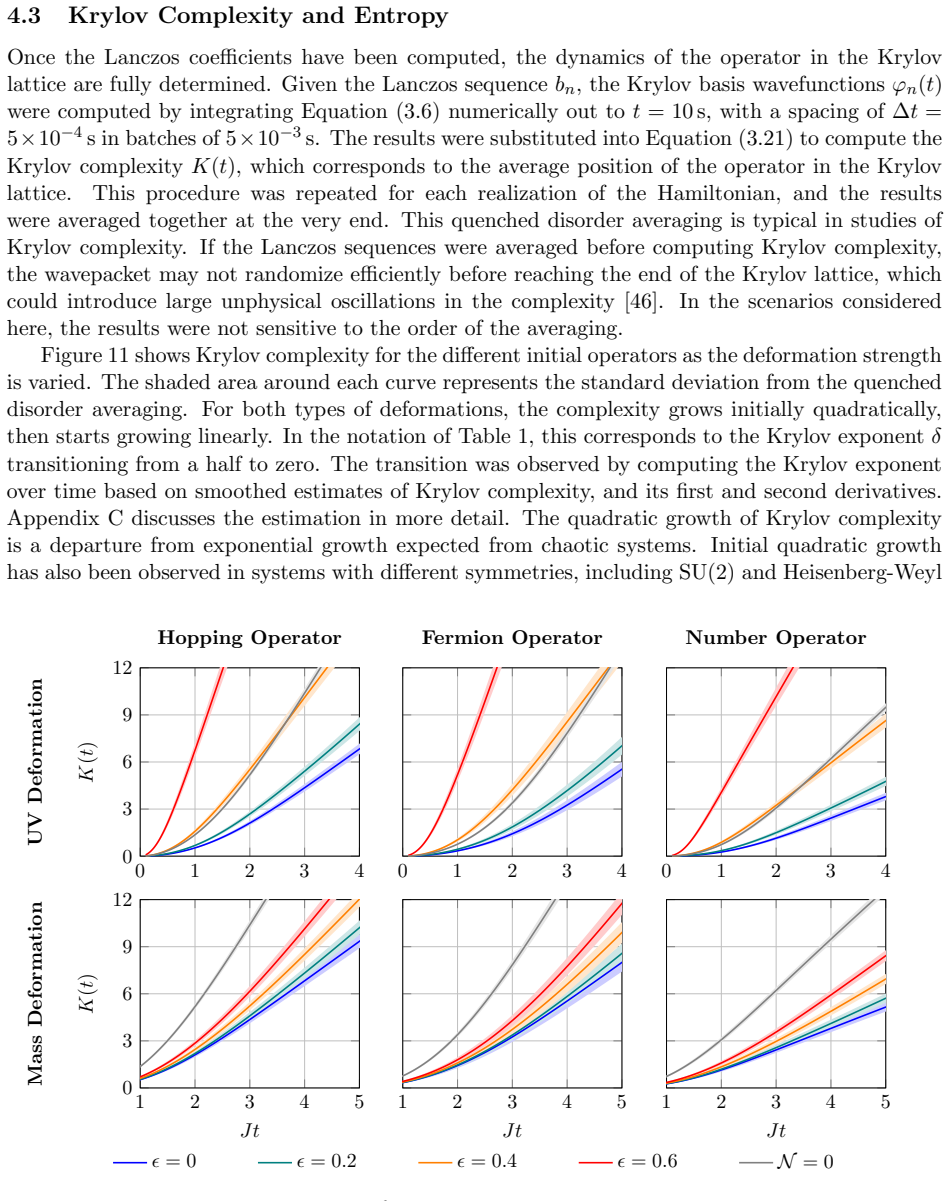
- Early-time Krylov complexity grows quadratically and then linearly, not exponentially; the deformation raises both the quadratic coefficient and the ballistic velocity, with the UV deformation's growth rate tracking gamma=(1+epsilon^2)/(1-epsilon^2)^2 and the mass deformation's growing roughly linearly in epsilon.
- Level statistics track the same split: the UV deformation increases the average gap ratio toward chaotic values, whereas the mass deformation pushes it toward the integrable, Poisson-like value. The paper connects the mass-deformation behavior to a drift toward integrability.
Where Pith is reading between the lines
- A direct check the paper leaves implicit: recompute the saturation fraction with the actual Lanczos chain lengths rather than the degeneracy-based bound. The paper's N=6 data give chain lengths of about 33 (undeformed), 239 (UV), and 859 (mass); those numbers put the mass-deformed fraction near 0.40, not 0.08, so the claimed contrast is sensitive to this normalization choice.
- If the ratio contrast survives at larger N, it would give a practical diagnostic: the fraction of Krylov space filled at saturation could be used to tell whether a given deformation preserves a residual supersymmetry or breaks it completely.
- The quadratic-then-linear growth observed at finite N is likely a finite-size effect; testing the same quantities with larger Hilbert spaces or using the large-q analytic control of the Lanczos sequence would show whether the deformation-dependent growth rates persist beyond the small systems simulated.
- The paper's two deformations affect different symmetries—the UV deformation breaks U(1) and U(1)_R, while the mass deformation preserves U(1). This suggests symmetry-resolved Krylov complexity, in which each charge sector contributes separately, could make the mechanism even more visible, but that analysis is not in the paper.
Editorial analysis
A structured set of objections, weighed in public.
Referee Report
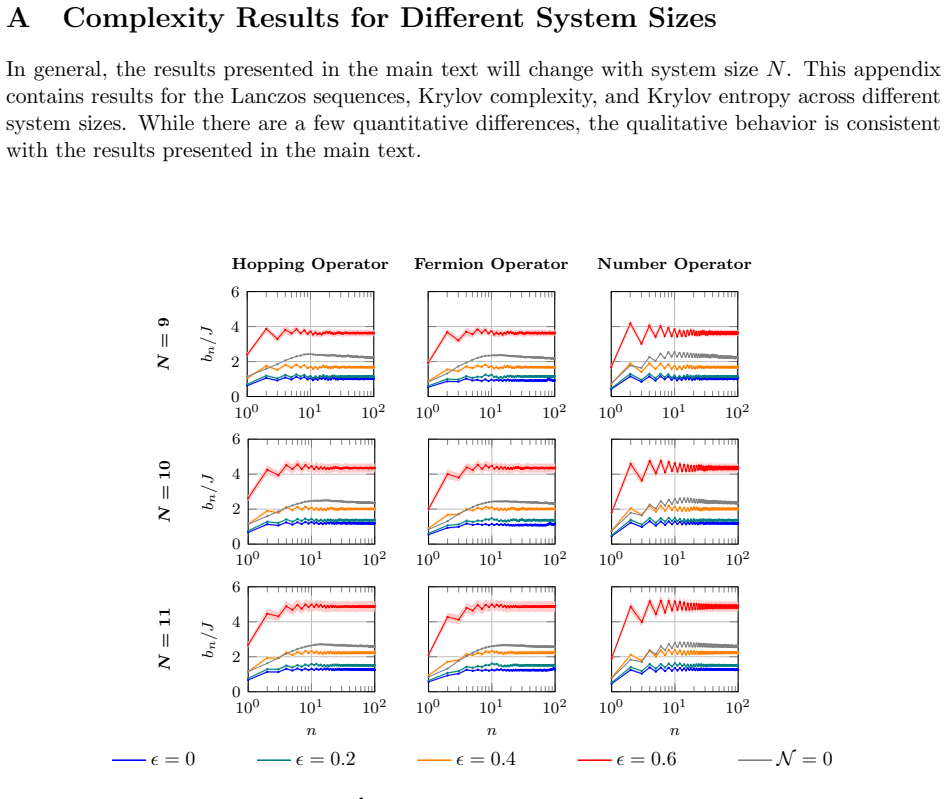
Summary. The paper numerically studies Krylov complexity in the N=2 supersymmetric SYK model under two deformations: an irrelevant UV deformation that breaks N=2 to N=1, and a mass deformation that breaks N=2 directly to N=0. For finite system sizes, the authors compute Lanczos coefficients, Krylov dimension, Krylov complexity, and Krylov entropy for several initial operators. They report that both deformations enlarge the Krylov space, increase early-time growth rates, and raise absolute saturation complexity, but differ in the late-time ratio of saturation complexity to Krylov-space size: the irrelevant deformation is claimed to increase this ratio, while the mass deformation is claimed to decrease it. The central late-time claim is operationalized through the quantity K_frac_sat, defined as K_sat/D_max^K, with D_max^K an upper-bound estimate from Eq. (4.1).
Significance. The paper's strength is its careful numerical implementation: it uses high-precision arithmetic, checks orthogonality of the Krylov basis, cross-checks two Lanczos algorithms, and compares against large-q analytic predictions. If the central claim about the distinct late-time signatures of the two supersymmetry-breaking mechanisms were correct, it would be a useful contribution to the operator-complexity literature. However, the main qualitative claim is not robust as stated because the denominator D_max^K is an upper bound on, not the actual size of, the Krylov space. The paper's own reported Lanczos termination lengths give different saturation fractions and reverse the claimed trend for the mass deformation. The numerical work itself is self-contained and not circular, but the headline interpretation requires revision.
major comments (2)
- [Sec. 4.2, Fig. 9, and Table 2] The central claim that the mass deformation decreases the saturation complexity fraction is based on K_frac_sat = K_sat/D_max^K, where D_max^K is the upper bound from Eq. (4.1), not the actual Krylov dimension. The paper itself reports that for the N=6 hopping operator the Lanczos sequence terminates at n≈33 (ϵ=0), n≈239 (UV deformation), and n≈859 (mass deformation). Using these termination lengths as the true Krylov dimension gives K_frac_sat ≈ 8.14/33 ≈ 0.25 (undeformed), ≈ 123.81/239 ≈ 0.52 (UV, ϵ=0.2), and ≈ 341.68/859 ≈ 0.40 (mass, ϵ=1). Thus the mass deformation does not decrease the ratio relative to the undeformed model; it increases it. The reported decrease from 0.14 to 0.08 is an artifact of dividing by D_max^K=4,033, which is many times larger than the actual chain length ≈859. Since the abstract and Sec. 5 frame the result as a 'fraction of the Krylov dimension,' this norma
- [Abstract and Sec. 5, item 3] The manuscript uses 'Krylov dimension' and 'size of the Krylov space' interchangeably with the upper bound D_max^K. Even if the authors intend to report the fraction of the maximum possible Krylov dimension, the abstract and discussion should say so explicitly. As written, the abstract's statement 'the mass deformation decreases it' is not supported by the data when the actual Krylov dimension is used. The paper can still claim an absolute increase in K_sat and a much larger D_max^K for the mass deformation, but the stated decrease in the saturation fraction is not a robust finding.
minor comments (4)
- [Sec. 4.3, Table 2 caption] The table's column heading K_frac_sat is defined numerically as K_sat/D_max^K, but the surrounding text sometimes calls it 'fraction of the maximum Krylov dimension' and other times 'fraction of the Krylov dimension.' Please use a single, precise term consistently.
- [Data access statement] The data/code availability statement points to the arXiv page (https://arxiv.org/abs/2511.20769) rather than an actual repository. A stable external repository or DOI should be provided for reproducibility.
- [Throughout] Minor typos and formatting issues: 'T able 1' in Table 1, 'F ermion Operator' in several figure captions, and inconsistent use of 'N=0 SYK with q=2 interactions' vs 'N=0 SYK with q=2' in the text.
- [Sec. 4.1] The degeneracy tolerance of 10^-10 is mentioned in the caption of Fig. 6 but not discussed in Sec. 4.1. A brief explanation of how this tolerance affects d_E and D_max^K would improve transparency.
Circularity Check
No circularity: Krylov data are computed directly from Hamiltonian realizations; fitted parameters are descriptive outputs, not inputs.
full rationale
The paper's numerical workflow is self-contained: Lanczos coefficients are computed by directly applying the Liouvillian to explicit Hamiltonian realizations, and Krylov complexity/entropy are obtained by integrating the resulting hopping equation and summing over the Krylov basis. The only fitted quantities (alpha, v_K, delta) are fits to already-computed complexity curves and are not fed back into the Lanczos computation. The large-q formulas from [23] are used as comparisons for b_1 and growth rates, not as input data generating the reported saturation values. No step in the derivation chain reduces by construction to its own inputs: the saturation fraction is defined as K_sat/D_max^K, a normalization convention, not a quantity whose value is inserted into the algorithm. The skeptic's concern about using the upper bound D_max^K instead of the actual Lanczos termination length (n≈859 for the mass deformation, n≈239 for UV, n≈33 for the undeformed model) is a legitimate robustness/correctness critique of the qualitative claim in Sec. 5 and Table 2, but it is not circularity: the same computed K_sat values are simply divided by a different denominator. The data/code link pointing to the arXiv page is an accessibility issue, not a circular-derivation issue. No load-bearing self-citations or imported uniqueness theorems appear; citations to prior work [23, 31, 46] provide external models, definitions, and benchmarks rather than the paper's own results. Accordingly, no specific circular step can be exhibited, and the appropriate score is 0.
Axiom & Free-Parameter Ledger
free parameters (6)
- Growth-rate proportionality constants α for UV deformation =
α ≈ 0.95γ (hopping), 0.78γ (fermion), 0.74γ (number), where γ=(1+ϵ²)/(1-ϵ²)²
- Ballistic velocity v_K for UV deformation =
v_K ≈ 3.4γ (hopping/fermion), 2.0γ (number)
- Growth-rate proportionality constants α for mass deformation =
α ≈ 0.52ϵ (hopping), 0.40ϵ (fermion/number)
- Ballistic velocity v_K for mass deformation =
v_K ≈ 4.4ϵ (hopping/fermion), 2.0ϵ (number)
- Saturation thresholds for K_sat and t_H =
K_sat = average of last 5% of complexity values; t_H = time to reach 95% of K_sat
- Degeneracy tolerance for gap ratio and d_E =
10^-10
axioms (6)
- standard math Lanczos algorithm constructs an orthonormal Krylov basis and the Lanczos coefficients determine the dynamics (Eqs. 3.3-3.6)
- standard math Operator growth hypothesis: chaotic systems have asymptotically linear Lanczos coefficients b_n ~ αn (Eq. 3.7)
- domain assumption N=2 SYK Hamiltonian is H={Q,Q†} with the deformations as defined in Sec 2.3 (Eqs. 2.16, 2.21)
- domain assumption Random couplings with Gaussian statistics; quenched disorder averaging over realizations
- domain assumption Infinite-temperature inner product (Frobenius) for operator evolution
- ad hoc to paper Use of D_max^K (Eq. 4.1) as a proxy for 'Krylov space size' in the saturation fraction
read the original abstract
We study the effect of supersymmetry breaking on Krylov complexity in the $\mathcal{N}=2$ SYK model under irrelevant and mass deformations of the Hamiltonian. The irrelevant deformation breaks $\mathcal{N}=2$ supersymmetry down to $\mathcal{N}=1$, while the mass deformation breaks supersymmetry completely. Using Krylov subspace methods, we analyze the Lanczos sequence, Krylov dimension, complexity, and entropy of the undeformed model and both deformations at finite system size. Both deformations enlarge the Krylov space and raise the saturation complexity as the BPS degeneracy is lifted. For the system sizes explored, the irrelevant deformation drives the saturation complexity to roughly half the Krylov dimension, while the mass deformation decreases it over an intermediate range of deformation strengths as the system drifts toward integrability. These distinct behaviors reveal how the mechanism of supersymmetry breaking leaves an imprint on quantum complexity.
Figures






Forward citations
Cited by 1 Pith paper
-
Grand Canonical vs Canonical Krylov Complexity in Double-Scaled Complex SYK Model
In double-scaled complex SYK, grand-canonical Krylov complexity is the charge-weighted sum of canonical complexities, saturating a conjectured inequality.
Reference graph
Works this paper leans on
-
[1]
Matsoukas-Roubeas, Pablo Mart ´ ınez-Azcona, Anatoly Dymarsky, and Adolfo del Campo
Pratik Nandy, Apollonas S. Matsoukas-Roubeas, Pablo Mart ´ ınez-Azcona, Anatoly Dymarsky, and Adolfo del Campo. Quantum Dynamics in Krylov Space: Methods and Applications. Phys. Rept., 1125-1128:1–82, 2024.[2405.09628]
Pith/arXiv arXiv 2024
-
[2]
Eliezer Rabinovici, Adri´ an S´ anchez-Garrido, Ruth Shir, and Julian Sonner. Krylov Complex- ity. 2025.[2507.06286]
Pith/arXiv arXiv 2025
-
[3]
Heller, and Nicole Yunger Halpern
Stefano Baiguera, Vijay Balasubramanian, Pawel Caputa, Shira Chapman, Jonas Haferkamp, Michal P. Heller, and Nicole Yunger Halpern. Quantum Complexity in Gravity, Quantum Field Theory, and Quantum Information Science.Phys. Rept., 1159:1–77, 2026.[2503.10753]
arXiv 2026
-
[4]
Juan Maldacena, Stephen H. Shenker, and Douglas Stanford. A Bound on Chaos.Journal of High Energy Physics, 2016(8), August 2016.[1503.01409]
Pith/arXiv arXiv 2016
-
[5]
Naoto Tsuji, Tomohiro Shitara, and Masahito Ueda. Bound on the Exponential Growth Rate of Out-of-time-ordered Correlators.Physical Review E, 98(1), July 2018.[1706.09160]
Pith/arXiv arXiv 2018
-
[6]
Parker, Xiangyu Cao, Alexander Avdoshkin, Thomas Scaffidi, and Ehud Alt- man
Daniel E. Parker, Xiangyu Cao, Alexander Avdoshkin, Thomas Scaffidi, and Ehud Alt- man. A Universal Operator Growth Hypothesis.Physical Review X, 9(4), October 2019. [1812.08657]
Pith/arXiv arXiv 2019
-
[7]
Numerical Mathematics and Scientific Computation
J¨ org Liesen and Zdenek Strakos.Krylov Subspace Methods: Principles and Analysis. Numerical Mathematics and Scientific Computation. Oxford University Press, 2012
2012
-
[8]
Cullum and Ralph A
Jane K. Cullum and Ralph A. Willoughby.Lanczos Algorithms for Large Symmetric Eigenvalue Computations. Society for Industrial and Applied Mathematics, 2002
2002
-
[9]
Gapless Spin-fluid Ground State in a Random Quantum Heisen- berg Magnet.Physical Review Letters, 70(21), 1993.[9212030]
Subir Sachdev and Jinwu Ye. Gapless Spin-fluid Ground State in a Random Quantum Heisen- berg Magnet.Physical Review Letters, 70(21), 1993.[9212030]
1993
-
[10]
A Simple Model of Quantum Holography
Alexei Kitaev. A Simple Model of Quantum Holography. Talks at KITP, April 7 and May 27, 2015
2015
-
[11]
Remarks on the Sachdev-Ye-Kitaev Model.Physical Review D, 94(10), November 2016.[1604.07818]
Juan Maldacena and Douglas Stanford. Remarks on the Sachdev-Ye-Kitaev Model.Physical Review D, 94(10), November 2016.[1604.07818]
Pith/arXiv arXiv 2016
-
[12]
The Spectrum in the Sachdev-Ye-Kitaev Model
Joseph Polchinski and Vladimir Rosenhaus. The Spectrum in the Sachdev-Ye-Kitaev Model. Journal of High Energy Physics, 2016(4):1–25, April 2016.[1601.06768]
Pith/arXiv arXiv 2016
-
[13]
Garc ´ ıa-Garc ´ ıa and Jacobus J.M
Antonio M. Garc ´ ıa-Garc ´ ıa and Jacobus J.M. Verbaarschot. Spectral and Thermodynamic Properties of the Sachdev-Ye-Kitaev Model.Physical Review D, 94(12), December 2016. [1610.03816]
Pith/arXiv arXiv 2016
-
[14]
Vladimir Rosenhaus. An Introduction to the SYK Model.Journal of Physics A: Mathematical and Theoretical, 52(32), July 2019.[1807.03334]
Pith/arXiv arXiv 2019
-
[15]
A Cordial Introduction to Double Scaled SYK.Rept
Micha Berkooz and Ohad Mamroud. A Cordial Introduction to Double Scaled SYK.Rept. Prog. Phys., 88(3), 2025.[2407.09396]
Pith/arXiv arXiv 2025
-
[16]
Chaos in AdS 2 Holography.Physical Review Letters, 117(11), 2016
Kristan Jensen. Chaos in AdS 2 Holography.Physical Review Letters, 117(11), 2016. [1605.06098]. 37
Pith/arXiv arXiv 2016
-
[17]
Thomas G. Mertens and Gustavo J. Turiaci. Solvable Models of Quantum Black Holes: A Review on Jackiw-Teitelboim Gravity.Living Reviews in Relativity, 26(1), July 2023. [2210.10846]
Pith/arXiv arXiv 2023
-
[18]
Gustavo J. Turiaci. Les Houches Lectures on Two-dimensional Gravity and Holography. 2024. [2412.09537]
arXiv 2024
-
[19]
Phil Saad, Stephen H. Shenker, and Douglas Stanford. JT Gravity as a Matrix Integral. 2019. [1903.11115]
Pith/arXiv arXiv 2019
-
[20]
Supersymmetric Sachdev- Ye-Kitaev Models.Physical Review D, 95(6), March 2017.[1610.08917]
Wenbo Fu, Davide Gaiotto, Juan Maldacena, and Subir Sachdev. Supersymmetric Sachdev- Ye-Kitaev Models.Physical Review D, 95(6), March 2017.[1610.08917]
Pith/arXiv arXiv 2017
-
[21]
Micha Berkooz, Nadav Brukner, Vladimir Narovlansky, and Amir Raz. The Double Scaled Limit of Super-symmetric SYK Models.Journal of High Energy Physics, 2020(12), December 2020.[2003.04405]
Pith/arXiv arXiv 2020
-
[22]
Cheng Peng, Marcus Spradlin, and Anastasia Volovich. Correlators in theN= 2 Supersym- metric SYK Model.Journal of High Energy Physics, 2017(10), October 2017.[1706.06078]
Pith/arXiv arXiv 2017
-
[23]
Matthew Heydeman, Yifei Liu, and Gustavo J. Turiaci. Supersymmetry Breaking in SYK and the Black Hole Spectrum.Journal of High Energy Physics, 06, 2025.[2408.12138]
Pith/arXiv arXiv 2025
-
[24]
M. Heydeman, G. J. Turiaci, and W. Zhao. Phases ofN= 2 Sachdev-Ye-Kitaev Models. Journal of High Energy Physics, 2023(1), January 2023.[2206.14900]
Pith/arXiv arXiv 2023
-
[25]
Song He, Pak Hang Chris Lau, Zhuo-Yu Xian, and Long Zhao. Quantum Chaos, Scrambling and Operator Growth inT TDeformed SYK Models.Journal of High Energy Physics, 2022 (12), December 2022.[2209.14936]
Pith/arXiv arXiv 2022
-
[26]
Takuya Kanazawa and Tilo Wettig. Complete Random Matrix Classification of SYK Models withN= 0, 1 and 2 Supersymmetry.Journal of High Energy Physics, 2017(9), September 2017.[1706.03044]
Pith/arXiv arXiv 2017
-
[27]
Spread Complexity for the Planar Limit of Holography.Journal of High Energy Physics, 06, 2025
Rathindra Nath Das, Saskia Demulder, Johanna Erdmenger, and Christian Northe. Spread Complexity for the Planar Limit of Holography.Journal of High Energy Physics, 06, 2025. [2412.09673]
Pith/arXiv arXiv 2025
-
[28]
Luca V. Iliesiu and Gustavo J. Turiaci. The Statistical Mechanics of Near-extremal Black Holes.Journal of High Energy Physics, 2021(5), May 2021.[2003.02860]
Pith/arXiv arXiv 2021
-
[29]
Matthew Heydeman, Luca V. Iliesiu, Gustavo J. Turiaci, and Wenli Zhao. The Statistical Mechanics of Near-BPS Black Holes.Journal of Physics A: Mathematical and Theoretical, 2021.[2011.01953]
Pith/arXiv arXiv 2021
-
[30]
Dionysios Anninos, Dami´ an A. Galante, and Sameer U. Sheorey. Renormalisation Group Flows of Deformed SYK Models.Journal of High Energy Physics, 11, 2023.[2212.04944]
Pith/arXiv arXiv 2023
-
[31]
Shira Chapman, Saskia Demulder, Dami´ an A. Galante, Sameer U. Sheorey, and Osher Shoval. Krylov Complexity and Chaos in Deformed SYK Models.Phys. Rev. B, 111, 2024. [2407.09604]. 38
Pith/arXiv arXiv 2024
-
[32]
Garc ´ ıa-Garc ´ ıa, Bruno Loureiro, Aurelio Romero-Berm´ udez, and Masaki Tezuka
Antonio M. Garc ´ ıa-Garc ´ ıa, Bruno Loureiro, Aurelio Romero-Berm´ udez, and Masaki Tezuka. Chaotic-Integrable Transition in the Sachdev-Ye-Kitaev Model.Physical Review Letters, 120 (24), June 2018.[1707.02197]
Pith/arXiv arXiv 2018
-
[33]
E. Rabinovici, A. S´ anchez-Garrido, R. Shir, and J. Sonner. Krylov Complexity from Integra- bility to Chaos.Journal of High Energy Physics, 2022(7), July 2022.[2207.07701]
Pith/arXiv arXiv 2022
-
[34]
E. Rabinovici, A. S´ anchez-Garrido, R. Shir, and J. Sonner. Krylov Localization and Suppres- sion of Complexity.Journal of High Energy Physics, 2022(3), March 2022.[2112.12128]
Pith/arXiv arXiv 2022
-
[35]
Cotler, Guy Gur-Ari, Masanori Hanada, Joseph Polchinski, Phil Saad, Stephen H
Jordan S. Cotler, Guy Gur-Ari, Masanori Hanada, Joseph Polchinski, Phil Saad, Stephen H. Shenker, Douglas Stanford, Alexandre Streicher, and Masaki Tezuka. Black Holes and Random Matrices.Journal of High Energy Physics, 2017(5), May 2017.[1611.04650]
Pith/arXiv arXiv 2017
-
[36]
Yingfei Gu, Alexei Kitaev, Subir Sachdev, and Grigory Tarnopolsky. Notes on the Com- plex Sachdev-Ye-Kitaev Model.Journal of High Energy Physics, 2020(2), February 2020. [1910.14099]
Pith/arXiv arXiv 2020
-
[37]
Benjamin James Pethybridge. Notes on Complexq= 2 SYK. 2024.[2403.04673]
Pith/arXiv arXiv 2024
-
[38]
Gauging the Complex SYK Model.Journal of High Energy Physics, 08, 2025.[2502.18595]
Ziruo Zhang and Cheng Peng. Gauging the Complex SYK Model.Journal of High Energy Physics, 08, 2025.[2502.18595]
arXiv 2025
-
[39]
Bekenstein-Hawking Entropy and Strange Metals.Physical Review X, 5(4), November 2015.[1506.05111]
Subir Sachdev. Bekenstein-Hawking Entropy and Strange Metals.Physical Review X, 5(4), November 2015.[1506.05111]
Pith/arXiv arXiv 2015
-
[40]
V. E. Kravtsov. Random Matrix Theory: Wigner-Dyson Statistics and Beyond. 2012. [0911.0639]
Pith/arXiv arXiv 2012
-
[41]
Springer International Publishing, 2018
Giacomo Livan, Marcel Novaes, and Pierpaolo Vivo.Introduction to Random Matrices. Springer International Publishing, 2018
2018
-
[42]
Soft Modes inN= 2 SYK Model.Journal of High Energy Physics, 2021(1), January 2021.[2006.13961]
Cheng Peng and Stefan Stanojevic. Soft Modes inN= 2 SYK Model.Journal of High Energy Physics, 2021(1), January 2021.[2006.13961]
Pith/arXiv arXiv 2021
-
[43]
Yiming Chen, Henry W. Lin, and Stephen H. Shenker. BPS Chaos.SciPost Phys., 18(2), 2025.[2407.19387]
Pith/arXiv arXiv 2025
-
[44]
Chi-Ming Chang, Yiming Chen, Bik Soon Sia, and Zhenbin Yang. Fortuity in SYK Models. Journal of High Energy Physics, 08, 2025.[2412.06902]
arXiv 2025
-
[45]
Weam Abou Hamdan and Dami´ an A. Galante. Exploring the Infrared Landscape of the SYK Model. 2025.[2511.14839]
arXiv 2025
-
[46]
E. Rabinovici, A. S´ anchez-Garrido, R. Shir, and J. Sonner. Operator Complexity: A Journey to the Edge of Krylov Space.Journal of High Energy Physics, 2021(6), June 2021.[2009.01862]
Pith/arXiv arXiv 2021
-
[47]
Viswanath and G
V.S. Viswanath and G. M¨ uller.The Recursion Method: Application to Many-Body Dynamics. Lecture Notes in Physics Monographs. Springer Berlin Heidelberg, 2013
2013
-
[48]
Roberts, Douglas Stanford, and Alexandre Streicher
Daniel A. Roberts, Douglas Stanford, and Alexandre Streicher. Operator Growth in the SYK Model.Journal of High Energy Physics, 2018(6), June 2018.[1802.02633]. 39
Pith/arXiv arXiv 2018
-
[49]
J.L.F. Barb´ on, E. Rabinovici, R. Shir, and R. Sinha. On the Evolution of Operator Complexity Beyond Scrambling.Journal of High Energy Physics, 2019(10), 2019.[1907.05393]
Pith/arXiv arXiv 2019
-
[50]
Euclidean Operator Growth and Quantum Chaos.Phys
Alexander Avdoshkin and Anatoly Dymarsky. Euclidean Operator Growth and Quantum Chaos.Phys. Rev. Res., 2(4), 2020.[1911.09672]
Pith/arXiv arXiv 2020
-
[51]
Magan, and Dimitrios Patramanis
Pawel Caputa, Javier M. Magan, and Dimitrios Patramanis. Geometry of Krylov Complexity. Phys. Rev. Res., 4, 2021.[2109.03824]
Pith/arXiv arXiv 2021
-
[52]
Operator Growth in SU(2) Yang-Mills Theory
Shiyong Guo. Operator Growth in SU(2) Yang-Mills Theory. 2022.[2208.13362]
Pith/arXiv arXiv 2022
-
[53]
Vijay Balasubramanian, Matthew DeCross, Arjun Kar, Yue (Cathy) Li, and Onkar Parrikar. Complexity Growth in Integrable and Chaotic Models.Journal of High Energy Physics, 07, 2021.[2101.02209]
Pith/arXiv arXiv 2021
-
[54]
A Relation between Krylov and Nielsen Complexity.Phys
Ben Craps, Oleg Evnin, and Gabriele Pascuzzi. A Relation between Krylov and Nielsen Complexity.Phys. Rev. Lett., 132(16), 2024.[2311.18401]
Pith/arXiv arXiv 2024
-
[55]
Arjun Kar, Lampros Lamprou, Moshe Rozali, and James Sully. Random Matrix Theory for Complexity Growth and Black Hole Interiors.Journal of High Energy Physics, 2022(1), January 2022.[2106.02046]
Pith/arXiv arXiv 2022
-
[56]
Growth of Block Diagonal Operators and Symmetry-resolved Krylov Complexity.Phys
Pawel Caputa, Giuseppe Di Giulio, and Tran Quang Loc. Growth of Block Diagonal Operators and Symmetry-resolved Krylov Complexity.Phys. Rev. Res., 7(4), 2025.[2507.02033]
arXiv 2025
-
[57]
Symmetry-Resolved Spread Com- plexity, 2025.[2509.12992]
Pawel Caputa, Giuseppe Di Giulio, and Tran Quang Loc. Symmetry-Resolved Spread Com- plexity, 2025.[2509.12992]
arXiv 2025
-
[58]
Shao-Kai Jian, Brian Swingle, and Zhuo-Yu Xian. Complexity Growth of Operators in the SYK Model and in JT Gravity.Journal of High Energy Physics, 2021(3), March 2021. [2008.12274]
Pith/arXiv arXiv 2021
-
[59]
E. Rabinovici, A. S´ anchez-Garrido, R. Shir, and J. Sonner. A Bulk Manifestation of Krylov Complexity.Journal of High Energy Physics, 08, 2023.[2305.04355]
Pith/arXiv arXiv 2023
-
[60]
Marco Ambrosini, Eliezer Rabinovici, Adri´ an S´ anchez-Garrido, Ruth Shir, and Julian Sonner. Operator K-complexity in DSSYK: Krylov Complexity Equals Bulk Length.Journal of High Energy Physics, 08, 2025.[2412.15318]
Pith/arXiv arXiv 2025
-
[61]
Holography of K-complexity: Switch- backs and Shockwaves
Marco Ambrosini, Eliezer Rabinovici, and Julian Sonner. Holography of K-complexity: Switch- backs and Shockwaves. 2025.[2510.17975]
Pith/arXiv arXiv 2025
-
[62]
McDonald, Joan Sim´ on, and Benjamin Strittmatter
Pawel Caputa, Bowen Chen, Ross W. McDonald, Joan Sim´ on, and Benjamin Strittmatter. Spread Complexity Rate as Proper Momentum. 2024.[2410.23334]
Pith/arXiv arXiv 2024
-
[63]
Heller, Jacopo Papalini, and Tim Schuhmann
Michal P. Heller, Jacopo Papalini, and Tim Schuhmann. Krylov Spread Complexity as Holographic Complexity beyond Jackiw-Teitelboim Gravity.Phys. Rev. Lett., 135(15), 2025. [2412.17785]
arXiv 2025
-
[64]
Heller, Fabio Ori, Jacopo Papalini, Tim Schuhmann, and Meng-Ting Wang
Michal P. Heller, Fabio Ori, Jacopo Papalini, Tim Schuhmann, and Meng-Ting Wang. De Sitter Holographic Complexity from Krylov Complexity in DSSYK. 2025.[2510.13986]. 40
arXiv 2025
-
[65]
Sergio E. Aguilar-Gutierrez. Building the Holographic Dictionary of the DSSYK from Chords, Complexity & Wormholes with Matter.Journal of High Energy Physics, 10, 2025. [2505.22716]
arXiv 2025
-
[66]
Aguilar-Gutierrez and Jiuci Xu
Sergio E. Aguilar-Gutierrez and Jiuci Xu. Geometry of Chord Intertwiner, Multiple Shocks and Switchback in Double-scaled SYK. 2025.[2506.19013]
arXiv 2025
-
[67]
Sergio E. Aguilar-Gutierrez. Symmetry Sectors in Chord Space and Relational Holography in the DSSYK. Lessons from Branes, Wormholes, and de Sitter Space.Journal of High Energy Physics, 10, 2025.[2506.21447]
arXiv 2025
-
[68]
Sergio E. Aguilar-Gutierrez. Towards Complexity in de Sitter Space from the Doubled-scaled Sachdev-Ye-Kitaev Model.Journal of High Energy Physics, 10, 2024.[2403.13186]
Pith/arXiv arXiv 2024
-
[69]
Sergio E. Aguilar-Gutierrez. Evolution With(out) Time: Relational Holography & BPS Com- plexity Growth inN= 2 Double-scaled SYK. 2025.[2510.11777]. 41
arXiv 2025
discussion (0)
Sign in with ORCID, Apple, or X to comment. Anyone can read and Pith papers without signing in.