REVIEW 4 major objections 5 minor 14 references
CSV-Decode: Certifiable Sub-Vocabulary Decoding for Efficient Large Language Model Inference
T0 review · 4 major / 5 minor · reviewed 2026-08-03 · deepseek-v4-flash
Pith's one-line read Most of a language model's vocabulary can be skipped at each step with provably unchanged top-k or ε-close softmax output.
desk verdict The certification math is real but the speedup story doesn't survive contact with a napkin; Tables II–III contradict themselves. read the letter →
The pith
A machine-rendered reading of the paper's core claim, the machinery that carries it, and where it could break.
The reading
What carries the argument
The load-bearing object is the cluster upper bound U_c(h_t) = ⟨μ_c,h_t⟩ + R_c‖h_t‖₂ + max_{i∈c} b_i. It is derived from an offline K-means clustering of the output embedding matrix (with optional spherical variants and bias binning) and gives, at O(d) cost per cluster, a safe ceiling on the logit of every token in the cluster. The online algorithm maintains a priority queue (max-heap) of these bounds, greedily 'opens' clusters with the highest upper bound, recomputes the current top-k threshold or partition function, and stops when the certification inequality holds. The bound converts the combinatorial problem of not missing a token into a simple numeric comparison.
What would settle it
Profile per-token latency on an 8B-parameter model with a 128K-token vocabulary, replacing only the output-layer matrix-vector product with the certified sparse version. If the output layer accounts for only a few milliseconds of a ~50ms baseline, the claimed tens-of-milliseconds reduction is impossible and the speedup claim is refuted.
Extended reading notes
Core claim
The central discovery is that the logit (raw score before normalization) of any token in a cluster can be upper-bounded by U_c(h_t) = ⟨μ_c,h_t⟩ + R_c‖h_t‖₂ + max_{i∈c} b_i, computed once per cluster in O(d) time. If every unopened cluster has U_c below the current k-th largest logit in the open set, then the open set's top-k is certified to match the full-vocabulary top-k. For softmax, if the weighted sum of e^{U_c} over unopened clusters is small relative to the open set's partition function, the total variation distance between the true softmax and the sub-vocabulary softmax is bounded by ε. The algorithm then greedily opens clusters in order of upper bound until certification holds or a b
Load-bearing premise
The reported speedups presuppose that the output layer is the dominant per-token cost and that the certified sub-vocabulary is small enough that sparse computation actually saves wall-clock time.
Editorial extensions
If this is right
- Any existing pretrained model can be accelerated without retraining, because the clustering is an offline preprocessing step on the output embedding matrix.
- Exact top-k procedures such as beam search can run faster with zero change to the chosen tokens; sampling procedures gain an ε-bounded fidelity guarantee.
- The per-step cost is O(Cd + |S_t|d), which is independent of the full vocabulary size V, so the benefit grows as vocabularies grow.
- A fallback to full vocabulary preserves correctness in hard or out-of-distribution steps, at the price of occasionally paying the full cost.
- Cluster-based sharding distributes the sparse work across multiple GPUs with low communication overhead, giving near-linear scaling.
Reading between the lines
- The same centroid-plus-radius certification could also speed up large retrieval indexes or extreme classification, where the 'vocabulary' is a corpus and the hidden state is a query.
- Because CSV-Decode reduces output-layer cost while speculative decoding reduces the number of forward passes, the two approaches should compose; their speedups may multiply if combined.
- The ε-certified softmax bound could be sharpened by using per-cluster variance or bias-bin information already discussed, which would reduce fallback rates without changing the algorithm.
- The paper's own limitation section implies that models with loose embedding clusters—such as very multilingual or numerical token sets—will see smaller gains, so the method's benefit is likely uneven across model families.
Editorial analysis
A structured set of objections, weighed in public.
Referee Report
Summary. The paper proposes CSV-Decode, a method for accelerating LLM decoding by pruning the output vocabulary. Vocabulary embeddings are clustered offline; at each decoding step, Cauchy-Schwarz inequalities give cluster-level upper bounds on logits, and clusters whose upper bound cannot affect the top-k result or the softmax mass are skipped. The paper presents two certification theorems (exact top-k, ε-bounded total variation), an online algorithm, a CUDA/multi-GPU system implementation, and experiments on several LLMs claiming 2.67–4.95× speedups over full-vocabulary decoding while maintaining quality.
Significance. The geometric certification core is simple but correct: Theorem 1 is a direct application of the cluster upper bound, and Theorem 2's TV derivation is algebraically sound up to notation. The approach is falsifiable and the pseudocode is explicit, which are strengths. If the speedups were real, the method would be a useful, training-free alternative to speculative decoding. However, the reported performance numbers are internally inconsistent and cannot be explained by the proposed mechanism. For Llama-3-8B, the output layer is only a small fraction of the model's memory traffic, so pruning it to 18% of the vocabulary cannot produce the claimed 2.75× end-to-end speedup. The theoretical contribution does not rescue the unsupported empirical claims.
major comments (4)
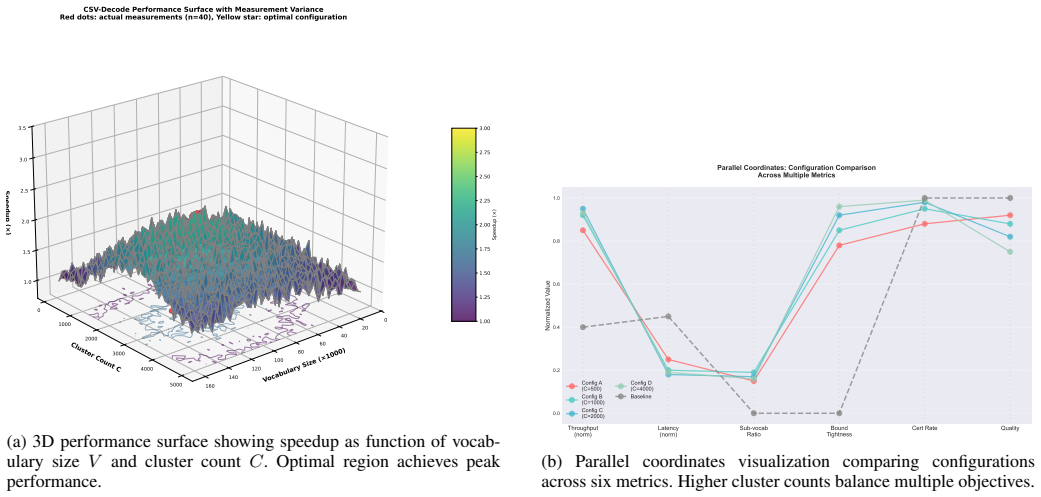
- [§V, Tables II–III] The headline speedup cannot be produced by the proposed mechanism. For Llama-3-8B (V=128,256, d=4,096), the output matrix has ~525M parameters ≈1.05 GB in FP16, versus ~16 GB for the whole model. In memory-bound decoding the output layer is ≤6.6% of per-step weight traffic; even deleting it entirely bounds the end-to-end gain by 1/(1−0.066)≈1.07×. With the reported |S|/V=18.4% sub-vocabulary, the expected gain is ~5%, not the 2.75× (TBT 52.3→19.1 ms) in Table II. The claimed 33.2 ms saving would require the output layer to occupy ~78% of baseline time. Additionally, Table II reports throughput 1,124 tok/s at TBT 52.3 ms, which implies ~59 concurrent sequences, outside the stated batch range 1–16 in §V. No component-level latency breakdown is given, so the speedup cannot be attributed to sparse GEMV; if it comes from CUDA Graphs or other system changes, the paper’s central contribution is
- [§III-B, Theorem 2] The softmax certification condition is not stated consistently with its proof. In Definition 2 and the theorem, Z_{S_t} is defined as the log-sum-exp (log Σ e^{ℓ_i}), while in the proof (Eqs. 21–25) Z_S is used as the plain sum Σ e^{ℓ_i}; the condition in Eq. (19) then mixes the two (e^{Z_S} appears). More importantly, the theorem’s sufficient condition uses |\bar{S}_t| e^{U_max}, whereas the proof introduces the cluster-wise tighter bound \hat{R} = Σ_{c∉C(S_t)} |c| e^{U_c} and states, without justification, that the two are equivalent. They are not: the cluster-wise sum is smaller, so satisfying the looser condition is sufficient but not necessary, and the algorithm as written depends on the unshown predicate SOFTMAX EPS CERTIFIED. The proof’s final TV formula R/(Z_S+R) is correct, but the theorem statement and the algorithm need to be aligned.
- [§IV, Algorithm 2] Algorithm 2, line 4, computes the local cluster bound as U_i ← ⟨h_t, μ_i⟩ + r_i + b_max^i. Eq. (13) defines U_c(h_t) = ⟨μ_c,h_t⟩ + R_c‖h_t‖_2 + max_{i∈c} b_i. Unless r_i is implicitly redefined as R_i‖h_t‖_2, the distributed workflow omits the norm factor and does not compute a valid upper bound. This is load-bearing for the multi-GPU scaling results in Table V, which rely on correct certification.
- [§V, Tables IV, VII–IX] The cross-task speedups reported for speculative-comparison benchmarks are not tied to the resource budget either. For example, Table VII reports 4.95× on 'CodeLlama 7&70B' while Table IV reports 2.67× on CodeLlama-13B; no definition of the paired model or its output-layer share is given. For Llama-3-70B (Table III, 2.90×), the output layer is an even smaller fraction of total weights, so the same arithmetic as in Comment 1 applies more strongly. These tables cannot be evaluated without benchmark definitions and component-level timings.
minor comments (5)
- [§IV, Sparse GEMV Kernel] The claim 'measured I=0.95 ops/byte hitting compute bound' is inconsistent with the roofline model: A100's FP16 ridge point is around 200 ops/byte; 0.95 ops/byte is deeply memory-bound, not compute-bound.
- [§IV, Sparse GEMV Kernel] The stated 156 TFLOPS on A100 is the dense FP16 Tensor Core peak, not an achieved kernel performance metric. Reporting a single TFLOPS number without wall-clock time and achieved bandwidth is not informative.
- [§II-B5] There is an unresolved citation marker '[?]' for the parallel speculative decoding work (PEARL).
- [§IV] The text says empirical coefficients α, β, γ for the cost model are provided in the appendix, but no appendix is included in the manuscript.
- [Table II] The abstract claims 99.3% quality retention, but Table II shows PPL 16.91 for CSV-Decode vs 16.85 for the baseline, which is ~99.65% retention. The discrepancy should be reconciled.
Circularity Check
No significant circularity: certification theorems follow from Cauchy-Schwarz bounds with no fitted or self-cited premises.
full rationale
The correctness derivation is self-contained. Equations (6)-(13) decompose each token embedding about its cluster centroid and use Cauchy-Schwarz to obtain the cluster-level upper bound U_c(h_t)=<mu_c,h_t>+R_c||h_t||_2+max_{i in c} b_i. Theorem 1 uses only this bound: if an outside token had logit above the k-th sub-vocabulary logit, then its cluster upper bound would also exceed it, contradicting the certification condition. Theorem 2 is a direct total-variation calculation, replacing the uncomputed outside mass by cluster-wise upper bounds; it does not presuppose the desired TV bound. Algorithm 1 opens clusters until the sufficient certification condition holds, so the certification condition is a proved criterion, not an assumed conclusion. The system-related elements that might look self-referential are not load-bearing: refs [9]-[13] are prior works by the authors cited only as related context, and the complexity model T_csv≈alpha(Cd)+beta(|S_t|d)+gamma plus the empirical curves S(V)=S0+alpha log(V/V0), |S_t|/V=..., and rho_fall=... are descriptive fits to reported measurements, not predictions used to derive the guarantees. Concerns that the reported end-to-end speedup magnitude is hard to explain by output-layer pruning alone are performance-measurement/correctness issues, not circularity of the mathematical derivation. No equation or fitted value is renamed as a prediction in a way that reduces the central claim to its inputs.
Assumptions & free parameters
free parameters (4)
- Cluster count C =
2000 (default); C_opt≈0.015·V from Fig. 1
- Softmax tolerance ε =
0.05 (default)
- Budget K_max and fallback parameters =
K_max adaptive with α=0.01, target ρ_fall=0.02
- Scaling-law coefficients =
S0=2.1, α=0.35, V0=32K; β=0.25, γ=0.8; δ=0.05, ϵ=0.1
assumptions (5)
- standard math Cauchy-Schwarz inequality
- domain assumption Each cluster c has finite radius R_c = max_i ‖W_i−μ_c‖₂
- domain assumption The approximate distribution p~ renormalizes sub-vocabulary masses
- domain assumption For the spherical variant, output embeddings are L2-normalized
- domain assumption Hidden state h_t is available and its norm can be computed at each step
Cite this review
Pith. "Pith review of CSV-Decode: Certifiable Sub-Vocabulary Decoding for Efficient Large Language Model Inference." pith.science (2026). https://pith.science/paper/W4F4SZ2E
@misc{pith2026251121702,
  author       = {Pith},
  title        = {Pith review of: CSV-Decode: Certifiable Sub-Vocabulary Decoding for Efficient Large Language Model Inference},
  year         = {2026},
  howpublished = {\url{https://pith.science/paper/W4F4SZ2E}},
  note         = {Machine review of arXiv:2511.21702}
}
abstract
Large language models face significant computational bottlenecks during inference due to the expensive output layer computation over large vocabularies. We present CSV-Decode, a novel approach that uses geometric upper bounds to construct small sub-vocabularies for each decoding step, enabling efficient sparse computation while maintaining dual correctness guarantees: exact top-$k$ certification and $\varepsilon$-certified softmax approximations. Our method clusters vocabulary embeddings offline and uses centroid-plus-radius bounds to identify which tokens can be safely omitted from computation. We provide a complete system implementation with sparse GEMV kernels, multi-GPU sharding, and CUDA Graph optimization. Experimental results demonstrate significant speedup over full vocabulary decoding while maintaining distributional guarantees and low fallback rates. Our code implementation available at \href{https://github.com/FastLM/CSV-Decode}{https://github.com/FastLM/CSV-Decode}.
Figures


Figures from the paper (1 more)

Reference graph
Works this paper leans on
-
[1]
Attention is all you need,
A. Vaswani, N. Shazeer, N. Parmar, J. Uszkoreit, L. Jones, A. N. Gomez, Ł. Kaiser, and I. Polosukhin, “Attention is all you need,” inAdvances in Neural Information Processing Systems, 2017
2017
-
[2]
Llama 2: Open foundation and fine-tuned chat models,
H. Touvron, L. Martin, K. Stone, P. Albert, A. Almahairi, Y . Babaei, N. Bashlykov, S. Batra, P. Bhargava, S. Bhosaleet al., “Llama 2: Open foundation and fine-tuned chat models,” inarXiv preprint arXiv:2307.09288, 2023
arXiv 2023
-
[3]
A. Q. Jiang, A. Sablayrolles, A. Mensch, C. Bamford, D. S. Chaplot, D. d. l. Casas, F. Bressand, G. Lengyel, G. Lample, L. Saulnieret al., “Mistral 7b,” inarXiv preprint arXiv:2310.06825, 2023
arXiv 2023
-
[4]
Efficient softmax ap- proximation for gpus,
E. Grave, A. Joulin, M. Cisse, and D. Grangier, “Efficient softmax ap- proximation for gpus,”Proceedings of the 34th International Conference on Machine Learning, 2017
2017
-
[5]
Efficient estimation of word representations in vector space,
T. Mikolov, K. Chen, G. Corrado, and J. Dean, “Efficient estimation of word representations in vector space,” inInternational Conference on Learning Representations, 2013
2013
-
[6]
Sparse convolutional neural networks,
B. Graham, “Sparse convolutional neural networks,” inProceedings of the IEEE Conference on Computer Vision and Pattern Recognition, 2014
2014
-
[7]
Reducing transformer depth on demand with structured dropout,
A. Fan, E. Grave, and A. Joulin, “Reducing transformer depth on demand with structured dropout,” inInternational Conference on Learning Representations, 2020
2020
-
[8]
Fast inference from trans- formers via speculative decoding,
Y . Leviathan, Y . Matias, and K. Radinsky, “Fast inference from trans- formers via speculative decoding,” inInternational Conference on Ma- chine Learning, 2023
2023
Show all 14 references
-
[9]
Designing large foundation models for efficient training and inference: A survey,
D. Liu, Y . Yu, Y . Wang, J. Wu, Z. Wan, S. Alinejad, B. Lengerich, and Y . N. Wu, “Designing large foundation models for efficient training and inference: A survey,” 2025, v5, April 14, 2025. [Online]. Available: https://arxiv.org/abs/2409.01990
2025 arXiv
-
[10]
MKA: Memory-keyed attention for efficient long-context reasoning,
D. Liu, Y . Yu, X. Wang, B. Lengerich, and Y . N. Wu, “MKA: Memory-keyed attention for efficient long-context reasoning,” inICML 2025 Workshop on Long-Context Foundation Models, 2025. [Online]. Available: https://openreview.net/forum?id=r1GbqYMJys
2025
-
[11]
Tinyserve: Query-aware cache selection for efficient llm serving,
D. Liu and Y . Yu, “Tinyserve: Query-aware cache selection for efficient llm serving,” 2025. [Online]. Available: https://arxiv.org/abs/2509.12211
2025
-
[12]
Pikv: Parallel distributed key-value cache for efficient llm inference,
D. Liu, X. Sun, M. Crowley, J. Zou, C. Zhang, Y . He, B. Lengerich, and Y . N. Wu, “Pikv: Parallel distributed key-value cache for efficient llm inference,” 2025. [Online]. Available: https://arxiv.org/abs/2508.06526
2025 arXiv
-
[13]
Llmeasyquant: Scalable quantization for parallel and distributed llm inference,
D. Liu and Y . Yu, “Llmeasyquant: Scalable quantization for parallel and distributed llm inference,” 2024. [Online]. Available: https://arxiv.org/abs/2406.19657
2024
-
[14]
Flashattention- 2: Faster attention with better parallelism and work partitioning,
T. Dao, D. Y . Fu, S. Ermon, A. Rudra, and C. R ´e, “Flashattention- 2: Faster attention with better parallelism and work partitioning,” in Advances in Neural Information Processing Systems. New Orleans, LA, USA: Curran Associates, Inc., 2023, pp. 1–15
2023
Reviewed August 3, 2026 · model on record in the stance chip above.
Discussion (0). Sign in to comment.