Exact four-vector work distribution and covariant fluctuation theorems of work for a relativistic particle in an expanding piston
Pith reviewed 2026-05-17 04:56 UTC · model grok-4.3
The pith
The joint distribution of four-vector work (W^0, W^1) for a relativistic particle in an expanding piston concentrates on the origin and specific curves rather than spreading smoothly.
A machine-rendered reading of the paper's core claim, the machinery that carries it, and where it could break.
Core claim
We derive the exact work distribution in this pedagogical model and find that the joint distribution of four-vector work (W^0, W^1) concentrates on the origin and some curves in the (W^0, W^1) space, rather than being smoothly distributed. In the non-relativistic limit, our model consistently recovers the non-relativistic dynamics. We further demonstrate that the momentum component of four-vector work remains significant in both the Lorentz-relativistic and Galilean-relativistic frameworks. On top of the work distribution, we verify a family of covariant fluctuation theorems of work.
What carries the argument
The four-vector work (W^0, W^1) whose support is restricted to the origin and discrete curves generated by successive instantaneous elastic collisions with a piston whose trajectory is prescribed externally.
If this is right
- The non-relativistic limit of the distribution reproduces the known one-dimensional expanding-piston results.
- The spatial component of the four-vector work stays appreciable even when the motion is only mildly relativistic.
- A family of covariant fluctuation theorems holds exactly for the four-vector work extracted from the collisions.
- The geometrical tracing of collision events extends without change to two- or three-dimensional piston geometries.
Where Pith is reading between the lines
- The curve-supported distribution implies that relativistic work is exchanged only at discrete momentum transfers set by the piston velocity at each bounce.
- The same geometrical construction could be applied to a particle reflecting from a moving mirror in electromagnetic or gravitational backgrounds.
- Measuring the joint statistics of energy and momentum transfer in a high-energy particle trap would directly test whether the support remains confined to curves.
Load-bearing premise
The piston expands according to a fixed external schedule and experiences no recoil or back-action from the particle collisions.
What would settle it
A direct numerical simulation of many particle-piston collisions that produces a continuous cloud of (W^0, W^1) points filling an area instead of lying on isolated curves would show the derived distribution is incorrect.
Figures


read the original abstract
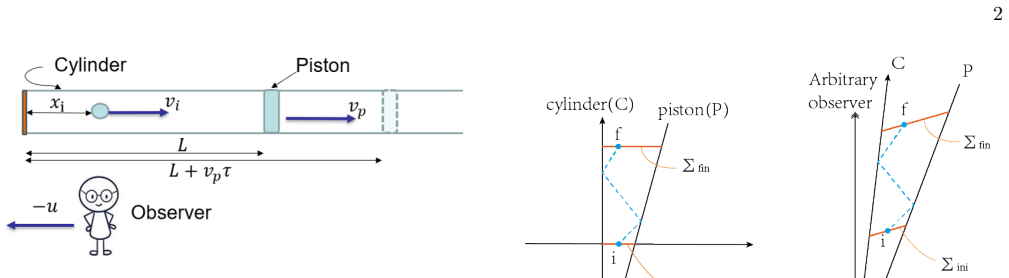
We investigate the non-equilibrium four-vector work in an expanding relativistic piston. We derive the exact work distribution in this pedagogical model and find that the joint distribution of four-vector work $(W^0, W^1)$ concentrates on the origin and some curves in the $(W^0, W^1)$ space, rather than being smoothly distributed. In the non-relativistic limit, our model consistently recovers the non-relativistic dynamics. We further demonstrate that the momentum component of four-vector work remains significant in both the Lorentz-relativistic and Galilean-relativistic frameworks. On top of the work distribution, we verify a family of covariant fluctuation theorems of work. In addition, we introduce a novel geometrical technique for analyzing the dynamics of relativistic collision processes, which can be straightforwardly extended to multi-dimensional piston models.
Editorial analysis
A structured set of objections, weighed in public.
Referee Report
Summary. The manuscript derives the exact four-vector work distribution for a single relativistic particle undergoing instantaneous elastic collisions with a piston whose expansion trajectory is prescribed externally. The joint distribution of the work four-vector components (W^0, W^1) is reported to concentrate on the origin and specific curves in the (W^0, W^1) plane rather than being continuously distributed. The non-relativistic limit is recovered, the momentum component of work is shown to remain significant, a family of covariant fluctuation theorems is verified, and a geometrical technique for analyzing relativistic collisions is introduced that may extend to multi-dimensional cases.
Significance. If the derivations are exact and the covariance holds without hidden frame dependence, the work provides a clean pedagogical model for relativistic stochastic thermodynamics. The concentration of the distribution on curves is a distinctive feature with potential implications for fluctuation relations in relativistic systems. The covariant theorems and geometrical method represent concrete advances that could be built upon in extensions to many-particle or higher-dimensional relativistic piston models.
major comments (2)
- [§2] §2 (Model definition): The piston trajectory is fixed externally in one inertial frame with no back-action from the particle. Because the four-vector work and the fluctuation theorems are constructed from this frame-specific protocol, it is unclear whether the reported concentration on curves and the covariant theorems survive a Lorentz boost of the entire process (including the transformed piston motion). An explicit check in a boosted frame is required to substantiate the covariance claim.
- [§4] §4 (Derivation of work distribution): The exact mapping from collision sequences to the support of the (W^0, W^1) distribution is central to the main result. The manuscript should provide the explicit relation between the number of collisions, the instantaneous velocities, and the resulting work values to confirm that the support is strictly confined to curves and the origin rather than acquiring a finite width from any continuous aspect of the dynamics.
minor comments (2)
- [Notation] The notation for the four-vector work components should be accompanied by the explicit transformation rules under Lorentz boosts to make the covariance statements immediately verifiable.
- [Figures] Figure captions for the work-distribution plots would benefit from indicating which curves correspond to zero, one, two, etc., collisions so that readers can directly connect the geometry to the collision counting.
Simulated Author's Rebuttal
We thank the referee for their careful reading, positive assessment, and constructive comments. We address each major comment point by point below, providing clarifications and committing to revisions that strengthen the manuscript without altering its core claims.
read point-by-point responses
-
Referee: [§2] §2 (Model definition): The piston trajectory is fixed externally in one inertial frame with no back-action from the particle. Because the four-vector work and the fluctuation theorems are constructed from this frame-specific protocol, it is unclear whether the reported concentration on curves and the covariant theorems survive a Lorentz boost of the entire process (including the transformed piston motion). An explicit check in a boosted frame is required to substantiate the covariance claim.
Authors: We agree that an explicit check in a boosted frame provides stronger substantiation for the covariance. While the four-vector definition of work and the Lorentz-invariant collision rules already indicate that the results should hold, we will add a dedicated subsection (or appendix) in the revised manuscript. There, we explicitly transform the piston trajectory and initial conditions under a Lorentz boost, recompute the collision sequence using the geometrical technique, and verify that the support of the joint (W^0, W^1) distribution remains confined to the origin and the same family of curves, with the covariant fluctuation theorems preserved in form and validity. revision: yes
-
Referee: [§4] §4 (Derivation of work distribution): The exact mapping from collision sequences to the support of the (W^0, W^1) distribution is central to the main result. The manuscript should provide the explicit relation between the number of collisions, the instantaneous velocities, and the resulting work values to confirm that the support is strictly confined to curves and the origin rather than acquiring a finite width from any continuous aspect of the dynamics.
Authors: We thank the referee for this request for explicitness. In the revised §4 we will insert the direct mapping: for a sequence of n collisions occurring at times t_i with instantaneous piston velocities v_p(t_i), the four-vector work components are obtained from the relativistic momentum and energy transfers at each collision via the elastic collision law. This yields W^0 = sum_i Delta E_i and W^1 = sum_i Delta p_i, where each Delta is fixed by the pre- and post-collision four-velocities. Consequently, for each fixed n the possible (W^0, W^1) pairs lie exactly on a curve parameterized by the ordered collision times; the origin corresponds to the zero-collision trajectory. Because the piston motion is prescribed and collisions are instantaneous, no continuous parameter remains to generate finite width. revision: yes
Circularity Check
Derivation of four-vector work distribution proceeds from explicit model dynamics without reduction to inputs or self-citations
full rationale
The paper constructs the work distribution from the relativistic collision rules and the externally prescribed piston trajectory in the given inertial frame. The concentration of the joint (W^0, W^1) distribution on the origin and discrete curves follows directly from the instantaneous elastic scattering kinematics and the fixed expansion law; this is an output of the dynamics, not a redefinition or fit. Recovery of the non-relativistic limit is shown by taking the appropriate velocity limit on the same equations. The covariant fluctuation theorems are verified by direct substitution into the derived distribution. No load-bearing step reduces to a prior result by the same authors, no parameter is fitted to a subset and then relabeled as a prediction, and no ansatz is smuggled via self-citation. The derivation is therefore self-contained against the stated model assumptions.
Axiom & Free-Parameter Ledger
axioms (2)
- domain assumption Instantaneous elastic collisions between particle and piston walls preserve the relativistic energy-momentum relation.
- domain assumption Piston expansion is prescribed externally with no back-reaction from the particle.
Lean theorems connected to this paper
-
IndisputableMonolith/Cost/FunctionalEquation.leanwashburn_uniqueness_aczel unclear?
unclearRelation between the paper passage and the cited Recognition theorem.
We derive the exact work distribution... joint distribution of four-vector work (W^0, W^1) concentrates on the origin and some curves... verify a family of covariant fluctuation theorems of work.
-
IndisputableMonolith/Foundation/RealityFromDistinction.leanreality_from_one_distinction unclear?
unclearRelation between the paper passage and the cited Recognition theorem.
We introduce a novel geometrical technique for analyzing the dynamics of relativistic collision processes... orthogonal reflection with respect to a hypersurface
What do these tags mean?
- matches
- The paper's claim is directly supported by a theorem in the formal canon.
- supports
- The theorem supports part of the paper's argument, but the paper may add assumptions or extra steps.
- extends
- The paper goes beyond the formal theorem; the theorem is a base layer rather than the whole result.
- uses
- The paper appears to rely on the theorem as machinery.
- contradicts
- The paper's claim conflicts with a theorem or certificate in the canon.
- unclear
- Pith found a possible connection, but the passage is too broad, indirect, or ambiguous to say the theorem truly supports the claim.
Reference graph
Works this paper leans on
- [1]
-
[2]
N. G. van Kampen, Relativistic thermodynamics of mov- ing systems, Phys. Rev.173, 295 (1968)
work page 1968
-
[3]
N. G. van Kampen, Relativistic thermodynamics, J. Phys. Soc. Jpn. Suppl.26, 316 (1969)
work page 1969
-
[4]
W. Israel and J. Stewart, Transient relativistic thermo- dynamics and kinetic theory, Annals of Physics118, 341 (1979). 16
work page 1979
-
[5]
W. Israel, Thermodynamics of relativistic systems, Phys- ica A: Statistical Mechanics and its Applications106, 204 (1981)
work page 1981
-
[6]
J.-F. Chen and H. T. Quan, Hierarchical structure of fluc- tuation theorems for a driven system in contact with mul- tiple heat reservoirs, Phys. Rev. E107, 024135 (2023)
work page 2023
- [7]
-
[8]
R. C. Lua and A. Y. Grosberg, Practical applicability of the jarzynski relation in statistical mechanics: A peda- gogical example, J. Phys. Chem. B109, 6805 (2005)
work page 2005
- [9]
-
[10]
H. T. Quan and C. Jarzynski, Validity of nonequilibrium work relations for the rapidly expanding quantum piston, Phys. Rev. E85, 031102 (2012)
work page 2012
-
[11]
Z. Fei, J. Zhang, R. Pan, T. Qiu, and H. T. Quan, Quan- tum work distributions associated with the dynamical casimir effect, Phys. Rev. A99, 052508 (2019)
work page 2019
-
[12]
T. Qiu, Z. Fei, R. Pan, and H. T. Quan, Path-integral approach to the calculation of the characteristic function of work, Phys. Rev. E101, 032111 (2020)
work page 2020
-
[13]
Z. Gong, Y. Lan, and H. T. Quan, Stochastic thermo- dynamics of a particle in a box, Phys. Rev. Lett.117, 180603 (2016)
work page 2016
-
[14]
Jarzynski, Nonequilibrium equality for free energy dif- ferences, Phys
C. Jarzynski, Nonequilibrium equality for free energy dif- ferences, Phys. Rev. Lett.78, 2690 (1997)
work page 1997
-
[15]
G. T. Moore, Quantum theory of the electromagnetic field in a variable-length one-dimensional cavity, J. Math. Phys.11, 2679 (1970)
work page 1970
-
[16]
M. Koehn, Solutions of the klein-gordon equation in an infinite square-well potential with a moving wall, Euro- phys. Lett.100, 60008 (2013)
work page 2013
-
[17]
F. J¨ uttner, Das Maxwellsche Gesetz der Geschwindigkeitsverteilung in der Relativtheorie, Annalen der Physik339, 856 (1911)
work page 1911
-
[18]
R. Hakim,Introduction to Relativistic Statistical Mechan- ics: Classical and Quantum(WORLD SCIENTIFIC, 2011)
work page 2011
-
[19]
J. L. Synge,The relativistic gas(North-Holland Publish- ing Company, Amsterdam; Interscience Publishers Inc., New York, 1957)
work page 1957
-
[20]
R. Nolte and A. Engel, Jarzynski equation for the expan- sion of a relativistic gas and black-body radiation, Phys- ica A: Statistical Mechanics and its Applications388, 3752 (2009)
work page 2009
discussion (0)
Sign in with ORCID, Apple, or X to comment. Anyone can read and Pith papers without signing in.