FACT-GS: Frequency-Aligned Complexity-Aware Texture Reparameterization for 2D Gaussian Splatting
Pith reviewed 2026-05-17 04:38 UTC · model grok-4.3
The pith
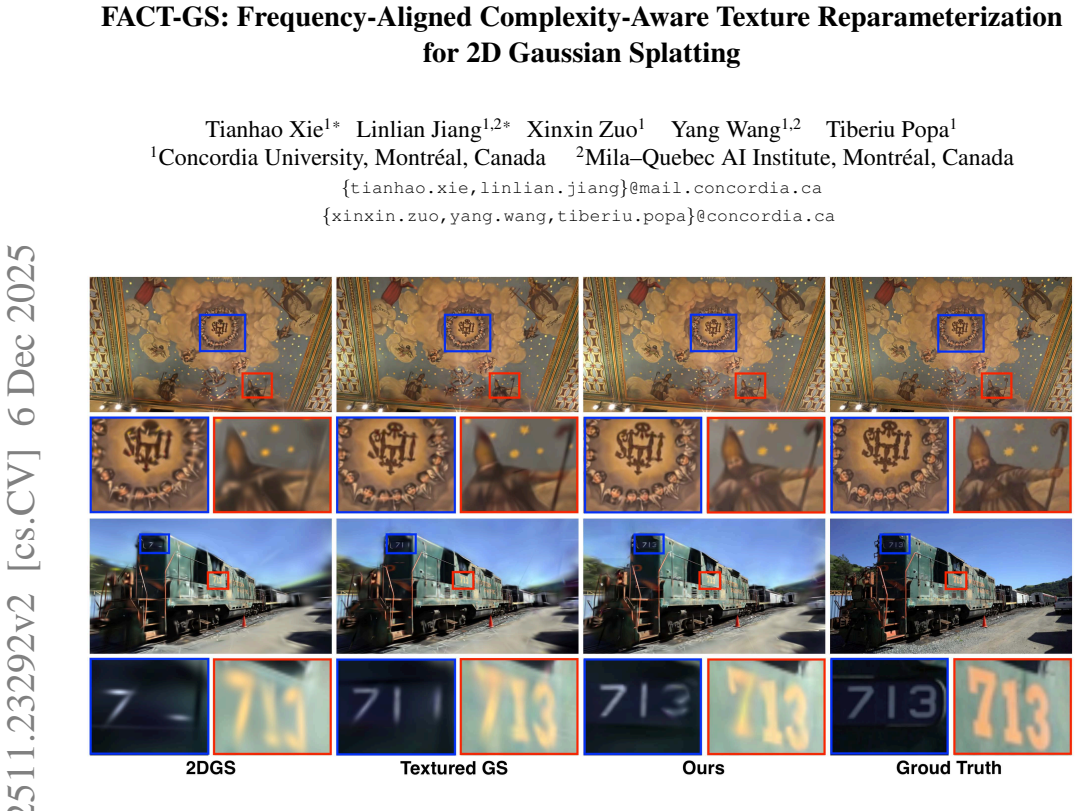
FACT-GS replaces uniform texture grids in 2D Gaussian Splatting with a learnable deformation field that allocates sampling density according to local visual frequency.
A machine-rendered reading of the paper's core claim, the machinery that carries it, and where it could break.
Core claim
FACT-GS reformulates texture parameterization as a differentiable sampling-density allocation problem, replacing the uniform textures with a learnable frequency-aware allocation strategy implemented via a deformation field whose Jacobian modulates local sampling density. Built on 2D Gaussian Splatting, FACT-GS performs non-uniform sampling on fixed-resolution texture grids, preserving real-time performance while recovering sharper high-frequency details under the same parameter budget.
What carries the argument
A deformation field whose Jacobian modulates local sampling density, reallocating fixed texture samples toward regions of higher visual frequency.
If this is right
- High-frequency scene content receives denser sampling without raising total texture parameters.
- Real-time rendering speed remains unchanged because the texture grid resolution is fixed.
- Texture space is used more efficiently across primitives with varying visual complexity.
- The approach stays compatible with existing 2D Gaussian Splatting pipelines.
Where Pith is reading between the lines
- The same Jacobian-based density modulation could be tested on 3D Gaussian primitives or other splatting variants to check whether the frequency alignment benefit scales beyond 2D.
- If the deformation field generalizes, it might reduce the need for multi-resolution texture pyramids in future real-time renderers.
- The method opens a path to integrate local frequency estimation directly into the optimization loop rather than as a separate preprocessing step.
Load-bearing premise
The learned deformation field can be optimized so its Jacobian aligns sampling density with true visual frequency without causing instability, aliasing, or visible artifacts at the original parameter budget.
What would settle it
Side-by-side rendering of the same scene with equal texture resolution and parameter count, checking whether high-frequency edges and textures appear measurably sharper or less aliased under the new allocation than under uniform grids.
Figures


read the original abstract
Realistic scene appearance modeling has advanced rapidly with Gaussian Splatting, which enables real-time, high-quality rendering. Recent advances introduced per-primitive textures that incorporate spatial color variations within each Gaussian, improving their expressiveness. However, texture-based Gaussians parameterize appearance with a uniform per-Gaussian sampling grid, allocating equal sampling density regardless of local visual complexity, which leads to inefficient texture space utilization. We introduce FACT-GS, a Frequency-Aligned Complexity-aware Texture Gaussian Splatting framework that allocates texture sampling density according to local visual frequency. Grounded in adaptive sampling theory, FACT-GS reformulates texture parameterization as a differentiable sampling-density allocation problem, replacing the uniform textures with a learnable frequency-aware allocation strategy implemented via a deformation field whose Jacobian modulates local sampling density. Built on 2D Gaussian Splatting, FACT-GS performs non-uniform sampling on fixed-resolution texture grids, preserving real-time performance while recovering sharper high-frequency details under the same parameter budget.
Editorial analysis
A structured set of objections, weighed in public.
Referee Report
Summary. The paper introduces FACT-GS, a Frequency-Aligned Complexity-Aware Texture Gaussian Splatting framework built on 2D Gaussian Splatting. It claims to reformulate per-Gaussian texture parameterization as a differentiable sampling-density allocation problem, replacing uniform sampling grids with a learnable frequency-aware strategy implemented via a deformation field whose Jacobian modulates local sampling density. This is intended to allocate higher sampling density to high-frequency regions, recovering sharper details under a fixed parameter budget while preserving real-time rendering performance.
Significance. If the central mechanism holds, the work could improve texture utilization efficiency in Gaussian Splatting without sacrificing speed, offering a grounded approach from adaptive sampling theory to better handle visual complexity. The explicit focus on maintaining real-time performance under the same budget is a practical strength.
major comments (2)
- [Abstract] Abstract: The reformulation relies on a learnable deformation field whose Jacobian modulates local sampling density, but no equations, parameterization details, or integration steps into the 2DGS pipeline are provided. This absence prevents verification of how frequency alignment is achieved or how the modulation interacts with the fixed-resolution texture grid.
- [Abstract] Abstract: The description states that the Jacobian modulates sampling density in a frequency-aware manner, yet provides no indication of regularization, projection, or constraints to enforce Jacobian determinant > 0 everywhere. Without such terms, gradient descent risks producing folds, negative densities, or aliasing artifacts that would directly contradict the claim of improved high-frequency recovery without visible degradation.
minor comments (1)
- [Abstract] The abstract could be strengthened by briefly noting the specific loss terms or optimization schedule used to train the deformation field.
Simulated Author's Rebuttal
We thank the referee for the constructive feedback on our work. We address each major comment point by point below, clarifying the technical details and making targeted revisions to improve the presentation of the method.
read point-by-point responses
-
Referee: [Abstract] Abstract: The reformulation relies on a learnable deformation field whose Jacobian modulates local sampling density, but no equations, parameterization details, or integration steps into the 2DGS pipeline are provided. This absence prevents verification of how frequency alignment is achieved or how the modulation interacts with the fixed-resolution texture grid.
Authors: We agree that the abstract, being a high-level summary, does not include the full equations. The complete parameterization of the deformation field, the Jacobian-based density modulation, frequency alignment mechanism, and integration steps with the 2D Gaussian Splatting pipeline are provided in Section 3.2 (Equations 3-6) and Section 3.3 of the manuscript. To address the verification concern directly, we have revised the abstract to include a concise reference to the core formulation and key equation. revision: yes
-
Referee: [Abstract] Abstract: The description states that the Jacobian modulates sampling density in a frequency-aware manner, yet provides no indication of regularization, projection, or constraints to enforce Jacobian determinant > 0 everywhere. Without such terms, gradient descent risks producing folds, negative densities, or aliasing artifacts that would directly contradict the claim of improved high-frequency recovery without visible degradation.
Authors: This is a valid concern regarding numerical stability. The manuscript includes a regularization term in the total loss (Section 4.2, Equation 10) that penalizes negative Jacobian determinants to prevent folding and ensure positive local densities. We also apply a soft projection during optimization to maintain invertibility. We have expanded the method section with an explicit paragraph on these safeguards and added an ablation study quantifying their impact on artifact reduction. revision: yes
Circularity Check
No significant circularity; derivation introduces independent learnable component.
full rationale
The paper's central construction replaces uniform texture grids with a new learnable deformation field whose Jacobian is used to modulate sampling density in a frequency-aware way. This is presented as an explicit reformulation grounded in adaptive sampling theory, adding a differentiable component rather than re-expressing a prior fitted quantity, renaming a known result, or reducing via self-citation to an unverified premise. The abstract and description contain no equations or steps that equate the output allocation directly to the input by construction, and the method is described as preserving real-time performance under the same parameter budget without invoking load-bearing self-references.
Axiom & Free-Parameter Ledger
axioms (1)
- domain assumption Adaptive sampling theory justifies allocating density according to local visual frequency
invented entities (1)
-
learnable deformation field whose Jacobian modulates sampling density
no independent evidence
Lean theorems connected to this paper
-
IndisputableMonolith/Foundation/AlexanderDuality.leanalexander_duality_circle_linking unclear?
unclearRelation between the paper passage and the cited Recognition theorem.
reformulates texture parameterization as a differentiable sampling-density allocation problem, replacing the uniform textures with a learnable frequency-aware allocation strategy implemented via a deformation field whose Jacobian modulates local sampling density
-
IndisputableMonolith/Foundation/Cost/FunctionalEquation.leanwashburn_uniqueness_aczel unclear?
unclearRelation between the paper passage and the cited Recognition theorem.
the induced sampling density is modulated by |det J_Φ(u,v)|
What do these tags mean?
- matches
- The paper's claim is directly supported by a theorem in the formal canon.
- supports
- The theorem supports part of the paper's argument, but the paper may add assumptions or extra steps.
- extends
- The paper goes beyond the formal theorem; the theorem is a base layer rather than the whole result.
- uses
- The paper appears to rely on the theorem as machinery.
- contradicts
- The paper's claim conflicts with a theorem or certificate in the canon.
- unclear
- Pith found a possible connection, but the passage is too broad, indirect, or ambiguous to say the theorem truly supports the claim.
Reference graph
Works this paper leans on
-
[1]
Building rome in a day.Communications of the ACM, 54 (10):105–112, 2011
Sameer Agarwal, Yasutaka Furukawa, Noah Snavely, Ian Si- mon, Brian Curless, Steven M Seitz, and Richard Szeliski. Building rome in a day.Communications of the ACM, 54 (10):105–112, 2011. 2
work page 2011
-
[2]
Mip-nerf: A multiscale representation for anti-aliasing neu- ral radiance fields
Jonathan T Barron, Ben Mildenhall, Matthew Tancik, Peter Hedman, Ricardo Martin-Brualla, and Pratul P Srinivasan. Mip-nerf: A multiscale representation for anti-aliasing neu- ral radiance fields. InProceedings of the IEEE/CVF inter- national conference on computer vision, pages 5855–5864,
-
[3]
Mip-nerf 360: Unbounded anti-aliased neural radiance fields
Jonathan T Barron, Ben Mildenhall, Dor Verbin, Pratul P Srinivasan, and Peter Hedman. Mip-nerf 360: Unbounded anti-aliased neural radiance fields. InProceedings of the IEEE/CVF conference on computer vision and pattern recognition, pages 5470–5479, 2022. 2, 6, 7
work page 2022
-
[4]
Textured gaussians for en- hanced 3d scene appearance modeling
Brian Chao, Hung-Yu Tseng, Lorenzo Porzi, Chen Gao, Tuotuo Li, Qinbo Li, Ayush Saraf, Jia-Bin Huang, Johannes Kopf, Gordon Wetzstein, et al. Textured gaussians for en- hanced 3d scene appearance modeling. InProceedings of the Computer Vision and Pattern Recognition Conference, pages 8964–8974, 2025. 1, 2, 3, 5, 6, 7, 8
work page 2025
-
[5]
Ahmet M Eskicioglu and Paul S Fisher. Image quality mea- sures and their performance.IEEE Transactions on commu- nications, 43(12):2959–2965, 2002. 4, 5, 8
work page 2002
-
[6]
Flashgs: Efficient 3d gaussian splatting for large-scale and high-resolution rendering
Guofeng Feng, Siyan Chen, Rong Fu, Zimu Liao, Yi Wang, Tao Liu, Boni Hu, Linning Xu, Zhilin Pei, Hengjie Li, et al. Flashgs: Efficient 3d gaussian splatting for large-scale and high-resolution rendering. InProceedings of the Computer Vision and Pattern Recognition Conference, pages 26652– 26662, 2025. 2
work page 2025
-
[7]
Dy- namic 3d gaussian fields for urban areas.arXiv preprint arXiv:2406.03175, 2024
Tobias Fischer, Jonas Kulhanek, Samuel Rota Bulo, Lorenzo Porzi, Marc Pollefeys, and Peter Kontschieder. Dy- namic 3d gaussian fields for urban areas.arXiv preprint arXiv:2406.03175, 2024. 2
-
[8]
Colmap-free 3d gaussian splat- ting
Yang Fu, Sifei Liu, Amey Kulkarni, Jan Kautz, Alexei A Efros, and Xiaolong Wang. Colmap-free 3d gaussian splat- ting. InProceedings of the IEEE/CVF Conference on Com- puter Vision and Pattern Recognition, pages 20796–20805,
-
[9]
Yasutaka Furukawa and Jean Ponce. Accurate, dense, and robust multiview stereopsis.IEEE transactions on pattern analysis and machine intelligence, 32(8):1362–1376, 2009. 2
work page 2009
-
[10]
Towards internet-scale multi-view stereo
Yasutaka Furukawa, Brian Curless, Steven M Seitz, and Richard Szeliski. Towards internet-scale multi-view stereo. In2010 IEEE computer society conference on computer vi- sion and pattern recognition, pages 1434–1441. IEEE, 2010. 2
work page 2010
-
[11]
Multidimensional adap- tive sampling and reconstruction for ray tracing
Toshiya Hachisuka, Wojciech Jarosz, Richard Peter Weistroffer, Kevin Dale, Greg Humphreys, Matthias Zwicker, and Henrik Wann Jensen. Multidimensional adap- tive sampling and reconstruction for ray tracing. InACM SIGGRAPH 2008 papers, pages 1–10. 2008. 2, 3
work page 2008
-
[12]
Fundamentals of texture mapping and im- age warping
Paul S Heckbert. Fundamentals of texture mapping and im- age warping. 1989. 2
work page 1989
-
[13]
Survey of texture mapping.IEEE computer graphics and applications, 6(11):56–67, 2007
Paul S Heckbert. Survey of texture mapping.IEEE computer graphics and applications, 6(11):56–67, 2007. 3
work page 2007
-
[14]
2d gaussian splatting for geometrically ac- curate radiance fields
Binbin Huang, Zehao Yu, Anpei Chen, Andreas Geiger, and Shenghua Gao. 2d gaussian splatting for geometrically ac- curate radiance fields. InACM SIGGRAPH 2024 conference papers, pages 1–11, 2024. 1, 2, 3, 6, 7, 8
work page 2024
-
[15]
Zhentao Huang and Minglun Gong. Textured-gs: Gaus- sian splatting with spatially defined color and opacity.arXiv preprint arXiv:2407.09733, 2024. 2, 3, 7, 8
-
[16]
Large scale multi-view stereopsis eval- uation
Rasmus Jensen, Anders Dahl, George V ogiatzis, Engin Tola, and Henrik Aanæs. Large scale multi-view stereopsis eval- uation. InProceedings of the IEEE conference on computer vision and pattern recognition, pages 406–413, 2014. 6, 7
work page 2014
-
[17]
3d gaussian splatting for real-time radiance field rendering.ACM Trans
Bernhard Kerbl, Georgios Kopanas, Thomas Leimk ¨uhler, and George Drettakis. 3d gaussian splatting for real-time radiance field rendering.ACM Trans. Graph., 42(4):139–1,
-
[18]
Arno Knapitsch, Jaesik Park, Qian-Yi Zhou, and Vladlen Koltun. Tanks and temples: Benchmarking large-scale scene reconstruction.ACM Transactions on Graphics (ToG), 36 (4):1–13, 2017. 6, 7
work page 2017
-
[19]
Wildgaussians: 3d gaussian splatting in the wild,
Jonas Kulhanek, Songyou Peng, Zuzana Kukelova, Marc Pollefeys, and Torsten Sattler. Wildgaussians: 3d gaussian splatting in the wild.arXiv preprint arXiv:2407.08447, 2024. 2
-
[20]
Mosca: Dynamic gaussian fusion from casual videos via 4d motion scaffolds
Jiahui Lei, Yijia Weng, Adam W Harley, Leonidas Guibas, and Kostas Daniilidis. Mosca: Dynamic gaussian fusion from casual videos via 4d motion scaffolds. InProceedings of the Computer Vision and Pattern Recognition Conference, pages 6165–6177, 2025. 3
work page 2025
-
[21]
3d-hgs: 3d half-gaussian splatting
Haolin Li, Jinyang Liu, Mario Sznaier, and Octavia Camps. 3d-hgs: 3d half-gaussian splatting. InProceedings of the Computer Vision and Pattern Recognition Conference, pages 10996–11005, 2025. 3 9
work page 2025
-
[22]
Jiahe Li, Jiawei Zhang, Xiao Bai, Jin Zheng, Xin Ning, Jun Zhou, and Lin Gu. Dngaussian: Optimizing sparse-view 3d gaussian radiance fields with global-local depth normaliza- tion. InProceedings of the IEEE/CVF conference on com- puter vision and pattern recognition, pages 20775–20785,
-
[23]
Vastgaussian: Vast 3d gaussians for large scene reconstruction
Jiaqi Lin, Zhihao Li, Xiao Tang, Jianzhuang Liu, Shiyong Liu, Jiayue Liu, Yangdi Lu, Xiaofei Wu, Songcen Xu, You- liang Yan, et al. Vastgaussian: Vast 3d gaussians for large scene reconstruction. InProceedings of the IEEE/CVF Con- ference on Computer Vision and Pattern Recognition, pages 5166–5175, 2024. 2
work page 2024
-
[24]
Xi Liu, Chaoyi Zhou, and Siyu Huang. 3dgs-enhancer: Enhancing unbounded 3d gaussian splatting with view- consistent 2d diffusion priors.Advances in Neural Informa- tion Processing Systems, 37:133305–133327, 2024. 3
work page 2024
-
[25]
Srinivasan, Rodrigo Ortiz-Cayon, Nima Khademi Kalantari, Ravi Ramamoorthi, Ren Ng, and Abhishek Kar
Ben Mildenhall, Pratul P. Srinivasan, Rodrigo Ortiz-Cayon, Nima Khademi Kalantari, Ravi Ramamoorthi, Ren Ng, and Abhishek Kar. Local light field fusion: Practical view syn- thesis with prescriptive sampling guidelines.ACM Transac- tions on Graphics (TOG), 2019. 6, 7
work page 2019
-
[26]
Ben Mildenhall, Pratul P Srinivasan, Matthew Tancik, Jonathan T Barron, Ravi Ramamoorthi, and Ren Ng. Nerf: Representing scenes as neural radiance fields for view syn- thesis.Communications of the ACM, 65(1):99–106, 2021. 2, 6, 7
work page 2021
-
[27]
Matt Pharr, Bartlomiej Wronski, Marco Salvi, and Marcos Fajardo. Filtering after shading with stochastic texture fil- tering.Proceedings of the ACM on Computer Graphics and Interactive Techniques, 7(1):1–20, 2024. 3
work page 2024
-
[28]
Victor Rong, Jingxiang Chen, Sherwin Bahmani, Kiriakos N Kutulakos, and David B Lindell. Gstex: Per-primitive tex- turing of 2d gaussian splatting for decoupled appearance and geometry modeling. In2025 IEEE/CVF Winter Conference on Applications of Computer Vision (WACV), pages 3508–
- [29]
-
[30]
Fabrice Rousselle, Claude Knaus, and Matthias Zwicker. Adaptive sampling and reconstruction using greedy error minimization.ACM Transactions on Graphics (TOG), 30 (6):1–12, 2011. 2, 3, 4
work page 2011
-
[31]
Texture mapping progressive meshes
Pedro V Sander, John Snyder, Steven J Gortler, and Hugues Hoppe. Texture mapping progressive meshes. InProceed- ings of the 28th annual conference on Computer graphics and interactive techniques, pages 409–416, 2001. 2, 4
work page 2001
-
[32]
Structure- from-motion revisited
Johannes L Schonberger and Jan-Michael Frahm. Structure- from-motion revisited. InProceedings of the IEEE con- ference on computer vision and pattern recognition, pages 4104–4113, 2016. 2
work page 2016
-
[33]
A comparison and eval- uation of multi-view stereo reconstruction algorithms
Steven M Seitz, Brian Curless, James Diebel, Daniel Scharstein, and Richard Szeliski. A comparison and eval- uation of multi-view stereo reconstruction algorithms. In 2006 IEEE computer society conference on computer vision and pattern recognition (CVPR’06), pages 519–528. IEEE, 2006
work page 2006
-
[34]
Photo tourism: exploring photo collections in 3d
Noah Snavely, Steven M Seitz, and Richard Szeliski. Photo tourism: exploring photo collections in 3d. InACM siggraph 2006 papers, pages 835–846. 2006
work page 2006
-
[35]
Noah Snavely, Steven M Seitz, and Richard Szeliski. Model- ing the world from internet photo collections.International journal of computer vision, 80(2):189–210, 2008. 2
work page 2008
-
[36]
Hdgs: Textured 2d gaussian splatting for enhanced scene rendering.arXiv preprint arXiv:2412.01823,
Yunzhou Song, Heguang Lin, Jiahui Lei, Lingjie Liu, and Kostas Daniilidis. Hdgs: Textured 2d gaussian splatting for enhanced scene rendering.arXiv preprint arXiv:2412.01823,
-
[37]
Svg-ir: Spatially-varying gaussian splatting for in- verse rendering
Hanxiao Sun, Yupeng Gao, Jin Xie, Jian Yang, and Beibei Wang. Svg-ir: Spatially-varying gaussian splatting for in- verse rendering. InProceedings of the Computer Vision and Pattern Recognition Conference, pages 16143–16152, 2025. 3
work page 2025
-
[38]
Neural brdf representation and importance sampling
Alejandro Sztrajman, Gilles Rainer, Tobias Ritschel, and Tim Weyrich. Neural brdf representation and importance sampling. InComputer Graphics Forum, pages 332–346. Wiley Online Library, 2021. 2, 3
work page 2021
-
[39]
Block-nerf: Scalable large scene neural view synthesis
Matthew Tancik, Vincent Casser, Xinchen Yan, Sabeek Prad- han, Ben Mildenhall, Pratul P Srinivasan, Jonathan T Barron, and Henrik Kretzschmar. Block-nerf: Scalable large scene neural view synthesis. InProceedings of the IEEE/CVF con- ference on computer vision and pattern recognition, pages 8248–8258, 2022. 2
work page 2022
-
[40]
Ref-nerf: Struc- tured view-dependent appearance for neural radiance fields
Dor Verbin, Peter Hedman, Ben Mildenhall, Todd Zickler, Jonathan T Barron, and Pratul P Srinivasan. Ref-nerf: Struc- tured view-dependent appearance for neural radiance fields. In2022 IEEE/CVF Conference on Computer Vision and Pat- tern Recognition (CVPR), pages 5481–5490. IEEE, 2022. 2
work page 2022
-
[41]
Efficiency of adaptive sampling in surface texture measurement for structured surfaces
Jian Wang, Xiangqian Jiang, LA Blunt, Richard K Leach, and Paul J Scott. Efficiency of adaptive sampling in surface texture measurement for structured surfaces. InJournal of Physics: Conference Series, page 012017. IOP Publishing,
-
[42]
Lance Williams. Pyramidal parametrics. InProceedings of the 10th annual conference on Computer graphics and inter- active techniques, pages 1–11, 1983. 3
work page 1983
-
[43]
Dynamic lidar re- simulation using compositional neural fields
Hanfeng Wu, Xingxing Zuo, Stefan Leutenegger, Or Litany, Konrad Schindler, and Shengyu Huang. Dynamic lidar re- simulation using compositional neural fields. InProceedings of the IEEE/CVF Conference on Computer Vision and Pat- tern Recognition, pages 19988–19998, 2024. 2
work page 2024
-
[44]
SVGS: Enhancing Gaussian Splatting Using Primitives with Spatially Varying Colors
Rui Xu, Wenyue Chen, Jiepeng Wang, Yuan Liu, Peng Wang, Lin Gao, Shiqing Xin, Taku Komura, Xin Li, and Wenping Wang. Supergaussians: Enhancing gaussian splat- ting using primitives with spatially varying colors.arXiv preprint arXiv:2411.18966, 2024. 3, 7
work page internal anchor Pith review Pith/arXiv arXiv 2024
-
[45]
Texture-gs: Disentangling the geometry and texture for 3d gaussian splatting editing
Tian-Xing Xu, Wenbo Hu, Yu-Kun Lai, Ying Shan, and Song-Hai Zhang. Texture-gs: Disentangling the geometry and texture for 3d gaussian splatting editing. InEuropean Conference on Computer Vision, pages 37–53. Springer,
-
[46]
Vickie Ye, Ruilong Li, Justin Kerr, Matias Turkulainen, Brent Yi, Zhuoyang Pan, Otto Seiskari, Jianbo Ye, Jeffrey Hu, Matthew Tancik, et al. gsplat: An open-source library for gaussian splatting.Journal of Machine Learning Research, 26(34):1–17, 2025. 6
work page 2025
-
[47]
Mip-splatting: Alias-free 3d gaussian splat- 10 ting
Zehao Yu, Anpei Chen, Binbin Huang, Torsten Sattler, and Andreas Geiger. Mip-splatting: Alias-free 3d gaussian splat- 10 ting. InProceedings of the IEEE/CVF conference on com- puter vision and pattern recognition, pages 19447–19456,
-
[48]
The unreasonable effectiveness of deep features as a perceptual metric
Richard Zhang, Phillip Isola, Alexei A Efros, Eli Shecht- man, and Oliver Wang. The unreasonable effectiveness of deep features as a perceptual metric. InProceedings of the IEEE conference on computer vision and pattern recogni- tion, pages 586–595, 2018. 6
work page 2018
-
[49]
Neural shell texture splatting: More details and fewer primitives
Xin Zhang, Anpei Chen, Jincheng Xiong, Pinxuan Dai, Yu- jun Shen, and Weiwei Xu. Neural shell texture splatting: More details and fewer primitives. InProceedings of the IEEE/CVF International Conference on Computer Vision, pages 25229–25238, 2025. 2, 3, 7
work page 2025
-
[50]
Yang Katie Zhao, Shang Wu, Jingqun Zhang, Sixu Li, Chaojian Li, and Yingyan Celine Lin. Instant-nerf: In- stant on-device neural radiance field training via algorithm- accelerator co-designed near-memory processing. In2023 60th ACM/IEEE Design Automation Conference (DAC), pages 1–6. IEEE, 2023. 2
work page 2023
-
[51]
Fsgs: Real-time few-shot view synthesis using gaussian splatting
Zehao Zhu, Zhiwen Fan, Yifan Jiang, and Zhangyang Wang. Fsgs: Real-time few-shot view synthesis using gaussian splatting. InEuropean conference on computer vision, pages 145–163. Springer, 2024. 3
work page 2024
-
[52]
Recent advances in adaptive sampling and reconstruction for monte carlo ren- dering
Matthias Zwicker, Wojciech Jarosz, Jaakko Lehtinen, Bochang Moon, Ravi Ramamoorthi, Fabrice Rousselle, Pradeep Sen, Cyril Soler, and S-E Yoon. Recent advances in adaptive sampling and reconstruction for monte carlo ren- dering. InComputer graphics forum, pages 667–681. Wiley Online Library, 2015. 2, 3, 4 11
work page 2015
discussion (0)
Sign in with ORCID, Apple, or X to comment. Anyone can read and Pith papers without signing in.