REVIEW 3 major objections 4 minor 39 references
Hybrid Synthetic Data Generation with Domain Randomization Enables Zero-Shot Vision-Based Part Inspection Under Extreme Class Imbalance
T0 review · 3 major / 4 minor · reviewed 2026-08-03 · deepseek-v4-flash
Pith's one-line read Trained only on synthetic images, a two-stage vision system inspects real automotive brackets at 96% accuracy and 90.1% balanced accuracy, beating few-shot real-data baselines—especially under 11:1 pass/fail imbalance.
desk verdict A useful engineering result that claims more than its 25-defect sample can support; fix the arithmetic and add error bars before publication. read the letter →
The pith
A machine-rendered reading of the paper's core claim, the machinery that carries it, and where it could break.
The reading
What carries the argument
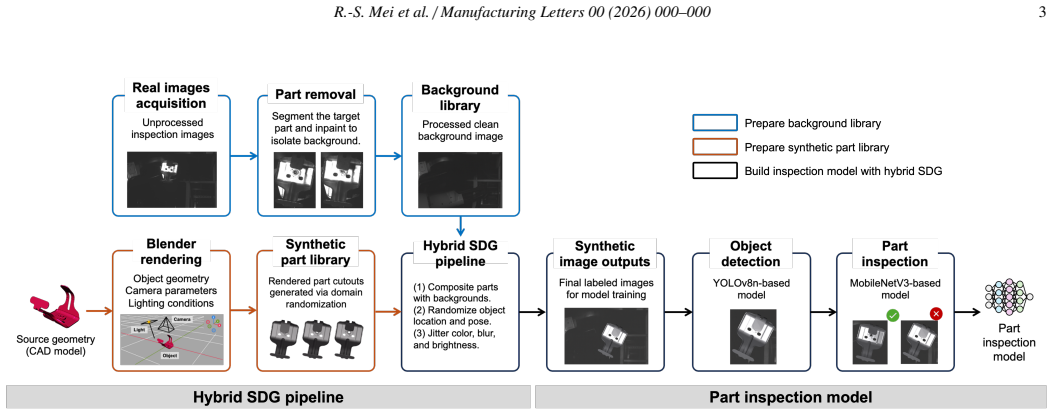
The load-bearing mechanism is the hybrid SDG pipeline: in a real-time renderer, a CAD bracket model is varied along three axes—tab bending angle (four pass angles, four fail angles), light power (three levels), and surface roughness (three levels)—to produce 72 configurations; rendered parts are composited onto nine real backgrounds (three station backgrounds times three exposure levels); and 20 classical augmentations per configuration generate 12,960 fully labeled images with automatically computed bounding boxes and pass/fail labels. This combination keeps geometric ground truth exact while forcing the model to learn real-world appearance, and it is what lets a COCO-pretrained YOLOv8n and
What would settle it
Collect, say, 300 additional real bracket images across shifts and lighting conditions, deliberately including high-glare and boundary-angle cases; run the published model without retraining. If balanced accuracy falls materially below 90% (or fail recall drops), the zero-shot robustness claim is falsified.
Extended reading notes
Core claim
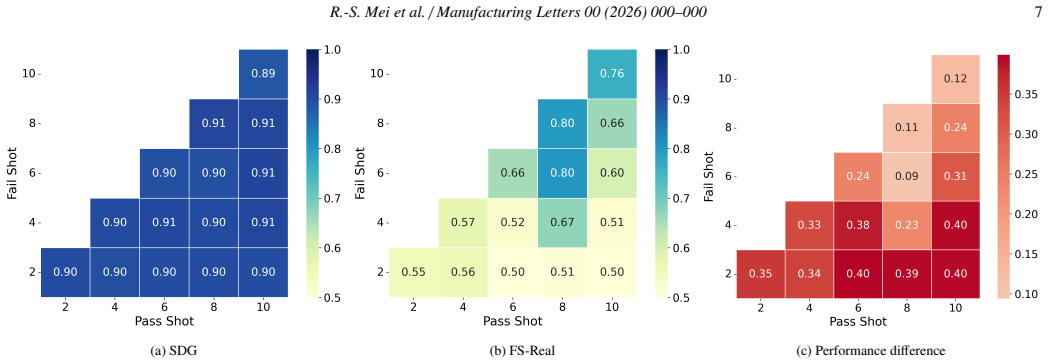
On its own terms, the paper's discovery is that zero-shot sim-to-real transfer works for quality inspection when synthetic data is made sufficiently varied and grounded in real backgrounds. Trained solely on 12,960 synthesized images, the pipeline detects real brackets with mAP@0.5 of 0.995 and classifies them as pass/fail with 96.0% accuracy and 90.1% balanced accuracy on 300 real images. Under controlled imbalance (up to 11:1 pass/fail), balanced accuracy stays in the 0.89–0.91 range, while fine-tuning on 2–10 real examples per class yields only 0.50–0.80 balanced accuracy and misses most real defects—Type II errors are 4.3–5.8 times higher for the few-shot baselines. The conclusion the au
Load-bearing premise
The domain randomization ranges (four bend angles, three light powers, three roughness levels, nine backgrounds) are assumed to cover the real inspection station's operating conditions; if real parts or lighting fall outside those ranges—as the paper's own specular-reflection errors show they sometimes do—the 90.1% balanced accuracy is not guaranteed.
Editorial extensions
If this is right
- New products could get a working inspection model in about an hour of compute instead of weeks of collecting and labeling real defective parts.
- Because the synthetic set is balanced by construction, the model does not collapse to 'always pass' under severe imbalance—the failure mode that few-shot real baselines exhibit (0% fail recall at 10 pass / 2 fail shots).
- The detection stage is essentially solved (mAP@0.5 = 0.995, recall 1.0), so remaining inspection errors are classification-level and concentrated in boundary geometry and extreme specular glare.
- The 7.6 ms per-image inference time on a laptop GPU means the two-stage pipeline can run at production line rates on edge hardware.
- The same pipeline is readily extended to multi-class severity grading or regression on continuous bend angles, since the CAD model can sample any angle.
Reading between the lines
- If real deployment lighting drifts beyond the randomized grid (e.g., direct specular highlights), the stated 90.1% balanced accuracy will likely degrade; a practical rollout should monitor for that failure mode and expand randomization accordingly.
- The approach's advantage is largest exactly where few-shot learning is weakest—when only 2 fail examples are available—suggesting that SDG is best used as a pretraining stage with optional small real fine-tuning, an ablation the paper does not run.
- The 300-image test set with only 25 fails makes the 90.1% balanced accuracy a point estimate with wide uncertainty; a larger, time-sampled evaluation would tighten the estimate and test station drift.
- Because the pipeline parameterizes geometry continuously, it could assign severity scores instead of binary labels, enabling process control to react to drift before parts become rejects.
Editorial analysis
A structured set of objections, weighed in public.
Referee Report
Summary. The paper proposes a hybrid synthetic data generation (SDG) pipeline that combines Blender-based rendering with domain randomization of part geometry, lighting, and surface roughness, and then composites the rendered parts onto real backgrounds to produce fully annotated training images. A two-stage architecture (YOLOv8n for detection, MobileNetV3-small for pass/fail classification) is trained exclusively on the synthetic dataset and evaluated on 300 real images. The authors report detection mAP@0.5 of 0.995, classification accuracy of 96.0%, balanced accuracy of 90.1%, and superior robustness under class imbalance compared with few-shot real-data baselines.
Significance. If the reported results are reliable, the work offers a practical, annotation-free route to vision-based inspection for a specific automotive bracket, addressing a well-known data bottleneck in manufacturing. The study design is thoughtful in several respects: it separates detection from classification, uses deterministic CAD-derived labels (avoiding circularity), reports confusion matrices, and repeats few-shot experiments five times. The main quantitative claims, however, rest on only 25 real defective samples, and the statistical uncertainty is substantial. The paper also candidly acknowledges in §4.5 that the domain-randomization ranges must cover the real environment and that the observed failures include cases outside those ranges. The central 'robust under extreme imbalance' claim therefore requires stronger statistical support or a more clearly scoped claim.
major comments (3)
- [§3.2, Table 2] The balanced accuracy reported as 90.1% is inconsistent with the confusion matrix: (267/275 + 21/25)/2 = (0.9709 + 0.8400)/2 = 0.9055, i.e. 90.5%. More importantly, the fail recall is 21/25, whose Wilson 95% CI is approximately [0.64, 0.94]; this translates to a balanced-accuracy CI of roughly [0.85, 0.96]. The abstract's '90–91%' is therefore a point estimate with a wide uncertainty band, not a demonstrated stable operating range. The authors should either report exact counts with confidence intervals or, preferably, evaluate on a larger defect sample.
- [§3.3, Table 3, Figure 8] The few-shot comparison is based on only 15 defect samples in the held-out set (Figure 8). The reported difference between 2/15 and 12/15 fail detections is statistically fragile. Table 3 reports half-ranges over five repetitions, but these repetitions only vary the random training subset while the test set is the leftover sample; the half-range is not a confidence interval for the underlying real-world performance. Please provide bootstrap or other confidence intervals and describe how the 300 real images were selected, so that the reader can assess whether the 25 defects are representative of the production distribution.
- [§4.5 and §4.2] The paper itself concedes that the domain randomization strategy assumes environmental conditions remain within the parameter ranges explored during SDG, and its own error analysis shows that Type II errors occur under 'extreme specular reflection' outside those ranges. Because the 300-image test set is the only evidence of the real distribution, the absence of a sampling protocol for these images weakens the generalization claim. The authors should specify the sampling procedure, or explicitly limit the conclusion to the particular test set rather than to the broader production population.
minor comments (4)
- [Abstract and §3.2] The abstract states 'the baselines reach only 50% accuracy'; this should be 'balanced accuracy' for consistency with the rest of the paper. Also, the '90–91%' range in the abstract is not supported by a single point estimate of 90.1% (or 90.5% per the confusion matrix).
- [§1, Introduction] The sentence 'Typically, thousands of images with precise bounding boxes' is incomplete; it should be 'Typically, thousands of images with precise bounding boxes are required.'
- [§3.3, Figure 8 caption] The caption says 'held-out validation set of 280 images, with 10 pass and 10 fail examples reserved for FS-Real model training.' It would help to state explicitly that the 280 images are the residual after excluding those 20 training images, and to note whether this is a single split or averaged across the five repetitions.
- [§2.1.1] The factorial design is described as '4×3×3 factorial design per class yielded 72 unique part configurations (36 pass, 36 fail).' This is correct but could be clearer: it is 4 bending angles (per class) × 3 light levels × 3 roughness levels = 36 per class, totaling 72.
Circularity Check
No significant circularity: synthetic labels are generated from CAD geometry and no test-set quantity is fitted into the model.
full rationale
The central claim is that a detection/classification pipeline trained only on 12,960 synthetic images transfers to 300 real bracket images. The synthetic labels are generated automatically from the CAD bending angle ('Binary class labels (pass/fail) were assigned based on the bending angle,' §2.1.3), and the real test labels are the same physical quality criterion; no parameter is fitted to the 300 real images. Bounding-box annotations come from the rendering overlay, not from the test set. The few-shot real-data baselines are trained on small real subsets, but they are comparators rather than inputs to the SDG model, so the comparison is not definitionally forced. Self-citations ([10], [23], [26]) are background literature references and are not used as load-bearing evidence for the transfer result. The paper's own stated limitations—§4.2 Type II errors under 'extreme specular reflection' outside the randomization ranges and §4.5 'the domain randomization strategy assumes environmental conditions remain within the parameter ranges explored during SDG'—are empirical generalizability caveats, not circular reductions. The inconsistency between 90.1% and 90.5% balanced accuracy is a reporting/statistical precision issue given only 25 real defect samples, not evidence that the prediction is constructed from its own inputs. No specific equation or definition reduces the claimed prediction to a fitted input, so no circular step is identified.
Assumptions & free parameters
free parameters (5)
- Pass/fail bending-angle ranges =
pass: 15/20/25/30°, fail: −5/0/5/10°
- Light power levels =
5, 10, 15 W
- Surface roughness levels =
0.2, 0.4, 0.6
- Background library size =
3 real backgrounds × 3 exposure levels = 9
- Augmentation ranges =
rotation ±30°, blur kernel {1,3,5}, brightness [0,50]
assumptions (5)
- domain assumption The CAD model of the bracket and its tab-bending deformation accurately represent the real production part geometry.
- domain assumption The 300 real images are representative of production conditions and their pass/fail labels are correct.
- domain assumption The vision-language model used to remove part instances from real backgrounds preserves authentic environmental statistics without introducing artifacts.
- domain assumption COCO and ImageNet pretrained weights provide a useful inductive bias for the inspection task.
- domain assumption The hand-chosen domain-randomization ranges (angles, light, roughness, backgrounds) cover the real inspection distribution.
Cite this review
Pith. "Pith review of Hybrid Synthetic Data Generation with Domain Randomization Enables Zero-Shot Vision-Based Part Inspection Under Extreme Class Imbalance." pith.science (2026). https://pith.science/paper/R4K44TIH
@misc{pith2026251200125,
  author       = {Pith},
  title        = {Pith review of: Hybrid Synthetic Data Generation with Domain Randomization Enables Zero-Shot Vision-Based Part Inspection Under Extreme Class Imbalance},
  year         = {2026},
  howpublished = {\url{https://pith.science/paper/R4K44TIH}},
  note         = {Machine review of arXiv:2512.00125}
}
read the original abstract
Machine learning, particularly deep learning, is transforming industrial quality inspection. Yet, training robust machine learning models typically requires large volumes of high-quality labeled data, which are expensive, time-consuming, and labor-intensive to obtain in manufacturing. Moreover, defective samples are intrinsically rare, leading to severe class imbalance that degrades model performance. These data constraints hinder the widespread adoption of machine learning-based quality inspection methods in real production environments. Synthetic data generation (SDG) offers a promising solution by enabling the creation of large, balanced, and fully annotated datasets in an efficient, cost-effective, and scalable manner. This paper presents a hybrid SDG framework that integrates simulation-based rendering, domain randomization, and real background compositing to enable zero-shot learning for computer vision-based industrial part inspection without manual annotation. The SDG pipeline generates 12,960 labeled images in one hour by varying part geometry, lighting, and surface properties, and then compositing synthetic parts onto real image backgrounds. A two-stage architecture utilizing a YOLOv8n backbone for object detection and MobileNetV3-small for quality classification is trained exclusively on synthetic data and evaluated on 300 real industrial parts. The proposed approach achieves an mAP@0.5 of 0.995 for detection, 96% classification accuracy, and 90.1% balanced accuracy. Comparative evaluation against few-shot real-data baseline approaches demonstrates significant improvement. The proposed SDG-based approach achieves 90-91% balanced accuracy under severe class imbalance, while the baselines reach only 50% accuracy. These results demonstrate that the proposed method enables annotation-free, scalable, and robust quality inspection for real-world manufacturing applications.
Figures


Figures from the paper (7 more)



Reference graph
Works this paper leans on
-
[1]
H. Kim, Y . Lin, T.-L. B. Tseng, A review on quality control in additive manufacturing, Rapid Prototyping Journal 24 (3) (2018) 645–669
2018
-
[2]
S. Jia, Z. Dong, C. Shao, Physics-informed data-driven machine health monitoring for two-photon lithography, arXiv preprint arXiv:2510.15075 (2025)
arXiv 2025
-
[3]
M. R. Islam, M. Z. H. Zamil, M. E. Rayed, M. M. Kabir, M. Mridha, S. Nishimura, J. Shin, Deep learning and computer vision techniques for enhanced quality control in manufacturing processes, IEEE Access (2024)
2024
-
[4]
X. Liu, Y . Li, Y . Guo, L. Zhou, Printing defect detection based on scale- adaptive template matching and image alignment, Sensors 23 (9) (2023) 4414
2023
-
[5]
L. He, X. Ren, Q. Gao, X. Zhao, B. Yao, Y . Chao, The connected- component labeling problem: A review of state-of-the-art algorithms, Pat- tern Recognition 70 (2017) 25–43
2017
-
[6]
Canny, A computational approach to edge detection, IEEE Transactions on pattern analysis and machine intelligence (6) (2009) 679–698
J. Canny, A computational approach to edge detection, IEEE Transactions on pattern analysis and machine intelligence (6) (2009) 679–698
2009
-
[7]
Archana, P
R. Archana, P. E. Jeevaraj, Deep learning models for digital image process- ing: a review, Artificial Intelligence Review 57 (1) (2024) 11
2024
-
[8]
J. M. D. Delgado, L. Oyedele, A. Ajayi, L. Akanbi, O. Akinade, M. Bilal, H. Owolabi, Robotics and automated systems in construction: Understand- ing industry-specific challenges for adoption, Journal of building engineer- ing 26 (2019) 100868. R.-S. Mei et al./Manufacturing Letters 00 (2026) 000–0009
2019
Show all 39 references
-
[9]
Chukwunweike, A
J. Chukwunweike, A. N. Anang, A. A. Adeniran, J. Dike, Enhancing man- ufacturing efficiency and quality through automation and deep learning: addressing redundancy, defects, vibration analysis, and material strength optimization vol. 23, World Journal of Advanced Research and ...
2024
-
[10]
S. Jia, S. Li, J. Sun, M. R. Dawson, K. C. Toussaint Jr, C. Shao, End-to- end part quality classification for two-photon lithography using computer vision, Manufacturing Letters 44 (2025) 1369–1377
2025
-
[11]
Rauch, T
L. Rauch, T. Braml, Semantic point cloud segmentation with deep- learning-based approaches for the construction industry: A survey, Applied Sciences 13 (16) (2023) 9146
2023
-
[12]
M. A. Rahman, M. F. Shahrior, K. Iqbal, A. A. Abushaiba, Enabling in- telligent industrial automation: A review of machine learning applications with digital twin and edge ai integration, Automation 6 (3) (2025) 37
2025
-
[13]
Y . Meng, Z. Dong, K.-C. Lu, S. Li, C. Shao, Meta-learning-based do- main generalization for cost-effective tool condition monitoring in ultra- sonic metal welding, IEEE Transactions on Industrial Informatics (2024)
2024
-
[14]
Sundaram, A
S. Sundaram, A. Zeid, Artificial intelligence-based smart quality inspection for manufacturing, Micromachines 14 (3) (2023) 570
2023
-
[15]
Y . Yang, Y . Zhang, Y . D. Cai, Q. Lu, S. Koric, C. Shao, Hierarchical mea- surement strategy for cost-effective interpolation of spatiotemporal data in manufacturing, Journal of Manufacturing Systems 53 (2019) 159–168
2019
-
[16]
Kodytek, A
P. Kodytek, A. Bodzas, P. Bilik, A large-scale image dataset of wood surface defects for automated vision-based quality control processes, F1000Research 10 (2022) 581
2022
-
[17]
Villalba-Diez, D
J. Villalba-Diez, D. Schmidt, R. Gevers, J. Ordieres-Mer ´e, M. Buchwitz, W. Wellbrock, Deep learning for industrial computer vision quality control in the printing industry 4.0, Sensors 19 (18) (2019) 3987
2019
-
[18]
Mehta, C
M. Mehta, C. Shao, A greedy agglomerative framework for clustered feder- ated learning, IEEE Transactions on Industrial Informatics 19 (12) (2023) 11856–11867
2023
-
[19]
Mehta, C
M. Mehta, C. Shao, Federated learning-based semantic segmentation for pixel-wise defect detection in additive manufacturing, Journal of Manufac- turing Systems 64 (2022) 197–210
2022
-
[20]
Mehta, S
M. Mehta, S. Chen, H. Tang, C. Shao, A federated learning approach to mixed fault diagnosis in rotating machinery, Journal of Manufacturing Sys- tems 68 (2023) 687–694
2023
-
[21]
Bergmann, M
P. Bergmann, M. Fauser, D. Sattlegger, C. Steger, Mvtec ad–a comprehen- sive real-world dataset for unsupervised anomaly detection, in: Proceed- ings of the IEEE/CVF conference on computer vision and pattern recogni- tion, 2019, pp. 9592–9600
2019
-
[22]
Y . Liu, C. Zhang, X. Dong, A survey of real-time surface defect inspec- tion methods based on deep learning, Artificial Intelligence Review 56 (10) (2023) 12131–12170
2023
-
[23]
R.-S. Mei, G. Li, S. Jia, L. Huang, L.-W. Shih, J. Arinez, J. Abell, C. Shao, Synthetic data generation in smart manufacturing applications: A sys- tematic review, SSRN Electronic Journal, preprint. Available at SSRN: http://dx.doi.org/10.2139/ssrn.5726804 (Oct. 2025)
2025 doi
-
[24]
Buggineni, C
V . Buggineni, C. Chen, J. Camelio, Enhancing manufacturing operations with synthetic data: a systematic framework for data generation, accuracy, and utility, Frontiers in Manufacturing Technology 4 (2024) 1320166
2024
-
[25]
Q. Zhou, X. Chen, J. Tang, Gans fostering data augmentation for automated surface inspection with adaptive learning bias, The International Journal of Advanced Manufacturing Technology 135 (11) (2024) 5647–5667
2024
-
[26]
R.-S. Mei, C. H. Conway, M. V . Bimrose, W. P. King, C. Shao, Deep learn- ing of 3d point clouds for detecting geometric defects in gears, Manufac- turing Letters 41 (2024) 1324–1333
2024
-
[27]
Z. Hu, T. Schlosser, M. Friedrich, A. L. V . e Silva, F. Beuth, D. Kow- erko, Utilizing generative adversarial networks for image data augmenta- tion and classification of semiconductor wafer dicing induced defects, in: 2024 IEEE 29th International Conference on Emerging Techn...
2024
-
[28]
A. A. R. M. Abu Ebayyeh, S. Danishvar, A. Mousavi, An Improved Cap- sule Network (WaferCaps) for Wafer Bin Map Classification Based on DC- GAN Data Upsampling, IEEE Transactions on Semiconductor Manufac- turing 35 (1) (2022) 50–59
2022
-
[29]
C. Hu, F. Cheng, Y . Zhao, S. Guo, L. Ma, State of charge estimation for lithium-ion batteries based on data augmentation with generative adversar- ial network, Journal of Energy Storage 80 (2024)
2024
-
[30]
Chen, et al., Dcgan-cnn with physical constraints for porosity prediction in laser metal deposition with unbalanced data, Manufacturing Letters 35 (2023) 1146–1154
M. Chen, et al., Dcgan-cnn with physical constraints for porosity prediction in laser metal deposition with unbalanced data, Manufacturing Letters 35 (2023) 1146–1154
2023
-
[31]
M. S. Werda, H. Taibi, K. Kouiss, A. Chebak, Generation of synthetic data for deep learning in manufacturing quality control systems, in: 2024 IEEE 22nd Mediterranean electrotechnical conference (MELECON), IEEE, 2024, pp. 74–79
2024
-
[32]
Moonen, B
S. Moonen, B. Vanherle, J. de Hoog, T. Bourgana, A. Bey-Temsamani, N. Michiels, Cad2render: A modular toolkit for gpu-accelerated photoreal- istic synthetic data generation for the manufacturing industry, in: Proceed- ings of the IEEE/CVF Winter Conference on Applications of C...
2023
-
[33]
J. Tang, H. Zhou, T. Wang, Z. Jin, Y . Wang, X. Wang, Cascaded foreign ob- ject detection in manufacturing processes using convolutional neural net- works and synthetic data generation methodology, Journal of Intelligent Manufacturing 34 (7) (2023) 2925–2941
2023
-
[34]
Neunzig, D
C. Neunzig, D. Moellensiep, M. Hartmann, B. Kuhlenkoetter, M. Moeller, J. Schulz, Enhanced classification of hydraulic testing of directional control valves with synthetic data generation, Production Engineering Research and Development 17 (5) (2023) 669–678
2023
-
[35]
Salvato, G
E. Salvato, G. Fenu, E. Medvet, F. A. Pellegrino, Crossing the reality gap: A survey on sim-to-real transferability of robot controllers in reinforcement learning, IEEE Access 9 (2021) 153171–153187
2021
-
[36]
Brock, J
A. Brock, J. Donahue, K. Simonyan, Large scale gan training for high fi- delity natural image synthesis, arXiv preprint arXiv:1809.11096 (2018)
2018 arXiv
-
[37]
M. M. Saad, R. O’Reilly, M. H. Rehmani, A survey on training challenges in generative adversarial networks for biomedical image analysis, Artificial Intelligence Review 57 (2) (2024) 19
2024
-
[38]
Zhang, Z
Z. Zhang, Z. Zhao, X. Zhang, C. Sun, X. Chen, Industrial anomaly detec- tion with domain shift: A real-world dataset and masked multi-scale recon- struction, Computers in Industry 151 (2023) 103990
2023
-
[39]
X. Zhu, T. Bilal, P. Mårtensson, L. Hanson, M. Bj ¨orkman, A. Maki, To- wards sim-to-real industrial parts classification with synthetic dataset, in: Proceedings of the IEEE/CVF conference on computer vision and pattern recognition, 2023, pp. 4454–4463
2023
Reviewed August 3, 2026 · model on record in the stance chip above.
Discussion (0). Continue with ORCID to comment.