REVIEW 5 major objections 5 minor 119 references
This paper shows that the shadow sizes of M87* and Sgr A* constrain the dark-matter parameter of a Bardeen black hole to a narrow range, predicting ~0.27–2.67 g/cm³ just outside Sgr A*'s shadow.
Reviewed by Pith at T0; open to challenge. T0 means a machine referee read the full paper against a public rubric. the ladder, T0–T4 →
T0 review · deepseek-v4-flash
2026-08-03 19:21 UTC pith:LD3MBULU
load-bearing objection Standard shadow+disk computation for the PFDM-Bardeen metric, but the abstract contradicts the body on blueshift and the promised DM-profile comparison is absent; the density claim also misses an 8π normalization. the 5 major comments →
Images of shadow and thin accretion disk around Bardeen black hole surrounded by perfect fluid dark matter
The pith
A machine-rendered reading of the paper's core claim, the machinery that carries it, and where it could break.
Core claim
On the paper's own terms, the central discovery is a constraint chain: for a static, spherically symmetric Bardeen black hole immersed in perfect fluid dark matter, the shadow radius equals the critical impact parameter b̄_c = r_ph/√f(r_ph) determined by the photon-sphere radius r_ph, with f(r) = 1 − 2Mr²/(r²+g²)^{3/2} − (b/r) ln(r/|b|). Comparing this to the EHT-inferred shadow diameters d_sh = (11 ± 1.5)M for M87* and (9.77 ± 0.67)M for Sgr A* confines b/M to O(10^-1–10^-2) for M87* and O(10^-2–10^-3) for Sgr A*. From ρ = b/r³, this implies a PFDM density of 0.27–2.67 g/cm³ at the Sgr A* shadow scale (R_sh ~ 5M), dropping to 10^-24–10^-25 g/cm³ at 100 pc. The same analysis shows that incre
What carries the argument
The load-bearing object is the critical impact parameter b̄_c = r_ph/√f(r_ph), which maps the photon-sphere radius to the apparent shadow diameter and is matched against EHT measurements. It is evaluated in the PFDM-Bardeen metric f(r) = 1 − 2Mr²/(r²+g²)^{3/2} − (b/r) ln(r/|b|), whose dark-matter content is encoded in the perfect-fluid stress-energy tensor with density profile ρ = −p_r = b/r³ and tangential pressures p_θ = p_φ = b/(2r³). The imaging side uses transfer functions that sum the observed intensity from successive disk crossings, together with the Novikov–Thorne flux formula and the redshift factor 1+z = (1+Ω b̄ sinθ cosα)/√(−g_tt − Ω²g_φφ), to produce primary and secondary images
Load-bearing premise
The whole argument depends on the assumption that the spacetime around M87* and Sgr A* is described by the Bardeen metric with the perfect-fluid dark-matter profile ρ = b/r³; if that profile is wrong, the shadow-derived bounds on b and the density prediction do not follow.
What would settle it
Take a sub-percent measurement of Sgr A*'s shadow diameter (for example, with space-based very-long-baseline interferometry): the PFDM-Bardeen model with b/M in the derived 10^-2–10^-3 range predicts a specific diameter interval, so a value outside it would refute the metric. Alternatively, a precision pulsar-orbit measurement of the local density near Sgr A* would independently test the 0.27–2.67 g/cm³ prediction.
If this is right
- If the metric is right, dark matter at the Sgr A* shadow scale has density ~0.27–2.67 g/cm³, orders of magnitude above typical galactic-halo values, so horizon-scale dark matter is dynamically significant.
- Shadow diameter and disk brightness together pin b/M; sharper future shadow measurements will shrink the allowed interval and sharpen the density prediction.
- Because the magnetic charge g is masked by PFDM, current shadow and disk images cannot distinguish the Bardeen regular black hole from a PFDM-Schwarzschild black hole of the same b.
- Different DM halo models (PFDM, NFW, Dehnen-type, Moore) predict distinct densities at the shadow radius and at 100 pc, making two-scale density measurements a potential model discriminator.
- The redshift analysis gives a qualitative test: the models predict a specific redshift/blueshift pattern with inclination, so observing significant blueshifted emission at low inclination would challenge all four DM models.
Where Pith is reading between the lines
- The density prediction is independently testable: a pulsar in a tight orbit around Sgr A* whose periastron precession fixes the local density would either confirm or exclude the 0.27–2.67 g/cm³ value, independent of shadow fitting.
- The analysis assumes a non-rotating metric and a distant observer; a rotating PFDM-Bardeen spacetime would shift the shadow diameter by a few percent, comparable to the 1σ bands, so the quoted b/M bounds may need revision once spin is included.
- The same shadow-matching pipeline could be applied to the central black holes in other galaxies with future space-VLBI measurements, turning any single shadow diameter into a local dark-matter density estimate.
- A cleaner falsifier than the shadow diameter itself is the predicted relation between b and the 100-pc density: measuring the large-scale density independently and checking consistency with the shadow-derived b would test the assumed b/r³ profile.
Editorial analysis
A structured set of objections, weighed in public.
Referee Report
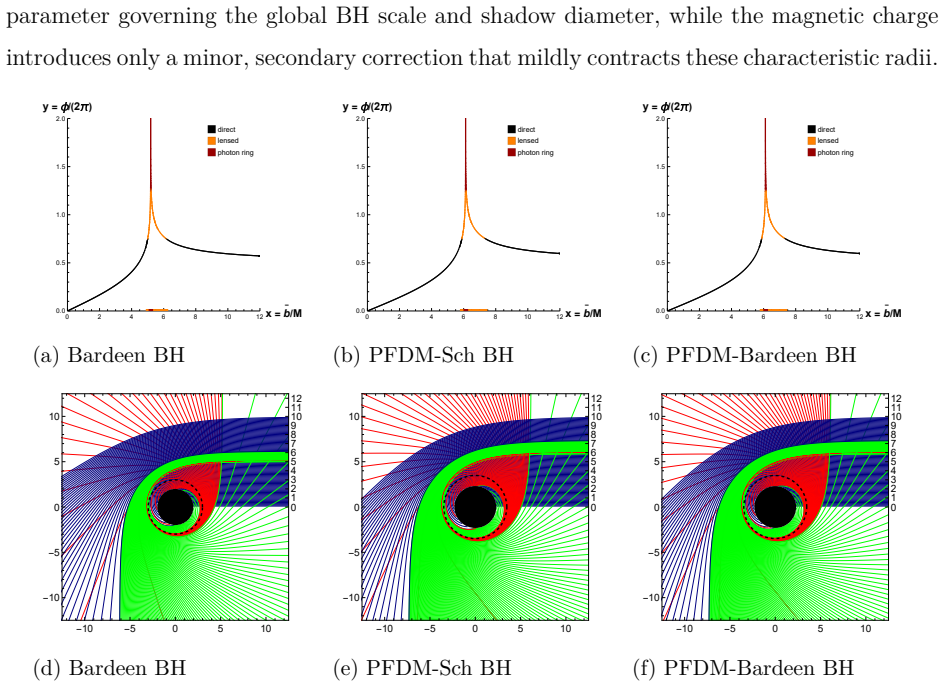
Summary. The paper studies the shadow and thin-disk images of a static, spherically symmetric Bardeen black hole immersed in perfect fluid dark matter (PFDM), with metric given by Eq. (6). The authors derive null geodesics, classify photon trajectories into direct, lensing, and photon-ring families, compute transfer functions and images for three emission models, and use EHT shadow-diameter measurements of M87* and Sgr A* to constrain the PFDM parameter b. The abstract further claims a PFDM density near the shadow of about 0.27–2.67 g/cm^3 for Sgr A* and a comparison with NFW, Dehnen-type, and Moore DM profiles. The numerical machinery is standard, but the manuscript contains several internal inconsistencies and missing derivations that affect the stated claims.
Significance. If fully supported, the paper would provide a useful EHT-based bound on a phenomenological PFDM parameter and demonstrate that the magnetic charge of the Bardeen model is subdominant for shadow and disk observables. The use of transfer functions, photon-ring classification, and redshift maps follows established methods. However, the headline density prediction is not derived in the body, the normalization of the PFDM stress-energy tensor is inconsistent with the metric, the promised comparison with NFW/Dehnen/Moore profiles is absent, and the blueshift statements in the different abstracts and in the body contradict each other. These issues must be resolved before the scientific claims can be assessed.
major comments (5)
- [Sec. II, Eqs. (4) and (6)] The PFDM stress-energy tensor in Eq. (4) is not consistent with the metric in Eq. (6) under standard G=c=1 units. For the metric f=1-2Mr^2/(r^2+g^2)^{3/2}-(b/r)ln(r/|b|), the Einstein equation G^t_t=8πT^t_t with T^t_t=-ρ gives a PFDM contribution to G^t_t of -b/r^3, so ρ should be b/(8π r^3), not b/r^3. Equivalently, the paper must explicitly state that it uses 8π=1 throughout. This is not a bookkeeping detail: the abstract's density range 0.27–2.67 g/cm^3 is computed from ρ=b/r^3 and is too large by a factor 8π. The shadow fit itself is unaffected because b/M is dimensionless, but the density claim is wrong as written. Additionally, the numerical density values are never derived in the body of the paper.
- [Abstract vs. Sec. V and Figs. 14–15] The abstract supplied with the paper states that 'blueshift appears in the primary image as inclination increases,' while the full-text abstract and Sec. V state that 'No blueshifted regions appear in any configuration' and 'all images show exclusively redshifted emission.' Figures 14 and 15 show colorbars labeled z with values starting at 0.75; if z denotes the redshift, values below 1 indicate blueshift. The paper must clarify whether the colorbar is z or 1+z and must reconcile the contradictory statements in the abstract and the body.
- [Abstract and Secs. II–VI] The abstract promises a comparison with NFW, Dehnen-type, and Moore dark-matter profiles and claims distinct densities at the shadow radius and at 100 pc. It also advertises a concrete PFDM density prediction near the shadow scale. None of these calculations appears in Sections II–VI. The body only analyzes Bardeen, PFDM-Schwarzschild, and PFDM-Bardeen metrics. Missing promised content is not a minor presentation issue when the abstract's central 'prediction' and 'distinguishing signature' rely on it.
- [Sec. III.B and Eq. (4)] The 'prediction' of the PFDM density is circular in an important sense: Eq. (4) defines ρ=b/r^3, and b is fitted from the shadow diameter. Substituting the fitted b into the assumed density profile gives a rearrangement of the fit, not an independent prediction. The statement that the four DM models exhibit distinct densities at the shadow radius is a comparison of model assumptions, not a falsifiable test, unless the PFDM density profile itself is constrained by independent data. The paper should be reframed accordingly.
- [Sec. III.B and Table I] The constraint on Sgr A* is essentially one-sided. For b≥0, the PFDM term in Eq. (6) makes the shadow larger than the Schwarzschild value of about 10.39M, whereas the central EHT value for Sgr A* is 9.77M. Table I confirms that only upper bounds are given for Sgr A* at 1σ; the allowed interval includes b=0. The abstract's wording that b is restricted to a 'narrow range' O(10^-2–10^-3) is therefore an overstatement. The paper should state explicitly that the Sgr A* data provide an upper limit rather than a two-sided constraint.
minor comments (5)
- [Notation] The symbol b is used both for the PFDM parameter and for the impact parameter in equations such as (31). This creates confusion, especially in Section V where the redshift factor is introduced.
- [Refs.] Reference [52] is incomplete ('6 2025'), and several references have formatting inconsistencies. Please check the bibliography.
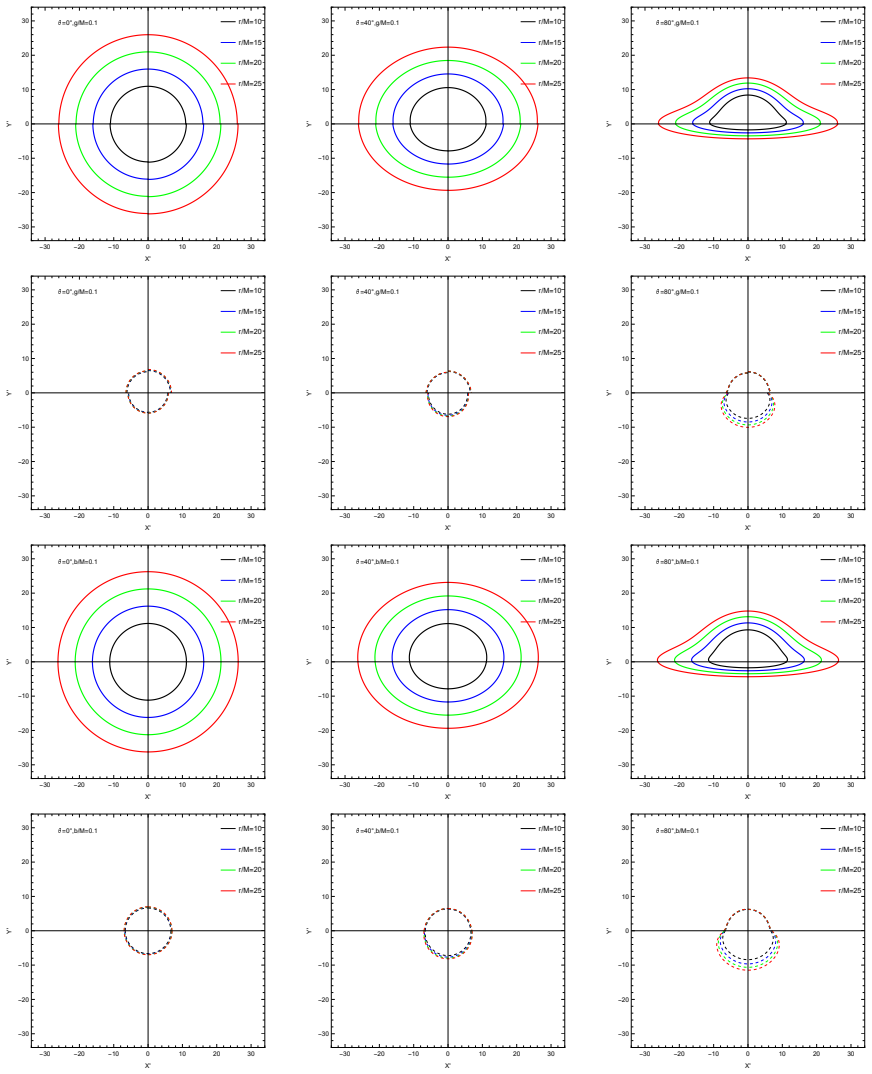
- [Figs. 4, 12, 13] Several figures lack axis labels or have labels such as 'Y’ X’' that are not defined. The contour plots in Fig. 4 would benefit from explicit axis captions.
- [Eq. (17)] The definition n(b̄)=(2m-1)/4 for m∈Z^+ is not directly connected to the intervals 1/4<n<3/4, 3/4<n<5/4, etc. Please clarify the indexing or use a more transparent parametrization.
- [Sec. IV] The text says the observer is placed along the polar axis (face-on view), but later figures and the redshift analysis consider inclinations such as 40° and 80°. The setup should be stated more carefully.
Circularity Check
EHT shadow fit is a legitimate external constraint, but the headline PFDM-density 'prediction' is the fitted b converted via the assumed profile ρ=b/r^3, so the prediction reduces by construction.
specific steps
-
fitted input called prediction
[Abstract (density claim); Sec. II Eq. (4); Sec. III Eqs. (12)-(14)]
"Abstract: 'From these constraints we derive a rough prediction for the PFDM density near the shadow scale (R_sh∼5M): ρ_PFDM ∼ 0.27-2.67 g/cm^3 for Sgr A*.' Sec. II Eq. (4): 'ρ = −p_r = b/r^3, pθ = pφ = b/2r^3.' Sec. III: '¯bc = rph/√f(rph)' (Eq. 12), fitted to 'dM87∗sh = (11 ± 1.5)M, dSgr.A∗sh = (9.77 ± 0.67)M' (Eq. 14)."
The EHT shadow diameter fixes the single free parameter b through b̄c = r_ph/√f(r_ph). Eq. (4) then defines the PFDM density as ρ=b/r^3, so the quoted density range at R_sh≈5M is exactly the fitted b rewritten in density units with the assumed r^-3 profile. No independent observable is introduced after the fit; the 'prediction' is statistically forced by the shadow constraint and would change only if the assumed profile (not fit to any density data) were changed. Thus the headline claim reduces to a refit of the same parameter.
full rationale
The core shadow computation is not circular: Eq. (12) is a genuine geometric relation, and the comparison with EHT diameters in Eq. (14) uses external observational data to constrain b. The image/disk parts (Secs. IV-V) are forward-model consequences of the assumed metric and standard ray-tracing, not circular. Circularity is localized to the abstract's density 'prediction': since the model postulates ρ=b/r^3 (Eq. 4), the fitted b determines ρ completely, so the density is the fit relabeled. The metric and PFDM source are adopted from Refs. [103,104] rather than derived; that is a model-dependence/correctness issue, not circularity. Self-citations (e.g., Refs. [18,19,52,119,120]) are used only for textbook Novikov-Thorne formulas and are not load-bearing. As a separate correctness caveat, Eqs. (4) and (6) are mutually consistent only if one uses the unstated 8π=1 normalization; in standard G=c=1 units the density would be b/(8πr^3), rescaling the quoted g/cm^3 range. That caveat affects the numerical density claim but is not itself a circularity.
Axiom & Free-Parameter Ledger
free parameters (2)
- PFDM parameter b =
b/M ~ 0.12-0.33 (M87*, 1-2σ), ~0.0015-0.092 (Sgr A*)
- Magnetic charge g
axioms (5)
- domain assumption The PFDM-Bardeen metric (Eq. 6) and the PFDM stress-energy tensor (Eqs. 3-4) correctly describe a Bardeen BH embedded in PFDM.
- domain assumption Weak energy condition b ≥ 0
- domain assumption EHT shadow diameter corresponds to the photon-sphere impact parameter of the static, spherically symmetric metric
- domain assumption Novikov-Thorne thin disk assumptions: geometrically thin, optically thick, Keplerian circular orbits, local blackbody radiation
- standard math Liouville's theorem and the transfer-function decomposition (direct/lensing/photon rings) from Gralla et al. [114]
read the original abstract
We investigate the shadow and optical appearance of Bardeen black hole (BH) immersed in perfect fluid dark matter (PFDM). Using EHT observations of M87* and Sgr A*, we constrain the DM parameter to a narrow range $b/M \sim \mathcal{O}(10^{-1}-10^{-2})$ for M87* and to $\mathcal{O}(10^{-2}-10^{-3})$ for Sgr A*. From these constraints we derive a rough prediction for the PFDM density near the shadow scale ($R_{\mathrm{sh}}\sim5M$): $\rho_{\mathrm{PFDM}} \sim 0.27$-$2.67\,\mathrm{g/cm^3}$ for Sgr A*, dropping to $\sim10^{-24}$-$10^{-25}\,\mathrm{g/cm^3}$ at 100 pc. Moreover, increasing $b$ substantially enlarges the photon sphere, impact parameter, shadow radius, and suppresses the observed disk brightness, while the magnetic charge $g$ produces only negligible corrections completely masked by PFDM on macroscopic scales. Subsequently, we investigate the primary/secondary images, flux, and redshift profiles for the PFDM-Bardeen BH using the Novikov-Thorne disk model, and compare these quantities with those of NFW, Dehnen-type and Moore DM BHs. The four BH types exhibit distinct densities at the shadow radius and at 100 pc, offering a potential distinguishing signature. Furthermore, for all DM BH models, blueshift appears in the primary image as inclination increases, while the secondary image remains redshift dominated even at high inclinations. Hence, if significant blueshifted emission were detected at low inclination, the predictions of these four DM models would be seriously challenged.
Figures






Reference graph
Works this paper leans on
-
[1]
For each emission prescription, the first two columns illustrate the radial profiles of the intrinsic disk emissivity and the corresponding intensity measured by a distant observer
r ≤ rH (24) Figures 7 and 8 display how the optical appearance of PFDM-Bardeen BH evolves as the DM parameter and magnetic charge. For each emission prescription, the first two columns illustrate the radial profiles of the intrinsic disk emissivity and the corresponding intensity measured by a distant observer. The final column translates these results in...
-
[2]
First M87 Event Horizon Telescope Results
Kazunori Akiyama et al. First M87 Event Horizon Telescope Results. I. The Shadow of the Supermassive Black Hole. Astrophys. J. Lett., 875:L1, 2019. 33 b/M = 0, θ = 10◦ Y’ X’ 1.1 1.2 1.3 1.4 1.5 z b/M = 0.05, θ = 10◦ Y’ X’ 1.1 1.2 1.3 1.4 1.5 z b/M = 0.08, θ = 10◦ Y’ X’ 1.1 1.2 1.3 1.4 1.5 z b/M = 0, θ = 40◦ Y’ X’ 1.0 1.2 1.4 1.6 1.8 z b/M = 0.05, θ = 40◦ ...
2019
-
[3]
First M87 Event Horizon Telescope Results
Kazunori Akiyama et al. First M87 Event Horizon Telescope Results. II. Array and Instru- mentation. Astrophys. J. Lett., 875(1):L2, 2019
2019
-
[4]
First M87 Event Horizon Telescope Results
Kazunori Akiyama et al. First M87 Event Horizon Telescope Results. III. Data Processing and Calibration. Astrophys. J. Lett., 875(1):L3, 2019
2019
-
[5]
First M87 Event Horizon Telescope Results
Kazunori Akiyama et al. First M87 Event Horizon Telescope Results. IV. Imaging the Central Supermassive Black Hole. Astrophys. J. Lett., 875(1):L4, 2019. 34 g/M = 0, θ = 10◦ Y’ X’ 1.1 1.2 1.3 1.4 1.5 z g/M = 0.3, θ = 10◦ Y’ X’ 1.1 1.2 1.3 1.4 1.5 z g/M = 0.6, θ = 10◦ Y’ X’ 1.1 1.2 1.3 1.4 1.5 1.6 z g/M = 0, θ = 40◦ Y’ X’ 1.0 1.2 1.4 1.6 1.8 z g/M = 0.3, θ...
2019
-
[6]
First M87 Event Horizon Telescope Results
Kazunori Akiyama et al. First M87 Event Horizon Telescope Results. V. Physical Origin of the Asymmetric Ring. Astrophys. J. Lett., 875(1):L5, 2019
2019
-
[7]
First M87 Event Horizon Telescope Results
Kazunori Akiyama et al. First M87 Event Horizon Telescope Results. VI. The Shadow and Mass of the Central Black Hole. Astrophys. J. Lett., 875(1):L6, 2019
2019
-
[8]
Haroldo C. D. Lima, Junior., Luís C. B. Crispino, Pedro V. P. Cunha, and Carlos A. R. Herdeiro. Can different black holes cast the same shadow? Phys. Rev. D, 103(8):084040, 2021. 35
2021
-
[9]
Völkel, Enrico Barausse, Nicola Franchini, and Avery E
Sebastian H. Völkel, Enrico Barausse, Nicola Franchini, and Avery E. Broderick. EHT tests of the strong-field regime of general relativity. Class. Quant. Grav., 38(21):21LT01, 2021
2021
-
[10]
Misba Afrin, Rahul Kumar, and Sushant G. Ghosh. Parameter estimation of hairy Kerr black holes from its shadow and constraints from M87*. Mon. Not. Roy. Astron. Soc., 504(4):5927–5940, 2021
2021
-
[11]
Olmo, Diego Rubiera-Garcia, and Diego Sáez-Chillón Gómez
Merce Guerrero, Gonzalo J. Olmo, Diego Rubiera-Garcia, and Diego Sáez-Chillón Gómez. Shadows and optical appearance of black bounces illuminated by a thin accretion disk. JCAP, 08:036, 2021
2021
-
[12]
Javier Badía and Ernesto F. Eiroa. Influence of an anisotropic matter field on the shadow of a rotating black hole. Phys. Rev. D, 102(2):024066, 2020
2020
-
[13]
EHTconstraintontheultralight scalar hair of the M87 supermassive black hole
PedroV.P.Cunha, CarlosA.R.Herdeiro, andEugenRadu. EHTconstraintontheultralight scalar hair of the M87 supermassive black hole. Universe, 5(12):220, 2019
2019
-
[14]
Black hole shadow in an asymptotically-flat, stationary, and axisymmetric spacetime: The Kerr-Newman and rotating regular black holes
Naoki Tsukamoto. Black hole shadow in an asymptotically-flat, stationary, and axisymmetric spacetime: The Kerr-Newman and rotating regular black holes. Phys. Rev. D, 97(6):064021, 2018
2018
-
[15]
Pedro V. P. Cunha, Emanuele Berti, and Carlos A. R. Herdeiro. Light-Ring Stability for Ultracompact Objects. Phys. Rev. Lett., 119(25):251102, 2017
2017
-
[16]
P. V. P. Cunha, J. Grover, C. Herdeiro, E. Radu, H. Runarsson, and A. Wittig. Chaotic lensingaroundbosonstarsandKerrblackholeswithscalarhair. Phys.Rev.D,94(10):104023, 2016
2016
-
[18]
Probing Einstein–Maxwell-scalar black hole via thin accretion disks and shadows with EHT observa- tions of M87* and Sgr A*
Yingdong Wu, Ziqiang Cai, Zhenglong Ban, Haiyuan Feng, and Wei-Qiang Chen. Probing Einstein–Maxwell-scalar black hole via thin accretion disks and shadows with EHT observa- tions of M87* and Sgr A*. Eur. Phys. J. C, 85(9):1085, 2025
2025
-
[19]
Thin accretion disk around Schwarzschild-like black hole in bumblebee gravity
Ziqiang Cai, Zhenglong Ban, Lu Wang, Haiyuan Feng, and Zheng-Wen Long. Thin accretion disk around Schwarzschild-like black hole in bumblebee gravity. JCAP, 10:101, 2025
2025
-
[20]
ThinaccretiondiskandshadowofKerr– Sen black hole in Einstein–Maxwell-dilaton–axion gravity
HaiyuanFeng, Rong-JiaYang, andWei-QiangChen. ThinaccretiondiskandshadowofKerr– Sen black hole in Einstein–Maxwell-dilaton–axion gravity. Astropart. Phys., 166:103075, 2025
2025
-
[21]
Possible signatures of 36 higher dimension in thin accretion disk around brane world black hole
Ailin Liu, Tong-Yu He, Ming Liu, Zhan-Wen Han, and Rong-Jia Yang. Possible signatures of 36 higher dimension in thin accretion disk around brane world black hole. JCAP, 07:062, 2024
2024
-
[22]
First Sagittarius A* Event Horizon Telescope Results
Kazunori Akiyama et al. First Sagittarius A* Event Horizon Telescope Results. I. The Shadow of the Supermassive Black Hole in the Center of the Milky Way. Astrophys. J. Lett., 930(2):L12, 2022
2022
-
[23]
First Sagittarius A* Event Horizon Telescope Results
Kazunori Akiyama et al. First Sagittarius A* Event Horizon Telescope Results. II. EHT and Multiwavelength Observations, Data Processing, and Calibration. Astrophys. J. Lett., 930(2):L13, 2022
2022
-
[24]
First Sagittarius A* Event Horizon Telescope Results
Kazunori Akiyama et al. First Sagittarius A* Event Horizon Telescope Results. III. Imaging of the Galactic Center Supermassive Black Hole. Astrophys. J. Lett., 930(2):L14, 2022
2022
-
[25]
First Sagittarius A* Event Horizon Telescope Results
Kazunori Akiyama et al. First Sagittarius A* Event Horizon Telescope Results. IV. Variabil- ity, Morphology, and Black Hole Mass. Astrophys. J. Lett., 930(2):L15, 2022
2022
-
[26]
First Sagittarius A* Event Horizon Telescope Results
Kazunori Akiyama et al. First Sagittarius A* Event Horizon Telescope Results. V. Testing Astrophysical Models of the Galactic Center Black Hole. Astrophys. J. Lett., 930(2):L16, 2022
2022
-
[27]
First Sagittarius A* Event Horizon Telescope Results
Kazunori Akiyama et al. First Sagittarius A* Event Horizon Telescope Results. VI. Testing the Black Hole Metric. Astrophys. J. Lett., 930(2):L17, 2022
2022
-
[28]
Carlos A. R. Herdeiro. Black Holes: On the Universality of the Kerr Hypothesis. Lect. Notes Phys., 1017:315–331, 2023
2023
-
[29]
J. L. Synge. The Escape of Photons from Gravitationally Intense Stars. Mon. Not. Roy. Astron. Soc., 131(3):463–466, 1966
1966
-
[31]
Measurement of the Kerr Spin Parameter by Observation of a Compact Object’s Shadow
Kenta Hioki and Kei-ichi Maeda. Measurement of the Kerr Spin Parameter by Observation of a Compact Object’s Shadow. Phys. Rev. D, 80:024042, 2009
2009
-
[32]
J. M. Bardeen. Timelike and null geodesics in the Kerr metric. Proceedings, Ecole d’Eté de Physique Théorique: Les Astres Occlus : Les Houches, France, August, 1972, 215-240, pages 215–240, 1973
1972
-
[33]
Shadow of the regular Bardeen black holes and comparison of the motion of photons and neutrinos
Zdenek Stuchlík and Jan Schee. Shadow of the regular Bardeen black holes and comparison of the motion of photons and neutrinos. Eur. Phys. J. C, 79(1):44, 2019
2019
-
[34]
Shadows of Multi- Black Holes: Analytic Exploration
Akifumi Yumoto, Daisuke Nitta, Takeshi Chiba, and Naoshi Sugiyama. Shadows of Multi- Black Holes: Analytic Exploration. Phys. Rev. D, 86:103001, 2012. 37
2012
-
[35]
Ahmadjon Abdujabbarov, Muhammed Amir, Bobomurat Ahmedov, and Sushant G. Ghosh. Shadow of rotating regular black holes. Phys. Rev. D, 93(10):104004, 2016
2016
-
[36]
Muhammed Amir and Sushant G. Ghosh. Shapes of rotating nonsingular black hole shadows. Phys. Rev. D, 94(2):024054, 2016
2016
-
[37]
Sharif and Sehrish Iftikhar
M. Sharif and Sehrish Iftikhar. Shadow of a Charged Rotating Non-Commutative Black Hole. Eur. Phys. J. C, 76(11):630, 2016
2016
-
[38]
Observing the shadow of Einstein-Maxwell-Dilaton-Axion black hole
Shao-Wen Wei and Yu-Xiao Liu. Observing the shadow of Einstein-Maxwell-Dilaton-Axion black hole. JCAP, 11:063, 2013
2013
-
[39]
Shadow of Kerr-Taub-NUT black hole
Ahmadjon Abdujabbarov, Farruh Atamurotov, Yusuf Kucukakca, Bobomurat Ahmedov, and Ugur Camci. Shadow of Kerr-Taub-NUT black hole. Astrophys. Space Sci., 344:429–435, 2013
2013
-
[40]
Juliano C. S. Neves. Constraining the tidal charge of brane black holes using their shadows. Eur. Phys. J. C, 80(8):717, 2020
2020
-
[41]
Leonardo Amarilla and Ernesto F. Eiroa. Shadow of a Kaluza-Klein rotating dilaton black hole. Phys. Rev. D, 87(4):044057, 2013
2013
-
[42]
Shadow of rotat- ing non-Kerr black hole
Farruh Atamurotov, Ahmadjon Abdujabbarov, and Bobomurat Ahmedov. Shadow of rotat- ing non-Kerr black hole. Phys. Rev. D, 88(6):064004, 2013
2013
-
[43]
Haryanto M. Siahaan. Black hole shadows in accelerating Kerr–Newman–Taub–NUT and Braneworld spacetimes. Eur. Phys. J. C, 85(4):431, 2025
2025
-
[44]
Shadows and accretion disk images of charged rotating black hole in modified gravity theory
He-Bin Zheng, Meng-Qi Wu, Guo-Ping Li, and Qing-Quan Jiang. Shadows and accretion disk images of charged rotating black hole in modified gravity theory. Eur. Phys. J. C, 85(1):46, 2025
2025
-
[45]
Pantig, and Ali Övgün
Gaetano Lambiase, Dhruba Jyoti Gogoi, Reggie C. Pantig, and Ali Övgün. Shadow and quasinormal modes of the rotating Einstein–Euler–Heisenberg black holes. Phys. Dark Univ., 48:101886, 2025
2025
-
[46]
Shadow of slowly rotating Kalb-Ramond black holes
Wentao Liu, Di Wu, and Jieci Wang. Shadow of slowly rotating Kalb-Ramond black holes. JCAP, 05:017, 2025
2025
-
[47]
Kerr black hole shadows from axion-photon coupling
Songbai Chen and Jiliang Jing. Kerr black hole shadows from axion-photon coupling. JCAP, 05:023, 2024
2024
-
[48]
Shadows and quasinormal modes of rotating black holes in Horndeski theory: Parameter 38 constraints using EHT observations of M87* and Sgr A*
Muhammad Zahid, Odil Yunusov, Chao Shen, Javlon Rayimbaev, and Sokhibjan Muminov. Shadows and quasinormal modes of rotating black holes in Horndeski theory: Parameter 38 constraints using EHT observations of M87* and Sgr A*. Phys. Dark Univ., 47:101734, 2025
2025
-
[49]
Revisiting the shadow of Johannsen-Psaltis black holes
Xinyu Wang, Zhixing Zhao, Xiao-Xiong Zeng, and Xin-Yang Wang. Revisiting the shadow of Johannsen-Psaltis black holes. Phys. Rev. D, 111(8):084054, 2025
2025
-
[50]
Israr Aslam, Xiao-Xiong Zeng, and Rabia Saleem
Chen-Yu Yang, M. Israr Aslam, Xiao-Xiong Zeng, and Rabia Saleem. Shadow images of Ghosh-Kumar rotating black hole illuminated by spherical light sources and thin accretion disks. JHEAp, 46:345, 2025
2025
-
[51]
Huber, Kari Rummukainen, and David J
Mark Hindmarsh, Stephan J. Huber, Kari Rummukainen, and David J. Weir. Shape of the acoustic gravitational wave power spectrum from a first order phase transition. Phys. Rev. D, 96(10):103520, 2017. [Erratum: Phys.Rev.D 101, 089902 (2020)]
2017
-
[52]
Ghosh, and Bobomurat Ahmedov
Uma Papnoi, Farruh Atamurotov, Sushant G. Ghosh, and Bobomurat Ahmedov. Shadow of five-dimensional rotating Myers-Perry black hole. Phys. Rev. D, 90(2):024073, 2014
2014
-
[53]
Shadow and thin accretion disk around Ayón-Beato-García black hole coupled with cloud of strings
Ziqiang Cai, Zhenglong Ban, Lu Wang, Haiyuan Feng, and Zheng-Wen Long. Shadow and thin accretion disk around Ayón-Beato-García black hole coupled with cloud of strings. 6 2025
2025
-
[54]
N. I. Shakura and R. A. Sunyaev. Black holes in binary systems. Observational appearance. Astron. Astrophys., 24:337–355, 1973
1973
-
[55]
Page and Kip S
Don N. Page and Kip S. Thorne. Disk-Accretion onto a Black Hole. Time-Averaged Structure of Accretion Disk. Astrophys. J., 191:499–506, 1974
1974
-
[56]
S. U. Viergutz. Image generation in Kerr geometry. I. Analytical investigations on the sta- tionary emitter-observer problem. American Academy of Pediatrics, 272:355, May 1993
1993
-
[57]
Speith, H
R. Speith, H. Riffert, and H. Ruder. The photon transfer function for accretion disks around a Kerr black hole. Computer Physics Communications, 88(2-3):109–120, August 1995
1995
-
[58]
Detecting Ac- cretion Disks in Active Galactic Nuclei
Claudio Fanton, Massimo Calvani, Fernando de Felice, and Andrej Cadez. Detecting Ac- cretion Disks in Active Galactic Nuclei. Publications of the Astronomical Society of Japan, 49:159–169, April 1997
1997
-
[59]
Broderick and Abraham Loeb
Avery E. Broderick and Abraham Loeb. Imaging bright spots in the accretion flow near the black hole horizon of Sgr A*. Mon. Not. Roy. Astron. Soc., 363:353–362, 2005
2005
-
[60]
A public code for general relativistic, polarised radiative transfer around spinning black holes
Jason Dexter. A public code for general relativistic, polarised radiative transfer around spinning black holes. Mon. Not. Roy. Astron. Soc., 462(1):115–136, 2016
2016
-
[61]
F. H. Vincent, T. Paumard, E. Gourgoulhon, and G. Perrin. GYOTO: a new general rela- 39 tivistic ray-tracing code. Class. Quant. Grav., 28:225011, 2011
2011
-
[62]
Image of a Kerr- Melvin black hole with a thin accretion disk
Yehui Hou, Zhenyu Zhang, Haopeng Yan, Minyong Guo, and Bin Chen. Image of a Kerr- Melvin black hole with a thin accretion disk. Phys. Rev. D, 106(6):064058, 2022
2022
-
[63]
Imaging thick accretion disks and jets surrounding black holes
Zhenyu Zhang, Yehui Hou, Minyong Guo, and Bin Chen. Imaging thick accretion disks and jets surrounding black holes. JCAP, 05:032, 2024
2024
-
[64]
Image of the Janis- Newman-Winicour naked singularity with a thin accretion disk
Galin Gyulchev, Petya Nedkova, Tsvetan Vetsov, and Stoytcho Yazadjiev. Image of the Janis- Newman-Winicour naked singularity with a thin accretion disk. Phys. Rev. D, 100(2):024055, 2019
2019
-
[65]
Rajibul Shaikh and Pankaj S. Joshi. Can we distinguish black holes from naked singularities by the images of their accretion disks? JCAP, 10:064, 2019
2019
-
[66]
Testing the rotational nature of the supermassive object M87* from the circularity and size of its first image
Cosimo Bambi, Katherine Freese, Sunny Vagnozzi, and Luca Visinelli. Testing the rotational nature of the supermassive object M87* from the circularity and size of its first image. Phys. Rev. D, 100(4):044057, 2019
2019
-
[67]
Testing the No-Hair Theorem with Observations of Black Holes in the Electromagnetic Spectrum
Tim Johannsen. Testing the No-Hair Theorem with Observations of Black Holes in the Electromagnetic Spectrum. Class. Quant. Grav., 33(12):124001, 2016
2016
-
[68]
Delilah E. A. Gates, Shahar Hadar, and Alexandru Lupsasca. Maximum observable blueshift from circular equatorial kerr orbiters. Phys. Rev. D, 102:104041, Nov 2020
2020
-
[69]
Nonlinear electrodynamics effects on the black hole shadow, deflection angle, quasinormal modes and greybody factors
Mert Okyay and Ali Övgün. Nonlinear electrodynamics effects on the black hole shadow, deflection angle, quasinormal modes and greybody factors. JCAP, 01(01):009, 2022
2022
-
[70]
J. P. Luminet. Image of a spherical black hole with thin accretion disk. Astron. Astrophys., 75:228–235, 1979
1979
-
[71]
Yutaka Hirai, Shinya Wanajo, and Takayuki R. Saitoh. Enrichment of Strontium in Dwarf Galaxies. Astrophys. J., 885:33, 2019
2019
-
[72]
Viewing the Shadow of the Black Hole at the Galactic Center
Heino Falcke, Fulvio Melia, and Eric Agol. Viewing the Shadow of the Black Hole at the Galactic Center. The Astrophysical Journal Letters, 528(1):L13–L16, January 2000
2000
-
[73]
Can the supermassive objects at the centers of galaxies be traversable worm- holes? the first test of strong gravity for mm/sub-mm very long baseline interferometry facilities
Cosimo Bambi. Can the supermassive objects at the centers of galaxies be traversable worm- holes? the first test of strong gravity for mm/sub-mm very long baseline interferometry facilities. Phys. Rev. D, 87:107501, May 2013
2013
-
[74]
Shadows and photon spheres with spherical accretions in the four-dimensional Gauss–Bonnet black hole
Xiao-Xiong Zeng, Hai-Qing Zhang, and Hongbao Zhang. Shadows and photon spheres with spherical accretions in the four-dimensional Gauss–Bonnet black hole. Eur. Phys. J. C, 80(9):872, 2020. 40
2020
-
[75]
The shadow and photon sphere of the charged black hole in Rastall gravity
Sen Guo, Ke-Jian He, Guan-Ru Li, and Guo-Ping Li. The shadow and photon sphere of the charged black hole in Rastall gravity. Class. Quant. Grav., 38(16):165013, 2021
2021
-
[76]
Image of a regular phantom compact object and its luminosity under spherical accretions
Xin Qin, Songbai Chen, and Jiliang Jing. Image of a regular phantom compact object and its luminosity under spherical accretions. Class. Quant. Grav., 38(11):115008, 2021
2021
-
[78]
One-loop divergencies in the theory of grav- itation
Gerard t Hooft and MJG1974AnIHP Veltman. One-loop divergencies in the theory of grav- itation. In Annales de l’IHP Physique théorique, volume 20, pages 69–94, 1974
1974
-
[79]
van Nieuwenhuizen
Stanley Deser and P. van Nieuwenhuizen. One Loop Divergences of Quantized Einstein- Maxwell Fields. Phys. Rev. D, 10:401, 1974
1974
-
[80]
van Nieuwenhuizen
Stanley Deser, Hung-Sheng Tsao, and P. van Nieuwenhuizen. One Loop Divergences of the Einstein Yang-Mills System. Phys. Rev. D, 10:3337, 1974
1974
-
[81]
Hawking and George F
Stephen W. Hawking and George F. R. Ellis. The Large Scale Structure of Space-Time. Cambridge Monographs on Mathematical Physics. Cambridge University Press, 2 2023
2023
-
[82]
Gerard ’t Hooft and M. J. G. Veltman. One loop divergencies in the theory of gravitation. Ann. Inst. H. Poincare A Phys. Theor., 20:69–94, 1974
1974
-
[83]
Einstein gravity with Gauss-Bonnet entropic corrections
Guido Cognola, Ratbay Myrzakulov, Lorenzo Sebastiani, and Sergio Zerbini. Einstein gravity with Gauss-Bonnet entropic corrections. Phys. Rev. D, 88(2):024006, 2013
2013
discussion (0)
Sign in with ORCID, Apple, or X to comment. Anyone can read and Pith papers without signing in.