REVIEW 3 major objections 5 minor 46 references
The paper claims that making spectral features outcome-aware — by adding a column δr₀ to the treatment–instrument operator — turns the worst spectral misalignment case into a one-feature recovery problem.
Reviewed by Pith at T0; open to challenge. T0 means a machine referee read the full paper against a public rubric. the ladder, T0–T4 →
Augmented Spectral Feature Learning biases the learned treatment–instrument features toward the outcome, recovering NPIV structural functions that spectrum-only SpecIV features miss.
T0 review reviewed 2026-08-03 challenge →
load-bearing objection New outcome-augmented spectral loss is a good idea and the experiments are encouraging, but the main 'one feature suffices' theorem rests on a false inequality and needs repair before the central claim can be trusted. the 3 major comments →
Outcome-Aware Spectral Feature Learning for Instrumental Variable Regression
The pith
A machine-rendered reading of the paper's core claim, the machinery that carries it, and where it could break.
The reading
Core claim
On its own terms, the paper's claim is that the outcome-agnostic failure of spectral IV regression is not intrinsic to spectral features, but only to the operator being decomposed. If the operator is changed from T to Tδ = [T | δr₀], then minimising the augmented loss Lδ(θ,ω) = ‖Tδ − Ψθ[Φθ* | ω]‖_HS² − ‖Tδ‖_HS² is equivalent to computing the rank-d truncated SVD of Tδ. When the structural function h₀ concentrates on a singular function deep in the spectrum of T, the paper proves that for large enough δ the top singular subspace of Tδ aligns with that signal, and the estimation error becomes approximately (1/λ_k²)(‖q₁‖/‖s₁‖) plus a representation-learning error; thus whenever the signal-to-no
What carries the argument
The load-bearing object is the augmented operator Tδ = [T | δr₀], which maps (h, a) to Th + aδr₀; adding the outcome column δr₀ bends the top singular subspaces toward components of the structural function that the original operator T ignores. The paper proves that the new contrastive loss Lδ(θ,ω) equals ‖Tδ − Ψθ[Φθ* | ω]‖_HS² − ‖Tδ‖_HS², so minimising it is exactly truncated SVD of Tδ. A singular-value gap γδ controls the perturbation between the subspaces of T and Tδ, and that gap is what makes one-feature recovery possible in the misaligned regime.
Load-bearing premise
The misaligned-regime recovery guarantee assumes the user already knows the spectral index where the signal sits and sets the augmentation strength from the true signal norm, and that the feature networks reach a small optimality gap in training; neither is guaranteed by the theory.
What would settle it
Take a finite-rank IV problem where the structural function equals one deep singular function exactly, compute the top singular subspace of Tδ with δ given by the paper's formula, and check whether the singular-value gap is positive and the top left singular vector aligns with the intended direction; then train the one-feature model and compare the L2 error to the bound. If the error does not fall as the signal-to-noise ratio grows with the singular value fixed, the mechanism fails.
If this is right
- Spectral IV estimators no longer need to learn many features when the signal sits deep in the spectrum; one outcome-aware feature can be enough, reducing feature dimension and statistical cost in misaligned regimes.
- Because the loss identity holds for any parameterisation, existing contrastive feature-learning pipelines can be made outcome-aware by adding the regularisation term, without changing the downstream 2SLS step.
- The augmented loss gives a principled way to measure how much of the structural function lies in the learned feature span, which can be used to compare feature sets and to guide the augmentation strength.
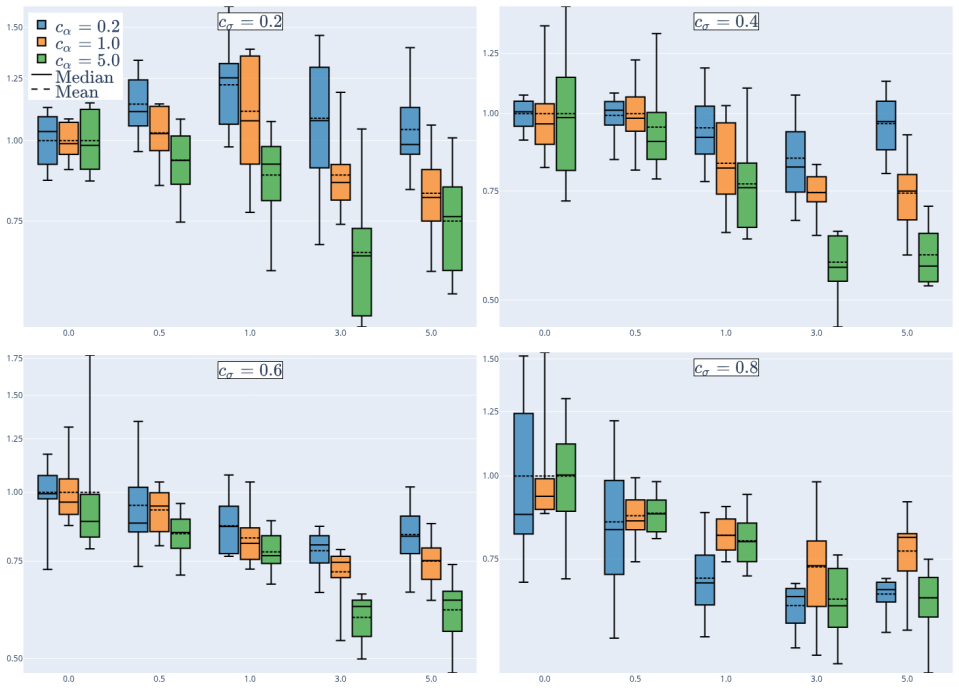
- In off-policy evaluation, where the outcome changes at every iteration of the value iteration, an outcome-agnostic spectral method can lose the relevant direction; the augmented method tracks the shifting signal and remains competitive.
- The generalisation bound is high-probability rather than in expectation, so practitioners get a finite-sample guarantee that degrades gracefully with the ill-posedness of the learned representation.
Where Pith is reading between the lines
- The rank-one augmentation is a template beyond IV: any spectral decomposition of a conditional operator can be steered by appending a rank-one column proportional to a downstream target, provided the contrastive loss admits the same Hilbert–Schmidt identity. This suggests analogues in state-space model learning and in solving conditional moment restrictions more broadly.
- The bad-scenario guarantee is oracle-dependent: choosing the right spectral index and augmentation strength needs the true signal norm. A data-driven rule that estimates these from the fitted operator would turn the theory into a practical procedure; the paper does not provide one.
- The higher-rank extension with moments such as E[Y^k|Z] is only sketched, but if the noise is heteroscedastic or the conditional distribution is asymmetric, those extra moments carry information the first moment misses. A full perturbation analysis for rank-K augmentation could make the method robust beyond mean-zero confounders.
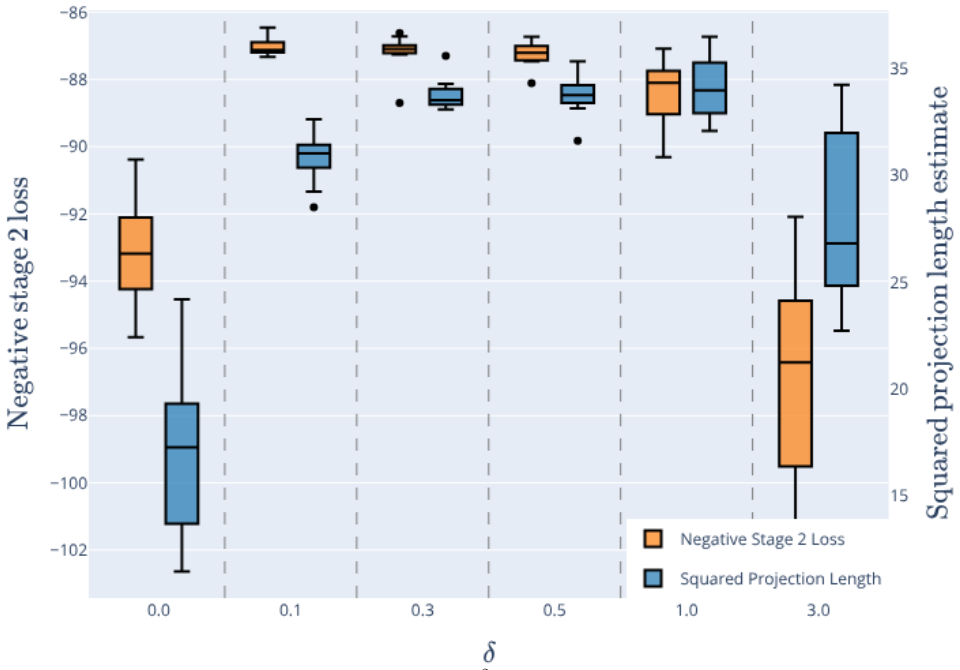
- The consistent benefit of small positive augmentation even in well-aligned settings hints that the augmentation acts as a regulariser, biasing features toward predictive directions at negligible cost to the operator approximation; testing this interpretation across a wider range of signal-to-noise ratios would be a cheap, direct extension.
Editorial analysis
A structured set of objections, weighed in public.
Referee Report
Summary. The paper proposes Augmented Spectral Feature Learning, an outcome-aware variant of SpecIV for nonparametric instrumental variable regression. The method replaces the target-agnostic spectral loss of SpecIV with a contrastive loss derived from an augmented operator T_δ = [T | δ r_0]. Proposition 1 establishes that minimizing this loss is equivalent to best rank-d approximation of T_δ. Theorem 1 gives a high-probability 2SLS excess-risk bound under sub-Gaussian assumptions, and Section 4/Appendix B.3 develop perturbation bounds intended to show that in a 'bad scenario' of spectral misalignment the method recovers the structural function with a single feature whenever the signal-to-noise ratio dominates the spectral decay. Experiments on synthetic data, dSprites benchmarks, and off-policy evaluation show gains over standard SpecIV for suitable δ.
Significance. The core idea is well motivated: making spectral feature learning outcome-aware directly targets the known failure mode of SpecIV when h_0 is misaligned with the top singular functions of T. The paper has several strengths: the data-splitting design (independent feature-learning and 2SLS datasets) avoids circularity in the statistical analysis; Proposition 1 is clean; Theorem 1 is a useful high-probability 2SLS bound; and the experimental section is substantial, including a genuinely harder dSprites task and an OPE setting. The authors are also candid about limitations, explicitly flagging the unquantified optimality gap E_d and the lack of theoretical justification for stage-2-loss model selection. However, the central 'bad scenario' guarantee — the paper's main advertised advantage over SpecIV — is not established by the current proof because of an invalid inequality in Appendix B.3. The idea may be repairable, but the theoretical claim as written is unsupported.
major comments (3)
- [Appendix B.3, 'Bad scenario' paragraph; Section 4, Eq. (18)] The one-feature recovery guarantee rests on an invalid inequality. From Eq. (8) with N={k}, Λ_d=λ_k, the correct gap is γ1(δ)=λ_k(√(1+δ²‖s1‖²)−1), not λ_k√(1+δ²‖s1‖²)−1 as written. With the text's formula, the claimed inequality γ1(δ)>λ_kδ‖s1‖−(1−λ_k) is equivalent, after dividing by λ_k, to √(1+x)>√x+1 for x=(δ‖s1‖)², which is false for every x>0. With the correct Eq. (8) formula, the claimed lower bound γ1>6(1−λ_k) requires conditions on λ_k that are not stated or proved. Therefore Eq. (18), the condition 7‖q1‖/‖s1‖+3E_1λ_k≤κλ_k², and the headline conclusion 'one feature suffices whenever ‖s1‖/‖q1‖≫λ_k⁻²' do not follow from the given derivation. The choice of δ (or the statement of the required spectral gap) must be corrected.
- [Section 4, bad-scenario paragraph] The advertised recovery guarantee is oracle-dependent in a way that is not acknowledged. The proof assumes the practitioner knows the singular index k on which h_0 concentrates and sets δ=7(1−λ_k)/(λ_k‖s1‖) using the true signal norm ‖s1‖. No data-driven procedure for identifying k is given, and Section 6.4's δ-selection rules are heuristic; Section D.8 explicitly concedes that stage-2-loss model selection has no theoretical justification. As a result, the theorem is a conditional oracle bound rather than a guarantee for the proposed algorithm. The paper should either provide a practical selection rule or clearly state that the theoretical result assumes oracle knowledge.
- [Section 4, Eq. (7) and Theorem 4] The end-to-end guarantee is conditional on the optimality gap E_d(θ,ω,δ)=‖T_δ^(d)−Ψ_θ[Φ_θ^*|ω]‖, which the paper explicitly leaves unquantified ('requires architecture-specific generalization bounds... an open problem'). Consequently the corollaries in the good and bad scenarios contain an additive term that could be arbitrarily large, and the results do not establish that training the neural networks with the contrastive loss attains the advertised rates. This is a known and acknowledged limitation, but it should be more prominently qualified in the abstract and conclusions, since the stated 'full generalization error bound' overstates what is proved.
minor comments (5)
- [Section 2, Eq. (2)] The notation 'Z⊥⊥/X' is a typo; it should express conditional independence, e.g., Z⊥⊥X with a slash through the independence symbol.
- [Proposition 1] The 'if and only if' statement assumes uniqueness of the best rank-d approximation of T_δ. If the singular values of T_δ have ties, the minimizer is not unique; the statement should say 'one of the minimizers' or add an explicit spectral-gap assumption for T_δ.
- [Eq. (18)] The displayed coefficient (5‖h0‖+λ_k²‖s1‖)/(λ_k²‖s1‖) appears to be a typo; presumably it should be 5‖h0‖/(λ_k²‖s1‖)+1. The condition '7‖q1‖/‖s1‖+3E_1λ_k≤κλ_k²' also does not match the substitution into Theorem 4's condition, even before accounting for the invalid γ1 bound.
- [Section 6.4 / Section D.8] The stage-2-loss model-selection strategy is used in the OPE experiments, despite the paper's own Section D.8 explaining that its theoretical justification 'remains elusive.' The main text should mark this strategy as heuristic, since a reader may otherwise take it as validated.
- [Section 6.3 / Section D.7] The sentence 'Since δ was automatically tuned ... and took the values of 1/10−3/10−2 for Cartpole/Mountain Car/Catch' is hard to parse; it should read something like 'took the values 1, 10⁻³, and 10⁻² for Cartpole, Mountain Car, and Catch, respectively.'
Circularity Check
No circularity: the augmented-loss/operator equivalence is an algebraic identity, the theoretical guarantees are oracle bounds not fitted predictions, and self-citations are contextual.
full rationale
Walking the derivation chain: the central equivalence (Prop. 1) is not a prediction but a proved identity—Appendix B.1 shows Lδ(θ,ω)=∥Tδ−Tθ,ω∥²_HS−∥Tδ∥²_HS, and Eckart–Young then makes 'minimizing Lδ equals best rank-d approximation of Tδ' true by construction. This is not an input being renamed as an output; the loss was deliberately constructed to match the operator, and the proof is self-contained. The final estimator is evaluated on data independent of the feature-learning sample, and δ is a user-tuned hyperparameter; the theory's δ=7(1−λ_k)/(λ_k∥s1∥) and conditions involving ∥s1∥, ∥q1∥, and k are oracle-style assumptions in the theorem statement, not fitted values later reported as predictions. Self-citations to [27] and [21] supply the SpecIV baseline loss, the good/bad-scenario vocabulary, and the optimality-gap measure; the new augmented operator and perturbation analysis are proved in the paper from Wedin, Weyl, and Eckart–Young, and the h_new benchmark is independently constructed. The paper explicitly acknowledges open items (architecture-specific bound for E_d; no theoretical backing for 2SLS-loss selection in D.8). The alleged false inequality in Eq. (18) is a proof-correctness concern, not a circularity: even if the displayed lower bound is wrong, that is an arithmetic error in the derivation, not an equivalence of the conclusion to the assumptions. Hence no circular step.
Axiom & Free-Parameter Ledger
free parameters (3)
- δ (augmentation strength) =
0.1–5.0 synthetic; 0.1–1.0 dSprites; 10^-3–1 OPE
- d (number of spectral features) =
11 synthetic; 16/32 dSprites; 1 in bad-scenario theory
- Network hyperparameters (architectures, learning rates, batch sizes, regularization) =
Various grids in Appendix D, Tables 1–5
axioms (7)
- domain assumption T: L2(X) → L2(Z) is a compact operator (Assumption 1)
- domain assumption r0 lies in the range of T (solution existence)
- domain assumption Whitened features are uniformly bounded (Assumption 2)
- domain assumption Measure of ill-posedness c > 0 (Assumption 3)
- standard math Noise U and approximation error are sub-Gaussian (Assumption 4)
- ad hoc to paper The optimality gap E_d(θ,ω,δ) is small (unquantified in Sec. 4)
- ad hoc to paper Bad-scenario oracle: h0 is concentrated on a known singular index k and δ is set from ‖s1‖ (Eq. 18)
invented entities (1)
-
Augmented operator Tδ = [T | δ r0]
no independent evidence
Cite this review
Pith. "Pith review of Outcome-Aware Spectral Feature Learning for Instrumental Variable Regression." pith.science (2026). https://pith.science/paper/44Y4OTZJ
@misc{pith2026251200919,
  author       = {Pith},
  title        = {Pith review of: Outcome-Aware Spectral Feature Learning for Instrumental Variable Regression},
  year         = {2026},
  howpublished = {\url{https://pith.science/paper/44Y4OTZJ}},
  note         = {Machine review of arXiv:2512.00919}
}
read the original abstract
We address the problem of causal effect estimation in the presence of hidden confounders using nonparametric instrumental variable (IV) regression. An established approach is to use estimators based on learned spectral features, that is, features spanning the top singular subspaces of the operator linking treatments to instruments. While powerful, such features are agnostic to the outcome variable. Consequently, the method can fail when the true causal function is poorly represented by these dominant singular functions. To mitigate, we introduce Augmented Spectral Feature Learning, a framework that makes the feature learning process outcome-aware. Our method learns features by minimizing a novel contrastive loss derived from an augmented operator that incorporates information from the outcome. By learning these task-specific features, our approach remains effective even under spectral misalignment. We provide a theoretical analysis of this framework and validate our approach on challenging benchmarks.
Figures





Reference graph
Works this paper leans on
-
[1]
Strong converse for identification via quantum channels
Rudolf Ahlswede and Andreas Winter. Strong converse for identification via quantum channels. InIEEE Transactions on Information Theory, volume 48-3, pages 569–579, 2002. doi: 10.1109/TIT.2002.9 98035
-
[2]
Andrew G. Barto, Richard S. Sutton, and Charles W. Anderson. Neuronlike adaptive elements that can solve difficult learning control problems.IEEE Transactions on Systems, Man, and Cybernetics, SMC-13(5):834–846, 1983. doi: 10.1109/TSMC.1983.6313077
arXiv 1983
-
[3]
Minimax instrumental variable regression andl_2convergence guarantees without identification or closedness
Andrew Bennett, Nathan Kallus, Xiaojie Mao, Whitney Newey, Vasilis Syrgkanis, and Masatoshi Ue- hara. Minimax instrumental variable regression andl_2convergence guarantees without identification or closedness. InThe Thirty Sixth Annual Conference on Learning Theory, pages 2291–2318. PMLR, 2023
2023
-
[4]
Semi-nonparametric iv estimation of shape- invariant engel curves.Econometrica, 75(6):1613–1669, 2007
Richard Blundell, Xiaohong Chen, and Dennis Kristensen. Semi-nonparametric iv estimation of shape- invariant engel curves.Econometrica, 75(6):1613–1669, 2007
2007
-
[5]
Steven J. Bradtke and Andrew G. Barto. Linear least-squares algorithms for temporal difference learning. Machine Learning, 22(1–3):33–57, 1996. ISSN 1573-0565. doi: 10.1007/bf00114723. URLhttp: //dx.doi.org/10.1007/BF00114723
-
[6]
Optimal rates for the regularized least-squares algorithm
Andrea Caponnetto and Ernesto De Vito. Optimal rates for the regularized least-squares algorithm. Foundations of Computational Mathematics, 7(3):331–368, 2007
2007
-
[7]
Using geographic variation in college proximity to estimate the return to schooling, 1993
David Card. Using geographic variation in college proximity to estimate the return to schooling, 1993
1993
-
[8]
Optimal sup-norm rates and uniform inference on nonlinear functionals of nonparametric iv regression.Quantitative Economics, 9(1):39–84, 2018
Xiaohong Chen and Timothy M Christensen. Optimal sup-norm rates and uniform inference on nonlinear functionals of nonparametric iv regression.Quantitative Economics, 9(1):39–84, 2018
2018
-
[9]
Estimation of nonparametric conditional moment models with pos- sibly nonsmooth generalized residuals.Econometrica, 80(1):277–321, 2012
Xiaohong Chen and Demian Pouzo. Estimation of nonparametric conditional moment models with pos- sibly nonsmooth generalized residuals.Econometrica, 80(1):277–321, 2012
2012
-
[10]
On instrumental variable regression for deep offline policy evaluation.Journal of Machine Learning Research, 23(302):1–40, 2022
Yutian Chen, Liyuan Xu, Caglar Gulcehre, Tom Le Paine, Arthur Gretton, Nando de Freitas, and Arnaud Doucet. On instrumental variable regression for deep offline policy evaluation.Journal of Machine Learning Research, 23(302):1–40, 2022. 12
2022
-
[11]
Nonparametric instrumental regres- sion.Econometrica, 79(5):1541–1565, 2011
Serge Darolles, Yanqin Fan, Jean-Pierre Florens, and Eric Renault. Nonparametric instrumental regres- sion.Econometrica, 79(5):1541–1565, 2011
2011
-
[12]
Minimax estimation of conditional moment models.Advances in Neural Information Processing Systems, 33, 2020
Nishanth Dikkala, Greg Lewis, Lester Mackey, and Vasilis Syrgkanis. Minimax estimation of conditional moment models.Advances in Neural Information Processing Systems, 33, 2020
2020
-
[13]
Identification and estimation by penal- ization in nonparametric instrumental regression.Econometric Theory, 27(3):472–496, 2011
Jean-Pierre Florens, Jan Johannes, and Sébastien Van Bellegem. Identification and estimation by penal- ization in nonparametric instrumental regression.Econometric Theory, 27(3):472–496, 2011
2011
-
[14]
Lehman, Matthieu Komorowski, Matthieu Komorowski, Aldo Faisal, Leo Anthony Celi, David Sontag, and Finale Doshi-Velez
Omer Gottesman, Fredrik Johansson, Joshua Meier, Jack Dent, Donghun Lee, Srivatsan Srinivasan, Linying Zhang, Yi Ding, David Wihl, Xuefeng Peng, Jiayu Yao, Isaac Lage, Christopher Mosch, Li wei H. Lehman, Matthieu Komorowski, Matthieu Komorowski, Aldo Faisal, Leo Anthony Celi, David Sontag, and Finale Doshi-Velez. Evaluating reinforcement learning algorit...
-
[15]
Nonparametric methods for inference in the presence of instrumental variables.Annals of Statistics, 33(6):2904–2929, 2005
Peter Hall and Joel L Horowitz. Nonparametric methods for inference in the presence of instrumental variables.Annals of Statistics, 33(6):2904–2929, 2005
2005
-
[16]
Deep iv: A flexible approach for counterfactual prediction
Jason Hartford, Greg Lewis, Kevin Leyton-Brown, and Matt Taddy. Deep iv: A flexible approach for counterfactual prediction. InInternational Conference on Machine Learning, pages 1414–1423. PMLR, 2017
2017
-
[17]
Primal-dual spectral representation for off-policy evaluation, 2024
Yang Hu, Tianyi Chen, Na Li, Kai Wang, and Bo Dai. Primal-dual spectral representation for off-policy evaluation, 2024. URLhttps://arxiv.org/abs/2410.17538
Pith/arXiv arXiv 2024
-
[18]
Batch normalization: Accelerating deep network training by reducing internal covariate shift
Sergey Ioffe and Christian Szegedy. Batch normalization: Accelerating deep network training by reducing internal covariate shift. In Francis Bach and David Blei, editors,Proceedings of the 32nd Inter- national Conference on Machine Learning, volume 37 ofProceedings of Machine Learning Research, pages 448–456, Lille, France, 07–09 Jul 2015. PMLR. URLhttps:...
2015
-
[19]
Nan Jiang and Tengyang Xie. Offline reinforcement learning in large state spaces: Algorithms and guarantees.arXiv preprint arXiv:2510.04088, 2025
arXiv 2025
-
[20]
Optimality and adaptivity of deep neural features for instrumental variable regression
Juno Kim, Dimitri Meunier, Arthur Gretton, Taiji Suzuki, and Zhu Li. Optimality and adaptivity of deep neural features for instrumental variable regression. InInternational Conference on Learning Representations, 2025
2025
-
[21]
Neuralconditionalprobabilityforuncertaintyquantification.Advances in Neural Information Processing Systems, 37, 2024
Vladimir Kostic, Grégoire Pacreau, Giacomo Turri, Pietro Novelli, Karim Lounici, and Massimiliano Pontil. Neuralconditionalprobabilityforuncertaintyquantification.Advances in Neural Information Processing Systems, 37, 2024
2024
-
[22]
Offline reinforcement learning: Tutorial, review, and perspectives on open problems, 2020
Sergey Levine, Aviral Kumar, George Tucker, and Justin Fu. Offline reinforcement learning: Tutorial, review, and perspectives on open problems, 2020. URLhttps://arxiv.org/abs/2005.01643
Pith/arXiv arXiv 2020
-
[23]
Adversarial generalized method of moments.arXiv preprint arXiv:1803.07164, 2018
Greg Lewis and Vasilis Syrgkanis. Adversarial generalized method of moments.arXiv preprint arXiv:1803.07164, 2018
Pith/arXiv arXiv 2018
-
[24]
Provably efficient neural estimation of structural equation models: An adversarial approach.Advances in Neural Information Processing Systems, 33, 2020
Luofeng Liao, You-Lin Chen, Zhuoran Yang, Bo Dai, Mladen Kolar, and Zhaoran Wang. Provably efficient neural estimation of structural equation models: An adversarial approach.Advances in Neural Information Processing Systems, 33, 2020
2020
-
[25]
dsprites: Disentanglement testing sprites dataset
Loic Matthey, Irina Higgins, Demis Hassabis, and Alexander Lerchner. dsprites: Disentanglement testing sprites dataset. https://github.com/deepmind/dsprites-dataset/, 2017
2017
-
[26]
Dimitri Meunier, Zhu Li, Tim Christensen, and Arthur Gretton. Nonparametric instrumental regression via kernel methods is minimax optimal.arXiv preprint arXiv:2411.19653, 2024. 13
Pith/arXiv arXiv 2024
-
[27]
Dimitri Meunier, Antoine Moulin, Jakub Wornbard, Vladimir R. Kostic, and Arthur Gretton. Demysti- fying spectral feature learning for instrumental variable regression, 2025. URLhttps://arxiv.org/ab s/2506.10899
arXiv 2025
-
[28]
Spectral normalization for generative adversarial networks
Takeru Miyato, Toshiki Kataoka, Masanori Koyama, and Yuichi Yoshida. Spectral normalization for generative adversarial networks. InInternational Conference on Learning Representations, 2018. URLhttps://openreview.net/forum?id=B1QRgziT-
2018
-
[29]
Volodymyr Mnih, Koray Kavukcuoglu, David Silver, Andrei A. Rusu, Joel Veness, Marc G. Bellemare, Alex Graves, Martin Riedmiller, Andreas K. Fidjeland, Georg Ostrovski, Stig Petersen, Charles Beattie, Amir Sadik, Ioannis Antonoglou, Helen King, Dharshan Kumaran, Daan Wierstra, Shane Legg, and Demis Hassabis. Human-level control through deep reinforcement l...
-
[30]
Phd thesis, Uni- versity of Cambridge, 1990
Andrew William Moore.Efficient Memory-Based Learning for Robot Control. Phd thesis, Uni- versity of Cambridge, 1990
1990
-
[31]
Instrumental variable estimation of nonparametric models
Whitney K Newey and James L Powell. Instrumental variable estimation of nonparametric models. Econometrica, 71(5):1565–1578, 2003
2003
-
[32]
Functional bilevel optimization for machine learning
Ieva Petrulionyte, Julien Mairal, and Michael Arbel. Functional bilevel optimization for machine learning. Advances in Neural Information Processing Systems, 37, 2024
2024
-
[33]
Zikai Shen, Zonghao Chen, Dimitri Meunier, Ingo Steinwart, Arthur Gretton, and Zhu Li. Nonparametric instrumental variable regression with observed covariates.arXiv preprint arXiv:2511.19404, 2025
arXiv 2025
-
[34]
Kernel instrumental variable regression.Advances in Neural Information Processing Systems, 32, 2019
Rahul Singh, Maneesh Sahani, and Arthur Gretton. Kernel instrumental variable regression.Advances in Neural Information Processing Systems, 32, 2019
2019
-
[35]
Spectral representation for causal estimation with hidden confounders
Haotian Sun, Antoine Moulin, Tongzheng Ren, Arthur Gretton, and Bo Dai. Spectral representation for causal estimation with hidden confounders. InThe 28th International Conference on Artificial Intelligence and Statistics, pages 2719–2727. PMLR, 2025
2025
-
[36]
An introduction to matrix concentration inequalities.Foundations and Trends®in Machine Learning, 8(1-2):1–230, 2015
Joel A Tropp. An introduction to matrix concentration inequalities.Foundations and Trends®in Machine Learning, 8(1-2):1–230, 2015
2015
-
[37]
Giacomo Turri, Luigi Bonati, Kai Zhu, Massimiliano Pontil, and Pietro Novelli. Self-supervised evolution operator learning for high-dimensional dynamical systems.arXiv preprint arXiv:2505.18671, 2025
Pith/arXiv arXiv 2025
-
[38]
Fast instrument learning with faster rates.Advances in Neural Information Processing Systems, 35:16596–16611, 2022
Ziyu Wang, Yuhao Zhou, and Jun Zhu. Fast instrument learning with faster rates.Advances in Neural Information Processing Systems, 35:16596–16611, 2022
2022
-
[39]
Perturbation bounds in connection with singular value decomposition.BIT Numerical Mathematics, 12(1):99–111, 1972
Per-Åke Wedin. Perturbation bounds in connection with singular value decomposition.BIT Numerical Mathematics, 12(1):99–111, 1972
1972
-
[40]
Learning deep features in instrumental variable regression
Liyuan Xu, Yutian Chen, Siddarth Srinivasan, Nando de Freitas, Arnaud Doucet, and Arthur Gretton. Learning deep features in instrumental variable regression. InInternational Conference on Learning Representations, 2021
2021
-
[41]
Deep proxy causal learning and its application to confounded bandit policy evaluation, 2024
Liyuan Xu, Heishiro Kanagawa, and Arthur Gretton. Deep proxy causal learning and its application to confounded bandit policy evaluation, 2024. URLhttps://arxiv.org/abs/2106.03907
Pith/arXiv arXiv 2024
-
[42]
measures
Liu Ziyin, Tilman Hartwig, and Masahito Ueda. Neural networks fail to learn periodic functions and how to fix it.Advances in Neural Information Processing Systems, 33:1583–1594, 2020. 14 A Technical Tools Notation.Throughout the appendix, for a compact operatorA,σ d(A)denotes thed-th largest singular value ofAand ifAis self-adjoint,λ d(A)denotes thed-th l...
2020
-
[44]
Start with an initial guess,Q0 (e.g.,Q 0 = 0)
-
[45]
At iterationk+ 1, we solve the NPIV problem defined byQk: •We construct the target outcomeYk using our previous estimateQk and the observed rewardr(S, A) from the data: Yk(S, A) =−1 γ (r(S, A)−Qk(S, A)) •We solve the spectral NPIV problemE[Yk |Z] = ˜TQ k+1 to find the new estimateQk+1
-
[46]
outcome-aware
Repeat until convergence. This iterative process introduces a potential for dynamic spectral misalignment. The targetYk changes at every iterationk. If the spectral features required to estimateYk (the “outcome-aware” direction) are not the same as the dominant spectral features of˜T, or if this direction shifts asQk converges, an outcome-agnostic method ...
-
[2018]
URLhttps://arxiv.org/abs/1805.12298
This paper was first reviewed by deepseek-v4-flash on August 3, 2026.
discussion (0)
Sign in with ORCID, Apple, or X to comment. Anyone can read and Pith papers without signing in.