REVIEW 5 major objections 4 minor 11 references
Inductive van der Waals Force between Two Quantum Loops
T0 review · 5 major / 4 minor · reviewed 2026-08-03 · deepseek-v4-flash
Pith's one-line read This paper claims that QED flips the inductive van der Waals force between two superconducting loops from repulsive to attractive, driven by a state-independent two-photon exchange term.
desk verdict Plausible and novel claim that the A² term gives a dominant attractive force, but the gauge-invariance and self-energy subtraction issues need a serious referee. read the letter →
The pith
A machine-rendered reading of the paper's core claim, the machinery that carries it, and where it could break.
The reading
What carries the argument
The central object is the A² (two-photon) term X = (1/2L)(∮A·dx)² in the QED Hamiltonian of each loop. Unlike the single-photon term W, X does not change the loop state; it creates or annihilates pairs of virtual photons. The key contribution ΔEiii is second-order in X and involves exchange of two photons between the loops. Its role is to add a state-independent energy shift that dominates the inter-loop force and flips the sign from repulsive (semiclassical) to attractive.
What would settle it
Measure the mechanical force between two inductively coupled superconducting loops as a function of separation in the regime R ≪ 2πℏc/Δ. If the force is repulsive, or if its distance dependence deviates from −ℏc/R² times a slowly varying logarithmic factor, the paper's central claim would be refuted.
Extended reading notes
Core claim
In the QED picture, the interaction Hamiltonian has two pieces: W (one-photon, p·A) and X (two-photon, A²). The semiclassical result is reproduced by the sum of processes (i) and (ii), giving ΔEi + ΔEii = 3/8 ℏω₀η². The second-order-X process, ΔEiii = −(ℏc/πa)ηλ, is absent from the semiclassical description and dominates the force: |F₃/F₁₂| ∼ c/(Rω₀) ≫ 1 in the quasi-instantaneous regime. Because ΔEiii shifts all loop states equally, it cannot be seen in spectroscopy; it manifests only as a mechanical force, which at short distances behaves as F₃ ≈ −(ℏc/R²) g(R).
Load-bearing premise
The central attractive term is computed after discarding divergent single-loop self-energy contributions without a regulator-independent proof that these pieces do not mix with the finite, R-dependent cross-loop two-photon exchange.
Editorial extensions
If this is right
- If the paper is right, a force measurement between two inductively coupled superconducting loops in their ground state will see attraction, with magnitude ≈ ℏc/R² at sub-micron separations.
- The same system should show a repulsive energy shift in spectroscopy, matching the semiclassical result, so the two types of experiment test different parts of the theory.
- The predicted force at R = 0.1 µm is roughly 3 × 10⁻¹² N, within reach of current force sensors.
- The short-distance force has a universal 1/R² Casimir-like form times a geometric logarithmic factor, distinct from the 1/R⁶ vdW form of the semiclassical term.
Reading between the lines
- A natural testable extension would be to vary the loop geometry (size, wire radius, relative angle) to check the predicted logarithmic factor g(R); the paper gives the formula but does not propose such a systematic study.
- Because ΔEiii is state-independent, the same attractive force should appear for any pair of loop states, not just the ground state; the paper computes the ground state but the mechanism does not depend on the level index.
- The analogy to the Casimir force suggests that the same A²-exchange mechanism might appear in other inductively coupled mesoscopic systems, adding a state-independent attraction that standard circuit models would miss.
Signed reviews
Editorial analysis
A structured set of objections, weighed in public.
Referee Report
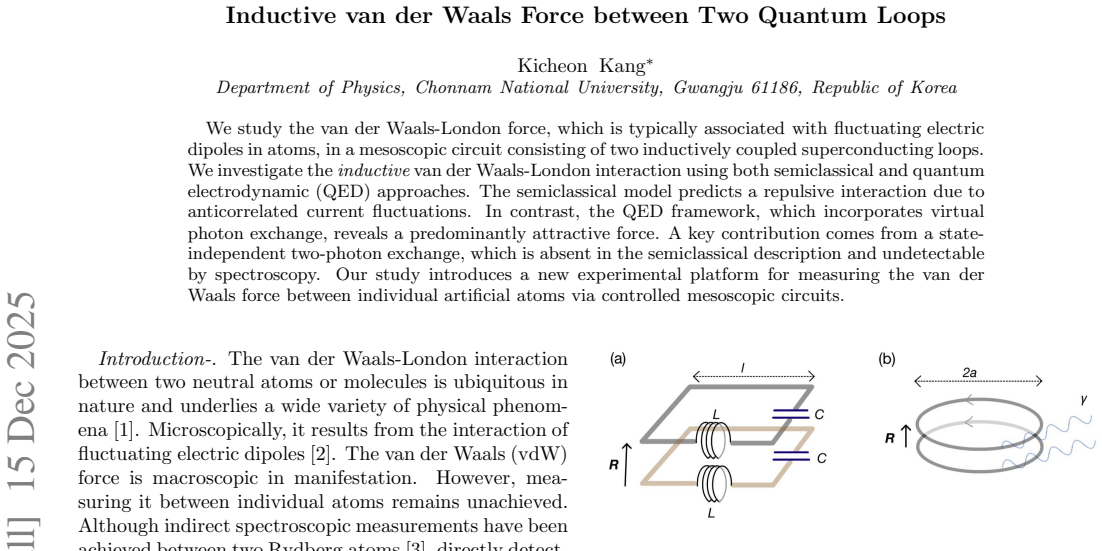
Summary. The paper studies the interaction between two inductively coupled superconducting loops, treated as quantum LC circuits, comparing a semiclassical zero-point-energy calculation with a QED treatment of the same system. The semiclassical model gives a repulsive ground-state shift, ΔEsc ≃ 3ℏω0η²/8 for small mutual inductance η = M/L. The QED calculation splits the interaction into a single-photon piece W and the A² piece X. Summing two fourth-order (i) and third-order (ii) contributions reproduces the semiclassical repulsion, while a second-order X-only process (iii) is claimed to give a dominant, state-independent, attractive contribution ΔEiii, with a short-distance force F3 ∼ −ℏc/R² g(R). The central claim is that this QED-specific term turns the repulsive inductive van der Waals force into an attractive one, observable in force measurements but invisible spectroscopically.
Significance. If the calculation is correct, the paper offers a concrete, falsifiable prediction: a direct force measurement between two inductively coupled superconducting loops should see an attractive Casimir-like force, even though spectroscopy of the same system would see a repulsive level shift. This would be a new mesoscopic test of vacuum/QED effects and would distinguish state-dependent energy shifts from state-independent force contributions. The semiclassical part is clean and the algebraic consistency check that ΔEi+ΔEii reproduces the small-η semiclassical repulsion is a useful cross-check. The paper is clearly written and the predicted experimental signature is well defined. Its main weakness is that the decisive new term ΔEiii is obtained through partially shown, approximation-laden steps and a gauge-dependent-looking A² interaction, with no regulator-independent demonstration that discarded self-energy terms leave the R-dependent result untouched.
major comments (5)
- [§ 'Quantum electrodynamic approach', Eqs. (19)-(22)] The central result ΔEiii and the force F3 rest on the approximation ℏω+ℏω′ → ℏω′ used after Eq. (19). In a second-order X process the two virtual photons are on equal footing, so this asymmetric truncation is not justified by the stated argument that ω′ ≲ c/|r1−r2| dominates. A symmetric evaluation of the two-photon integral could change the prefactor, the power law, or the sign of ΔEiii. Since the sign and magnitude of the attractive force are the paper's central claim, this approximation must be either derived carefully or replaced by an exact/symmetric evaluation with a justified error estimate.
- [§ 'Quantum electrodynamic approach', Eq. (14c), (21)] The dominant contribution comes from the A² term X in the Coulomb-gauge minimal-coupling Hamiltonian. The decomposition H = H0 + W + X is not manifestly gauge invariant, and the paper does not show that ΔEiii is gauge invariant. A unitary transformation such as the Power-Zienau or dipole transformation can remove or reshuffle A² terms; the same physical interaction must then be reproduced by W-only diagrams. Without such an analysis, the possibility remains that the predicted attraction is a gauge artifact. This is a load-bearing issue: the central claim is specifically that ΔEiii dominates and changes the sign of the force.
- [§ 'Quantum electrodynamic approach', Eqs. (15), (21)] The paper repeatedly states that 'self-interaction contributions... are irrelevant and discarded,' but no regulator-independent proof is given. In second-order X, the A² operator contains contractions of two fields at the same spatial point that produce divergent zero-photon intermediate states; the finite R-dependent cross-loop correlation must be separated from these divergences in a well-defined way. If the subtraction scheme depends on the regulator or on the approximation, the finite ΔEiii shown in Eq. (22a) is not uniquely defined. The authors should specify a normal-ordering or renormalization prescription and show that the discarded terms do not mix with the cross-loop two-photon contribution.
- [§ 'Quantum electrodynamic approach', Eqs. (17), (20), (22a)] The derivations of the three central energy shifts are not shown. The Letter jumps from the integrals (16) and (19) to the closed results (17), (20), and (22a). In particular, the positive coefficient of ΔEii in Eq. (20) and the factor 1/π and the definition of λ(R) in Eq. (22b) are crucial for the sign, the magnitude, and the distance dependence of the final prediction. A reader cannot verify these results without the intermediate algebra. The equivalence ΔEi+ΔEii = 3ℏω0η²/8 is stated after the fact; the cancellation of the geometric factors must be shown explicitly.
- [Eq. (3)] The generalized force is defined as ∂L/∂R, but the sign of the force and the relation to the energy derivative are not discussed. For R treated as an external parameter, the mechanical force is usually −∂H/∂R; the paper's sign convention should be stated clearly, because the classification of the semiclassical interaction as 'repulsive' depends on this convention.
minor comments (4)
- [Fig. 4] The vertical axis label of panel (b) appears as 'F /( ħħ / R² )'; this should be ℏc/R², with the 'c' included.
- [Abstract and author address] Typos: 'a ssociated' should be 'associated'; 'Gwang ju' should be 'Gwangju'.
- [Introduction, 'semiclassical approach'] The classical force in Eq. (3) is written as F = ∂L/∂R, but it would be helpful to note that the force is evaluated at fixed canonical variables so that the derivative of the kinetic term does not contribute.
- [Throughout] The terms 'state-independent' and 'undetectable by spectroscopy' are used for ΔEiii. It might be worth noting explicitly that this assumes the same X-induced shift for all loop states within the two-level truncation, and that any dependence on the excitation energy through the intermediate state would need to be checked.
Circularity Check
No significant circularity: the QED attraction term is derived independently, and the semiclassical match is a consistency check rather than an input.
full rationale
The derivation chain is self-contained and does not reduce to its inputs. The semiclassical repulsion is computed from coupled LC oscillators, while the QED attraction is obtained by second-order perturbation in X=(1/2L)(∮A·dl)^2, Eq. (21), followed by an analytic evaluation with stated approximations. No fitted parameter is renamed as a prediction; no self-citation is load-bearing; no uniqueness theorem is imported; and the new term ΔEiii is not defined to equal the claimed force. The check that ΔEi+ΔEii equals the small-η semiclassical result, Eq. (23) versus Eq. (8), is a consistency test: the circuit parameters Δ=ℏω0 and |Īn|²=ℏω0/2L are model inputs, but the semiclassical energy shift was not inserted into the perturbation calculation. The genuine weakness flagged in Eqs. (15) and (21), where 'self-interaction contributions... are irrelevant and discarded' without a regulator-independent proof, is a possible correctness or renormalization gap, but it is not a circular step: the cross-loop A²/A² correlation still has independent content and yields a falsifiable prediction, F3 ∼ −ℏc/R²g(R). Therefore the circularity score is 0.
Assumptions & free parameters
assumptions (5)
- domain assumption Each loop is a single-mode harmonic LC oscillator with V(Q)=Q²/(2C), Δ=ℏω0, and |Ibar|²=ℏω0/(2L).
- domain assumption Quasi-instantaneous limit: in denominators, ℏω+Δ ≈ ℏω and ℏω+ℏω′ ≈ ℏω′.
- ad hoc to paper Single-loop self-energy contributions to ΔEi, ΔEii, and ΔEiii are divergent but can be discarded without affecting the R-dependent interaction.
- domain assumption The loops are treated as one-dimensional filamentary curves, with a wire-radius cutoff b used in logarithmic factors.
- domain assumption The radiation field is quantized in free space as plane waves and the loops do not back-react on the mode structure.
Cite this review
Pith. "Pith review of Inductive van der Waals Force between Two Quantum Loops." pith.science (2026). https://pith.science/paper/JMJTWF3J
@misc{pith2026251201263,
  author       = {Pith},
  title        = {Pith review of: Inductive van der Waals Force between Two Quantum Loops},
  year         = {2026},
  howpublished = {\url{https://pith.science/paper/JMJTWF3J}},
  note         = {Machine review of arXiv:2512.01263}
}
read the original abstract
We study the van der Waals-London force, which is typically associated with fluctuating electric dipoles in atoms, in a mesoscopic circuit consisting of two inductively coupled superconducting loops. We investigate the {\em inductive} van der Waals-London interaction using both semiclassical and quantum electrodynamic (QED) approaches. The semiclassical model predicts a repulsive interaction due to anticorrelated current fluctuations. In contrast, the QED framework, which incorporates virtual photon exchange, reveals a predominantly attractive force. A key contribution comes from a state-independent two-photon exchange, which is absent in the semiclassical description and undetectable by spectroscopy. Our study introduces a theoretical framework for exploring the van der Waals force between individual artificial atoms via controlled mesoscopic circuits.
Figures


Reference graph
Works this paper leans on
-
[1]
V. A. Parsegian, Van der Waals forces: a handbook for bi- ologists, chemists, engineers, and physicists (Cambridge university press, 2005)
2005
-
[2]
London, Transactions of the Faraday Society 33, 8b (1937)
F. London, Transactions of the Faraday Society 33, 8b (1937)
1937
-
[3]
Beguin, A
L. Beguin, A. Vernier, R. Chicireanu, T. Lahaye, and A. Browaeys, Physical Review Letters 110, 263201 (2013)
2013
-
[4]
You and F
J.-Q. You and F. Nori, Nature 474, 589 (2011)
2011
-
[5]
C. L. Degen, F. Reinhard, and P. Cappellaro, Reviews of Modern Physics 89, 035002 (2017)
2017
-
[6]
Kleppner, Lecture Notes for Atomic and Optical Physics: 8.2 The van der Waals interaction (Mas- sachusetts Institute of Technology, 1994)
D. Kleppner, Lecture Notes for Atomic and Optical Physics: 8.2 The van der Waals interaction (Mas- sachusetts Institute of Technology, 1994)
1994
-
[7]
H. B. Casimir and D. Polder, Physical Review 73, 360 (1948)
1948
-
[8]
Moser, J
J. Moser, J. G¨ uttinger, A. Eichler, M. J. Esplandiu, D. Liu, M. Dykman, and A. Bachtold, Nature Nanotech- nology 8, 493 (2013)
2013
Show all 11 references
-
[9]
Schwinger, Letters in Mathematical Physics 1, 43 (1975)
J. Schwinger, Letters in Mathematical Physics 1, 43 (1975)
1975
-
[10]
R. L. Jaffe, Physical Review D 72, 021301 (2005)
2005
-
[11]
Cohen-Tannoudji, J
C. Cohen-Tannoudji, J. Dupont-Roc, and G. Grynberg, Atom-photon interactions: basic processes and applica- tions (John Wiley & Sons, 2024)
2024
Reviewed August 3, 2026 · model on record in the stance chip above.
Discussion (0). Continue with ORCID to comment.