REVIEW 3 major objections 6 minor 58 references
Locally driving a single site in a dissipative Lieb lattice can turn the destructive interference that creates flat bands into a source of antibunched light on a neighbouring dark site.
Reviewed by Pith at T0; open to challenge. T0 means a machine referee read the full paper against a public rubric. the ladder, T0–T4 →
T0 review · deepseek-v4-flash
2026-08-03 19:07 UTC pith:3AKMUPAK
load-bearing objection A genuinely new UPB-in-lattices result with a solid three-site analytic core, but the flat-band connection is not proven by the confounded control in Sec. III E. the 3 major comments →
Antibunching in locally driven dissipative Lieb lattices
The pith
A machine-rendered reading of the paper's core claim, the machinery that carries it, and where it could break.
Core claim
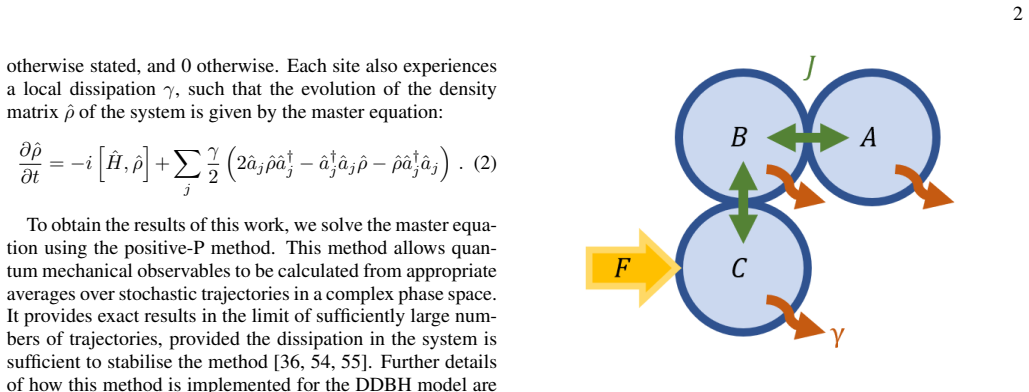
The paper claims that in a locally driven Lieb lattice, the destructive interference which produces the flat band and dark B sites can be repurposed to suppress double occupation of a chosen dark site, yielding enhanced antibunching via a mechanism analogous to unconventional photon blockade. Concretely, for a five-unit-cell quasi-1D chain with drive F=J=3γ, U=0.1γ, and Δ=-0.2γ, the adjacent site 3B reaches g^(2)(0)=0.468, while A and C sites remain nearly coherent. Destroying the flat band by setting Δ_C=-5γ reduces the effect to g^(2)(0)=0.948, directly linking the antibunching to the same interference that creates the flat band. The work also demonstrates the effect in a 2D Lieb lattice a
What carries the argument
Unconventional photon blockade (UPB): the cancellation of the two-boson occupation amplitude on a target site by destructive interference between different excitation paths, here enabled by the same geometric frustration that makes B sites dark in a Lieb lattice. The analytical optimization for a single unit cell (three-site chain) is derived from a weak-driving two-boson ansatz, setting the C_020 amplitude to zero and yielding closed-form equations for the optimal detuning and hopping.
Load-bearing premise
The central numerical claim rests on the positive-P method with 2000 trajectories yielding converged, unbiased steady-state and second-order correlation functions for the extended lattices, with no convergence tests or code provided; the analytical parameter optimization additionally assumes weak driving while the simulations operate at F≈γ.
What would settle it
Compute g^(2)(0) on site 3B of the five-unit-cell chain using an independent method (e.g., a matrix-product-state based master equation solver or exact diagonalization for a reduced lattice) at U=0.1γ, Δ=-0.2γ, F=J=3.0γ; if the result deviates significantly from the reported 0.468, the positive-P sampling is biased. Alternatively, in a Lieb micropillar lattice, measure g^(2)(0) on the dark site adjacent to a locally driven C site while detuning C sites to destroy the flat band; the predicted jump from ~0.45 to ~0.95 either occurs or it does not.
If this is right
- A single local drive can generate antibunching on a preselected site of an extended lattice, offering a scalable alternative to two-site UPB devices.
- The effect provides experimentally accessible parameters for polariton micropillar lattices, with g^(2)(0) below 0.5 and occupations above 0.1 at U/γ=0.1.
- Adding a background drive on other C sites allows the hopping J to be halved while maintaining antibunching, doubling the oscillation period of g^(2)(τ) and easing detector time-resolution requirements.
- The link between flat-band interference and antibunching implies that measuring g^(2)(0) on dark sites can act as a probe of flat-band integrity in real lattices.
- Local driving schemes can be extended to other lattice geometries and to other correlation functions, broadening the toolkit for quantum correlations in driven-dissipative systems.
Where Pith is reading between the lines
- The same interference mechanism could be exploited to generate entanglement or squeezed states between multiple dark sites in larger two-dimensional Lieb lattices, where multiple B sites are simultaneously addressed.
- If the flat-band connection is robust, disorder or perturbations that break the flat band should degrade antibunching, making g^(2)(0) on dark sites a sensitive diagnostic for flat-band physics in experiments.
- The positive-P results for extended lattices could be cross-checked against tensor-network or exact diagonalization methods on small systems; agreement would strengthen the reliability of the stochastic approach for multi-time correlations in open lattices.
- Frustrated geometries other than Lieb lattices (e.g., kagome or pyrochlore) that also host dark sites may support analogous UPB-like antibunching under localized driving.
Editorial analysis
A structured set of objections, weighed in public.
Referee Report
Summary. The paper studies the driven-dissipative Bose-Hubbard model on Lieb lattices with a coherent drive applied locally to a C site. It first derives, in the weak-driving limit, analytic conditions for optimal antibunching on the middle B site of a three-site chain (Eqs. (6)–(8) and Appendix A). It then uses positive-P stochastic simulations to show that on quasi-1D Lieb lattices (and in one 2D example) the B site adjacent to the drive exhibits strong antibunching, e.g. g^(2)(0)=0.468 for U=0.1γ, Δ=-0.2γ, F=J=3.0γ in the 5-cell system. The authors optimize parameters for observability in polariton micropillar experiments, introduce a background drive to recover antibunching at lower J, and present a flat-band control in Sec. III E that they interpret as evidence for a common destructive-interference origin of the flat band and the enhanced antibunching.
Significance. If the numerical results are reliable, this is a useful extension of unconventional photon blockade from dimers to extended lattice geometries: it demonstrates that local driving can create non-classical correlations on selected dark sites of a Lieb lattice, and it identifies practical advantages (longer oscillation period in g^(2)(τ), reduced side peaks) that are relevant to polariton micropillar experiments. The analytic three-site derivation is transparent and internally consistent, and the positive-P method is, in principle, an exact stochastic technique for this model. The main qualifications are the absence of convergence/error-bar information for the numerics and the weak control used to connect the effect to flat-band interference.
major comments (3)
- [Sec. III E, Fig. 10] The control for the flat-band claim is confounded. Changing Δ_C from -0.2γ to -5.0γ simultaneously destroys the flat band and moves the driven C site 5γ off resonance relative to the laser tuned to A/B. The reduced effective drive lowers the B-site occupation; at low occupancy any weakly driven nonlinear system tends to g^(2)(0)→1, so the observed 0.948 does not specifically implicate flat-band interference. Since Sec. IV uses this result to argue for a common destructive-interference origin, please supply a control that breaks the flat band while keeping the C sites on resonance (e.g., detuning the A sublattice, or a staggered hopping), or otherwise match the B-site occupation across the comparison.
- [Sec. II; Figs. 13–17] No convergence tests are reported for the positive-P simulations. The paper states that 2000 samples are used, but most g^(2)(0) values in parameter scans are plotted without error bars, and some key numbers (e.g., g^(2)(0)=0.468 in Fig. 6) are quoted without uncertainty. Because the parameter choices in Secs. III C/D and Appendix B are optima of these curves, it is essential to know whether the reported minima are significant. Please add error bars or statistical bootstrap uncertainties, and provide a convergence check (e.g., trajectory number, or comparison with an exact master equation/DMRG calculation for a small system).
- [Appendix A; Sec. III A] The analytic optimal condition is derived in the weak-driving limit (amplitude hierarchy A2, linearized density matrix A3). The numerical demonstration of the 3-site optimum uses F=γ (Fig. 3), and the extended lattices use F=J=3γ, i.e., outside the assumed weak-driving regime. The agreement at F=γ is encouraging, but the paper does not quantify the range of validity of the analytic formulas or show that the same two-boson interference mechanism is operative at the drive strengths of the main results. Please test the ansatz against exact numerics as a function of F, or explicitly restrict the analytic-optimum claim to weak driving.
minor comments (6)
- [Abstract; Sec. II] The abstract states that positive-P allows one to calculate correlations 'exactly' for extended lattices. With a finite number of trajectories (2000), the results are only exact in the limit of large samples and sufficient dissipation; please soften the wording or state the finite-sample nature explicitly.
- [Fig. 3] The text says that for sites A and C the g^(2)(τ) values are 'approximately equal' at all τ, but this is not shown or explained. Please either display these curves or give a brief reason for the equivalence.
- [Sec. III E] For the flat-band comparison, please report the B-site occupations n for both Δ_C cases. The interpretation of g^(2)(0)≈0.948 as 'weak antibunching' depends strongly on whether the occupation is also strongly reduced in the off-resonant case.
- [Sec. II; Appendix B] Please specify the time step δt, the number of steady-state time samples N_t, and the total integration time used in the positive-P simulations, in addition to the total trajectory count.
- [Figs. 7 and 9] The 'period' of the oscillations in g^(2)(τ) is described as the gap between the two maxima adjacent to τ=0, but this quantity is not formally defined. Please define it precisely, especially because it is used to claim a doubling of the period at lower J.
- [Reproducibility] The simulations use the xmds2 package, but no code or data availability statement is included. Providing scripts or data would strengthen reproducibility, particularly for the parameter scans in Appendix B.
Circularity Check
No significant circularity found; the analytic UPB condition is derived from the Hamiltonian, the positive-P simulations provide an independent numerical check, and parameter choices are explicitly disclosed as optimizations rather than independent predictions.
full rationale
The paper's main derivation chain is not circular. Equations (6)–(8) in Sec. III A and Appendix A are obtained by applying the standard weak-driving two-boson ansatz from Ref. [41] and imposing the condition that the two-boson occupation amplitude on the central B site vanishes (C020 = 0). This is a design target derived from the model, not a parameter fitted to the simulation output. The positive-P simulations in Fig. 3 then independently evaluate g^(2)(0) at those analytic parameters, giving a nontrivial numerical check at finite drive. For the larger lattices, the paper is transparent that parameter choices are optimized using the simulation results themselves: Sec. III B states that 'any optimisation of the physical parameters must instead be performed using the results of the positive-P simulations,' and Sec. III C says 'From that analysis we choose the parameters ... as a primary example that provides a good compromise between minimising g^(2)(0) on site 3B.' Thus the reported g^(2)(0) values at the chosen parameters are optima, not independent predictions; this is a disclosed optimization procedure, not circularity. The self-citations to Ref. [36] (positive-P implementation) and Ref. [57] (multi-time correlations) are methodological and supported by prior published work and standard positive-P theory; there is no load-bearing appeal to an unverified self-cited uniqueness theorem. The flat-band control in Sec. III E is arguably confounded (changing Δ_C to −5γ both destroys the flat band and moves the driven C site far off resonance), and no convergence tests are shown for the 2000-trajectory positive-P averages. These are legitimate correctness or inference-quality caveats, but they do not amount to the paper's conclusions being equivalent to its inputs by construction. Overall, the derivation is self-contained and the numerical results are computed from the model rather than imported from the target claims.
Axiom & Free-Parameter Ledger
free parameters (5)
- Detuning Δ =
-0.28γ (3-site), -0.2γ (lattices)
- Hopping J =
2.775γ (3-site), 3.0γ or 1.5γ (lattices)
- Drive strength F =
0.5γ to 4.0γ
- Background drive F_bg =
0.8γ
- Interaction U =
0.1γ
axioms (4)
- domain assumption The driven-dissipative Bose-Hubbard model with on-site Kerr nonlinearity and Markovian local dissipation (Eqs. 1–2) describes polariton micropillar lattices.
- domain assumption Positive-P stochastic equations (3) yield exact quantum expectation values in the limit of many trajectories and sufficient dissipation.
- ad hoc to paper The weak-driving, two-boson Fock-state ansatz and amplitude hierarchy (A1)–(A3) are valid for the 3-site analytic optimisation.
- ad hoc to paper Setting the B-site double-occupation amplitude C020 = 0 gives the optimal antibunching condition on that site.
read the original abstract
In Lieb lattices, geometric frustration and destructive interference of hopping cancels the occupation of certain sites, leading to flat-band physics. Here, we show numerically how, in the driven-dissipative Bose-Hubbard (DDBH) model arranged into Lieb lattices and related geometries, specific localised driving schemes can repurpose this interference to generate enhanced antibunching via a mechanism similar to the so-called unconventional photon blockade. Stochastic simulations using the positive-P method allow us to calculate occupations and second order correlations exactly for extended lattices. We use this to optimise the parameters for the possible observation of this effect in polariton micropillar experiments. This work demonstrates the possibility of using localised driving and interference effects to generate non-trivial quantum correlations in open quantum lattice systems. Specifically, producing antibunching in the dark sites of the flat band system rather than the usual and less useful bunching.
Figures


Reference graph
Works this paper leans on
-
[1]
Carusotto and C
I. Carusotto and C. Ciuti, Quantum fluids of light, Rev. Mod. Phys.85, 299 (2013)
2013
-
[2]
J. M. Raimond, M. Brune, and S. Haroche, Manipulating quan- tum entanglement with atoms and photons in a cavity, Rev. Mod. Phys.73, 565 (2001)
2001
-
[3]
Walther, B
H. Walther, B. T. H. Varcoe, B.-G. Englert, and T. Becker, Cav- ity quantum electrodynamics, Reports on Progress in Physics 69, 1325 (2006). 12
2006
-
[4]
Reiserer and G
A. Reiserer and G. Rempe, Cavity-based quantum networks with single atoms and optical photons, Rev. Mod. Phys.87, 1379 (2015)
2015
-
[5]
Schmidt and J
S. Schmidt and J. Koch, Circuit qed lattices: Towards quantum simulation with superconducting circuits, Annalen der Physik 525, 395 (2013)
2013
-
[6]
A. A. Houck, H. E. Türeci, and J. Koch, On-chip quantum sim- ulation with superconducting circuits, Nature Physics8, 292 (2012)
2012
-
[7]
J. M. Fink, A. Dombi, A. Vukics, A. Wallraff, and P. Domokos, Observation of the photon-blockade breakdown phase transi- tion, Phys. Rev. X7, 011012 (2017)
2017
-
[8]
Fitzpatrick, N
M. Fitzpatrick, N. M. Sundaresan, A. C. Y . Li, J. Koch, and A. A. Houck, Observation of a dissipative phase transition in a one-dimensional circuit qed lattice, Phys. Rev. X7, 011016 (2017)
2017
-
[9]
A. J. Kollár, M. Fitzpatrick, and A. A. Houck, Hyperbolic lat- tices in circuit quantum electrodynamics, Nature571, 45–50 (2019)
2019
-
[10]
Carusotto, D
I. Carusotto, D. Gerace, H. E. Tureci, S. De Liberato, C. Ciuti, and A. Imamo ˇglu, Fermionized photons in an array of driven dissipative nonlinear cavities, Phys. Rev. Lett.103, 033601 (2009)
2009
-
[11]
R. O. Umucal ılar and I. Carusotto, Fractional quantum hall states of photons in an array of dissipative coupled cavities, Phys. Rev. Lett.108, 206809 (2012)
2012
-
[12]
Kasprzak, S
J. Kasprzak, S. Reitzenstein, E. A. Muljarov, C. Kistner, C. Schneider, M. Strauss, S. Höfling, A. Forchel, and W. Lang- bein, Up on the jaynes–cummings ladder of a quantum- dot/microcavity system, Nature Materials9, 304 (2010)
2010
-
[13]
Amo and J
A. Amo and J. Bloch, Exciton-polaritons in lattices: A non- linear photonic simulator, Comptes Rendus Physique17, 934 (2016)
2016
-
[14]
Schneider, K
C. Schneider, K. Winkler, M. D. Fraser, M. Kamp, Y . Ya- mamoto, E. A. Ostrovskaya, and S. Höfling, Exciton-polariton trapping and potential landscape engineering, Reports on Progress in Physics80, 016503 (2016)
2016
-
[15]
C. W. Lai, N. Y . Kim, S. Utsunomiya, G. Roumpos, H. Deng, M. D. Fraser, T. Byrnes, P. Recher, N. Kumada, T. Fujisawa, and Y . Yamamoto, Coherent zero-state andπ-state in an exci- ton–polariton condensate array, Nature450, 529–532 (2007)
2007
-
[16]
N. Y . Kim, K. Kusudo, C. Wu, N. Masumoto, A. Löf- fler, S. Höfling, N. Kumada, L. Worschech, A. Forchel, and Y . Yamamoto, Dynamical d-wave condensation of exci- ton–polaritons in a two-dimensional square-lattice potential, Nature Physics7, 681–686 (2011)
2011
-
[17]
Tanese, H
D. Tanese, H. Flayac, D. Solnyshkov, A. Amo, A. Lemaître, E. Galopin, R. Braive, P. Senellart, I. Sagnes, G. Malpuech, and J. Bloch, Polariton condensation in solitonic gap states in a one-dimensional periodic potential, Nature Communications4, 1749 (2013)
2013
-
[18]
Tanese, E
D. Tanese, E. Gurevich, F. Baboux, T. Jacqmin, A. Lemaître, E. Galopin, I. Sagnes, A. Amo, J. Bloch, and E. Akker- mans, Fractal energy spectrum of a polariton gas in a fibonacci quasiperiodic potential, Phys. Rev. Lett.112, 146404 (2014)
2014
-
[19]
Zhang, S
B. Zhang, S. Brodbeck, Z. Wang, M. Kamp, C. Schneider, S. Höfling, and H. Deng, Coupling polariton quantum boxes in sub-wavelength grating microcavities, Applied Physics Letters 106, 051104 (2015)
2015
-
[20]
Baboux, L
F. Baboux, L. Ge, T. Jacqmin, M. Biondi, E. Galopin, A. Lemaître, L. Le Gratiet, I. Sagnes, S. Schmidt, H. E. Türeci, A. Amo, and J. Bloch, Bosonic condensation and disorder- induced localization in a flat band, Phys. Rev. Lett.116, 066402 (2016)
2016
-
[21]
St-Jean, V
P. St-Jean, V . Goblot, E. Galopin, A. Lemaître, T. Ozawa, L. Le Gratiet, I. Sagnes, J. Bloch, and A. Amo, Lasing in topo- logical edge states of a one-dimensional lattice, Nature Photon- ics11, 651–656 (2017)
2017
-
[22]
Klembt, T
S. Klembt, T. H. Harder, O. A. Egorov, K. Winkler, H. Su- chomel, J. Beierlein, M. Emmerling, C. Schneider, and S. Höfling, Polariton condensation in s- and p-flatbands in a two-dimensional lieb lattice, Applied Physics Letters111, 231102 (2017)
2017
-
[23]
Klembt, T
S. Klembt, T. Harder, O. Egorov, K. Winkler, R. Ge, M. Ban- dres, M. Emmerling, L. Worschech, T. Liew, M. Segev, et al., Exciton-polariton topological insulator, Nature562, 552 (2018)
2018
-
[24]
C. E. Whittaker, E. Cancellieri, P. M. Walker, D. R. Gule- vich, H. Schomerus, D. Vaitiekus, B. Royall, D. M. Whittaker, E. Clarke, I. V . Iorsh, I. A. Shelykh, M. S. Skolnick, and D. N. Krizhanovskii, Exciton polaritons in a two-dimensional lieb lattice with spin-orbit coupling, Phys. Rev. Lett.120, 097401 (2018)
2018
-
[25]
Goblot, B
V . Goblot, B. Rauer, F. Vicentini, A. Le Boité, E. Galopin, A. Lemaître, L. Le Gratiet, A. Harouri, I. Sagnes, S. Ravets, C. Ciuti, A. Amo, and J. Bloch, Nonlinear polariton fluids in a flatband reveal discrete gap solitons, Phys. Rev. Lett.123, 113901 (2019)
2019
-
[26]
Mili ´cevi´c, G
M. Mili ´cevi´c, G. Montambaux, T. Ozawa, O. Jamadi, B. Real, I. Sagnes, A. Lemaître, L. Le Gratiet, A. Harouri, J. Bloch, and A. Amo, Type-iii and tilted dirac cones emerging from flat bands in photonic orbital graphene, Phys. Rev. X9, 031010 (2019)
2019
-
[27]
R. Su, S. Ghosh, J. Wang, S. Liu, C. Diederichs, T. C. H. Liew, and Q. Xiong, Observation of exciton polariton condensation in a perovskite lattice at room temperature, Nature Physics16, 301–306 (2020)
2020
-
[28]
N. H. M. Dang, D. Gerace, E. Drouard, G. Trippé-Allard, F. Lédée, R. Mazurczyk, E. Deleporte, C. Seassal, and H. S. Nguyen, Tailoring dispersion of room-temperature exciton- polaritons with perovskite-based subwavelength metasurfaces, Nano Letters20, 2113 (2020)
2020
-
[29]
Dusel, S
M. Dusel, S. Betzold, O. Egorov, S. Klembt, J. Ohmer, U. Fis- cher, S. Höfling, and C. Schneider, Room temperature organic exciton-polariton condensate in a lattice, Nature Communica- tions11, 2863 (2020)
2020
-
[30]
Brennecke, T
F. Brennecke, T. Donner, S. Ritter, T. Bourdel, M. Köhl, and T. Esslinger, Cavity qed with a bose–einstein condensate, Na- ture450, 268 (2007)
2007
-
[31]
Usaj, Localization engineering by resonant driving in dissi- pative polariton arrays, SciPost Phys
G. Usaj, Localization engineering by resonant driving in dissi- pative polariton arrays, SciPost Phys. Core7, 052 (2024)
2024
-
[32]
Muñoz de las Heras, A
A. Muñoz de las Heras, A. Amo, and A. González-Tudela, Nonlinearity-enabled localization in driven-dissipative pho- tonic lattices, Phys. Rev. A109, 063523 (2024)
2024
-
[33]
Biondi, E
M. Biondi, E. P. L. van Nieuwenburg, G. Blatter, S. D. Huber, and S. Schmidt, Incompressible polaritons in a flat band, Phys. Rev. Lett.115, 143601 (2015)
2015
-
[34]
Hyrkäs, V
M. Hyrkäs, V . Apaja, and M. Manninen, Many-particle dynam- ics of bosons and fermions in quasi-one-dimensional flat-band lattices, Phys. Rev. A87, 023614 (2013)
2013
-
[35]
Casteels, R
W. Casteels, R. Rota, F. Storme, and C. Ciuti, Probing photon correlations in the dark sites of geometrically frustrated cavity lattices, Phys. Rev. A93, 043833 (2016)
2016
-
[36]
Deuar, A
P. Deuar, A. Ferrier, M. Matuszewski, G. Orso, and M. H. Szyma´nska, Fully quantum scalable description of driven- dissipative lattice models, PRX Quantum2, 010319 (2021)
2021
-
[37]
Gardiner and P
C. Gardiner and P. Zoller,Quantum Noise(Springer, 2004)
2004
-
[38]
Muñoz-Matutano, A
G. Muñoz-Matutano, A. Wood, M. Johnsson, X. Vidal, B. Q. 13 Baragiola, A. Reinhard, A. Lemaître, J. Bloch, A. Amo, G. Nogues, B. Besga, M. Richard, and T. V olz, Emergence of quantum correlations from interacting fibre-cavity polaritons, Nature Materials18, 213–218 (2019)
2019
-
[39]
Delteil, T
A. Delteil, T. Fink, A. Schade, S. Höfling, C. Schneider, and A. ˙Imamo˘glu, Towards polariton blockade of confined exci- ton–polaritons, Nature Materials18, 219–222 (2019)
2019
-
[40]
T. C. H. Liew and V . Savona, Single photons from coupled quantum modes, Phys. Rev. Lett.104, 183601 (2010)
2010
-
[41]
Bamba, A
M. Bamba, A. Imamo ˘glu, I. Carusotto, and C. Ciuti, Origin of strong photon antibunching in weakly nonlinear photonic molecules, Phys. Rev. A83, 021802 (2011)
2011
-
[42]
Bamba and C
M. Bamba and C. Ciuti, Counter-polarized single-photon gen- eration from the auxiliary cavity of a weakly nonlinear photonic molecule, Applied Physics Letters99, 171111 (2011)
2011
-
[43]
Ferretti, L
S. Ferretti, L. C. Andreani, H. E. Türeci, and D. Gerace, Photon correlations in a two-site nonlinear cavity system under coher- ent drive and dissipation, Phys. Rev. A82, 013841 (2010)
2010
-
[44]
Flayac and V
H. Flayac and V . Savona, Input-output theory of the unconven- tional photon blockade, Phys. Rev. A88, 033836 (2013)
2013
-
[45]
Ferretti, V
S. Ferretti, V . Savona, and D. Gerace, Optimal antibunching in passive photonic devices based on coupled nonlinear res- onators, New Journal of Physics15, 025012 (2013)
2013
-
[46]
T. C. H. Liew and V . Savona, Multimode entanglement in cou- pled cavity arrays, New Journal of Physics15, 025015 (2013)
2013
-
[47]
Gerace and V
D. Gerace and V . Savona, Unconventional photon blockade in doubly resonant microcavities with second-order nonlinearity, Phys. Rev. A89, 031803 (2014)
2014
-
[48]
Xu and Y
X.-W. Xu and Y . Li, Strong photon antibunching of symmet- ric and antisymmetric modes in weakly nonlinear photonic molecules, Phys. Rev. A90, 033809 (2014)
2014
-
[49]
Lemonde, N
M.-A. Lemonde, N. Didier, and A. A. Clerk, Antibunching and unconventional photon blockade with gaussian squeezed states, Phys. Rev. A90, 063824 (2014)
2014
-
[50]
Flayac and V
H. Flayac and V . Savona, Single photons from dissipation in coupled cavities, Phys. Rev. A94, 013815 (2016)
2016
-
[51]
Flayac and V
H. Flayac and V . Savona, Unconventional photon blockade, Phys. Rev. A96, 053810 (2017)
2017
-
[52]
H. J. Snijders, J. A. Frey, J. Norman, H. Flayac, V . Savona, A. C. Gossard, J. E. Bowers, M. P. van Exter, D. Bouwmeester, and W. Löffler, Observation of the unconventional photon blockade, Phys. Rev. Lett.121, 043601 (2018)
2018
-
[53]
Vaneph, A
C. Vaneph, A. Morvan, G. Aiello, M. Féchant, M. Aprili, J. Gabelli, and J. Estève, Observation of the unconventional photon blockade in the microwave domain, Phys. Rev. Lett. 121, 043602 (2018)
2018
-
[54]
Naether, F
U. Naether, F. Quijandría, J. J. García-Ripoll, and D. Zueco, Stationary discrete solitons in a driven dissipative bose-hubbard chain, Phys. Rev. A91, 033823 (2015)
2015
-
[55]
Mandt, D
S. Mandt, D. Sadri, A. A. Houck, and H. E. Türeci, Stochas- tic differential equations for quantum dynamics of spin-boson networks, New Journal of Physics17, 053018 (2015)
2015
-
[56]
G. R. Dennis, J. J. Hope, and M. T. Johnsson, Xmds2: Fast, scalable simulation of coupled stochastic partial differ- ential equations, Computer Physics Communications184, 201 (2013)
2013
-
[57]
Deuar, Multi-time correlations in the positive-P, Q, and dou- bled phase-space representations, Quantum5, 455 (2021)
P. Deuar, Multi-time correlations in the positive-P, Q, and dou- bled phase-space representations, Quantum5, 455 (2021)
2021
-
[58]
Y . Wang, X. Zheng, T. C. H. Liew, and Y . D. Chong, Long-lived photon blockade with weak optical nonlinearity, arXiv (2025), preprint, ArXiv:2502.09930
Pith/arXiv arXiv 2025
discussion (0)
Sign in with ORCID, Apple, or X to comment. Anyone can read and Pith papers without signing in.