REVIEW 3 major objections 5 minor 75 references
A learned manifold of real human motion lets two distance scores judge AI-generated actions and their temporal coherence more reliably than existing metrics or multimodal judges.
Reviewed by Pith at T0; open to challenge. T0 means a machine referee read the full paper against a public rubric. the ladder, T0–T4 →
T0 review · deepseek-v4-flash
2026-08-03 19:06 UTC pith:YZFYLRCZ
load-bearing objection A solid evaluation method and benchmark undermined by an in-distribution S_cons test; the temporal metric shows real external signal, and the action-consistency claim needs held-out validation before it should be trusted. the 3 major comments →
Generative Action Tell-Tales: Assessing Human Motion in Synthesized Videos
The pith
A machine-rendered reading of the paper's core claim, the machinery that carries it, and where it could break.
Core claim
The paper's central claim is that a video shows a 'real' human action exactly when its embedding lands close to where real videos of that action cluster, and moves through that space at a smooth, plausible pace. The authors demonstrate this by training a small transformer encoder on windows of real video using two objectives: a supervised contrastive loss that pulls same-action windows together, and a hard-negative loss that shoves temporally corrupted windows (shuffled, frozen, or reversed frames) away. The resulting space is called the action manifold. A generated video is scored for action consistency by the L2 distance between its averaged window embedding and the action-class centroid,
What carries the argument
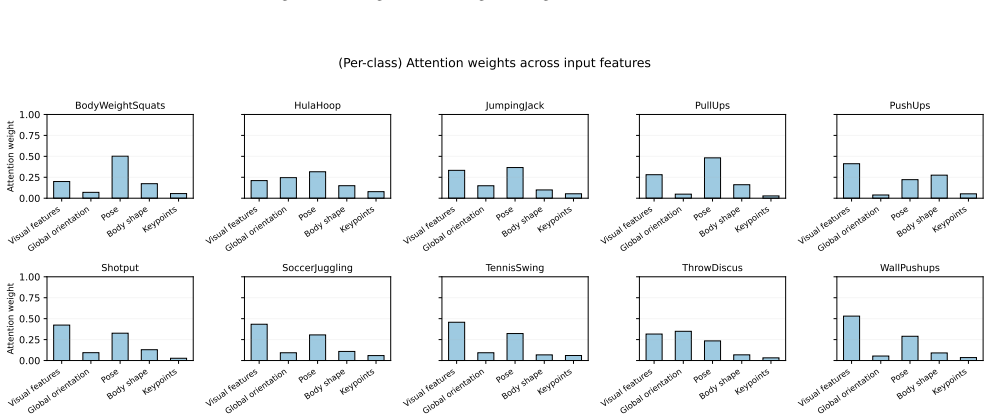
The load-bearing object is the learned action manifold: a latent space in which each temporal window of real human motion is encoded by a transformer that fuses per-frame static features (3D body pose, shape, global orientation, 2D keypoints, visual appearance) with first-order temporal-derivative features. The training uses a supervised contrastive loss for same-action clustering and a hard-negative loss that repels temporally distorted windows, so the space is simultaneously semantic and motion-sensitive. Two derived scores carry the argument: S_cons measures distance to the nearest action-class centroid, and S_temp measures average jump size between consecutive frame embeddings; their joi
Load-bearing premise
The main load-bearing premise is that the benchmark's human-ratings comparison is fair: the encoder is trained on the same ten action classes used in the benchmark, so the measured advantage over zero-shot baselines may not hold for actions the encoder has never seen.
What would settle it
Generate videos of human actions outside the ten classes used in training, collect human ratings, estimate centroids from real videos of those new classes, and recompute S_cons; if its rank correlation with human judgments drops to the level of the strongest baseline (around 0.45), the reported gains are an artifact of the training-class overlap.
If this is right
- Generated videos can be scored without any reference clip or text prompt, purely by how their embeddings sit relative to a real-action manifold.
- The temporal-coherence score generalizes to actions outside the training set and reproduces the human ranking of text-to-video models on an external benchmark.
- Removing the motion-derivative features causes the largest drop in accuracy, so temporal dynamics are the primary signal, not appearance.
- The benchmark's human ratings expose that current video generators still fail systematically on whole-body rotational actions.
Where Pith is reading between the lines
- Editorial inference: the benchmark scores the metric on the same ten action classes used to train the encoder, so the large gain over zero-shot multimodal judges may partly reflect an in-distribution advantage; whether it holds on arbitrary unseen actions is the natural next test.
- Editorial inference: the same manifold could be turned into a debugging tool — a video's per-window trajectory shows where it leaves the manifold, localizing which seconds of generation are anatomically or temporally wrong.
- Editorial inference: because S_temp only measures smoothness, a frozen or duplicated-frame video can receive an artificially good score (the paper's own sensitivity analysis shows this exception); pairing it with S_cons or a stillness detector would close that hole.
- Editorial inference: if centroids can be computed cheaply from a few real videos of a new action class, the metric becomes a practical plug-in for model selection during video-generation development.
Editorial analysis
A structured set of objections, weighed in public.
Referee Report
Summary. The paper proposes a learned latent manifold for evaluating human actions in AI-generated videos. The approach extracts human-centric features (SMPL pose/shape/orientation, 2D keypoints, visual features) plus first-order temporal derivatives, trains a transformer encoder with supervised contrastive and hard-negative losses on 10 UCF-101 action classes, and derives two metrics: S_cons (distance of a generated video's embedding to a class centroid of real videos) and S_temp (mean inter-frame embedding distance). The authors introduce TAG-Bench, a benchmark of 300 generated videos with human ratings on Action Consistency and Temporal Coherence, and report that S_cons reaches Spearman ρ=0.61 and S_temp ρ=0.64, outperforming the best baseline (GPT-5) by 35.6% and 68.4% respectively. External validation on VBench-2.0 is performed with S_temp only, where it ranks four text-to-video models in agreement with humans.
Significance. If the claims hold, a learned human-action manifold metric would be a valuable tool for video generation evaluation, and TAG-Bench with human ratings is a useful community resource. The paper's strengths include a well-motivated combination of 3D/2D/visual features and temporal derivatives, thorough ablations (loss terms, input features, visual backbone, window length), and a serious human-study protocol with subject rejection and convergence analysis. The code is promised publicly. However, the central claim of a general-purpose human-action fidelity metric is not yet supported: the main S_cons result is evaluated on the same action classes used for training, and the only external benchmark test excludes S_cons entirely. Additionally, S_temp as defined in Eq. (4) assigns a perfect score to a static video, a known failure mode that the supplementary material concedes.
major comments (3)
- [Sec. 5.1 / Sec. 3.3 / Sec. 5.3] The headline comparison for S_cons is in-distribution with respect to action classes. Sec. 5.1 states the encoder is trained from scratch on the same 10 UCF-101 categories used in TAG-Bench, and Sec. 3.3 defines S_cons as a distance to class centroids c_k fitted from real videos of those exact classes. Thus the 0.61 vs 0.45 (GPT-5) and the claimed +35.6%/+68.4% gains in Table 1 show advantages on a test whose action vocabulary is identical to the training vocabulary, whereas the MLLM baselines are zero-shot. The external validation in Sec. 5.3 explicitly excludes S_cons because 'S_cons requires a corresponding action centroid,' so no evidence is presented that S_cons transfers to unseen actions. The abstract's claim of a general human-action fidelity metric therefore rests on missing evidence. I request an evaluation on held-out action classes (e.g., remaining UCF-101 or Kinetics action
- [Eq. (4) / Supp. Fig. 12] S_temp is defined as the average inter-frame embedding distance; identical adjacent frames yield zero distance. A video that is frozen or nearly static is therefore scored as perfectly temporally coherent. The supplementary material (Fig. 12 and surrounding text) explicitly acknowledges this 'Copy' exception, noting that S_temp does not increase because identical adjacent frames produce low embedding differences. This is not a peripheral artifact: static or near-static frames are a common failure mode of video generators, and the paper's own hard-negative training (Sec. 3.2.2) includes repeated-frame distortions as negatives. As defined, the metric cannot distinguish a static frame from smooth coherent motion. This limitation should be addressed in the metric itself or clearly stated as a scope restriction in the main paper, and the claim that S_temp measures temporal coherence should be
- [Table 1 / Fig. 3] The paper reports Spearman correlations without confidence intervals or significance tests. The differences between S_cons/S_temp and GPT-5 (0.61 vs 0.45; 0.64 vs 0.38) on 300 videos may be affected by sampling variability, especially given human-rating noise (inter-rater agreement is 0.72/0.71). In the VBench-2.0 external validation, Fig. 3 reports ρ=1.0000 based on only four models (Table 7), which is not statistically meaningful by itself. I recommend adding bootstrap confidence intervals for the correlations and, for the win-ratio comparison, reporting the number of prompts/comparisons and a test of ranking agreement that accounts for the small N.
minor comments (5)
- [Throughout] Several typos and formatting artifacts: in Table 1, '/uk' and 'ὑ2' symbols appear to be rendering issues; the abstract and Sec. 1 use '68%' without specifying the two metrics separately; Fig. 3 caption says 'ρ=1.0000' but the axis labels and fitting line are not defined in the caption.
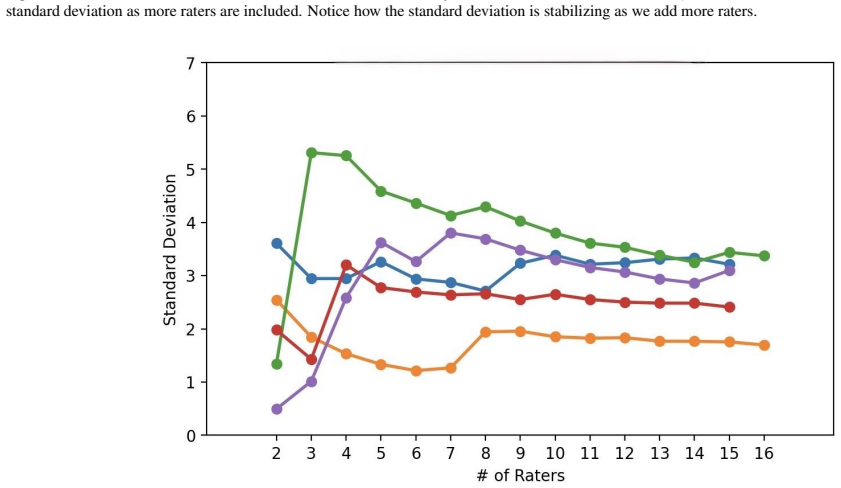
- [Sec. 4 / Supp. B.2] The number of retained raters differs between the main text (Sec. 4: after subject rejection, average inter-rater correlation 0.716/0.710) and the appendix (121 retained for Action Consistency, 141 for Temporal Coherence). Please reconcile these numbers or clarify the exact sequence of filtering.
- [Sec. 5.3] For the VBench-2.0 external evaluation, the paper says 'we evaluate only videos with a single visible person per frame,' but does not report how many videos/prompts were retained after filtering. This information is needed to assess the robustness of the win-ratio result.
- [Sec. 5.5, Table 4] When replacing ViT features with CLIP or DINOv2, the paper says 'we train the encoder from scratch' but does not specify whether the same training budget and hyperparameters were used; if not, the comparison may reflect tuning rather than feature quality.
- [Sec. 3.2.1] The notation in Eq. (2) for the attention weights is slightly confusing: the softmax is over k, but the query q and key projection are shared across all k. Clarify that a single query is used per frame.
Circularity Check
No significant circularity; the S_cons in-distribution train/test overlap is an evaluation-scope caveat, not a derivation that reduces to its inputs.
full rationale
The paper's derivation is not circular by construction. The action-consistency metric is defined (Sec. 3.3) as the L2 distance between a generated video's mean [CLS] embedding and a class centroid c_k averaged over real videos; the encoder is trained with a supervised contrastive loss (Sec. 3.2.2, 5.1). This makes S_cons a fitted nearest-centroid score, but the reported 0.61 Spearman correlation is measured against independently collected human ratings of generated videos (Sec. 4, 5.2), not against the class labels used to fit the encoder/centroids. The correlation is therefore an empirical result, not an identity. S_temp (Eq. 4) is a self-contained inter-frame embedding-distance measure and is externally validated on VBench-2.0 prompts not in the training classes (Sec. 5.3), giving the temporal-coherence claim independent support. The main caveat is evaluation scope, not circularity: Sec. 5.1 trains on 'the same 10 UCF101 action categories' used in TAG-Bench (Sec. 4), and Sec. 5.3 admits S_cons is not applied to VBench-2.0 because 'Scons requires a corresponding action centroid.' Thus S_cons's generalization to unseen action classes is untested, and the +35.6%/+68.4% gains over zero-shot GPT-5 (Table 1) may be inflated by in-distribution fitting. The supplementary also admits a 'Copy' failure mode for S_temp (Fig. 12). These are validity/robustness limitations, not examples of a prediction being equivalent to its input by construction. No load-bearing self-citation chain, uniqueness import, or ansatz-via-citation is present.
Axiom & Free-Parameter Ledger
free parameters (4)
- Action class centroids c_k =
10×256-D vectors (one per class)
- Hard-negative loss weight λ =
10
- Temporal window length T =
32 frames
- Subject-rejection thresholds =
95th percentile, R1/R2 criteria, ρ<0.55
axioms (4)
- domain assumption UCF-101 class labels for the 10 selected actions are a valid semantic ground truth for action consistency.
- domain assumption SMPL parameters, 2D keypoints, and ViT appearance features extracted from generated videos are sufficiently reliable to represent motion and anatomy.
- domain assumption Human ratings on AMT after multi-stage subject rejection and z-scoring reflect true action consistency and temporal coherence.
- domain assumption The learned embedding space is structured so that real videos of an action form compact clusters and generated videos of the same action should lie near the real centroid.
read the original abstract
Despite rapid advances in video generative models, robust metrics for evaluating visual and temporal correctness of complex human actions remain elusive. Critically, existing pure-vision encoders and Multimodal Large Language Models (MLLMs) are strongly appearance-biased, lack temporal understanding, and thus struggle to discern intricate motion dynamics and anatomical implausibilities in generated videos. We tackle this gap by introducing a novel evaluation metric derived from a learned latent space of real-world human actions. Our method first captures the nuances, constraints, and temporal smoothness of real-world motion by fusing appearance-agnostic human skeletal geometry features with appearance-based features. We posit that this combined feature space provides a robust representation of action plausibility. Given a generated video, our metric quantifies its action quality by measuring the distance between its underlying representations and this learned real-world action distribution. For rigorous validation, we develop a new multi-faceted benchmark specifically designed to probe temporally challenging aspects of human action fidelity. Through extensive experiments, we show that our metric achieves substantial improvement of more than 68% compared to existing state-of-the-art methods on our benchmark, performs competitively on established external benchmarks, and has a stronger correlation with human perception. Our in-depth analysis reveals critical limitations in current video generative models and establishes a new standard for advanced research in video generation.
Figures






Reference graph
Works this paper leans on
-
[1]
Gpt-4 technical report.arXiv preprint arXiv:2303.08774,
Josh Achiam, Steven Adler, Sandhini Agarwal, Lama Ah- mad, Ilge Akkaya, Florencia Leoni Aleman, Diogo Almeida, Janko Altenschmidt, Sam Altman, Shyamal Anadkat, et al. Gpt-4 technical report.arXiv preprint arXiv:2303.08774,
-
[2]
Kuhl, and Andrew N
Alison Gopnik, Patricia K. Kuhl, and Andrew N. Meltzoff. The scientist in the crib: Minds, brains, and how children learn, 1999. 1
1999
-
[3]
Di- rect motion models for assessing generated videos.arXiv preprint arXiv:2505.00209, 2025
Kelsey Allen, Carl Doersch, Guangyao Zhou, Mohammed Suhail, Danny Driess, Ignacio Rocco, Yulia Rubanova, Thomas Kipf, Mehdi SM Sajjadi, Kevin Murphy, et al. Di- rect motion models for assessing generated videos.arXiv preprint arXiv:2505.00209, 2025. 6, 8
Pith/arXiv arXiv 2025
-
[4]
Amazon mechanical turk
Amazon Web Services, Inc. Amazon mechanical turk. https://www.mturk.com/. Accessed: November
-
[5]
Tuned con- trastive learning.arXiv preprint arXiv:2305.10675, 2023
Chaitanya Animesh and Manmohan Chandraker. Tuned con- trastive learning.arXiv preprint arXiv:2305.10675, 2023. 4
Pith/arXiv arXiv 2023
-
[6]
Videophy: Evaluating physical commonsense for video generation.arXiv preprint arXiv:2406.03520, 2024
Hritik Bansal, Zongyu Lin, Tianyi Xie, Zeshun Zong, Michal Yarom, Yonatan Bitton, Chenfanfu Jiang, Yizhou Sun, Kai- Wei Chang, and Aditya Grover. Videophy: Evaluating physical commonsense for video generation.arXiv preprint arXiv:2406.03520, 2024. 2
Pith/arXiv arXiv 2024
-
[7]
Hritik Bansal, Clark Peng, Yonatan Bitton, Roman Golden- berg, Aditya Grover, and Kai-Wei Chang. Videophy-2: A challenging action-centric physical commonsense evaluation in video generation.arXiv preprint arXiv:2503.06800, 2025. 6, 8
Pith/arXiv arXiv 2025
-
[8]
Row, Peterson and Company, 1954
Roger G Barker and Herbert F Wright.Midwest and the USA. Row, Peterson and Company, 1954. 1
1954
-
[9]
Is space-time attention all you need for video understanding? International Conference on Machine Learning, 2021
Gedas Bertasius, Heng Wang, and Lorenzo Torresani. Is space-time attention all you need for video understanding? International Conference on Machine Learning, 2021. 4
2021
-
[10]
Andreas Blattmann, Tim Dockhorn, Sumith Kulal, Daniel Mendelevitch, Maciej Kilian, Dominik Lorenz, Yam Levi, Zion English, Vikram V oleti, Adam Letts, et al. Stable video diffusion: Scaling latent video diffusion models to large datasets.arXiv preprint arXiv:2311.15127, 2023. 2
Pith/arXiv arXiv 2023
-
[11]
Realtime multi-person 2d pose estimation using part affin- ity fields
Zhe Cao, Tomas Simon, Shih-En Wei, and Yaser Sheikh. Realtime multi-person 2d pose estimation using part affin- ity fields. InProceedings of the IEEE/CVF Conference on Computer Vision and Pattern Recognition, 2017. 3
2017
-
[12]
Emerg- ing properties in self-supervised vision transformers.2021 IEEE/CVF International Conference on Computer Vision,
Mathilde Caron, Hugo Touvron, Ishan Misra, Herv’e J’egou, Julien Mairal, Piotr Bojanowski, and Armand Joulin. Emerg- ing properties in self-supervised vision transformers.2021 IEEE/CVF International Conference on Computer Vision,
2021
-
[13]
Emerg- ing properties in self-supervised vision transformers
Mathilde Caron, Hugo Touvron, Ishan Misra, Herv ´e J´egou, Julien Mairal, Piotr Bojanowski, and Armand Joulin. Emerg- ing properties in self-supervised vision transformers. In Proceedings of the IEEE/CVF International Conference on Computer Vision, 2021. 6
2021
-
[14]
A short note on the kinetics-700 human action dataset.arXiv preprint arXiv:1907.06987, 2019
Joao Carreira, Eric Noland, Chloe Hillier, and Andrew Zis- serman. A short note on the kinetics-700 human action dataset.arXiv preprint arXiv:1907.06987, 2019. 9
Pith/arXiv arXiv 1907
-
[15]
Joseph Cho, Fachrina Dewi Puspitasari, Sheng Zheng, Jingyao Zheng, Lik-Hang Lee, Tae-Ho Kim, Choong Seon Hong, and Chaoning Zhang. Sora as an agi world model? a complete survey on text-to-video generation.arXiv preprint arXiv:2403.05131, 2024. 2, 5
arXiv 2024
-
[16]
Gheorghe Comanici, Eric Bieber, Mike Schaekermann, Ice Pasupat, Noveen Sachdeva, Inderjit Dhillon, Marcel Blis- tein, Ori Ram, Dan Zhang, Evan Rosen, et al. Gemini 2.5: Pushing the frontier with advanced reasoning, multimodality, long context, and next generation agentic capabilities.arXiv preprint arXiv:2507.06261, 2025. 6, 7
Pith/arXiv arXiv 2025
-
[17]
Arcface: Additive angular margin loss for deep face recognition
Jiankang Deng, Jia Guo, Niannan Xue, and Stefanos Zafeiriou. Arcface: Additive angular margin loss for deep face recognition. InProceedings of the IEEE/CVF Confer- ence on Computer Vision and Pattern Recognition, 2019. 8
2019
-
[18]
Alexey Dosovitskiy. An image is worth 16x16 words: Transformers for image recognition at scale.arXiv preprint arXiv:2010.11929, 2020. 3
Pith/arXiv arXiv 2010
-
[19]
Tokenhmr: Advancing human mesh recov- ery with a tokenized pose representation
Sai Kumar Dwivedi, Yu Sun, Priyanka Patel, Yao Feng, and Michael J Black. Tokenhmr: Advancing human mesh recov- ery with a tokenized pose representation. InProceedings of the IEEE/CVF Conference on Computer Vision and Pattern Recognition, 2024. 5, 9, 4, 7
2024
-
[20]
Smpl made simple faqs.https : / / files
Perceiving Systems Department MPI for Intelligent Sys- tems. Smpl made simple faqs.https : / / files . is . tue . mpg . de / black / talks / SMPL - made - simple-FAQs.pdf. 3
-
[21]
Ava: A video dataset of spatio-temporally localized atomic visual actions
Chunhui Gu, Chen Sun, David A Ross, Carl V ondrick, Car- oline Pantofaru, Yeqing Li, Sudheendra Vijayanarasimhan, George Toderici, Susanna Ricco, Rahul Sukthankar, et al. Ava: A video dataset of spatio-temporally localized atomic visual actions. InProceedings of the IEEE/CVF Conference on Computer Vision and Pattern Recognition, 2018. 1
2018
-
[22]
Deep residual learning for image recognition
Kaiming He, Xiangyu Zhang, Shaoqing Ren, and Jian Sun. Deep residual learning for image recognition. InProceed- ings of the IEEE/CVF Conference on Computer Vision and Pattern Recognition, 2016. 6
2016
-
[23]
Videoscore: Building automatic metrics to simulate fine-grained human feedback for video genera- tion
Xuan He, Dongfu Jiang, Ge Zhang, Max Ku, Achint Soni, Sherman Siu, Haonan Chen, Abhranil Chandra, Ziyan Jiang, Aaran Arulraj, et al. Videoscore: Building automatic metrics to simulate fine-grained human feedback for video genera- tion. InProceedings of the Conference on Empirical Meth- ods in Natural Language Processing, 2024. 2, 6, 8
2024
-
[24]
Xuan He, Dongfu Jiang, Ping Nie, Minghao Liu, Zhengxuan Jiang, Mingyi Su, Wentao Ma, Junru Lin, Chun Ye, Yi Lu, et al. Videoscore2: Think before you score in generative video evaluation.arXiv preprint arXiv:2509.22799, 2025. 5, 6, 8
arXiv 2025
-
[25]
Clipscore: A reference-free evaluation met- ric for image captioning
Jack Hessel, Ari Holtzman, Maxwell Forbes, Ronan Le Bras, and Yejin Choi. Clipscore: A reference-free evaluation met- ric for image captioning. InProceedings of the Confer- ence on Empirical Methods in Natural Language Processing,
-
[26]
Video dif- fusion models.Advances in Neural Information Processing Systems, 2022
Jonathan Ho, Tim Salimans, Alexey Gritsenko, William Chan, Mohammad Norouzi, and David J Fleet. Video dif- fusion models.Advances in Neural Information Processing Systems, 2022. 2 10
2022
-
[27]
Wenyi Hong, Ming Ding, Wendi Zheng, Xinghan Liu, and Jie Tang. Cogvideo: Large-scale pretraining for text-to-video generation via transformers.arXiv preprint arXiv:2205.15868, 2022. 2, 7, 5
Pith/arXiv arXiv 2022
-
[28]
Image quality metrics: Psnr vs
Alain Hore and Djemel Ziou. Image quality metrics: Psnr vs. ssim. InProceedings of the 20th IEEE International Confer- ence on Pattern Recognition, 2010. 2
2010
-
[29]
Methodologies for the subjective assessment of the quality of television pic- tures
International Telecommunication Union. Methodologies for the subjective assessment of the quality of television pic- tures. Technical report, ITU Radiocommunication Sector (ITU-R), 2019. 2
2019
-
[30]
Black, David W
Angjoo Kanazawa, Michael J. Black, David W. Jacobs, and Jitendra Malik. End-to-end recovery of human shape and pose. InProceedings of the IEEE/CVF Conference on Com- puter Vision and Pattern Recognition, 2018. 3
2018
-
[31]
Vibe: Video inference for human body pose and shape estimation
Muhammed Kocabas, Nikos Athanasiou, and Michael J Black. Vibe: Video inference for human body pose and shape estimation. InProceedings of the IEEE/CVF Confer- ence on Computer Vision and Pattern Recognition, 2020. 3
2020
-
[32]
Weijie Kong, Qi Tian, Zijian Zhang, Rox Min, Zuozhuo Dai, Jin Zhou, Jiangfeng Xiong, Xin Li, Bo Wu, Jianwei Zhang, et al. Hunyuanvideo: A systematic framework for large video generative models.arXiv preprint arXiv:2412.03603, 2024. 2, 5, 7, 9
Pith/arXiv arXiv 2024
-
[33]
Kling: High-fidelity and temporally consistent text-to-video generation.Technical Report, 2024
Kuaishou Technology. Kling: High-fidelity and temporally consistent text-to-video generation.Technical Report, 2024. https://kling.kuaishou.com. 7, 5
2024
-
[34]
What matters when building vision-language models? Advances in Neural Information Processing Systems, 2024
Hugo Laurenc ¸on, L´eo Tronchon, Matthieu Cord, and Victor Sanh. What matters when building vision-language models? Advances in Neural Information Processing Systems, 2024. 6
2024
-
[35]
Genmo: A generalist model for human motion.arXiv preprint arXiv:2505.01425,
Jiefeng Li, Jinkun Cao, Haotian Zhang, Davis Rempe, Jan Kautz, Umar Iqbal, and Ye Yuan. Genmo: A generalist model for human motion.arXiv preprint arXiv:2505.01425,
-
[36]
Visual instruction tuning.Advances in Neural Information Processing Systems, 2023
Haotian Liu, Chunyuan Li, Qingyang Wu, and Yong Jae Lee. Visual instruction tuning.Advances in Neural Information Processing Systems, 2023. 6
2023
-
[37]
Llava-next: Im- proved reasoning, ocr, and world knowledge for large mul- timodal models (llava v1.6).https : / / llava - vl
Haotian Liu, Chunyuan Li, Yuheng Li, Bo Li, Yuanhan Zhang, Sheng Shen, and Yong Jae Lee. Llava-next: Im- proved reasoning, ocr, and world knowledge for large mul- timodal models (llava v1.6).https : / / llava - vl . github . io / blog / 2024 - 01 - 30 - llava - next/,
2024
-
[38]
Evalcrafter: Benchmarking and eval- uating large video generation models
Yaofang Liu, Xiaodong Cun, Xuebo Liu, Xintao Wang, Yong Zhang, Haoxin Chen, Yang Liu, Tieyong Zeng, Raymond Chan, and Ying Shan. Evalcrafter: Benchmarking and eval- uating large video generation models. InProceedings of the IEEE/CVF Conference on Computer Vision and Pattern Recognition, 2024. 2
2024
-
[39]
Smpl: A skinned multi- person linear model.Seminal Graphics Papers: Pushing the Boundaries, Volume 2, 2023
Matthew Loper, Naureen Mahmood, Javier Romero, Gerard Pons-Moll, and Michael J Black. Smpl: A skinned multi- person linear model.Seminal Graphics Papers: Pushing the Boundaries, Volume 2, 2023. 3
2023
-
[40]
Decoupled weight decay regularization.arXiv preprint arXiv:1711.05101, 2017
Ilya Loshchilov and Frank Hutter. Decoupled weight decay regularization.arXiv preprint arXiv:1711.05101, 2017. 6
Pith/arXiv arXiv 2017
-
[41]
X-clip: End-to-end multi-grained con- trastive learning for video-text retrieval, 2022
Yiwei Ma, Guohai Xu, Xiaoshuai Sun, Ming Yan, Ji Zhang, and Rongrong Ji. X-clip: End-to-end multi-grained con- trastive learning for video-text retrieval, 2022. 6, 8
2022
-
[42]
No-reference image quality assessment in the spa- tial domain.IEEE Transactions on Image Processing, 2012
Anish Mittal, Anush Krishna Moorthy, and Alan Conrad Bovik. No-reference image quality assessment in the spa- tial domain.IEEE Transactions on Image Processing, 2012. 6, 8
2012
-
[43]
Do generative video models understand physical principles?arXiv preprint arXiv:2501.09038, 2025
Saman Motamed, Laura Culp, Kevin Swersky, Priyank Jaini, and Robert Geirhos. Do generative video models understand physical principles?arXiv preprint arXiv:2501.09038, 2025. 1, 2
Pith/arXiv arXiv 2025
-
[44]
Sora: A large-scale diffusion transformer for text- to-video generation.Technical Report, 2024.https:// openai.com/research/sora
OpenAI. Sora: A large-scale diffusion transformer for text- to-video generation.Technical Report, 2024.https:// openai.com/research/sora. 2, 7, 5
2024
-
[45]
Gpt-5 system card
OpenAI. Gpt-5 system card. Technical report, OpenAI,
-
[46]
Dinov2: Learning robust visual features without supervision
Maxime Oquab, Timoth ´ee Darcet, Th ´eo Moutakanni, Huy V o, Marc Szafraniec, Vasil Khalidov, Pierre Fernandez, Daniel Haziza, Francisco Massa, Alaaeldin El-Nouby, et al. Dinov2: Learning robust visual features without supervision. arXiv preprint arXiv:2304.07193, 2023. 9
Pith/arXiv arXiv 2023
-
[47]
Expressive body capture: 3d hands, face, and body from a single image
Georgios Pavlakos, Vasileios Choutas, Nima Ghorbani, Timo Bolkart, Ahmed AA Osman, Dimitrios Tzionas, and Michael J Black. Expressive body capture: 3d hands, face, and body from a single image. InProceedings of the IEEE/CVF Conference on Computer Vision and Pattern Recognition, 2019. 3
2019
-
[48]
Learn- ing transferable visual models from natural language super- vision
Alec Radford, Jong Wook Kim, Chris Hallacy, Aditya Ramesh, Gabriel Goh, Sandhini Agarwal, Girish Sastry, Amanda Askell, Pamela Mishkin, Jack Clark, et al. Learn- ing transferable visual models from natural language super- vision. InInternational Conference on Machine Learning. PmLR, 2021. 3, 6, 9, 8
2021
-
[49]
Two-stream con- volutional networks for action recognition in videos.Ad- vances in Neural Information Processing Systems, 2014
Karen Simonyan and Andrew Zisserman. Two-stream con- volutional networks for action recognition in videos.Ad- vances in Neural Information Processing Systems, 2014. 4
2014
-
[50]
Khurram Soomro, Amir Roshan Zamir, and Mubarak Shah. Ucf101: A dataset of 101 human actions classes from videos in the wild.arXiv preprint arXiv:1212.0402, 2012. 5, 9
Pith/arXiv arXiv 2012
-
[51]
Runway gen-4: Advancing realistic text-to-video generation.Technical Report, 2024.https: //research.runwayml.com/gen4
Runway Research Team. Runway gen-4: Advancing realistic text-to-video generation.Technical Report, 2024.https: //research.runwayml.com/gen4. 1, 2, 5, 7
2024
-
[52]
Human motion dif- fusion model.arXiv preprint arXiv:2209.14916, 2022
Guy Tevet, Sigal Raab, Brian Gordon, Yonatan Shafir, Daniel Cohen-Or, and Amit H Bermano. Human motion dif- fusion model.arXiv preprint arXiv:2209.14916, 2022. 2
Pith/arXiv arXiv 2022
-
[53]
What’s in a latent? leveraging diffusion latent space for domain generalization
Xavier Thomas and Deepti Ghadiyaram. What’s in a latent? leveraging diffusion latent space for domain generalization. arXiv preprint arXiv:2503.06698, 2025. 6
Pith/arXiv arXiv 2025
-
[54]
Videomae: Masked autoencoders are data-efficient learners for self-supervised video pre-training.Advances in Neural Information Processing Systems, 2022
Zhan Tong, Yibing Song, Jue Wang, and Limin Wang. Videomae: Masked autoencoders are data-efficient learners for self-supervised video pre-training.Advances in Neural Information Processing Systems, 2022. 6
2022
-
[55]
Thomas Unterthiner, Sjoerd Van Steenkiste, Karol Kurach, Raphael Marinier, Marcin Michalski, and Sylvain Gelly. To- wards accurate generative models of video: A new metric & challenges.arXiv preprint arXiv:1812.01717, 2018. 2 11
Pith/arXiv arXiv 2018
-
[56]
Visualizing data using t-sne.Journal of Machine Learning Research,
Laurens van der Maaten and Geoffrey Hinton. Visualizing data using t-sne.Journal of Machine Learning Research,
-
[57]
Attention is all you need.Advances in Neural Information Processing Systems, 30, 2017
Ashish Vaswani, Noam Shazeer, Niki Parmar, Jakob Uszko- reit, Llion Jones, Aidan N Gomez, Łukasz Kaiser, and Illia Polosukhin. Attention is all you need.Advances in Neural Information Processing Systems, 30, 2017. 4
2017
-
[58]
Praneeth, Sumohana S
Narasimhan Venkatanath, D. Praneeth, Sumohana S. Chan- nappayya, and Swarup S. Medasani. Blind image quality evaluation using perception-based features. InProceedings of the 2015 Twenty First National Conference on Communi- cations, 2015. 6, 8
2015
-
[59]
Wan: Open and advanced large-scale video gen- erative models.arXiv preprint arXiv:2503.20314, 2025
Team Wan, Ang Wang, Baole Ai, Bin Wen, Chaojie Mao, Chen-Wei Xie, Di Chen, Feiwu Yu, Haiming Zhao, Jianxiao Yang, et al. Wan: Open and advanced large-scale video gen- erative models.arXiv preprint arXiv:2503.20314, 2025. 1, 2, 5, 7
Pith/arXiv arXiv 2025
-
[60]
Bovik, H.R
Zhou Wang, A.C. Bovik, H.R. Sheikh, and E.P. Simoncelli. Image quality assessment: from error visibility to structural similarity.IEEE Transactions on Image Processing, 2004. 6, 8
2004
-
[61]
Image quality assessment: from error visibility to structural similarity.IEEE Transactions on Image Process- ing, 2004
Zhou Wang, Alan C Bovik, Hamid R Sheikh, and Eero P Si- moncelli. Image quality assessment: from error visibility to structural similarity.IEEE Transactions on Image Process- ing, 2004. 2, 6, 8
2004
-
[62]
Video models are zero-shot learn- ers and reasoners.arXiv preprint arXiv:2509.20328, 2025
Thadd ¨aus Wiedemer, Yuxuan Li, Paul Vicol, Shixiang Shane Gu, Nick Matarese, Kevin Swersky, Been Kim, Priyank Jaini, and Robert Geirhos. Video models are zero-shot learn- ers and reasoners.arXiv preprint arXiv:2509.20328, 2025. 2
Pith/arXiv arXiv 2025
-
[63]
Detectron2.https://github
Yuxin Wu, Alexander Kirillov, Francisco Massa, Wan-Yen Lo, and Ross Girshick. Detectron2.https://github. com/facebookresearch/detectron2, 2019. 5, 4
2019
-
[64]
A survey on video diffusion models.ACM Computing Surveys, 2024
Zhen Xing, Qijun Feng, Haoran Chen, Qi Dai, Han Hu, Hang Xu, Zuxuan Wu, and Yu-Gang Jiang. A survey on video diffusion models.ACM Computing Surveys, 2024. 2
2024
-
[65]
Seeing the ar- row of time in large multimodal models.arXiv preprint arXiv:2506.03340, 2025
Zihui Xue, Mi Luo, and Kristen Grauman. Seeing the ar- row of time in large multimodal models.arXiv preprint arXiv:2506.03340, 2025. 7
arXiv 2025
-
[66]
Qwen3 technical report.arXiv preprint arXiv:2505.09388, 2025
An Yang, Anfeng Li, Baosong Yang, Beichen Zhang, Binyuan Hui, Bo Zheng, Bowen Yu, Chang Gao, Chengen Huang, Chenxu Lv, et al. Qwen3 technical report.arXiv preprint arXiv:2505.09388, 2025. 6
Pith/arXiv arXiv 2025
-
[67]
Effec- tive whole-body pose estimation with two-stages distillation
Zhendong Yang, Ailing Zeng, Chun Yuan, and Yu Li. Effec- tive whole-body pose estimation with two-stages distillation. Proceedings of the IEEE/CVF International Conference on Computer Vision, 2023. 5
2023
-
[68]
The unreasonable effectiveness of deep features as a perceptual metric
Richard Zhang, Phillip Isola, Alexei A Efros, Eli Shecht- man, and Oliver Wang. The unreasonable effectiveness of deep features as a perceptual metric. InProceedings of the IEEE/CVF Conference on Computer Vision and Pattern Recognition, 2018. 2
2018
-
[69]
Shiwei Zhang, Jiayu Wang, Yingya Zhang, Kang Zhao, Hangjie Yuan, Zhiwu Qin, Xiang Wang, Deli Zhao, and Jingren Zhou. I2vgen-xl: High-quality image-to-video synthesis via cascaded diffusion models.arXiv preprint arXiv:2311.04145, 2023. 2
Pith/arXiv arXiv 2023
-
[70]
Video instruction tuning with synthetic data.arXiv preprint arXiv:2410.02713, 2024
Yuanhan Zhang, Jinming Wu, Wei Li, Bo Li, Zejun Ma, Zi- wei Liu, and Chunyuan Li. Video instruction tuning with synthetic data.arXiv preprint arXiv:2410.02713, 2024. 8
Pith/arXiv arXiv 2024
-
[71]
Dian Zheng, Ziqi Huang, Hongbo Liu, Kai Zou, Yinan He, Fan Zhang, Lulu Gu, Yuanhan Zhang, Jingwen He, Wei- Shi Zheng, et al. Vbench-2.0: Advancing video generation benchmark suite for intrinsic faithfulness.arXiv preprint arXiv:2503.21755, 2025. 2, 5, 6, 7, 8
Pith/arXiv arXiv 2025
-
[72]
Zangwei Zheng, Xiangyu Peng, Tianji Yang, Chenhui Shen, Shenggui Li, Hongxin Liu, Yukun Zhou, Tianyi Li, and Yang You. Open-sora: Democratizing efficient video production for all.arXiv preprint arXiv:2412.20404, 2024. 5 12 Generative Action Tell-Tales: Assessing Human Motion in Synthesized Videos Supplementary Material Table of Contents A.Human Evaluation...
Pith/arXiv arXiv 2024
-
[75]
- Check pose, motion pattern, timing, and repeated evidence of that action
Action Consistency (action_consistency): How well does the visible action in the frames match the described target action? - Focus only on what is clearly shown. - Check pose, motion pattern, timing, and repeated evidence of that action. - Do NOT guess intentions outside the frames
-
[76]
action_consistency
Temporal Coherence (temporal_coherence): How physically realistic / plausible are the motions and body configurations? - Look for broken limbs, impossible joint angles, teleporting limbs, limbs merging into objects, obvious gravity violations, ghost artifacts (extra arms / missing torso), etc. - Minor render glitches are OK if motion is still basically hu...
-
[2025]
Accessed: 2025-11-10. 6
2025
discussion (0)
Sign in with ORCID, Apple, or X to comment. Anyone can read and Pith papers without signing in.