Recognition: 2 theorem links
· Lean TheoremAn experimentally validated end-to-end framework for operando modeling of intrinsically complex metallosilicates
Pith reviewed 2026-05-17 03:24 UTC · model grok-4.3
The pith
An end-to-end computational framework enables quantitative atomistic simulations of complex amorphous metallosilicates by matching multiple experimental observables.
A machine-rendered reading of the paper's core claim, the machinery that carries it, and where it could break.
Core claim
We enable quantitative operando atomistic modeling of intrinsically complex materials through an experimentally validated end-to-end computational framework. The approach combines separation of simulation domains, lightweight machine-learning potentials trained on high-fidelity data, and large-scale de novo in silico synthesis that mimics experimental procedures. Applied to realistic mesoporous SiO2(Al2O3)x/2 (0 ≤ x ≤ 0.4), the simulations quantitatively reproduce bulk densities, pair distribution functions, infrared spectra, and hydroxyl densities, while also permitting analysis of acid sites and vibrations relevant to catalysis and adsorption.
What carries the argument
The end-to-end framework that separates simulation domains, deploys lightweight machine-learning potentials trained on high-fidelity data, and executes large-scale de novo in silico synthesis that replicates experimental synthesis routes.
If this is right
- Simulations of SiO2(Al2O3)x/2 reproduce bulk densities, pair distribution functions, infrared spectra, and hydroxyl densities to experimental accuracy.
- Acid-site distributions and vibrational modes become directly accessible for catalytic and adsorption studies.
- Composition-to-property relations for metallosilicates can now be explored systematically within a single validated workflow.
- The same separation of domains and in-silico synthesis protocol can be reused for other intrinsically complex materials.
Where Pith is reading between the lines
- The framework's ability to generate realistic hydroxyl densities and acid sites could shorten the cycle from material design to catalyst testing by guiding which compositions to synthesize first.
- Because the in silico synthesis follows experimental protocols, the resulting structures may serve as starting points for studying dynamic changes under reaction conditions that are hard to probe directly.
- Quantitative matches to multiple independent observables reduce the risk that agreement on any single metric is accidental.
Load-bearing premise
Lightweight machine-learning potentials trained on high-fidelity data together with de novo in silico synthesis that mimics experimental procedures are assumed to capture the full structural and chemical complexity of amorphous metallosilicates under realistic conditions without systematic biases.
What would settle it
Additional experimental measurements of catalytic turnover rates or adsorption isotherms on the same SiO2(Al2O3)x/2 samples that deviate systematically from the framework's predictions would falsify the claim of quantitative operando modeling.
Figures



read the original abstract
Structurally and chemically complex materials such as amorphous metallosilicates underpin major catalytic and separation technologies, yet their intrinsic complexity challenges reliable atomistic modeling under realistic conditions. Consequently, simulations that connect composition to material properties remain largely inaccessible for these materials. Here, we enable quantitative operando atomistic modeling of intrinsically complex materials through an experimentally validated end-to-end computational framework. The approach combines separation of simulation domains, lightweight machine-learning potentials trained on high-fidelity data, and large-scale de novo in silico synthesis that mimics experimental procedures. We apply the framework to realistic mesoporous SiO$_2$(Al$_2$O$_3$)$_{x/2}$ (0 $\leq x \leq$ 0.4) and validate the results experimentally. Simulations quantitatively reproduce multiple experimental observables, including bulk densities, pair distribution functions, infrared spectra, and hydroxyl densities. Beyond prediction, the framework enables analysis of acid sites and vibrations for catalytic and adsorption processes. By integrating simulation and experiment within a unified workflow, we advance the realism and reliability of atomistic modeling for intrinsically complex materials.
Editorial analysis
A structured set of objections, weighed in public.
Referee Report
Summary. The manuscript presents an end-to-end computational framework for operando atomistic modeling of amorphous metallosilicates, combining separation of simulation domains, lightweight machine-learning potentials trained on high-fidelity data, and large-scale de novo in silico synthesis that mimics experimental procedures. Applied to realistic mesoporous SiO₂(Al₂O₃)_{x/2} (0 ≤ x ≤ 0.4), the simulations are experimentally validated by quantitative reproduction of bulk densities, pair distribution functions, infrared spectra, and hydroxyl densities. The framework is further used to analyze acid sites and vibrations relevant to catalytic and adsorption processes.
Significance. If the validations hold without systematic bias in the generated ensembles, the work would be significant for enabling reliable atomistic simulations of intrinsically complex, disordered materials central to catalysis and separation technologies. The experimental validation against multiple independent observables provides external grounding, and the integration of ML potentials with procedure-mimicking synthesis offers a scalable path to operando modeling. The paper's strength lies in its unified simulation-experiment workflow and the explicit enablement of acid-site analysis.
major comments (1)
- [Validation results and acid-site analysis sections] The central claim of quantitative operando modeling for catalysis rests on the generated structures being representative of local Al environments and site accessibility. However, the reported validations (bulk densities, PDFs, IR spectra, hydroxyl counts) are global metrics that can be satisfied by multiple disordered configurations. No direct comparison to experimental Al speciation (e.g., via NMR) or next-nearest-neighbor statistics is described, leaving open the possibility that the de novo synthesis protocol introduces kinetic or thermodynamic biases relative to experimental formation pathways. This directly affects transferability to operando observables.
minor comments (2)
- [Methods] Clarify the exact composition of the ML training sets and any data exclusion criteria used in constructing the high-fidelity reference data.
- [Results] Specify error bars or uncertainty quantification for the quantitative matches to experimental observables (e.g., PDF peak positions and IR band intensities).
Simulated Author's Rebuttal
We thank the referee for their constructive and detailed feedback. We address the major comment point by point below, with revisions incorporated where the concern is valid.
read point-by-point responses
-
Referee: [Validation results and acid-site analysis sections] The central claim of quantitative operando modeling for catalysis rests on the generated structures being representative of local Al environments and site accessibility. However, the reported validations (bulk densities, PDFs, IR spectra, hydroxyl counts) are global metrics that can be satisfied by multiple disordered configurations. No direct comparison to experimental Al speciation (e.g., via NMR) or next-nearest-neighbor statistics is described, leaving open the possibility that the de novo synthesis protocol introduces kinetic or thermodynamic biases relative to experimental formation pathways. This directly affects transferability to operando observables.
Authors: We appreciate the referee's emphasis on validating local Al environments to support the operando modeling claims. The global metrics (densities, PDFs, IR spectra, and hydroxyl densities) do constrain short-range order, including Al-O coordination and vibrational signatures tied to Al substitution, but we agree they are not exhaustive for all aspects of Al speciation. In the revised manuscript, we have added a dedicated subsection in the Validation results section that compares simulated Al coordination distributions and next-nearest-neighbor statistics against experimental solid-state NMR data reported in the literature for aluminosilicates of comparable composition. This comparison shows predominant tetrahedral Al with Si-Al connectivities consistent with experimental observations, indicating that the de novo synthesis protocol does not introduce large kinetic or thermodynamic biases relative to experimental pathways. These additions directly address transferability concerns for catalytic applications. revision: yes
Circularity Check
No significant circularity: external experimental benchmarks ground the framework
full rationale
The paper describes an end-to-end workflow that trains lightweight ML potentials on high-fidelity data and performs de novo in silico synthesis to generate structures for mesoporous metallosilicates, then validates the resulting ensembles against independent experimental observables including bulk densities, pair distribution functions, infrared spectra, and hydroxyl densities. No derivation step reduces a target prediction to a fitted parameter by construction, nor does any load-bearing claim rest on a self-citation chain or imported uniqueness theorem. The quantitative reproduction of multiple distinct experimental quantities supplies external grounding that keeps the central claims self-contained rather than tautological.
Axiom & Free-Parameter Ledger
free parameters (1)
- ML potential hyperparameters and training set selection
axioms (1)
- domain assumption The de novo in silico synthesis procedure accurately mimics the experimental synthesis conditions and resulting structural ensemble.
Lean theorems connected to this paper
-
IndisputableMonolith/Cost/FunctionalEquation.leanwashburn_uniqueness_aczel unclear?
unclearRelation between the paper passage and the cited Recognition theorem.
domain-specific training strategy... syn-MTP... eq-MTP... lightweight machine-learning potentials trained on high-fidelity data
-
IndisputableMonolith/Foundation/RealityFromDistinction.leanreality_from_one_distinction unclear?
unclearRelation between the paper passage and the cited Recognition theorem.
end-to-end workflow... de novo in silico synthesis that mimics experimental procedures
What do these tags mean?
- matches
- The paper's claim is directly supported by a theorem in the formal canon.
- supports
- The theorem supports part of the paper's argument, but the paper may add assumptions or extra steps.
- extends
- The paper goes beyond the formal theorem; the theorem is a base layer rather than the whole result.
- uses
- The paper appears to rely on the theorem as machinery.
- contradicts
- The paper's claim conflicts with a theorem or certificate in the canon.
- unclear
- Pith found a possible connection, but the passage is too broad, indirect, or ambiguous to say the theorem truly supports the claim.
Reference graph
Works this paper leans on
-
[1]
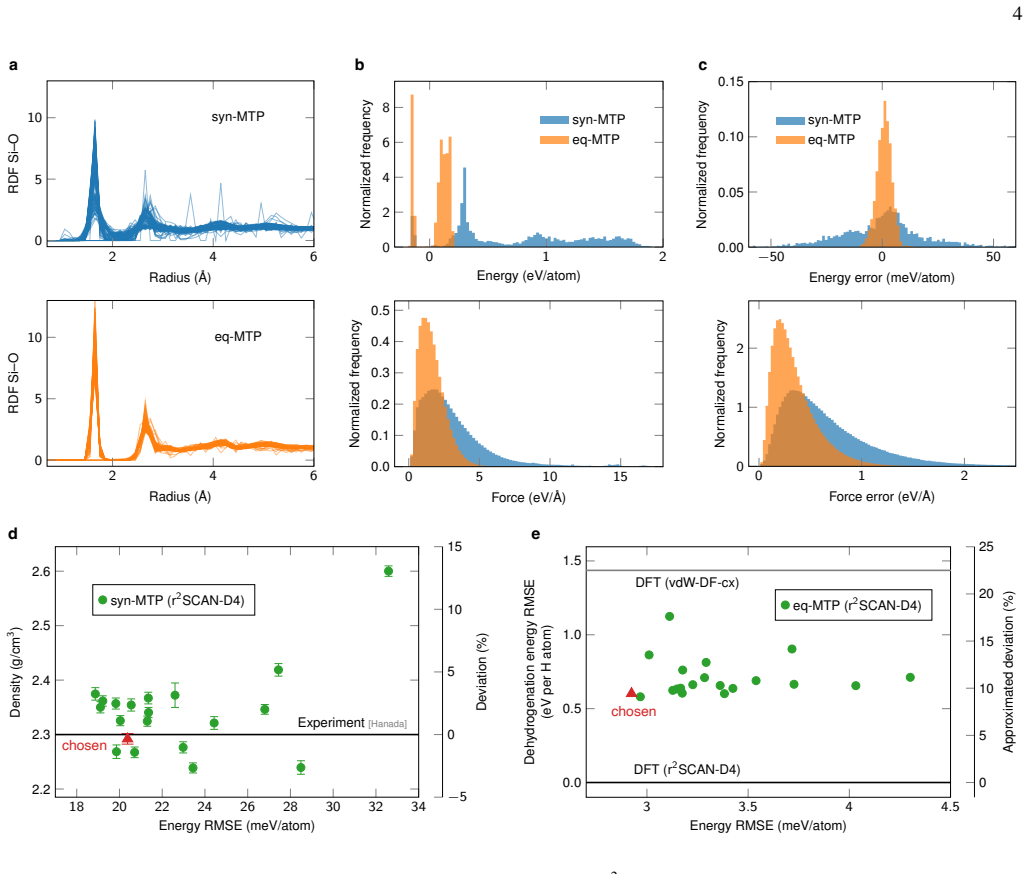
MTPs Machine-learning interatomic potentials (MLIPs), specifically moment tensor potentials (MTPs), were trained for the two utilized exchange- correlation functionals (vdW-DF-cx and r 2SCAN-D4).81–83 For each func- tional, syn-MTP was optimized for the generation of aluminosilicate meso- pores by the templated melt–quench process and the description of c...
-
[2]
DFT calculations The energies, forces, and stresses of configurations in the training sets were calculated using density functional theory (DFT) as implemented inVASP 87 within the projector augmented-wave (PAW) method.88,89 The configurations of the valence electrons in the PAW potentials were: Si: 3s 23p2; O: 2s 22p4; Al: 3s 23p1; H: 1s1. For the exchan...
-
[3]
All simulations were performed using theLAMMPSsoftware
Melt–quench processes Bulk amorphous aluminosilicate structures with a composition of SiO2(Al2O3)x/2 for different Al/Si molar ratiosx(x=0,0.05,0.1,0.2) were generated using a melt–quench process based on the respective syn-MTP. All simulations were performed using theLAMMPSsoftware. 93,94 Initial struc- tures were generated by randomly inserting appropri...
-
[4]
Aluminosilicates with pores Porous amorphous aluminosilicates with a composition of SiO2(Al2O3)x/2 were created, similar to the bulk structures with an additional cylindrical wall inside of a hexagonal cell, similar to the approach of Feuston.69 Initially, pre- cursor molecules were inserted into a hexagonal cell region surrounding a Lennard–Jones cylinde...
-
[5]
PDFs The atomic pair distribution functions (PDFs) of bulk aluminosilicates gen- erated using r 2SCAN-D4 syn-MTPs, weighted by X-ray scattering powers, were calculated as implemented in theDIFFPY-CMIpackage. 101,102 The lim- ited range of scattering vectors of the respective instrument was simulated withQ max =50 ˚A−1.103 For each Al/Si ratio, 5 samples o...
-
[6]
Dehydrogenation energies of OH groups The dehydrogenation energies of Al–OH and Si–OH groups at the sur- face of OH–functionalized mesoporous aluminosilicates were obtained as the reaction energies of removal of a H atom,E=E(pore–Si/Al–O) +E(H)− E(pore–Si/Al–OH), whereE(pore–Si/Al–O)is the pore with a Si– or Al–OH group, whose H was removed, H is a hydrog...
-
[7]
Infrared spectra The infrared spectra were simulated by calculating the change in the po- larization of a vibrational normal mode using the Born effective charge tensor as implemented inPHONOPY-SPECTROSCOPY. 104 30 samples of 200-atom bulk aluminosilicates were generated using the melt-quench process using r2SCAN-D4 syn-MTP. 10 samples of 700-atom porous ...
-
[8]
Comparison to GRACE foundation models The speed of graph atomic cluster expansion (GRACE) foundation mod- els was compared with that of MTP-Kokkos 109 in GPU architecture. The tested GRACE models were GRACE-2L-OAM, GRACE-1L-OAM, GRACE- FS-OAM as implemented inGRACEMAKERpackage. 45,110 A single acceler- ator on an Nvidia V100S GPU node was used. Aluminosil...
work page 2000
-
[9]
Mea- surements were performed with an EM10C/CR TEM (Zeiss) at 60 kV
TEM Samples for transmission electron microscopy (TEM) were finely pow- dered and applied to pioloform coated copper grids (mesh: 400, Plano). Mea- surements were performed with an EM10C/CR TEM (Zeiss) at 60 kV . Pic- tures were taken with a water-cooled 1k slow-scan CCD Camera (7888-IV , TRS) and the attached software Image eSP
-
[10]
Measurements were performed at the beamline ID31 at the European Synchrotron Radiation Fa- cility
PDFs measured by synchrotron X-ray Total scattering experiments and PDF analysis were performed as com- missioned service by the Momentum Transfer GmbH. Measurements were performed at the beamline ID31 at the European Synchrotron Radiation Fa- cility. The sample powders were loaded into cylindrical slots (approximately 1 mm thickness) held between Kapton ...
-
[11]
F ourier-transform infrared spectroscopy Infrared spectra were recorded in transmission mode on a Nicolet 6700 spectrometer. Solid samples were prepared by mixing and finely grinding ap- proximately 2 mg of the silica material with about 50 mg of pre-dried KBr (Sigma Aldrich,≥90%) using a mortar and pestle, followed by pressing the mixture into pellets at...
-
[12]
30 to 50 mg of sample were weighed into a J
Accessible hydroxyl groups For the determination of the total amount of accessible hydroxyl groups samples were dried at 200 ◦C in high vacuum for 16 h to remove any ab- sorbed water. 30 to 50 mg of sample were weighed into a J. Young NMR tube under a dry nitrogen atmosphere together with ferrocene (10 mg, Thermo Scientific, 99%) as internal standard. Deu...
work page 2022
-
[13]
M. Fahda, J. Fayek, E. Dib, H. Cruchade, N. Pichot, N. Chaouati, L. Pinard, P. S. Petkov, G. N. Vayssilov, A. May- oral, B. Witulski, L. Lakiss, and V . Valtchev, Investigating the physicochemical properties of an extra-large pore aluminosili- cate ZEO-1, Chem. Mater.36, 5405–5421 (2024)
work page 2024
-
[14]
M. Liu, Y . Ge, J. Du, Z. Song, C. Zhang, Q. Zhou, Y . Zhang, and X. Gu, Hierarchical MFI zeolite membranes for superior xylene separation, Adv. Funct. Mater.34, 2400772 (2024)
work page 2024
-
[15]
L. Sun, G. Romolini, B. Dieu, D. Grandjean, M. Keshavarz, E. Fron, F. D’Acapito, M. B. J. Roeffaers, M. Van der Auw- eraer, and J. Hofkens, Ultrasensitive luminescence switching of zeolite Y confined silver clusters for dual-channel oxygen sensing, Adv. Opt. Mater.12, 2400784 (2024)
work page 2024
-
[16]
X. Liu, X. Liu, F. Yang, and Y . Wu, Experimental investiga- tion of low-temperature fluidised bed thermochemical energy storage with salt-mesoporous silica composite materials, Appl. Energy362, 122953 (2024)
work page 2024
-
[17]
Y . Sheng and H. C. Zeng, Monodisperse aluminosilicate spheres with tunable Al/Si ratio and hierarchical macro- meso-microporous structure, ACS Appl. Mater. Interfaces7, 13578–13589 (2015)
work page 2015
-
[18]
S. H. Hakim and B. H. Shanks, Synthesis and characterization of hierarchically structured aluminosilicates, J. Mater. Chem. 21, 7364–7375 (2011)
work page 2011
-
[19]
J. Gajardo, J. Colmenares-Zerpa, A. F. Peixoto, D. S. A. Silva, J. A. Silva, F. Gispert-Guirado, J. Llorca, E. A. Urquieta- Gonzalez, J. B. O. Santos, J. Szanyi, C. Sep ´ulveda, M. G. ´Alvarez, and R. J. Chiment˜ao, Revealing the effects of high Al loading incorporation in the SBA-15 silica mesoporous mate- rial, J. Porous Mater.30, 1687 (2023)
work page 2023
- [20]
-
[21]
V . L. Deringer, N. Bernstein, A. P. Bart ´ok, M. J. Cliffe, R. N. Kerber, L. E. Marbella, C. P. Grey, S. R. Elliott, and G. Cs ´anyi, Realistic atomistic structure of amorphous silicon from machine-learning-driven molecular dynamics, J. Phys. Chem. Lett.9, 2879 (2018)
work page 2018
- [22]
-
[23]
K. Kobayashi, H. Nakamura, A. Yamaguchi, M. Itakura, M. Machida, and M. Okumura, Machine learning potentials for tobermorite minerals, Comput. Mater. Sci.188, 110173 (2021)
work page 2021
-
[24]
S. Urata, N. Nakamura, T. Tada, A. R. Tan, R. G ´omez- Bombarelli, and H. Hosono, Suppression of rayleigh scatter- ing in silica glass by codoping boron and fluorine: Molecular dynamics simulations with force-matching and neural network potentials, J. Phys. Chem. C126, 2264 (2022)
work page 2022
-
[25]
L. C. Erhard, J. Rohrer, K. Albe, and V . L. Deringer, A machine-learned interatomic potential for silica and its rela- tion to empirical models, npj Comput. Mater.8, 90 (2022)
work page 2022
- [26]
-
[27]
M. Bertani, T. Charpentier, F. Faglioni, and A. Pedone, Accu- rate and transferable machine learning potential for molecular dynamics simulation of sodium silicate glasses, J. Chem. The- ory Comput.20, 1358 (2024)
work page 2024
-
[28]
L. C. Erhard, J. Rohrer, K. Albe, and V . L. Deringer, Mod- elling atomic and nanoscale structure in the silicon–oxygen system through active machine learning, Nat. Commun.15, 1927 (2024)
work page 1927
-
[29]
A. Erlebach, M. ˇS´ıpka, I. Saha, P. Nachtigall, C. J. Heard, and L. Grajciar, A reactive neural network framework for water- loaded acidic zeolites, Nat. Commun.15, 4215 (2024)
work page 2024
-
[30]
H. Li, Y . Jing, Z. Liu, L. Cong, J. Zhao, Y . Sun, W. Li, J. Yan, J. Yang, and X. Li, A machine-learning interatomic potential to study dry/wet oxidation process of silicon, J. Appl. Phys. 136, 095302 (2024)
work page 2024
- [31]
-
[32]
N. Leimeroth, J. Rohrer, and K. Albe, Structure–property rela- tions of silicon oxycarbides studied using a machine learning interatomic potential, J. Am. Ceram. Soc.107, 6896 (2024)
work page 2024
-
[33]
M. Falgoust and P. Kroll, Machine-learning interatomic po- tentials for pyrolysis of polysiloxanes and properties of SiCO ceramics, J. Am. Ceram. Soc.107, 7653 (2024)
work page 2024
-
[34]
S. Roy, J. P. D ¨urholt, T. S. Asche, F. Zipoli, and R. G ´omez- Bombarelli, Learning a reactive potential for silica-water through uncertainty attribution, Nat. Commun.15, 6030 (2024)
work page 2024
-
[35]
J. P. Perdew, J. A. Chevary, S. H. V osko, K. A. Jackson, M. R. Pederson, D. J. Singh, and C. Fiolhais, Atoms, molecules, solids, and surfaces: Applications of the generalized gradient approximation for exchange and correlation, Phys. Rev. B46, 6671–6687 (1992)
work page 1992
-
[36]
J. P. Perdew, K. Burke, and M. Ernzerhof, Generalized gradient approximation made simple, Phys. Rev. Lett.77, 3865–3868 (1996)
work page 1996
-
[37]
J. P. Perdew, A. Ruzsinszky, G. I. Csonka, O. A. Vydrov, G. E. Scuseria, L. A. Constantin, X. Zhou, and K. Burke, Restor- ing the density-gradient expansion for exchange in solids and surfaces, Phys. Rev. Lett.100, 136406 (2008)
work page 2008
-
[38]
J. Sun, A. Ruzsinszky, and J. P. Perdew, Strongly constrained and appropriately normed semilocal density functional, Phys. Rev. Lett.115, 036402 (2015)
work page 2015
-
[39]
J. W. Furness, A. D. Kaplan, J. Ning, J. P. Perdew, and J. Sun, Accurate and numerically efficient r2SCAN meta-generalized gradient approximation, J. Phys. Chem. Lett.11, 8208–8215 (2020)
work page 2020
- [40]
- [41]
-
[42]
E. Caldeweyher, J.-M. Mewes, S. Ehlert, and S. Grimme, Ex- tension and evaluation of the D4 London-dispersion model for periodic systems, Phys. Chem. Chem. Phys.22, 8499–8512 (2020)
work page 2020
-
[43]
K. Berland and P. Hyldgaard, Exchange functional that tests the robustness of the plasmon description of the van der Waals 13 density functional, Phys. Rev. B89, 035412 (2014)
work page 2014
-
[44]
A. P. Bart´ok, M. C. Payne, R. Kondor, and G. Cs´anyi, Gaussian approximation potentials: The accuracy of quantum mechan- ics, without the electrons, Phys. Rev. Lett.104, 136403 (2010)
work page 2010
-
[45]
T. L. Pham, H. Kino, K. Terakura, T. Miyake, and H. C. Dam, Novel mixture model for the representation of potential energy surfaces, J. Chem. Phys.145, 154103 (2016)
work page 2016
-
[46]
J. Behler and M. Parrinello, Generalized neural-network repre- sentation of high-dimensional potential-energy surfaces, Phys. Rev. Lett.98, 146401 (2007)
work page 2007
-
[47]
H. Wang, L. Zhang, J. Han, and W. E, DeePMD-kit: A deep learning package for many-body potential energy representa- tion and molecular dynamics, Comput. Phys. Commun.228, 178–184 (2018)
work page 2018
-
[48]
L. Zhang, J. Han, H. Wang, W. A. Saidi, R. Car, and E. Weinan, End-to-end symmetry preserving inter-atomic potential energy model for finite and extended systems, inProceedings of the 32nd International Conference on Neural Information Pro- cessing Systems, NIPS’18 (Curran Associates Inc., Red Hook, NY , USA, 2018) p. 4441–4451
work page 2018
-
[49]
Drautz, Atomic cluster expansion for accurate and transfer- able interatomic potentials, Phys
R. Drautz, Atomic cluster expansion for accurate and transfer- able interatomic potentials, Phys. Rev. B99, 014104 (2019)
work page 2019
-
[50]
K. Sch ¨utt, P.-J. Kindermans, H. E. Sauceda Felix, S. Chmiela, A. Tkatchenko, and K.-R. M ¨uller, Schnet: A continuous-filter convolutional neural network for modeling quantum interac- tions, inAdvances in Neural Information Processing Systems, V ol. 30 (Curran Associates, Inc., 2017)
work page 2017
-
[51]
K. Sch ¨utt, O. Unke, and M. Gastegger, Equivariant message passing for the prediction of tensorial properties and molecular spectra, inProceedings of the 38th International Conference on Machine Learning(PMLR, 2021) p. 9377–9388
work page 2021
-
[52]
A. V . Shapeev, Moment tensor potentials: A class of system- atically improvable interatomic potentials, Multiscale Model. Simul.14, 1153 (2016)
work page 2016
-
[53]
V . Van Speybroeck, M. Bocus, P. Cnudde, and L. Van- duyfhuys, Operando modeling of zeolite-catalyzed reactions using first-principles molecular dynamics simulations, ACS Catal.13, 11455–11493 (2023)
work page 2023
-
[54]
F. Tielens, M. Gierada, J. Handzlik, and M. Calatayud, Charac- terization of amorphous silica based catalysts using DFT com- putational methods, Catal. Today354, 3 (2020)
work page 2020
- [55]
-
[56]
A. Erlebach, P. Nachtigall, and L. Grajciar, Accurate large- scale simulations of siliceous zeolites by neural network po- tentials, npj Comput. Mater.8, 174 (2022)
work page 2022
-
[57]
A. Bochkarev, Y . Lysogorskiy, and R. Drautz, Graph atomic cluster expansion for semilocal interactions beyond equivari- ant message passing, Phys. Rev. X14, 021036 (2024)
work page 2024
-
[58]
Open Materials 2024 (OMat24) Inorganic Materials Dataset and Models
L. Barroso-Luque, M. Shuaibi, X. Fu, B. M. Wood, M. Dzamba, M. Gao, A. Rizvi, C. L. Zitnick, and Z. W. Ulissi, Open materials 2024 (OMat24) inorganic materials dataset and models, arXiv:2410.12771 [cond-mat.mtrl-sci] (2024)
work page internal anchor Pith review Pith/arXiv arXiv 2024
-
[59]
B. Deng, P. Zhong, K. Jun, J. Riebesell, K. Han, C. J. Bartel, and G. Ceder, Chgnet as a pretrained universal neural network potential for charge-informed atomistic modelling, Nat. Mach. Intell.5, 1031–1041 (2023)
work page 2023
-
[60]
A. Forslund, J. H. Jung, Y . Ikeda, and B. Grabowski, Free- energy perturbation in the exchange-correlation space acceler- ated by machine learning: Application to silica polymorphs, arXiv:2505.00789 [cond-mat] (2025)
-
[61]
J. Liu, X. He, J. Z. H. Zhang, and L.-W. Qi, Hydrogen-bond structure dynamics in bulk water: insights from ab initio simu- lations with coupled cluster theory, Chem. Sci.9, 2065 (2018)
work page 2065
-
[62]
J. H ¨anseroth, A. Fl ¨ototto, M. N. Qaisrani, and C. Dreßler, Fine-tuning unifies foundational machine-learned inter- atomic potential architectures at ab initio accuracy (2025), arXiv:2511.05337 [physics.chem-ph]
- [63]
-
[64]
Y . Wei, W. Yang, and Z. Yang, An excellent universal catalyst support-mesoporous silica: Preparation, modification and ap- plications in energy-related reactions, Int. J. Hydrogen Energy 47, 9537 (2022)
work page 2022
- [65]
-
[66]
M. F. Ando, O. Benzine, Z. Pan, J.-L. Garden, K. Wondraczek, S. Grimm, K. Schuster, and L. Wondraczek, Boson peak, het- erogeneity and intermediate-range order in binary SiO2-Al2O3 glasses, Sci. Rep.8, 5394 (2018)
work page 2018
-
[67]
H. Morikawa, S.-I. Miwa, M. Miyake, F. Marumo, and T. Sata, Structural analysis of SiO2-Al2O3 glasses, J. Am. Ceram. Soc. 65, 78 (1982)
work page 1982
-
[68]
S. B. Khemis, L. Cormier, E. Burov, H. Montigaud, B. Baptiste, and S. Nowak, Comparative structural study of Al2O3–SiO2 glasses and amorphous thin films, Int. J. Appl. Glass Sci.15, 212 (2024)
work page 2024
- [69]
-
[70]
G. Busca, Catalytic materials based on silica and alumina: Structural features and generation of surface acidity, Prog. Mater. Sci.104, 215 (2019)
work page 2019
-
[71]
V . Sanchez Escribano, G. Garbarino, E. Finocchio, and G. Busca,γ-alumina and amorphous silica–alumina: Struc- tural features, acid sites and the role of adsorbed water, Top. Catal.60, 1554 (2017)
work page 2017
-
[72]
F. Leydier, C. Chizallet, A. Chaumonnot, M. Digne, E. Soyer, A.-A. Quoineaud, D. Costa, and P. Raybaud, Brønsted acidity of amorphous silica–alumina: The molecular rules of proton transfer, J. Catal.284, 215 (2011)
work page 2011
-
[73]
W. Hu, Q. Luo, Y . Su, L. Chen, Y . Yue, C. Ye, and F. Deng, Acid sites in mesoporous Al-SBA-15 material as revealed by solid-state NMR spectroscopy, Microporous Mesoporous Mater.92, 22 (2006)
work page 2006
-
[74]
J. E. Readman, P. M. Forster, K. W. Chapman, P. J. Chupas, J. B. Parise, and J. A. Hriljac, Pair distribution function analy- sis of pressure treated zeolite Na-A, Chem. Commun.23, 3383 (2009)
work page 2009
- [75]
-
[76]
A. Minami, P. Hu, Y . Sada, H. Yamada, K. Ohara, Y . Yonezawa, Y . Sasaki, Y . Yanaba, M. Takemoto, Y . Yoshida, T. Okubo, and T. Wakihara, Tracking sub-nano-scale structural evolution in zeolite synthesis by in situ high-energy X-ray total scattering measurement with pair distribution function analy- sis, J. Am. Chem. Soc144, 23313 (2022)
work page 2022
- [77]
-
[78]
M. Palencia, Functional transformation of Fourier-transform mid-infrared spectrum for improving spectral specificity by simple algorithm based on wavelet-like functions, J. Adv. Res. 14, 53–62 (2018)
work page 2018
-
[79]
D. J. Lucas, L. A. Curtiss, and J. A. Pople, Theoretical study of the silicon–oxygen hydrides SiOH n (n=0–4) and SiOH+n (n=0–5): Dissociation energies, ionization energies, enthalpies of formation, and proton affinities, J. Chem. Phys. 99, 6697–6703 (1993). 14
work page 1993
-
[80]
S. Itzigehl, T. Ott, A.-K. Str ¨ohle, H.-H. Nguyen, R. Talei, N. Ay, M. W. Terban, M. Dyballa, G. Schmitz, D. P. Estes, and J. R. Bruckner, Efficient synthesis of well-defined ordered mesoporous aluminosilicates with tailorable acidity (2025), under review
work page 2025
discussion (0)
Sign in with ORCID, Apple, or X to comment. Anyone can read and Pith papers without signing in.