REVIEW 5 major objections 5 minor 46 references
Reasoning-Aware Multimodal Fusion for Hateful Video Detection
T0 review · 5 major / 5 minor · reviewed 2026-08-03 · deepseek-v4-flash
Pith's one-line read Adversarial reasoning and cross-modal fusion lift hateful-video detection to a new state of the art.
desk verdict Solid engineering with a genuinely new adversarial-reasoning formulation, but the missing VLM-probability control leaves the central attribution unproven. read the letter →
The pith
A machine-rendered reading of the paper's core claim, the machinery that carries it, and where it could break.
The reading
What carries the argument
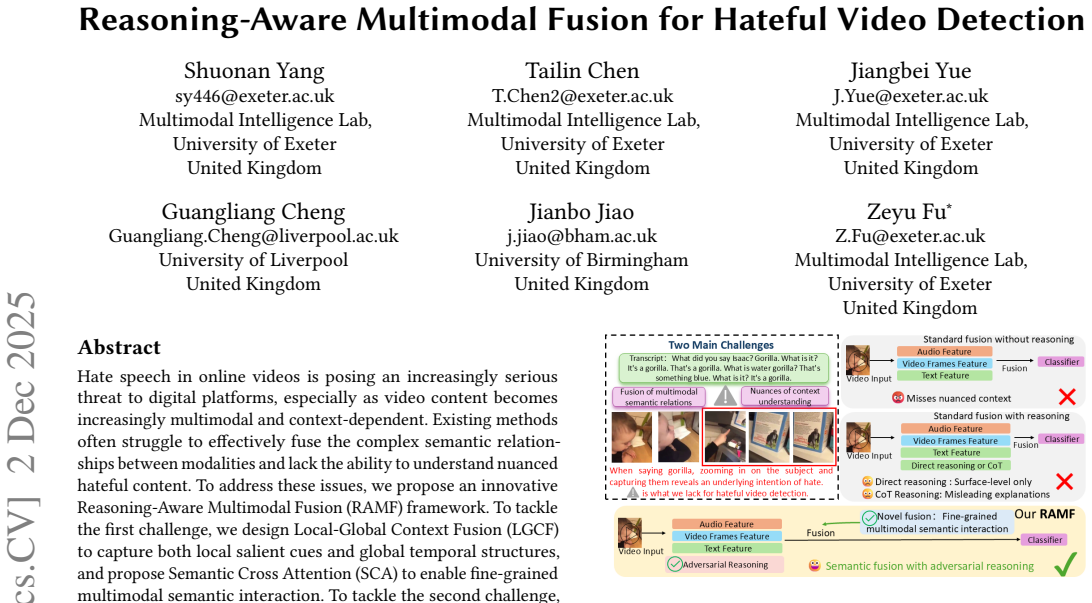
Three components carry the argument: (1) Adversarial reasoning—a three-prompt VLM procedure that produces objective, hate-assumed, and non-hate-assumed text for the same video; (2) Local-Global Context Fusion (LGCF)—a per-modality encoder that combines a local temporal convolution/max-pool channel with a global average-pool channel via a learned gate; and (3) Semantic Cross Attention (SCA)—an attention mechanism with cross-head 2D convolutions and odd-even head mixing, applied twice to fuse the modalities and then the reasoning texts.
What would settle it
Train the fusion model (LGCF and SCA) on raw modalities plus a zero-shot VLM hard label (1 or 0) as a fourth modality, without the adversarial reasoning texts. If the macro-F1 gap over the no-reasoning baseline matches the gap achieved by RAMF's adversarial reasoning, then the improvement comes from VLM classification signal, not from adversarial reasoning. Alternatively, replace the hate-assumed text with a scrambled or templated version and check whether the second-layer SCA still yields the same recall gain.
Extended reading notes
Core claim
The central claim is that structured, contrastive reasoning from a vision-language model—objective description, hate-assumed inference, non-hate-assumed inference—provides complementary semantic signal that improves hateful video classification, and that this signal is best integrated through a two-stage attention hierarchy: first fuse raw video, audio, text, and objective description; then fuse that representation with the two assumption-based reasonings. The paper reports state-of-the-art results on HateMM and MultiHateClip, with macro-F1 of 85.1/70.9/71.7 and hate recall of 85.5/62.2/67.4 respectively, exceeding the previous best MoRE by 3.0/8.4/4.3 MF1 points and 8.5/21.0/18.1 recall poi
Load-bearing premise
The central assumption is that the vision-language model's structured outputs—especially the hate-assumed and non-hate-assumed inferences—contain reliable, non-redundant signal about hateful intent that is not already present in the raw video, audio, and transcript features; if the VLM's reasoning is just a paraphrase of the label, the headline gain would be a distillation effect rather than a fusion innovation.
Editorial extensions
If this is right
- If correct, the two-stage fusion recipe applies to any task with auxiliary free-form text (e.g., captions, comments) by treating that text as an extra modality fused at a later layer.
- The large hate-class recall gains imply the method is particularly useful for moderation pipelines where missing hate is costlier than false alarms.
- Replacing the VLM generator (Qwen2.5-VL) with a different one (LLaMA4) changes results little, suggesting the adversarial structure, not the specific generator, drives the gain.
- The re-partitioned evaluation with mutually exclusive test folds suggests the improvements are not an artifact of a fixed split, assuming the new partition is unbiased.
Reading between the lines
- The 'adversarial' framing is not adversarial training but contrastive prompting; the method could be viewed as distillation from the VLM's opinion space, so the gain may shrink if the VLM is much worse or much better—a test would be to rerun with a deliberately broken assumption prompt.
- The paper does not analyze failure cases where both assumptions are plausible; a natural extension is to measure uncertainty or disagreement between the two inferences as a signal for borderline content.
- Because the new partition deviates from previous protocols, exact comparison with published numbers is tricky; reproducibility depends on the released code and the VLM API stability.
Editorial analysis
A structured set of objections, weighed in public.
Referee Report
Summary. The paper proposes RAMF, a multimodal fusion framework for hateful video detection. It combines (i) a structured 'adversarial reasoning' stage in which a vision-language model (Qwen2.5-VL-32B) generates objective descriptions, hate-assumed inferences, and non-hate-assumed inferences, and (ii) two fusion mechanisms: LGCF (local-global context fusion with gated pooling) and SCA (semantic cross-attention with cross-head and structural-mixing convolutions). The model is evaluated on HateMM and MultiHateClip (Chinese and English subsets) with five-fold cross-validation, and reported to outperform prior state-of-the-art methods. The paper claims 3% Macro-F1 and 7% hate-class recall improvements over SOTA, with ablations attributing these gains to the adversarial reasoning stage and to the proposed fusion modules.
Significance. If the results hold, RAMF is a strong empirical contribution to multimodal hateful video detection. The fusion-only variant (MF) already beats the published MoRE baseline on all three dataset/feature combinations in Table 1, which suggests that the LGCF/SCA modules are effective independent of the VLM reasoning component. The adversarial reasoning idea is interesting and timely, and the paper provides a clear architecture with detailed ablations. However, the headline '3%/7% over SOTA' numbers are internally inconsistent with the table (they are relative to the authors' own MF baseline, not MoRE), and the attribution of the residual gain to adversarial reasoning is not yet distinguished from VLM probability distillation. These issues need correction before the significance can be fully assessed.
major comments (5)
- [Abstract; §1 Contribution 3] The abstract and contribution list state 'improvements of 3% in Macro-F1 and 7% in hate class recall' over SOTA. Averaging the MF vs RAMF differences in Table 1 (T2·A2·V2) gives ≈3% MF1 and ≈7% recall, but MF is the authors' own fusion-only model, not the published SOTA (MoRE). Against MoRE, the differences are larger (e.g., HateMM MF1 +3.0, MHC-Chinese +8.4, MHC-English +4.3; recall +8.5, +21.0, +18.1). The abstract should either report the MoRE comparison or explicitly state that 3%/7% is relative to the internal MF ablation baseline.
- [§3.2; §4.3 Table 2] The ablation 'w/o Assumption' (↓2.06 MF1) removes T_H and T_N but does not control for the VLM's own hate probability. Because T_H and T_N are generated with prompts that instruct the VLM to assume hate/non-hate, their text plausibly encodes the VLM's posterior over the label. The second SCA layer could then be learning VLM distillation rather than complementary reasoning. Please add a control that feeds the same VLM's scalar probability (or a single class token) through the same second SCA, and/or an objective-description-only condition with the label. Without this, the paper's central attribution of the gain to 'adversarial reasoning' is not established.
- [§4 Experiments; Appendix B] The evaluation protocol is unclear and potentially leaks information. The paper says '70%/10%/20% split' and '5-fold cross-validation', but Appendix B states that test sets are mutually exclusive while training/validation splits 'may partially overlap across folds'. This is not standard k-fold CV and can bias validation-based model selection. Please specify the exact construction of the five folds, state whether each baseline model was retrained and selected on exactly the same fold partitions, and confirm that no baseline results are taken from the original papers under a different split. The sentence 'For baseline models, we strictly adhere to the settings specified in their original papers' is ambiguous on this point.
- [§3.5, §4.4, Figure 9] The paper repeatedly refers to an analysis of convolutional kernel sizes but leaves a dangling reference: 'Table??' in §3.5 and 'Figure 9' in §4.4. The same Figure 9 appears to cover both SCA and LGCF kernel sizes, but the caption does not identify the experimental conditions. This makes the robustness claim (kernel size is non-critical) difficult to verify. Please resolve the reference and specify which hyperparameter is varied in each panel.
- [Overall attribution] Section 3.2 lists three mechanisms by which adversarial reasoning should help (structured prompting, self-correction, evidence grounding), but none of these is isolated experimentally. The two VLM variants (RAMF1 vs RAMF2) only show robustness to VLM quality; they do not test the self-correction mechanism. Consider an ablation that uses only objective descriptions (T_O) plus CoT or plus a single hate-assumed text, and an ablation that uses hate-assumed and non-hate-assumed without objective descriptions. This would more directly support the 'complementary perspectives' mechanism.
minor comments (5)
- [Throughout] Several typos and incomplete references: 'Local-Gobal Context Fuison' (§3.4), 'Maroc F1' (§4.2), 'Table??' (§3.5), 'pipline' (§3.1), 'LLama' (§4.1). Please proofread carefully.
- [Abstract vs §1] The abstract promises code at github.com/Multimodal-Intelligence-Lab-MIL/RAMF, while the introduction and footnote say the code is at an anonymous link and 'will be released after the anonymity period ends'. This inconsistency should be fixed.
- [§3.3] The text says the text encoder is 'Bert or HateXplain (HXP)', but the caption of Table 1 uses BERT/HXP and (mBert for MHC-Chinese). It would help to state which encoder is used for which dataset/feature row explicitly in the main text, not only in the table.
- [§4.4 / Figure 9] The hyperparameter analysis figure lacks error bars or fold-level variations; since the paper uses five folds, reporting mean ± std (as in Table 4) would strengthen the claim of robustness to kernel size.
- [Appendix B] The statement 'training and validation splits may partially overlap across folds' is concerning and should be justified. If the validation set overlaps with training in some folds, model selection can be optimistic. Please clarify why this design was chosen and whether it affects the reported numbers.
Circularity Check
No significant circularity; the central results are empirical, supported by ablations, and the only self-citations are not load-bearing.
full rationale
The paper's claimed derivation is empirical rather than formal. The adversarial reasoning texts T_O, T_H, and T_N are input features produced by a fixed Qwen2.5-VL prompt; they are not fitted to the target labels, and the classifier is trained and evaluated on held-out validation/test folds. The contribution of the reasoning stage is measured by ablations (e.g., 'w/o Assumption' ↓2.06 MF1; MF-CoT ↓1.14) rather than asserted by construction. The fusion modules (LGCF, SCA) are likewise validated by component ablations and against external baselines on two datasets. The only self-citations ([43], [44], [45]) support design motivation or serve as comparison baselines; the temporal-distribution premise is also supported by external reference [41], and no uniqueness claim or ansatz is imported from the authors' prior work. The possible confound that VLM prose may leak the VLM's implicit hate judgment is a correctness/attribution risk, not circularity, because the reported predictions are not equal to the VLM's outputs or to fitted parameters by construction. Hence score 0.
Assumptions & free parameters
free parameters (8)
- LGCF LTC Conv1D kernel size =
3
- SCA CHC 2D convolution kernel =
3x3
- SCA SMC group-conv kernel/stride =
2/2
- MLP projection and classifier dims =
{512,256} and {128,64,2}
- VLM input frames =
16 (RAMF) vs 5 (zero-shot baselines)
- VLM decoding hyperparameters =
temperature 0.7, top-p 0.9, max 2048 tokens
- Training schedule =
lr 1e-4; epochs 60/20; batch 64/32/16; seed 2021
- Data re-partition =
70/10/20 5-fold with mutually exclusive test sets
assumptions (5)
- domain assumption Hate cues appear either in short bursts or dispersed across the full video timeline, motivating separate local and global channels.
- domain assumption Qwen2.5-VL-32B's adversarial reasoning texts provide reliable, non-redundant signal for hateful intent.
- domain assumption The re-partitioned five-fold protocol with overlapping train/validation splits is a fair and generalizable evaluation.
- domain assumption The HateMM and MHC labels are accurate enough to serve as ground truth.
- standard math Pretrained encoders (BERT/HXP/CLAP/CLIP/ViT/ViViT) transfer to this task and provide useful embeddings.
Cite this review
Pith. "Pith review of Reasoning-Aware Multimodal Fusion for Hateful Video Detection." pith.science (2026). https://pith.science/paper/HXHEFVPD
@misc{pith2026251202743,
  author       = {Pith},
  title        = {Pith review of: Reasoning-Aware Multimodal Fusion for Hateful Video Detection},
  year         = {2026},
  howpublished = {\url{https://pith.science/paper/HXHEFVPD}},
  note         = {Machine review of arXiv:2512.02743}
}
read the original abstract
Hate speech in online videos is posing an increasingly serious threat to digital platforms, especially as video content becomes increasingly multimodal and context-dependent. Existing methods often struggle to effectively fuse the complex semantic relationships between modalities and lack the ability to understand nuanced hateful content. To address these issues, we propose an innovative Reasoning-Aware Multimodal Fusion (RAMF) framework. To tackle the first challenge, we design Local-Global Context Fusion (LGCF) to capture both local salient cues and global temporal structures, and propose Semantic Cross Attention (SCA) to enable fine-grained multimodal semantic interaction. To tackle the second challenge, we introduce adversarial reasoning-a structured three-stage process where a vision-language model generates (i) objective descriptions, (ii) hate-assumed inferences, and (iii) non-hate-assumed inferences-providing complementary semantic perspectives that enrich the model's contextual understanding of nuanced hateful intent. Evaluations on two real-world hateful video datasets demonstrate that our method achieves robust generalisation performance, improving upon state-of-the-art methods by 3% and 7% in Macro-F1 and hate class recall, respectively. The source codes and data required to reproduce our results are available at https://github.com/Multimodal-Intelligence-Lab-MIL/RAMF.
Figures


Figures from the paper (10 more)


Reference graph
Works this paper leans on
-
[1]
Anurag Arnab, Mostafa Dehghani, Georg Heigold, Chen Sun, Mario Lučić, and Cordelia Schmid. 2021. ViViT: A Video Vision Transformer. arXiv:2103.15691 [cs.CV] https://arxiv.org/abs/2103.15691
arXiv 2021
-
[2]
Shuai Bai, Keqin Chen, Xuejing Liu, Jialin Wang, Wenbin Ge, Sibo Song, Kai Dang, Peng Wang, Shijie Wang, Jun Tang, Humen Zhong, Yuanzhi Zhu, Mingkun Yang, Zhaohai Li, Jianqiang Wan, Pengfei Wang, Wei Ding, Zheren Fu, Yiheng Xu, Jiabo Ye, Xi Zhang, Tianbao Xie, Zesen Cheng, Hang Zhang, Zhibo Yang, Haiyang Xu, and Junyang Lin. 2025. Qwen2.5-VL Technical Rep...
arXiv 2025
-
[3]
Zico Kolter, and Vladlen Koltun
Shaojie Bai, J. Zico Kolter, and Vladlen Koltun. 2018. An Empirical Evalua- tion of Generic Convolutional and Recurrent Networks for Sequence Modeling. arXiv:1803.01271 [cs.LG] https://arxiv.org/abs/1803.01271
arXiv 2018
-
[4]
Fazl Barez, Tung-Yu Wu, Iván Arcuschin, Michael Lan, Vincent Wang, Noah Siegel, Nicolas Collignon, Clement Neo, Isabelle Lee, Alasdair Paren, et al. 2025. Chain-of-thought is not explainability.Preprint, alphaXiv(2025), v2
2025
-
[5]
Ying Chen, Yilu Zhou, Sencun Zhu, and Heng Xu. 2012. Detecting Offensive Lan- guage in Social Media to Protect Adolescent Online Safety. In2012 International Conference on Privacy, Security, Risk and Trust and 2012 International Confernece on Social Computing. 71–80. doi:10.1109/SocialCom-PASSAT.2012.55
-
[6]
Michele Corazza, Stefano Menini, Elena Cabrio, Sara Tonelli, and Serena Villata
-
[7]
Berta Céspedes-Sarrias, Carlos Collado-Capell, Pablo Rodenas-Ruiz, Olena Hry- nenko, and Andrea Cavallaro. 2025. MM-HSD: Multi-Modal Hate Speech De- tection in Videos. InProceedings of the 33rd ACM International Conference on Multimedia (MM ’25). ACM, 2546–2555. doi:10.1145/3746027.3754558
arXiv 2025
-
[8]
Mithun Das, Rohit Raj, Punyajoy Saha, Binny Mathew, Manish Gupta, and Ani- mesh Mukherjee. 2023. Hatemm: A multi-modal dataset for hate video classi- fication. InProceedings of the International AAAI Conference on Web and Social Media, Vol. 17. 1014–1023
2023
Show all 46 references
-
[9]
Thomas Davidson, Dana Warmsley, Michael Macy, and Ingmar Weber. 2017. Automated Hate Speech Detection and the Problem of Offensive Language.Pro- ceedings of the International AAAI Conference on Web and Social Media11 (03 2017). doi:10.1609/icwsm.v11i1.14955
2017 doi
-
[10]
Jacob Devlin, Ming-Wei Chang, Kenton Lee, and Kristina Toutanova. 2019. BERT: Pre-training of Deep Bidirectional Transformers for Language Understanding. In Proceedings of the 2019 Conference of the North American Chapter of the Association for Computational Linguistics: Human...
2019
-
[11]
Alexey Dosovitskiy, Lucas Beyer, Alexander Kolesnikov, Dirk Weissenborn, Xi- aohua Zhai, Thomas Unterthiner, Mostafa Dehghani, Matthias Minderer, Georg Heigold, Sylvain Gelly, et al. 2020. An image is worth 16x16 words: Transformers for image recognition at scale.arXiv preprin...
2020 arXiv
-
[12]
Benjamin Elizalde, Soham Deshmukh, and Huaming Wang. 2023. Nat- ural Language Supervision for General-Purpose Audio Representations. arXiv:2309.05767 [cs.SD] https://arxiv.org/abs/2309.05767
2023 arXiv
-
[13]
Jeffrey L. Elman. 1990. Finding structure in time.Cognitive Science14, 2 (1990), 179–211. doi:10.1016/0364-0213(90)90002-E
1990 doi
-
[14]
Olga Golovneva, Tianlu Wang, Jason Weston, and Sainbayar Sukhbaatar. 2025. Multi-Token Attention. arXiv:2504.00927 [cs.CL] https://arxiv.org/abs/2504.00927
2025 arXiv
-
[15]
Ming Shan Hee, Zihan Gao, Yinglong Wang, Xiangxiang Chu, Roy Ka-Wei Lee, and Zengchang Qin. 2025. Contrastive Instruction Fine-Tuning Large Multimodal Model for Hateful Meme Classification.Proceedings of the International AAAI Conference on Web and Social Media19, 1 (Jun. 2025...
2025 doi
-
[16]
Ming Shan Hee and Roy Ka-Wei Lee. 2025. Demystifying Hateful Content: Lever- aging Large Multimodal Models for Hateful Meme Detection with Explainable Decisions. arXiv:2502.11073 [cs.CL] https://arxiv.org/abs/2502.11073
2025 arXiv
-
[17]
Ming Shan Hee, Shivam Sharma, Rui Cao, Palash Nandi, Preslav Nakov, Tanmoy Chakraborty, and Roy Ka-Wei Lee. 2024. Recent Advances in Online Hate Speech Moderation: Multimodality and the Role of Large Models. InFindings of the Association for Computational Linguistics: EMNLP 20...
2024 doi
-
[18]
Sepp Hochreiter and Jürgen Schmidhuber. 1997. Long Short-Term Memory. Neural Computation9, 8 (1997), 1735–1780. doi:10.1162/neco.1997.9.8.1735
1997 doi
-
[19]
Koushik, Diptesh Kanojia, and Helen Treharne
Girish A. Koushik, Diptesh Kanojia, and Helen Treharne. 2025. Towards a Robust Framework for Multimodal Hate Detection: A Study on Video vs. Image-based Content. InCompanion Proceedings of the ACM on Web Conference 2025(Sydney NSW, Australia)(WWW ’25). Association for Computin...
2025
-
[21]
Le Cun, B
Y. Le Cun, B. Boser, J. S. Denker, D. Henderson, R. E. Howard, W. Hubbard, and L. D. Jackel. 1989. Handwritten digit recognition with a back-propagation network. InProceedings of the 3rd International Conference on Neural Information Processing Systems (NIPS’89). MIT Press, Ca...
1989
-
[22]
Atanu Mandal, Gargi Roy, Amit Barman, Indranil Dutta, and Sudip Kumar Naskar
-
[23]
Binny Mathew, Punyajoy Saha, Seid Muhie Yimam, Chris Biemann, Pawan Goyal, and Animesh Mukherjee. 2021. HateXplain: A Benchmark Dataset for Explain- able Hate Speech Detection. InProceedings of the AAAI Conference on Artificial Intelligence, Vol. 35. 14867–14875
2021
-
[24]
Leland McInnes, John Healy, and James Melville. 2020. UMAP: Uni- form Manifold Approximation and Projection for Dimension Reduction. arXiv:1802.03426 [stat.ML] https://arxiv.org/abs/1802.03426
2020 arXiv
-
[25]
Stefano Menini, Giovanni Moretti, Michele Corazza, Elena Cabrio, Sara Tonelli, and Serena Villata. 2019. A System to Monitor Cyberbullying based on Message Classification and Social Network Analysis. InProceedings of the Third Workshop on Abusive Language Online, Sarah T. Robe...
2019 doi
-
[26]
Lindasalwa Muda, Mumtaj Begam, and Irraivan Elamvazuthi. 2010. Voice recog- nition algorithms using mel frequency cepstral coefficient (MFCC) and dynamic time warping (DTW) techniques.arXiv preprint arXiv:1003.4083(2010)
2010 arXiv
-
[27]
OpenAI. 2024. GPT-4o System Card. arXiv:2410.21276 [cs.CL] https://arxiv.org/ abs/2410.21276
2024 arXiv
-
[28]
David Patterson, Joseph Gonzalez, Urs Hölzle, Quoc Le, Chen Liang, Lluis-Miquel Munguia, Daniel Rothchild, David So, Maud Texier, and Jeff Dean. 2022. The Carbon Footprint of Machine Learning Training Will Plateau, Then Shrink. arXiv:2204.05149 [cs.LG] https://arxiv.org/abs/2204.05149
2022 arXiv
-
[29]
Qwen. 2024. Qwen2.5 Technical Report. arXiv:2412.15115 [cs.CL]
2024 arXiv
-
[30]
Alec Radford, Jong Wook Kim, Chris Hallacy, Aditya Ramesh, Gabriel Goh, Sandhini Agarwal, Girish Sastry, Amanda Askell, Pamela Mishkin, Jack Clark, Gretchen Krueger, and Ilya Sutskever. 2021. Learning Transferable Visual Models From Natural Language Supervision. arXiv:2103.000...
2021 arXiv
-
[31]
Alec Radford, Jong Wook Kim, Tao Xu, Greg Brockman, Christine Mcleavey, and Ilya Sutskever. 2023. Robust Speech Recognition via Large-Scale Weak Super- vision. InProceedings of the 40th International Conference on Machine Learning (Proceedings of Machine Learning Research, Vol...
2023
-
[32]
Nagendra Kumar
Mohammad Zia Ur Rehman, Anukriti Bhatnagar, Omkar Kabde, Shubhi Bansal, and Dr. Nagendra Kumar. 2025. ImpliHateVid: A Benchmark Dataset and Two- stage Contrastive Learning Framework for Implicit Hate Speech Detection in Videos. InProceedings of the 63rd Annual Meeting of the A...
2025 doi
-
[33]
Naquee Rizwan, Paramananda Bhaskar, Mithun Das, Swadhin Satyaprakash Majhi, Punyajoy Saha, and Animesh Mukherjee. 2025. Exploring the Limits of Zero Shot Vision Language Models for Hate Meme Detection: The Vulnerabilities and their Interpretations.Proceedings of the Internatio...
2025 doi
-
[34]
Adi Robertson. 2025. Facebook ranks worst for online harassment, according to a global activist survey.The Verge(2025). https://www.theverge.com/news/713976/ online-harassment-meta-social-media-environmental-activists Accessed: 2025- 07-31
2025
-
[35]
Yunlong Tang, Jing Bi, Siting Xu, Luchuan Song, Susan Liang, Teng Wang, Daoan Zhang, Jie An, Jingyang Lin, Rongyi Zhu, Ali Vosoughi, Chao Huang, Zeliang Zhang, Pinxin Liu, Mingqian Feng, Feng Zheng, Jianguo Zhang, Ping Luo, Jiebo Luo, and Chenliang Xu. 2025. Video Understandin...
2025
-
[36]
Mark Townsend. 2025. UK a ’powder keg’ of social tensions a year on from sum- mer riots, report warns.The Guardian(2025). https://www.theguardian.com/uk- news/2025/jul/15/social-tensions-british-people-polarisation-research Accessed: 2025-07-31
2025
-
[37]
Zico Kolter, Louis-Philippe Morency, and Ruslan Salakhutdinov
Yao-Hung Hubert Tsai, Shaojie Bai, Paul Pu Liang, J. Zico Kolter, Louis-Philippe Morency, and Ruslan Salakhutdinov. 2019. Multimodal Transformer for Unaligned Multimodal Language Sequences. InProceedings of the 57th Annual Meeting of the Association for Computational Linguisti...
2019 doi
-
[38]
Neeraj Vashistha and Arkaitz Zubiaga. 2021. Online Multilingual Hate Speech Detection: Experimenting with Hindi and English Social Media.Information12, 1 (2021). doi:10.3390/info12010005
2021 doi
-
[39]
Gomez, Łukasz Kaiser, and Illia Polosukhin
Ashish Vaswani, Noam Shazeer, Niki Parmar, Jakob Uszkoreit, Llion Jones, Aidan N. Gomez, Łukasz Kaiser, and Illia Polosukhin. 2017. Attention is all you need. InProceedings of the 31st International Conference on Neural Information Processing Systems(Long Beach, California, US...
2017
-
[40]
Han Wang, Rui Yang Tan, and Roy Ka-Wei Lee. 2025. Cross-Modal Transfer from Memes to Videos: Addressing Data Scarcity in Hateful Video Detection. In Proceedings of the ACM on Web Conference 2025 (WWW ’25). ACM, 5255–5263. doi:10.1145/3696410.3714534
2025
-
[41]
Han Wang, Zhuoran Wang, and Roy Ka-Wei Lee. 2025. HateClipSeg: A Segment- Level Annotated Dataset for Fine-Grained Hate Video Detection. InProceed- ings of the 33rd ACM International Conference on Multimedia (MM ’25). ACM, 13304–13310. doi:10.1145/3746027.3758289
2025
-
[42]
Han Wang, Tan Rui Yang, Usman Naseem, and Roy Ka-Wei Lee. 2024. Multihate- clip: A multilingual benchmark dataset for hateful video detection on youtube and bilibili. InProceedings of the 32nd ACM International Conference on Multimedia. 7493–7502
2024
-
[43]
Shuonan Yang, Tailin Chen, Rahul Singh, Jiangbei Yue, Jianbo Jiao, and Zeyu Fu. 2025. Revealing Temporal Label Noise in Multimodal Hateful Video Classifi- cation. InProceedings of the 4th International Workshop on Multimodal Human Understanding for the Web and Social Media(Ire...
2025
-
[44]
Jiangbei Yue, Shuonan Yang, Tailin Chen, Jianbo Jiao, and Zeyu Fu. 2025. Mul- timodal Hate Detection Using Dual-Stream Graph Neural Networks.ArXiv abs/2509.13515 (2025). https://api.semanticscholar.org/CorpusID:281333169
2025
-
[45]
The placeholder{text}is replaced by the raw transcript. The model therefore performs binary classification in a strict zero-shot setting and must output exactly “1
Yinghui Zhang, Tailin Chen, Yuchen Zhang, and Zeyu Fu. 2024. Enhanced Multimodal Hate Video Detection via Channel-wise and Modality-wise Fusion . In2024 IEEE International Conference on Data Mining Workshops (ICDMW). IEEE Computer Society, Los Alamitos, CA, USA, 183–190. doi:1...
2024
-
[2020]
Internet Technol.20, 2, Article 10 (March 2020), 22 pages
A Multilingual Evaluation for Online Hate Speech Detection.ACM Trans. Internet Technol.20, 2, Article 10 (March 2020), 22 pages. doi:10.1145/3377323
2020 doi
-
[2024]
arXiv:2401.10653 [cs.CL] https://arxiv.org/abs/2401.10653
Attentive Fusion: A Transformer-based Approach to Multimodal Hate Speech Detection. arXiv:2401.10653 [cs.CL] https://arxiv.org/abs/2401.10653
Reviewed August 3, 2026 · model on record in the stance chip above.
Discussion (0). Sign in to comment.