Geometry of particle emission in UrQMD Ar+Sc collisions at SPS energies
Pith reviewed 2026-05-17 01:22 UTC · model grok-4.3
The pith
Simulations of Ar+Sc collisions at SPS energies show two-pion pair sources follow Lévy-stable distributions whose parameters map to spatial scale, shape, and emission strength.
A machine-rendered reading of the paper's core claim, the machinery that carries it, and where it could break.
Core claim
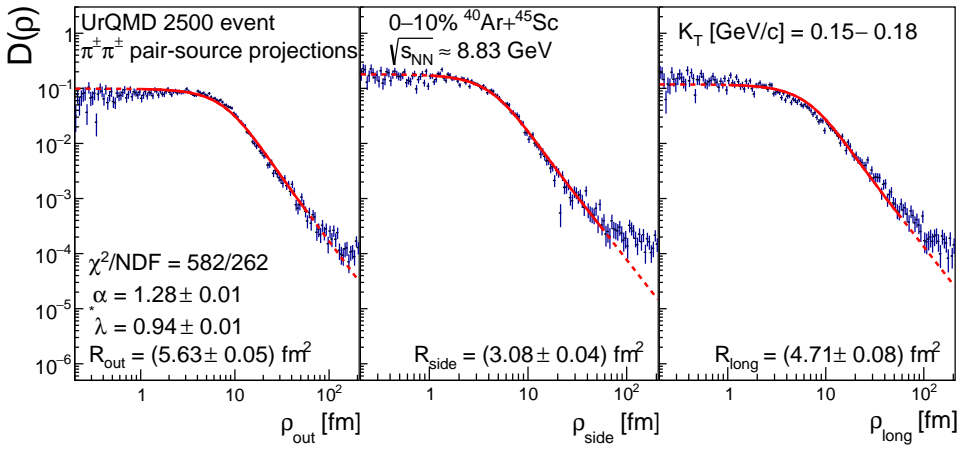
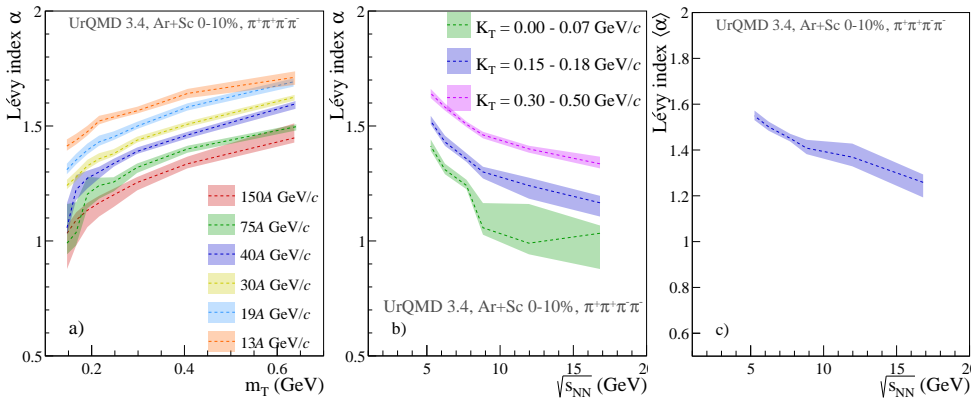
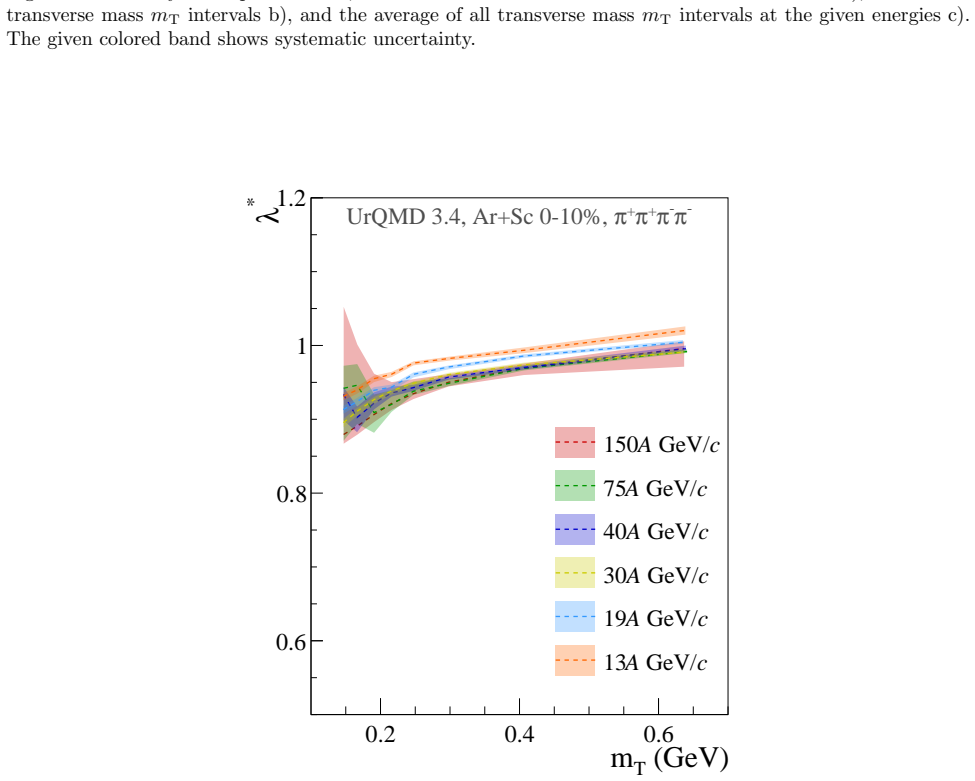
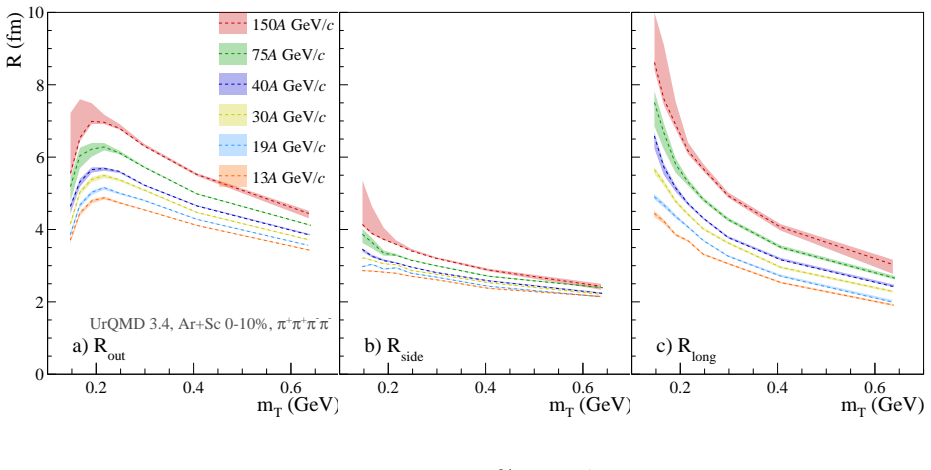
In central 40Ar+45Sc collisions at SPS energies the Ultra-Relativistic Quantum Molecular Dynamics Monte-Carlo event generator, after validation against hadronic spectra, yields three-dimensional two-pion pair source distributions that are described by Lévy-stable distributions. The extracted Lévy parameters are interpreted as measures of the spatial scale, the shape, and the strength of the emitting source, establishing a baseline for future experimental measurements in intermediate systems.
What carries the argument
Three-dimensional two-pion pair source distributions extracted from UrQMD events and fitted to Lévy-stable distributions, with parameters interpreted for spatial scale, shape, and strength.
If this is right
- Lévy parameters extracted from the simulations quantify the spatial extent, non-Gaussian shape, and emission intensity of the pion source in these collisions.
- The same fitting procedure extends femtoscopy studies from large systems at RHIC and LHC energies to intermediate systems at SPS energies.
- The calculated sources serve as a theoretical reference against which upcoming experimental measurements in Ar+Sc collisions can be compared.
Where Pith is reading between the lines
- Confirmation by experiment would support the idea that Lévy distributions capture emission geometry across a wide range of collision sizes.
- The same simulation-plus-fit approach could be applied to other intermediate systems or energies to map how source parameters evolve.
- Direct comparison of the Lévy parameters with hydrodynamic or transport-model predictions for the emission zone could test the microscopic origin of the non-Gaussian shape.
Load-bearing premise
The UrQMD Monte Carlo generator, once validated against hadronic spectra, produces two-pion source distributions that can be directly compared to experimental femtoscopy measurements.
What would settle it
Experimental two-pion correlation data from Ar+Sc collisions at SPS energies whose extracted source shapes deviate significantly from Lévy-stable forms would falsify the description.
Figures
read the original abstract
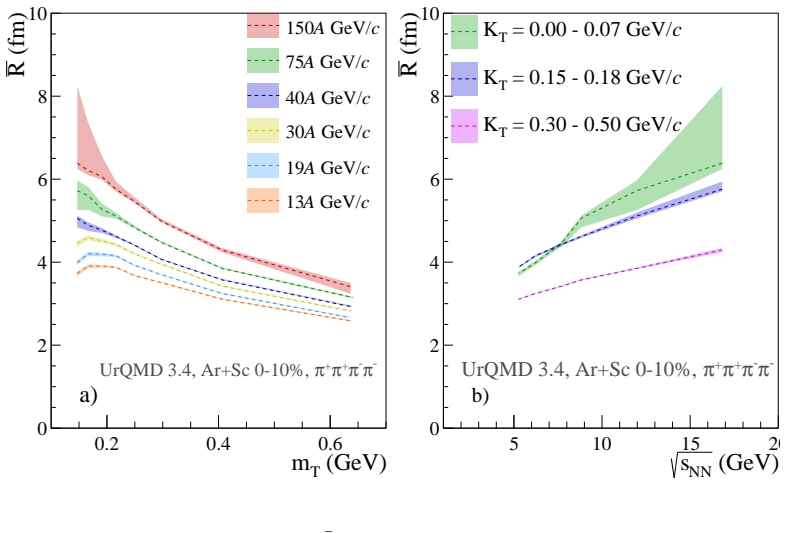
Over the past few decades, progress in femtoscopy has been driven by the interplay between experimental measurements and theoretical calculations. Measurements provide data to support the theory, while theoretical predictions guide new measurements. In the recent decade, several experiments have confirmed that the two-particle pion-emitting source is well described by L\'evy alpha-stable distributions. To enable theoretical interpretation, phenomenological simulations have been done at RHIC and LHC energies, in large systems such as Au+Au or Pb+Pb, using various available heavy-ion collision models. However, such simulations have not been done in intermediate systems. In this paper, we investigate three-dimensional two-pion pair source distributions from $^{40}$Ar+$^{45}$Sc central collisions at SPS energies, generated with the Ultra-Relativistic Quantum Molecular Dynamics Monte-Carlo event generator. Supplemented by a validation of the simulated hadronic spectra, we find that the pair source can be described with L\'evy-stable distributions. We subsequently interpret the physical meaning of the extracted L\'evy parameters corresponding to the spatial scale, shape, and strength of the source. Our results form a baseline for future experimental measurements in intermediate systems.
Editorial analysis
A structured set of objections, weighed in public.
Referee Report
Summary. The paper uses the UrQMD Monte Carlo generator to simulate central 40Ar+45Sc collisions at SPS energies. After validating the model against single-particle hadronic pT and rapidity spectra, the authors extract the three-dimensional two-pion pair source distribution from the simulated emission points and show that it is well described by Lévy-stable distributions. They then interpret the extracted Lévy parameters (spatial scale R, shape parameter α, and strength λ) and position the results as a baseline for future experimental femtoscopy studies in intermediate-mass systems.
Significance. If the central finding holds, the work supplies the first Lévy-parameter predictions for smaller collision systems at SPS energies, complementing existing RHIC/LHC studies in large systems. The reliance on a publicly documented event generator supports reproducibility, and the explicit extraction of source parameters from Monte Carlo output provides a concrete, falsifiable reference for experimental comparisons.
major comments (1)
- [Validation section] Validation section: The model is validated solely against one-body pT and rapidity distributions. These observables do not directly constrain the relative space-time separations that define the pair source function S(r). Resonance lifetimes, rescattering, and freeze-out choices in UrQMD can modify the source geometry without altering single-particle yields, so the physical interpretation of the Lévy parameters (scale, shape, strength) risks being specific to this generator rather than a general feature of the collision system. The manuscript should add a discussion of source-construction details and any sensitivity tests to these model ingredients.
minor comments (2)
- Figure captions and text should explicitly state the fitting range and goodness-of-fit metric (e.g., χ²/dof) used to establish the Lévy description of the source.
- Notation for the three-dimensional source function and the Lévy parametrization should be introduced consistently in the methods section before the results are presented.
Simulated Author's Rebuttal
We thank the referee for the positive evaluation and the recommendation for minor revision. The single comment on validation and source construction is constructive, and we address it directly below while committing to appropriate revisions.
read point-by-point responses
-
Referee: [Validation section] Validation section: The model is validated solely against one-body pT and rapidity distributions. These observables do not directly constrain the relative space-time separations that define the pair source function S(r). Resonance lifetimes, rescattering, and freeze-out choices in UrQMD can modify the source geometry without altering single-particle yields, so the physical interpretation of the Lévy parameters (scale, shape, strength) risks being specific to this generator rather than a general feature of the collision system. The manuscript should add a discussion of source-construction details and any sensitivity tests to these model ingredients.
Authors: We agree that single-particle spectra alone do not fully constrain the space-time separations encoded in S(r). UrQMD incorporates resonance lifetimes, rescattering, and freeze-out through its established transport dynamics, yet the resulting source geometry remains model-specific. In the revised manuscript we will add a new subsection detailing the source-construction procedure: how emission points (space-time coordinates at last interaction) are recorded for each pion, the freeze-out criteria employed, and the binning used to obtain the three-dimensional pair source distribution. We will also include a concise discussion of potential sensitivities to key model ingredients (e.g., resonance lifetimes and rescattering cross sections) and explicitly note the model dependence as a limitation, framing the results as a reproducible baseline for the UrQMD description of intermediate-mass systems at SPS energies. A comprehensive sensitivity scan lies outside the scope of this baseline study but will be highlighted as a natural direction for follow-up work. revision: partial
Circularity Check
No significant circularity in UrQMD-generated Lévy source analysis
full rationale
The paper runs the external UrQMD Monte Carlo generator to produce Ar+Sc collision events, validates the output against single-particle pT and rapidity spectra, computes the three-dimensional two-pion emission-point source S(r) directly from the simulated space-time coordinates, and fits Lévy-stable distributions to that computed source. The extracted scale, shape (α), and strength parameters are then interpreted as properties of the model output. None of these steps reduces by construction to the inputs: the Lévy fit is a post-hoc description of independently generated data rather than a self-definition or a fitted quantity renamed as a prediction. No load-bearing self-citation chain or uniqueness theorem is invoked to force the result. The analysis is therefore self-contained as a characterization of publicly documented simulation output and receives a score of 0.
Axiom & Free-Parameter Ledger
free parameters (1)
- Lévy alpha, R, lambda
axioms (1)
- domain assumption UrQMD provides a sufficiently realistic description of particle production and correlations in Ar+Sc collisions at SPS energies
Lean theorems connected to this paper
-
IndisputableMonolith/Foundation/AlexanderDuality.leanalexander_duality_circle_linking unclear?
unclearRelation between the paper passage and the cited Recognition theorem.
we find that the pair source can be described with Lévy-stable distributions. We subsequently interpret the physical meaning of the extracted Lévy parameters corresponding to the spatial scale, shape, and strength of the source.
-
IndisputableMonolith/Cost/FunctionalEquation.leanwashburn_uniqueness_aczel unclear?
unclearRelation between the paper passage and the cited Recognition theorem.
The three-dimensional Lév y-stable distributions were found to describe the simulated data.
What do these tags mean?
- matches
- The paper's claim is directly supported by a theorem in the formal canon.
- supports
- The theorem supports part of the paper's argument, but the paper may add assumptions or extra steps.
- extends
- The paper goes beyond the formal theorem; the theorem is a base layer rather than the whole result.
- uses
- The paper appears to rely on the theorem as machinery.
- contradicts
- The paper's claim conflicts with a theorem or certificate in the canon.
- unclear
- Pith found a possible connection, but the passage is too broad, indirect, or ambiguous to say the theorem truly supports the claim.
Reference graph
Works this paper leans on
-
[1]
G. Goldhaber, W. B. Fowler, S. Goldhaber, and T. F. Hoang. Pion-pion correlations in antiproton annihi- lation events.Phys. Rev. Lett., 3:181, 1959
work page 1959
-
[2]
G. Goldhaber, S. Goldhaber, W.-Y. Lee, and A. Pais. Influence of Bose-Einstein statistics on the anti-proton proton annihilation process.Phys. Rev., 120:300, 1960
work page 1960
-
[3]
D. A. Brown and P. Danielewicz. Imaging of sources in heavy ion reactions.Phys. Lett. B, 398:252–258, 1997
work page 1997
-
[4]
S. S. Adler et al. Evidence for a long-range component in the pion emission source in Au + Au collisions at √sN N = 200 GeV.Phys. Rev. Lett., 98:132301, 2007
work page 2007
-
[5]
A. Adare et al. L´ evy-stable two-pion Bose-Einstein correlations in √sN N = 200 GeV Au+Au collisions. Phys. Rev. C, 97(6):064911, 2018. [Erratum: Phys.Rev.C 108, 049905 (2023)]
work page 2018
-
[6]
H. Adhikary et al. Two-pion femtoscopic correlations in Be+Be collisions at √sNN = 16.84 GeV measured by the NA61/SHINE at CERN.Eur. Phys. J. C, 83(10):919, 2023
work page 2023
-
[7]
A. Tumasyan et al. Two-particle Bose-Einstein correlations and their L´ evy parameters in PbPb collisions at sNN=5.02 TeV.Phys. Rev. C, 109(2):024914, 2024
work page 2024
-
[8]
D. Kincses. Pion Interferometry with L´ evy-Stable Sources in = 200 GeV Au + Au Collisions at STAR. Universe, 10(3):102, 2024
work page 2024
-
[9]
N. J. Abdulameer et al. Centrality dependence of L´ evy-stable two-pion Bose-Einstein correlations in sNN=200 GeV Au+Au collisions.Phys. Rev. C, 110(6):064909, 2024
work page 2024
-
[10]
T. Cs¨ org˝ o, B. Lorstad, and J. Zim´ anyi. Quantum statistical correlations for slowly expanding systems. Phys. Lett. B, 338:134–140, 1994
work page 1994
-
[11]
S. V. Akkelin and Yu. M. Sinyukov. The HBT interferometry of expanding sources.Phys. Lett. B, 356:525– 530, 1995
work page 1995
-
[12]
M. Csan´ ad and D.l Kincses. Femtoscopy with L´ evy Sources from SPS through RHIC to LHC.Universe, 10(2):54, 2024. 7
work page 2024
-
[13]
L´ evy walk of pions in heavy-ion collisions.Commun
D´ aniel Kincses, M´ arton Nagy, and M´ at´ e Csan´ ad. L´ evy walk of pions in heavy-ion collisions.Commun. Phys., 8(1):55, 2025
work page 2025
- [14]
- [15]
-
[16]
D. Kincses, M. Stefaniak, and M. Csan´ ad. Event-by-Event Investigation of the Two-Particle Source Func- tion in Heavy-Ion Collisions with EPOS.Entropy, 24(3):308, 2022
work page 2022
-
[17]
B. K´ orodi, D. Kincses, and M. Csan´ ad. Event-by-event investigation of the two-particle source function in sNN=2.76 TeV PbPb collisions with EPOS.Phys. Lett. B, 847:138295, 2023
work page 2023
-
[18]
D. Kincses, E. ´Arp´ asi, L. Kov´ acs, M. Nagy, and M. Csan´ ad. Three-dimensional sizes and shapes of pion emission in heavy-ion collisions. 11 2025
work page 2025
-
[19]
T. Cs¨ org˝ o, S. Hegyi, T. Novak, and W. A. Zajc. Bose-Einstein or HBT correlations and the anomalous dimension of QCD.Acta Phys. Polon. B, 36:329–337, 2005
work page 2005
-
[20]
T. Cs¨ org˝ o, S. Hegyi, T. Nov´ ak, and W. A. Zajc. Bose-Einstein or HBT correlation signature of a second order QCD phase transition.AIP Conf. Proc., 828(1):525–532, 2006
work page 2006
-
[21]
S.A. Bass et al. Microscopic models for ultrarelativistic heavy ion collisions.Prog.Part.Nucl.Phys., 41:255– 369, 1998
work page 1998
-
[22]
M. Bleicher et al. Relativistic hadron hadron collisions in the ultrarelativistic quantum molecular dynamics model.J.Phys., G25:1859–1896, 1999
work page 1999
-
[23]
N. Abgrall et al. NA61/SHINE facility at the CERN SPS: beams and detector system.JINST, 9:P06005, 2014
work page 2014
-
[24]
M. A. Lisa, S. Pratt, R. Soltz, and U. Wiedemann. Femtoscopy in relativistic heavy ion collisions.Ann. Rev. Nucl. Part. Sci., 55:357–402, 2005
work page 2005
-
[25]
T. Cs¨ org˝ o. Particle interferometry from 40-MeV to 40-TeV.Acta Phys. Hung. A, 15:1–80, 2002
work page 2002
-
[26]
G. Bertsch, M. Gong, and M. Tohyama. Pion Interferometry in Ultrarelativistic Heavy Ion Collisions. Phys. Rev. C, 37:1896–1900, 1988
work page 1900
- [27]
- [28]
-
[29]
Scott Chapman, Pierre Scotto, and Ulrich W. Heinz. A New cross term in the two particle HBT correlation function.Phys. Rev. Lett., 74:4400–4403, 1995
work page 1995
-
[30]
S. S. Adler et al. Bose-Einstein correlations of charged pion pairs in Au + Au collisions at s(NN)**(1/2) = 200-GeV.Phys. Rev. Lett., 93:152302, 2004
work page 2004
-
[31]
S. Pratt. Coherence and Coulomb Effects on Pion Interferometry.Phys. Rev. D, 33:72–79, 1986
work page 1986
-
[32]
Excitation function of femtoscopic L´ evy source parameters of pion pairs in EPOS4
Yan Huang, Matyas Molnar, Daniel Kincses, and Mate Csanad. Excitation function of femtoscopic L´ evy source parameters of pion pairs in EPOS4. 12 2025
work page 2025
-
[33]
B. P´ orfy. Femtoscopy using L´ evy-type source at NA61/SHINE.PoS, ICHEP2024:603, 2025
work page 2025
-
[34]
T. Cs¨ org˝ o and B. L¨ orstad. Bose-Einstein correlations for three-dimensionally expanding, cylindrically symmetric, finite systems.Phys. Rev. C, 54:1390–1403, 1996. 8
work page 1996
discussion (0)
Sign in with ORCID, Apple, or X to comment. Anyone can read and Pith papers without signing in.