REVIEW 4 major objections 5 minor 100 references
Concept signals in transformers live in a sparse high-activation tail — the rest is noise.
Reviewed by Pith at T0; open to challenge. T0 means a machine referee read the full paper against a public rubric. the ladder, T0–T4 →
T0 review · deepseek-v4-flash
2026-08-03 18:27 UTC pith:WQEWQ7PH
load-bearing objection Strong empirical case that the tail of in-concept activations is a reliable detection signal for visual concepts; text modality rests on synthetic labels and the abstract overclaims a proof that never appears. the 4 major comments →
The SuperActivator Mechanism: Transformers Concentrate Reliable Concept Signals in the Tail
The pith
A machine-rendered reading of the paper's core claim, the machinery that carries it, and where it could break.
Core claim
The central claim is the SuperActivator Mechanism: for a concept vector v_c, the token activation scores s_c(z)=<z, v_c> mostly overlap between in-concept and out-of-concept tokens, but the in-concept distribution D^in_c develops a positive tail that separates from D^out_c with depth; the tokens in that tail, called SuperActivators, appear in most concept-positive samples and are therefore reliable indicators of presence. Detection reduces to max-pooling token activations and thresholding at the global in-concept quantile τ = Q_{1−δ}(S^+_{val,c}) with small δ. The paper further proves that concept-aligned attention heads multiplicatively amplify pairwise activation gaps, so already-extreme a
What carries the argument
SuperActivator threshold — τ^{super}_{c,δ}=Q_{1−δ}(S^+_{val,c}), the (1−δ) quantile of in-concept validation activations; tokens scoring above it are SuperActivators. The detection rule is max-pooling over token activations with this threshold, which is what turns the tail into a concept detector. The theoretical engine is a proof that concept-aligned attention heads amplify pairwise activation gaps multiplicatively, making extreme activations grow faster than typical ones; this is offered as the reason the tail is sparse, consistent across depth, and present in both modalities.
Load-bearing premise
The token-level in/out concept partition is trusted as ground truth — and for the text datasets that partition comes from an LLM's generated or wrapped spans, so if embeddings encode the generator's style rather than the concept, the tail signal is partly a dataset artifact.
What would settle it
Run the identical SuperActivator detector on a human-annotated, token-level text corpus for a concept like sarcasm or emotion, with no LLM-generated context. If the top 5–10% in-concept activation tail does not separate from out-of-concept activations, or F1 falls to baseline levels, the mechanism's text-domain claim collapses. A simpler check: train on LLM-labeled positive tokens and test on concept-positive sentences with LLM-stylistic cues such as hashtags, emoji, or tag-wrapped spans removed; a sharp performance drop would indicate the tail encodes label-generation style rather than the co
If this is right
- Concept detection can be done with almost no tuning: fixing the tail at 10% of in-concept activations and learning a single threshold from sample-level labels nearly matches the fully tuned SuperActivator detector and beats all baselines.
- Concept localization improves by using the mean embedding of local SuperActivators as the attribution objective, yielding higher alignment with human masks and better insertion/deletion faithfulness than the global concept vector.
- The tail signal persists across supervised and unsupervised concept extraction, including mean prototypes, linear separators, k-means, and sparse autoencoders, so the mechanism is tied to how transformers encode semantics rather than to one concept-vector construction.
- SuperActivators are not position-dependent, so the signal is semantic rather than an artifact of where tokens appear in the input.
- The amplification theorem gives a testable reason concept separability grows with depth and plateaus in middle layers before final-layer compression.
Where Pith is reading between the lines
- Because the three text datasets define token-level concepts with LLM-generated labels — one fully synthetic, two augmented with machine-written neutral context — the tail signal for sarcasm and emotion may be partly a stylistic signature of the label generator rather than the concept itself; human-labeled span data would settle this.
- If the mechanism is as general as claimed, the tail threshold should also work for detecting concepts discovered entirely without labels on new domains and non-transformer architectures; the paper tests transformers only.
- Extreme-value reasoning suggests the SuperActivator threshold is an estimate of a high quantile of a heavy-tailed distribution; this connects to outlier and novelty detection and could be formalized to set sparsity δ without validation.
- The coverage result implies the detector inherits label noise: positive spans that lack any extreme token will be systematically missed, which may explain the weaker tail coverage the paper admits for text.
Editorial analysis
A structured set of objections, weighed in public.
Referee Report
Summary. The paper introduces the 'SuperActivator Mechanism,' the observation that for transformer concept vectors, the extreme high-activation tail of the in-concept token distribution provides a sparse but reliable signal for concept presence. The authors define a SuperActivator threshold as the (1−δ) quantile of validation-set in-concept activations, aggregate token activations by max-pooling, and threshold at this quantile for concept detection. They report consistent F1 improvements over standard aggregators and prompting baselines across four image datasets and three text datasets, several models (CLIP, LLaMA, Gemma, Qwen), multiple concept-vector types (mean prototypes, linear separators, k-means, k-means separators, SAEs), and multiple layers. They also propose using the average embedding of local SuperActivators as an attribution objective, reporting improved alignment with ground-truth masks and better insertion/deletion scores. The Appendix contains extensive ablations on layer depth, sparsity, token position, and a fixed-sparsity variant (N@Tail) that requires only sample-level labels and nearly matches the tuned method.
Significance. If the empirical claims hold, the paper identifies a practically useful and broadly applicable property of transformer concept representations: instead of pooling all token activations, focusing on the extreme tail yields better concept detection and attribution. The strongest strengths are the breadth of the evaluation (7 datasets, 5 concept-vector types, 4-5 model families, layer and sparsity ablations), the inclusion of error bars, the released code, and especially the N@Tail variant in Appendix L, which shows that the main detection benefit survives without per-concept tuning of the sparsity parameter. These are substantial. However, the cross-modality generality claim is weakened by the reliance on GPT-4o-generated token-level labels for the text datasets, and the abstract asserts a proof that does not appear in the manuscript. The attribution results are also partly circular because the SuperActivator objective is derived from the same ground-truth labels used for evaluation. With appropriate qualification and additional controls, the image-domain results and the detection methodology would be a solid contribution.
major comments (4)
- [Abstract and §1] The abstract claims: 'we prove that concept-aligned attention heads multiplicatively amplify pairwise activation gaps, with already-extreme activations growing fastest.' No theorem, proof, or proof sketch appears anywhere in the main text or appendices. This is an unsupported central claim as stated. Either provide the proof (or a precise theorem with assumptions) or remove/soften the claim to an empirical observation.
- [§4.1, Appendix C.4] The text-domain evaluation is confounded by the use of GPT-4o for token-level supervision. In the fully synthetic Sarcasm dataset, both sarcastic and neutral sentences are GPT-generated, so the SuperActivator threshold τ = Q_{1−δ}(S+_val) may be isolating GPT-4o's stylistic markers rather than a general concept signal. For iSarcasm and GoEmotions, the out-of-concept tokens come from GPT-written neutral context, so the separation between the tail of Din_c and Dout_c could reflect human-vs-GPT stylometric differences. This directly undermines the headline claim of a modality-independent transformer property. Appendix B itself concedes that for text not all in-concept samples contain a tail token. Please add a control using human-written neutral context or a human-annotated token-level text dataset, or explicitly qualify the text results as potentially dataset-specific.
- [§4.3, Appendix N] The attribution evaluation is partly circular. SuperActivators are defined as the top δ of validation in-concept activations, where δ is calibrated per concept to maximize detection F1, and at test time they are tokens exceeding that label-derived threshold. The attribution objective is then the mean embedding of these SuperActivators, and the resulting maps are evaluated against the same ground-truth masks used to define in-concept tokens. It is not surprising that they align better than a global concept vector. The paper needs a control that uses an equally label-informed objective without the tail selection — e.g., the mean embedding of all positive tokens, or a random subset of positive tokens — to show that the improvement is due to the tail property rather than to label leakage into the attribution objective.
- [§3.2 and Appendix H/I] The claim that detection 'peaks when using only 5–10% of in-concept token activations' is in part definitional, because δ directly controls the quantile of the in-concept distribution used as the threshold. Figure 5 and the Appendix H/I curves are calibration curves for a family of quantile thresholds, not independent evidence of a mechanism. The N@Tail variant in Appendix L mitigates the tuning concern, and I would encourage the authors to present that as the primary practical evidence for the tail being sufficient. The text should be carefully worded to avoid presenting the optimal-δ analysis as an unanticipated discovery.
minor comments (5)
- [Appendix B, last paragraph] The sentence 'there appears to be activations in the tail of Din_c that are well-separated from Din_c' should read 'well-separated from Dout_c'; as written it is self-referential and likely a typo.
- [Table 2 and Appendix N.1] The citation for MFABA is inconsistent: the main Table 2 cites [67] for MFABA, but [67] is FullGrad, while Appendix N.1 correctly cites [89] for MFABA. Please correct the reference.
- [Appendix O, Table 12] The COCO SAE SuperAct row reports F1 = 0.582 ± 0.000, which is suspiciously precise; if this is due to a degenerate single concept or rounding, please clarify.
- [Appendix C.4] The augmentation prompts include some duplicated phrases (e.g., 'remaining 100%') and inconsistent punctuation. A careful copyedit would improve readability.
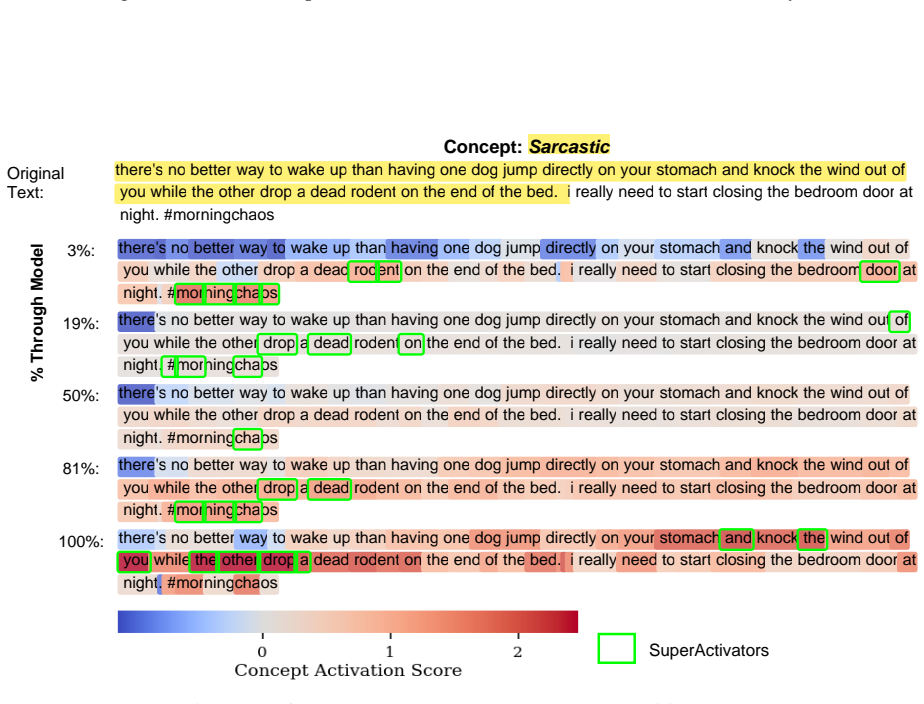
- [Figure 13 caption] The caption says 'SuperActivators' after all three concept activation rows, but only one concept's tail is marked. Clarify which concept the green boxes refer to.
Circularity Check
No significant circularity: the empirical SuperActivator claims are evaluated on held-out test data and against an independent out-of-concept distribution; flagged limitations are data-validity and proof-completeness issues, not circular reductions.
full rationale
Walking the derivation chain, the central definition τ^super_{c,δ}=Q_{1−δ}(S+_val,c) (Sec. 3.2) does make the SuperActivator set the top δ of in-concept validation activations, and δ is later calibrated on validation F1 (Sec. 4.2, App. D). But the paper's claims are not forced by this definition: detection F1 is computed on held-out test samples; tail separation is additionally quantified against the independent q0.98(D_out_c) (Figs. 3–4, App. B); and the finding that optimal δ is small is an empirical property of the location of the argmax, not an identity. Baselines are calibrated with the same validation procedure, so the 'up to 0.14 F1' comparison is fair. Two non-circular concerns are worth flagging: (i) Appendix C.4 states text token-level labels are generated 'via controlled prompting of GPT-4o,' so the three text results may partly reflect GPT-4o's stylistic markers rather than the concepts themselves; this is a validity/generality limitation, not a reduction of the equations to their inputs. (ii) The Abstract claims 'we prove that concept-aligned attention heads multiplicatively amplify pairwise activation gaps,' but no such proof appears in the body — an omitted proof/overclaim, again not circular. The only author self-citation ([68]) appears in a Related Work survey and is not load-bearing. Hence no circularity; score 0.
Axiom & Free-Parameter Ledger
free parameters (5)
- δ (sparsity level) =
per-concept 2–10% typical; iSarcasm ~40%; fixed variant 10%
- Model layer per concept =
chosen from a fixed depth grid per concept and per method
- Unsupervised concept matching oracle =
best validation F1 unit per ground-truth concept
- k-means k =
1000 token-level, 50 CLS-level
- Text dataset construction probabilities =
20% / 15% / random structural choices
axioms (5)
- domain assumption Concepts are representable as directions in embedding space; dot-product activation measures concept presence (linearity hypothesis)
- domain assumption Token-level ground-truth labels correctly partition in-concept vs out-of-concept tokens
- domain assumption Out-of-concept distribution Dout_c built only from samples without c avoids self-attention leakage
- domain assumption Validation-calibrated (δ, layer, threshold) transfer to the test distribution
- domain assumption Embedding normalization/mean-centering using training statistics preserves relevant concept structure
invented entities (1)
-
SuperActivator tokens
no independent evidence
read the original abstract
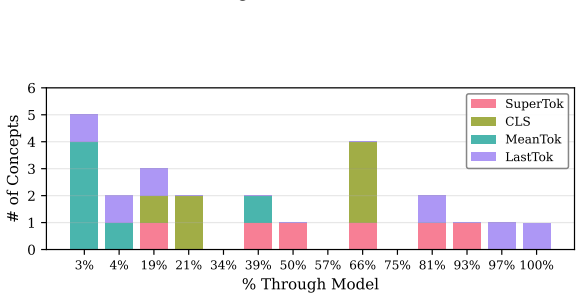
Concept vectors aim to enhance model interpretability by linking internal representations with human-understandable semantics, but their practical utility is often limited by noisy and inconsistent activations. In this work, we uncover the SuperActivator Mechanism: a transformer dynamic that amplifies concept activation gaps, concentrating the most reliable concept evidence into a small set of high-activation tokens. To develop a theoretical understanding of this mechanism, we prove that concept-aligned attention heads multiplicatively amplify pairwise activation gaps, with already-extreme activations growing fastest. We find that this amplification is not just theoretical, but also occurs empirically on large-scale models: while in- and out-of-concept activation distributions overlap considerably, the in-concept distribution develops a positive tail clearly separated from the noise. These high-tail tokens, which we call SuperActivators, appear consistently across concept-positive samples, making them reliable indicators of concept presence. Accordingly, SuperActivator-based detection improves F1 by up to 0.14 over standard concept activation aggregators and prompting baselines across image and text modalities, models, layers, and concept extraction techniques, demonstrating the generality and practicality of our insights. Further empirical analysis demonstrates that the most reliable SuperActivators are sparse, with detection typically peaking when using only 5-10% of in-concept token activations, and capture more faithful localized semantics than global concept vectors.
Figures






Reference graph
Works this paper leans on
-
[1]
Meaningfully debugging model mistakes using conceptual counterfactual explanations, 2022
Abubakar Abid, Mert Yuksekgonul, and James Zou. Meaningfully debugging model mistakes using conceptual counterfactual explanations, 2022. URLhttps://arxiv.org/abs/2106.12723
Pith/arXiv arXiv 2022
-
[2]
Understanding intermediate layers using linear classifier probes,
Guillaume Alain and Yoshua Bengio. Understanding intermediate layers using linear classifier probes,
-
[3]
Probing for constituency structure in neural language models
David Arps, Younes Samih, Laura Kallmeyer, and Hassan Sajjad. Probing for constituency structure in neural language models. In Yoav Goldberg, Zornitsa Kozareva, and Yue Zhang, editors,Findings of the Association for Computational Linguistics: EMNLP 2022, pages 6738–6757, Abu Dhabi, United Arab Emirates, December 2022. Association for Computational Linguis...
doi:10.18653/v1/2022 2022
-
[4]
David Bau, Jun-Yan Zhu, Hendrik Strobelt, Agata Lapedriza, Bolei Zhou, and Antonio Torralba. Understanding the role of individual units in a deep neural network.Proceedings of the National Academy of Sciences, 2020. ISSN 0027-8424. doi: 10.1073/pnas.1907375117. URL https://www.pnas. org/content/early/2020/08/31/1907375117
-
[5]
Maike Behrendt, Stefan Sylvius Wagner, and Stefan Harmeling. Maxpoolbert: Enhancing bert classification via layer- and token-wise aggregation.ArXiv, abs/2505.15696, 2025. URL https: //api.semanticscholar.org/CorpusID:278782887
arXiv 2025
-
[6]
Opensurfaces: A richly annotated catalog of surface appearance.ACM Transactions on Graphics (SIGGRAPH), 32(4), 2013
Sean Bell, Paul Upchurch, Noah Snavely, and Kavita Bala. Opensurfaces: A richly annotated catalog of surface appearance.ACM Transactions on Graphics (SIGGRAPH), 32(4), 2013
2013
-
[7]
Itay Benou and Tammy Riklin-Raviv. Show and tell: Visually explainable deep neural nets via spatially- aware concept bottleneck models, 2025. URLhttps://arxiv.org/abs/2502.20134
arXiv 2025
-
[8]
Lukas Berglund, Meg Tong, Max Kaufmann, Mikita Balesni, Asa Cooper Stickland, Tomasz Korbak, and Owain Evans. The reversal curse: Llms trained on "a is b" fail to learn "b is a", 2024. URL https://arxiv.org/abs/2309.12288
Pith/arXiv arXiv 2024
-
[9]
Anthropic Research Preprint, 2023
Trenton Bricken, Adly Templeton, Jonathan Batson, Brian Chen, Adam Jermyn, Tom Conerly, andet al.Towards monosemanticity: Decomposing language models with dictionary learning. Anthropic Research Preprint, 2023. Available at Anthropic’s website
2023
-
[10]
Runjin Chen, Andy Arditi, Henry Sleight, Owain Evans, and Jack Lindsey. Persona vectors: Monitoring and controlling character traits in language models.ArXiv, abs/2507.21509, 2025. URL https://api. semanticscholar.org/CorpusID:280337840
Pith/arXiv arXiv 2025
-
[11]
Concept whitening for interpretable image recognition.Nature Machine Intelligence, 2:772 – 782, 2020
Zhi Chen, Yijie Bei, and Cynthia Rudin. Concept whitening for interpretable image recognition.Nature Machine Intelligence, 2:772 – 782, 2020. URLhttps://api.semanticscholar.org/CorpusID:211031886
2020
-
[12]
Evaluation of bert and albert sentence embedding performance on downstream nlp tasks, 2021
Hyunjin Choi, Judong Kim, Seongho Joe, and Youngjune Gwon. Evaluation of bert and albert sentence embedding performance on downstream nlp tasks, 2021. URLhttps://arxiv.org/abs/2101.10642
Pith/arXiv arXiv 2021
-
[13]
Hoagy Cunningham, Aidan Ewart, Logan Riggs, Robert Huben, and Lee Sharkey. Sparse autoencoders find highly interpretable features in language models.ArXiv, abs/2309.08600, 2023. URL https: //api.semanticscholar.org/CorpusID:261934663
Pith/arXiv arXiv 2023
-
[14]
Saeuron: Interpretable concept unlearning in diffusion models with sparse autoencoders, 2025
Bartosz Cywi ´ nski and Kamil Deja. Saeuron: Interpretable concept unlearning in diffusion models with sparse autoencoders, 2025. URLhttps://arxiv.org/abs/2501.18052
Pith/arXiv arXiv 2025
-
[15]
Discovering latent concepts learned in bert, 2022
Fahim Dalvi, Abdul Rafae Khan, Firoj Alam, Nadir Durrani, Jia Xu, and Hassan Sajjad. Discovering latent concepts learned in bert, 2022. URLhttps://arxiv.org/abs/2205.07237
Pith/arXiv arXiv 2022
-
[16]
Goemotions: A dataset of fine-grained emotions
Dorottya Demszky, Dana Movshovitz-Attias, Jeongwoo Ko, Alan Cowen, Gaurav Nemade, and Sujith Ravi. Goemotions: A dataset of fine-grained emotions. InProceedings of the 58th Annual Meeting of the Association for Computational Linguistics (ACL), pages 4040–4054, 2020. 11
2020
-
[17]
From colors to classes: Emergence of concepts in vision transformers.ArXiv, abs/2503.24071, 2025
Teresa Dorszewski, Lenka Tvetkov’a, Robert Jenssen, Lars Kai Hansen, and Kristoffer Wickstrøm. From colors to classes: Emergence of concepts in vision transformers.ArXiv, abs/2503.24071, 2025. URL https://api.semanticscholar.org/CorpusID:277467666
Pith/arXiv arXiv 2025
-
[18]
Alexey Dosovitskiy, Lucas Beyer, Alexander Kolesnikov, Dirk Weissenborn, Xiaohua Zhai, Thomas Unterthiner, Mostafa Dehghani, Matthias Minderer, Georg Heigold, Sylvain Gelly, Jakob Uszkoreit, and Neil Houlsby. An image is worth 16x16 words: Transformers for image recognition at scale.ArXiv, abs/2010.11929, 2020. URLhttps://api.semanticscholar.org/CorpusID:...
Pith/arXiv arXiv 2010
-
[19]
Toy models of superposition, 2022
Nelson Elhage, Tristan Hume, Catherine Olsson, Nicholas Schiefer, Tom Henighan, Shauna Kravec, Zac Hatfield-Dodds, Robert Lasenby, Dawn Drain, Carol Chen, Roger Grosse, Sam McCandlish, Jared Kaplan, Dario Amodei, Martin Wattenberg, and Christopher Olah. Toy models of superposition, 2022. URLhttps://arxiv.org/abs/2209.10652
Pith/arXiv arXiv 2022
-
[20]
Mark Everingham, Luc Van Gool, Christopher K. I. Williams, John Winn, and Andrew Zisserman. The pascal visual object classes (voc) challenge, 2010
2010
-
[21]
Craft: Concept recursive activation factorization for explainability.2023 IEEE/CVF Conference on Computer Vision and Pattern Recognition (CVPR), pages 2711–2721, 2022
Thomas Fel, Agustin Picard, Louis Béthune, Thibaut Boissin, David Vigouroux, Julien Colin, Rémi Cadène, and Thomas Serre. Craft: Concept recursive activation factorization for explainability.2023 IEEE/CVF Conference on Computer Vision and Pattern Recognition (CVPR), pages 2711–2721, 2022. URL https://api.semanticscholar.org/CorpusID:253708233
2023
-
[22]
Explaining groups of instances with shap-iq
Thomas Fel, Alexandre Jullien, David Vigouroux, Remi Cadene, Thomas Nicodeme, Matthieu Laly, Asma Fermanian, Benjamin Audit, and Thomas Scantamburlo. Explaining groups of instances with shap-iq. InInternational Conference on Artificial Intelligence and Statistics, pages 6467–6491. PMLR, 2023
2023
-
[23]
Yossi Gandelsman, Alexei A. Efros, and Jacob Steinhardt. Interpreting clip’s image representation via text-based decomposition.ArXiv, abs/2310.05916, 2023. URL https://api.semanticscholar.org/ CorpusID:263829688
Pith/arXiv arXiv 2023
-
[25]
Scaling and evaluating sparse autoencoders, 2024
Leo Gao, Tom Dupré la Tour, Henk Tillman, Gabriel Goh, Rajan Troll, Alec Radford, Ilya Sutskever, Jan Leike, and Jeffrey Wu. Scaling and evaluating sparse autoencoders, 2024. URL https://arxiv.org/ abs/2406.04093
Pith/arXiv arXiv 2024
-
[26]
Amirata Ghorbani, James Wexler, and Been Kim. Automating interpretability: Discovering and testing visual concepts learned by neural networks.ArXiv, abs/1902.03129, 2019. URL https://api. semanticscholar.org/CorpusID:59842921
Pith/arXiv arXiv 1902
-
[27]
Multimodal neurons in artificial neural networks.Distill, 2021
Gabriel Goh, Nick Cammarata †, Chelsea Voss †, Shan Carter, Michael Petrov, Ludwig Schubert, Alec Radford, and Chris Olah. Multimodal neurons in artificial neural networks.Distill, 2021. doi: 10.23915/distill.00030. https://distill.pub/2021/multimodal-neurons
-
[28]
Aaron Grattafiori, Abhimanyu Dubey, Abhinav Jauhri, Abhinav Pandey, Abhishek Kadian, Ahmad Al-Dahle, Aiesha Letman, Akhil Mathur, Alan Schelten, Alex Vaughan, et al. The llama 3 herd of models. arXiv preprint arXiv:2407.21783, 2024
Pith/arXiv arXiv 2024
-
[29]
Ryan Greenblatt, Carson Denison, Benjamin Wright, Fabien Roger, Monte MacDiarmid, Sam Marks, Johannes Treutlein, Tim Belonax, Jack Chen, David Duvenaud, Akbir Khan, Julian Michael, Sören Mindermann, Ethan Perez, Linda Petrini, Jonathan Uesato, Jared Kaplan, Buck Shlegeris, Samuel R. Bowman, and Evan Hubinger. Alignment faking in large language models, 202...
Pith/arXiv arXiv 2024
-
[30]
Tudor Groza, Harrison Caufield, Daniel Gration, et al. An evaluation of gpt models for phe- notype concept recognition.BMC Medical Informatics and Decision Making, 24(30), 2024. doi: 10.1186/s12911-024-02439-w. URLhttps://doi.org/10.1186/s12911-024-02439-w. 12
-
[31]
Gabriel Ilharco, Mitchell Wortsman, Ross Wightman, Cade Gordon, Nicholas Carlini, Rohan Taori, Achal Dave, Vaishaal Shankar, Hongseok Namkoong, John Miller, Hannaneh Hajishirzi, Ali Farhadi, and Ludwig Schmidt. Openclip, July 2021. URL https://doi.org/10.5281/zenodo.5143773. If you use this software, please cite it as below
-
[32]
Billion-scale similarity search with GPUs.IEEE Transactions on Big Data, 7(3):535–547, 2019
Jeff Johnson, Matthijs Douze, and Hervé Jégou. Billion-scale similarity search with GPUs.IEEE Transactions on Big Data, 7(3):535–547, 2019
2019
-
[33]
Lawrence Zitnick, and Ross Girshick
Justin Johnson, Bharath Hariharan, Laurens van der Maaten, Li Fei-Fei, C. Lawrence Zitnick, and Ross Girshick. Clevr: A diagnostic dataset for compositional language and elementary visual reasoning. In Proceedings of the IEEE Conference on Computer Vision and Pattern Recognition (CVPR), 2017
2017
-
[34]
Inter- pretability beyond feature attribution: Quantitative testing with concept activation vectors (tcav)
Been Kim, Martin Wattenberg, Justin Gilmer, Carrie Cai, James Wexler, Fernanda Viegas, et al. Inter- pretability beyond feature attribution: Quantitative testing with concept activation vectors (tcav). In International conference on machine learning, pages 2668–2677. PMLR, 2018
2018
-
[35]
Concept bottleneck models
Pang Wei Koh, Thao Nguyen, Yew Siang Tang, Stephen Mussmann, Emma Pierson, Been Kim, and Percy Liang. Concept bottleneck models. In Hal Daumé III and Aarti Singh, editors,Proceedings of the 37th International Conference on Machine Learning, volume 119 ofProceedings of Machine Learning Research, pages 5338–5348. PMLR, 13–18 Jul 2020
2020
-
[36]
Gemma scope: Open sparse autoencoders everywhere all at once on gemma 2, 2024
Tom Lieberum, Senthooran Rajamanoharan, Arthur Conmy, Lewis Smith, Nicolas Sonnerat, Vikrant Varma, János Kramár, Anca Dragan, Rohin Shah, and Neel Nanda. Gemma scope: Open sparse autoencoders everywhere all at once on gemma 2, 2024. URLhttps://arxiv.org/abs/2408.05147
Pith/arXiv arXiv 2024
-
[37]
Sparse autoencoders reveal selective remapping of visual concepts during adaptation, 2025
Hyesu Lim, Jinho Choi, Jaegul Choo, and Steffen Schneider. Sparse autoencoders reveal selective remapping of visual concepts during adaptation, 2025. URLhttps://arxiv.org/abs/2412.05276
Pith/arXiv arXiv 2025
-
[38]
Lawrence Zitnick
Tsung-Yi Lin, Michael Maire, Serge Belongie, Lubomir Bourdev, Ross Girshick, James Hays, Pietro Perona, Deva Ramanan, Piotr Dollár, and C. Lawrence Zitnick. Microsoft coco: Common objects in context. InEuropean Conference on Computer Vision (ECCV), 2014
2014
-
[39]
Jack Lindsey, Wes Gurnee, Emmanuel Ameisen, Brian Chen, Adam Pearce, Nicholas L. Turner, Craig Citro, David Abrahams, Shan Carter, Basil Hosmer, Jonathan Marcus, Michael Sklar, Adly Templeton, Trenton Bricken, Callum McDougall, Hoagy Cunningham, Thomas Henighan, Adam Jermyn, Andy Jones, Andrew Persic, Zhenyi Qi, T. Ben Thompson, Sam Zimmerman, Kelley Rivo...
-
[40]
Sheng Liu, Haotian Ye, Lei Xing, and James Y. Zou. In-context vectors: Making in context learning more effective and controllable through latent space steering.ArXiv, abs/2311.06668, 2023. URL https://api.semanticscholar.org/CorpusID:265149781
Pith/arXiv arXiv 2023
-
[41]
A unified approach to interpreting model predictions
Scott M Lundberg and Su-In Lee. A unified approach to interpreting model predictions. InAdvances in neural information processing systems 30, 2017
2017
-
[42]
Calm: A causality-guided framework for generating local and global model explanations
Divyanshu Mahajan, Chenhao Tan, and Matthew Turek. Calm: A causality-guided framework for generating local and global model explanations. InProceedings of the IEEE/CVF Winter Conference on Applications of Computer Vision, pages 1215–1224, 2021
2021
-
[43]
Promises and pitfalls of black-box concept learning models.ArXiv, abs/2106.13314, 2021
Anita Mahinpei, Justin Clark, Isaac Lage, Finale Doshi-Velez, and Weiwei Pan. Promises and pitfalls of black-box concept learning models.ArXiv, abs/2106.13314, 2021. URL https://api.semanticscholar. org/CorpusID:235652059
Pith/arXiv arXiv 2021
-
[44]
Detecting high-stakes interactions with activation probes.ArXiv, abs/2506.10805, 2025
Alex McKenzie, Urja Pawar, Phil Blandfort, William Bankes, David Krueger, Ekdeep Singh Lubana, and Dmitrii Krasheninnikov. Detecting high-stakes interactions with activation probes.ArXiv, abs/2506.10805, 2025. URLhttps://api.semanticscholar.org/CorpusID:279318482. 13
arXiv 2025
-
[45]
Linguistic regularities in continuous space word representations
Tomas Mikolov, Wen tau Yih, and Geoffrey Zweig. Linguistic regularities in continuous space word representations. InNorth American Chapter of the Association for Computational Linguistics, 2013. URL https://api.semanticscholar.org/CorpusID:7478738
2013
-
[46]
Springer Nature Switzerland, 2023
Georgii Mikriukov, Gesina Schwalbe, Christian Hellert, and Korinna Bade.Evaluating the Stability of Semantic Concept Representations in CNNs for Robust Explainability, page 499–524. Springer Nature Switzerland, 2023. ISBN 9783031440670. doi: 10.1007/978-3-031-44067-0_26. URL http://dx.doi. org/10.1007/978-3-031-44067-0_26
-
[47]
Large language models: A survey, 2025
Shervin Minaee, Tomas Mikolov, Narjes Nikzad, Meysam Chenaghlu, Richard Socher, Xavier Amatriain, and Jianfeng Gao. Large language models: A survey, 2025. URL https://arxiv.org/abs/2402.06196
Pith/arXiv arXiv 2025
-
[48]
Fraser, and Svetlana Kiritchenko
Isar Nejadgholi, Esma Balkır, Kathleen C. Fraser, and Svetlana Kiritchenko. Towards procedural fairness: Uncovering biases in how a toxic language classifier uses sentiment information, 2022. URL https://arxiv.org/abs/2210.10689
Pith/arXiv arXiv 2022
-
[49]
Angus Nicolson, Lisa Schut, J. Alison Noble, and Yarin Gal. Explaining explainability: Recommenda- tions for effective use of concept activation vectors, 2025. URLhttps://arxiv.org/abs/2404.03713
Pith/arXiv arXiv 2025
-
[50]
Zoom in: An introduction to circuits.Distill, 2020
Chris Olah, Nick Cammarata, Ludwig Schubert, Gabriel Goh, Michael Petrov, and Shan Carter. Zoom in: An introduction to circuits.Distill, 2020. doi: 10.23915/distill.00024.001. https://distill.pub/2020/circuits/zoom-in
-
[51]
Gpt-4o system card, 2024
OpenAI. Gpt-4o system card, 2024. URL https://openai.com/index/gpt-4o-system-card/ . Model documentation and safety evaluation
2024
-
[52]
isarcasm: A dataset of intended sarcasm
Silviu Oprea and Walid Magdy. isarcasm: A dataset of intended sarcasm. InProceedings of the 58th Annual Meeting of the Association for Computational Linguistics. Association for Computational Linguistics, 2020
2020
-
[53]
Disentangling neuron representations with concept vectors
Laura O’Mahony, Vincent Andrearczyk, Henning Müller, and Mara Graziani. Disentangling neuron representations with concept vectors. In2023 IEEE/CVF Conference on Computer Vision and Pattern Recognition Workshops (CVPRW), pages 3770–3775, 2023. doi: 10.1109/CVPRW59228.2023.00390
arXiv 2023
-
[54]
MacArthur, and Christopher R
Enrico Parisini, Tapabrata Chakraborti, Chris Harbron, Ben D. MacArthur, and Christopher R. S. Banerji. Leakage and interpretability in concept-based models, 2025. URL https://arxiv.org/abs/2504. 14094
2025
-
[55]
Rise: Randomized input sampling for explanation of black-box models
Vitali Petsiuk, Abir Das, and Kate Saenko. Rise: Randomized input sampling for explanation of black-box models. InProceedings of the British Machine Vision Conference (BMVC), 2018
2018
-
[56]
Learning transferable visual models from natural language supervision, 2021
Alec Radford, Jong Wook Kim, Chris Hallacy, Aditya Ramesh, Gabriel Goh, Sandhini Agarwal, Girish Sastry, Amanda Askell, Pamela Mishkin, Jack Clark, Gretchen Krueger, and Ilya Sutskever. Learning transferable visual models from natural language supervision, 2021. URL https://arxiv.org/abs/ 2103.00020
Pith/arXiv arXiv 2021
-
[57]
why should i trust you?
Marco Tulio Ribeiro, Sameer Singh, and Carlos Guestrin. "why should i trust you?": Explaining the predictions of any classifier. InProceedings of the 22nd ACM SIGKDD international conference on knowledge discovery and data mining, pages 1135–1144, 2016
2016
-
[58]
Steering llama 2 via contrastive activation addition.ArXiv, abs/2312.06681, 2023
Nina Rimsky, Nick Gabrieli, Julian Schulz, Meg Tong, Evan Hubinger, and Alexander Matt Turner. Steering llama 2 via contrastive activation addition.ArXiv, abs/2312.06681, 2023. URL https://api. semanticscholar.org/CorpusID:266174252
Pith/arXiv arXiv 2023
-
[59]
Roboflow100-vl: A multi-domain object detection benchmark for vision-language models
Peter Robicheaux, Matvei Popov, Anish Madan, Isaac Robinson, Joseph Nelson, Deva Ramanan, and Neehar Peri. Roboflow100-vl: A multi-domain object detection benchmark for vision-language models. ArXiv, abs/2505.20612, 2025. URLhttps://api.semanticscholar.org/CorpusID:278910603
arXiv 2025
-
[60]
A conversation with bing’s chatbot left me deeply unsettled.The New York Times
Kevin Roose. A conversation with bing’s chatbot left me deeply unsettled.The New York Times. URL https://www.nytimes.com/2023/02/16/technology/bing-sydney-microsoft-ai-chatbot.html. 14
2023
-
[61]
Friedrich
Johannes Rückert, Asma Ben Abacha, Alba Garcia Seco de Herrera, Louise Bloch, Raphael Brüngel, Ahmad Idrissi-Yaghir, Henning Schäfer, Henning Müller, and Christoph M. Friedrich. Overview of imageclefmedical 2023 – caption prediction and concept detection. InCLEF 2023: Conference and Labs of the Evaluation Forum, September 2023
2023
-
[62]
Large language models encode semantics in low-dimensional linear subspaces, 2025
Baturay Saglam, Paul Kassianik, Blaine Nelson, Sajana Weerawardhena, Yaron Singer, and Amin Karbasi. Large language models encode semantics in low-dimensional linear subspaces, 2025. URL https://arxiv.org/abs/2507.09709
arXiv 2025
-
[63]
Antonio De Santis, Riccardo Campi, Matteo Bianchi, and Marco Brambilla. Visual-tcav: Concept-based attribution and saliency maps for post-hoc explainability in image classification.ArXiv, abs/2411.05698,
-
[64]
LAION-5b: An open large-scale dataset for training next generation image-text models
Christoph Schuhmann, Romain Beaumont, Richard Vencu, Cade W Gordon, Ross Wightman, Mehdi Cherti, Theo Coombes, Aarush Katta, Clayton Mullis, Mitchell Wortsman, Patrick Schramowski, Srivatsa R Kundurthy, Katherine Crowson, Ludwig Schmidt, Robert Kaczmarczyk, and Jenia Jitsev. LAION-5b: An open large-scale dataset for training next generation image-text mod...
2022
-
[65]
Grad-cam: Visual explanations from deep networks via gradient-based localization
Ramprasaath R Selvaraju, Michael Cogswell, Abhishek Das, Ramakrishna Vedantam, Devi Parikh, and Dhruv Batra. Grad-cam: Visual explanations from deep networks via gradient-based localization. In Proceedings of the IEEE international conference on computer vision, pages 618–626, 2017
2017
-
[66]
Turner, and Luis Espinosa-Anke
Zara Siddique, Liam D. Turner, and Luis Espinosa-Anke. Dialz: A python toolkit for steering vectors,
-
[67]
Full-gradient representation for neural network visualization
Suraj Srinivas and François Fleuret. Full-gradient representation for neural network visualization. In Advances in Neural Information Processing Systems 32, 2019
2019
-
[68]
Towards compositionality in concept learning.ArXiv, abs/2406.18534, 2024
Adam Stein, Aaditya Naik, Yinjun Wu, Mayur Naik, and Eric Wong. Towards compositionality in concept learning.ArXiv, abs/2406.18534, 2024
Pith/arXiv arXiv 2024
-
[69]
Axiomatic attribution for deep networks
Mukund Sundararajan, Ankur Taly, and Qiqi Yan. Axiomatic attribution for deep networks. In International conference on machine learning, pages 3319–3328. PMLR, 2017
2017
-
[70]
URLhttps://arxiv.org/abs/2505.06262
-
[71]
Pooling and attention: What are effective designs for llm-based embedding models?, 2024
Yixuan Tang and Yi Yang. Pooling and attention: What are effective designs for llm-based embedding models?, 2024. URLhttps://arxiv.org/abs/2409.02727
Pith/arXiv arXiv 2024
-
[72]
Gemma Team, Morgane Riviere, Shreya Pathak, Pier Giuseppe Sessa, Cassidy Hardin, Surya Bhupati- raju, Léonard Hussenot, Thomas Mesnard, Bobak Shahriari, Alexandre Ramé, Johan Ferret, Peter Liu, Pouya Tafti, Abe Friesen, Michelle Casbon, Sabela Ramos, Ravin Kumar, Charline Le Lan, Sammy Jerome, Anton Tsitsulin, Nino Vieillard, Piotr Stanczyk, Sertan Girgin...
Pith/arXiv arXiv 2024
-
[73]
Investigating task-specific prompts and sparse autoencoders for activation monitoring, 2025
Henk Tillman and Dan Mossing. Investigating task-specific prompts and sparse autoencoders for activation monitoring, 2025. URLhttps://arxiv.org/abs/2504.20271
Pith/arXiv arXiv 2025
-
[74]
From noise to narrative: Tracing the origins of hallucinations in transformers, 2025
Praneet Suresh, Jack Stanley, Sonia Joseph, Luca Scimeca, and Danilo Bzdok. From noise to narrative: Tracing the origins of hallucinations in transformers, 2025. URL https://arxiv.org/abs/2509.06938
arXiv 2025
-
[75]
Disentangled representation learning,
Xin Wang, Hong Chen, Si’ao Tang, Zihao Wu, and Wenwu Zhu. Disentangled representation learning,
-
[76]
Manning, and Christopher Potts
Zhengxuan Wu, Aryaman Arora, Atticus Geiger, Zheng Wang, Jing Huang, Dan Jurafsky, Christopher D. Manning, and Christopher Potts. Axbench: Steering llms? even simple baselines outperform sparse autoencoders, 2025. URLhttps://arxiv.org/abs/2501.17148
Pith/arXiv arXiv 2025
-
[77]
Yan Xie, Zequn Zeng, Hao Zhang, Yucheng Ding, Yi Wang, Zhengjue Wang, Bo Chen, and Hongwei Liu. Discovering fine-grained visual-concept relations by disentangled optimal transport concept bottleneck models, 2025. URLhttps://arxiv.org/abs/2505.07209
Pith/arXiv arXiv 2025
-
[78]
Vazquez, Ulisse Mini, and Monte MacDiarmid
Alexander Matt Turner, Lisa Thiergart, Gavin Leech, David Udell, Juan J. Vazquez, Ulisse Mini, and Monte MacDiarmid. Steering language models with activation engineering, 2024. URL https://arxiv. org/abs/2308.10248
Pith/arXiv arXiv 2024
-
[79]
Yifan Yang, Xiaoyu Liu, Qiao Jin, Furong Huang, and Zhiyong Lu. Unmasking and quantifying racial bias of large language models in medical report generation.Communications Medicine, 4(1), September 2024. ISSN 2730-664X. doi: 10.1038/s43856-024-00601-z. URL http://dx.doi.org/10. 1038/s43856-024-00601-z
-
[80]
URLhttps://arxiv.org/abs/2211.11695
-
[81]
Latent concept-based explanation of nlp models.ArXiv, abs/2404.12545, 2024
Xuemin Yu, Fahim Dalvi, Nadir Durrani, and Hassan Sajjad. Latent concept-based explanation of nlp models.ArXiv, abs/2404.12545, 2024. URL https://api.semanticscholar.org/CorpusID: 269282778
Pith/arXiv arXiv 2024
discussion (0)
Sign in with ORCID, Apple, or X to comment. Anyone can read and Pith papers without signing in.