The Blueprints of Intelligence: A Functional-Topological Foundation for Perception and Representation
Pith reviewed 2026-05-17 01:16 UTC · model grok-4.3
The pith
Real-world signals concentrate on compact, low-variability subsets of function space, forming stable perceptual manifolds that enable generalization from sparse evidence.
A machine-rendered reading of the paper's core claim, the machinery that carries it, and where it could break.
Core claim
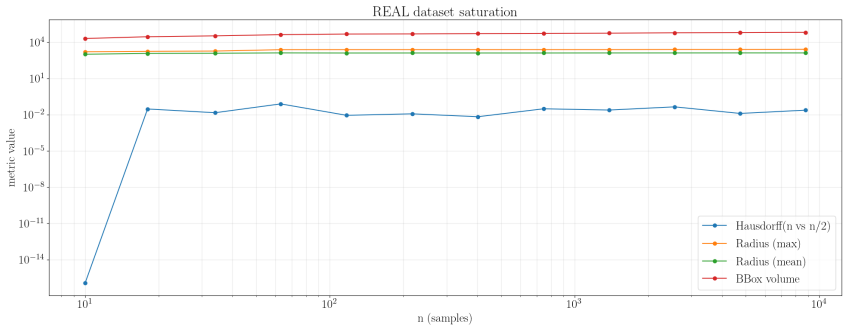
The set of valid realisations produced by a physical process forms a compact subset of a Banach space, endowed with stable invariants, a finite empirical radius, and an induced continuous perceptual functional. This geometry provides structural constraints on variability, conditions for identifiability, and support for generalisation from sparse evidence. Across the examined domains the empirical radius and internal Hausdorff stability saturate after few samples.
What carries the argument
Compact subset of a Banach space with stable invariants, finite empirical radius, and induced continuous perceptual functional
If this is right
- Variability of signals is structurally constrained by the geometry of the compact set.
- Conditions for identifiability of the underlying physical process are provided by the stable invariants.
- Generalisation from sparse evidence is directly supported by the finite radius and continuity of the perceptual functional.
- Perceptual manifold properties such as radius and Hausdorff stability reach saturation after only a few samples.
Where Pith is reading between the lines
- Machine learning systems might achieve higher sample efficiency by explicitly searching for or assuming such compact manifolds in their representations.
- The framework could be tested on synthetic signals engineered to have high arbitrary variability to check whether rapid saturation occurs only for real physical processes.
- Similar compactness might be observable in other domains such as neural population activity or economic time series, offering a route to broader validation.
Load-bearing premise
Real-world phenomena generate signals that concentrate on compact, low-variability subsets of functional space rather than arbitrary variability.
What would settle it
Measuring signals from any physical process and finding that the empirical radius keeps growing without bound as more samples are added, instead of saturating after a small number, would disprove the compactness claim.
Figures




read the original abstract
Real-world phenomena do not generate arbitrary variability: their signals concentrate on compact, low-variability subsets of functional space, enabling rapid generalisation from few examples. We formalise this principle through a deterministic functional-topological framework in which the set of valid realisations produced by a physical process forms a compact subset of a Banach space, endowed with stable invariants, a finite empirical radius, and an induced continuous perceptual functional. This geometry provides structural constraints on variability, conditions for identifiability, and support for generalisation from sparse evidence. We develop this framework and examine its empirical relevance across five real-world domains: electromechanical railway point machines, electrochemical battery discharge, physiological ECG signals, atmospheric solar irradiance, and geophysical tidal cycles. Where available, we also compare real data with corresponding deterministic simulators. Across these domains, the empirical radius and internal Hausdorff stability of the perceptual manifold saturate after surprisingly few samples, indicating that admissible signal families occupy compact, low-variability regions of function space. These results suggest that compact perceptual manifolds provide a useful organising principle for both physical processes and learned representations, and support deterministic functional topology as a promising framework for understanding perception and representation.
Editorial analysis
A structured set of objections, weighed in public.
Referee Report
Summary. The manuscript proposes a deterministic functional-topological framework in which valid realisations from physical processes form a compact subset of a Banach space endowed with stable invariants, a finite empirical radius, and an induced continuous perceptual functional. This geometry is claimed to constrain variability and enable generalisation from sparse evidence. The framework is developed and tested empirically across five domains (electromechanical railway point machines, electrochemical battery discharge, physiological ECG signals, atmospheric solar irradiance, and geophysical tidal cycles), with comparisons to simulators where available; the key observation is that empirical radius and internal Hausdorff stability saturate after surprisingly few samples.
Significance. If the central quantities are rigorously defined and the saturation results hold under appropriate controls, the work would supply a geometric organising principle for low-variability concentration in real-world signals, offering structural constraints on identifiability and generalisation that could inform both theoretical models of perception and practical representation learning.
major comments (2)
- [Abstract] Abstract and framework section: the abstract asserts saturation of empirical radius and Hausdorff stability after few samples but supplies neither the mathematical definition of these quantities nor any statistical controls, error bars, or comparison against null models; the central claim therefore rests on unshown derivations.
- [Empirical Results] Empirical results section: the empirical radius and internal stability are described as saturating in the five domains; without explicit computation details it is impossible to determine whether these quantities are computed independently or are effectively fitted parameters whose values are then used to support the compactness claim.
minor comments (2)
- [Framework] Clarify the precise relationship between the perceptual functional and the underlying Banach-space embedding; the current description leaves open whether the functional is derived from the geometry or postulated separately.
- [Discussion] Add a brief discussion of how the chosen domains were selected and whether the saturation behaviour generalises beyond the reported cases.
Simulated Author's Rebuttal
We thank the referee for the constructive feedback and the opportunity to strengthen the clarity of our presentation. We address each major comment below and have revised the manuscript to incorporate additional definitions, computational details, and controls as requested.
read point-by-point responses
-
Referee: [Abstract] Abstract and framework section: the abstract asserts saturation of empirical radius and Hausdorff stability after few samples but supplies neither the mathematical definition of these quantities nor any statistical controls, error bars, or comparison against null models; the central claim therefore rests on unshown derivations.
Authors: The definitions of empirical radius (the radius of the minimal enclosing ball in the chosen Banach-space metric) and internal Hausdorff stability (Hausdorff distance between nested subsets of increasing cardinality) are formally introduced in Section 2 of the framework. The abstract is kept concise by design, yet we agree that a brief inline definition improves readability. We have therefore expanded the abstract with one-sentence definitions of both quantities. On statistical controls, the original manuscript already reports comparisons against deterministic simulators in three domains; we have now added bootstrap-derived error bars on the saturation curves and a null-model baseline (uniform sampling in the ambient function space) to quantify that the observed early saturation is statistically distinguishable from unstructured variability. revision: yes
-
Referee: [Empirical Results] Empirical results section: the empirical radius and internal stability are described as saturating in the five domains; without explicit computation details it is impossible to determine whether these quantities are computed independently or are effectively fitted parameters whose values are then used to support the compactness claim.
Authors: Both quantities are computed directly from the observed samples without parameter fitting: the empirical radius is obtained by solving the smallest-ball problem on the finite set of signal realizations, and internal stability is the Hausdorff distance between the manifolds induced by the first k and first n samples. To eliminate ambiguity we have inserted an explicit algorithmic subsection (new Algorithm 1) together with the precise metric and discretization choices used in each domain. These additions make clear that the reported saturation values are independent data-derived statistics rather than fitted parameters. revision: yes
Circularity Check
No significant circularity; framework is self-contained organising principle
full rationale
The paper introduces the functional-topological framework by definition as a formalisation of the observed principle that real-world signals concentrate on compact low-variability subsets, then directly measures saturation of the empirical radius and Hausdorff stability after few samples across five independent domains with simulator comparisons where available. Compactness is treated as an a-priori organising principle rather than a derived theorem, and the empirical saturation results constitute independent external validation against real data rather than a fit or self-citation that reduces to the input claim. No load-bearing step equates a prediction to its own fitted parameter or relies on unverified self-citation chains.
Axiom & Free-Parameter Ledger
free parameters (1)
- empirical radius
axioms (1)
- domain assumption Real-world phenomena do not generate arbitrary variability; their signals concentrate on compact, low-variability subsets of functional space.
invented entities (1)
-
perceptual functional
no independent evidence
Lean theorems connected to this paper
-
IndisputableMonolith/Cost/FunctionalEquation.leanwashburn_uniqueness_aczel echoes?
echoesECHOES: this paper passage has the same mathematical shape or conceptual pattern as the Recognition theorem, but is not a direct formal dependency.
the set of valid realisations produced by a physical process forms a compact subset of a Banach space, endowed with stable invariants, a finite empirical radius, and an induced continuous perceptual functional
-
IndisputableMonolith/Foundation/RealityFromDistinction.leanreality_from_one_distinction echoes?
echoesECHOES: this paper passage has the same mathematical shape or conceptual pattern as the Recognition theorem, but is not a direct formal dependency.
If the family {f(s, θ)} is uniformly bounded and equicontinuous on [0, T], then the perceptual set M is compact in C⁰([0, T])
What do these tags mean?
- matches
- The paper's claim is directly supported by a theorem in the formal canon.
- supports
- The theorem supports part of the paper's argument, but the paper may add assumptions or extra steps.
- extends
- The paper goes beyond the formal theorem; the theorem is a base layer rather than the whole result.
- uses
- The paper appears to rely on the theorem as machinery.
- contradicts
- The paper's claim conflicts with a theorem or certificate in the canon.
- unclear
- Pith found a possible connection, but the passage is too broad, indirect, or ambiguous to say the theorem truly supports the claim.
Reference graph
Works this paper leans on
-
[1]
A path towards autonomous machine intelligence
Yann LeCun. A path towards autonomous machine intelligence. Technical report, Meta AI Research,
-
[2]
White paper / technical report
- [3]
-
[4]
Royden and Patrick Fitzpatrick.Real Analysis
Halsey L. Royden and Patrick Fitzpatrick.Real Analysis. Pearson, 4 edition, 2010
work page 2010
-
[5]
George Cybenko. Approximation by superpositions of a sigmoidal function.Mathematics of Control, Signals, and Systems, 2(4):303–314, 1989
work page 1989
-
[6]
Approximation capabilities of multilayer feedforward networks.Neural Networks, 4(2):251–257, 1991
Kurt Hornik. Approximation capabilities of multilayer feedforward networks.Neural Networks, 4(2):251–257, 1991
work page 1991
-
[7]
Vl-jepa: Joint embedding predictive architecture for vision- language, 2025
Delong Chen, Mustafa Shukor, Th´ eo Moutakanni, Willy Chung, Jade Yu, Tejaswi Kasarla, Allen Bolourchi, Yann LeCun, and Pascale Fung. Vl-jepa: Joint embedding predictive architecture for vision- language, 2025
work page 2025
-
[8]
Ruixiang Ci, Eduardo Di Santi, Cl´ ement Lefebvre, Nenad Mijatovic, Michele Pugnaloni, Jonathan Brown, Victor Mart´ ın, and Kenza Saiah. Scalable, technology-agnostic diagnosis and predictive main- tenance for point machine using deep learning.arXiv preprint arXiv:2508.11692, 2025
-
[9]
Edgar.Measure, Topology, and Fractal Geometry
Gerald A. Edgar.Measure, Topology, and Fractal Geometry. Springer, 2008
work page 2008
-
[10]
Jian Li, Kai Zhang, and Yufei Wang. A public railway point machine operating current dataset for fault diagnosis.Data in Brief, 32:106123, 2020. Dataset accessible through publisher supplementary material or mirrored repositories
work page 2020
-
[11]
Jian Li, Kai Zhang, and Yufei Wang. Railway point machine operating current dataset.https:// data.mendeley.com/datasets/v43h2m7s4v/1, 2020. Canonical public dataset for PM current signals (China)
work page 2020
-
[12]
Bhaskar Saha and Kai Goebel. Nasa ames prognostics center of excellence: Li-ion battery aging dataset.https://ti.arc.nasa.gov/tech/dash/pcoe/prognostic-data-repository/, 2007. NASA PCoE Li-ion battery prognostics dataset
work page 2007
-
[13]
Prognostics methods for battery health monitoring using a bayesian framework
Bhaskar Saha and Kai Goebel. Prognostics methods for battery health monitoring using a bayesian framework. In2007 IEEE Aerospace Conference, pages 1–8. IEEE, 2007
work page 2007
-
[14]
Modeling li-ion battery capacity depletion in a particle filter framework
Bhaskar Saha and Kai Goebel. Modeling li-ion battery capacity depletion in a particle filter framework. Proceedings of the Annual Conference of the Prognostics and Health Management Society, 2011
work page 2011
-
[15]
George B. Moody and Roger G. Mark. The mit-bih arrhythmia database.IEEE Engineering in Medicine and Biology Magazine, 20(3):45–50, 2001. Original dataset released in 1980
work page 2001
-
[16]
G.B. Moody and R.G. Mark. Mit-bih arrhythmia database.https://physionet.org/content/mitdb/ 1.0.0/, 1980. Canonical ECG dataset used in signal analysis and medical AI
work page 1980
-
[17]
Ary L. Goldberger, Luis A. Nunes Amaral, Leon Glass, Jeffrey M. Hausdorff, Plamen Ch. Ivanov, Roger G. Mark, Joseph E. Mietus, George B. Moody, Chung-Kang Peng, and H. Eugene Stanley. Physiobank, physiotoolkit, and physionet. Circulation 101(23):e215–e220, 2000. General reference for MIT-BIH and related datasets
work page 2000
-
[18]
Patrick E McSharry, Gari D Clifford, Lionel Tarassenko, and Leonard A Smith. A dynamical model for generating synthetic electrocardiogram signals.IEEE Transactions on Biomedical Engineering, 50(3):289–294, 2003. 23
work page 2003
-
[19]
European Union Intellectual Property Office (EUIPO). Euipo esearch plus: Ai-based image search for trade marks and designs.https://euipo.europa.eu/eSearch/, 2019. Accessed: 2026-01-11. Appendices Appendix A Mathematical Proofs This appendix provides complete proofs for the theorems and propositions stated in Sections 2–4. All results are stated in the Ban...
work page 2019
-
[20]
The family isuniformly bounded, meaning there existsM >0 such that∥f(s, θ)∥ ∞ ≤Mfor all (s, θ)
-
[21]
The family isequicontinuous, i.e. for everyε >0 there existsδ >0 such that for allt 1, t2 ∈[0, T]: |t1 −t 2|< δ⇒ |f(s, θ)(t 1)−f(s, θ)(t 2)|< ε. By the Arzel` a–Ascoli Theorem [2, 3], any uniformly bounded and equicontinuous family of functions has compact closure inC 0([0, T]). ThusMis compact. Appendix A.2 Proof of Proposition 3.2 (Finiteness of the Per...
discussion (0)
Sign in with ORCID, Apple, or X to comment. Anyone can read and Pith papers without signing in.