REVIEW 3 major objections 5 minor 115 references
LeAD-M3D reports state-of-the-art monocular 3D detection accuracy on KITTI, Waymo, and Rope3D while running up to 3.6× faster than prior high-accuracy models, without LiDAR, stereo, or geometric assumptions.
Reviewed by Pith at T0; open to challenge. T0 means a machine referee read the full paper against a public rubric. the ladder, T0–T4 →
T0 review · deepseek-v4-flash
2026-08-03 18:19 UTC pith:CT3ISXHH
load-bearing objection Genuinely new LiDAR-free distillation trick for real-time M3D, thoroughly ablated and honestly reported, but the headline 3.6x speedup rests on an un-re-measured baseline runtime and there are no error bars on the small SOTA margins. the 3 major comments →
LeAD-M3D: Leveraging Asymmetric Distillation for Real-Time Monocular 3D Detection
The pith
A machine-rendered reading of the paper's core claim, the machinery that carries it, and where it could break.
Core claim
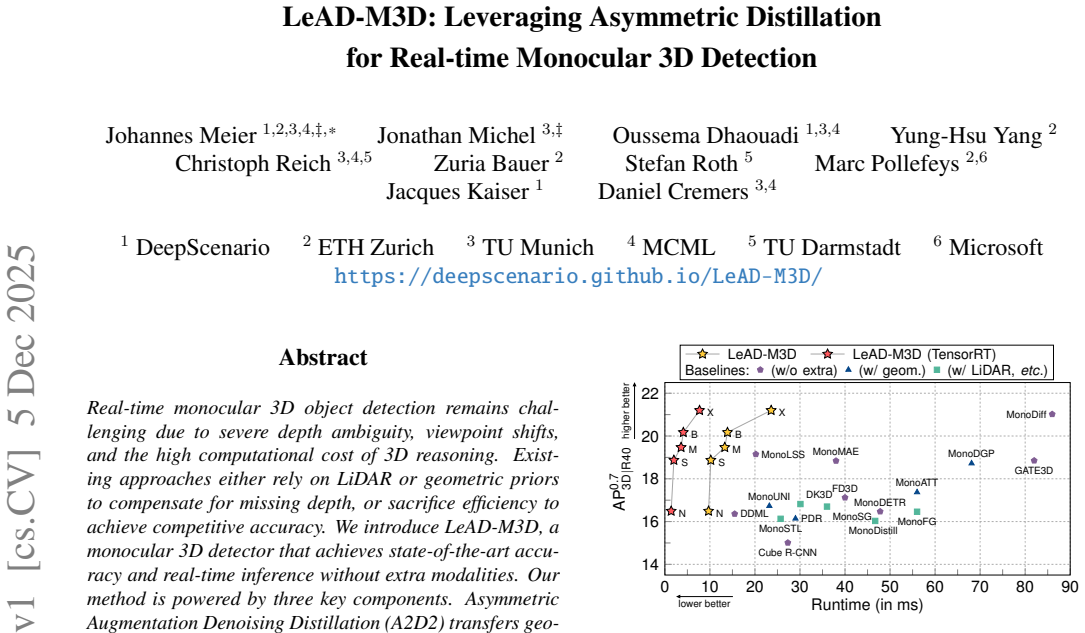
LeAD-M3D's central claim is that high-fidelity monocular 3D detection and real-time efficiency are simultaneously attainable without extra modalities. The largest variant achieves the highest car AP3D|R40 on the KITTI test set among monocular methods (30.76 Easy / 21.20 Moderate / 18.76 Hard at IoU 0.7), the best AP3D on the Waymo validation set (16.46 AP at IoU 0.5 Level 1, a +2.97 gain over the previous best), and the best reported car AP on Rope3D (16.45 AP at IoU 0.7), while running at 23.6 ms on an RTX 8000 — 3.6× faster than the prior SOTA MonoDiff's reported 86 ms. The paper attributes this primarily to A2D2, which frames distillation as a denoising task: the teacher sees clean images
What carries the argument
The load-bearing mechanism is A2D2, a LiDAR-free knowledge-distillation scheme built on an information asymmetry that costs nothing at inference. The teacher (the largest model variant X) is frozen after standard training; the student sees a mixup-blended image with probability 0.5, while the teacher sees clean images. Since mixup preserves object geometry in image coordinates, the student learns to denoise the augmentation by matching the teacher's 64-channel instance-depth features, with each channel weighted by its importance (normalized absolute weight in the depth head) and each instance weighted by a relative depth-error quality score. The two supporting components are CM3D, which repl
Load-bearing premise
The advertised Pareto frontier assumes the reported 86 ms runtime of MonoDiff (from its authors, not re-measured on the same hardware) is comparable to LeAD-M3D's 23.6 ms on the RTX 8000.
What would settle it
Re-benchmark MonoDiff (and other prior SOTA methods with public code) on the same NVIDIA RTX 8000 with the same post-processing, batch size, and input resolution as LeAD-M3D; if MonoDiff runs faster than roughly 85 ms under identical conditions, the headline 3.6× speed-up and the associated Pareto claim weaken.
If this is right
- On KITTI, the largest variant outperforms all prior monocular methods in AP3D, including those using LiDAR or geometric priors, while running real-time.
- On Waymo, LeAD-M3D X improves the previous best AP3D by 2.97 at IoU 0.5 Level 1; even the B variant exceeds all prior methods.
- On Rope3D, the method achieves the best reported car AP without ground-plane input, indicating cross-view generalization beyond forward-facing automotive cameras.
- The ablation attributes the largest single gain to A2D2 (+2.29 AP on the KITTI validation set with the B model); CM3D adds +0.83 AP, and the full system improves the baseline by +2.67 AP.
- A2D2 transfers to other baselines: applied as self-distillation, it improves MonoLSS by +1.76 Moderate AP and MonoCD by +2.73 Moderate AP on KITTI validation.
Where Pith is reading between the lines
- If MonoDiff and other prior SOTA methods are re-benchmarked on the same hardware with identical post-processing, the 3.6× speed advantage could shrink; the Pareto-frontier claim is only as strong as the fairness of the runtime comparison.
- The ablation shows removing the clean–mixed asymmetry is the most damaging change, which suggests a testable extension: strengthening the augmentation (e.g., higher mixup ratios or multiple blends) might further improve depth reasoning.
- Because CGI3D produces outputs identical to dense inference, its speed-up is a pure engineering optimization independent of the accuracy gains; other real-time detectors could adopt it standalone.
- The Waymo long-range (50 m to infinity) AP actually decreases relative to the baseline in some settings, so the reported gains are concentrated in near- and mid-range; a distance-stratified analysis would clarify where A2D2 and CM3D help most.
Editorial analysis
A structured set of objections, weighed in public.
Referee Report
Summary. LeAD-M3D is a monocular 3D object detector built on YOLOv10, introducing three components: A2D2 (asymmetric augmentation denoising distillation using mixup and a quality/importance-weighted depth-feature loss), CM3D (3D-aware consistent matching that adds MGIoU to the 2D assignment score), and CGI3D (confidence-gated 3D inference that restricts regression heads to top-k 3×3 patches). The paper reports state-of-the-art accuracy on KITTI, Waymo, and Rope3D, and claims a new Pareto frontier by running up to 3.6× faster than MonoDiff, without LiDAR, stereo, or geometric priors.
Significance. If the results hold, LeAD-M3D is a meaningful contribution: it demonstrates a LiDAR-free distillation scheme that generalizes to other baselines (Supp. Tab. 9), a matching criterion that plausibly improves 3D assignment, and a simple inference-side speedup with no measured accuracy loss. The paper is generally well structured, the ablations are broad, and the supplementary material includes honest runtime decompositions and cross-device measurements. The main limitation is that the headline Pareto-frontier claim rests on a small KITTI accuracy margin (0.18 AP Mod over MonoDiff) and on runtime numbers for many baselines that are author-reported rather than re-measured on the same hardware. As submitted, the evidence for a new SOTA Pareto frontier is not yet conclusive.
major comments (3)
- [Sec. 4.3, Supp. Tab. 17, Fig. 1] The 3.6× speed-up over MonoDiff is computed from MonoDiff's author-reported runtime of 86 ms (marked †), not re-measured on the same NVIDIA RTX 8000. The caption states that re-evaluation is performed only when public code is available, and MonoDiff has no released code. Since the central Pareto-frontier claim depends on this single external number, the speed comparison is not controlled. Please provide a same-hardware measurement if possible, or explicitly rephrase the claim to state that the speed advantage is relative to the original paper's reported runtime and may change under re-benchmarking.
- [Tab. 2, Supp. Tab. 16] On the KITTI test set, LeAD-M3D X achieves 21.20 AP Mod vs. MonoDiff's 21.02, a margin of 0.18 AP. The paper reports no error bars or multiple seeds anywhere, so this margin is within typical run-to-run variance for KITTI-style evaluation. Please provide variance estimates (e.g., 3–5 seeds on the validation split) or some other statistical support for the claim of state-of-the-art accuracy. This concern also applies to the Waymo and Rope3D gains, which are larger but still lack variance information.
- [Sec. 4.4, Tab. 5] The ablation description is ambiguous and the stated gains do not match the table. The text says 'Integrating CM3D (row 2) contributes 0.83 AP' and 'the Distill module (row 3) ... yields the largest single boost of +2.29 AP'. From Tab. 5, row 3 (Mod 21.81) gives +2.21 over the baseline (19.60) and +1.38 over row 2 (20.43), not +2.29. Please clarify the exact configuration of each row (which of A2D2, 2D IoU, 3D MGIoU are present) and recompute the stated deltas. This is load-bearing because the paper identifies A2D2 as the primary contributor.
minor comments (5)
- [Abstract / Sec. 1] The abstract and intro state '3.6× faster' without the caveat that the comparison runtime for MonoDiff is author-reported. Please qualify the claim, e.g., 'based on the runtime reported in the original paper'.
- [Sec. 3.5 / Tab. 7] The TensorRT results in Supp. Tab. 14 show that the CGI3D speedup shrinks to 26% in an optimized environment. The 'real-time' claim is hardware-dependent; consider presenting TensorRT runtimes for all model variants in the main paper, not only in the supplement.
- [Tab. 6] The row 'Ours w/o clean images' shows a dramatic drop on Easy AP (from 28.33 to 17.19) but only a modest drop on Mod AP (from 22.72 to 21.57). This discrepancy is not discussed; please provide an explanation.
- [Fig. 1] The legend includes 'LeAD-M3D (TensorRT)' but the caption does not explain which variants use TensorRT and what hardware settings apply. Please add a note.
- [Supp. Tab. 10] The MixSKD comparison is useful, but the baseline configuration (same teacher/student, same epochs, same data augmentation) should be stated explicitly to ensure the 3.04 AP drop is not due to unfair hyperparameters.
Circularity Check
No circularity: central claims are externally benchmarked; self-citations are non-load-bearing and the runtime caveat is a verification gap, not a circular step.
full rationale
The paper's derivation is self-contained and benchmark-anchored. A2D2 (Eqs. 1-4) uses ground-truth depth only to weight teacher features; the student is also supervised by ground-truth 3D boxes (L_cls, L_2D, L_3D) and is evaluated on held-out KITTI/Waymo/Rope3D, so no predicted quantity is recycled as an input. CM3D (Eqs. 5-6) changes the matching score but does not define the evaluation metric. CGI3D's 'identical outputs' claim is an architectural identity (3x3 conv + 1x1 convs), not a fitted prediction. Self-citations [60,61] are used for mixup/virtual-depth details and SO(3) parametrization; they are not load-bearing for the SOTA claim. The only flagged limitation is the runtime footnote in Supp. Tab. 17 (MonoDiff's 86 ms is author-reported, marked †, not re-measured on the RTX 8000); this is a verification gap on the speed axis of the Pareto comparison, not a circular reduction. No equation reduces by construction to its own input.
Axiom & Free-Parameter Ledger
free parameters (7)
- α (class-confidence exponent in CM3D) =
0.5
- β (2D IoU exponent in CM3D) =
1.0
- γ (MGIoU exponent in CM3D) =
1.0
- λ_distill =
0.1
- top-k for CGI3D =
k=50 (KITTI/Waymo), 200 (Rope3D)
- mixup probability and blending ratio =
0.5 / 0.5
- ε in teacher-quality weight =
0.1
axioms (4)
- domain assumption Mixup preserves object geometry in image coordinates, so depth features from a mixup image can be denoised to match clean-image features.
- domain assumption MGIoU is a reliable 3D overlap surrogate for prediction-to-ground-truth assignment.
- domain assumption The regression heads have an effective receptive field of exactly 3×3 (one 3×3 conv and two 1×1 convs), so patch-based CGI3D outputs are identical to dense inference.
- domain assumption Published numbers from prior methods (KITTI/Waymo/Rope3D tables) are trustworthy and comparable, and pretraining differences (MS-COCO vs. ImageNet) do not materially favor LeAD-M3D.
read the original abstract
Real-time monocular 3D object detection remains challenging due to severe depth ambiguity, viewpoint shifts, and the high computational cost of 3D reasoning. Existing approaches either rely on LiDAR or geometric priors to compensate for missing depth or sacrifice efficiency to achieve competitive accuracy. We introduce LeAD-M3D, a monocular 3D detector that achieves state-of-the-art accuracy and real-time inference without extra modalities. Our method is enabled by three key components. Asymmetric Augmentation Denoising Distillation (A2D2) transfers geometric knowledge from a clean-image teacher to a MixUp-noised student via a quality- and importance-weighted depth-feature loss, enabling stronger depth reasoning without LiDAR. 3D-aware Consistent Matching (CM$_{\text{3D}}$) improves prediction-to-ground truth assignment by integrating 3D MGIoU into the matching score, yielding stable and precise supervision. Finally, Confidence-Gated 3D Inference (CGI$_{\text{3D}}$) accelerates inference by restricting expensive 3D regression to confident regions. Together, these contributions set a new Pareto frontier for monocular 3D detection: LeAD-M3D achieves state-of-the-art accuracy on KITTI and Waymo, and the best reported car AP on Rope3D, while running up to 3.6$\,\times$ faster than prior high-accuracy models (e.g., MonoDiff). LeAD-M3D demonstrates that high fidelity and real-time monocular 3D detection is simultaneously attainable, without LiDAR, stereo, or strong geometric assumptions.
Figures


Reference graph
Works this paper leans on
-
[1]
Integrating 3D object detection with ontologies for accurate digital twin creation in manufacturing systems.Int
Tina Boroukhian, Kritkorn Supyen, Jhealyn Bautista Sam- son, Atit Bashyal, and Hendro Wicaksono. Integrating 3D object detection with ontologies for accurate digital twin creation in manufacturing systems.Int. J. Adv. Manuf. Tech- nol., 140(9):4679–4711, 2025. 1
2025
-
[2]
M3D-RPN: Monocular 3D region proposal network for object detection
Garrick Brazil and Xiaoming Liu. M3D-RPN: Monocular 3D region proposal network for object detection. InICCV, pages 9286–9295, 2019. 7, ix, x
2019
-
[3]
Kinematic 3D object detection in monoc- ular video
Garrick Brazil, Gerard Pons-Moll, Xiaoming Liu, and Bernt Schiele. Kinematic 3D object detection in monoc- ular video. InECCV, pages 135–152, 2020. 7, ix
2020
-
[4]
Omni3D: A large benchmark and model for 3D object detection in the wild
Garrick Brazil, Abhinav Kumar, Julian Straub, Nikhila Ravi, Justin Johnson, and Georgia Gkioxari. Omni3D: A large benchmark and model for 3D object detection in the wild. InCVPR, pages 13154–13164, 2023. 6, ii, vii, viii
2023
-
[5]
Han, and Manmohan Chandraker
Guobin Chen, Wongun Choi, Xiang Yu, Tony X. Han, and Manmohan Chandraker. Learning efficient object detec- tion models with knowledge distillation. InNeurIPS, pages 742–751, 2017. 3
2017
-
[6]
MonoRUn: Monocular 3D object detection by reconstruction and uncertainty propagation
Hansheng Chen, Yuyao Huang, Wei Tian, Zhong Gao, and Lu Xiong. MonoRUn: Monocular 3D object detection by reconstruction and uncertainty propagation. InCVPR, pages 10379–10388, 2021. viii
2021
-
[7]
End-to-end autonomous driving: Challenges and frontiers.IEEE Trans
Li Chen, Penghao Wu, Kashyap Chitta, Bernhard Jaeger, Andreas Geiger, and Hongyang Li. End-to-end autonomous driving: Challenges and frontiers.IEEE Trans. Pattern Anal. Mach. Intell., 46(12):10164–10183, 2024. 1
2024
-
[8]
LW-DETR: A transformer replacement to YOLO for real-time detection
Qiang Chen, Xiangbo Su, Xinyu Zhang, Jian Wang, Ji- ahui Chen, Yunpeng Shen, Chuchu Han, Ziliang Chen, Weixiang Xu, Fanrong Li, Shan Zhang, Kun Yao, Errui Ding, Gang Zhang, and Jingdong Wang. LW-DETR: A transformer replacement to YOLO for real-time detection. arXiv:2406.03459 [cs.CV], 2024. 3
Pith/arXiv arXiv 2024
-
[9]
3D object proposals for accurate object class detection
Xiaozhi Chen, Kaustav Kundu, Yukun Zhu, Andrew G Berneshawi, Huimin Ma, Sanja Fidler, and Raquel Urta- sun. 3D object proposals for accurate object class detection. NIPS, 28, 2015. 5
2015
-
[10]
Xiahan Chen, Mingjian Chen, Sanli Tang, Yi Niu, and Jiang Zhu. MOSE: Boosting vision-based roadside 3D object de- tection with scene cues.arXiv:2404.05280 [cs.CV], 2024. 2, ix
Pith/arXiv arXiv 2024
-
[11]
MonoPair: Monocular 3D object detection using pairwise spatial relationships
Yongjian Chen, Lei Tai, Kai Sun, and Mingyang Li. MonoPair: Monocular 3D object detection using pairwise spatial relationships. InCVPR, pages 12090–12099, 2020. viii
2020
-
[12]
Pseudo-stereo for monocular 3D object detection in autonomous driving
Yi-Nan Chen, Hang Dai, and Yong Ding. Pseudo-stereo for monocular 3D object detection in autonomous driving. In CVPR, pages 877–887, 2022. viii
2022
-
[13]
Temporal feature fusion for 3D detection in monocular video.IEEE Trans
Haoran Cheng, Liang Peng, Zheng Yang, Binbin Lin, Xi- aofei He, and Boxi Wu. Temporal feature fusion for 3D detection in monocular video.IEEE Trans. Image Process., 33:2665–2675, 2024. 2
2024
-
[14]
Recent advance- ments in end-to-end autonomous driving using deep learn- ing: A survey.IEEE Trans
Pranav Singh Chib and Pravendra Singh. Recent advance- ments in end-to-end autonomous driving using deep learn- ing: A survey.IEEE Trans. Intell. Veh., 9(1):103–118,
-
[15]
Depth- discriminative metric learning for monocular 3D object de- tection
Wonhyeok Choi, Mingyu Shin, and Sunghoon Im. Depth- discriminative metric learning for monocular 3D object de- tection. InNeurIPS, pages 80165–80177, 2023. 6, 7, vi, vii, viii
2023
-
[16]
MonoDistill: Learn- ing spatial features for monocular 3D object detection
Zhiyu Chong, Xinzhu Ma, Hong Zhang, Yuxin Yue, Haojie Li, Zhihui Wang, and Wanli Ouyang. MonoDistill: Learn- ing spatial features for monocular 3D object detection. In ICLR, 2022. 2, 3, 6, vi, vii, viii
2022
-
[17]
Highly accurate and diverse traffic data: The deep- scenario open 3D dataset
Oussema Dhaouadi, Johannes Meier, Luca Wahl, Jacques Kaiser, Luca Scalerandi, Nick Wandelburg, Zhuolun Zhou, Nijanthan Berinpanathan, Holger Banzhaf, and Daniel Cre- mers. Highly accurate and diverse traffic data: The deep- scenario open 3D dataset. InIV, pages 377–384, 2025. 2
2025
-
[18]
Selective trans- fer learning of cross-modality distillation for monocular 3D object detection.IEEE Trans
Rui Ding, Meng Yang, and Nanning Zheng. Selective trans- fer learning of cross-modality distillation for monocular 3D object detection.IEEE Trans. Circuits Syst. Video Technol., 34(10):9925–9938, 2024. 2, 6, vi, vii
2024
-
[19]
MonoSG: Monocular 3D object detection with stereo guidance.IEEE Robotics Autom
Zhiwei Fan, Chao Xu, Minghang Chu, Yuling Huang, Yaoyao Ma, Jing Wang, Yishen Xu, and Di Wu. MonoSG: Monocular 3D object detection with stereo guidance.IEEE Robotics Autom. Lett., 10(4):3604–3611, 2025. 2, 6, vi, vii, viii
2025
-
[20]
CC-3DT: Panoramic 3D object track- ing via cross-camera fusion
Tobias Fischer, Yung-Hsu Yang, Suryansh Kumar, Min Sun, and Fisher Yu. CC-3DT: Panoramic 3D object track- ing via cross-camera fusion. InCoRL, 2022. 3
2022
-
[21]
MonoMM: A multi-scale mamba-enhanced network for real-time monocular 3D ob- ject detection.J
Youjia Fu, Zihao Xu, Junsong Fu, Huixia Xue, Shuqiu Tan, Lei Li, and Shaoxun Qing. MonoMM: A multi-scale mamba-enhanced network for real-time monocular 3D ob- ject detection.J. Supercomput., 81(3):449, 2025. viii
2025
-
[22]
MonoFG: Monocular 3D object de- tection with knowledge distillation for human-centric au- tonomous driving systems.ACM Trans
Honghao Gao, Xinxin Yu, Yueshen Xu, Qionghuizi Ran, and Walayat Hussain. MonoFG: Monocular 3D object de- tection with knowledge distillation for human-centric au- tonomous driving systems.ACM Trans. Auton. Adapt. Syst.,
-
[23]
Are we ready for autonomous driving? the KITTI vision bench- mark suite
Andreas Geiger, Philip Lenz, and Raquel Urtasun. Are we ready for autonomous driving? the KITTI vision bench- mark suite. InCVPR, pages 3354–3361, 2012. 2, 5, 6, 7, 8, i, ii, iii, iv, v, vi, vii, viii, ix, xi
2012
-
[24]
Maybank, and Dacheng Tao
Jianping Gou, Baosheng Yu, Stephen J. Maybank, and Dacheng Tao. Knowledge distillation: A survey.Int. J. Comput. Vis., 129(6):1789–1819, 2021. 3
2021
-
[25]
Homography loss for monocular 3D object detection
Jiaqi Gu, Bojian Wu, Lubin Fan, Jianqiang Huang, Shen Cao, Zhiyu Xiang, and Xian-Sheng Hua. Homography loss for monocular 3D object detection. InCVPR, pages 1070– 1079, 2022. vi, viii
2022
-
[26]
SSD- MonoDETR: Supervised scale-aware deformable trans- former for monocular 3D object detection.IEEE Trans
Xuan He, Fan Yang, Kailun Yang, Jiacheng Lin, Hao- long Fu, Meng Wang, Jin Yuan, and Zhiyong Li. SSD- MonoDETR: Supervised scale-aware deformable trans- former for monocular 3D object detection.IEEE Trans. Intell. Veh., 9(1):555–567, 2024. 7, viii
2024
-
[27]
Hinton, Oriol Vinyals, and Jeffrey Dean
Geoffrey E. Hinton, Oriol Vinyals, and Jeffrey Dean. Distilling the knowledge in a neural network. arXiv:1503.02531 [stat.ML], 2015. 2
Pith/arXiv arXiv 2015
-
[28]
Cross-modality knowledge distillation network for monocular 3D object de- tection
Yu Hong, Hang Dai, and Yong Ding. Cross-modality knowledge distillation network for monocular 3D object de- tection. InECCV, pages 87–104, 2022. 2, 3, vii, viii, x
2022
-
[29]
Joint monocular 3D vehicle detection and tracking
Hou-Ning Hu, Qi-Zhi Cai, Dequan Wang, Ji Lin, Min Sun, Philipp Krähenbühl, Trevor Darrell, and Fisher Yu. Joint monocular 3D vehicle detection and tracking. InICCV, pages 5390–5399, 2019. 3
2019
-
[30]
Kuan-Chih Huang, Tsung-Han Wu, Hung-Ting Su, and Winston H. Hsu. MonoDTR: Monocular 3D object detec- tion with depth-aware transformer. InCVPR, pages 4002– 4011, 2022. viii
2022
-
[31]
GATE3D: Generalized attention-based task-synergized es- timation in 3D
Eunsoo Im, Jung Kwon Lee, and Changhyun Jee. GATE3D: Generalized attention-based task-synergized es- timation in 3D. InCVPRW, 2025. 3, 6, vii, viii
2025
-
[32]
Depth estimation from surface- ground correspondence for monocular 3D object detec- tion.IEEE Trans
Yinshuai Ji and Jinhua Xu. Depth estimation from surface- ground correspondence for monocular 3D object detec- tion.IEEE Trans. Intell. Transp. Syst., 25(11):16312– 16322, 2024. 6, vi, vii
2024
-
[33]
MonoUNI: A uni- fied vehicle and infrastructure-side monocular 3D object detection network with sufficient depth clues
Jinrang Jia, Zhenjia Li, and Yifeng Shi. MonoUNI: A uni- fied vehicle and infrastructure-side monocular 3D object detection network with sufficient depth clues. InNeurIPS,
-
[34]
En- hancing monocular 3-D object detection through data aug- mentation strategies.IEEE Trans
Yisong Jia, Jue Wang, Huihui Pan, and Weichao Sun. En- hancing monocular 3-D object detection through data aug- mentation strategies.IEEE Trans. Instrum. Meas., 73:1–11,
-
[35]
MonoMAE: Enhancing monocular 3D detection through depth-aware masked autoencoders
Xueying Jiang, Sheng Jin, Xiaoqin Zhang, Ling Shao, and Shijian Lu. MonoMAE: Enhancing monocular 3D detection through depth-aware masked autoencoders. In NeurIPS, 2024. 3, 6, vi, vii
2024
-
[36]
Stereo- scopic vision recalling memory for monocular 3D object detection.IEEE Trans
Jung Uk Kim, Hyung-Il Kim, and Yong Man Ro. Stereo- scopic vision recalling memory for monocular 3D object detection.IEEE Trans. Image Process., 32:2749–2760,
-
[37]
Kingma and Jimmy Ba
Diederik P. Kingma and Jimmy Ba. Adam: A method for stochastic optimization. InICLR, 2015. ii
2015
-
[38]
YOLOv1 to YOLOv11: A comprehensive survey of real-time object detection innovations and challenges
Manikanta Kotthapalli, Deepika Ravipati, and Reshma Bhatia. YOLOv1 to YOLOv11: A comprehensive survey of real-time object detection innovations and challenges. CoRR, 2025. 3
2025
-
[39]
DEVIANT: Depth equivari- ant network for monocular 3D object detection
Abhinav Kumar, Garrick Brazil, Enrique Corona, Armin Parchami, and Xiaoming Liu. DEVIANT: Depth equivari- ant network for monocular 3D object detection. InECCV, pages 664–683, 2022. 5, 7, vi, vii, viii, x
2022
-
[40]
Duy-Tho Le, Trung Pham, Jianfei Cai, and Hamid Rezatofighi. Marginalized generalized IoU (MGIoU): A unified objective function for optimizing any convex para- metric shapes.arXiv:2504.16443 [cs.CV], 2025. 5, xi
Pith/arXiv arXiv 2025
-
[41]
YOLOv13: Real-time object detec- tion with hypergraph-enhanced adaptive visual perception
Mengqi Lei, Siqi Li, Yihong Wu, Han Hu, You Zhou, Xinhu Zheng, Guiguang Ding, Shaoyi Du, Zongze Wu, and Yue Gao. YOLOv13: Real-time object detec- tion with hypergraph-enhanced adaptive visual perception. arXiv:2506.17733 [cs.CV], 2025. 3
Pith/arXiv arXiv 2025
-
[42]
Overview of 3D object detection for robot environment perception
Mingxing Li and Nan Ma. Overview of 3D object detection for robot environment perception. InICIVIS, pages 675– 681, 2023. 1
2023
-
[43]
Densely constrained depth estimator for monocu- lar 3D object detection
Yingyan Li, Yuntao Chen, Jiawei He, and Zhaoxiang Zhang. Densely constrained depth estimator for monocu- lar 3D object detection. InECCV, pages 718–734, 2022. 2, viii
2022
-
[44]
BEVDepth: Acquisition of reliable depth for multi-view 3D object detection
Yinhao Li, Zheng Ge, Guanyi Yu, Jinrong Yang, Zen- gran Wang, Yukang Shi, Jianjian Sun, and Zeming Li. BEVDepth: Acquisition of reliable depth for multi-view 3D object detection. InAAAI, pages 1477–1485, 2023. 7, ix
2023
-
[45]
Diversity matters: Fully ex- ploiting depth clues for reliable monocular 3D object de- tection
Zhuoling Li, Zhan Qu, Yang Zhou, Jianzhuang Liu, Hao- qian Wang, and Lihui Jiang. Diversity matters: Fully ex- ploiting depth clues for reliable monocular 3D object de- tection. InCVPR, pages 2781–2790, 2022. 5, vi, viii
2022
-
[46]
BEVFormer: Learning bird’s-eye-view representation from multi-camera images via spatiotemporal transformers
Zhiqi Li, Wenhai Wang, Hongyang Li, Enze Xie, Chong- hao Sima, Tong Lu, Yu Qiao, and Jifeng Dai. BEVFormer: Learning bird’s-eye-view representation from multi-camera images via spatiotemporal transformers. InECCV, pages 1–18, 2022. 7, ix
2022
-
[47]
MonoLSS: Learn- able sample selection for monocular 3D detection
Zhenjia Li, Jinrang Jia, and Yifeng Shi. MonoLSS: Learn- able sample selection for monocular 3D detection. In3DV, pages 1125–1135, 2024. 3, 6, 7, i, iii, iv, vi, vii, viii
2024
-
[48]
MonoAux: Fully exploiting auxil- iary information and uncertainty for monocular 3D object detection.Cyborg Bionic Syst., 5:0097, 2024
Zhenglin Li, Wenbo Zheng, Le Yang, Liyan Ma, Yang Zhou, and Yan Peng. MonoAux: Fully exploiting auxil- iary information and uncertainty for monocular 3D object detection.Cyborg Bionic Syst., 5:0097, 2024. 7
2024
-
[49]
MonoJSG: Joint semantic and geometric cost volume for monocular 3D ob- ject detection
Qing Lian, Peiliang Li, and Xiaozhi Chen. MonoJSG: Joint semantic and geometric cost volume for monocular 3D ob- ject detection. InCVPR, pages 1060–1069, 2022. 7, viii
2022
-
[50]
Belongie, James Hays, Pietro Perona, Deva Ramanan, Piotr Dollár, and C
Tsung-Yi Lin, Michael Maire, Serge J. Belongie, James Hays, Pietro Perona, Deva Ramanan, Piotr Dollár, and C. Lawrence Zitnick. Microsoft COCO: Common objects in context. InECCV, pages 740–755, 2014. iv, v
2014
-
[51]
MonoTAKD: Teach- ing assistant knowledge distillation for monocular 3D ob- ject detection
Hou-I Liu, Christine Wu, Jen-Hao Cheng, Wenhao Chai, Shian-Yun Wang, Gaowen Liu, Jenq-Neng Hwang, Hong- Han Shuai, and Wen-Huang Cheng. MonoTAKD: Teach- ing assistant knowledge distillation for monocular 3D ob- ject detection. InCVPR, pages 22266–22275, 2025. 1, 6, v, vi, vii, viii
2025
-
[52]
Learning auxiliary monocular contexts helps monocular 3D object detection
Xianpeng Liu, Nan Xue, and Tianfu Wu. Learning auxiliary monocular contexts helps monocular 3D object detection. InAAAI, pages 1810–1818, 2022. 3, 5, 6, 7, vi, vii, viii, ix
2022
-
[53]
Monocular 3D object detection with bounding box denoising in 3D by perceiver
Xianpeng Liu, Ce Zheng, Kelvin Cheng, Nan Xue, Guo- Jun Qi, and Tianfu Wu. Monocular 3D object detection with bounding box denoising in 3D by perceiver. InICCV, pages 6413–6423, 2023. 7
2023
-
[54]
AutoShape: Real-time shape-aware monocular 3D object detection
Zongdai Liu, Dingfu Zhou, Feixiang Lu, Jin Fang, and Liangjun Zhang. AutoShape: Real-time shape-aware monocular 3D object detection. InICCV, pages 15621– 15630, 2021. 2, viii
2021
-
[55]
Geometry uncer- tainty projection network for monocular 3D object detec- tion
Yan Lu, Xinzhu Ma, Lei Yang, Tianzhu Zhang, Yating Liu, Qi Chu, Junjie Yan, and Wanli Ouyang. Geometry uncer- tainty projection network for monocular 3D object detec- tion. InICCV, pages 3091–3101, 2021. 3, 7, viii
2021
-
[56]
Wenyu Lv, Yian Zhao, Qinyao Chang, Kui Huang, Guanzhong Wang, and Yi Liu. RT-DETRv2: Improved baseline with bag-of-freebies for real-time detection trans- former.arXiv:2407.17140 [cs.CV], 2024. 3
Pith/arXiv arXiv 2024
-
[57]
Rethinking pseudo- LiDAR representation
Xinzhu Ma, Shinan Liu, Zhiyi Xia, Hongwen Zhang, Xingyu Zeng, and Wanli Ouyang. Rethinking pseudo- LiDAR representation. InECCV, pages 311–327, 2020. 7
2020
-
[58]
Delving into local- ization errors for monocular 3D object detection
Xinzhu Ma, Yinmin Zhang, Dan Xu, Dongzhan Zhou, Shuai Yi, Haojie Li, and Wanli Ouyang. Delving into local- ization errors for monocular 3D object detection. InCVPR, pages 4721–4730, 2021. 1, 2, 7, ix
2021
-
[59]
Amir M. Mansourian, Rozhan Ahmadi, Masoud Ghafouri, Amir Mohammad Babaei, Elaheh Badali Golezani, Zeynab Yasamani Ghamchi, Vida Ramezanian, Alireza Taherian, Kimia Dinashi, Amirali Miri, and Shohreh Kasaei. A comprehensive survey on knowledge distillation. Trans. Mach. Learn. Res., 2025. 3
2025
-
[60]
CARLA Drone: Monocular 3D object detection from a dif- ferent perspective
Johannes Meier, Luca Scalerandi, Oussema Dhaouadi, Jacques Kaiser, Araslanov Nikita, and Daniel Cremers. CARLA Drone: Monocular 3D object detection from a dif- ferent perspective. InGCPR, 2024. 1, 2, 3, 5, 7, ii, iii, ix
2024
-
[61]
MonoCT: Overcoming monocular 3D detection domain shift with consistent teacher models
Johannes Meier, Louis Inchingolo, Oussema Dhaouadi, Yan Xia, Jacques Kaiser, and Daniel Cremers. MonoCT: Overcoming monocular 3D detection domain shift with consistent teacher models. InICRA, pages 351–358. IEEE,
-
[62]
3D bounding box estimation using deep learning and geometry
Arsalan Mousavian, Dragomir Anguelov, John Flynn, and Jana Kosecka. 3D bounding box estimation using deep learning and geometry. InCVPR, pages 5632–5640, 2017. ii
2017
-
[63]
Depth- guided vision transformer with normalizing flows for monocular 3D object detection.IEEE CAA J
Cong Pan, Junran Peng, and Zhaoxiang Zhang. Depth- guided vision transformer with normalizing flows for monocular 3D object detection.IEEE CAA J. Autom. Sinica, 11(3):673–689, 2024. 7
2024
-
[64]
Is pseudo-LiDAR needed for monocular 3D object detection? InICCV, pages 3122–3132, 2021
Dennis Park, Rares Ambrus, Vitor Guizilini, Jie Li, and Adrien Gaidon. Is pseudo-LiDAR needed for monocular 3D object detection? InICCV, pages 3122–3132, 2021. viii
2021
-
[65]
DID-M3D: Decoupling instance depth for monocular 3D object detection
Liang Peng, Xiaopei Wu, Zheng Yang, Haifeng Liu, and Deng Cai. DID-M3D: Decoupling instance depth for monocular 3D object detection. InECCV, pages 71–88,
-
[66]
Learning occupancy for monocular 3D object detec- tion
Liang Peng, Junkai Xu, Haoran Cheng, Zheng Yang, Xi- aopei Wu, Wei Qian, Wenxiao Wang, Boxi Wu, and Deng Cai. Learning occupancy for monocular 3D object detec- tion. InCVPR, pages 10281–10292, 2024. 2, 3, 6, vi, vii, viii, x
2024
-
[67]
D-FINE: Redefine regression task in DETRs as fine-grained distribution refinement
Yansong Peng, Hebei Li, Peixi Wu, Yueyi Zhang, Xiaoyan Sun, and Feng Wu. D-FINE: Redefine regression task in DETRs as fine-grained distribution refinement. InICLR,
-
[68]
MonoDGP: Monocular 3D object detection with decoupled-query and geometry-error priors
Fanqi Pu, Yifan Wang, Jiru Deng, and Wenming Yang. MonoDGP: Monocular 3D object detection with decoupled-query and geometry-error priors. InCVPR, pages 6520–6530, 2025. 2, 6, 7, iv, vi, vii, viii
2025
-
[69]
Yasiru Ranasinghe, Deepti Hegde, and Vishal M. Patel. MonoDiff: Monocular 3D object detection and pose es- timation with diffusion models. InCVPR, pages 10659– 10670, 2024. 1, 6, vi, vii, viii
2024
-
[70]
Waslander
Cody Reading, Ali Harakeh, Julia Chae, and Steven L. Waslander. Categorical depth distribution network for monocular 3D object detection. InCVPR, pages 8555– 8564, 2021. 2, 3, vi, vii, viii, x
2021
-
[71]
Girshick, and Jian Sun
Shaoqing Ren, Kaiming He, Ross B. Girshick, and Jian Sun. Faster R-CNN: Towards real-time object detection with region proposal networks. InNeurIPS, pages 91–99,
-
[72]
3D-Net: Monocular 3D object recogni- tion for traffic monitoring.Expert Syst
Mahdi Rezaei, Mohsen Azarmi, and Farzam Moham- mad Pour Mir. 3D-Net: Monocular 3D object recogni- tion for traffic monitoring.Expert Syst. Appl., 227:120253,
-
[73]
Bernstein, Alexan- der C
Olga Russakovsky, Jia Deng, Hao Su, Jonathan Krause, Sanjeev Satheesh, Sean Ma, Zhiheng Huang, Andrej Karpathy, Aditya Khosla, Michael S. Bernstein, Alexan- der C. Berg, and Li Fei-Fei. ImageNet large scale visual recognition challenge.Int. J. Comput. Vis., 115(3):211– 252, 2015. iv, v
2015
-
[74]
Victor Sanh, Lysandre Debut, Julien Chaumond, and Thomas Wolf. DistilBERT, a distilled version of BERT: smaller, faster, cheaper and lighter.arXiv:1910.01108 [cs.CL], 2019. 3
Pith/arXiv arXiv 1910
-
[75]
PDR: Progressive depth regu- larization for monocular 3D object detection.IEEE Trans
Hualian Sheng, Sijia Cai, Na Zhao, Bing Deng, Min-Jian Zhao, and Gim Hee Lee. PDR: Progressive depth regu- larization for monocular 3D object detection.IEEE Trans. Circuits Syst. Video Technol., 33(12):7591–7603, 2023. vii, viii
2023
-
[76]
CoBEV: Elevating roadside 3D object detection with depth and height complementarity.IEEE Trans
Hao Shi, Chengshan Pang, Jiaming Zhang, Kailun Yang, Yuhao Wu, Huajian Ni, Yining Lin, Rainer Stiefelhagen, and Kaiwei Wang. CoBEV: Elevating roadside 3D object detection with depth and height complementarity.IEEE Trans. Image Process., 33:5424–5439, 2024. 2, 7, ix
2024
-
[77]
Mul- tivariate probabilistic monocular 3D object detection
Xuepeng Shi, Zhixiang Chen, and Tae-Kyun Kim. Mul- tivariate probabilistic monocular 3D object detection. In WACV, pages 4270–4279, 2023. 7, viii
2023
-
[78]
Rambach, Benjamin Busam, Didier Stricker, and Federico Tombari
Yongzhi Su, Yan Di, Guangyao Zhai, Fabian Manhardt, Ja- son R. Rambach, Benjamin Busam, Didier Stricker, and Federico Tombari. OPA-3D: Occlusion-aware pixel-wise aggregation for monocular 3D object detection.IEEE Robotics Autom. Lett., 8(3):1327–1334, 2023. viii
2023
-
[79]
Scalability in perception for autonomous driv- ing: Waymo Open Dataset
Pei Sun, Henrik Kretzschmar, Xerxes Dotiwalla, Aure- lien Chouard, Vijaysai Patnaik, Paul Tsui, James Guo, Yin Zhou, Yuning Chai, Benjamin Caine, Vijay Vasudevan, Wei Han, et al. Scalability in perception for autonomous driv- ing: Waymo Open Dataset. InCVPR, pages 2443–2451,
-
[80]
Mingxing Tan and Quoc V . Le. EfficientNetV2: Smaller models and faster training. InICML, pages 10096–10106,
discussion (0)
Sign in with ORCID, Apple, or X to comment. Anyone can read and Pith papers without signing in.