Radial modes of pressure bumps and dips in astrophysical discs
Pith reviewed 2026-05-17 01:04 UTC · model grok-4.3
The pith
Pressure extrema in astrophysical discs act as waveguides for radial wave modes that propagate at all frequencies or at fixed frequencies depending on the type of extremum.
A machine-rendered reading of the paper's core claim, the machinery that carries it, and where it could break.
Core claim
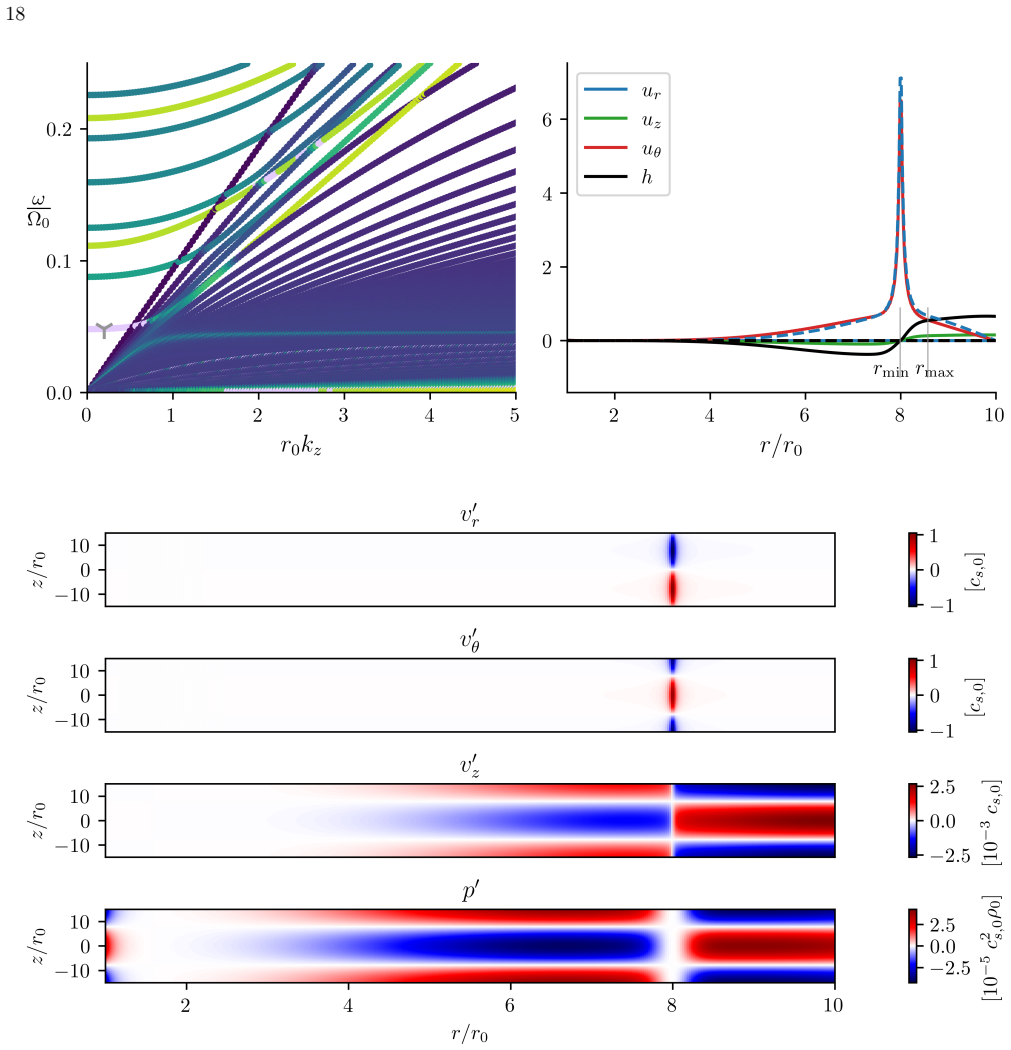
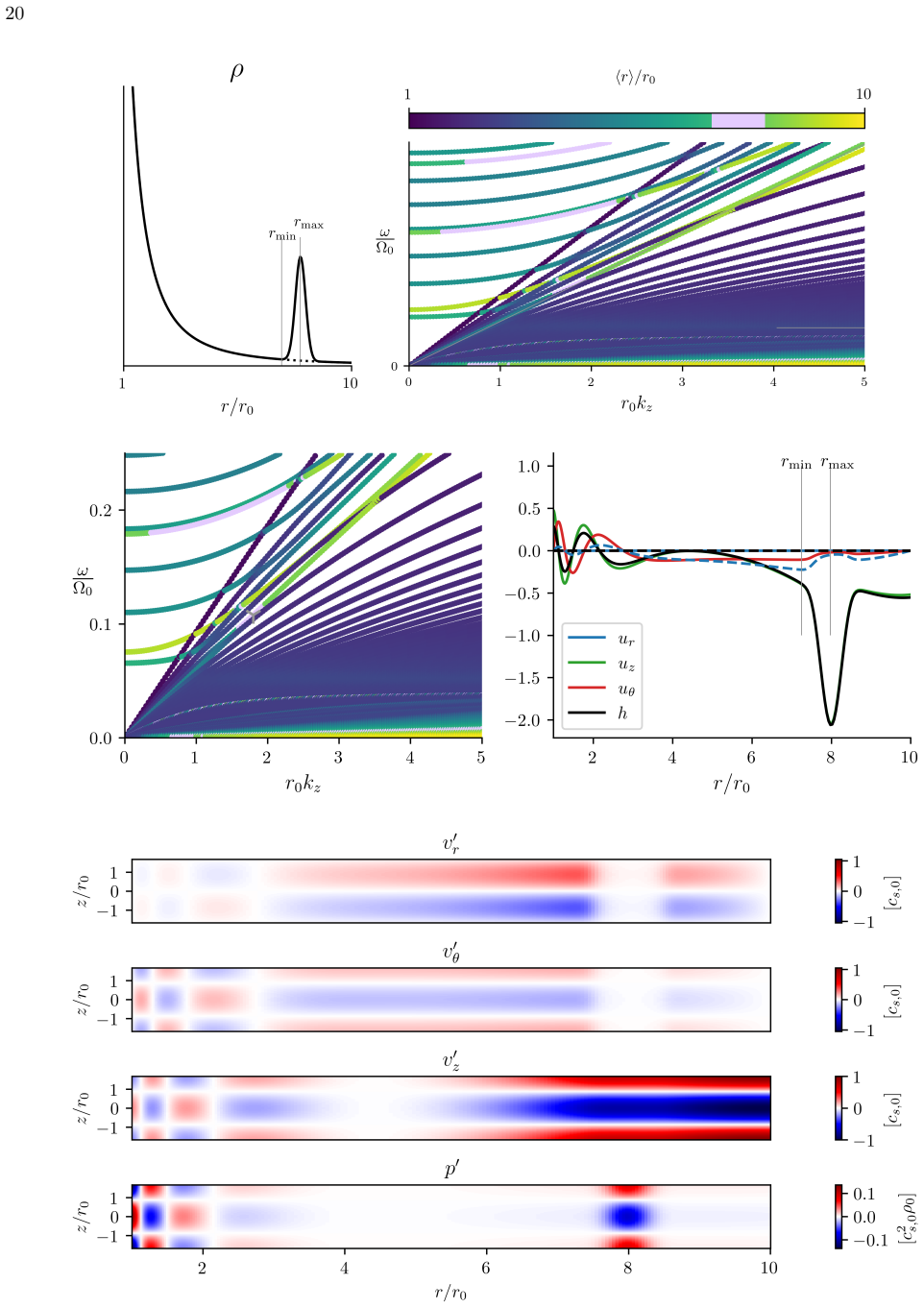
Pressure extrema consist of wave guides in which topological modes propagate. The fundamental mode trapped at a pressure bump can propagate at all frequencies, allowing it to resonate with any temporal forcing, while the mode associated with a pressure gap propagates at a fixed frequency with arbitrary vertical phase velocity. These features follow from a generalised local dispersion relation that includes pressure gradients and reveals the role of an epicyclic-acoustic frequency in setting mode branches.
What carries the argument
Generalised local dispersion relation from the wave topology framework that includes pressure gradients and an epicyclic-acoustic frequency to determine propagating mode branches.
If this is right
- The fundamental mode at pressure bumps can resonate with any temporal forcing.
- The mode at pressure gaps propagates at one fixed frequency but with arbitrary vertical phase velocity.
- Pressure extrema function as waveguides that trap these topological radial modes.
- These modes provide specific signatures useful for discoseismology.
Where Pith is reading between the lines
- Signatures of these modes in disc observations could allow mapping of unseen pressure structures.
- The wave topology approach could be tested on other stratified rotating flows such as stellar interiors.
- Adding dust or magnetic fields to the model would reveal whether the waveguide property survives in more complete disc descriptions.
Load-bearing premise
The local dispersion relation derived from wave topology accurately describes the radial modes without major contributions from global curvature, nonlinear effects or vertical structure details omitted from the approximation.
What would settle it
Detection of radial oscillations at pressure bumps that either show propagation at every frequency or fail to do so across a range of observed forcing frequencies in protoplanetary discs.
Figures



read the original abstract
This study investigates the signatures of pressure extrema on global oscillations in discs. To this end, we use the framework of wave topology to establish a generalised local dispersion relation that includes pressure gradients. We highlight the influence of a previously unrecognized epicyclic-acoustic frequency and derive an analytical criterion for the existence of a branch of modes transiting between the inertial and the pressure bands. We find that pressure extrema consist of wave guides in which such topological modes propagate. The fundamental mode trapped at a pressure bump can propagate at all frequencies, allowing it to resonate with any temporal forcing, while the mode associated with a pressure gap propagates at a fixed frequency, propagates with arbitrary vertical phase velocity. These specific features make them attractive candidates for future discoseismology.
Editorial analysis
A structured set of objections, weighed in public.
Referee Report
Summary. The manuscript investigates signatures of pressure extrema on global oscillations in astrophysical discs. Using the wave topology framework, it derives a generalized local dispersion relation that incorporates pressure gradients and identifies a previously unrecognized epicyclic-acoustic frequency. An analytical criterion is obtained for the existence of a branch of modes transiting between inertial and pressure bands. The central claim is that pressure extrema function as waveguides for topological radial modes: the fundamental mode trapped at a pressure bump propagates at all frequencies (allowing resonance with arbitrary temporal forcing), while the mode associated with a pressure gap propagates at a fixed frequency with arbitrary vertical phase velocity. These properties are presented as attractive for future discoseismology applications.
Significance. If the local approximation is valid, the work supplies an analytical, parameter-free framework for mode trapping at disc pressure structures that could unify aspects of inertial and acoustic oscillations. The identification of all-frequency propagation at bumps and the fixed-frequency gap mode offers concrete, falsifiable predictions for discoseismology. The derivation of the branch-transit criterion from wave topology is a clear strength when the underlying assumptions hold.
major comments (2)
- [Dispersion relation and branch-transit criterion] The generalized local dispersion relation (derived in the section introducing the epicyclic-acoustic frequency and the branch-transit criterion) assumes a locally uniform background. Pressure bumps and dips are radially extended global features; when the mode radial wavelength becomes comparable to the extremum width, omitted global curvature terms (radial derivatives of the epicyclic frequency and non-WKB corrections) can alter the allowed frequency bands and the claimed 'all frequencies' or 'fixed frequency' behaviour. This assumption is load-bearing for the waveguide interpretation.
- [Waveguide properties and mode propagation] No explicit verification is provided that global radial structure or vertical details neglected in the local approximation remain negligible inside the waveguide (e.g., via comparison to a global numerical solution or WKB validity estimate). This directly affects the central claim that pressure extrema consist of waveguides with the stated propagation properties.
minor comments (2)
- [Notation and definitions] The notation for the epicyclic-acoustic frequency should be introduced with an explicit equation and contrasted with the standard epicyclic frequency to prevent reader confusion.
- [Figures] Dispersion-relation figures would benefit from explicit shading or labels distinguishing the inertial, pressure, and transiting branches.
Simulated Author's Rebuttal
We thank the referee for their detailed and constructive report. The comments raise important points about the limitations of the local approximation used in our analysis, which we address below. We have revised the manuscript to incorporate clarifications on the validity regime of our results.
read point-by-point responses
-
Referee: The generalized local dispersion relation (derived in the section introducing the epicyclic-acoustic frequency and the branch-transit criterion) assumes a locally uniform background. Pressure bumps and dips are radially extended global features; when the mode radial wavelength becomes comparable to the extremum width, omitted global curvature terms (radial derivatives of the epicyclic frequency and non-WKB corrections) can alter the allowed frequency bands and the claimed 'all frequencies' or 'fixed frequency' behaviour. This assumption is load-bearing for the waveguide interpretation.
Authors: We agree that our generalized local dispersion relation relies on the assumption of a locally uniform background, which is standard in WKB analyses but breaks down when the radial wavelength of the mode approaches the radial width of the pressure extremum. In such cases, global curvature terms and non-WKB effects could indeed modify the frequency bands and propagation properties. Our central claims regarding the waveguide behavior are intended to apply in the regime where the local approximation holds, i.e., for modes with radial wavelengths shorter than the scale of the pressure structures. To address this, we will add a dedicated subsection in the discussion clarifying the conditions under which the local approximation is valid and noting the potential impact of global effects when this condition is violated. revision: yes
-
Referee: No explicit verification is provided that global radial structure or vertical details neglected in the local approximation remain negligible inside the waveguide (e.g., via comparison to a global numerical solution or WKB validity estimate). This directly affects the central claim that pressure extrema consist of waveguides with the stated propagation properties.
Authors: We acknowledge the value of explicit verification for the applicability of the local results. Our manuscript provides an analytical framework and includes basic WKB validity estimates based on the derived dispersion relation. However, a direct comparison with global numerical solutions is not included, as the focus is on the topological and analytical aspects. We will expand the text to provide a more quantitative estimate of the WKB parameter (e.g., the ratio of wavelength to extremum width) under which the waveguide properties hold, and discuss how vertical structure effects are expected to be secondary for the radial modes considered. A full numerical validation would be a natural extension for future work. revision: partial
Circularity Check
No circularity: derivation applies external wave topology framework to disc equations
full rationale
The paper derives a generalised local dispersion relation by applying the wave topology framework to the standard equations of disc dynamics with pressure gradients included. The analytical criterion for branch transit between inertial and pressure bands, and the subsequent identification of pressure extrema as waveguides with specific propagation properties (all frequencies for bumps, fixed frequency for gaps), are direct consequences of this relation rather than inputs redefined as outputs. No self-citations, fitted parameters, or ansatzes are invoked in a load-bearing way that reduces the central claims to the paper's own assumptions by construction. The derivation remains self-contained against the external wave topology framework and standard disc equations.
Axiom & Free-Parameter Ledger
axioms (1)
- domain assumption Wave topology framework can be extended to include pressure gradients in the local dispersion relation for disc oscillations.
Lean theorems connected to this paper
-
IndisputableMonolith/Foundation/AlexanderDuality.leanalexander_duality_circle_linking unclear?
unclearRelation between the paper passage and the cited Recognition theorem.
We use the framework of wave topology to establish a generalised local dispersion relation that includes pressure gradients... Chern numbers C=±1... spectral flow... modes transiting between the inertial and the pressure bands... pressure extrema consist of wave guides
What do these tags mean?
- matches
- The paper's claim is directly supported by a theorem in the formal canon.
- supports
- The theorem supports part of the paper's argument, but the paper may add assumptions or extra steps.
- extends
- The paper goes beyond the formal theorem; the theorem is a base layer rather than the whole result.
- uses
- The paper appears to rely on the theorem as machinery.
- contradicts
- The paper's claim conflicts with a theorem or certificate in the canon.
- unclear
- Pith found a possible connection, but the passage is too broad, indirect, or ambiguous to say the theorem truly supports the claim.
Reference graph
Works this paper leans on
-
[1]
https://doi.org/10.1093/mnras/136.3.293. JCB Papaloizou and JE Pringle. The dynamical stability of differentially rotating discs–ii.Monthly Notices of the Royal Astronomical Society, 213(4):799–820, 1985. C. C. Lin and Frank H. Shu. On the Spiral Structure of Disk Galaxies, II. Outline of a Theory of Density Waves. Proceedings of the National Academy of S...
-
[2]
Peter Goldreich and Scott Tremaine
https://doi.org/10.1093/mnras/108.3.214. Peter Goldreich and Scott Tremaine. The excitation and evolution of density waves.Astrophysical Journal, 222 (1):850–858, 1978. Peter Goldreich and Scott Tremaine. The excitation of density waves at the lindblad and corotation resonances by an external potential.Astrophysical Journal, 233(3): 857–871, 1979. S. H. L...
-
[3]
https://doi.org/10.1093/mnras/272.3.618
ISSN 0035-8711. https://doi.org/10.1093/mnras/272.3.618. G.I. Ogilvie. Waves and instabilities in a differentially rotating disc containing a poloidal magnetic field. Monthly Notices of the Royal Astronomical Society, 297 (1):291–314, June 1998. ISSN 0035-8711. https://doi.org/10.1046/j.1365-8711.1998.01507.x. Steven A Balbus and John F Hawley. Instabilit...
-
[4]
Armand Leclerc, Guillaume Laibe, and Nicolas Perez
https://doi.org/10.3847/2041-8213/ade396. Armand Leclerc, Guillaume Laibe, and Nicolas Perez. Wave topology of stellar inertial oscillations.Physical Review Research, 6(4):043299, December 2024b. https://doi.org/10.1103/PhysRevResearch.6.043299. Stefan Keppeler. Introduction to wigner-weyl calculus,
-
[5]
Brian C Hall.Quantum theory for mathematicians
URL https://www.math.uni-tuebingen.de/user/ stke/teaching/wigner weyl. Brian C Hall.Quantum theory for mathematicians. Springer, 2013. 13 Yohei Onuki. Quasi-local method of wave decomposition in a slowly varying medium.Journal of Fluid Mechanics, 883:A56, 2020. J´ er´ emie Vidal and Yves Colin de Verdi` ere. Inertia-gravity waves in geophysical vortices, ...
-
[6]
https://doi.org/10.1111/j.1365-2966.2008.13207.x. Janosz W. Dewberry, Henrik N. Latter, and Gordon I. Ogilvie. Quasi-periodic oscillations and the global modes of relativistic, MHD accretion discs.MNRAS, 476(3): 4085–4103, May 2018. https://doi.org/10.1093/mnras/sty385. Benoˆ ıt Commer¸ con, Francesco Lovascio, Elliot Lynch, and Enrico Ragusa. Discs are b...
discussion (0)
Sign in with ORCID, Apple, or X to comment. Anyone can read and Pith papers without signing in.