Recognition: 2 theorem links
· Lean TheoremHoloNet: Toward a Unified Einstein-Maxwell-Dilaton Framework of QCD
Pith reviewed 2026-05-17 01:45 UTC · model grok-4.3
The pith
A neural network learns the holographic metric and coupling from zero-density lattice QCD data and then extends the description to finite density to map the phase diagram.
A machine-rendered reading of the paper's core claim, the machinery that carries it, and where it could break.
Core claim
HoloNet learns the metric profile A(z) and the gauge-dilaton coupling f(z) directly from lattice QCD data at μ=0. These functions are substituted into the Einstein-Maxwell-Dilaton equations to recover the lattice thermodynamics at zero density. The same embedding then yields predictions at finite density, including the location of the critical end point, while the derived potential and coupling remain consistent with holographic renormalization results.
What carries the argument
HoloNet, the neural-network pipeline that extracts the metric profile A(z) and coupling f(z) from zero-density lattice data and inserts them into the Einstein-Maxwell-Dilaton equations.
If this is right
- The trained model reproduces the lattice equation of state and baryon number fluctuations at zero density with high fidelity.
- The same functions allow direct extension to finite chemical potential, where lattice methods are limited by the sign problem.
- The framework produces a map of the QCD phase diagram and an estimate for the location of the critical end point.
- The reconstructed potential V(φ) and coupling f(φ) agree quantitatively with results from holographic renormalization.
Where Pith is reading between the lines
- The method could be retrained on additional lattice observables such as susceptibilities or correlation functions to further constrain the bulk geometry.
- Similar data-driven extraction might be applied to other gauge theories where holographic duals are conjectured but functional forms are unknown.
- Direct comparison with small-μ lattice data could reveal whether the learned functions require explicit density dependence.
Load-bearing premise
The metric profile and coupling learned exclusively from zero-density lattice data remain the correct functions to use in the Einstein-Maxwell-Dilaton equations once a nonzero chemical potential is introduced.
What would settle it
If independent calculations or future lattice results at small but nonzero chemical potential show that the predicted critical end point location or equation of state deviates significantly from the HoloNet extrapolation, the assumption that no density-dependent corrections are needed would be falsified.
Figures


read the original abstract
We propose HoloNet, a neural-network framework that unifies lattice QCD(LQCD) thermodynamics and holographic Einstein-Maxwell-Dilaton (EMD) theory within a data-to-holography pipeline. Instead of assuming specific functional forms, HoloNet learns the metric profile $A(z)$ and the gauge-dilaton coupling $f(z)$ directly from 2+1-flavor LQCD data at $\mu=0$. These learned functions are embedded into the EMD equations, enabling the model to reproduce the lattice equation of state and baryon number fluctuations with high fidelity. Once trained, HoloNet provides a fully data-driven holographic description of QCD that extends naturally to finite density, allowing us to map the phase diagram and estimate the location of the critical end point (CEP). The reconstructed potential $V(\phi)$ and coupling $f(\phi)$ agree quantitatively with those obtained from holographic renormalization, demonstrating that HoloNet can consistently bridge different holographic models.
Editorial analysis
A structured set of objections, weighed in public.
Referee Report
Summary. The manuscript introduces HoloNet, a neural-network framework that learns the metric profile A(z) and gauge-dilaton coupling f(z) directly from 2+1-flavor lattice QCD data at μ=0 without assuming specific functional forms. These functions are embedded into the Einstein-Maxwell-Dilaton equations to reproduce the lattice equation of state and baryon number fluctuations at zero density with claimed high fidelity. The trained model is then extended to finite chemical potential to map the QCD phase diagram and estimate the location of the critical end point, with reconstructed V(φ) and f(φ) shown to agree quantitatively with holographic renormalization results.
Significance. If the central extrapolation holds, the work could provide a useful data-driven bridge between lattice QCD and holographic EMD models, enabling finite-density predictions where direct lattice methods face the sign problem. The avoidance of ad-hoc functional forms for potentials and the quantitative μ=0 reproduction are positive features. However, the significance is tempered by the lack of independent validation for the finite-μ regime, which risks making the CEP estimate an uncontrolled continuation of the zero-density fit rather than a robust prediction.
major comments (3)
- [Finite-density extension and results] The central finite-density claim (phase diagram mapping and CEP location) rests on inserting A(z) and f(z) learned exclusively from μ=0 data into the full EMD equations with nonzero chemical potential boundary conditions. No test, constraint, or justification is provided that these functions acquire no density-dependent corrections; this assumption is load-bearing and unverified.
- [Abstract and μ=0 reproduction section] The abstract states high-fidelity reproduction of the equation of state and fluctuations at μ=0, yet supplies no quantitative error bars, cross-validation statistics, or explicit checks on whether the zero-density functions remain valid when μ is switched on. This weakens confidence in the subsequent extrapolation.
- [Potential reconstruction] The reconstruction of V(φ) and f(φ) is reported to agree quantitatively with holographic renormalization, but it is unclear from the training procedure how the neural-network outputs for A(z) and f(z) are converted to these potentials and whether this agreement independently supports the finite-μ predictions.
minor comments (2)
- Clarify the neural-network architecture with an explicit diagram or layer equations to aid reproducibility.
- [Training procedure] Specify the exact lattice data sets employed (temperature range, number of configurations, action details) in the training description.
Simulated Author's Rebuttal
We thank the referee for the careful reading and constructive comments on our manuscript. We address each major comment below and have revised the manuscript to strengthen the presentation and clarify key assumptions.
read point-by-point responses
-
Referee: [Finite-density extension and results] The central finite-density claim (phase diagram mapping and CEP location) rests on inserting A(z) and f(z) learned exclusively from μ=0 data into the full EMD equations with nonzero chemical potential boundary conditions. No test, constraint, or justification is provided that these functions acquire no density-dependent corrections; this assumption is load-bearing and unverified.
Authors: We appreciate the referee highlighting this foundational assumption. Within the EMD holographic framework, A(z) and f(z) encode the dual description of the QCD vacuum structure as determined by μ=0 lattice data; finite-density effects enter solely through the Maxwell boundary conditions while the bulk functions remain fixed, consistent with standard practice in holographic QCD models. Direct validation at finite μ is precluded by the sign problem, but we have added a new discussion paragraph explaining this rationale, referencing analogous extrapolations in the EMD literature, and explicitly noting the assumption as a model limitation. revision: yes
-
Referee: [Abstract and μ=0 reproduction section] The abstract states high-fidelity reproduction of the equation of state and fluctuations at μ=0, yet supplies no quantitative error bars, cross-validation statistics, or explicit checks on whether the zero-density functions remain valid when μ is switched on. This weakens confidence in the subsequent extrapolation.
Authors: We agree that quantitative metrics improve transparency. The revised manuscript now reports explicit reproduction accuracies (typically within 1–3% for thermodynamic quantities and susceptibilities), includes error bands on all μ=0 comparison figures, and adds a validation subsection with cross-validation results across lattice ensembles. We also demonstrate that the learned functions produce stable results for small nonzero μ before the full extrapolation. revision: yes
-
Referee: [Potential reconstruction] The reconstruction of V(φ) and f(φ) is reported to agree quantitatively with holographic renormalization, but it is unclear from the training procedure how the neural-network outputs for A(z) and f(z) are converted to these potentials and whether this agreement independently supports the finite-μ predictions.
Authors: We thank the referee for noting the need for procedural clarity. We have expanded the methods section and added an appendix that details the conversion: the NN outputs A(z) and f(z) are inserted into the EMD equations and solved via holographic renormalization to obtain V(φ) and the φ-dependent coupling. This quantitative agreement validates that HoloNet recovers standard holographic potentials from data without ad-hoc assumptions. While it does not constitute independent finite-μ validation, it confirms internal consistency of the zero-density training and thereby lends support to the overall framework. revision: partial
Circularity Check
No significant circularity in derivation chain
full rationale
The paper trains HoloNet exclusively on μ=0 LQCD data to determine A(z) and f(z), then inserts these functions into the EMD equations. Reproduction of zero-density thermodynamics and fluctuations occurs by construction as a fit. However, the finite-density extension (phase diagram, CEP location) is not equivalent to the inputs by construction; it rests on the explicit assumption that A(z) and f(z) carry no additional μ dependence. This assumption is externally falsifiable by future nonzero-density lattice data or other holographic models and does not reduce any claimed prediction to a renaming or re-use of the training set. No self-definitional equations, load-bearing self-citations, or uniqueness theorems imported from the same authors appear in the abstract or described pipeline. The derivation therefore remains self-contained against external benchmarks.
Axiom & Free-Parameter Ledger
free parameters (1)
- Neural-network weights and architecture hyperparameters
axioms (1)
- domain assumption The Einstein-Maxwell-Dilaton action in five dimensions correctly encodes the thermodynamics of 2+1-flavor QCD.
Lean theorems connected to this paper
-
IndisputableMonolith/Cost/FunctionalEquation.leanwashburn_uniqueness_aczel echoes?
echoesECHOES: this paper passage has the same mathematical shape or conceptual pattern as the Recognition theorem, but is not a direct formal dependency.
HoloNet learns the metric profile A(z) and the gauge-dilaton coupling f(z) directly from 2+1-flavor LQCD data at μ=0. These learned functions are embedded into the EMD equations... reconstructed potential V(ϕ) and coupling f(ϕ) agree quantitatively with those obtained from holographic renormalization.
-
IndisputableMonolith/Foundation/AlphaCoordinateFixation.leancostAlphaLog_high_calibrated_iff echoes?
echoesECHOES: this paper passage has the same mathematical shape or conceptual pattern as the Recognition theorem, but is not a direct formal dependency.
V(ϕ) = −12 cosh(c1 ϕ) + c2 ϕ², f(ϕ) = c3 sech(c4(ϕ + c5)³)
What do these tags mean?
- matches
- The paper's claim is directly supported by a theorem in the formal canon.
- supports
- The theorem supports part of the paper's argument, but the paper may add assumptions or extra steps.
- extends
- The paper goes beyond the formal theorem; the theorem is a base layer rather than the whole result.
- uses
- The paper appears to rely on the theorem as machinery.
- contradicts
- The paper's claim conflicts with a theorem or certificate in the canon.
- unclear
- Pith found a possible connection, but the passage is too broad, indirect, or ambiguous to say the theorem truly supports the claim.
Reference graph
Works this paper leans on
-
[1]
The sub-networks dy- namically generate the layer-wise values of A(z) and f (z)
Self-adaptive optimization . The sub-networks dy- namically generate the layer-wise values of A(z) and f (z). Previous approaches [64] treat these values as direct pa- rameters of the global network, reconstructing the geom- etry through their optimization. By contrast, our model computes them on the fly through explicit neural net- works. Although seeming...
-
[2]
062182, a3 = 0 . 21002, a4 = 0 . 020314, f1 = 0 . 31197, f2 = 0. 079030, f3 = 0. 34070. The analytic and neural-network results agree very well, with the analytic curves shown in black in Figs. 2, 6, 7, and 8. In the temperature range 130–400 MeV, the maximal relative discrepancies between the neural- network reconstruction and the LQCD data are of order ...
-
[3]
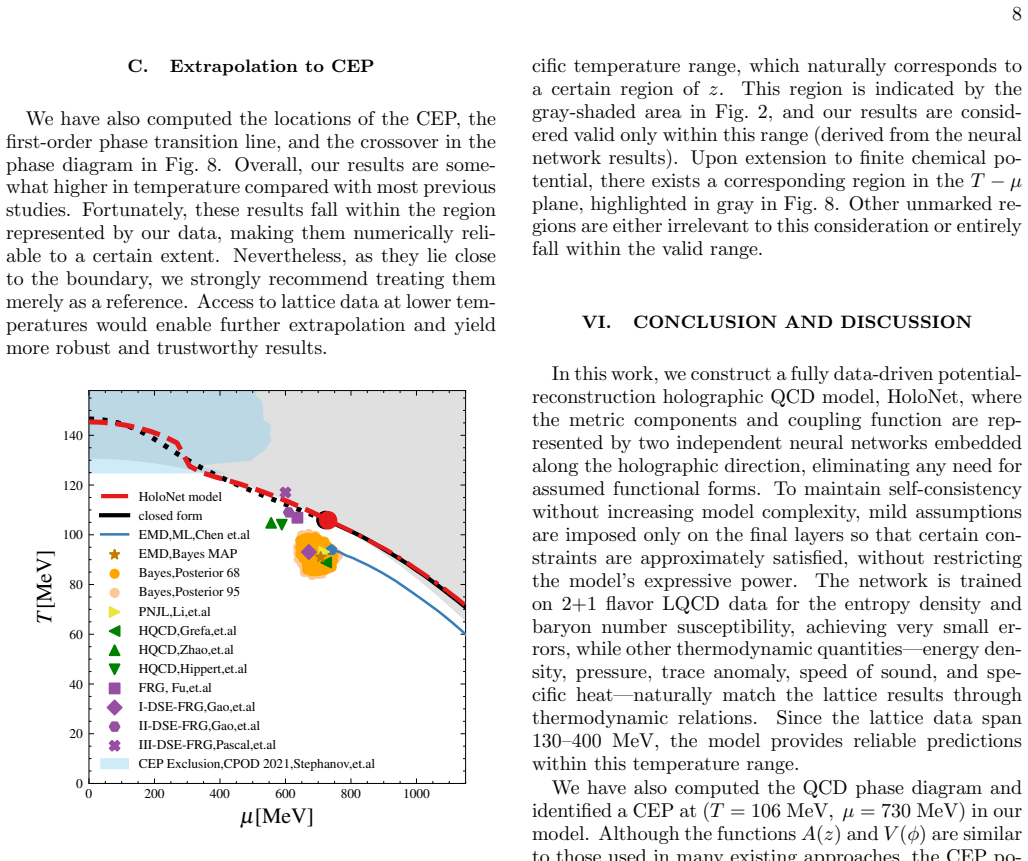
061371, c5 = 0. 35482. 8 C. Extrapolation to CEP We have also computed the locations of the CEP, the first-order phase transition line, and the crossover in the phase diagram in Fig. 8. Overall, our results are some- what higher in temperature compared with most previous studies. Fortunately, these results fall within the region represented by our data, ma...
work page 2021
-
[4]
Christian Schmidt and Sayantan Sharma. The phase structure of qcd. Journal of Physics G: Nuclear and Particle Physics, 44(10):104002, 2017
work page 2017
-
[5]
Higher moments of net proton multiplicity distributions at rhic
MM Aggarwal, Z Ahammed, A V Alakhverdyants, I Alekseev, J Alford, BD Anderson, D Arkhipkin, GS Averichev, J Balewski, LS Barnby, et al. Higher moments of net proton multiplicity distributions at rhic. Physical review letters, 105(2):022302, 2010
work page 2010
-
[6]
MM Aggarwal, Z Ahammed, A V Alakhverdyants, I Alek- seev, BD Anderson, D Arkhipkin, GS Averichev, J Balewski, LS Barnby, S Baumgart, et al. An experi- mental exploration of the qcd phase diagram: the search for the critical point and the onset of de-confinement. arXiv preprint arXiv:1007.2613, 2010
work page internal anchor Pith review Pith/arXiv arXiv 2010
-
[7]
Energy dependence of moments of net-proton multiplicity distributions at rhic
L Adamczyk, JK Adkins, G Agakishiev, MM Aggarwal, Z Ahammed, I Alekseev, J Alford, CD Anson, A Aparin, D Arkhipkin, et al. Energy dependence of moments of net-proton multiplicity distributions at rhic. Physical Review Letters, 112(3):032302, 2014
work page 2014
-
[8]
Xiaofeng Luo and Nu Xu. Search for the qcd critical point with fluctuations of conserved quantities in relativistic heavy-ion collisions at rhic: an overview. Nuclear Science and Techniques, 28(8):112, 2017
work page 2017
-
[9]
Nonmonotonic energy dependence of net-proton number fluctuations
Jaroslav Adam, L Adamczyk, JR Adams, JK Adkins, G Agakishiev, MM Aggarwal, Z Ahammed, I Alekseev, DM Anderson, A Aparin, et al. Nonmonotonic energy dependence of net-proton number fluctuations. Physical review letters, 126(9):092301, 2021
work page 2021
-
[10]
Mohamed Samy Abdallah, BE Aboona, Jaroslav Adam, Leszek Adamczyk, Joseph R Adams, J Kevin Ad- kins, Ishu Aggarwal, Madan Mohan Aggarwal, Zubayer Ahammed, Derek M Anderson, et al. Higher-order cu- mulants and correlation functions of proton multiplicity distributions in s nn= 3 gev au+ au collisions at the rhic star experiment. Physical Review C, 107(2):02...
work page 2023
-
[11]
The QCD equation of state from the lattice
Owe Philipsen. The QCD equation of state from the lattice. Prog. Part. Nucl. Phys., 70:55–107, 2013
work page 2013
-
[12]
The qcd equation of state from the lat- tice
Owe Philipsen. The qcd equation of state from the lat- tice. Progress in Particle and Nuclear Physics, 70:55–107, 2013
work page 2013
-
[13]
Introductory lectures on lattice QCD at nonzero baryon number
Gert Aarts. Introductory lectures on lattice QCD at nonzero baryon number. J. Phys. Conf. Ser., 706(2):022004, 2016
work page 2016
-
[14]
Finite-density lattice QCD and sign problem: Current status and open problems
Keitaro Nagata. Finite-density lattice QCD and sign problem: Current status and open problems. Prog. Part. Nucl. Phys., 127:103991, 2022
work page 2022
-
[15]
Qcd phase structure at finite temperature and density
Wei-jie Fu, Jan M Pawlowski, and Fabian Rennecke. Qcd phase structure at finite temperature and density. Physical Review D, 101(5):054032, 2020
work page 2020
-
[16]
Func- tional renormalization group study of the quark-meson model with ω meson
Hui Zhang, Defu Hou, Toru Kojo, and Bin Qin. Func- tional renormalization group study of the quark-meson model with ω meson. Physical Review D, 96(11):114029, 2017
work page 2017
-
[17]
Qcd phase transitions via a re- fined truncation of dyson-schwinger equations
Fei Gao and Yu-xin Liu. Qcd phase transitions via a re- fined truncation of dyson-schwinger equations. Physical Review D, 94(7):076009, 2016
work page 2016
-
[18]
Phase diagram and critical end point for strongly interacting quarks
Si-xue Qin, Lei Chang, Huan Chen, Yu-xin Liu, and Craig D Roberts. Phase diagram and critical end point for strongly interacting quarks. Physical Review Letters, 106(17):172301, 2011
work page 2011
-
[19]
Locate qcd critical end point in a con- tinuum model study
Chao Shi, Yong-long Wang, Yu Jiang, Zhu-fang Cui, and Hong-Shi Zong. Locate qcd critical end point in a con- tinuum model study. Journal of High Energy Physics, 2014(7):1–10, 2014
work page 2014
-
[20]
Phase structure of three and four flavor qcd
Christian S Fischer, Jan Luecker, and Christian A Welzbacher. Phase structure of three and four flavor qcd. Physical Review D, 90(3):034022, 2014. 10
work page 2014
-
[21]
MA Halasz, AD Jackson, RE Shrock, Misha A Stephanov, and JJM Verbaarschot. Phase diagram of qcd. Physical Review D, 58(9):096007, 1998
work page 1998
-
[22]
Dynamical model of elementary particles based on an analogy with superconductivity
Yoichiro Nambu and Giovanni Jona-Lasinio. Dynamical model of elementary particles based on an analogy with superconductivity. i. Physical review, 122(1):345, 1961
work page 1961
-
[23]
Splitting of chiral and deconfinement phase transitions induced by rotation
Fei Sun, Kun Xu, and Mei Huang. Splitting of chiral and deconfinement phase transitions induced by rotation. Physical Review D, 108(9):096007, 2023
work page 2023
-
[24]
Zhibin Li, Kun Xu, Xinyang Wang, and Mei Huang. The kurtosis of net baryon number fluctuations from a realis- tic polyakov–nambu–jona-lasinio model along the exper- imental freeze-out line. The European Physical Journal C, 79(3):245, 2019
work page 2019
-
[25]
Qcd phase diagram at finite baryon and isospin chemical potentials
Takahiro Sasaki, Yuji Sakai, Hiroaki Kouno, and Masanobu Yahiro. Qcd phase diagram at finite baryon and isospin chemical potentials. Physical Review D—Particles, Fields, Gravitation, and Cosmology, 82(11):116004, 2010
work page 2010
-
[26]
Quarkyonic matter and chiral symmetry breaking
Larry McLerran, Krzysztof Redlich, and Chihiro Sasaki. Quarkyonic matter and chiral symmetry breaking. Nuclear Physics A, 824(1-4):86–100, 2009
work page 2009
-
[27]
The large-n limit of superconformal field theories and supergravity
Juan Maldacena. The large-n limit of superconformal field theories and supergravity. International journal of theoretical physics, 38(4):1113–1133, 1999
work page 1999
-
[28]
Anti De Sitter Space And Holography
Edward Witten. Anti de sitter space and holography. arXiv preprint hep-th/9802150, 1998
work page internal anchor Pith review Pith/arXiv arXiv 1998
-
[29]
Gauge theory correlators from non-critical string theory
Steven S Gubser, Igor R Klebanov, and Alexander M Polyakov. Gauge theory correlators from non-critical string theory. Physics Letters B, 428(1-2):105–114, 1998
work page 1998
-
[30]
Large n field theories, string theory and gravity
Ofer Aharony, Steven S Gubser, Juan Maldacena, Hi- rosi Ooguri, and Yaron Oz. Large n field theories, string theory and gravity. Physics Reports, 323(3-4):183–386, 2000
work page 2000
-
[31]
Qcd and a holographic model of hadrons
Joshua Erlich, Emanuel Katz, Dam T Son, and Mikhail A Stephanov. Qcd and a holographic model of hadrons. Physical review letters, 95(26):261602, 2005
work page 2005
-
[32]
Andreas Karch, Emanuel Katz, Dam T Son, and Mikhail A Stephanov. Linear confinement and ads/qcd. Physical Review D—Particles, Fields, Gravitation, and Cosmology, 74(1):015005, 2006
work page 2006
-
[33]
Holo- graphic qcd in the veneziano limit at a finite magnetic field and chemical potential
Umut G¨ ursoy, Matti J¨ arvinen, and Govert Nijs. Holo- graphic qcd in the veneziano limit at a finite magnetic field and chemical potential. Physical Review Letters, 120(24):242002, 2018
work page 2018
-
[34]
Neu- ral ordinary differential equations for mapping the mag- netic qcd phase diagram via holography
Rong-Gen Cai, Song He, Li Li, and Hong-An Zeng. Neu- ral ordinary differential equations for mapping the mag- netic qcd phase diagram via holography. arXiv preprint arXiv:2406.12772, 2024
-
[35]
Oliver DeWolfe, Steven S Gubser, and Christopher Rosen. A holographic critical point. Physical Review D—Particles, Fields, Gravitation, and Cosmology, 83(8):086005, 2011
work page 2011
-
[36]
Mimicking the qcd equation of state with a dual black hole
Steven S Gubser and Abhinav Nellore. Mimicking the qcd equation of state with a dual black hole. Physical Review D—Particles, Fields, Gravitation, and Cosmology, 78(8):086007, 2008
work page 2008
-
[37]
Hot and dense quark-gluon plasma thermo- dynamics from holographic black holes
Joaquin Grefa, Jorge Noronha, Jacquelyn Noronha- Hostler, Israel Portillo, Claudia Ratti, and Romulo Rougemont. Hot and dense quark-gluon plasma thermo- dynamics from holographic black holes. Physical Review D, 104(3):034002, 2021
work page 2021
-
[38]
Gravitational waves and primordial black hole produc- tions from gluodynamics by holography
Song He, Li Li, Zhibin Li, and Shao-Jiang Wang. Gravitational waves and primordial black hole produc- tions from gluodynamics by holography. Science China Physics, Mechanics & Astronomy, 67(4):240411, 2024
work page 2024
-
[39]
Probing qcd critical point and induced gravitational wave by black hole physics
Rong-Gen Cai, Song He, Li Li, and Yuan-Xu Wang. Probing qcd critical point and induced gravitational wave by black hole physics. Physical Review D, 106(12):L121902, 2022
work page 2022
-
[40]
Holographic entanglement properties in the qcd phase diagram from einstein-maxwell-dilaton models
Zhibin Li. Holographic entanglement properties in the qcd phase diagram from einstein-maxwell-dilaton models. Physical Review D, 110(4):046012, 2024
work page 2024
-
[41]
Revisiting holographic model for thermal and dense qcd with a crit- ical point
Qingxuan Fu, Song He, Li Li, and Zhibin Li. Revisiting holographic model for thermal and dense qcd with a crit- ical point. Journal of High Energy Physics, 2025(6):1–19, 2025
work page 2025
-
[42]
A Refined Holographic QCD Model and QCD Phase Structure
Yi Yang and Pei-Hung Yuan. A Refined Holographic QCD Model and QCD Phase Structure. JHEP, 11:149, 2014
work page 2014
-
[43]
Confinement- deconfinement phase transition for heavy quarks in a soft wall holographic qcd model
Yi Yang and Pei-Hung Yuan. Confinement- deconfinement phase transition for heavy quarks in a soft wall holographic qcd model. Journal of High Energy Physics, 2015(12):1–22, 2015
work page 2015
-
[44]
David Dudal and Subhash Mahapatra. Thermal entropy of a quark-antiquark pair above and below deconfine- ment from a dynamical holographic qcd model. Physical Review D, 96(12):126010, 2017
work page 2017
-
[45]
Chiral and de- confining phase transitions from holographic qcd study
Zhen Fang, Song He, and Danning Li. Chiral and de- confining phase transitions from holographic qcd study. Nuclear Physics B, 907:187–207, 2016
work page 2016
-
[46]
Danning Li, Song He, Mei Huang, and Qi-Shu Yan. Thermodynamics of deformed ads5 model with a pos- itive/negative quadratic correction in graviton-dilaton system. Journal of High Energy Physics, 2011(9):1–38, 2011
work page 2011
-
[47]
Criticality of qcd in a holographic qcd model with critical end point
Xun Chen, Danning Li, and Mei Huang. Criticality of qcd in a holographic qcd model with critical end point. Chinese Physics C, 43(2):023105, 2019
work page 2019
-
[48]
Gluodynamics and deconfinement phase transi- tion under rotation from holography
Xun Chen, Lin Zhang, Danning Li, Defu Hou, and Mei Huang. Gluodynamics and deconfinement phase transi- tion under rotation from holography. Journal of High Energy Physics, 2021(7):1–28, 2021
work page 2021
-
[49]
Thermodynamics of heavy quarkonium in a magnetic field background
Jing Zhou, Xun Chen, Yan-Qing Zhao, and Jialun Ping. Thermodynamics of heavy quarkonium in a magnetic field background. Physical Review D, 102(8):086020, 2020
work page 2020
-
[50]
Machine learning holographic black hole from lattice qcd equation of state
Xun Chen and Mei Huang. Machine learning holographic black hole from lattice qcd equation of state. Physical Review D, 109(5):L051902, 2024
work page 2024
-
[51]
The entanglement properties of holographic qcd model with a critical end point
Zhibin Li, Kun Xu, and Mei Huang. The entanglement properties of holographic qcd model with a critical end point. Chinese Physics C, 45(1):013116, 2021
work page 2021
-
[52]
Dynamical holographic qcd model for glueball and light meson spectra
Danning Li and Mei Huang. Dynamical holographic qcd model for glueball and light meson spectra. Journal of High Energy Physics, 2013(11):1–51, 2013
work page 2013
-
[53]
The dy- namical holographic qcd method for hadron physics and qcd matter
Yidian Chen, Danning Li, and Mei Huang. The dy- namical holographic qcd method for hadron physics and qcd matter. Communications in Theoretical Physics, 74(9):097201, 2022
work page 2022
-
[54]
Physics- driven learning for inverse problems in quantum chromo- dynamics
Gert Aarts, Kenji Fukushima, Tetsuo Hatsuda, Andreas Ipp, Shuzhe Shi, Lingxiao Wang, and Kai Zhou. Physics- driven learning for inverse problems in quantum chromo- dynamics. Nature Reviews Physics, 7(3):154–163, 2025
work page 2025
-
[55]
Ads/deep-learning made easy: sim- ple examples
Mugeon Song, Maverick SH Oh, Yongjun Ahn, and Keun-Young Kima. Ads/deep-learning made easy: sim- ple examples. Chinese Physics C, 45(7):073111, 2021. 11
work page 2021
-
[56]
Ads/deep- learning made easy ii: neural network-based approaches to holography and inverse problems
Hyun-Sik Jeong, Hanse Kim, Keun-Young Kim, Gaya Yun, Hyeonwoo Yu, and Kwan Yun. Ads/deep- learning made easy ii: neural network-based approaches to holography and inverse problems. arXiv preprint arXiv:2511.22522, 2025
-
[57]
Holographic reconstruction of black hole spacetime: machine learning and entanglement entropy
Byoungjoon Ahn, Hyun-Sik Jeong, Keun-Young Kim, and Kwan Yun. Holographic reconstruction of black hole spacetime: machine learning and entanglement entropy. Journal of High Energy Physics, 2025(1):1–41, 2025
work page 2025
-
[58]
Neural ordinary differential equations
Ricky TQ Chen, Yulia Rubanova, Jesse Bettencourt, and David K Duvenaud. Neural ordinary differential equations. Advances in neural information processing systems, 31, 2018
work page 2018
-
[59]
Data- driven einstein-dilaton model for pure yang-mills ther- modynamics and glueball spectrum
Xun Chen, Yidian Chen, and Kai Zhou. Data- driven einstein-dilaton model for pure yang-mills ther- modynamics and glueball spectrum. arXiv preprint arXiv:2507.06729, 2025
-
[60]
Koji Hashimoto, Koshiro Matsuo, Masaki Murata, Gakuto Ogiwara, and Daichi Takeda. Machine-learning emergent spacetime from linear response in future table- top quantum gravity experiments. Machine Learning: Science and Technology, 6(1):015030, 2025
work page 2025
-
[61]
Uni- fication of symmetries inside neural networks: trans- former, feedforward and neural ode
Koji Hashimoto, Yuji Hirono, and Akiyoshi Sannai. Uni- fication of symmetries inside neural networks: trans- former, feedforward and neural ode. Machine Learning: Science and Technology, 5(2):025079, 2024
work page 2024
-
[62]
Deep learning bulk spacetime from boundary optical conductivity
Byoungjoon Ahn, Hyun-Sik Jeong, Keun-Young Kim, and Kwan Yun. Deep learning bulk spacetime from boundary optical conductivity. Journal of High Energy Physics, 2024(3):1–30, 2024
work page 2024
-
[63]
Deep learning- based holography for t-linear resistivity
Byoungjoon Ahn, Hyun-Sik Jeong, Chang-Woo Ji, Keun-Young Kim, and Kwan Yun. Deep learning- based holography for t-linear resistivity. arXiv preprint arXiv:2502.10245, 2025
-
[64]
Neural ordinary differential equation and holographic quantum chromodynamics
Koji Hashimoto, Hong-Ye Hu, and Yi-Zhuang You. Neural ordinary differential equation and holographic quantum chromodynamics. Mach. Learn. Sci. Tech., 2(3):035011, 2021
work page 2021
-
[65]
Tetsuya Akutagawa, Koji Hashimoto, and Takayuki Sumimoto. Deep learning and ads/qcd. Physical Review D, 102(2):026020, 2020
work page 2020
-
[66]
Neu- ral ordinary differential equation and holographic quan- tum chromodynamics
Koji Hashimoto, Hong-Ye Hu, and Yi-Zhuang You. Neu- ral ordinary differential equation and holographic quan- tum chromodynamics. Machine Learning: Science and Technology, 2(3):035011, 2021
work page 2021
-
[67]
Deep learning and holographic qcd
Koji Hashimoto, Sotaro Sugishita, Akinori Tanaka, and Akio Tomiya. Deep learning and holographic qcd. Physical Review D, 98(10):106014, 2018
work page 2018
-
[68]
Deriving the dilaton potential in improved holo- graphic qcd from the meson spectrum
Koji Hashimoto, Keisuke Ohashi, and Takayuki Sumi- moto. Deriving the dilaton potential in improved holo- graphic qcd from the meson spectrum. Physical Review D, 105(10):106008, 2022
work page 2022
-
[69]
The holo- graphic weyl anomaly
Mark Henningson and Kostas Skenderis. The holo- graphic weyl anomaly. Journal of High Energy Physics, 1998(07):023, 1998
work page 1998
-
[70]
A stress ten- sor for anti-de sitter gravity
Vijay Balasubramanian and Per Kraus. A stress ten- sor for anti-de sitter gravity. Communications in Mathematical Physics, 208(2):413–428, 1999
work page 1999
-
[71]
Holographic reconstruction of spacetime and renormalization in the ads/cft correspondence
Sebastian De Haro, Kostas Skenderis, and Sergey N Solodukhin. Holographic reconstruction of spacetime and renormalization in the ads/cft correspondence. Communications in Mathematical Physics, 217(3):595– 622, 2001
work page 2001
-
[72]
In which, A and potential function V are mutually de- termined and are not independent variables
-
[73]
Machine learning holographic black hole from lattice QCD equation of state
Xun Chen and Mei Huang. Machine learning holographic black hole from lattice QCD equation of state. Phys. Rev. D, 109(5):L051902, 2024
work page 2024
-
[74]
Bayesian inference of the critical end point in a (2+ 1)-flavor system from holographic qcd
Liqiang Zhu, Xun Chen, Kai Zhou, Hanzhong Zhang, and Mei Huang. Bayesian inference of the critical end point in a (2+ 1)-flavor system from holographic qcd. Physical Review D, 112(2):026019, 2025
work page 2025
-
[75]
Spectra of glueballs and oddballs and the equation of state from holographic qcd
Lin Zhang, Chutian Chen, Yidian Chen, and Mei Huang. Spectra of glueballs and oddballs and the equation of state from holographic qcd. Physical Review D, 105(2):026020, 2022
work page 2022
-
[76]
Katz, Stefan Krieg, and Kalman K
Szabocls Borsanyi, Zoltan Fodor, Christian Hoelbling, Sandor D. Katz, Stefan Krieg, and Kalman K. Szabo. Full result for the QCD equation of state with 2+1 fla- vors. Phys. Lett. B, 730:99–104, 2014
work page 2014
-
[77]
Training behavior of deep neural network in frequency domain
Zhi-Qin John Xu, Yaoyu Zhang, and Yanyang Xiao. Training behavior of deep neural network in frequency domain. arXiv e-prints, pages arXiv–1807, 2018
work page 2018
-
[78]
Equation of state in (2+ 1)-flavor qcd
Alexei Bazavov, Tanmoy Bhattacharya, Carleton De- Tar, H-T Ding, Steven Gottlieb, Rajan Gupta, P Hegde, UM Heller, Frithjof Karsch, Edwin Laermann, et al. Equation of state in (2+ 1)-flavor qcd. Physical Review D, 90(9):094503, 2014
work page 2014
-
[79]
Fluctuations of conserved charges at finite temperature from lattice qcd
Szabolcs Borsanyi, Zoltan Fodor, Sandor D Katz, Stefan Krieg, Claudia Ratti, and Kalman Szabo. Fluctuations of conserved charges at finite temperature from lattice qcd. Journal of High Energy Physics, 2012(1):1–15, 2012
work page 2012
-
[80]
Interpretable Machine Learning for Science with PySR and SymbolicRegression.jl
Miles Cranmer. Interpretable machine learning for sci- ence with pysr and symbolicregression. jl. arXiv preprint arXiv:2305.01582, 2023
work page internal anchor Pith review Pith/arXiv arXiv 2023
discussion (0)
Sign in with ORCID, Apple, or X to comment. Anyone can read and Pith papers without signing in.