REVIEW 5 minor 41 references
The paper claims that electron-top contact interactions, even when all five operators are marginalised, shift the 1-sigma Higgs self-coupling bound from 16.9% to 17.2% at FCC-ee, keeping the extraction essentially uncontaminated.
Reviewed by Pith at T0; open to challenge. T0 means a machine referee read the full paper against a public rubric. the ladder, T0–T4 →
T0 review · deepseek-v4-flash
2026-08-03 18:00 UTC pith:IRWBV3T4
load-bearing objection Solid projection paper: the eett flat direction is resolved by above-pole fermion-pair ratios, and the kappa3 sensitivity stays ~17% even if those ratios are dropped; it deserves a real referee.
Could electron-top interactions spoil the measurement of the Higgs trilinear? -A quantitative estimate at future lepton colliders-
The pith
A machine-rendered reading of the paper's core claim, the machinery that carries it, and where it could break.
Core claim
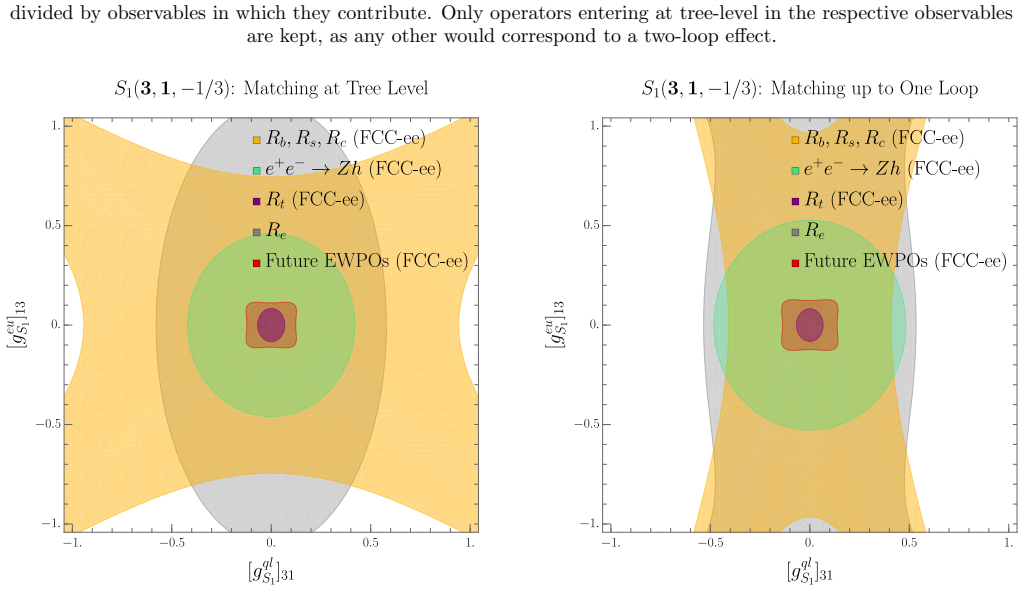
On its own terms, the paper establishes that electron-top contact interactions do not spoil the Higgs self-coupling measurement at FCC-ee. The central numbers are the 1-sigma bounds on kappa3: 16.9% with no electron-top operators, and 17.2% when all five are active and marginalised over; even adding all top- and electron-philic operators yields 23%, and the explicit leptoquark models give 0.172 (tree-level matching) and 0.171 (one-loop matching). The mechanism is that the degeneracy between the self-coupling and the electron-top operators in Higgsstrahlung is broken by independent observables — especially the ratio of e+e- to t-tbar to light-quark pair production at 365 GeV and the light-qua
What carries the argument
The load-bearing observable is the ratio Rt = sigma(e+e- -> t tbar) / sum_q sigma(e+e- -> q qbar) at sqrt(s) = 365 GeV, projected to be measured to about one part in 10^4. Rt is a tree-level probe of the five electron-top operators, and its sensitivity is orthogonal to the one-loop, top-Yukawa-enhanced mixing of the same operators into the Z-electron coupling (for example, the Zee coupling receives a contribution proportional to log(mZ/Lambda) times [Cqe] - [Ceu]). The analysis combines Rt with above-pole Rb, Rs, Rc ratios, FCC-ee electroweak precision observables, HL-LHC Drell-Yan, and the NLO Higgsstrahlung cross-section; keeping all five operators in a marginalised fit removes the flat di
Load-bearing premise
The load-bearing assumption is that the 365 GeV measurement of the ratio of top-pair to light-quark-pair production reaches the projected ~10^-4 precision, and that all Higgs couplings other than the trilinear remain SM-like; if either fails, the flat direction between the electron-top operators and the self-coupling can reopen and push the kappa3 bound above the quoted 17-18%.
What would settle it
Rerun the marginalised fit replacing the assumed 10^-4 uncertainty on Rt at 365 GeV with 10^-3: if a flat direction reappears and the 1-sigma kappa3 bound grows beyond about 20%, the paper's central conclusion fails. An observed deviation in Rt or Rb at FCC-ee larger than the projected precision would also change the electron-top constraints enough to reopen the degeneracy with the trilinear.
If this is right
- With all five electron-top operators switched on and marginalised, the 1-sigma kappa3 precision degrades from 16.9% to 17.2%, a relative change of about 2%.
- The above-pole fermion-pair ratios, not Higgsstrahlung, provide the main constraints on electron-top operators, so the kappa3 extraction is largely insensitive to them.
- Individual bounds on the five coefficients reach the 10-20 TeV range even in the fully marginalised fit.
- In explicit leptoquark models that generate all five operators, one-loop versus tree-level matching changes the kappa3 bound only from 0.172 to 0.171.
- A 1-sigma sensitivity of order 17% on kappa3 is preserved under the assumption of otherwise SM-like Higgs couplings.
Where Pith is reading between the lines
- Editorial extension: the same mechanism — using orthogonal tree-level pair-production ratios to break loop-level degeneracies — should apply to other four-fermion operators that contaminate Higgsstrahlung, such as electron-charm or electron-bottom contacts; the paper's framework can be exported to those cases.
- The reliance on ratios rather than absolute cross-sections cancels luminosity-type systematics, but it shifts the burden onto the Standard Model prediction for the normalising sum; a mismatch there would be a new source of error not covered by the quoted precision.
- If the 365 GeV top-pair-to-light-quark ratio is measured with worse precision than 10^-4, or if that run is dropped from the schedule, the marginalised kappa3 bound is likely to approach the 17.6% value the authors find without the above-pole ratios.
Editorial analysis
A structured set of objections, weighed in public.
Referee Report
Summary. This paper quantifies the impact of SMEFT four-fermion operators with two electrons and two top quarks on the extraction of the Higgs trilinear coupling κ3 from e+e−→Zh at FCC-ee. The authors combine the NLO Zh cross-section of Ref. [18] with projected constraints from LHC Drell-Yan, current and FCC-ee EWPOs, FCC-ee measurements of R_b, R_s, R_c, R_t and R_e above the Z pole, and the Zh measurement itself. Fitting CH together with the five eett Wilson coefficients, they find that the 1σ sensitivity to κ3 degrades only from 16.9% to 17.2% (and to 17.6% if the above-pole Rq ratios are removed), and to 23% if all top- and electrophilic operators are included. The result is checked in two leptoquark UV completions (S1 and R2), including one-loop matching.
Significance. The conclusion—that eett contact interactions do not significantly spoil the FCC-ee κ3 program—is an important and non-trivial input for the design of the Higgs physics case of future e+e− colliders. The paper goes beyond earlier work (Ref. [10]) by showing that Rq-type fermion-pair measurements above the Z pole resolve the pseudo-flat direction, and it carefully checks the robustness of this conclusion: the row 'All eett (w/o Rq above pole)' in Table III already limits the degradation to 0.7 percentage points, so the headline claim does not hinge on the least-validated external projections. The explicit leptoquark matching and the Λ=10 TeV scale check are also commendable. These features make the analysis more convincing than a purely EFT projection.
minor comments (5)
- [Abstract and Section V.B] The phrase 'below the percent level' is ambiguous: the change from 16.9% to 17.2% is 0.3 percentage points, but a relative degradation of about 1.8%. Please specify 'by less than one percentage point in absolute terms' to avoid overstatement.
- [Eq. (23)] There are typographical errors in Eq. (23): 'g4' should presumably be 'g^4' and there is a double plus sign ('+ +g2'). Please correct.
- [Table I and Section V.B] The paper uses projected precisions from Ref. [22] for Rq and Rt as inputs. Although Table III shows that removing the Rq ratios does not change the central conclusion, the text would benefit from an explicit sentence stating that the O(10^-4) Rt precision and the Rq projections are assumed inputs and that the conclusion is stable if they are degraded or removed.
- [General] The analysis relies on public tools (DsixTools, HighPT) but no data-availability statement is provided. Making the precise likelihood inputs, observable definitions, and fit configurations available (e.g. as a supplementary file) would improve reproducibility.
- [Figures 6 and 7] The labels and legends in Figures 6 and 7 are very small. Enlarging them, or providing an online version, would help the reader compare the marginalised and individual bounds.
Circularity Check
No significant circularity: the kappa3 sensitivity is a projected SMEFT parameter mapping, not a fitted input renamed as a prediction.
full rationale
I walked the derivation chain. The central claim is that eett four-fermion operators degrade the projected 1-sigma sensitivity to kappa3 from 16.9% (no eett) to 17.2% (all five eett coefficients marginalised), with 17.6% even if the above-pole Rq ratios are removed (Table III). The derivation chain is: (i) Eq. (8) gives the SMEFT NLO decomposition of sigma(e+e- -> Zh) in terms of Wilson coefficients; (ii) Eq. (5) expresses kappa3 in terms of CH (with CH2 and CHD argued to be separately constrained by kappaZ and the T-parameter, Fig. 1); (iii) the paper projects the expected bound on CH from the assumed Zh precision, marginalising over eett coefficients whose constraints come from independent observables (EWPOs, HL-LHC Drell-Yan via HighPT, and FCC-ee fermion-pair ratios). The conversion of the CH bound into a kappa3 bound is a parameter mapping within the same EFT, not a case of fitting kappa3 and then claiming to predict it; this is standard SMEFT projection practice and is explicitly labeled as such ('delta kappa3 proportional to CH, such that a bound on CH can be automatically translated into a constraint on the Higgs self-coupling'). No load-bearing step reduces by construction to its own input. The least externally validated input is the O(10^-4) precision on Rt from Ref. [22], but Table III's 'All eett (w/o Rq above pole)' row (0.176) shows the central claim does not rest on that input. Self-citations (HighPT [20], flavour papers [14,23,27,29]) are to public code and external literature, used as tools, not as unverified uniqueness theorems. The paper explicitly performs conservative checks (Lambda=10 TeV changes bounds by 20-30% and strengthens them; one-loop vs tree-level leptoquark matching gives delta kappa3 = 0.172 vs 0.171). I find no step satisfying the quoted-reduction standard for circularity.
Axiom & Free-Parameter Ledger
free parameters (3)
- Wilson coefficients C_lq(1), C_lq(3), Clu, Cqe, Ceu, CH (and for the leptoquark models the couplings yS1, yR2 and masses =
Values bounded/floated in the fit; reported as bounds in TeV (e.g. individual 40.3 TeV for C_lq(1), marginalised 18.0 Te
- Renormalisation/initial scale Lambda =
Lambda = 1 TeV in the main analysis
- Experimental precision assumptions (input projections) =
e.g. 0.3% precision on sigma(Zh) at 240 GeV; O(10^-4) precision on Rt at 365 GeV from Ref. [22]
axioms (7)
- domain assumption SMEFT parametrisation with dimension-6 operators is a valid description of new physics at the scales considered.
- standard math The Warsaw basis and the standard SMEFT operator normalisation are used.
- domain assumption The background SM predictions for the ratio observables Rq, Rt etc. are known with negligible uncertainty compared to the projected experimental precision.
- domain assumption Only SM-NP interference terms are kept in the cross-sections (linear SMEFT), and O(C^2) terms are neglected except where noted.
- domain assumption The flavour assumption of an electrophilic and top-philic scenario (U(1)_e and third-generation dominance) defines the operator set.
- domain assumption The matching of the S1 and R2 leptoquarks onto SMEFT is valid at one-loop, with the given finite terms computed by SOLD.
- domain assumption The quoted projected sensitivities from FCC feasibility studies (Zh precision 0.3%, EWPO projections, etc.) are realistic.
read the original abstract
The measurement of the Higgs self-coupling is considered the next milestone in the study of the Higgs boson properties. At future $e^+e^-$ facilities below the double Higgs production threshold, this is extracted from the $Zh$ production cross-section, which is sensitive to the trilinear coupling at the one-loop level. At the same perturbative order, potential effects beyond the Standard Model (SM) may affect the Higgstrahlung rate and distort the self-coupling determination. We study the question focusing especially on contact interactions containing two electron and two top-quark fields. We conclude that, in the context of FCC-ee and its planned runs at different energies, $eett$ interactions change the Higgs self-coupling sensitivity below the percent level. Even in the most pessimistic scenarios, we confirm a robust sensitivity of the order of 17% at the 1$\sigma$ confidence level under the assumption of otherwise SM-like Higgs couplings. A crucial role in these results is played by the measurement of fermion pair production above the $Z$ resonance.
Figures




Reference graph
Works this paper leans on
-
[1]
pp → ee with a b¯b pair in the initial state ( b¯b → ee)
Drell–Yan at LHC, i.e. pp → ee with a b¯b pair in the initial state ( b¯b → ee). This has been explored e.g. in Ref. [23], yielding bounds in the TeV range
-
[2]
b¯b production at lepton colliders above the Z pole, for which the FCC-ee prospects have been studied in detail in Ref. [22]. 4 CH e e Z h Z h Z FIG. 2: Contribution of the Higgs trilinear coupling to the Zh cross-section. e e Ceett t t Z h Ceett e e v v t t Z q q Ceett t t e e (a) (b) (c) FIG. 3: Example one-loop SMEFT diagrams involving eett operators r...
-
[3]
Scalar and tensor operators The scalar and tensor operators complying with our assumptions are [O(1) lequ]1133 = (¯l1e1)(¯q3u3) [O(3) lequ]1133 = (¯l1σµνe1)(¯q3σµνu3) (14) These have top-quark Yukawa enhanced running effects into both the electron Yukawa and electron dipole oper- ators (the latter one being two-loop), so one gets a con- straint from the e...
-
[4]
Quantum Universe
Four-lepton and four-quark operators Under the same assumptions, four-lepton and four- quark operators may be generated as well. In particular, the following structures would be allowed [Oee]1111 = (¯e1γµe1)(¯e1γµe1) , [Ole]1111 = (¯l1γµl1)(¯e1γµe1) , [Oll]1111 = (¯l1γµl1)(¯l1γµl1) , [O(1) qq ]3333 = (¯q3γµq3)(¯q3γµq3) , [O(3) qq ]3333 = (¯q3γµσI q3)(¯q3γ...
-
[5]
collaboration (CMS), (2025), arXiv:2510.07527 [hep- ex]
C. collaboration (CMS), (2025), arXiv:2510.07527 [hep- ex]
arXiv 2025
-
[6]
G. Aad et al. (ATLAS), Phys. Rev. Lett. 133, 101801 (2024), arXiv:2406.09971 [hep-ex]
Pith/arXiv arXiv 2024
-
[7]
E. W. N. Glover and J. J. van der Bij, Nucl. Phys. B 309, 282 (1988)
1988
-
[8]
J. Alison et al. , Rev. Phys. 5, 100045 (2020), arXiv:1910.00012 [hep-ph]. 15 1000 2000 3000 4000 500010-5 10-4 0.001 0.010 0.100 FIG. 11: Comparison of different contributions to the partonic Drell–Yan cross-section. All coefficients except [C(3) lq ]1133 are set to zero at the scale Λ. The red (NLO) line is the contribution from the constant, finite ter...
Pith/arXiv arXiv 2020
-
[9]
M. McCullough, Phys. Rev. D 90, 015001 (2014), [Er- ratum: Phys.Rev.D 92, 039903 (2015)], arXiv:1312.3322 [hep-ph]
Pith/arXiv arXiv 2014
-
[10]
S. Di Vita, G. Durieux, C. Grojean, J. Gu, Z. Liu, G. Panico, M. Riembau, and T. Vantalon, JHEP 02, 178 (2018), arXiv:1711.03978 [hep-ph]
Pith/arXiv arXiv 2018
-
[11]
F. Maltoni, D. Pagani, and X. Zhao, JHEP 07, 087 (2018), arXiv:1802.07616 [hep-ph]
Pith/arXiv arXiv 2018
-
[12]
M. Benedikt et al. (FCC), (2025), 10.17181/CERN.9DKX.TDH9, arXiv:2505.00272 [hep- ex]
Pith/arXiv arXiv 2025
-
[13]
J. de Blas et al. (Physics Preparatory Group), (2025), 10.17181/CERN.35CH.2O2P, arXiv:2511.03883 [hep-ex]
arXiv 2025
-
[14]
L. Bellafronte, S. Dawson, P. P. Giardino, and H. Liu, (2025), arXiv:2507.02039 [hep-ph]
arXiv 2025
-
[15]
R. Barbieri, B. Bellazzini, V. S. Rychkov, and A. Varag- nolo, Phys. Rev. D 76, 115008 (2007), arXiv:0706.0432 [hep-ph]
Pith/arXiv arXiv 2007
-
[16]
J. Elias-Mir´ o, C. Grojean, R. S. Gupta, and D. Mar- zocca, JHEP 05, 019 (2014), arXiv:1312.2928 [hep-ph]
Pith/arXiv arXiv 2014
-
[17]
R. Contino, M. Ghezzi, C. Grojean, M. Muhlleitner, and M. Spira, JHEP 07, 035 (2013), arXiv:1303.3876 [hep- ph]
Pith/arXiv arXiv 2013
-
[18]
L. Allwicher, C. Cornella, G. Isidori, and B. A. Stefanek, JHEP 03, 049 (2024), arXiv:2311.00020 [hep-ph]
Pith/arXiv arXiv 2024
-
[19]
V. Maura, B. A. Stefanek, and T. You, JHEP 10, 022 (2025), arXiv:2412.14241 [hep-ph]
Pith/arXiv arXiv 2025
-
[20]
J. ter Hoeve, L. Mantani, J. Rojo, A. N. Rossia, and E. Vryonidou, Phys. Rev. D 112, 013008 (2025), arXiv:2504.05974 [hep-ph]
Pith/arXiv arXiv 2025
-
[21]
V. Maura, B. A. Stefanek, and T. You, Phys. Rev. Lett. 135, 141802 (2025), arXiv:2503.13719
Pith/arXiv arXiv 2025
-
[22]
K. Asteriadis, S. Dawson, P. P. Giardino, and R. Szafron, JHEP 02, 162 (2025), arXiv:2409.11466 [hep-ph]
Pith/arXiv arXiv 2025
-
[23]
B. Grzadkowski, M. Iskrzynski, M. Misiak, and J. Rosiek, JHEP 10, 085 (2010), arXiv:1008.4884 [hep- ph]
Pith/arXiv arXiv 2010
-
[24]
L. Allwicher, D. A. Faroughy, F. Jaffredo, O. Sumensari, and F. Wilsch, Comput. Phys. Commun. 289, 108749 (2023), arXiv:2207.10756 [hep-ph]
Pith/arXiv arXiv 2023
-
[25]
V. Bres´ o-Pla, A. Falkowski, and M. Gonz´ alez-Alonso, JHEP 08, 021 (2021), arXiv:2103.12074 [hep-ph]
Pith/arXiv arXiv 2021
-
[26]
A. Greljo, H. Tiblom, and A. Valenti, SciPost Phys. 18, 152 (2025), arXiv:2411.02485 [hep-ph]
Pith/arXiv arXiv 2025
-
[27]
L. Allwicher, D. A. Faroughy, F. Jaffredo, O. Sumensari, and F. Wilsch, JHEP 03, 064 (2023), arXiv:2207.10714 [hep-ph]
Pith/arXiv arXiv 2023
-
[28]
E. E. Jenkins, A. V. Manohar, and M. Trott, JHEP 01, 035 (2014), arXiv:1310.4838 [hep-ph]
Pith/arXiv arXiv 2014
-
[29]
A. Crivellin, C. Greub, D. M¨ uller, and F. Saturnino, JHEP 02, 182 (2021), arXiv:2010.06593 [hep-ph]
Pith/arXiv arXiv 2021
-
[30]
H. Davoudiasl and P. P. Giardino, Phys. Rev. D 109, 075037 (2024), arXiv:2311.12112 [hep-ph]
Pith/arXiv arXiv 2024
-
[31]
L. Allwicher, M. McCullough, S. Renner, D. Rocha, and B. Smith, (2025), arXiv:2511.02642 [hep-ph]
arXiv 2025
-
[32]
J. J. Ethier, G. Magni, F. Maltoni, L. Mantani, E. R. Nocera, J. Rojo, E. Slade, E. Vryonidou, and C. Zhang (SMEFiT), JHEP 11, 089 (2021), arXiv:2105.00006 [hep- ph]
Pith/arXiv arXiv 2021
-
[33]
L. Allwicher, G. Isidori, and M. Pesut, Eur. Phys. J. C 85, 631 (2025), arXiv:2503.17019 [hep-ph]
Pith/arXiv arXiv 2025
-
[34]
M. Bordone, C. Cornella, and J. Davighi, Eur. Phys. J. C 85, 995 (2025), arXiv:2503.22635 [hep-ph]
arXiv 2025
-
[35]
J. Fuentes-Martin, P. Ruiz-Femenia, A. Vicente, and J. Virto, Eur. Phys. J. C 81, 167 (2021), arXiv:2010.16341 [hep-ph]
Pith/arXiv arXiv 2021
-
[36]
Future col- lider constraints on top-quark operators,
F. Cornet-Gomez, V. Miralles, M. Miralles L´ opez, M. Moreno Ll´ acer, and M. Vos, “Future col- lider constraints on top-quark operators,” (2025), arXiv:2503.11518 [hep-ph]
arXiv 2025
-
[37]
I. Dorˇ sner, S. Fajfer, A. Greljo, J. F. Kamenik, and N. Koˇ snik, Phys. Rept.641, 1 (2016), arXiv:1603.04993 [hep-ph]
Pith/arXiv arXiv 2016
-
[38]
J. de Blas, J. C. Criado, M. Perez-Victoria, and J. San- tiago, JHEP 03, 109 (2018), arXiv:1711.10391 [hep-ph]
Pith/arXiv arXiv 2018
-
[39]
V. Gherardi, D. Marzocca, and E. Venturini, JHEP 07, 225 (2020), [Erratum: JHEP 01, 006 (2021)], arXiv:2003.12525 [hep-ph]
Pith/arXiv arXiv 2020
- [40]
-
[41]
J. Gargalionis, J. Quevillon, P. N. H. Vuong, and T. You, JHEP 07, 136 (2025), arXiv:2412.01759 [hep-ph]. 16 FIG. 12: The 2 σ C.L. allowed regions from different observables, for the one particle extension of the Leptoquark R2 only, with MR2 = 1 TeV. The matching on the left is done at tree level and on the right at one-loop. The couplings are defined in ...
arXiv 2025
discussion (0)
Sign in with ORCID, Apple, or X to comment. Anyone can read and Pith papers without signing in.