Chiral, parity-doublet, effective-Lagrangian mean-field theories for nuclear and astrophysical phenomenology
Pith reviewed 2026-05-17 01:30 UTC · model grok-4.3
The pith
Parity-doublet models allow baryons to keep mass even after the chiral condensate disappears through a symmetry-invariant term m0.
A machine-rendered reading of the paper's core claim, the machinery that carries it, and where it could break.
Core claim
Parity-doublet effective Lagrangians accommodate a chirally invariant mass term m0 that remains nonzero when the chiral condensate vanishes, thereby enabling a unified mean-field treatment of baryonic matter across vacuum, nuclear, and astrophysical density regimes while preserving chiral symmetry.
What carries the argument
The parity-doublet Lagrangian with its chirally invariant mass term m0 that survives condensate melting and is used in the mean-field approximation for nuclear and stellar matter.
If this is right
- Vector interactions in the mean-field treatment produce nuclear saturation at the correct density and binding energy.
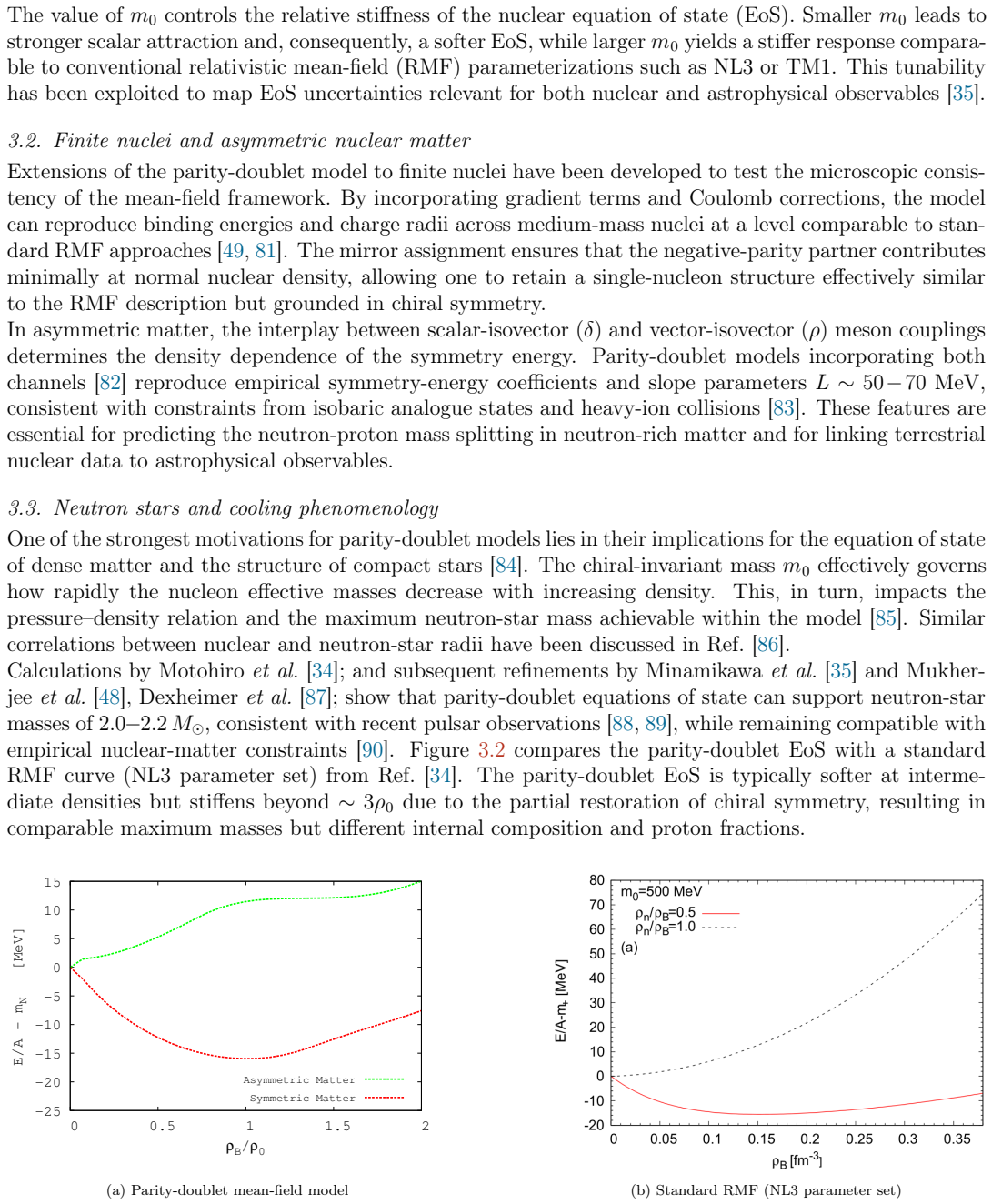
- Parity doubling modifies the equation of state at high density and thereby affects neutron-star mass-radius relations.
- The presence of parity partners influences neutrino emission rates and therefore neutron-star cooling curves.
- Lattice and phenomenological constraints on m0 reduce the model parameter space for applications to dense matter.
Where Pith is reading between the lines
- The framework could be extended by adding mesonic fluctuations to test stability at supranuclear densities where mean-field may break down.
- Matching to quark-based descriptions at still higher densities would require tracking how m0 evolves across a possible phase transition.
- Gravitational-wave signals from neutron-star mergers offer an independent test of the parity-doubled equation of state beyond static properties.
Load-bearing premise
The mean-field approximation remains adequate for a unified description from vacuum through nuclear matter to dense astrophysical conditions.
What would settle it
Lattice QCD results at finite temperature showing that the chirally invariant mass m0 must be zero or that the predicted baryon mass splitting contradicts observed parity-partner masses.
Figures

read the original abstract
Chiral-parity (parity-doublet) effective Lagrangian models provide a compact and symmetry-consistent framework for describing baryons and their negative-parity partners in terms of linearly-realized chiral symmetry. Unlike the conventional, linear, sigma model; the parity-doublet approach accommodates a chirally-invariant mass term, $m_0$, allowing finite baryon-masses even when the chiral condensate melts. This feature enables a unified treatment of hadronic matter across vacuum, nuclear and dense astrophysical regimes. This compact review summarizes the key structures of parity-doublet Lagrangians; outlines the mean-field formulation for nuclear and stellar matter; and highlights recent phenomenological and lattice constraints on the chirally-invariant mass. Emphasis is placed on mirror versus na\"ive chiral assignments; the role of vector interactions in achieving nuclear saturation; and the implications of parity doubling for the equation-of-state of dense matter and neutron-star cooling. The review concludes with current theoretical challenges and perspectives for extending these models beyond the mean-field approximation.
Editorial analysis
A structured set of objections, weighed in public.
Referee Report
Summary. The manuscript is a compact review of chiral-parity (parity-doublet) effective Lagrangian models that employ linearly realized chiral symmetry to describe baryons and their negative-parity partners. Central to the framework is the chirally invariant mass parameter m0, which permits finite baryon masses even when the chiral condensate vanishes, thereby enabling a unified mean-field treatment of hadronic matter from vacuum through nuclear saturation to dense astrophysical regimes. The review outlines the Lagrangian structures, contrasts mirror and naïve assignments, discusses the role of vector interactions for saturation, summarizes phenomenological and lattice constraints on m0, and addresses implications for the equation of state and neutron-star cooling, while noting current challenges and the need to move beyond mean field.
Significance. If the summaries of existing literature are accurate and balanced, the review provides a useful, self-contained reference that consolidates the symmetry advantages of parity-doublet constructions over conventional linear sigma models. Explicit discussion of lattice and phenomenological bounds on m0 together with the acknowledgment of mean-field limitations and future extensions beyond mean field adds practical value for researchers seeking unified descriptions of nuclear and stellar matter.
minor comments (3)
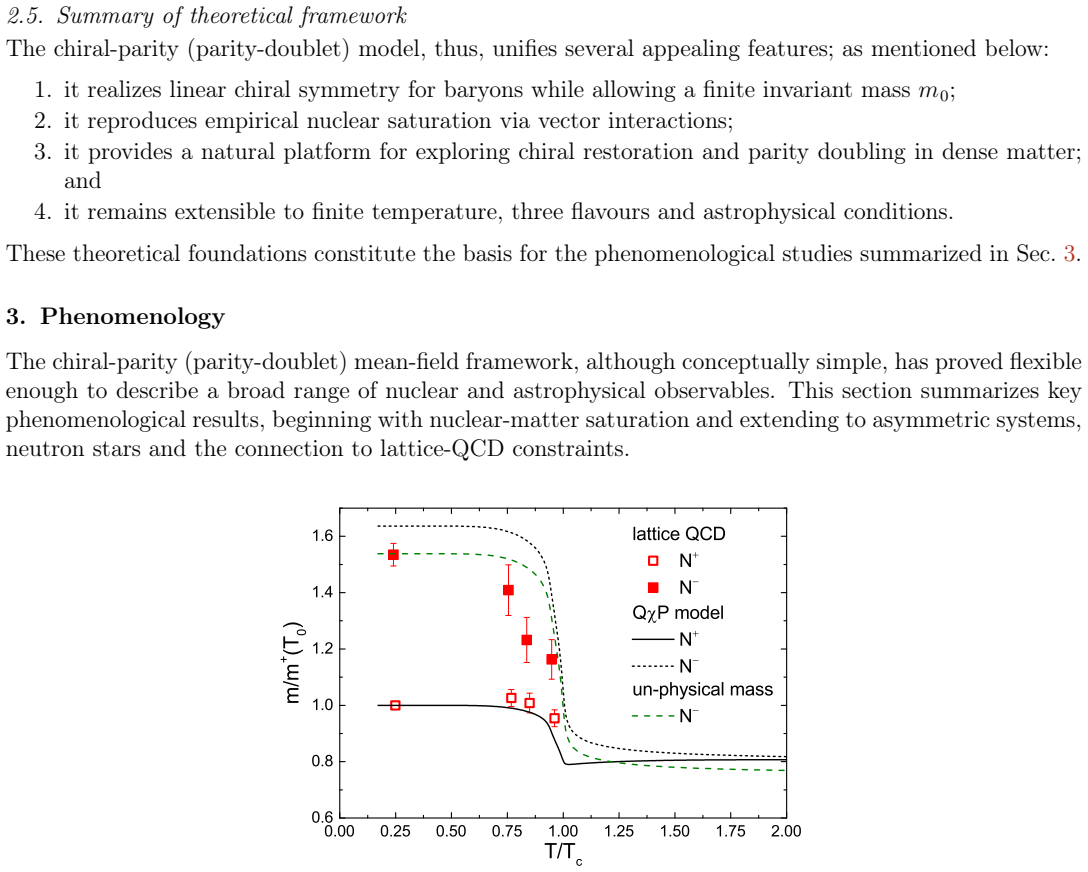
- The abstract states that the review 'highlights recent phenomenological and lattice constraints on the chirally-invariant mass,' yet the text does not appear to include an explicit table or figure compiling the numerical ranges and references for m0; adding such a summary would improve accessibility without altering the central narrative.
- In the discussion of mirror versus naïve assignments, the distinction is described qualitatively; a brief side-by-side comparison of the transformation properties under chiral rotations (perhaps in an appendix or short table) would clarify the difference for readers less familiar with the assignments.
- The concluding section on theoretical challenges correctly flags the need to go beyond mean field, but a short paragraph sketching one concrete example of a fluctuation correction or functional renormalization-group treatment would make the perspective more actionable.
Simulated Author's Rebuttal
We thank the referee for the positive summary and recommendation of minor revision. The report accurately captures the scope and intent of the manuscript as a compact review of parity-doublet models. No specific major comments were provided in the report, so we have no point-by-point revisions to address at this stage. We are prepared to incorporate any additional suggestions that may arise during the revision process.
Circularity Check
No significant circularity in this review paper
full rationale
This is a review summarizing structures, mean-field formulations, and constraints from prior literature on parity-doublet models. The central claim regarding the chirally-invariant mass m0 is definitional to the cited constructions and not derived anew here. No load-bearing step reduces by the paper's own equations or self-citation chain to an input defined inside this manuscript; external references and explicit discussion of limitations keep the presentation self-contained against benchmarks.
Axiom & Free-Parameter Ledger
axioms (1)
- domain assumption Chiral symmetry is realized linearly in the effective Lagrangian for baryons and their parity partners.
Lean theorems connected to this paper
-
IndisputableMonolith/Foundation/RealityFromDistinction.leanreality_from_one_distinction unclear?
unclearRelation between the paper passage and the cited Recognition theorem.
Chiral-parity (parity-doublet) effective Lagrangian models provide a compact and symmetry-consistent framework for describing baryons and their negative-parity partners in terms of linearly-realized chiral symmetry. Unlike the conventional, linear, sigma model; the parity-doublet approach accommodates a chirally-invariant mass term, m0, allowing finite baryon-masses even when the chiral condensate melts.
What do these tags mean?
- matches
- The paper's claim is directly supported by a theorem in the formal canon.
- supports
- The theorem supports part of the paper's argument, but the paper may add assumptions or extra steps.
- extends
- The paper goes beyond the formal theorem; the theorem is a base layer rather than the whole result.
- uses
- The paper appears to rely on the theorem as machinery.
- contradicts
- The paper's claim conflicts with a theorem or certificate in the canon.
- unclear
- Pith found a possible connection, but the passage is too broad, indirect, or ambiguous to say the theorem truly supports the claim.
Reference graph
Works this paper leans on
-
[1]
Dynamical Model of Elementary Particles Based on an Analogy with Superconductivity. I
Y. Nambu, G. Jona-Lasinio, Dynamical model of elementary particles based on an analogy with superconductivity I, Phys. Rev. 122 (1961) 345–358.doi:10.1103/PhysRev.122.345
-
[2]
Y. Nambu, G. Jona-Lasinio, Dynamical model of elementary particles based on an analogy with superconductivity II, Phys. Rev. 124 (1961) 246–254.doi:10.1103/PhysRev.124.246
-
[3]
Weinberg, Nonlinear realizations of chiral symmetry, Phys
S. Weinberg, Nonlinear realizations of chiral symmetry, Phys. Rev. 166 (1968) 1568–1577.doi: 10.1103/PhysRev.166.1568
-
[4]
Weise, Chiral symmetry in strongly interacting matter: from nuclear matter to phases of QCD, Prog
W. Weise, Chiral symmetry in strongly interacting matter: from nuclear matter to phases of QCD, Prog. Theor. Phys. Suppl. 186 (2010) 390–403.doi:10.1143/PTPS.186.390
-
[5]
M. Gell-Mann, M. Lévy, The axial vector current in beta decay, Nuovo Cim. 16 (1960) 705.doi: 10.1007/BF02859738
-
[6]
S. Weinberg, Gravitation and cosmology: principles and applications of the general theory of rela- tivity, John Wiley & Sons, New York, 1972
work page 1972
-
[7]
Weinberg, Dynamical approach to current algebra, Phys
S. Weinberg, Dynamical approach to current algebra, Phys. Rev. Lett. 18 (1967) 188–191.doi: 10.1103/PhysRevLett.18.188
-
[8]
Fukushima, Chiral effective model with the Polyakov loop, Phys
K. Fukushima, Chiral effective model with the Polyakov loop, Phys. Lett. B 591 (2004) 277–284. doi:10.1016/j.physletb.2004.04.027. 8
-
[9]
K. Fukushima, Y. Hidaka, A model study of the sign problem in the mean-field approximation, Phys. Rev. D 75 (2007) 036002.doi:10.1103/PhysRevD.75.036002
-
[10]
Fukushima, Critical surface in hot and dense QCD with the vector interaction, Phys
K. Fukushima, Critical surface in hot and dense QCD with the vector interaction, Phys. Rev. D 78 (2008) 114019.doi:10.1103/PhysRevD.78.114019
-
[11]
Fukushima, Phase diagrams in the three-flavour Nambu−Jona-Lasinio model with the Polyakov loop, Phys
K. Fukushima, Phase diagrams in the three-flavour Nambu−Jona-Lasinio model with the Polyakov loop, Phys. Rev. D 77 (2008) 114028, [Erratum: Phys. Rev. D 78 (2008) 039902].doi:10.1103/ PhysRevD.77.114028,10.1103/PhysRevD.78.039902
-
[12]
Fukushima, Isentropic thermodynamics in the PNJL model, Phys
K. Fukushima, Isentropic thermodynamics in the PNJL model, Phys. Rev. D 79 (2009) 074015. doi:10.1103/PhysRevD.79.074015
-
[13]
Fukushima, Hadron resonance gas and mean-field nuclear matter for baryon number fluctuations, Phys
K. Fukushima, Hadron resonance gas and mean-field nuclear matter for baryon number fluctuations, Phys. Rev. C 91 (4) (2015) 044910.doi:10.1103/PhysRevC.91.044910
-
[14]
Fukushima, Quark description of the Nambu-Goldstone bosons in the colour-flavour locked phase, Phys
K. Fukushima, Quark description of the Nambu-Goldstone bosons in the colour-flavour locked phase, Phys. Rev. D 70 (2004) 094014.doi:10.1103/PhysRevD.70.094014
-
[15]
K. Fukushima, C. Sasaki, The phase diagram of nuclear and quark matter at high baryon density, Prog. Part. Nucl. Phys. 72 (2013) 99–154.doi:10.1016/j.ppnp.2013.05.003
-
[16]
H. Stöcker, W. Greiner, High-energy heavy-ion collisions: probing the equation-of-state of highly excited hadronic matter, Phys. Rept. 137 (1986) 277–392.doi:10.1016/0370-1573(86)90131-6
-
[17]
B.-J. Schaefer, J. Pawlowski, J. Wambach, The phase structure of the Polyakov-quark-meson model, Phys. Rev. D 76 (2007) 074023.doi:10.1103/PhysRevD.76.074023
-
[18]
C. Ratti, M. Thaler, W. Weise, Phases of QCD: lattice thermodynamics and a field theoretical model, Phys. Rev. D 73 (2006) 014019.doi:10.1103/PhysRevD.73.014019
-
[19]
C. Ratti, W. Weise, Thermodynamics of two-colour QCD and the Nambu−Jona-Lasinio model, Phys. Rev. D 70 (2004) 054013.doi:10.1103/PhysRevD.70.054013
-
[20]
C. DeTar, T. Kunihiro, Linear sigma model with parity doubling, Phys. Rev. D 39 (1989) 2805–2808. doi:10.1103/PhysRevD.39.2805
-
[21]
Y. Nemoto, D. Jido, M. Oka, A. Hosaka, Decays of1 2-baryons in chiral effective theory, Phys. Rev. D 57 (1998) 4124–4135.doi:10.1103/PhysRevD.57.4124
-
[22]
D. Jido, M. Oka, A. Hosaka, Chiral symmetry of baryons, Prog. Theor. Phys. 106 (2001) 873–908. doi:10.1143/PTP.106.873
-
[23]
D. Jido, J. Oller, E. Oset et al., Chiral dynamics of the twoΛ(1405) states, Nucl. Phys. A 725 (2003) 181–200.doi:10.1016/S0375-9474(03)01598-7
-
[25]
S. Gallas, F. Giacosa, Mirror versus naive assignment in chiral models for the nucleon, Int. J. Mod. Phys. A 29 (17) (2014) 1450098.doi:10.1142/S0217751X14500985
-
[26]
P. Papazoglou, S. Schramm, J. Schaffner-Bielich et al., Chiral Lagrangian for strange hadronic matter, Phys. Rev. C 57 (1998) 2576–2588.doi:10.1103/PhysRevC.57.2576
-
[27]
P. Papazoglou, D. Zschiesche, S. Schramm et al., Nuclei in a chiral SU(3) model, Phys. Rev. C 59 (1999) 411–427.doi:10.1103/PhysRevC.59.411. 9
-
[28]
J. Boguta, A. Bodmer, Relativistic calculation of nuclear matter and the nuclear surface, Nucl. Phys. A 292 (1977) 413–428.doi:10.1016/0375-9474(77)90626-1
-
[29]
Boguta, A saturating chiral field theory of nuclear matter, Phys
J. Boguta, A saturating chiral field theory of nuclear matter, Phys. Lett. B 120 (1-3) (1983) 34–38
work page 1983
- [30]
-
[31]
V. Dexheimer, G. Pagliara, L. Tolos et al., Neutron stars within the SU(2) parity doublet model, Eur. Phys. J. A38 (2008) 105–113.doi:10.1140/epja/i2008-10652-0
-
[32]
J. Steinheimer, S. Schramm, H. Stocker, An effective chiral hadron-quark equation-of-state, J. Phys. G 38 (2011) 035001.doi:10.1088/0954-3899/38/3/035001
-
[33]
V. Dexheimer, J. Steinheimer, R. Negreiros, S. Schramm, Hybrid stars in an SU(3) parity doublet model, Phys. Rev. C 87 (1) (2013) 015804.doi:10.1103/PhysRevC.87.015804
-
[34]
Y. Motohiro, Y. Kim, M. Harada, Asymmetric nuclear matter in a parity doublet model with hidden local symmetry, Phys. Rev. C 92 (2) (2015) 025201, [Erratum: Phys. Rev. C 95 (5) (2017) 059903]. doi:10.1103/PhysRevC.92.025201,10.1103/PhysRevC.95.059903
-
[35]
T. Minamikawa, T. Kojo, M. Harada, Chiral condensates for neutron stars in hadron-quark crossover: from a parity doublet nucleon model to a Nambu–Jona-Lasinio quark model, Phys. Rev. C 104 (6) (2021) 065201.doi:10.1103/PhysRevC.104.065201
-
[36]
G. Aarts, C. Allton, S. Hands et al., Nucleons and parity doubling across the deconfinement transi- tion, Phys. Rev. D 92 (1) (2015) 014503.doi:10.1103/PhysRevD.92.014503
-
[37]
T. Yamazaki, M. Harada, Constraint to chiral invariant masses of nucleons from GW170817 in an extended parity doublet model, Phys. Rev. C 100 (2) (2019) 025205.doi:10.1103/PhysRevC.100. 025205
-
[38]
M. Cheng, P. Hegde, C. Jung et al., Baryon number, strangeness and electric charge fluctuations in QCD at high temperature, Phys. Rev. D 79 (7) (2009) 074505.doi:10.1103/PhysRevD.79.074505
-
[39]
A. Mukherjee, J. Steinheimer, S. Schramm, Higher-order baryon number susceptibilities: interplay between the chiral and the nuclear liquid-gas transitions, Phys. Rev. C 96 (2) (2017) 025205.doi: 10.1103/PhysRevC.96.025205
-
[40]
J. Steinheimer, Y. Wang, A. Mukherjee et al., Nuclear interactions and net-proton number fluc- tuations in heavy-ion collisions at the SIS18 accelerator, Phys. Lett. B 785 (2018) 40–45.doi: 10.1016/j.physletb.2018.07.068
-
[41]
J. Steinheimer, S. Schramm, The problem of repulsive quark interactions: lattice versus mean field models, Phys. Lett. B 696 (2011) 257–261.doi:10.1016/j.physletb.2010.12.046
-
[42]
H. Abuki, R. Anglani, R. Gatto et al., Chiral crossover, deconfinement and quarkyonic matter within a Nambu−Jona-Lasinio model with the Polyakov loop, Phys. Rev. D78 (2008) 034034.doi: 10.1103/PhysRevD.78.034034
-
[43]
H. Abuki, M. Ciminale, R. Gatto et al., Electrical neutrality and pion modes in the two-flavour PNJL model, Phys. Rev. D 78 (2008) 014002.doi:10.1103/PhysRevD.78.014002
-
[45]
M. Abu-Shady, Extended chiral quark models in the framework of quantum chromodynamics: theory and their applications in hot and dense mediums, ARXIV:1707.08045 (2017).doi:10.48550/arXiv. 1707.08045. 10
work page internal anchor Pith review Pith/arXiv arXiv doi:10.48550/arxiv 2017
-
[46]
A. Mukherjee, A. Bhattacharyya, S. Schramm, Effects of a non-zero strangeness-chemical-potential in strong interaction models, Phys. Lett. B 797 (2019) 134899.doi:10.1016/j.physletb.2019. 134899
-
[47]
P. Adhikari, S. Beleznay, M. Mannarelli, Finite density two-colour chiral perturbation theory revis- ited, Eur. Phys. J. C 78 (6) (2018) 441.doi:10.1140/epjc/s10052-018-5934-6
-
[48]
A. Mukherjee, S. Schramm, J. Steinheimer, V. Dexheimer, The application of the quark-hadron chiral parity-doublet model to neutron star matter, Astron. Astrophys. 608 (2017) A110.doi: 10.1051/0004-6361/201731505
-
[49]
Y.-K. Kong, Y. Kim, M. Harada, Nuclear matter and finite nuclei: recent studies based on parity doublet model, Symmetry 16 (9) (2024).doi:10.3390/sym16091238
-
[50]
M. Hanauske, J. Steinheimer, L. Bovard et al., Concluding remarks: connecting relativistic heavy- ion collisions and neutron-star mergers by the equation-of-state of dense hadron- and quark- matter as signalled by gravitational waves, J. Phys. Conf. Ser. 878 (1) (2017) 012031.doi: 10.1088/1742-6596/878/1/012031
-
[51]
S. Schramm, V. Dexheimer, A. Mukherjee, J. Steinheimer, Neutron stars and the equation-of-state, J. Astrophys. Astron. 39 (4) (2018) 42.doi:10.1007/s12036-018-9534-5
-
[52]
S. Schramm, V. Dexheimer, A. Mukherjee, J. Steinheimer, Dense and hot matter in compact stars and heavy-ion collisions, EPJ Web of Conferences 171 (2018) 08002
work page 2018
-
[53]
S. Schramm, V. Dexheimer, J. Steinheimer, A. Mukherjee, Exotic matter in neutron stars and the equation-of-state, PoS FRAPWS2018 (2019) 048.doi:10.22323/1.331.0048
-
[54]
S. Schramm, J. Steinheimer, V. Dexheimer, A. Mukherjee, Modelling hybrid stars and hot matter, Nucl. Phys. A 982 (2019) 887–890.doi:10.1016/j.nuclphysa.2018.09.067
-
[55]
J. Steinheimer, A. Mukherjee, N. Wechselberger et al., The hot and dense QCD equation-of-state in heavy-ion collisions and neutron-star mergers, Springer Proc. Phys. 208 (2018) 191–198.doi: 10.1007/978-3-319-94256-8_22
-
[57]
M. Marczenko, L. McLerran, K. Redlich, C. Sasaki, Reaching percolation and conformal limits in neutron stars, Phys. Rev. C 107 (2) (2023) 025802.doi:10.1103/PhysRevC.107.025802
-
[58]
J. Weyrich, N. Strodthoff, L. von Smekal, Chiral mirror-baryon-meson model and nuclear matter beyond mean-field approximation, Phys. Rev. C 92 (1) (2015) 015214.doi:10.1103/PhysRevC.92. 015214
-
[59]
R. Casalbuoni, D. Dominici, R. Gatto, Effective Lagrangian description of the possible strong sector of the standard model, Physics Letters B 147 (6) (1984) 419–424
work page 1984
-
[60]
T. Hatsuda, M. Prakash, Parity doubling of the nucleon and first order chiral transition in dense matter, Phys. Lett. B 224 (1989) 11–15.doi:10.1016/0370-2693(89)91040-X
-
[61]
A. Hosaka, D. Jido, M. Oka, Chiral symmetry aspects of positive and negative parity baryons, Prog. Theor. Phys. Suppl. 149 (2003) 203–214.doi:10.1143/PTPS.149.203
-
[62]
Walecka, A theory of highly condensed matter, Annals Phys
J. Walecka, A theory of highly condensed matter, Annals Phys. 83 (1974) 491–529.doi:10.1016/ 0003-4916(74)90208-5. 11
work page 1974
-
[63]
M. Bender, P.-H. Heenen, P.-G. Reinhard, Self-consistent mean-field models for nuclear structure, Rev. Mod. Phys. 75 (2003) 121–180.doi:10.1103/RevModPhys.75.121
-
[64]
J. Cleymans, M. Gorenstein, J. Stalnacke, E. Suhonen, Excluded volume effect and the quark - hadron phase transition, Phys. Scripta 48 (1993) 277–280.doi:10.1088/0031-8949/48/3/004
-
[65]
G. Aarts, C. Allton, D. de Boni et al., Light baryons below and above the deconfinement transition: medium effects and parity doubling, JHEP 06 (2017) 034.doi:10.1007/JHEP06(2017)034
-
[66]
In:Physics Reports363.4 (2002)
J. Berges, N. Tetradis, C. Wetterich, Nonperturbative renormalization flow in quantum field theory and statistical physics, Phys. Rept. 363 (2002) 223–386.doi:10.1016/S0370-1573(01)00098-9
-
[67]
Z. Fodor, S. Katz, Critical point of QCD at finiteTandµ, lattice results for physical quark masses, JHEP 04 (2004) 050.doi:10.1088/1126-6708/2004/04/050
-
[68]
C. Herold, M. Nahrgang, Y. Yan, C. Kobdaj, Dynamical net-proton fluctuations near a QCD critical point, Phys. Rev. C 93 (2) (2016) 021902.doi:10.1103/PhysRevC.93.021902
-
[69]
J. Rafelski, B. Muller, Strangeness production in the quark-gluon plasma, Phys. Rev. Lett. 48 (1982) 1066, [Erratum: Phys. Rev. Lett. 56 (1986) 2334].doi:10.1103/PhysRevLett.48.1066,10.1103/ PhysRevLett.56.2334
-
[70]
S. Rößner, C. Ratti, W. Weise, Polyakov loop, diquarks and the two-flavour phase diagram, Phys. Rev. D 75 (2007) 034007.doi:10.1103/PhysRevD.75.034007
-
[71]
G. Veneziano, S. Yankielowicz, An effective Lagrangian for the pureN= 1supersymmetric Yang- Mills theory, Phys. Lett. B 113 (3) (1982) 231–236
work page 1982
-
[72]
M. Ferreira, P. Costa, D. Menezes et al., Deconfinement and chiral restoration within the SU(3) Polyakov−Nambu−Jona-Lasinio and entangled Polyakov–Nambu–Jona-Lasinio models in an exter- nal magnetic field, Phys. Rev. D 89 (1) (2014) 016002, [Addendum: Phys. Rev. D 89 (1) (2014) 019902].doi:10.1103/PhysRevD.89.016002,10.1103/PhysRevD.89.019902
-
[73]
L. Satarov, M. Dmitriev, I. Mishustin, Equation-of-state of hadron resonance gas and the phase diagram of strongly interacting matter, Phys. Atom. Nucl. 72 (2009) 1390–1415.doi:10.1134/ S1063778809080146
work page 2009
-
[74]
S. Rößner, T. Hell, C. Ratti, W. Weise, The chiral and deconfinement crossover transitions: PNJL model beyond mean field, Nucl. Phys. A 814 (2008) 118–143.doi:10.1016/j.nuclphysa.2008.10. 006
-
[75]
M. Stephanov, K. Rajagopal, E. Shuryak, Signatures of the tricritical point in QCD, Phys. Rev. Lett. 81 (1998) 4816–4819.doi:10.1103/PhysRevLett.81.4816
-
[76]
T. Cohen, R. Furnstahl, D. Griegel, Quark and gluon condensates in nuclear matter, Phys. Rev. C 45 (1992) 1881–1893.doi:10.1103/PhysRevC.45.1881
-
[77]
J. Rusnak, R. Furnstahl, Relativistic point-coupling models as effective theories of nuclei, Nucl. Phys. A 627 (3) (1997) 495–521.doi:10.1016/S0375-9474(97)00598-8
-
[78]
R. Furnstahl, B. Serot, H.-B. Tang, A chiral effective lagrangian for nuclei, Nucl. Phys. A 615 (4) (1997) 441–482, [Erratum: Nucl. Phys. A 640 (1998) 505].doi:10.1016/S0375-9474(96)00472-1, 10.1016/S0375-9474(98)00449-7
-
[79]
D. Zschiesche, L. Tolos, J. Schaffner-Bielich, R. Pisarski, Cold, dense nuclear matter in an SU(2) parity doublet model, Phys. Rev. C 75 (2007) 055202.doi:10.1103/PhysRevC.75.055202
-
[80]
D. Rischke, M. Gorenstein, H. Stöcker, W. Greiner, Excluded volume effect for the nuclear matter equation of state, Z. Phys. C 51 (1991) 485–490.doi:10.1007/BF01548574. 12
-
[81]
C. Sasaki, B. Friman, K. Redlich, Susceptibilities and the phase structure of a chiral model with Polyakov loops, Phys. Rev. D 75 (2007) 074013.doi:10.1103/PhysRevD.75.074013
-
[82]
Y. Kong, T. Minamikawa, M. Harada, Neutron star matter based on a parity doublet model including thea 0(980)meson, Phys. Rev. C 108 (2023) 055206.doi:10.1103/PhysRevC.108.055206
-
[83]
W. Reisdorf, A. Andronic, R. Averbeck et al., Systematics of central heavy-ion collisions in the 1 AGeV regime, Nucl. Phys. A 848 (2010) 366–427.doi:10.1016/j.nuclphysa.2010.09.008
discussion (0)
Sign in with ORCID, Apple, or X to comment. Anyone can read and Pith papers without signing in.